SB62 IPCC Side Event - Working Group I contribution to the 7th IPCC Assessment Report
SB62 IPCC Side Event - Informing Climate Action: The science & cross-cutting topics of IPCC’s Seventh Assessment Report
Working Group I contribution to the 7th IPCC Assessment Report
Robert Vautard and Xiaoye Zhang, Working Group I Co-Chairs
SB62 IPCC Side Event - Working Group I contribution to the 7th IPCC Assessment Report
1.
S E VE N T H A S S E S S M E N T C Y C L E
Working Group I contribution to the
7th
IPCC Assessment Report
IPCC Working Group I, 7th Assessment Cycle
Robert Vautard and Xiaoye Zhang, Co-Chairs WGI
2.
S
E
V
E
N
T
H
A
S
S
E
S
S
M
E
N
T
C
Y
C
L
E
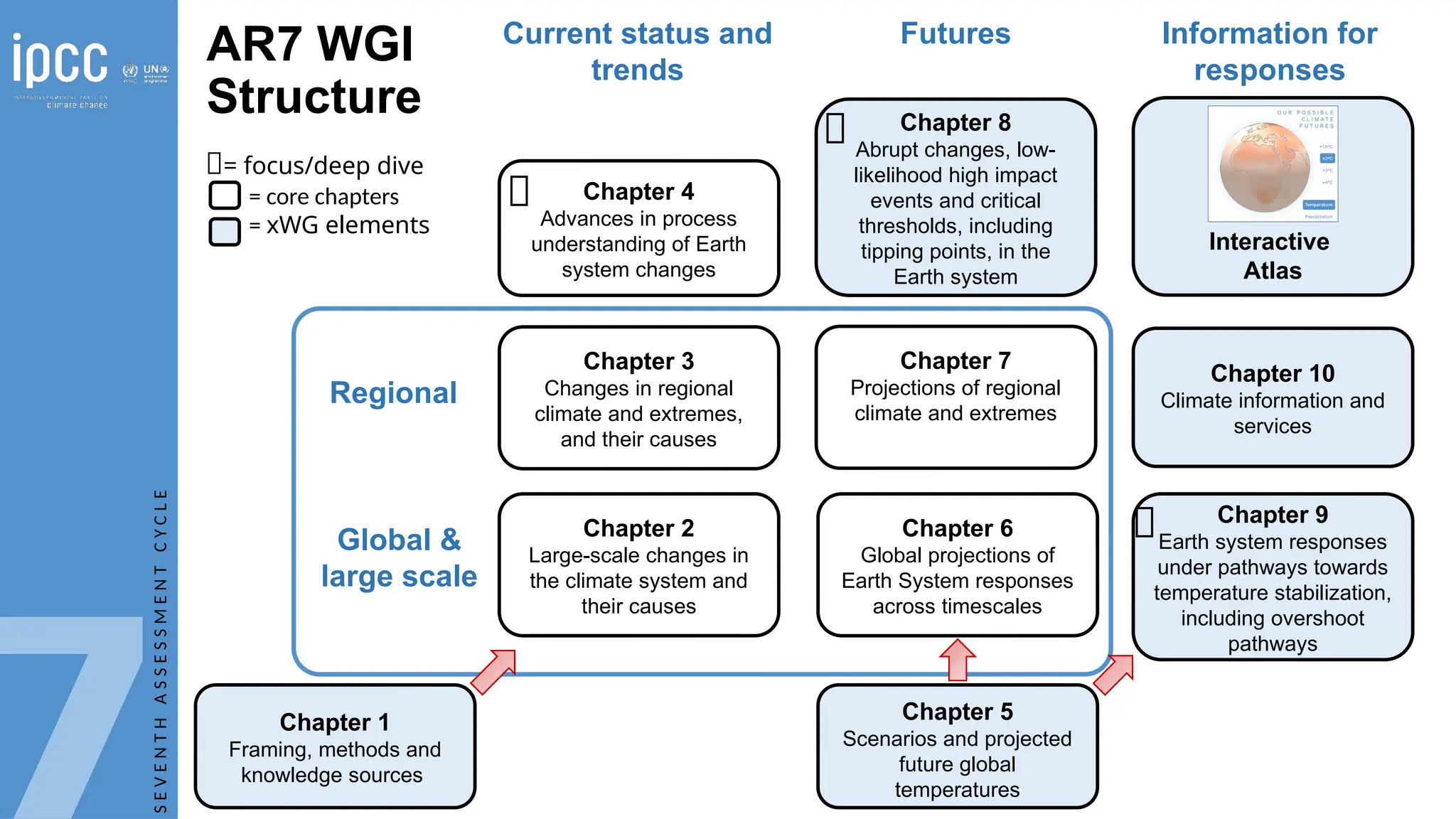
AR7 WGI
Structure
Chapter 1
Framing,methods and
knowledge sources
Chapter 2
Large-scale changes in
the climate system and
their causes
Chapter 3
Changes in regional
climate and extremes,
and their causes
Chapter 6
Global projections of
Earth System responses
across timescales
Chapter 7
Projections of regional
climate and extremes
Chapter 8
Abrupt changes, low-
likelihood high impact
events and critical
thresholds, including
tipping points, in the
Earth system
Chapter 4
Advances in process
understanding of Earth
system changes
Chapter 5
Scenarios and projected
future global
temperatures
Chapter 9
Earth system responses
under pathways towards
temperature stabilization,
including overshoot
pathways
Chapter 10
Climate information and
services
Futures Information for
responses
Interactive
Atlas
🔎
🔎
🔎= focus/deep dive
= core chapters
= xWG elements
Current status and
trends
Global &
large scale
Regional
🔎
3.
S E VE N T H A S S E S S M E N T C Y C L E
S
E
V
E
N
T
H
A
S
S
E
S
S
M
E
N
T
C
Y
C
L
E
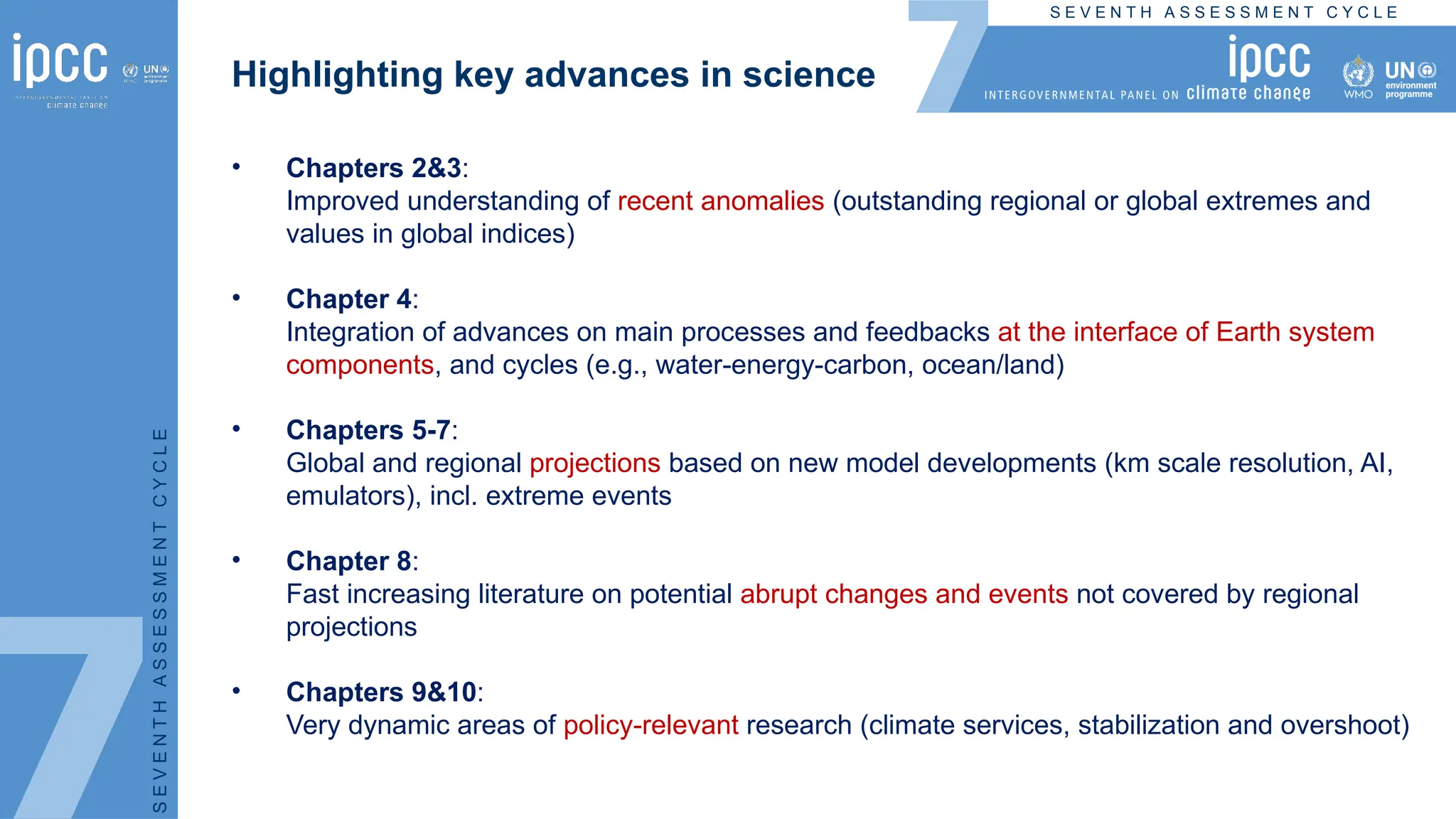
Highlighting key advances in science
• Chapters 2&3:
Improved understanding of recent anomalies (outstanding regional or global extremes and
values in global indices)
• Chapter 4:
Integration of advances on main processes and feedbacks at the interface of Earth system
components, and cycles (e.g., water-energy-carbon, ocean/land)
• Chapters 5-7:
Global and regional projections based on new model developments (km scale resolution, AI,
emulators), incl. extreme events
• Chapter 8:
Fast increasing literature on potential abrupt changes and events not covered by regional
projections
• Chapters 9&10:
Very dynamic areas of policy-relevant research (climate services, stabilization and overshoot)
4.
S E VE N T H A S S E S S M E N T C Y C L E
S
E
V
E
N
T
H
A
S
S
E
S
S
M
E
N
T
C
Y
C
L
E
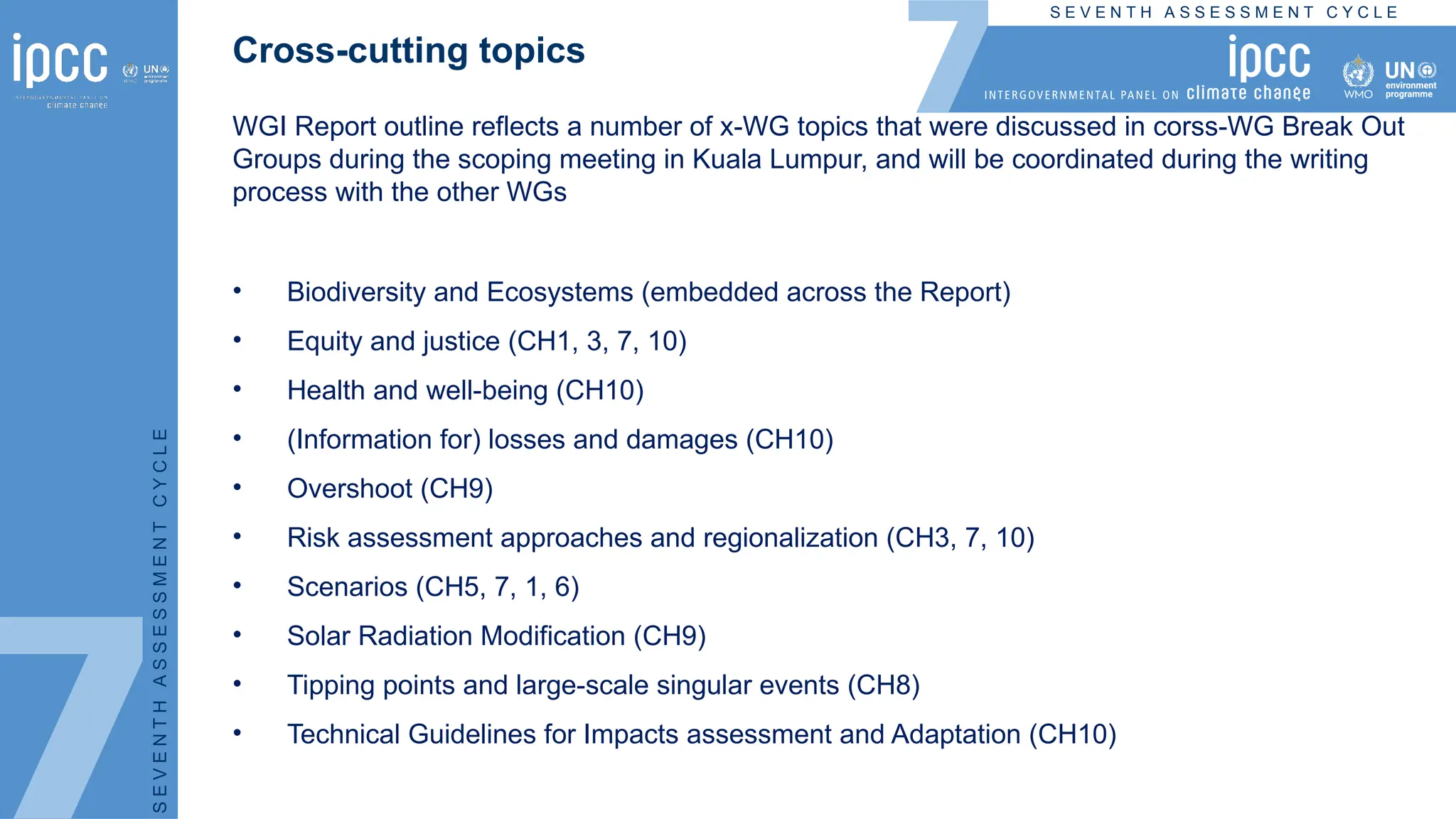
Cross-cutting topics
WGI Report outline reflects a number of x-WG topics that were discussed in corss-WG Break Out
Groups during the scoping meeting in Kuala Lumpur, and will be coordinated during the writing
process with the other WGs
• Biodiversity and Ecosystems (embedded across the Report)
• Equity and justice (CH1, 3, 7, 10)
• Health and well-being (CH10)
• (Information for) losses and damages (CH10)
• Overshoot (CH9)
• Risk assessment approaches and regionalization (CH3, 7, 10)
• Scenarios (CH5, 7, 1, 6)
• Solar Radiation Modification (CH9)
• Tipping points and large-scale singular events (CH8)
• Technical Guidelines for Impacts assessment and Adaptation (CH10)
5.
S E VE N T H A S S E S S M E N T C Y C L E
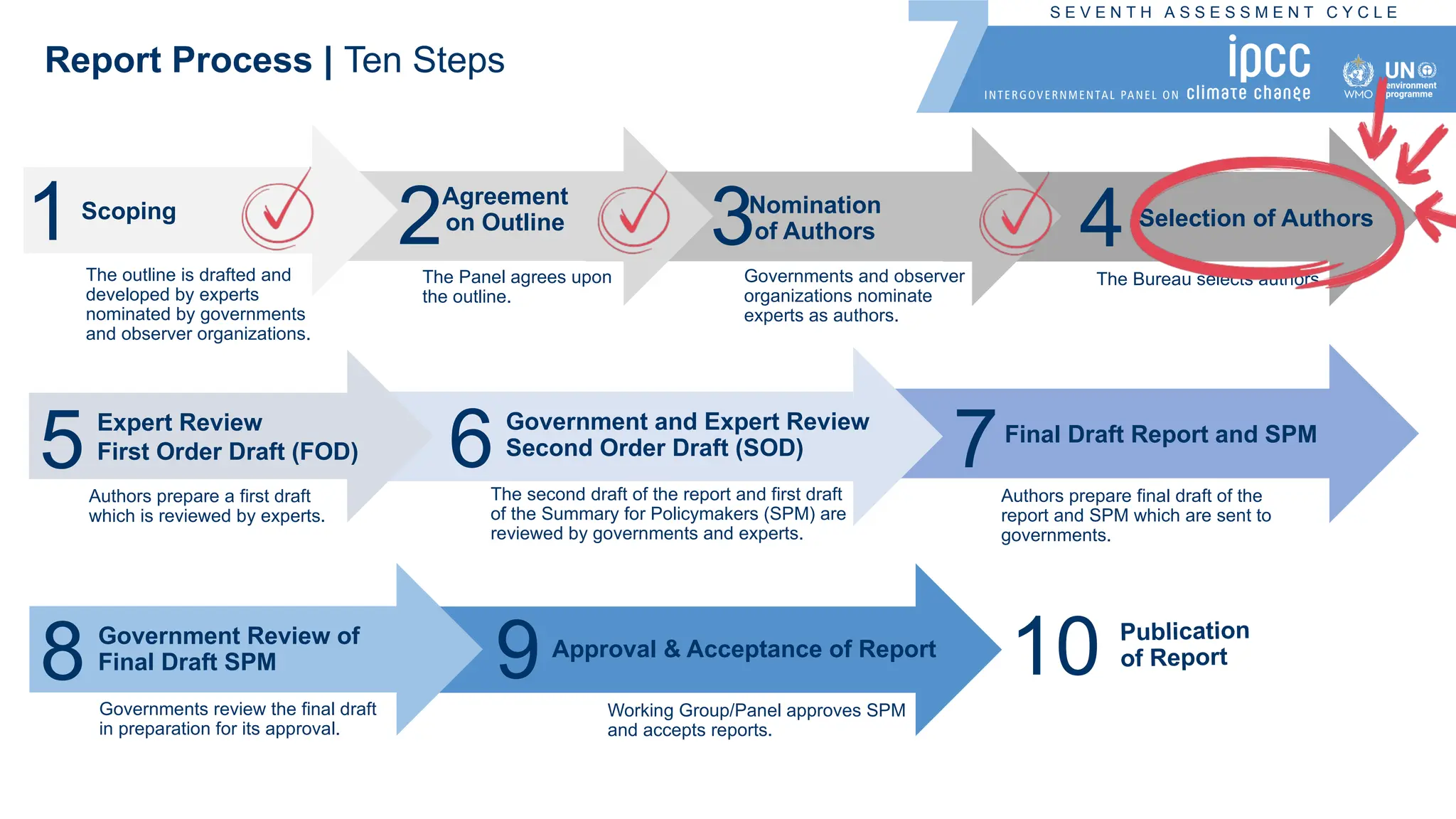
The outline is drafted and
developed by experts
nominated by governments
and observer organizations.
Nomination
of Authors
Selection of Authors
Expert Review
First Order Draft (FOD)
Government and Expert Review
Second Order Draft (SOD)
Final Draft Report and SPM
Government Review of
Final Draft SPM
Report Process | Ten Steps
Publication
of Report
Approval & Acceptance of Report
2Agreement
on Outline
Scoping
1
The Panel agrees upon
the outline.
3Governments and observer
organizations nominate
experts as authors.
4
The Bureau selects authors.
5Authors prepare a first draft
which is reviewed by experts.
6The second draft of the report and first draft
of the Summary for Policymakers (SPM) are
reviewed by governments and experts.
7Authors prepare final draft of the
report and SPM which are sent to
governments.
8 Governments review the final draft
in preparation for its approval.
Working Group/Panel approves SPM
and accepts reports.
9 10
6.
S E VE N T H A S S E S S M E N T C Y C L E
THANK YOU
FOR YOUR ATTENTION
ipcc-sec@wmo.int
ipcc-media@wmo.int
Robert Vautard
WGI Co-Chair of
IPCC AR7
Xiaoye Zhang
WGI Co-Chair of
IPCC AR7
Editor's Notes
#2
Some more background on the structure and interlinkages:
2, 3, 6 and 7, supported by Ch.4, are the core of the classical WGI assessment, where the reader will find easy-to-use information on changes, including region-by-region in Ch.3 and Ch.7 –
2 and 6 addressing observed changes in the climate system, and projected future changes in the Earth System, at global and large-scales, with 3 and 7 doing the same for regional and subregional change.
Chapters 3 and 7 include regional extreme events, and larger-scale potential abrupt change events are detailed in depth in Ch.8
Chapter 4 is an integrated chapter dedicated to advances in process understanding across al components of the Earth system, and focuses on integrating the different systems and cycles. It is also the main home for model evaluation, thought that will be part of the assessment in other chapters as well. Chapter 4 has a critical role in supporting much of the core assessment, including the attribution assessment in c. 2 and 3, and will have a larger author team
Chapter 5 assesses the broad range of available emissions and land-use scenarios, with a focus on global temperature and the Earth's energy budget indices. It will provide an in-depth evaluation of the opportunities and limitations of lower complexity climate models and emulators, and assess the role of non-co2 forcers and carbon budgets.
It will feed into Ch.6 and 7, and have close interlinkages with Ch 4 and 9
Ch.9, as already mentioned, provides a deep dive of the specific Earth system responses to temperature stabilization, net-zero and net-negative emissions, and also examine the potential, consequences and risks of SRM.
CH.10 will largely build on assessments in Chapter 3 and 7, with a focus on accessibility and usability of climate information for different sectors and regions, including for climate services, capacity building, education etc.
It will also provide a link to the interactive Atlas, which will be build based on expertise in the relevant chapters, with support from external service providers for the implementation.
#5 Check for better slide from WGII
What makes IPCC reports so unique is its global reach and the review, adoption and approval of its products by all 195 member governments.
So how does this science-policy-coproduction process work in practice?
Governments, Bureau and science community are involved in different ways along the cycle. IPCC reports are produced in ten steps –
First, a group of experts nominated by governments and observer organisations, and selected by the relevant WG Bureaux, produces an outline, consisting of chapter titles and indicative bullets, as a guidance to the authors.
Second, the panel agrees on the report outline
Third, a call for nominations is issued by the Secretariat, based on the agreed outline, and governments and observer organisations nominate experts as authors. This is the stage we are at the moment, and we will explain in more detail in a moment.
Fourth, the Bureau selects the author teams, mindful of regional and gender balance, and the necessary areas of expertise based on the outlines.
The writing process thereafter is supported by four lead authors meetings, and produces a first oder draft (FOD) after the second LAM, which is reviewed by experts.
In the next and sixth steps, the second order draft, that has matured and taken aboard all review comments from the FOD, is finalized after the third LAM and sent to both experts and governments for review. This SOD also contains the first draft of the Summary for Policymakers.
Seventh, the authors produce the final draft report, and eight, the final SPM is sent to governments for review and comments (after LAM4).
Finally, the working group plenary and panel will approve the revised SPM line-by-line, and accept the underlying report, which is then published.