SCIENCE 9- QUARTER 1
MODULE 5: BIODIVERSITY AND EVOLUTION
MEASURING
POPULATION DENSITY
Prepared by: Ms. Evelyn C. Bañas
1. Determine the pattern of
population distribution.
2. Compare the distribution
patterns of the different populations
After going through this lesson you are
expected to:
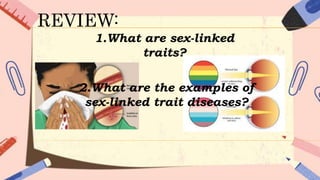
1.What are sex-linked
traits?
2.What are the examples of
sex-linked trait diseases?
REVIEW:
An article/Passage
PHILIPPINE
BIODIVERSITY
Facts:
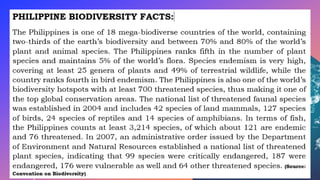
1. Why is the Philippines considered
one of the world's biodiversity
hotspots?
2. Identify examples of threatened
species mentioned in the passage?
Processing Questions:
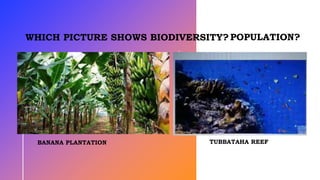
BANANA PLANTATION
WHICH PICTURE SHOWS BIODIVERSITY?POPULATION?
TUBBATAHA REEF
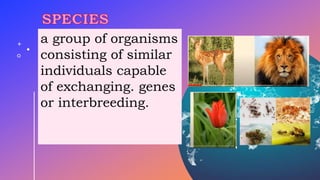
a group of organisms
consisting of similar
individuals capable
of exchanging. genes
or interbreeding.
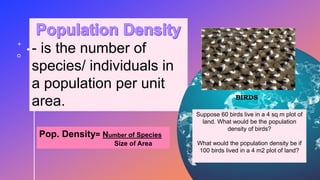
- is the number of
species/ individuals in
a population per unit
area.
Pop. Density= Number of Species
Size of Area
BIRDS
Suppose 60 birds live in a 4 sq m plot of
land. What would be the population
density of birds?
What would the population density be if
100 birds lived in a 4 m2 plot of land?
BIRDS
- Population can be of the same size, but
they may have different densities.
1. Birth Rate
2. Death Rate
3. When new members moving into a
population(Immigration)or When new members
moving out of a population (Emigration)
Changes in population aize may be
attributed to many factors:
IN A COMMUNITY, THERE IS ALWAYS A
POPULATION OF DIFFERENT ORGANISMS
AND SPECIES.
IN AN ENVIRONMENT, THE ECOSYSTEM
NEEDS TO BE BALANCED FOR THEM TO
SURVIVE. THE SIZE OF POPULATION IS
ALWAYS AFFECTED BY DIFFERENT
FACTORS.
are environmental
conditions that keep a population from
increasing in size and help balance
ecosystems.
Anything that limits the size
of a population like certain
environmental conditions are
called LIMITING FACTORS
Examples of Limiting Factors:
1. Availability of food
2. Water and
3. Living conditions
4. Light Temperature
5. Soil Nutrients
the population size an
environment can support.
-it is affected by changes in the
environment.
01
02
03
04
05
06
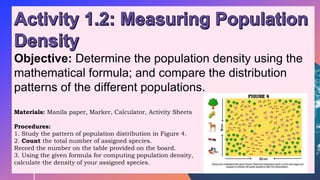
Objective: Determine the population density using the
mathematical formula; and compare the distribution
patterns of the different populations.
Materials: Manila paper, Marker, Calculator, Activity Sheets
Procedures:
1. Study the pattern of population distribution in Figure 4.
2. Count the total number of assigned species.
Record the number on the table provided on the board.
3. Using the given formula for computing population density,
calculate the density of your assigned species.
Procedures:
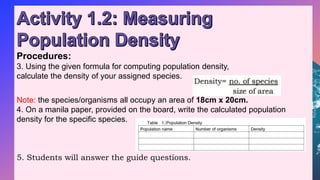
3. Using the given formula for computing population density,
calculate the density of your assigned species.
Note: the species/organisms all occupy an area of 18cm x 20cm.
4. On a manila paper, provided on the board, write the calculated population
density for the specific species.
5. Students will answer the guide questions.
01
02
03
04
05
06
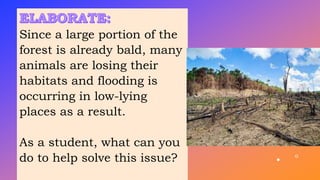
Since a large portion of the
forest is already bald, many
animals are losing their
habitats and flooding is
occurring in low-lying
places as a result.
As a student, what can you
do to help solve this issue?
Direction: Determine Population Density.
1. If 40 flies occupy an area of 60 m2 of grass,
what is the Population Density of the flies?
A. 0.33 C. 0.67
B. 0.50 D. 0.75
Read and Study
Activity 1.3 on your
SLM Q1-Module 5
page 6.
Thank you !
For your active participation….

Science for Grade-9-Quarter-1-MODULE 5.pptx

  • 1.
    SCIENCE 9- QUARTER1 MODULE 5: BIODIVERSITY AND EVOLUTION MEASURING POPULATION DENSITY Prepared by: Ms. Evelyn C. Bañas
  • 2.
    1. Determine thepattern of population distribution. 2. Compare the distribution patterns of the different populations After going through this lesson you are expected to:
  • 3.
    1.What are sex-linked traits? 2.Whatare the examples of sex-linked trait diseases? REVIEW:
  • 4.
  • 6.
    1. Why isthe Philippines considered one of the world's biodiversity hotspots? 2. Identify examples of threatened species mentioned in the passage? Processing Questions:
  • 7.
    BANANA PLANTATION WHICH PICTURESHOWS BIODIVERSITY?POPULATION? TUBBATAHA REEF
  • 10.
    a group oforganisms consisting of similar individuals capable of exchanging. genes or interbreeding.
  • 11.
    - is thenumber of species/ individuals in a population per unit area. Pop. Density= Number of Species Size of Area BIRDS Suppose 60 birds live in a 4 sq m plot of land. What would be the population density of birds? What would the population density be if 100 birds lived in a 4 m2 plot of land?
  • 12.
  • 13.
    - Population canbe of the same size, but they may have different densities. 1. Birth Rate 2. Death Rate 3. When new members moving into a population(Immigration)or When new members moving out of a population (Emigration) Changes in population aize may be attributed to many factors:
  • 14.
    IN A COMMUNITY,THERE IS ALWAYS A POPULATION OF DIFFERENT ORGANISMS AND SPECIES. IN AN ENVIRONMENT, THE ECOSYSTEM NEEDS TO BE BALANCED FOR THEM TO SURVIVE. THE SIZE OF POPULATION IS ALWAYS AFFECTED BY DIFFERENT FACTORS.
  • 15.
    are environmental conditions thatkeep a population from increasing in size and help balance ecosystems. Anything that limits the size of a population like certain environmental conditions are called LIMITING FACTORS
  • 16.
    Examples of LimitingFactors: 1. Availability of food 2. Water and 3. Living conditions 4. Light Temperature 5. Soil Nutrients
  • 17.
    the population sizean environment can support. -it is affected by changes in the environment.
  • 18.
  • 19.
    Objective: Determine thepopulation density using the mathematical formula; and compare the distribution patterns of the different populations. Materials: Manila paper, Marker, Calculator, Activity Sheets Procedures: 1. Study the pattern of population distribution in Figure 4. 2. Count the total number of assigned species. Record the number on the table provided on the board. 3. Using the given formula for computing population density, calculate the density of your assigned species.
  • 20.
    Procedures: 3. Using thegiven formula for computing population density, calculate the density of your assigned species. Note: the species/organisms all occupy an area of 18cm x 20cm. 4. On a manila paper, provided on the board, write the calculated population density for the specific species. 5. Students will answer the guide questions.
  • 21.
  • 22.
    Since a largeportion of the forest is already bald, many animals are losing their habitats and flooding is occurring in low-lying places as a result. As a student, what can you do to help solve this issue?
  • 23.
    Direction: Determine PopulationDensity. 1. If 40 flies occupy an area of 60 m2 of grass, what is the Population Density of the flies? A. 0.33 C. 0.67 B. 0.50 D. 0.75
  • 24.
    Read and Study Activity1.3 on your SLM Q1-Module 5 page 6.
  • 25.
    Thank you ! Foryour active participation….