GRADES 1 to 12
DAILY LESSON LOG
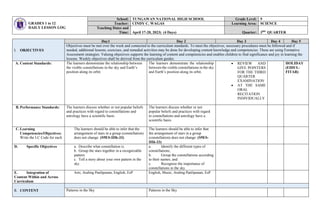
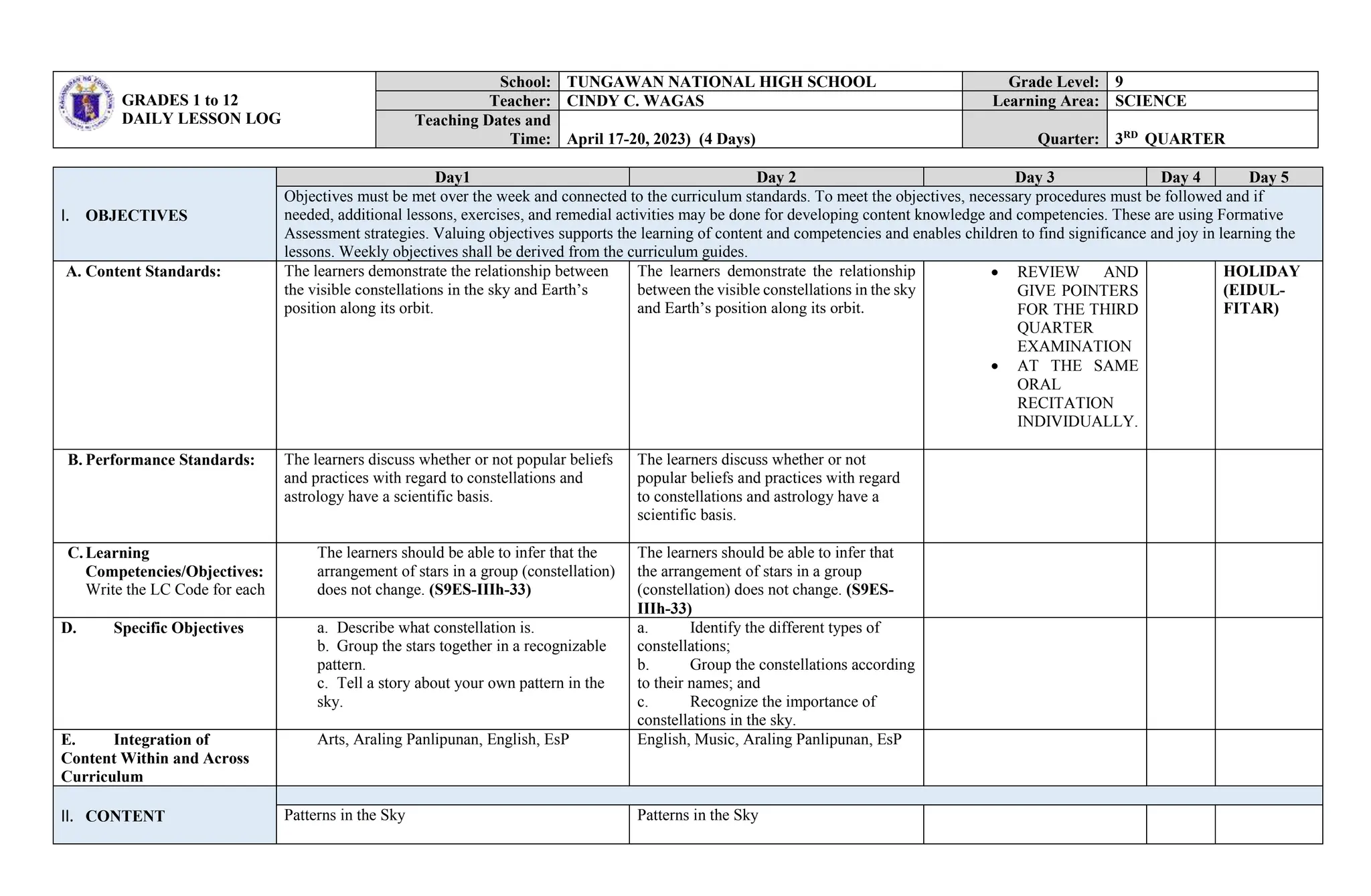
School: TUNGAWAN NATIONAL HIGH SCHOOL Grade Level: 9
Teacher: CINDY C. WAGAS Learning Area: SCIENCE
Teaching Dates and
Time: April 17-20, 2023) (4 Days) Quarter: 3RD
QUARTER
I. OBJECTIVES
Day1 Day 2 Day 3 Day 4 Day 5
Objectives must be met over the week and connected to the curriculum standards. To meet the objectives, necessary procedures must be followed and if
needed, additional lessons, exercises, and remedial activities may be done for developing content knowledge and competencies. These are using Formative
Assessment strategies. Valuing objectives supports the learning of content and competencies and enables children to find significance and joy in learning the
lessons. Weekly objectives shall be derived from the curriculum guides.
A. Content Standards: The learners demonstrate the relationship between
the visible constellations in the sky and Earth’s
position along its orbit.
The learners demonstrate the relationship
between the visible constellations in the sky
and Earth’s position along its orbit.
 REVIEW AND
GIVE POINTERS
FOR THE THIRD
QUARTER
EXAMINATION
 AT THE SAME
ORAL
RECITATION
INDIVIDUALLY.
HOLIDAY
(EIDUL-
FITAR)
B. Performance Standards: The learners discuss whether or not popular beliefs
and practices with regard to constellations and
astrology have a scientific basis.
The learners discuss whether or not
popular beliefs and practices with regard
to constellations and astrology have a
scientific basis.
C.Learning
Competencies/Objectives:
Write the LC Code for each
The learners should be able to infer that the
arrangement of stars in a group (constellation)
does not change. (S9ES-IIIh-33)
The learners should be able to infer that
the arrangement of stars in a group
(constellation) does not change. (S9ES-
IIIh-33)
D. Specific Objectives a. Describe what constellation is.
b. Group the stars together in a recognizable
pattern.
c. Tell a story about your own pattern in the
sky.
a. Identify the different types of
constellations;
b. Group the constellations according
to their names; and
c. Recognize the importance of
constellations in the sky.
E. Integration of
Content Within and Across
Curriculum
Arts, Araling Panlipunan, English, EsP English, Music, Araling Panlipunan, EsP
II. CONTENT Patterns in the Sky Patterns in the Sky
III. LEARNING
RESOURCES
A.References
1. Teacher’s Guide Pages pp. 161 pp. 161
2. Learner’s Materials
Pages
pp.217 pp.217
3. Textbook Pages
4. Additional Materials
from Learning Resource
(LR) portal
Slides, laptop, textbook, LEAP Slides, laptop, textbook, LEAP
B. Other Learning Resources https://www.youtube.com/watch?v=1sZ15SUeS9w
http://www.science-teachers.com/constellations.htm
https://www.constellation-
guide.com/constellation-names/
https://www.thoughtco.com/constellations-
3071087
IV. PROCEDURES
Day 1 Day 2 Day 3 Day 4 Day 5
These steps should be done across the week. Spread out the activities appropriately so that students will learn well. Always be guided by demonstration of
learning by the students which you can infer from formative assessment activities. Sustain learning systematically by providing students with multiple ways
to learn new things, practice their learning, question their learning processes, and draw conclusions about what they learned in relation to their life
experiences and previous knowledge. Indicate the time allotment for each step.
A. RAPID SIKAP READING Let the students read the Passage.
As I looked up at the sky, I noticed a fascinating
pattern forming. A group of fluffy white clouds
was arranged in a straight line, evenly spaced
apart. They stretched across the entire sky,
creating a mesmerizing sight.
I wondered what could have caused this
pattern. Was it just a coincidence, or was there
something else at play? As I continued to watch,
I noticed that the clouds were slowly moving,
drifting across the sky. And as they moved, the
pattern began to change, with new clouds
joining the line and others falling away.
Master the tonguetwister about Pattern in the
sky
"Peter Piper picked a pattern in the sky, A
picturesque panorama passing by, He tried to
trace its twists and turns, But tangled his
tongue with the twists and burns."
B. Reviewing Previous Lesson
or Presenting the New
Lesson
It occurred to me that this was a perfect
example of how patterns in nature are
constantly evolving and changing. What might
seem like a fixed pattern at first glance is
actually a dynamic and ever-changing system,
influenced by countless factors like wind,
temperature, and moisture.
As I continued to watch the clouds, I realized
that patterns can be found everywhere in the
natural world, from the veins in a leaf to the
spirals of a seashell. And just like the clouds,
these patterns are not static, but rather are
constantly shifting and evolving in response to
their environment.
It was a humbling reminder that even the most
seemingly simple things in nature are full of
complexity and wonder and that there is always
more to discover if we take the time to observe
and appreciate the patterns around us.
Elicit (3 mins) Paper Cabbage Throwing: Throw
the rolled paper cabbage from one of the students
to the other randomly until the music stops, then
whoever will hold the cabbage will unfold the
paper, read and answer the questions written on it.
Let students answer in complete sentences.
Questions:
1. What is apparent brightness?
2. What is absolute brightness?
3. What effect does the distance of
the light sources have on the
apparent brightness of stars?
1. Apparent brightness is the
star’s brightness as seen from
Elicit (3 mins) Magic Box: The teacher will
show the students the magic box and asks 3
students from the class to pick something
inside. Let the student perform what is being
instructed from the picked item.
Items inside the box:
1. Rolled paper with questions, define
constellation with your words.
2. Flashcard of a constellation let the student
name it.
Earth.
2. Absolute brightness is actual
The brightness of the star.
3. As long as the two light
sources are the same, the
farther away the light, the
dimmer it seems.
A constellation is a group of stars in a
recognizable pattern.
Orion is one of the
prominent constellations in the sky. The
name is Orion means hunter. It is seen in
the night sky all over the world during
winter.
C.Establishing a Purpose for
the Lesson
Engage (2 mins) 3 Pics, 1 Word: (This will lead
students to describe stars forming groups.)
Students’ answers vary.
Engage (5 mins)
The teacher will show a picture to the
students.
https://www.thoughtco.com/constellations-
3071087
What can you observe in the picture?
I can see different patterns of star
formation.
There are different types of
constellations in the sky.
D.Presenting
Examples/Instances of the
Lesson
(10 mins)Show video capturing constellation.
https://www.youtube.com/watch?v=1sZ15SUeS9w
Ask questions to students and post these on the
board to guide the students as they watch the video.
Use Number Heads in asking questions from the
students. (Example: All number 1 in the group will
Can you name the constellations that you
can see in the picture?
How are they named as such?
Students will hypothesize.
This is Ursa Major
or the big bear.
answer question 1 and all number 2 in the group will
answer question number 2.)
Questions:
1. What did you see?
2. What images are formed?
1. I saw different patterns of stars in the sky and
these are called constellations.
2. The different constellations that were mentioned
in the video clip are Ursa Major, Big Dipper, Orion,
Crux, and Sagittarius.
E. Discussing new
concepts and
practicing new skills #1
Explore (10 mins) Group the students into 4 small
groups and let them perform an activity, Pattern in
the Sky (see attached activity sheet) The reporter
of the group will present their output after.
Guide questions:
1. What pattern did you identify in
the map?
2. Can you name them?
The answer of the group varies depending on their
recognized pattern of stars.
Explore (10 mins)
Reading Comprehension
Students will be given fact sheet and they
are going to read the Constellation Names.
They will be given 5 minutes to do the
activity. The teacher will remind the students
to read it silently. The questions will then be
orally asked by the teacher. (see attached
fact sheet)
Guide Questions:
1. How are the constellations
grouped?
2. What are the names of the
group of constellations?
3. Who gave names to these
Constellations?
The constellations were
grouped according to their
names.
2. There are three major groups
of constellations associated
with Greek mythology,
scientific instruments and
exotic animals
3. Constellations named after
scientific instruments were
mostly created by Nicolas
Louis de Lacaille in the 18th
Century. The constellations
that carry names of exotic
animals were for the most part
introduced by the Dutch
navigators Pieter Dirkszoon
Keyser and Frederick de
Houtman in the 16th century.
F. Discussing new
concepts and
practicing new skills #2
(10 mins) Based on the previously watched video
ask one representative from each group to name a
constellation and give some bases on how early
civilizations came up with this name.
One of the most prominent constellations in the
sky is Orion. The Greeks named Orion which
means hunter and it is seen in the night sky all over
the world during winter.
(21 mins) Group Activity. The students will
be group into 3. Activity sheets will be given
to them as their guide in doing their assigned
task.
Group 1. Table Completion.
Group 2. Matching Game.
Group 3. Jingle Composition.
Each group will be given 15 minutes to
prepare their outputs and then 2 minutes for
their presentations.
The teacher will give feedbacks and inputs
as well as correcting misconceptions after
the presentations.
(See attached activity sheet)
G. Developing mastery Explain (4 mins)
Ask the students: What do you call group of stars
in a recognizable pattern? Let students answer in a
complete sentence.
Show familiar constellation flashcards to
students and let them name the constellations.
Explain (10 mins)
Oral Questioning: Q and A using Number
Heads.
The teacher will ask all number 2 from the
groups to answer the questions being asked.
Questions:
1. How are the constellations
grouped?
2. How many groups of
constellations are there and
what are their names?
A
B
C
D
The group of stars in a recognizable pattern is
called a constellation.
A. Ursa Major – big bear,
B. Sagittarius – the bull
C. Orion – the hunter
D. Gemini – the twin
3. What are the family of constellations
under Greek
mythology?
4. Give at least three examples of
constellations per group.
The constellations were
grouped according to them
names.
2. There are three groups of
constellations namely exotic
animal, scientific instruments
and figures from Greek
mythology.
3. Constellation under Greek
Mythology is grouped into
three families, the Perseus family,
Hercules family, Orion family
and Ursa Major’s family.
4. Examples of constellations in
Greek mythology are
Andromeda, Cassiopea, Lyra,
Ara, Draco, Gemini.
Constellations named after
scientific instruments are
Norma, Circinus and Octans.
Constellations named after
exotic animals are Dorado,
Grus and Tucana.
H. Finding
practical applications
of concepts and skills
in daily living
Elaborate (10 mins) Let students make up their
own 2 – D Model of Constellation using the
previously assigned materials to them. Let students
make a one-paragraph story about their own
pattern in the sky. Select representatives per group
to showcase their outputs.
Students’ presentations may vary according to
their outputs.
Elaborate (5 mins) The teacher will ask the
students:
How important is the constellation to ancient
people or even to the people at this time?
The stars allowed farmers to plan ahead and
form agriculture, and constellations made it
easier to recognize and interpret the patterns
in the sky. The constellations also helped
with navigation. It is fairly easy to spot
Polaris where it always point north.
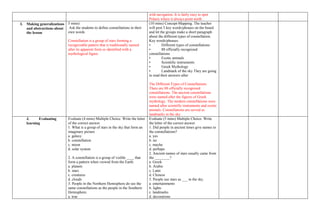
I. Making generalizations
and abstractions about
the lesson
5 mins)
Ask the students to define constellations in their
own words.
Constellation is a group of stars forming a
recognizable pattern that is traditionally named
after its apparent form or identified with a
mythological figure.
(10 mins) Concept-Mapping. The teacher
will post 5 key words/phrases on the board
and let the groups make a short paragraph
about the different types of constellation.
Key words/phrases:
• Different types of constellations
• 88 officially recognized
constellations
• Exotic animals
• Scientific instruments
• Greek Mythology
• Landmark of the sky They are going
to read their answers after
The Different Types of Constellations
There are 88 officially recognized
constellations. The ancient constellations
were named after the figures of Greek
mythology. The modern constellations were
named after scientific instruments and exotic
animals. Constellations are served as
landmarks in the sky.
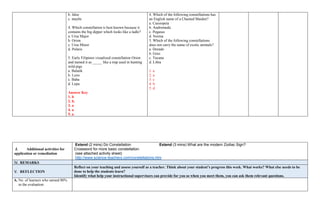
J. Evaluating
learning
Evaluate (4 mins) Multiple Choice: Write the letter
of the correct answer.
1. What is a group of stars in the sky that form an
imaginary picture
a. galaxy
b. constellation
c. moon
d. solar system
2. A constellation is a group of visible ____ that
form a pattern when viewed from the Earth.
a. planets
b. stars
c. creatures
d. clouds
3. People in the Northern Hemisphere do see the
same constellations as the people in the Southern
Hemisphere.
a. true
Evaluate (5 mins) Multiple Choice: Write
the letter of the correct answer.
1. Did people in ancient times give names to
the constellations?
a. yes
b. no
c. maybe
d. perhaps
2. Ancient names of stars usually came from
the ________?
a. Greek
b. Arabic
c. Latin
d. Chinese
3. People use stars as ___ in the sky.
a. entertainments
b. lights
c. landmarks
d. decorations
b. false
c. maybe
4. Which constellation is best known because it
contains the big dipper which looks like a ladle?
a. Ursa Major
b. Orion
c. Ursa Minor
d. Polaris
5. Early Filipinos visualized constellation Orion
and named it as _____ like a trap used in hunting
wild pigs.
a. Balatik
b. Lynx
c. Baha
d. Lepu
Answer Key
1. b
2. b.
3. a
4. a
5. a
4. Which of the following constellations has
an English name of a Chained Maiden?
a. Cassiopeia
b. Andromeda
c. Pegasus
d. Norma
5. Which of the following constellations
does not carry the name of exotic animals?
a. Dorado
b. Grus
c. Tucana
d. Libra
1. a
2. a
3. c
4. b
5. d
J. Additional activities for
application or remediation
Extend (2 mins) Do Constellation Extend (3 mins) What are the modern Zodiac Sign?
Crossword for more basic constellation.
(see attached activity sheet)
http://www.science-teachers.com/constellations.htm
IV. REMARKS
V. REFLECTION
Reflect on your teaching and assess yourself as a teacher. Think about your student’s progress this week. What works? What else needs to be
done to help the students learn?
Identify what help your instructional supervisors can provide for you so when you meet them, you can ask them relevant questions.
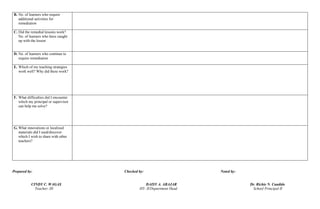
A. No. of learners who earned 80%
in the evaluation
B. No. of learners who require
additional activities for
remediation
C. Did the remedial lessons work?
No. of learners who have caught
up with the lesson
D. No. of learners who continue to
require remediation
E. Which of my teaching strategies
work well? Why did these work?
F. What difficulties did I encounter
which my principal or supervisor
can help me solve?
G. What innovations or localized
materials did I used/discover
which I wish to share with other
teachers?
Prepared by: Checked by: Noted by:
CINDY C. WAGAS DAISY A. ABAJAR Dr. Richie N. Candido
Teacher- III HT- II/Department Head School Principal II
JENNIFER T. BAGUIO
Master Teacher- II

Grade 9 Science DLL (Third Quarter) Week 8.docx

  • 1.
    GRADES 1 to12 DAILY LESSON LOG School: TUNGAWAN NATIONAL HIGH SCHOOL Grade Level: 9 Teacher: CINDY C. WAGAS Learning Area: SCIENCE Teaching Dates and Time: April 17-20, 2023) (4 Days) Quarter: 3RD QUARTER I. OBJECTIVES Day1 Day 2 Day 3 Day 4 Day 5 Objectives must be met over the week and connected to the curriculum standards. To meet the objectives, necessary procedures must be followed and if needed, additional lessons, exercises, and remedial activities may be done for developing content knowledge and competencies. These are using Formative Assessment strategies. Valuing objectives supports the learning of content and competencies and enables children to find significance and joy in learning the lessons. Weekly objectives shall be derived from the curriculum guides. A. Content Standards: The learners demonstrate the relationship between the visible constellations in the sky and Earth’s position along its orbit. The learners demonstrate the relationship between the visible constellations in the sky and Earth’s position along its orbit.  REVIEW AND GIVE POINTERS FOR THE THIRD QUARTER EXAMINATION  AT THE SAME ORAL RECITATION INDIVIDUALLY. HOLIDAY (EIDUL- FITAR) B. Performance Standards: The learners discuss whether or not popular beliefs and practices with regard to constellations and astrology have a scientific basis. The learners discuss whether or not popular beliefs and practices with regard to constellations and astrology have a scientific basis. C.Learning Competencies/Objectives: Write the LC Code for each The learners should be able to infer that the arrangement of stars in a group (constellation) does not change. (S9ES-IIIh-33) The learners should be able to infer that the arrangement of stars in a group (constellation) does not change. (S9ES- IIIh-33) D. Specific Objectives a. Describe what constellation is. b. Group the stars together in a recognizable pattern. c. Tell a story about your own pattern in the sky. a. Identify the different types of constellations; b. Group the constellations according to their names; and c. Recognize the importance of constellations in the sky. E. Integration of Content Within and Across Curriculum Arts, Araling Panlipunan, English, EsP English, Music, Araling Panlipunan, EsP II. CONTENT Patterns in the Sky Patterns in the Sky
  • 2.
    III. LEARNING RESOURCES A.References 1. Teacher’sGuide Pages pp. 161 pp. 161 2. Learner’s Materials Pages pp.217 pp.217 3. Textbook Pages 4. Additional Materials from Learning Resource (LR) portal Slides, laptop, textbook, LEAP Slides, laptop, textbook, LEAP B. Other Learning Resources https://www.youtube.com/watch?v=1sZ15SUeS9w http://www.science-teachers.com/constellations.htm https://www.constellation- guide.com/constellation-names/ https://www.thoughtco.com/constellations- 3071087 IV. PROCEDURES Day 1 Day 2 Day 3 Day 4 Day 5 These steps should be done across the week. Spread out the activities appropriately so that students will learn well. Always be guided by demonstration of learning by the students which you can infer from formative assessment activities. Sustain learning systematically by providing students with multiple ways to learn new things, practice their learning, question their learning processes, and draw conclusions about what they learned in relation to their life experiences and previous knowledge. Indicate the time allotment for each step. A. RAPID SIKAP READING Let the students read the Passage. As I looked up at the sky, I noticed a fascinating pattern forming. A group of fluffy white clouds was arranged in a straight line, evenly spaced apart. They stretched across the entire sky, creating a mesmerizing sight. I wondered what could have caused this pattern. Was it just a coincidence, or was there something else at play? As I continued to watch, I noticed that the clouds were slowly moving, drifting across the sky. And as they moved, the pattern began to change, with new clouds joining the line and others falling away. Master the tonguetwister about Pattern in the sky "Peter Piper picked a pattern in the sky, A picturesque panorama passing by, He tried to trace its twists and turns, But tangled his tongue with the twists and burns."
  • 3.
    B. Reviewing PreviousLesson or Presenting the New Lesson It occurred to me that this was a perfect example of how patterns in nature are constantly evolving and changing. What might seem like a fixed pattern at first glance is actually a dynamic and ever-changing system, influenced by countless factors like wind, temperature, and moisture. As I continued to watch the clouds, I realized that patterns can be found everywhere in the natural world, from the veins in a leaf to the spirals of a seashell. And just like the clouds, these patterns are not static, but rather are constantly shifting and evolving in response to their environment. It was a humbling reminder that even the most seemingly simple things in nature are full of complexity and wonder and that there is always more to discover if we take the time to observe and appreciate the patterns around us. Elicit (3 mins) Paper Cabbage Throwing: Throw the rolled paper cabbage from one of the students to the other randomly until the music stops, then whoever will hold the cabbage will unfold the paper, read and answer the questions written on it. Let students answer in complete sentences. Questions: 1. What is apparent brightness? 2. What is absolute brightness? 3. What effect does the distance of the light sources have on the apparent brightness of stars? 1. Apparent brightness is the star’s brightness as seen from Elicit (3 mins) Magic Box: The teacher will show the students the magic box and asks 3 students from the class to pick something inside. Let the student perform what is being instructed from the picked item. Items inside the box: 1. Rolled paper with questions, define constellation with your words. 2. Flashcard of a constellation let the student name it.
  • 4.
    Earth. 2. Absolute brightnessis actual The brightness of the star. 3. As long as the two light sources are the same, the farther away the light, the dimmer it seems. A constellation is a group of stars in a recognizable pattern. Orion is one of the prominent constellations in the sky. The name is Orion means hunter. It is seen in the night sky all over the world during winter. C.Establishing a Purpose for the Lesson Engage (2 mins) 3 Pics, 1 Word: (This will lead students to describe stars forming groups.) Students’ answers vary. Engage (5 mins) The teacher will show a picture to the students. https://www.thoughtco.com/constellations- 3071087 What can you observe in the picture? I can see different patterns of star formation. There are different types of constellations in the sky. D.Presenting Examples/Instances of the Lesson (10 mins)Show video capturing constellation. https://www.youtube.com/watch?v=1sZ15SUeS9w Ask questions to students and post these on the board to guide the students as they watch the video. Use Number Heads in asking questions from the students. (Example: All number 1 in the group will Can you name the constellations that you can see in the picture? How are they named as such? Students will hypothesize. This is Ursa Major or the big bear.
  • 5.
    answer question 1and all number 2 in the group will answer question number 2.) Questions: 1. What did you see? 2. What images are formed? 1. I saw different patterns of stars in the sky and these are called constellations. 2. The different constellations that were mentioned in the video clip are Ursa Major, Big Dipper, Orion, Crux, and Sagittarius. E. Discussing new concepts and practicing new skills #1 Explore (10 mins) Group the students into 4 small groups and let them perform an activity, Pattern in the Sky (see attached activity sheet) The reporter of the group will present their output after. Guide questions: 1. What pattern did you identify in the map? 2. Can you name them? The answer of the group varies depending on their recognized pattern of stars. Explore (10 mins) Reading Comprehension Students will be given fact sheet and they are going to read the Constellation Names. They will be given 5 minutes to do the activity. The teacher will remind the students to read it silently. The questions will then be orally asked by the teacher. (see attached fact sheet) Guide Questions: 1. How are the constellations grouped? 2. What are the names of the group of constellations? 3. Who gave names to these Constellations? The constellations were grouped according to their names. 2. There are three major groups of constellations associated with Greek mythology, scientific instruments and exotic animals
  • 6.
    3. Constellations namedafter scientific instruments were mostly created by Nicolas Louis de Lacaille in the 18th Century. The constellations that carry names of exotic animals were for the most part introduced by the Dutch navigators Pieter Dirkszoon Keyser and Frederick de Houtman in the 16th century. F. Discussing new concepts and practicing new skills #2 (10 mins) Based on the previously watched video ask one representative from each group to name a constellation and give some bases on how early civilizations came up with this name. One of the most prominent constellations in the sky is Orion. The Greeks named Orion which means hunter and it is seen in the night sky all over the world during winter. (21 mins) Group Activity. The students will be group into 3. Activity sheets will be given to them as their guide in doing their assigned task. Group 1. Table Completion. Group 2. Matching Game. Group 3. Jingle Composition. Each group will be given 15 minutes to prepare their outputs and then 2 minutes for their presentations. The teacher will give feedbacks and inputs as well as correcting misconceptions after the presentations. (See attached activity sheet) G. Developing mastery Explain (4 mins) Ask the students: What do you call group of stars in a recognizable pattern? Let students answer in a complete sentence. Show familiar constellation flashcards to students and let them name the constellations. Explain (10 mins) Oral Questioning: Q and A using Number Heads. The teacher will ask all number 2 from the groups to answer the questions being asked. Questions: 1. How are the constellations grouped? 2. How many groups of constellations are there and what are their names?
  • 7.
    A B C D The group ofstars in a recognizable pattern is called a constellation. A. Ursa Major – big bear, B. Sagittarius – the bull C. Orion – the hunter D. Gemini – the twin 3. What are the family of constellations under Greek mythology? 4. Give at least three examples of constellations per group. The constellations were grouped according to them names. 2. There are three groups of constellations namely exotic animal, scientific instruments and figures from Greek mythology. 3. Constellation under Greek Mythology is grouped into three families, the Perseus family, Hercules family, Orion family and Ursa Major’s family. 4. Examples of constellations in Greek mythology are Andromeda, Cassiopea, Lyra, Ara, Draco, Gemini. Constellations named after scientific instruments are Norma, Circinus and Octans. Constellations named after exotic animals are Dorado, Grus and Tucana. H. Finding practical applications of concepts and skills in daily living Elaborate (10 mins) Let students make up their own 2 – D Model of Constellation using the previously assigned materials to them. Let students make a one-paragraph story about their own pattern in the sky. Select representatives per group to showcase their outputs. Students’ presentations may vary according to their outputs. Elaborate (5 mins) The teacher will ask the students: How important is the constellation to ancient people or even to the people at this time? The stars allowed farmers to plan ahead and form agriculture, and constellations made it easier to recognize and interpret the patterns in the sky. The constellations also helped
  • 8.
    with navigation. Itis fairly easy to spot Polaris where it always point north. I. Making generalizations and abstractions about the lesson 5 mins) Ask the students to define constellations in their own words. Constellation is a group of stars forming a recognizable pattern that is traditionally named after its apparent form or identified with a mythological figure. (10 mins) Concept-Mapping. The teacher will post 5 key words/phrases on the board and let the groups make a short paragraph about the different types of constellation. Key words/phrases: • Different types of constellations • 88 officially recognized constellations • Exotic animals • Scientific instruments • Greek Mythology • Landmark of the sky They are going to read their answers after The Different Types of Constellations There are 88 officially recognized constellations. The ancient constellations were named after the figures of Greek mythology. The modern constellations were named after scientific instruments and exotic animals. Constellations are served as landmarks in the sky. J. Evaluating learning Evaluate (4 mins) Multiple Choice: Write the letter of the correct answer. 1. What is a group of stars in the sky that form an imaginary picture a. galaxy b. constellation c. moon d. solar system 2. A constellation is a group of visible ____ that form a pattern when viewed from the Earth. a. planets b. stars c. creatures d. clouds 3. People in the Northern Hemisphere do see the same constellations as the people in the Southern Hemisphere. a. true Evaluate (5 mins) Multiple Choice: Write the letter of the correct answer. 1. Did people in ancient times give names to the constellations? a. yes b. no c. maybe d. perhaps 2. Ancient names of stars usually came from the ________? a. Greek b. Arabic c. Latin d. Chinese 3. People use stars as ___ in the sky. a. entertainments b. lights c. landmarks d. decorations
  • 9.
    b. false c. maybe 4.Which constellation is best known because it contains the big dipper which looks like a ladle? a. Ursa Major b. Orion c. Ursa Minor d. Polaris 5. Early Filipinos visualized constellation Orion and named it as _____ like a trap used in hunting wild pigs. a. Balatik b. Lynx c. Baha d. Lepu Answer Key 1. b 2. b. 3. a 4. a 5. a 4. Which of the following constellations has an English name of a Chained Maiden? a. Cassiopeia b. Andromeda c. Pegasus d. Norma 5. Which of the following constellations does not carry the name of exotic animals? a. Dorado b. Grus c. Tucana d. Libra 1. a 2. a 3. c 4. b 5. d J. Additional activities for application or remediation Extend (2 mins) Do Constellation Extend (3 mins) What are the modern Zodiac Sign? Crossword for more basic constellation. (see attached activity sheet) http://www.science-teachers.com/constellations.htm IV. REMARKS V. REFLECTION Reflect on your teaching and assess yourself as a teacher. Think about your student’s progress this week. What works? What else needs to be done to help the students learn? Identify what help your instructional supervisors can provide for you so when you meet them, you can ask them relevant questions. A. No. of learners who earned 80% in the evaluation
  • 10.
    B. No. oflearners who require additional activities for remediation C. Did the remedial lessons work? No. of learners who have caught up with the lesson D. No. of learners who continue to require remediation E. Which of my teaching strategies work well? Why did these work? F. What difficulties did I encounter which my principal or supervisor can help me solve? G. What innovations or localized materials did I used/discover which I wish to share with other teachers? Prepared by: Checked by: Noted by: CINDY C. WAGAS DAISY A. ABAJAR Dr. Richie N. Candido Teacher- III HT- II/Department Head School Principal II
  • 11.