Student seminar
presentation
Science Encyclopedia
BY
A.BRISLIN
ROLL NO:35
SECTION:A
PHYSICAL SCIENCE
V.O.C.COLLEGE OF EDUCATION
THOOTHUKUDI
 The Encyclopedia of science provides a comprehensive
international reference work covering the range of
methodologies,perspective,focus and cultures of this field of
inquiry,and contributions of leading researchers from around
the globe.
 A set of books that gives information about many subjects
arranged in the order of the alphabet.
 The word “Encylopedia”originated from the Greek word Cyclo
and Pedia – which means circle or a complete system of
learning.
 An encyclopedia is a general summary of thought and
knowledge which will serve as the basis for common
understandings between specialists and for ideology of education
and so become a guiding centre for the intellectual activities of
mankind.
H.G.Wells
 Definitions of the subject
 Explanations about the subject
 Historical or background information along with data
 Photograph and sketches of notable persons
 Detailed index with cross references to locate the
information easily and quickly
 Detailed bibliography or reference at the end of articles
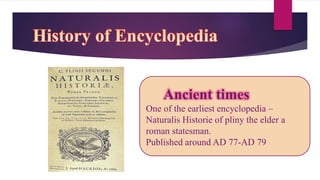
Ancient times
One of the earliest encyclopedia –
Naturalis Historie of pliny the elder a
roman statesman.
Published around AD 77-AD 79
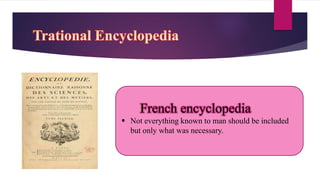
French encyclopedia
 Not everything known to man should be included
but only what was necessary.
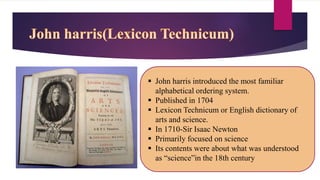
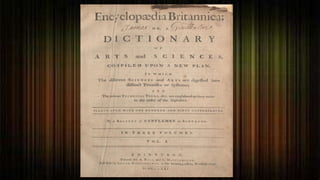
 John harris introduced the most familiar
alphabetical ordering system.
 Published in 1704
 Lexicon Technicum or English dictionary of
arts and science.
 In 1710-Sir Isaac Newton
 Primarily focused on science
 Its contents were about what was understood
as “science”in the 18th century
)
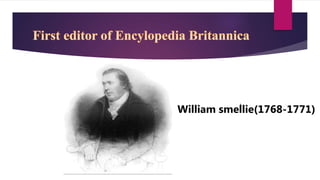
William smellie(1768-1771)
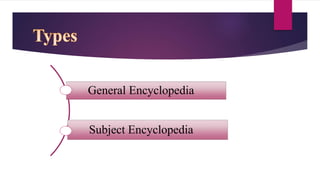
General Encyclopedia
Subject Encyclopedia
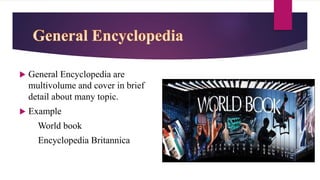
 General Encyclopedia are
multivolume and cover in brief
detail about many topic.
 Example
World book
Encyclopedia Britannica
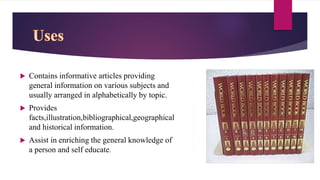
 Contains informative articles providing
general information on various subjects and
usually arranged in alphabetically by topic.
 Provides
facts,illustration,bibliographical,geographical
and historical information.
 Assist in enriching the general knowledge of
a person and self educate.
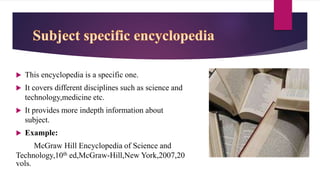
 This encyclopedia is a specific one.
 It covers different disciplines such as science and
technology,medicine etc.
 It provides more indepth information about
subject.
 Example:
McGraw Hill Encyclopedia of Science and
Technology,10th ed,McGraw-Hill,New York,2007,20
vols.
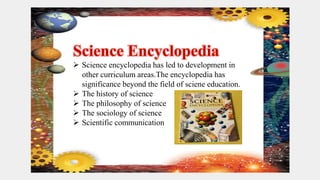
 Science encyclopedia has led to development in
other curriculum areas.The encyclopedia has
significance beyond the field of sciene education.
 The history of science
 The philosophy of science
 The sociology of science
 Scientific communication
Devoted to particular subject fields.
Exclusive,elaborative and exhaustive treatment
which gives a detailed account of a subject.
Consist a collection of articles on a particular
subject area.
Rapid advances in the fields of sciences in recent
years.
Covers all minute information –for advanced
research and other purposes.
 A print encyclopedia is a set of books that contain information
about many different subjects.
 The amount of information cannot put into one book, divided into
many smaller books.
 Each book is called volume.
 Example
 Authors last name,first initial(Date)Title of Articles.Title of Encyclopedia(Volume,
Pages)City of publication:Publishing company.
 Bergamann,P.G.(1993).Relativity.In The New Encyclopedia Britannica(Vol.26,pp.501-
508).Chicago:Encyclopedia Britannica.
 Also called Internet encyclopedia
or digital encyclopedia
 Accessible through the internet
Example
Wikipedia
 We live in a digital world where information is available
instantaneously and things change rapidly.
 To evolve with such a connected society, many
encyclopedias have moved their print versions into
online.
 Such online knowledge bases allow students and
teachers quick, up-to-date access wherever they are
connected to the web, whereas expensive and heavy
books serve as a barrier to some.
 World Book Online, for instance, offers a subscription-
based version.
 Give more comprehensive information than
library books or any other reference materials.
 Useful for personal knowledge growth and
professional growth.
 Offer exhaustive information on specific topics
for professional purposes.
 We get more detailed information on the topic
under discussion.
 The knowledge is also quite shallow.
 For instance if we want to learn about science we should get an
introductory science book or a book about the history of science.
 Encyclopedias are a lot like dictionaries and we should use them as
reference.
 We will be having limited knowledge about everything.
 The world is changing every second –if we don’t read at one point
of time our skills will be outdated.
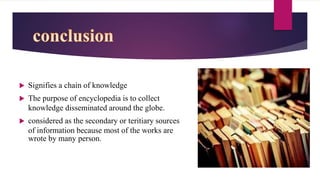
 Signifies a chain of knowledge
 The purpose of encyclopedia is to collect
knowledge disseminated around the globe.
 considered as the secondary or teritiary sources
of information because most of the works are
wrote by many person.
 “Encyclopedia”Archieved from the original on august 3,2007.Glossary of Library Terms.
Riverside City College, Digital Library/Learning Resource Center. Retrieved on:
November 17, 2007.”Encyclopedia”Archieved from the original on august 3,2007.
 Encyclopedia Britannica.Retrieved july 27,2010
 Monique Paulmier-Foucart, "Medieval Encyclopaedias", in André Vauchez (ed.),
Encyclopedia of the Middle Ages, James Clarke & Co, 2002
 Gunstone,Richard (ed)Encyclopedia of science education;2015
 The Encyclopedia of history of science(ETHOS)(ISSN2462-5890)article in history of
science and technology.
Science encyclopedia

Science encyclopedia

  • 1.
    Student seminar presentation Science Encyclopedia BY A.BRISLIN ROLLNO:35 SECTION:A PHYSICAL SCIENCE V.O.C.COLLEGE OF EDUCATION THOOTHUKUDI
  • 3.
     The Encyclopediaof science provides a comprehensive international reference work covering the range of methodologies,perspective,focus and cultures of this field of inquiry,and contributions of leading researchers from around the globe.  A set of books that gives information about many subjects arranged in the order of the alphabet.
  • 4.
     The word“Encylopedia”originated from the Greek word Cyclo and Pedia – which means circle or a complete system of learning.  An encyclopedia is a general summary of thought and knowledge which will serve as the basis for common understandings between specialists and for ideology of education and so become a guiding centre for the intellectual activities of mankind. H.G.Wells
  • 5.
     Definitions ofthe subject  Explanations about the subject  Historical or background information along with data  Photograph and sketches of notable persons  Detailed index with cross references to locate the information easily and quickly  Detailed bibliography or reference at the end of articles
  • 6.
    Ancient times One ofthe earliest encyclopedia – Naturalis Historie of pliny the elder a roman statesman. Published around AD 77-AD 79
  • 7.
    French encyclopedia  Noteverything known to man should be included but only what was necessary.
  • 8.
     John harrisintroduced the most familiar alphabetical ordering system.  Published in 1704  Lexicon Technicum or English dictionary of arts and science.  In 1710-Sir Isaac Newton  Primarily focused on science  Its contents were about what was understood as “science”in the 18th century
  • 9.
  • 11.
  • 12.
     General Encyclopediaare multivolume and cover in brief detail about many topic.  Example World book Encyclopedia Britannica
  • 13.
     Contains informativearticles providing general information on various subjects and usually arranged in alphabetically by topic.  Provides facts,illustration,bibliographical,geographical and historical information.  Assist in enriching the general knowledge of a person and self educate.
  • 14.
     This encyclopediais a specific one.  It covers different disciplines such as science and technology,medicine etc.  It provides more indepth information about subject.  Example: McGraw Hill Encyclopedia of Science and Technology,10th ed,McGraw-Hill,New York,2007,20 vols.
  • 15.
     Science encyclopediahas led to development in other curriculum areas.The encyclopedia has significance beyond the field of sciene education.  The history of science  The philosophy of science  The sociology of science  Scientific communication
  • 16.
    Devoted to particularsubject fields. Exclusive,elaborative and exhaustive treatment which gives a detailed account of a subject. Consist a collection of articles on a particular subject area. Rapid advances in the fields of sciences in recent years. Covers all minute information –for advanced research and other purposes.
  • 19.
     A printencyclopedia is a set of books that contain information about many different subjects.  The amount of information cannot put into one book, divided into many smaller books.  Each book is called volume.  Example  Authors last name,first initial(Date)Title of Articles.Title of Encyclopedia(Volume, Pages)City of publication:Publishing company.  Bergamann,P.G.(1993).Relativity.In The New Encyclopedia Britannica(Vol.26,pp.501- 508).Chicago:Encyclopedia Britannica.
  • 20.
     Also calledInternet encyclopedia or digital encyclopedia  Accessible through the internet Example Wikipedia
  • 21.
     We livein a digital world where information is available instantaneously and things change rapidly.  To evolve with such a connected society, many encyclopedias have moved their print versions into online.  Such online knowledge bases allow students and teachers quick, up-to-date access wherever they are connected to the web, whereas expensive and heavy books serve as a barrier to some.  World Book Online, for instance, offers a subscription- based version.
  • 23.
     Give morecomprehensive information than library books or any other reference materials.  Useful for personal knowledge growth and professional growth.  Offer exhaustive information on specific topics for professional purposes.  We get more detailed information on the topic under discussion.
  • 24.
     The knowledgeis also quite shallow.  For instance if we want to learn about science we should get an introductory science book or a book about the history of science.  Encyclopedias are a lot like dictionaries and we should use them as reference.  We will be having limited knowledge about everything.  The world is changing every second –if we don’t read at one point of time our skills will be outdated.
  • 25.
     Signifies achain of knowledge  The purpose of encyclopedia is to collect knowledge disseminated around the globe.  considered as the secondary or teritiary sources of information because most of the works are wrote by many person.
  • 26.
     “Encyclopedia”Archieved fromthe original on august 3,2007.Glossary of Library Terms. Riverside City College, Digital Library/Learning Resource Center. Retrieved on: November 17, 2007.”Encyclopedia”Archieved from the original on august 3,2007.  Encyclopedia Britannica.Retrieved july 27,2010  Monique Paulmier-Foucart, "Medieval Encyclopaedias", in André Vauchez (ed.), Encyclopedia of the Middle Ages, James Clarke & Co, 2002  Gunstone,Richard (ed)Encyclopedia of science education;2015  The Encyclopedia of history of science(ETHOS)(ISSN2462-5890)article in history of science and technology.