• is a type of reference work


 • a compendium holding a summary of information from
either all branches of knowledge or a particular branch of
knowledge.

• Encyclopedias are divided into articles or entries, which are
usually accessed alphabetically by article name.
•The word encyclopedia comes from the Koine Greek
transliterated enkykliospaideia, meaning
                    "general education":

• One of the earliest encyclopedic works to have survived to
modern times is the Naturalist Historia of Pliny the Elder.

             The Britannica is the oldest English-language
             encyclopedia still being produced. It was first
             published between 1768 and 1771 in
             Edinburgh, Scotland as three volumes.
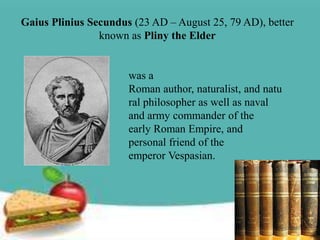
Gaius Plinius Secundus (23 AD – August 25, 79 AD), better
                known as Pliny the Elder


                      was a
                      Roman author, naturalist, and natu
                      ral philosopher as well as naval
                      and army commander of the
                      early Roman Empire, and
                      personal friend of the
                      emperor Vespasian.
18th–19th centuries

•The beginnings of the modern idea of the general-
purpose, widely distributed printed encyclopedia precede
the 18th century encyclopedists.

•Ephraim Chambers published his Cyclopedia in 1728. It
included a broad scope of subjects, used an alphabetic
arrangement, relied on many different contributors and
included the innovation of cross-referencing other sections
within articles. Chambers has been referred to as the father
of the modern encyclopedia for this two-volume work.
•In the early 20th century, the Encyclopedia
Britannica reached its eleventh edition, and
inexpensive     encyclopedias     such    as
Harmsworth's Universal Encyclopedia and
Everyman's Encyclopedia were common.
International development


                                  International development

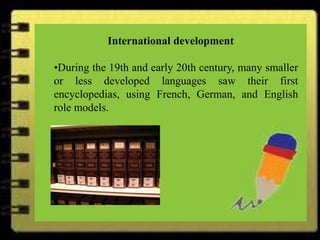
                       •During the 19th and early 20th century, many smaller
                       or less developed languages saw their first
                       encyclopedias, using French, German, and English
                       role models.
Fist Encyclopedia in the World


•The first major Danish encyclopedia was Salmonsens
Konversationsleksikon (19 volumes, 1893–1911)


•The first major Finnish encyclopedia was Tietosanakirja
(11 volumes, 1909–1922).

20th century
          •Popular and affordable encyclopaedias such as
          Harmsworth's Universal Encyclopaedia and the
          Children's Encyclopaedia appeared in the early
          1920s.
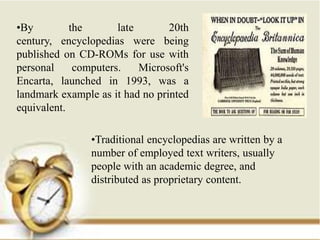
•By         the       late       20th
century, encyclopedias were being
published on CD-ROMs for use with
personal     computers.    Microsoft's
Encarta, launched in 1993, was a
landmark example as it had no printed
equivalent.

                •Traditional encyclopedias are written by a
                number of employed text writers, usually
                people with an academic degree, and
                distributed as proprietary content.
Twenty-first century


•The encyclopedia's hierarchical structure and evolving
nature is particularly adaptable to a digital format

Characteristics

         Four major elements define an encyclopedia:
  • its subject matter

   • its scope

  • its method of organization
• and its method of production:


Encyclopedias can be general, containing articles on
topics in every field (the English-language Encyclopedia
Britannica and German Brockhaus are well-known
examples).

General encyclopedias often contain guides on how to do
a variety of things, as well as embedded dictionaries and
gazetteers.


Some systematic method of organization is essential to
making an encyclopedia usable as a work of reference.
Encyclopedia This word signifies chain of knowledge


The purpose of an encyclopedia is to collect knowledge
disseminated around the globe.

Encyclopedia is considered as the secondary or tertiary
sources of information, because most of the works are wrote
by many person.
The End…
       Presented by:

Mark Angelo M. Labitigan
       BLIS-III

        Presented to:

Ms. Myrna P. Macapia, Librarian

Markey encyclopedia

  • 2.
    • is atype of reference work • a compendium holding a summary of information from either all branches of knowledge or a particular branch of knowledge. • Encyclopedias are divided into articles or entries, which are usually accessed alphabetically by article name.
  • 3.
    •The word encyclopediacomes from the Koine Greek transliterated enkykliospaideia, meaning "general education": • One of the earliest encyclopedic works to have survived to modern times is the Naturalist Historia of Pliny the Elder. The Britannica is the oldest English-language encyclopedia still being produced. It was first published between 1768 and 1771 in Edinburgh, Scotland as three volumes.
  • 4.
    Gaius Plinius Secundus(23 AD – August 25, 79 AD), better known as Pliny the Elder was a Roman author, naturalist, and natu ral philosopher as well as naval and army commander of the early Roman Empire, and personal friend of the emperor Vespasian.
  • 5.
    18th–19th centuries •The beginningsof the modern idea of the general- purpose, widely distributed printed encyclopedia precede the 18th century encyclopedists. •Ephraim Chambers published his Cyclopedia in 1728. It included a broad scope of subjects, used an alphabetic arrangement, relied on many different contributors and included the innovation of cross-referencing other sections within articles. Chambers has been referred to as the father of the modern encyclopedia for this two-volume work.
  • 6.
    •In the early20th century, the Encyclopedia Britannica reached its eleventh edition, and inexpensive encyclopedias such as Harmsworth's Universal Encyclopedia and Everyman's Encyclopedia were common.
  • 7.
    International development International development •During the 19th and early 20th century, many smaller or less developed languages saw their first encyclopedias, using French, German, and English role models.
  • 8.
    Fist Encyclopedia inthe World •The first major Danish encyclopedia was Salmonsens Konversationsleksikon (19 volumes, 1893–1911) •The first major Finnish encyclopedia was Tietosanakirja (11 volumes, 1909–1922). 20th century •Popular and affordable encyclopaedias such as Harmsworth's Universal Encyclopaedia and the Children's Encyclopaedia appeared in the early 1920s.
  • 9.
    •By the late 20th century, encyclopedias were being published on CD-ROMs for use with personal computers. Microsoft's Encarta, launched in 1993, was a landmark example as it had no printed equivalent. •Traditional encyclopedias are written by a number of employed text writers, usually people with an academic degree, and distributed as proprietary content.
  • 10.
    Twenty-first century •The encyclopedia'shierarchical structure and evolving nature is particularly adaptable to a digital format Characteristics Four major elements define an encyclopedia: • its subject matter • its scope • its method of organization
  • 11.
    • and itsmethod of production: Encyclopedias can be general, containing articles on topics in every field (the English-language Encyclopedia Britannica and German Brockhaus are well-known examples). General encyclopedias often contain guides on how to do a variety of things, as well as embedded dictionaries and gazetteers. Some systematic method of organization is essential to making an encyclopedia usable as a work of reference.
  • 12.
    Encyclopedia This wordsignifies chain of knowledge The purpose of an encyclopedia is to collect knowledge disseminated around the globe. Encyclopedia is considered as the secondary or tertiary sources of information, because most of the works are wrote by many person.
  • 13.
    The End… Presented by: Mark Angelo M. Labitigan BLIS-III Presented to: Ms. Myrna P. Macapia, Librarian