Dr. Hari Singh Gour Vishwavidyalaya
Central University , Sagar
SESSION : 2024 – 25
School of Arts and Information Science
DEPARTMENT OF LIBRARY AND INFORMATION SCIENCE
MASTERS OF LIBRARY AND INFORMATION SCIENCE
Subject Name : Management of e- resources
Subject Code : LIS – SEC -127
TOPIC : Encyclopaedia Britannica Online
SUBMITTED TO
Dr. NEELAM THAPA
(Assistant Professor)
ROHIT KUSHWAHA
(Research Scholar)
SUBMITTED BY
NEELAM PATEL
M.lib.I.Sc
CONTENTS
• Introduction
• Authority
• History
• Scope
• Treatment
• Arrangement
• Format
• Search and Navigation
• Accessibility
• Special Features
• Policies
• Limitations
• References
ENCYCLOPAEDIA
BRITANNICA
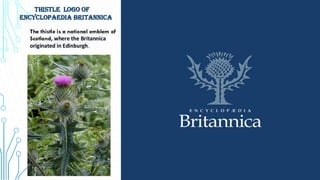
THISTLE Logo of
Encyclopaedia Britannica
The thistle is a national emblem of
Scotland, where the Britannica
originated in Edinburgh.
INTRODUCTION
• The word encyclopaedia is derived from the Greek enkyklios paideia, “general education,” and
it at first meant a circle or a complete system of learning—that is, an all-around education.
• Acc. to Oxford English dic. Encyclopaedia is a literary work containing extensive
information on all branches of knowledge usually arranged in alphabetical order.
• The first edition of Britannica was published in Edinburgh between 1768 and 1771 as a
dictionary of arts and science in 3 volumes.
• Encyclopaedia Britannica is the most popular encyclopaedia among all encyclopaedias. This
encyclopaedia has been serving it’s users for more than 250 years.
• The Encyclopaedia Britannica is a general knowledge English-language encyclopaedia.
• This encyclopaedia is a single best source of long, scholarly and authoritative articles.
• It has wider coverage of both topics and geographical areas . It is very useful source of all types
of libraries.
• The site is full of rich and relevant multimedia photos, illustrations, maps, videos.
• Among the contributors, some 120 Noble laureates have contributed such as former US
President Bill Clinton, Noble Peace Prize winner Desmond Steven Chu, the US Sceretary of
Energy and Noble prize winner in physics in 1997, Noble Peace Prize winner Jody Williams etc.
• Proprietry work.
AUTHORITY
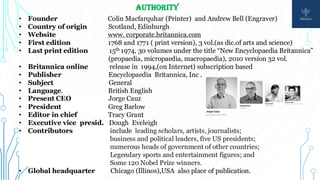
• Founder Colin Macfarquhar (Printer) and Andrew Bell (Engraver)
• Country of origin Scotland, Edinburgh
• Website www. corporate.britannica.com
• First edition 1768 and 1771 ( print version), 3 vol.(as dic.of arts and science)
• Last print edition 15th 1974, 30 volumes under the title “New Encyclopaedia Britannica”
(propaedia, micropaedia, macropaedia), 2010 version 32 vol.
• Britannica online release in 1994,(on Internet) subscription based
• Publisher Encyclopaedia Britannica, Inc .
• Subject General
• Language. British English
• Present CEO Jorge Jorge Cauz
• President Greg Barlow
• Editor in chief Tracy Grant
• Executive vice presid. Dough Eveleigh
• Contributors include leading scholars, artists, journalists;
business and political leaders, five US presidents;
numerous heads of government of other countries;
Legendary sports and entertainment figures; and
Some 120 Nobel Prize winners.
• Global headquarter Chicago (Illinos),USA also place of publication.
HISTORY
• 1st ed. published in Edinburgh, Scotland between 1768-1771 as a dictionary of arts
science in 3 vol. Most of the articles were written by William smellie.
• 2nd ed. published between 1777 & 1784, 10 vol. adding history and biography of persons no longer
alive.
• 3rd ed. published in 1810 in 20 vol. First time articles were written by experts in their fields.
• 9th ed. 25 vol. New information was added, articles became more lengthy, systematically
arranged.
• 11th ed. published in 1910 & 1911, 29 vol. Articles were more scholarly, comprehensive and well
illustrated, contained about 59% new material.
• 1929 ownership passed from British to American publishers.
• 14th ed.1929, 24 vol.,including index and atlas, revised and policy of continuous revision
introduced , 14 ed. appeared in new printing in 1965.
• 15th ed. 1974 published under the title”New Encyclopaedia Britannica" in 30 vol., has 3 parts
(propaedia, micropaedia, macropaedia). Written by 100 full time editors. Last print ed.
• 1981, under an agreement with Mead Data Central, the first digital version of the Encyclopædia
Britannica was created for the LexisNexis service.
• 1990s Britannica was made available for electronic delivery on a number of CD-ROM-based
products,
• 1994 Britannica debuted the first Internet-based encyclopaedia. Users paid a fee to access the
information, which was located at http://www.eb.com.
• In 1996 Britannica was sold to financier Jacob E. Safra.
• In 1999 the company launched Britannica.com, a free site featuring an Internet search engine,
subject channels, current events, and essays, as well as the complete text of the encyclopaedia.
• Britannica’s online distribution was split into two avenues: one, Britannica.com, aimed at
consumers and supported by advertisements and subscription fees (from subscribers who
wanted an ad-free experience), and the other, at the eb.com domain, for institutions such as
schools and libraries.
• In 2006 the company debuted the Britannica Blog.
• 2008 a mobile site was introduced, and in 2010 the first Britannica apps were released.
SCOPE
• It is oldest general knowledge English Language dictionary.
• Subject Coverage: Animals & Nature, History & Society, Science & Tech, Geography &
Travel, Biographies, Arts & Culture, Money.
• International approach and Universal coverage.
• Useful for kids, Students, Scholars etc.
• Only available in English language.
• Follow extremely rigorous editorial process, highly trained editors who know their craft,
extensive fact checking.
• Full text database, thousands of illustrations and links to outside sources.
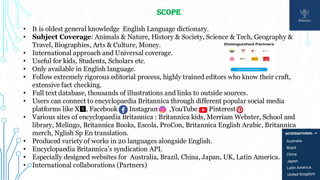
• Users can connect to encyclopaedia Britannica through different popular social media
platforms like X , Facebook , Instagram ,YouTube , Pinterest.
• Various sites of encyclopaedia Britannica : Britannica kids, Merriam Webster, School and
library, Melingo, Britannica Books, Escola, ProCon, Britannica English Arabic, Britannica
merch, Nglish Sp En translation.
• Produced variety of works in 20 languages alongside English.
• Encyclopaedia Britannica’s syndication API.
• Especially designed websites for Australia, Brazil, China, Japan, UK, Latin America.
• International collaborations (Partners)
• Readers themselves can get involved in Britannica’s editorial process, by sending suggestions,
revisions, updates and getting credit if those suggestions are approved.
• Topics covered are complete in coverage , and facts provided are accurate and reliable.
• Can create account through email id and user get updates about new additions, fact of the day,
new release etc.
TREATMENT
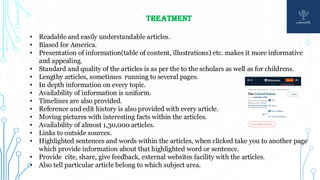
• Readable and easily understandable articles.
• Biased for America.
• Presentation of information(table of content, illustrations) etc. makes it more informative
and appealing.
• Standard and quality of the articles is as per the to the scholars as well as for childrens.
• Lengthy articles, sometimes running to several pages.
• In depth information on every topic.
• Availability of information is uniform.
• Timelines are also provided.
• Reference and edit history is also provided with every article.
• Moving pictures with interesting facts within the articles.
• Availability of almost 1,30,000 articles.
• Links to outside sources.
• Highlighted sentences and words within the articles, when clicked take you to another page
which provide information about that highlighted word or sentence.
• Provide cite, share, give feedback, external websites facility with the articles.
• Also tell particular article belong to which subject area.
ARRANGEMENT
• Topical arrangement (further subdivision is given )
• Within the articles information is arranged in chronological order .
• Category wise
• Feature wise
• Subdivision under the Main Division
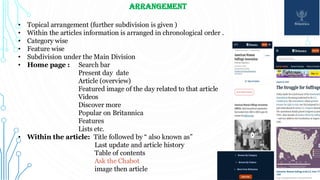
• Home page : Search bar
Present day date
Article (overview)
Featured image of the day related to that article
Videos
Discover more
Popular on Britannica
Features
Lists etc.
• Within the article: Title followed by “ also known as”
Last update and article history
Table of contents
Ask the Chabot
image then article
FORMAT
• Use Georgia font style .
• Font size is easily readable.
• Text are written with black an blue colour with bold heading written in black.
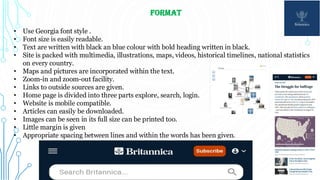
• Site is packed with multimedia, illustrations, maps, videos, historical timelines, national statistics
on every country.
• Maps and pictures are incorporated within the text.
• Zoom-in and zoom-out facility.
• Links to outside sources are given.
• Home page is divided into three parts explore, search, login.
• Website is mobile compatible.
• Articles can easily be downloaded.
• Images can be seen in its full size can be printed too.
• Little margin is given
• Appropriate spacing between lines and within the words has been given.
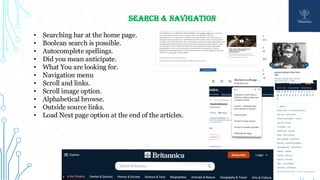
SEARCH & NAVIGATION
• Searching bar at the home page.
• Boolean search is possible.
• Autocomplete spellings.
• Did you mean anticipate.
• What You are looking for.
• Navigation menu
• Scroll and links.
• Scroll image option.
• Alphabetical browse.
• Outside source links.
• Load Next page option at the end of the articles.
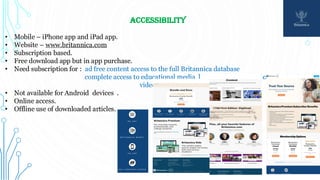
ACCESSIBILITY
• Mobile – iPhone app and iPad app.
• Website – www.britannica.com
• Subscription based.
• Free download app but in app purchase.
• Need subscription for : ad free content access to the full Britannica database
complete access to educational media library of images, podcasts, E books,
video series.
• Not available for Android devices .
• Online access.
• Offline use of downloaded articles.
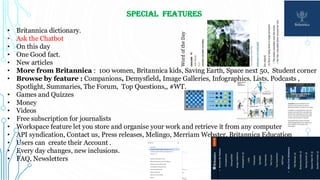
Special FEATURES
• Britannica dictionary.
• Ask the Chatbot
• On this day
• One Good fact.
• New articles
• More from Britannica : 100 women, Britannica kids, Saving Earth, Space next 50, Student corner
• Browse by feature : Companions, Demysfield, Image Galleries, Infographics, Lists, Podcasts ,
Spotlight, Summaries, The Forum, Top Questions,, #WT.
• Games and Quizzes
• Money
• Videos
• Free subscription for journalists
• Workspace feature let you store and organise your work and retrieve it from any computer
• API syndication, Contact us, Press releases, Melingo, Merriam Webster, Britannica Education
• Users can create their Account .
• Every day changes, new inclusions.
• FAQ, Newsletters
POLICIES
Revision policy :
• Britannica is updated continuously, changes are made everyday, revise or add more than a
thousand articles a month.
• Death of notable persons are usually posted immediately.
• Last updated on Feb 8, 2024.
Privacy policy :
• No personal information is collected from users known to be under thirteen (13) years of age without
the consent of their educational institution or the child’s parent or guardian.
• The Company may disclose your personal information to a third-party for a business purpose or sell
your personal information, subject to your right to opt-out of those sales.
• If you are 16 years of age or older, you have the right to direct us to not sell your personal information
at any time (the “right to opt-out”).
Refund policy:
• If you acquired an annual subscription to one of the Subscription Services and you terminate your
subscription within 30 days of the date of activation of your Account, you are eligible to receive a
refund of the subscription fee paid to Britannica.
• Monthly subscription if cancelled, no refund.
LiMITATIONS
• High internet dependency.
• Need subscription, for ad free experience and for some other features to be accessed
• iPhone app and iPad appear only free to download , in-app purchase.
• English language encyclopaedia.
• Biased for America.
• No refund, if cancel the monthly subscription.
• Not available for android devices.
• Games are not included in ad free experiences.
REFERENCES
• britannica.com
• YouTube
Evaluation encyclopaedia Britannica online

Evaluation encyclopaedia Britannica online

  • 1.
    Dr. Hari SinghGour Vishwavidyalaya Central University , Sagar SESSION : 2024 – 25 School of Arts and Information Science DEPARTMENT OF LIBRARY AND INFORMATION SCIENCE MASTERS OF LIBRARY AND INFORMATION SCIENCE Subject Name : Management of e- resources Subject Code : LIS – SEC -127 TOPIC : Encyclopaedia Britannica Online SUBMITTED TO Dr. NEELAM THAPA (Assistant Professor) ROHIT KUSHWAHA (Research Scholar) SUBMITTED BY NEELAM PATEL M.lib.I.Sc
  • 2.
    CONTENTS • Introduction • Authority •History • Scope • Treatment • Arrangement • Format • Search and Navigation • Accessibility • Special Features • Policies • Limitations • References ENCYCLOPAEDIA BRITANNICA
  • 3.
    THISTLE Logo of EncyclopaediaBritannica The thistle is a national emblem of Scotland, where the Britannica originated in Edinburgh.
  • 4.
    INTRODUCTION • The wordencyclopaedia is derived from the Greek enkyklios paideia, “general education,” and it at first meant a circle or a complete system of learning—that is, an all-around education. • Acc. to Oxford English dic. Encyclopaedia is a literary work containing extensive information on all branches of knowledge usually arranged in alphabetical order. • The first edition of Britannica was published in Edinburgh between 1768 and 1771 as a dictionary of arts and science in 3 volumes. • Encyclopaedia Britannica is the most popular encyclopaedia among all encyclopaedias. This encyclopaedia has been serving it’s users for more than 250 years. • The Encyclopaedia Britannica is a general knowledge English-language encyclopaedia. • This encyclopaedia is a single best source of long, scholarly and authoritative articles. • It has wider coverage of both topics and geographical areas . It is very useful source of all types of libraries. • The site is full of rich and relevant multimedia photos, illustrations, maps, videos. • Among the contributors, some 120 Noble laureates have contributed such as former US President Bill Clinton, Noble Peace Prize winner Desmond Steven Chu, the US Sceretary of Energy and Noble prize winner in physics in 1997, Noble Peace Prize winner Jody Williams etc. • Proprietry work.
  • 5.
    AUTHORITY • Founder ColinMacfarquhar (Printer) and Andrew Bell (Engraver) • Country of origin Scotland, Edinburgh • Website www. corporate.britannica.com • First edition 1768 and 1771 ( print version), 3 vol.(as dic.of arts and science) • Last print edition 15th 1974, 30 volumes under the title “New Encyclopaedia Britannica” (propaedia, micropaedia, macropaedia), 2010 version 32 vol. • Britannica online release in 1994,(on Internet) subscription based • Publisher Encyclopaedia Britannica, Inc . • Subject General • Language. British English • Present CEO Jorge Jorge Cauz • President Greg Barlow • Editor in chief Tracy Grant • Executive vice presid. Dough Eveleigh • Contributors include leading scholars, artists, journalists; business and political leaders, five US presidents; numerous heads of government of other countries; Legendary sports and entertainment figures; and Some 120 Nobel Prize winners. • Global headquarter Chicago (Illinos),USA also place of publication.
  • 6.
    HISTORY • 1st ed.published in Edinburgh, Scotland between 1768-1771 as a dictionary of arts science in 3 vol. Most of the articles were written by William smellie. • 2nd ed. published between 1777 & 1784, 10 vol. adding history and biography of persons no longer alive. • 3rd ed. published in 1810 in 20 vol. First time articles were written by experts in their fields. • 9th ed. 25 vol. New information was added, articles became more lengthy, systematically arranged. • 11th ed. published in 1910 & 1911, 29 vol. Articles were more scholarly, comprehensive and well illustrated, contained about 59% new material. • 1929 ownership passed from British to American publishers. • 14th ed.1929, 24 vol.,including index and atlas, revised and policy of continuous revision introduced , 14 ed. appeared in new printing in 1965. • 15th ed. 1974 published under the title”New Encyclopaedia Britannica" in 30 vol., has 3 parts (propaedia, micropaedia, macropaedia). Written by 100 full time editors. Last print ed. • 1981, under an agreement with Mead Data Central, the first digital version of the Encyclopædia Britannica was created for the LexisNexis service. • 1990s Britannica was made available for electronic delivery on a number of CD-ROM-based products,
  • 7.
    • 1994 Britannicadebuted the first Internet-based encyclopaedia. Users paid a fee to access the information, which was located at http://www.eb.com. • In 1996 Britannica was sold to financier Jacob E. Safra. • In 1999 the company launched Britannica.com, a free site featuring an Internet search engine, subject channels, current events, and essays, as well as the complete text of the encyclopaedia. • Britannica’s online distribution was split into two avenues: one, Britannica.com, aimed at consumers and supported by advertisements and subscription fees (from subscribers who wanted an ad-free experience), and the other, at the eb.com domain, for institutions such as schools and libraries. • In 2006 the company debuted the Britannica Blog. • 2008 a mobile site was introduced, and in 2010 the first Britannica apps were released.
  • 8.
    SCOPE • It isoldest general knowledge English Language dictionary. • Subject Coverage: Animals & Nature, History & Society, Science & Tech, Geography & Travel, Biographies, Arts & Culture, Money. • International approach and Universal coverage. • Useful for kids, Students, Scholars etc. • Only available in English language. • Follow extremely rigorous editorial process, highly trained editors who know their craft, extensive fact checking. • Full text database, thousands of illustrations and links to outside sources. • Users can connect to encyclopaedia Britannica through different popular social media platforms like X , Facebook , Instagram ,YouTube , Pinterest. • Various sites of encyclopaedia Britannica : Britannica kids, Merriam Webster, School and library, Melingo, Britannica Books, Escola, ProCon, Britannica English Arabic, Britannica merch, Nglish Sp En translation. • Produced variety of works in 20 languages alongside English. • Encyclopaedia Britannica’s syndication API. • Especially designed websites for Australia, Brazil, China, Japan, UK, Latin America. • International collaborations (Partners)
  • 9.
    • Readers themselvescan get involved in Britannica’s editorial process, by sending suggestions, revisions, updates and getting credit if those suggestions are approved. • Topics covered are complete in coverage , and facts provided are accurate and reliable. • Can create account through email id and user get updates about new additions, fact of the day, new release etc.
  • 10.
    TREATMENT • Readable andeasily understandable articles. • Biased for America. • Presentation of information(table of content, illustrations) etc. makes it more informative and appealing. • Standard and quality of the articles is as per the to the scholars as well as for childrens. • Lengthy articles, sometimes running to several pages. • In depth information on every topic. • Availability of information is uniform. • Timelines are also provided. • Reference and edit history is also provided with every article. • Moving pictures with interesting facts within the articles. • Availability of almost 1,30,000 articles. • Links to outside sources. • Highlighted sentences and words within the articles, when clicked take you to another page which provide information about that highlighted word or sentence. • Provide cite, share, give feedback, external websites facility with the articles. • Also tell particular article belong to which subject area.
  • 11.
    ARRANGEMENT • Topical arrangement(further subdivision is given ) • Within the articles information is arranged in chronological order . • Category wise • Feature wise • Subdivision under the Main Division • Home page : Search bar Present day date Article (overview) Featured image of the day related to that article Videos Discover more Popular on Britannica Features Lists etc. • Within the article: Title followed by “ also known as” Last update and article history Table of contents Ask the Chabot image then article
  • 12.
    FORMAT • Use Georgiafont style . • Font size is easily readable. • Text are written with black an blue colour with bold heading written in black. • Site is packed with multimedia, illustrations, maps, videos, historical timelines, national statistics on every country. • Maps and pictures are incorporated within the text. • Zoom-in and zoom-out facility. • Links to outside sources are given. • Home page is divided into three parts explore, search, login. • Website is mobile compatible. • Articles can easily be downloaded. • Images can be seen in its full size can be printed too. • Little margin is given • Appropriate spacing between lines and within the words has been given.
  • 13.
    SEARCH & NAVIGATION •Searching bar at the home page. • Boolean search is possible. • Autocomplete spellings. • Did you mean anticipate. • What You are looking for. • Navigation menu • Scroll and links. • Scroll image option. • Alphabetical browse. • Outside source links. • Load Next page option at the end of the articles.
  • 14.
    ACCESSIBILITY • Mobile –iPhone app and iPad app. • Website – www.britannica.com • Subscription based. • Free download app but in app purchase. • Need subscription for : ad free content access to the full Britannica database complete access to educational media library of images, podcasts, E books, video series. • Not available for Android devices . • Online access. • Offline use of downloaded articles.
  • 15.
    Special FEATURES • Britannicadictionary. • Ask the Chatbot • On this day • One Good fact. • New articles • More from Britannica : 100 women, Britannica kids, Saving Earth, Space next 50, Student corner • Browse by feature : Companions, Demysfield, Image Galleries, Infographics, Lists, Podcasts , Spotlight, Summaries, The Forum, Top Questions,, #WT. • Games and Quizzes • Money • Videos • Free subscription for journalists • Workspace feature let you store and organise your work and retrieve it from any computer • API syndication, Contact us, Press releases, Melingo, Merriam Webster, Britannica Education • Users can create their Account . • Every day changes, new inclusions. • FAQ, Newsletters
  • 16.
    POLICIES Revision policy : •Britannica is updated continuously, changes are made everyday, revise or add more than a thousand articles a month. • Death of notable persons are usually posted immediately. • Last updated on Feb 8, 2024. Privacy policy : • No personal information is collected from users known to be under thirteen (13) years of age without the consent of their educational institution or the child’s parent or guardian. • The Company may disclose your personal information to a third-party for a business purpose or sell your personal information, subject to your right to opt-out of those sales. • If you are 16 years of age or older, you have the right to direct us to not sell your personal information at any time (the “right to opt-out”). Refund policy: • If you acquired an annual subscription to one of the Subscription Services and you terminate your subscription within 30 days of the date of activation of your Account, you are eligible to receive a refund of the subscription fee paid to Britannica. • Monthly subscription if cancelled, no refund.
  • 17.
    LiMITATIONS • High internetdependency. • Need subscription, for ad free experience and for some other features to be accessed • iPhone app and iPad appear only free to download , in-app purchase. • English language encyclopaedia. • Biased for America. • No refund, if cancel the monthly subscription. • Not available for android devices. • Games are not included in ad free experiences.
  • 18.