Encyclopedias From tomes to technology LIB 640 Information Sources and Services Summer 2009
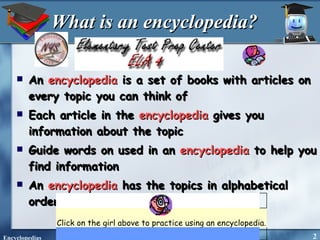
What is an encyclopedia? An  encyclopedia  is a set of books with articles on every topic you can think of Each article in the  encyclopedia  gives you information about the topic Guide words on used in an  encyclopedia  to help you find information An  encyclopedia  has the topics in alphabetical order. Click on the girl above to practice using an encyclopedia.  
Origin of the word? The term The word  encyclopedia  comes from the  Classical Greek  “ἐνκύκλιos παιδεία” (transliterated “enkyklios paideia”), literally, a “[well-]rounded education,” meaning “general knowledge.”  The word  encyclopaedia  was first used as a noun by the Croatian  encyclopedist   Pavao Skalić  in the title of his book,  Encyclopaedia seu orbis disciplinarum tam sacrarum quam prophanarum epistemon  (Encyclopaedia, or Knowledge of the  World of Disciplines, Basel, 1559). From “ Encyclopedia ” on  Wikipedia
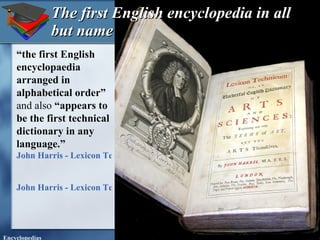
The first English encyclopedia in all but name “ the first English encyclopaedia arranged in alphabetical order”  and also  “appears to be the first technical dictionary in any language.” John Harris - Lexicon Technicum - 1704 first edition John Harris - Lexicon Technicum - 1708 second edition
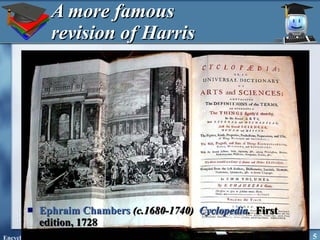
A more famous revision of Harris Ephraim Chambers  (c.1680-1740)  Cyclopedia .  First edition, 1728
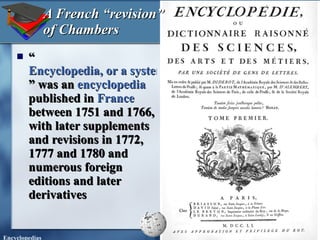
“ Encyclopedia, or a systematic dictionary of the sciences, arts, and crafts ” was an  encyclopedia  published in  France  between 1751 and 1766, with later supplements and revisions in 1772, 1777 and 1780 and numerous foreign editions and later derivatives A French “revision” of Chambers
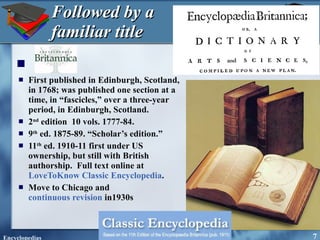
Followed by a familiar title First published in Edinburgh, Scotland, in 1768; was published one section at a time, in “fascicles,” over a three-year period, in Edinburgh, Scotland. 2 nd  edition  10 vols. 1777-84. 9 th  ed. 1875-89. “Scholar’s edition.” 11 th  ed. 1910-11 first under US ownership, but still with British authorship.  Full text online at  LoveToKnow Classic Encyclopedia . Move to Chicago and  continuous revision  in1930s
Encyclopedia or Dictionary? Why both? the dictionary of arts and sciences was the more direct predecessor of the modern encyclopedia.  e. g. John Harris’s  Lexicon technicum  (2 vols., 1704, 1710); and Ephraim Chambers’s (1680–1740)  Cyclopaedia  (2 vols., 1728).  These works consisted of entries on terms (mainly from the arts and sciences) in alphabetical order, but they professed to be more than definitions of words by also being descriptions of things.  Encyclopedism - Alphabetical Encyclopedias Other Free Encyclopedias  ::  Science Encyclopedia  ::  The History of Ideas Vol 2
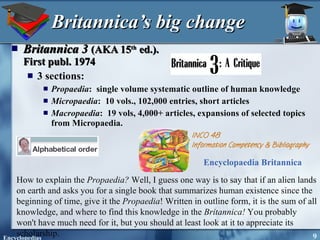
Britannica’s big change Britannica 3   (AKA 15 th  ed.).  First publ. 1974 3 sections:  Propaedia :  single volume systematic outline of human knowledge Micropaedia :  10 vols., 102,000 entries, short articles Macropaedia :  19 vols, 4,000+ articles, expansions of selected topics from Micropaedia. How to explain the  Propaedia?  Well, I guess one way is to say that if an alien lands on earth and asks you for a single book that summarizes human existence since the beginning of time, give it the  Propaedia ! Written in outline form, it is the sum of all knowledge, and where to find this knowledge in the  Britannica!  You probably won't have much need for it, but you should at least look at it to appreciate its scholarship.  Encyclopaedia Britannica
From print to electronic In the early 1980s,  Academic American Encyclopedia , published by Grolier, went on-line [dial-up] through a number of information services.  The first encyclopedia to be produced in a CD format was also the  Academic American  (December 1985).  [Both of the above were text-only] Compton's MultiMedia Encyclopedia  was released in CD format in 1989 and integrates sound, pictures, animation, and text in what is termed  multimedia CD-ROM .
A popular children’s encyclopedia For almost 90 years, World Book has been committed to publishing encyclopedias and other reference products that meet the highest standards of editorial excellence while keeping pace with the technological developments that define the computer age. About World Book
And then there was  Wikipedia Actually,  Nupedia  came first: Nupedia  was a  Web-based   encyclopedia  whose articles were written by experts and licensed as  free content . It was founded by  Jimmy Wales  and underwritten by  Bomis , with  Larry Sanger  as editor-in-chief. Nupedia lasted from March of 2000 [ 1]   until September of 2003, and is mostly known now as the predecessor of the  free   wiki  encyclopedia,  Wikipedia . See also Larry Sanger’s  The Early History of Nupedia and Wikipedia: A Memoir  http://web.archive.org/web/*/http://www.nupedia.com  (archived) Type of site Internet encyclopedia project
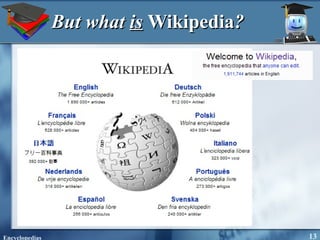
But what  is   Wikipedia ?
Anyone can edit? What is  Wikipedia ? Wikipedia is an  encyclopedia  written  collaboratively  by  many of its readers . It is a special type of website, called a  wiki , that makes collaboration easy. Many people are constantly improving Wikipedia, making thousands of changes an hour, all of which are recorded on  article histories  and  recent changes . Inappropriate changes are usually removed quickly, and repeat offenders can be  blocked from editing . Learn more  about the project
Discussion about  Wikipedia Library Journal : . . . once given the freedom (to edit), will people abuse it? Most certainly. Many observers have already expressed concerns over Wikipedia’s shortcomings, pointing to valid examples of editorial inferiority, yet many others have been charmed by its concept and astonished by its up-to-dateness. Some have gone so far as to claim they prefer it to the venerable (albeit not free) Encyclopaedia Britannica Online. I Want My Wikipedia!  by Barry X. Miller, Karl Helicher, & Teresa Berry --  Library Journal , 4/1/2006
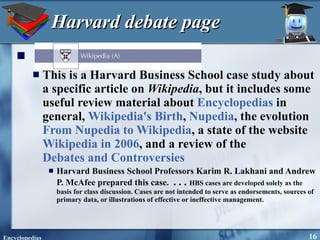
Harvard debate page This is a Harvard Business School case study about a specific article on  Wikipedia , but it includes some useful review material about  Encyclopedias  in general,  Wikipedia's Birth ,  Nupedia , the evolution  From Nupedia to Wikipedia , a state of the website  Wikipedia in 2006 , and a review of the  Debates and Controversies Harvard Business School Professors Karim R. Lakhani and Andrew P. McAfee prepared this case.  . . .  HBS cases are developed solely as the basis for class discussion. Cases are not intended to serve as endorsements, sources of primary data, or illustrations of effective or ineffective management.
Should we dismiss  Wikipedia ? Probably not, just be careful, though! Because of its up-to-date information, Wikipedia will attract high school and college students. However, as with much information floating around in cyberspace, a healthy degree of skepticism and skill at winnowing fact from opinion are required. Karl Helicher, Director of Upper Merion Twp. Lib., King of Prussia, PA in  I Want My Wikipedia! Despite its flaws, however, Wikipedia should not be dismissed. Although the writing is not exceptional, good content abounds. Teresa Berry, Associate Professor/Science Librarian at the Univ. of Tennessee Libs., Knoxville in  I Want My Wikipedia!
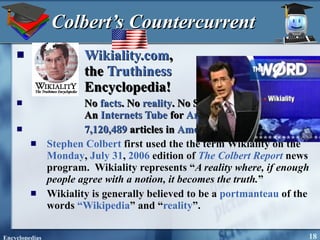
Colbert’s Countercurrent Wikiality.com ,  the  Truthiness   Encyclopedia!  No  facts . No  reality . No Spelcheck.  An  Internets Tube  for  America !  7,120,489  articles in  American Stephen Colbert  first used the the term Wikiality on the  Monday ,  July 31 ,  2006  edition of  The Colbert Report  news program.  Wikiality represents “ A reality where, if enough people agree with a notion, it becomes the truth. ” Wikiality is generally believed to be a  portmanteau  of the words  “Wikipedia ” and “ reality ”.
One solution to  Wikipedia   We are an encyclopedia project, and more.  We are a different sort of Web 2.0 project:  We offer gentle expert oversight.  We use our real names, not pseudonyms.  We're collegial.  We have added  over 2,400 articles  since Nov. 2006.  We aim at credibility and quality not just quantity.  The world needs a more credible free encyclopedia.  Help create it.
What  is  an encyclopedia for? Authority and dependability? Or a quick source of “facts”? Or what? OR
But is it OR any more? Britannica announcement: Encyclopaedia Britannica is about to  launch a new initiative that we’re very  enthusiastic about. The main thrust of this  initiative is to promote greater participation by both our expert contributors and readers. Both groups will be invited to play a larger role in expanding, improving, and maintaining the information we publish on the Web under the Encyclopaedia Britannica name as well as in sharing content they create with other Britannica visitors.  More Participation and Collaboration from Experts and Readers This entry was posted on Tuesday, June 3rd, 2008 at 2:37 pm
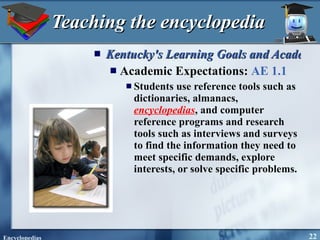
Teaching the encyclopedia Kentucky's Learning Goals and Academic Expectations Academic Expectations:  AE 1.1 Students use reference tools such as dictionaries, almanacs,  encyclopedias , and computer reference programs and research tools such as interviews and surveys to find the information they need to meet specific demands, explore interests, or solve specific problems.
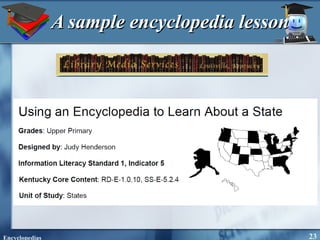
A sample encyclopedia lesson

Encyclopedias--Powerpoint 2003

  • 1.
    Encyclopedias From tomesto technology LIB 640 Information Sources and Services Summer 2009
  • 2.
    What is anencyclopedia? An encyclopedia is a set of books with articles on every topic you can think of Each article in the encyclopedia gives you information about the topic Guide words on used in an encyclopedia to help you find information An encyclopedia has the topics in alphabetical order. Click on the girl above to practice using an encyclopedia.  
  • 3.
    Origin of theword? The term The word encyclopedia comes from the Classical Greek “ἐνκύκλιos παιδεία” (transliterated “enkyklios paideia”), literally, a “[well-]rounded education,” meaning “general knowledge.” The word encyclopaedia was first used as a noun by the Croatian encyclopedist Pavao Skalić in the title of his book, Encyclopaedia seu orbis disciplinarum tam sacrarum quam prophanarum epistemon (Encyclopaedia, or Knowledge of the World of Disciplines, Basel, 1559). From “ Encyclopedia ” on Wikipedia
  • 4.
    The first Englishencyclopedia in all but name “ the first English encyclopaedia arranged in alphabetical order” and also “appears to be the first technical dictionary in any language.” John Harris - Lexicon Technicum - 1704 first edition John Harris - Lexicon Technicum - 1708 second edition
  • 5.
    A more famousrevision of Harris Ephraim Chambers (c.1680-1740) Cyclopedia . First edition, 1728
  • 6.
    “ Encyclopedia, ora systematic dictionary of the sciences, arts, and crafts ” was an encyclopedia published in France between 1751 and 1766, with later supplements and revisions in 1772, 1777 and 1780 and numerous foreign editions and later derivatives A French “revision” of Chambers
  • 7.
    Followed by afamiliar title First published in Edinburgh, Scotland, in 1768; was published one section at a time, in “fascicles,” over a three-year period, in Edinburgh, Scotland. 2 nd edition 10 vols. 1777-84. 9 th ed. 1875-89. “Scholar’s edition.” 11 th ed. 1910-11 first under US ownership, but still with British authorship. Full text online at LoveToKnow Classic Encyclopedia . Move to Chicago and continuous revision in1930s
  • 8.
    Encyclopedia or Dictionary?Why both? the dictionary of arts and sciences was the more direct predecessor of the modern encyclopedia. e. g. John Harris’s Lexicon technicum (2 vols., 1704, 1710); and Ephraim Chambers’s (1680–1740) Cyclopaedia (2 vols., 1728). These works consisted of entries on terms (mainly from the arts and sciences) in alphabetical order, but they professed to be more than definitions of words by also being descriptions of things. Encyclopedism - Alphabetical Encyclopedias Other Free Encyclopedias :: Science Encyclopedia :: The History of Ideas Vol 2
  • 9.
    Britannica’s big changeBritannica 3 (AKA 15 th ed.). First publ. 1974 3 sections: Propaedia : single volume systematic outline of human knowledge Micropaedia : 10 vols., 102,000 entries, short articles Macropaedia : 19 vols, 4,000+ articles, expansions of selected topics from Micropaedia. How to explain the Propaedia? Well, I guess one way is to say that if an alien lands on earth and asks you for a single book that summarizes human existence since the beginning of time, give it the Propaedia ! Written in outline form, it is the sum of all knowledge, and where to find this knowledge in the Britannica! You probably won't have much need for it, but you should at least look at it to appreciate its scholarship. Encyclopaedia Britannica
  • 10.
    From print toelectronic In the early 1980s, Academic American Encyclopedia , published by Grolier, went on-line [dial-up] through a number of information services. The first encyclopedia to be produced in a CD format was also the Academic American (December 1985). [Both of the above were text-only] Compton's MultiMedia Encyclopedia was released in CD format in 1989 and integrates sound, pictures, animation, and text in what is termed multimedia CD-ROM .
  • 11.
    A popular children’sencyclopedia For almost 90 years, World Book has been committed to publishing encyclopedias and other reference products that meet the highest standards of editorial excellence while keeping pace with the technological developments that define the computer age. About World Book
  • 12.
    And then therewas Wikipedia Actually, Nupedia came first: Nupedia was a Web-based encyclopedia whose articles were written by experts and licensed as free content . It was founded by Jimmy Wales and underwritten by Bomis , with Larry Sanger as editor-in-chief. Nupedia lasted from March of 2000 [ 1] until September of 2003, and is mostly known now as the predecessor of the free wiki encyclopedia, Wikipedia . See also Larry Sanger’s The Early History of Nupedia and Wikipedia: A Memoir http://web.archive.org/web/*/http://www.nupedia.com (archived) Type of site Internet encyclopedia project
  • 13.
    But what is Wikipedia ?
  • 14.
    Anyone can edit?What is Wikipedia ? Wikipedia is an encyclopedia written collaboratively by many of its readers . It is a special type of website, called a wiki , that makes collaboration easy. Many people are constantly improving Wikipedia, making thousands of changes an hour, all of which are recorded on article histories and recent changes . Inappropriate changes are usually removed quickly, and repeat offenders can be blocked from editing . Learn more about the project
  • 15.
    Discussion about Wikipedia Library Journal : . . . once given the freedom (to edit), will people abuse it? Most certainly. Many observers have already expressed concerns over Wikipedia’s shortcomings, pointing to valid examples of editorial inferiority, yet many others have been charmed by its concept and astonished by its up-to-dateness. Some have gone so far as to claim they prefer it to the venerable (albeit not free) Encyclopaedia Britannica Online. I Want My Wikipedia! by Barry X. Miller, Karl Helicher, & Teresa Berry -- Library Journal , 4/1/2006
  • 16.
    Harvard debate pageThis is a Harvard Business School case study about a specific article on Wikipedia , but it includes some useful review material about Encyclopedias in general, Wikipedia's Birth , Nupedia , the evolution From Nupedia to Wikipedia , a state of the website Wikipedia in 2006 , and a review of the Debates and Controversies Harvard Business School Professors Karim R. Lakhani and Andrew P. McAfee prepared this case. . . . HBS cases are developed solely as the basis for class discussion. Cases are not intended to serve as endorsements, sources of primary data, or illustrations of effective or ineffective management.
  • 17.
    Should we dismiss Wikipedia ? Probably not, just be careful, though! Because of its up-to-date information, Wikipedia will attract high school and college students. However, as with much information floating around in cyberspace, a healthy degree of skepticism and skill at winnowing fact from opinion are required. Karl Helicher, Director of Upper Merion Twp. Lib., King of Prussia, PA in I Want My Wikipedia! Despite its flaws, however, Wikipedia should not be dismissed. Although the writing is not exceptional, good content abounds. Teresa Berry, Associate Professor/Science Librarian at the Univ. of Tennessee Libs., Knoxville in I Want My Wikipedia!
  • 18.
    Colbert’s Countercurrent Wikiality.com, the Truthiness Encyclopedia! No facts . No reality . No Spelcheck. An Internets Tube for America ! 7,120,489 articles in American Stephen Colbert first used the the term Wikiality on the Monday , July 31 , 2006 edition of The Colbert Report news program. Wikiality represents “ A reality where, if enough people agree with a notion, it becomes the truth. ” Wikiality is generally believed to be a portmanteau of the words “Wikipedia ” and “ reality ”.
  • 19.
    One solution to Wikipedia We are an encyclopedia project, and more. We are a different sort of Web 2.0 project: We offer gentle expert oversight. We use our real names, not pseudonyms. We're collegial. We have added over 2,400 articles since Nov. 2006. We aim at credibility and quality not just quantity. The world needs a more credible free encyclopedia. Help create it.
  • 20.
    What is an encyclopedia for? Authority and dependability? Or a quick source of “facts”? Or what? OR
  • 21.
    But is itOR any more? Britannica announcement: Encyclopaedia Britannica is about to launch a new initiative that we’re very enthusiastic about. The main thrust of this initiative is to promote greater participation by both our expert contributors and readers. Both groups will be invited to play a larger role in expanding, improving, and maintaining the information we publish on the Web under the Encyclopaedia Britannica name as well as in sharing content they create with other Britannica visitors. More Participation and Collaboration from Experts and Readers This entry was posted on Tuesday, June 3rd, 2008 at 2:37 pm
  • 22.
    Teaching the encyclopediaKentucky's Learning Goals and Academic Expectations Academic Expectations: AE 1.1 Students use reference tools such as dictionaries, almanacs, encyclopedias , and computer reference programs and research tools such as interviews and surveys to find the information they need to meet specific demands, explore interests, or solve specific problems.
  • 23.