Mustansiriyah University
College of Arts
Information and Library Science Department
EcoleThis
prsentation
will help you
to know every
thing about
Encyclopedias
I need information
about
Encyclopedias
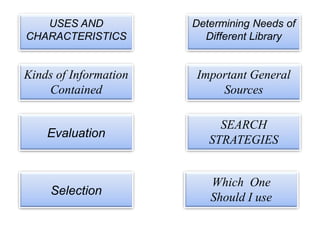
USES AND
CHARACTERISTICS
Important General
Sources
SEARCH
STRATEGIES
Determining Needs of
Different Library
Kinds of Information
Contained
Selection
Evaluation
Which One
Should I use
USES AND CHARACTERISTICS
is a comprehensive written holding information fromEncyclopedia
either all topics of knowledge or a particular topic of knowledge
and it has historically endeavored to do just that whether the
encyclopedia be a single volume on specific subject , or
multivolume work such as the new encyclopedia Britannica ,the
goal remains implicit : to provide a summarized compendium of
multidisciplinary knowledge in a verifiable , organized ,and readily
accessible manner that allows its user to meet their information
needs .
Jacques Barzun
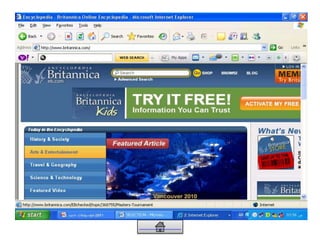
notes that encyclopedias should be learned and not blindly used .
It is valuable to categorize the types of questions best answered
through their use:
Ready Reference Information: what is the size of Jupiter ? These
are types of questions suited to encyclopedia.
General Background Information : how dose photosynthesis work
. one can consult encyclopedias to garner background information
they give definitions explain phenomena and provide illustrations.
They often list cross- references to related information.
Pre research Information : encyclopedia provide a useful launch
point for learning basic research skills and for embarking on
research itself
Kinds of Information Contained
Encyclopedias provide a well-organized overview of selected topics of
major importance. They deliver a survey presentation, a snapshot of
how topics are and were. Encyclopedias are written in an objective
rather than an analytical style
Single – Volume Encyclopedias
Encyclopedia for Children and Young Adults
sometimes parents will use these encyclopedias as teaching tools for
their pre- school-aged children. This kind of tend to place more
emphasis on format , illustrations , andpedagogical tools perhaps
as a way of makingit easier for children to learn how to use them
It is deliver condensed, factual information, often with
accompanying illustrations. arranged in dictionary format without an
index ,they are inexpensive alternatives to multi-volume sets. They
can be readily purchased by individuals for home use or by libraries
seeking cost-effective ways.
Subject Encyclopedias
its unlike there single or multivolume counterparts
having a broader scope, give more in – depth
coverage to a specific field of knowledge. It can deliver
depth and breadth of information not covered in general
encyclopedias and can easily be used to augment the
reference of a library
Encyclopedia Year Books and
Supplements
With the advent of electronic encyclopedias, yearbooks
and supplements have become an even more important
feature of encyclopedia publishing. Year books have
always functioned as year in review reference tools,
providing users with either chronological or topical
reports of the events and / or people that shaped the
world in a given year.
Foreign – Language Encyclopedias
It can provide a wealth of information about a particular
country or culture and are invaluable additions to
academic libraries. Its appear as single – or multivolume
entities
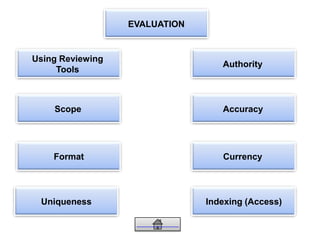
EVALUATION
Scope
Uniqueness
Accuracy
Indexing (Access)
Currency
Authority
Format
Using Reviewing
Tools
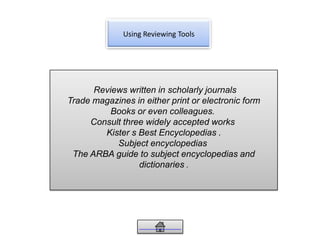
Using Reviewing Tools
Reviews written in scholarly journals
Trade magazines in either print or electronic form
Books or even colleagues.
Consult three widely accepted works
Kister s Best Encyclopedias .
Subject encyclopedias
The ARBA guide to subject encyclopedias and
dictionaries .
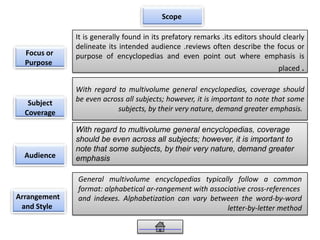
Scope
Focus or
Purpose
Subject
Coverage
Audience
Arrangement
and Style
With regard to multivolume general encyclopedias, coverage should
be even across all subjects; however, it is important to note that some
subjects, by their very nature, demand greater emphasis.
It is generally found in its prefatory remarks .its editors should clearly
delineate its intended audience .reviews often describe the focus or
purpose of encyclopedias and even point out where emphasis is
placed .
General multivolume encyclopedias typically follow a common
format: alphabetical ar-rangement with associative cross-references
and indexes. Alphabetization can vary between the word-by-word
letter-by-letter method
With regard to multivolume general encyclopedias, coverage
should be even across all subjects; however, it is important to
note that some subjects, by their very nature, demand greater
emphasis
Format
The physical format of an encyclopedia is inextricably
intertwined with its accessibility and overall usefulness.
An encyclopedia whose physical format looks daunting or
appears confusing in spite of its content may dissuade
potential users from choosing it
the advent of CD-ROM and online encyclopedias,
physical format now can be seen as having two facets:
outside packaging and interface design. Plastic
containers and glossy illustrations replace book bindings.
Query boxes and radio buttons replace indexes and
cross-references .
Uniqueness
An encyclopedia is unique if it contains features that set it
apart from other encyclope-dias. The inclusion of a variety
of reading guides and study aids makes World Book unique.
The effective blending of sound, images, and text
distinguishes Microsoft's Encarta.
Authority
As with any reference source, authority, or the staff
responsible for the content, has im-mense value when
one chooses to use or purchase the source. An
examination of a source's prefatory remarks can reveal
much about its authority and, thus, its worthiness. With
regard to encyclopedias
Accuracy
Objectivity
Accuracy and Reliability of
Information
a librarian should pay careful attention to
what an article includes or omits. A
librarian should also be concerned with
balanced coverage and?
librarians should choose an
encyclo-pedia wisely and be mindful that
they should look at other sources to
verify information lo-cated in that
encyclopedia.
Currency
Encyclopedias, like computers, lose value soon after they
are purchased. Given the lengthy lead times for publication
of print works, one could even posit that print encyclope-dias
lose value while in press..
Electronic encyclopedias often provide a solution to the
problem of currency. Online encyclopedias, in particular,
have no limitations, other than those imposed by their
produc-ers, on the level and frequency of updates. CD-ROM
versions, however, are limited by pro-duction schedules,
cost, and space constraints
Indexing (Access)
With regard to print encyclopedias, indexing remains the
key means of accessing infor-mation. As pointed out in
Chapter 4, indexes are tools that point users to required
informa-tion. Reading guides, tables of contents, cross-
references, and bibliographies should not be discounted.
Most encyclopedias have separate indexes, but tend to
differ in terms of scope and subject subdivision.
Selection
Purchasing an encyclopedia, whether it be a print, CD-ROM, or
online version, is a major investment in terms of cost; with a print
set, space constraints also can be an issue. With recent advances
in technology and requests to make information widely accessible
The world in which printed encyclopedias were produced and
consumed has vanished. The economics that control and constrain
the produc-tion of encyclopedic knowledge have likewise changed
radically.
Electronic options
earmarked for the purchase of print encyclopedias on other items.
The other electronic alternative, an encyclopedia on CD-ROM or
DVD, is also a good choice and often a better one than online
encyclopedias, some of which have currency and server stability
problems. Nearly all of the CD-ROM/DVD encyclopedias offer
multimedia (e.g., sound and video clips, Web links) and all cost less
than $100.00 (as of 2000). Although fewer users can access CD-
ROM/DVD encyclopedias at one time, their selection may be the best a
library can make.
Users With
General Needs
Determining Needs of Different Library
Learners
People who need brief factual information or leads to
sources about a particular topic qualify as users with
general needs. Unlike learners, general users will not
consult an encyclo-pedia's research guides but rather
will focus on locating information quickly and easily.
The needs of a library's users determine which encyclopedias a librarian
should select for purchase. A business information center would probably
not need Child craft , just as a small public library probably would not
purchase the McGraw-Hill Encyclopedia of Science and Technology
Anyone can be a learner, and publishers of
encyclopedias generally target their products to this
individual. Encyclopedias play a didactic role
regardless of the age of the learner. They provide a
range of tools that can help a wide variety of people
learn how to access, synthesize, and in some cases,
analyze information
Users With Scholarly or
Specialized Needs
subject encyclopedias would be a better choice. A doctoral candidate in
library history would obviously benefit by access to the Encyclopedia of
Library History, and the library and information science librar-ian would
undoubtedly choose that for inclusion in the reference collection.
Cost plays a major role in the acquisition of any library material.
Encyclopedias, and their acquisition should not be a cavalier matter,
publishers price encyclopedias according to their use. Academic and
nonprofit institutions buy at a discount; commercial or individual users
pay retail price. Some publishers of multivolume sets such as the
McGraw-Hill Encyclopedia even offer compact, 'one-volume versions
containing material extracted from the larger set .
Users With Scholarly or Specialized Needs
subject encyclopedias would be a better choice. A doctoral candidate in library
history would obviously benefit by access to the Encyclopedia of Library
History, and the library and information science librar-ian would undoubtedly
choose that for inclusion in the reference collection.
Cost plays a major role in the acquisition of any library material.
Encyclopedias, and their acquisition should not be a cavalier matter,
publishers price encyclopedias according to their use. Academic and
nonprofit institutions buy at a discount; commercial or individual users
pay retail price. Some publishers of multivolume sets such as the
McGraw-Hill Encyclopedia even offer compact, 'one-volume versions
containing material extracted from the larger set .
Cost
Impact of Format on Coasts
For years, librarians could only purchase print encyclopedias.
Multivolume general sets cost the most and had limited shelf lives.
However, once a library made the purchase, it owned it outright
and could provide unlimited access to it. The downside lay in
having to make this investment over and over because
encyclopedias lose their currency rather quickly. With the advent
of CD-ROM technology, libraries now theoretically have a lower-
cost alternative to print encyclopedias. Moreover, libraries that
choose CD-ROM encyclope-dias instead of print versions can
readily afford to purchase new CD-ROM encyclopedias every
year, thus making a significant improvement in the area of
currency. Like their print counterparts,
IMPORTANT GENERAL SOURCES
Single – Volume Encyclopedias
Encyclopedias for Adults
Encyclopedia for Children and Young Adults
Subject Encyclopedias
Encyclopedia for Children and Young Adults
World Book Encyclopedia prides itself as being suitable as a "family
reference tool" that is also used by "librarians, teachers, and the general
public to satisfy their everyday reference needs.
The 2000 revision of World Book contains:
twenty-two volumes, more than 14,000 pages
over 17,000 signed articles, and 28,000 illustrations (photographs, maps,
charts, timelines, graphs, diagrams, and art)
World Book's strength lies in its ability to help a wide variety of users find
information quickly and effectively.
All subjects are arranged alphabetically using the word-by-word method.
Cross-references also play a significant role in this alphabetical
arrangement.
Topics and subtopics are shown in boldface within or beside articles.
and page numbers and guide words appear at the top of every page.
Articles vary in length and treatment depending on the subject matter and
intended audience
World Book conveys a lot of its information in tables, graphs, and charts.
Another great strength of World Book is its ability to be used as a learning and
instruc-tional tool.
Lengthy articles are often followed by an outline of the article for quick review
purposes, related entries, and a list of study questions
World Book is also available as a CD-ROM called World Book Millennium.
There are sev-eral editions of this product, including the Standard Edition and the
Deluxe Edition. Viewed as favorably by librarians as its print counterpart, it is
compatible with Windows 95/98/NT.
These CD-ROM products are unique in that they contain the complete text of
the print coun-terpart plus audio, video, animation, pictures, maps, and links to
Internet sources. The Stan-dard Edition includes every article from the World
Book Encyclopedia plus thousands more and a feature called "Surf the
Millennium," which allows users to search on simulated Web sites for each
century. It also includes a free year of updates, plus a 60-day subscription to
World Book Online.
The Deluxe Edition has all of the aforementioned features plus more
mul-timedia (videos, maps, 360-degree panoramas, photos, and sound) as well
as a homework tool kit and research wizards. World Book also offers a DVD
version, Discoveries, but that does not derive its content from World Book
Encyclopedia. Instead, World Book takes its content from "one of Europe's best-
selling encyclopedias" (but fails to identify the actual source) and offers its users
a plethora of images, sounds, and animation. Users can search thematically,
chrono-logically, or via subject. Also included are tips for research reports. World
Book has also devel-oped a version for the Macintosh, aptly titled World Book
Macintosh Edition. It includes all articles contained in the print version, but also
has features not offered in the Windows ver-sion, such as virtual reality tours, a
quiz wizard, and a distance calculator. Macintosh users also get a year's online
subscription. World Book Online contains the complete contents of the print set
plus 3,700 more articles, as well as links to periodical articles and Web sites.
Articles vary in length and treatment depending on the subject matter and
intended audience
World Book conveys a lot of its information in tables, graphs, and charts.
Another great strength of World Book is its ability to be used as a learning and
instruc-tional tool.
Lengthy articles are often followed by an outline of the article for quick review
purposes, related entries, and a list of study questions
World Book is also available as a CD-ROM called World Book Millennium.
There are sev-eral editions of this product, including the Standard Edition and the
Deluxe Edition. Viewed as favorably by librarians as its print counterpart, it is
compatible with Windows 95/98/NT.
These CD-ROM products are unique in that they contain the complete text of
the print coun-terpart plus audio, video, animation, pictures, maps, and links to
Internet sources. The Stan-dard Edition includes every article from the World
Book Encyclopedia plus thousands more and a feature called "Surf the
Millennium," which allows users to search on simulated Web sites for each
century. It also includes a free year of updates, plus a 60-day subscription to
World Book Online.
Encyclopedia for Adults
Encyclopedia Americana,
Academic American Encyclopedia,
Funk & Wagnalls New Encyclopedia.
The differences among these four general, multivolume sets lie in :
length,
presentation,
style, and size.
The first two titles listed qualify as full-length sets and the last two as
mid-length.
The largest of the multivolume English-language general
encyclopedias, New Encyclo-paedia Britannica is considered by many to
be the most scholarly. On October 19,1999, Encyclopedia Britannica
, announced that itBritannica.comInc.'s electronic resources division,
would make the entire text of Encyclopaedia Britannica available free of
charge within the company's Web site.
Encyclopedia Britannica
Encyclopedia Britannica continues to publish a print edition and its publisher
Paul Hoffman has stated: "There is a place for books alongside all of the digital
for-mats, and many people around the world still want books."
The 1999 revision, published in fall 1998, contains thirty-two volumes and comes
in three parts:
1-the Propaed
2- the Micropae-dia
3- and the Macropaedia.
The single-volume Propaedia (volume 30) acts as an "outline of knowledge.
The twelve-volume Micropaedia serves as the ready-reference portion of the
en-cyclopedia
and the seventeen-volume Macropaedia contains lengthy, detailed articles.
The Index to the 1999 set comes in two volumes.
CD-ROM and online versions are also available and purchasers
can also buy Britannica Book of the Year separately.
The Propaedia serves as "a topical guide to the contents of
Encyclopaedia Britannica, enabling the reader to carry out an
orderly plan of reading in any field of knowledge or learn-ing chosen
for study in some depth.
the Propaedia, or "out-line of knowledge," can seem daunting to
the uninitiated. It has a unique structure that allows the user to find
relationships and connections within and across disciplines and thus
to rele-vant information in the Micropaedia and Macropaedia.
The Propaedia also contains lists of the approximately 4,300
contributing authors of signed articles
the 2,600 Micropaedia subject experts who did not also contribute
signed articles.
Britannica'sIndex includes over 215,000 entries with more than 500,000
references and cross-references and provides ready access to the
information contained in the Micropaedia and the Macropaedia
Whereas the Index tells the user where to find information, the
Propaedia tells the user what information can be found.
The Micropaedia can be used as a resource on its own or as a support
resource for the Macropaedia
The structure of the Micropaedia facilitates easy access to the
information contained within
Cross-references have several functions within the Micropaedia. They
can act as referents to alternate names or spellings or operate as see also,
see under
Page format tends toward the crowded, with little white space, use of
smallish fonts, and illustrations
Britannica's Macropaedia has 672 detailed survey articles averaging 26
pages in length.
Some articles even exceed 100 pages>
A bibliography follows every article. Like the Micropae-dia
The Macropaedia in-corporates larger illustrations and several color-
insert plates; however, Britannica, in spite of adding more graphics to the
1999 version, will never rival World Book in terms of number of
photographs, images, and illustrations used.
Another tool connected to Britannica is its Book of the Year. Purchased
separately, this single volume includes vast statistical information in the
"World Data" section, a collection of current facts and figures for 217
countries and dependencies of the world. Because Britannica does not
cover statistical information in depth in its Propaedia, Micropaedia, and
Macropae-dia
Although locating information in the New Encyclopedia Britannica can
be difficult or intimidating for some, the depth and breadth of scholarship
contained within outweigh these difficulties. Nevertheless, because CD-
ROM and online versions eliminate the need to move thfough multiple
print volumes, libraries that can afford to purchase and maintain a
com-puter network may want to consider switching from the print set to an
electronic version to give users easier access to information housed in
what many deem the premier English-language encyclopedia produced
today.
New Encyclopedia Britannica, as mentioned earlier, also comes in CD-
ROM and Web versions. Britannica CD 2000 Deluxe Edition
Britannica Book of the Year, more than 125,000 Internet links via
Britannica Online, photos, maps, illustrations, and Merriam-Webster's
Collegiate Dictionary 10 – edition.
Britannica Online
Britannica Online, the Web version of New Encyclopedia Britannica,
maintains the high standards that are the hallmark of the print version
and augments what is available in the print edition. Using a Netscape
Windows format,
Britannica Online contains over 72,000 entries, a wealth of graphics,
images, tables, and figures, along with a powerful Boolean-based
search engine that can be readily used by novice or advanced
searchers
Britannica Online also differs from the print version in terms of new
features offered. Included are a browsable Propaedia (a hierarchical
list of subjects that allows the user to scan quickly the scope,
con-tents, and organization of the Encyclopedia Britannica
There are two versions of the online service, one free and one fee-
based
Academic American (2000
Focusing more on breadth of coverage than on detail, has more than
45,000 articles compared to 672 in Britannica's Macropaedia. It also
comprises only thirty volumes and its index contains fewer than 250,000
entries.
it is a mid-length encyclopedia, whereas Britannica is a full-length one.
there are thousands of cross-references sprinkled throughout. The
editorial staff sees its mission as disseminating information clearly and
succinctly
the information seems factual and up-to-date. For the 2000 version
5,750 new and revised articles were added as well as 114 new subjects
and 660 photographs, illus-trations, and maps. Its Periodic Table contains
Element 112. The 23,000 illustrations (75 % in color)—one-third of the space
used in the entire
the Grolier Multimedia Encyclopedia
on CD-ROM provides a wonderful partnership between text and media
Grolier Internet Index, which is updated monthly. With a few minor exceptions,
the online
version mirrors the CD-ROM, but it has the advantage of being more current
and the possibility of being accessed by a larger number of simultaneous users.
The first encyclopedia published in the United States (1829), Encyclopedia
Americana
prides itself on its focus on U.S. history, geography, and biography as well as on
science and
technology. This is not to say that it sacrifices coverage of other countries or
topics to make
room for these emphases; Encyclopedia Americana is second only to Britannica
in terms of depth and breadth .
Several articles run to 100 pages (many even have their own table of
con-
tents), cross-references are numerous, and bibliographies appear at the
end of longer articles
as well as at the end of major sections within them. Like Britannica,
Encyclopedia Americana
uses illustrations sparingly; the majority are black and white even though
more color photo-
graphs were added in 1999. But, unlike Britannica, only a fraction of
Encyclopedia Americana articles are signed.
The thirty-volume 1999 version includes 45,000 articles; 23,000
illustrations (20 % in color); 1,300 maps; and a 353,000-entry index.
Despite its philosophy of"continuous revision," Encyclopedia Americana's
currency appears to be a weak point.,
For example, the coverage in the "American Literature" section ends in the late
1960s. No men-
tion of the 1994 Northridge earthquake is made in the article on "California." This
problem is
less apparent in the CD-ROM version. Encyclopedia Americana on CD-ROM ranks
alone
with Encyclopaedia Britannica in terms of comprehensive coverage. Not only does
it include
the information contained in the thirty-volume print set, it also houses Merriam
Webster's
Collegiate Dictionary, 10th Edition, Chronology of World History (produced by
Helican Pub-
lishing Company), and Academic Press's Dictionary of Science and Technology.
In addition, the Grolier Internet Index links more than 30,000 Americana
articles to carefully chosen Web sites. And, like Britannica on CD-ROM,
content, not the latest multimedia advancement, is showcased
An online version of Encyclopedia Americana is offered, and online
subscription rates vary according to the number of users. As is the case for
most online encyclopedias, a sub-scription commitment gives the purchaser
a substantial discount on the print version. Ency-clopedia Americana Online
allows keyword and Boolean-based searches; provides quarterly updates of
encyclopedia articles and monthly updates of hypertext links; and includes
access to The Americana Journal, a searchable current events database. It
also offers over 6,000 bibli-ographies; 155,000 links to Web sites; and
access to The American Heritage Dictionary of the English Language,
Third, Roget's II: The New Thesaurus, Third Edition, and the contents of
seventy-five magazines and journals.
It should be noted that Encyclopedia Americana is one of a suite of online
products offered through the Grolier Online gateway. In 1997 Grolier Inc.
combined Encyclopedia Americana and Grolier Multimedia Encyclopedia for
delivery on the Web. Selected in 1997 as the recipient of Booklist's "Reference
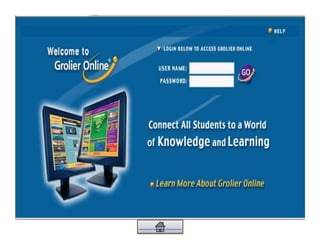
Source of the Year" award, Grolier Online stays true to the standards established
by its print counterparts. Although not as comprehensive in coverage as
Britannica Online, it provides its users with access to infor-mation beyond that
currently available in print versions. Since 1997, Grolier has addedother products
to its gateway, including The New Book of Knowledge, Nueva enciclopedia
Cumbre en linea, The New Book of Popular Science, and Lands and Peoples.
For several years, Funk & Wagnalls New Encyclopedia had been known as the
"super-market" encyclopedia. However, when Microsoft decided to use its content
as the foundation for its Encarta encyclopedia on CD-ROM, that stigma began to
fade.
retains several successful features such as natural language searching
(introduced in 2000), a dynamic timeline, a curriculum guide, and
access to Encarta Online.
Encarta also comes in seven foreign editions, each of which is
tailored to a specific country, region, or lan-guage group. With respect
to interface design,
Encarta 2001 is the most user-friendly of all CD-RO encyclopedias.
It readily merges browability, superior multimedia (including new
panoramic and collage images), and online searching capabilities so
that the user can easily access high-quality content.
Monthly downloads from the Microsoft Encarta Web site are easy
and quick.
Encarta 2001
The only weakness noted appears to be the need to switch among
three discs to take full advantage of all the multimedia.
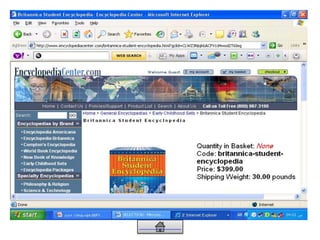
Not to be outdone by Web competitors like
Britannica Online
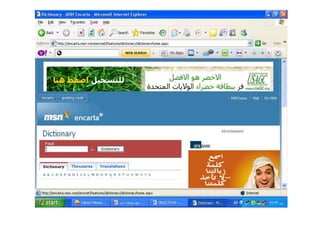
, Microsoft also has Encarta Online Deluxe
, a Web-based version at Encarta En-cyclopedia Deluxe 200
. All Encarta products are competitively priced.
Single - Volume Encyclopedias
Although the format of single-volume encyclopedias has become
increasingly popular over the past few years, there are not many
current editions or revisions from which to choose. Some print
standards, like The Random House Encyclopedia (1990), have not
been re-cently revised. The newest edition of The Columbia
Encyclopedia (2000) includes more than 50,000 articles with nearly
1,500 new entries as well as fully updated existing entries and
geo-graphical entries that reflect the most recent political changes.
This edition is also freely avail-able on the Web.
Subject Encyclopedias
Although there are numerous high-quality subject encyclopedias, the limits of a
single chapter allow for discussion of only three important multidisciplinary titles:
the Gale Encyclo-pedia of Multicultural America, Encyclopedia o
Multiculturalism, and the McGraw-Hill Ency-clopedia of Science and Technology
Published in 2000 to meet the need for information about ethnicities in the
United States Students looking for more detailed treatments would necessarily
look to the Encyclope-dia of Multiculturalism, published by Marshall Cavendish.
First published in 1994 as a six-volume set, two additional volumes or
supplements were published in 1998. The publisher aims to collect substantive
information about groups of people At the other end of the size and cost
spectrum falls the twenty-volume McGraw-Hill Encyclopedia of Science and
Technology. Unsurpassed in scope and coverage, the eighth edi-tion, published
in 1997, contains over 10% more coverage than the seventh edition, with 7,100
entries (of which 1,600 are new or revised) and over 13,000 illustrations (nearly
1,800 are new additions). Over 3,500 individuals contributed to this edition; 19
have won the Nobel Prize. In spite of having so many world-renowned experts,
the McGraw-Hill Encyclopedia of Science and Technology is written to
accommodate a wide variety of readers, from the layper-son to the
specialist. Specific disciplines, such as meteorology and physics, are
covered in broad, survey articles. Each entry begins with a definition and a
general overview of the topic. The entry then progresses from the general to
the specific in an effort to provide comprehen-sive coverage of the topic.
Bibliographies typically come at the end of an article. Pure science remains
the focus of the eighth edition; there are no articles devoted to sociological,
historical, and biographical aspects of science or technology. Over 60,000
cross-references are included. Perhaps the best feature of this subject
encyclopedia is its organization. One can locate infor-mation using four
methods: find an article alphabetically in its appropriate volume; consult the
170,000-entry index; browse the "Topical Index" (a list of all titles contained
within a spe-cific discipline); and use the "Study Guides." The last three
features are found in Volume 20. The "Study Guides" are essentially outlines
of six major disciplines: biology, chemistry, engi-neering and technology,
geosciences, health, and physics. They aid students in their studies and
also act as reference tools.
SEARCH STRATEGIES
Knowledge of how and when to use that
sources plays
a key role with respect to locating
required information quickly and
efficiently . With the advent of electronic
encyclopedia , search strategies with
regards first to selection of an
encyclopedia and second to locating
information contained within the
encyclopedia have become more
complex . Users need to have some
computer experience to conduct even
the simple search.
Which Encyclopedia Should I Use
Encyclopedia are now available in for formats(print , CD-ROM
,DVD ,and on line) the question it self will help the librarian
determine not only which encyclopedia to choose, but in which
format
Thanks for your listening

Encyclopedias

  • 1.
    Mustansiriyah University College ofArts Information and Library Science Department EcoleThis prsentation will help you to know every thing about Encyclopedias I need information about Encyclopedias
  • 2.
    USES AND CHARACTERISTICS Important General Sources SEARCH STRATEGIES DeterminingNeeds of Different Library Kinds of Information Contained Selection Evaluation Which One Should I use
  • 3.
    USES AND CHARACTERISTICS isa comprehensive written holding information fromEncyclopedia either all topics of knowledge or a particular topic of knowledge and it has historically endeavored to do just that whether the encyclopedia be a single volume on specific subject , or multivolume work such as the new encyclopedia Britannica ,the goal remains implicit : to provide a summarized compendium of multidisciplinary knowledge in a verifiable , organized ,and readily accessible manner that allows its user to meet their information needs . Jacques Barzun notes that encyclopedias should be learned and not blindly used .
  • 4.
    It is valuableto categorize the types of questions best answered through their use: Ready Reference Information: what is the size of Jupiter ? These are types of questions suited to encyclopedia. General Background Information : how dose photosynthesis work . one can consult encyclopedias to garner background information they give definitions explain phenomena and provide illustrations. They often list cross- references to related information. Pre research Information : encyclopedia provide a useful launch point for learning basic research skills and for embarking on research itself
  • 5.
    Kinds of InformationContained Encyclopedias provide a well-organized overview of selected topics of major importance. They deliver a survey presentation, a snapshot of how topics are and were. Encyclopedias are written in an objective rather than an analytical style
  • 6.
    Single – VolumeEncyclopedias Encyclopedia for Children and Young Adults sometimes parents will use these encyclopedias as teaching tools for their pre- school-aged children. This kind of tend to place more emphasis on format , illustrations , andpedagogical tools perhaps as a way of makingit easier for children to learn how to use them It is deliver condensed, factual information, often with accompanying illustrations. arranged in dictionary format without an index ,they are inexpensive alternatives to multi-volume sets. They can be readily purchased by individuals for home use or by libraries seeking cost-effective ways.
  • 7.
    Subject Encyclopedias its unlikethere single or multivolume counterparts having a broader scope, give more in – depth coverage to a specific field of knowledge. It can deliver depth and breadth of information not covered in general encyclopedias and can easily be used to augment the reference of a library
  • 8.
    Encyclopedia Year Booksand Supplements With the advent of electronic encyclopedias, yearbooks and supplements have become an even more important feature of encyclopedia publishing. Year books have always functioned as year in review reference tools, providing users with either chronological or topical reports of the events and / or people that shaped the world in a given year.
  • 9.
    Foreign – LanguageEncyclopedias It can provide a wealth of information about a particular country or culture and are invaluable additions to academic libraries. Its appear as single – or multivolume entities
  • 10.
  • 11.
    Using Reviewing Tools Reviewswritten in scholarly journals Trade magazines in either print or electronic form Books or even colleagues. Consult three widely accepted works Kister s Best Encyclopedias . Subject encyclopedias The ARBA guide to subject encyclopedias and dictionaries .
  • 12.
    Scope Focus or Purpose Subject Coverage Audience Arrangement and Style Withregard to multivolume general encyclopedias, coverage should be even across all subjects; however, it is important to note that some subjects, by their very nature, demand greater emphasis. It is generally found in its prefatory remarks .its editors should clearly delineate its intended audience .reviews often describe the focus or purpose of encyclopedias and even point out where emphasis is placed . General multivolume encyclopedias typically follow a common format: alphabetical ar-rangement with associative cross-references and indexes. Alphabetization can vary between the word-by-word letter-by-letter method With regard to multivolume general encyclopedias, coverage should be even across all subjects; however, it is important to note that some subjects, by their very nature, demand greater emphasis
  • 13.
    Format The physical formatof an encyclopedia is inextricably intertwined with its accessibility and overall usefulness. An encyclopedia whose physical format looks daunting or appears confusing in spite of its content may dissuade potential users from choosing it the advent of CD-ROM and online encyclopedias, physical format now can be seen as having two facets: outside packaging and interface design. Plastic containers and glossy illustrations replace book bindings. Query boxes and radio buttons replace indexes and cross-references .
  • 14.
    Uniqueness An encyclopedia isunique if it contains features that set it apart from other encyclope-dias. The inclusion of a variety of reading guides and study aids makes World Book unique. The effective blending of sound, images, and text distinguishes Microsoft's Encarta.
  • 15.
    Authority As with anyreference source, authority, or the staff responsible for the content, has im-mense value when one chooses to use or purchase the source. An examination of a source's prefatory remarks can reveal much about its authority and, thus, its worthiness. With regard to encyclopedias
  • 16.
    Accuracy Objectivity Accuracy and Reliabilityof Information a librarian should pay careful attention to what an article includes or omits. A librarian should also be concerned with balanced coverage and? librarians should choose an encyclo-pedia wisely and be mindful that they should look at other sources to verify information lo-cated in that encyclopedia.
  • 17.
    Currency Encyclopedias, like computers,lose value soon after they are purchased. Given the lengthy lead times for publication of print works, one could even posit that print encyclope-dias lose value while in press.. Electronic encyclopedias often provide a solution to the problem of currency. Online encyclopedias, in particular, have no limitations, other than those imposed by their produc-ers, on the level and frequency of updates. CD-ROM versions, however, are limited by pro-duction schedules, cost, and space constraints
  • 18.
    Indexing (Access) With regardto print encyclopedias, indexing remains the key means of accessing infor-mation. As pointed out in Chapter 4, indexes are tools that point users to required informa-tion. Reading guides, tables of contents, cross- references, and bibliographies should not be discounted. Most encyclopedias have separate indexes, but tend to differ in terms of scope and subject subdivision.
  • 19.
    Selection Purchasing an encyclopedia,whether it be a print, CD-ROM, or online version, is a major investment in terms of cost; with a print set, space constraints also can be an issue. With recent advances in technology and requests to make information widely accessible The world in which printed encyclopedias were produced and consumed has vanished. The economics that control and constrain the produc-tion of encyclopedic knowledge have likewise changed radically.
  • 20.
    Electronic options earmarked forthe purchase of print encyclopedias on other items. The other electronic alternative, an encyclopedia on CD-ROM or DVD, is also a good choice and often a better one than online encyclopedias, some of which have currency and server stability problems. Nearly all of the CD-ROM/DVD encyclopedias offer multimedia (e.g., sound and video clips, Web links) and all cost less than $100.00 (as of 2000). Although fewer users can access CD- ROM/DVD encyclopedias at one time, their selection may be the best a library can make.
  • 21.
    Users With General Needs DeterminingNeeds of Different Library Learners People who need brief factual information or leads to sources about a particular topic qualify as users with general needs. Unlike learners, general users will not consult an encyclo-pedia's research guides but rather will focus on locating information quickly and easily. The needs of a library's users determine which encyclopedias a librarian should select for purchase. A business information center would probably not need Child craft , just as a small public library probably would not purchase the McGraw-Hill Encyclopedia of Science and Technology Anyone can be a learner, and publishers of encyclopedias generally target their products to this individual. Encyclopedias play a didactic role regardless of the age of the learner. They provide a range of tools that can help a wide variety of people learn how to access, synthesize, and in some cases, analyze information
  • 22.
    Users With Scholarlyor Specialized Needs subject encyclopedias would be a better choice. A doctoral candidate in library history would obviously benefit by access to the Encyclopedia of Library History, and the library and information science librar-ian would undoubtedly choose that for inclusion in the reference collection. Cost plays a major role in the acquisition of any library material. Encyclopedias, and their acquisition should not be a cavalier matter, publishers price encyclopedias according to their use. Academic and nonprofit institutions buy at a discount; commercial or individual users pay retail price. Some publishers of multivolume sets such as the McGraw-Hill Encyclopedia even offer compact, 'one-volume versions containing material extracted from the larger set .
  • 23.
    Users With Scholarlyor Specialized Needs subject encyclopedias would be a better choice. A doctoral candidate in library history would obviously benefit by access to the Encyclopedia of Library History, and the library and information science librar-ian would undoubtedly choose that for inclusion in the reference collection.
  • 24.
    Cost plays amajor role in the acquisition of any library material. Encyclopedias, and their acquisition should not be a cavalier matter, publishers price encyclopedias according to their use. Academic and nonprofit institutions buy at a discount; commercial or individual users pay retail price. Some publishers of multivolume sets such as the McGraw-Hill Encyclopedia even offer compact, 'one-volume versions containing material extracted from the larger set . Cost
  • 25.
    Impact of Formaton Coasts For years, librarians could only purchase print encyclopedias. Multivolume general sets cost the most and had limited shelf lives. However, once a library made the purchase, it owned it outright and could provide unlimited access to it. The downside lay in having to make this investment over and over because encyclopedias lose their currency rather quickly. With the advent of CD-ROM technology, libraries now theoretically have a lower- cost alternative to print encyclopedias. Moreover, libraries that choose CD-ROM encyclope-dias instead of print versions can readily afford to purchase new CD-ROM encyclopedias every year, thus making a significant improvement in the area of currency. Like their print counterparts,
  • 26.
    IMPORTANT GENERAL SOURCES Single– Volume Encyclopedias Encyclopedias for Adults Encyclopedia for Children and Young Adults Subject Encyclopedias
  • 27.
    Encyclopedia for Childrenand Young Adults World Book Encyclopedia prides itself as being suitable as a "family reference tool" that is also used by "librarians, teachers, and the general public to satisfy their everyday reference needs. The 2000 revision of World Book contains: twenty-two volumes, more than 14,000 pages over 17,000 signed articles, and 28,000 illustrations (photographs, maps, charts, timelines, graphs, diagrams, and art) World Book's strength lies in its ability to help a wide variety of users find information quickly and effectively. All subjects are arranged alphabetically using the word-by-word method. Cross-references also play a significant role in this alphabetical arrangement. Topics and subtopics are shown in boldface within or beside articles. and page numbers and guide words appear at the top of every page.
  • 28.
    Articles vary inlength and treatment depending on the subject matter and intended audience World Book conveys a lot of its information in tables, graphs, and charts. Another great strength of World Book is its ability to be used as a learning and instruc-tional tool. Lengthy articles are often followed by an outline of the article for quick review purposes, related entries, and a list of study questions World Book is also available as a CD-ROM called World Book Millennium. There are sev-eral editions of this product, including the Standard Edition and the Deluxe Edition. Viewed as favorably by librarians as its print counterpart, it is compatible with Windows 95/98/NT. These CD-ROM products are unique in that they contain the complete text of the print coun-terpart plus audio, video, animation, pictures, maps, and links to Internet sources. The Stan-dard Edition includes every article from the World Book Encyclopedia plus thousands more and a feature called "Surf the Millennium," which allows users to search on simulated Web sites for each century. It also includes a free year of updates, plus a 60-day subscription to World Book Online.
  • 29.
    The Deluxe Editionhas all of the aforementioned features plus more mul-timedia (videos, maps, 360-degree panoramas, photos, and sound) as well as a homework tool kit and research wizards. World Book also offers a DVD version, Discoveries, but that does not derive its content from World Book Encyclopedia. Instead, World Book takes its content from "one of Europe's best- selling encyclopedias" (but fails to identify the actual source) and offers its users a plethora of images, sounds, and animation. Users can search thematically, chrono-logically, or via subject. Also included are tips for research reports. World Book has also devel-oped a version for the Macintosh, aptly titled World Book Macintosh Edition. It includes all articles contained in the print version, but also has features not offered in the Windows ver-sion, such as virtual reality tours, a quiz wizard, and a distance calculator. Macintosh users also get a year's online subscription. World Book Online contains the complete contents of the print set plus 3,700 more articles, as well as links to periodical articles and Web sites.
  • 30.
    Articles vary inlength and treatment depending on the subject matter and intended audience World Book conveys a lot of its information in tables, graphs, and charts. Another great strength of World Book is its ability to be used as a learning and instruc-tional tool. Lengthy articles are often followed by an outline of the article for quick review purposes, related entries, and a list of study questions World Book is also available as a CD-ROM called World Book Millennium. There are sev-eral editions of this product, including the Standard Edition and the Deluxe Edition. Viewed as favorably by librarians as its print counterpart, it is compatible with Windows 95/98/NT. These CD-ROM products are unique in that they contain the complete text of the print coun-terpart plus audio, video, animation, pictures, maps, and links to Internet sources. The Stan-dard Edition includes every article from the World Book Encyclopedia plus thousands more and a feature called "Surf the Millennium," which allows users to search on simulated Web sites for each century. It also includes a free year of updates, plus a 60-day subscription to World Book Online.
  • 31.
    Encyclopedia for Adults EncyclopediaAmericana, Academic American Encyclopedia, Funk & Wagnalls New Encyclopedia. The differences among these four general, multivolume sets lie in : length, presentation, style, and size. The first two titles listed qualify as full-length sets and the last two as mid-length. The largest of the multivolume English-language general encyclopedias, New Encyclo-paedia Britannica is considered by many to be the most scholarly. On October 19,1999, Encyclopedia Britannica , announced that itBritannica.comInc.'s electronic resources division, would make the entire text of Encyclopaedia Britannica available free of charge within the company's Web site.
  • 32.
    Encyclopedia Britannica Encyclopedia Britannicacontinues to publish a print edition and its publisher Paul Hoffman has stated: "There is a place for books alongside all of the digital for-mats, and many people around the world still want books." The 1999 revision, published in fall 1998, contains thirty-two volumes and comes in three parts: 1-the Propaed 2- the Micropae-dia 3- and the Macropaedia. The single-volume Propaedia (volume 30) acts as an "outline of knowledge. The twelve-volume Micropaedia serves as the ready-reference portion of the en-cyclopedia and the seventeen-volume Macropaedia contains lengthy, detailed articles.
  • 33.
    The Index tothe 1999 set comes in two volumes. CD-ROM and online versions are also available and purchasers can also buy Britannica Book of the Year separately. The Propaedia serves as "a topical guide to the contents of Encyclopaedia Britannica, enabling the reader to carry out an orderly plan of reading in any field of knowledge or learn-ing chosen for study in some depth. the Propaedia, or "out-line of knowledge," can seem daunting to the uninitiated. It has a unique structure that allows the user to find relationships and connections within and across disciplines and thus to rele-vant information in the Micropaedia and Macropaedia. The Propaedia also contains lists of the approximately 4,300 contributing authors of signed articles the 2,600 Micropaedia subject experts who did not also contribute signed articles.
  • 34.
    Britannica'sIndex includes over215,000 entries with more than 500,000 references and cross-references and provides ready access to the information contained in the Micropaedia and the Macropaedia Whereas the Index tells the user where to find information, the Propaedia tells the user what information can be found. The Micropaedia can be used as a resource on its own or as a support resource for the Macropaedia The structure of the Micropaedia facilitates easy access to the information contained within Cross-references have several functions within the Micropaedia. They can act as referents to alternate names or spellings or operate as see also, see under Page format tends toward the crowded, with little white space, use of smallish fonts, and illustrations
  • 35.
    Britannica's Macropaedia has672 detailed survey articles averaging 26 pages in length. Some articles even exceed 100 pages> A bibliography follows every article. Like the Micropae-dia The Macropaedia in-corporates larger illustrations and several color- insert plates; however, Britannica, in spite of adding more graphics to the 1999 version, will never rival World Book in terms of number of photographs, images, and illustrations used. Another tool connected to Britannica is its Book of the Year. Purchased separately, this single volume includes vast statistical information in the "World Data" section, a collection of current facts and figures for 217 countries and dependencies of the world. Because Britannica does not cover statistical information in depth in its Propaedia, Micropaedia, and Macropae-dia
  • 36.
    Although locating informationin the New Encyclopedia Britannica can be difficult or intimidating for some, the depth and breadth of scholarship contained within outweigh these difficulties. Nevertheless, because CD- ROM and online versions eliminate the need to move thfough multiple print volumes, libraries that can afford to purchase and maintain a com-puter network may want to consider switching from the print set to an electronic version to give users easier access to information housed in what many deem the premier English-language encyclopedia produced today. New Encyclopedia Britannica, as mentioned earlier, also comes in CD- ROM and Web versions. Britannica CD 2000 Deluxe Edition Britannica Book of the Year, more than 125,000 Internet links via Britannica Online, photos, maps, illustrations, and Merriam-Webster's Collegiate Dictionary 10 – edition.
  • 37.
    Britannica Online Britannica Online,the Web version of New Encyclopedia Britannica, maintains the high standards that are the hallmark of the print version and augments what is available in the print edition. Using a Netscape Windows format, Britannica Online contains over 72,000 entries, a wealth of graphics, images, tables, and figures, along with a powerful Boolean-based search engine that can be readily used by novice or advanced searchers Britannica Online also differs from the print version in terms of new features offered. Included are a browsable Propaedia (a hierarchical list of subjects that allows the user to scan quickly the scope, con-tents, and organization of the Encyclopedia Britannica There are two versions of the online service, one free and one fee- based
  • 40.
    Academic American (2000 Focusingmore on breadth of coverage than on detail, has more than 45,000 articles compared to 672 in Britannica's Macropaedia. It also comprises only thirty volumes and its index contains fewer than 250,000 entries. it is a mid-length encyclopedia, whereas Britannica is a full-length one. there are thousands of cross-references sprinkled throughout. The editorial staff sees its mission as disseminating information clearly and succinctly the information seems factual and up-to-date. For the 2000 version 5,750 new and revised articles were added as well as 114 new subjects and 660 photographs, illus-trations, and maps. Its Periodic Table contains Element 112. The 23,000 illustrations (75 % in color)—one-third of the space used in the entire
  • 41.
    the Grolier MultimediaEncyclopedia on CD-ROM provides a wonderful partnership between text and media Grolier Internet Index, which is updated monthly. With a few minor exceptions, the online version mirrors the CD-ROM, but it has the advantage of being more current and the possibility of being accessed by a larger number of simultaneous users. The first encyclopedia published in the United States (1829), Encyclopedia Americana prides itself on its focus on U.S. history, geography, and biography as well as on science and technology. This is not to say that it sacrifices coverage of other countries or topics to make room for these emphases; Encyclopedia Americana is second only to Britannica in terms of depth and breadth .
  • 43.
    Several articles runto 100 pages (many even have their own table of con- tents), cross-references are numerous, and bibliographies appear at the end of longer articles as well as at the end of major sections within them. Like Britannica, Encyclopedia Americana uses illustrations sparingly; the majority are black and white even though more color photo- graphs were added in 1999. But, unlike Britannica, only a fraction of Encyclopedia Americana articles are signed. The thirty-volume 1999 version includes 45,000 articles; 23,000 illustrations (20 % in color); 1,300 maps; and a 353,000-entry index. Despite its philosophy of"continuous revision," Encyclopedia Americana's currency appears to be a weak point.,
  • 44.
    For example, thecoverage in the "American Literature" section ends in the late 1960s. No men- tion of the 1994 Northridge earthquake is made in the article on "California." This problem is less apparent in the CD-ROM version. Encyclopedia Americana on CD-ROM ranks alone with Encyclopaedia Britannica in terms of comprehensive coverage. Not only does it include the information contained in the thirty-volume print set, it also houses Merriam Webster's Collegiate Dictionary, 10th Edition, Chronology of World History (produced by Helican Pub- lishing Company), and Academic Press's Dictionary of Science and Technology.
  • 45.
    In addition, theGrolier Internet Index links more than 30,000 Americana articles to carefully chosen Web sites. And, like Britannica on CD-ROM, content, not the latest multimedia advancement, is showcased An online version of Encyclopedia Americana is offered, and online subscription rates vary according to the number of users. As is the case for most online encyclopedias, a sub-scription commitment gives the purchaser a substantial discount on the print version. Ency-clopedia Americana Online allows keyword and Boolean-based searches; provides quarterly updates of encyclopedia articles and monthly updates of hypertext links; and includes access to The Americana Journal, a searchable current events database. It also offers over 6,000 bibli-ographies; 155,000 links to Web sites; and access to The American Heritage Dictionary of the English Language, Third, Roget's II: The New Thesaurus, Third Edition, and the contents of seventy-five magazines and journals.
  • 46.
    It should benoted that Encyclopedia Americana is one of a suite of online products offered through the Grolier Online gateway. In 1997 Grolier Inc. combined Encyclopedia Americana and Grolier Multimedia Encyclopedia for delivery on the Web. Selected in 1997 as the recipient of Booklist's "Reference Source of the Year" award, Grolier Online stays true to the standards established by its print counterparts. Although not as comprehensive in coverage as Britannica Online, it provides its users with access to infor-mation beyond that currently available in print versions. Since 1997, Grolier has addedother products to its gateway, including The New Book of Knowledge, Nueva enciclopedia Cumbre en linea, The New Book of Popular Science, and Lands and Peoples. For several years, Funk & Wagnalls New Encyclopedia had been known as the "super-market" encyclopedia. However, when Microsoft decided to use its content as the foundation for its Encarta encyclopedia on CD-ROM, that stigma began to fade.
  • 47.
    retains several successfulfeatures such as natural language searching (introduced in 2000), a dynamic timeline, a curriculum guide, and access to Encarta Online. Encarta also comes in seven foreign editions, each of which is tailored to a specific country, region, or lan-guage group. With respect to interface design, Encarta 2001 is the most user-friendly of all CD-RO encyclopedias. It readily merges browability, superior multimedia (including new panoramic and collage images), and online searching capabilities so that the user can easily access high-quality content. Monthly downloads from the Microsoft Encarta Web site are easy and quick. Encarta 2001
  • 48.
    The only weaknessnoted appears to be the need to switch among three discs to take full advantage of all the multimedia. Not to be outdone by Web competitors like Britannica Online , Microsoft also has Encarta Online Deluxe , a Web-based version at Encarta En-cyclopedia Deluxe 200 . All Encarta products are competitively priced.
  • 50.
    Single - VolumeEncyclopedias Although the format of single-volume encyclopedias has become increasingly popular over the past few years, there are not many current editions or revisions from which to choose. Some print standards, like The Random House Encyclopedia (1990), have not been re-cently revised. The newest edition of The Columbia Encyclopedia (2000) includes more than 50,000 articles with nearly 1,500 new entries as well as fully updated existing entries and geo-graphical entries that reflect the most recent political changes. This edition is also freely avail-able on the Web.
  • 51.
    Subject Encyclopedias Although thereare numerous high-quality subject encyclopedias, the limits of a single chapter allow for discussion of only three important multidisciplinary titles: the Gale Encyclo-pedia of Multicultural America, Encyclopedia o Multiculturalism, and the McGraw-Hill Ency-clopedia of Science and Technology Published in 2000 to meet the need for information about ethnicities in the United States Students looking for more detailed treatments would necessarily look to the Encyclope-dia of Multiculturalism, published by Marshall Cavendish. First published in 1994 as a six-volume set, two additional volumes or supplements were published in 1998. The publisher aims to collect substantive information about groups of people At the other end of the size and cost spectrum falls the twenty-volume McGraw-Hill Encyclopedia of Science and Technology. Unsurpassed in scope and coverage, the eighth edi-tion, published in 1997, contains over 10% more coverage than the seventh edition, with 7,100 entries (of which 1,600 are new or revised) and over 13,000 illustrations (nearly 1,800 are new additions). Over 3,500 individuals contributed to this edition; 19 have won the Nobel Prize. In spite of having so many world-renowned experts,
  • 52.
    the McGraw-Hill Encyclopediaof Science and Technology is written to accommodate a wide variety of readers, from the layper-son to the specialist. Specific disciplines, such as meteorology and physics, are covered in broad, survey articles. Each entry begins with a definition and a general overview of the topic. The entry then progresses from the general to the specific in an effort to provide comprehen-sive coverage of the topic. Bibliographies typically come at the end of an article. Pure science remains the focus of the eighth edition; there are no articles devoted to sociological, historical, and biographical aspects of science or technology. Over 60,000 cross-references are included. Perhaps the best feature of this subject encyclopedia is its organization. One can locate infor-mation using four methods: find an article alphabetically in its appropriate volume; consult the 170,000-entry index; browse the "Topical Index" (a list of all titles contained within a spe-cific discipline); and use the "Study Guides." The last three features are found in Volume 20. The "Study Guides" are essentially outlines of six major disciplines: biology, chemistry, engi-neering and technology, geosciences, health, and physics. They aid students in their studies and also act as reference tools.
  • 53.
    SEARCH STRATEGIES Knowledge ofhow and when to use that sources plays a key role with respect to locating required information quickly and efficiently . With the advent of electronic encyclopedia , search strategies with regards first to selection of an encyclopedia and second to locating information contained within the encyclopedia have become more complex . Users need to have some computer experience to conduct even the simple search.
  • 54.
    Which Encyclopedia ShouldI Use Encyclopedia are now available in for formats(print , CD-ROM ,DVD ,and on line) the question it self will help the librarian determine not only which encyclopedia to choose, but in which format
  • 55.
    Thanks for yourlistening