Outline
introduction…………………………………………………….1
what is infrared radiation?…………………………….…2
how do infrared rays work?................................3
Application of infrared radiation………………….…..4
Reference………………………………………………………...6
Introduction
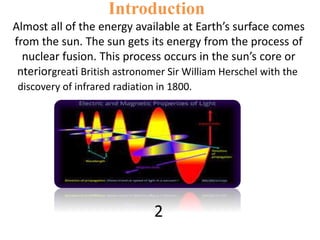
Almost all of the energy available at Earth’s surface comes
from the sun. The sun gets its energy from the process of
nuclear fusion. This process occurs in the sun’s core or
nteriorgreati British astronomer Sir William Herschel with the
discovery of infrared radiation in 1800.
2
What is infrared radiation?
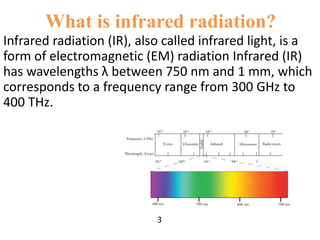
Infrared radiation (IR), also called infrared light, is a
form of electromagnetic (EM) radiation Infrared (IR)
has wavelengths λ between 750 nm and 1 mm, which
corresponds to a frequency range from 300 GHz to
400 THz.
3
How do infrared rays work?
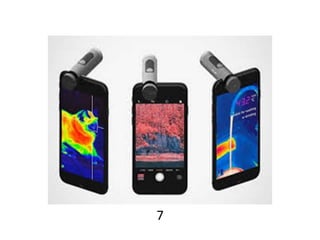
An infrared camera detects the thermal energy or
heat emitted by the scene being observed and
converts it into an electronic signal. This signal is then
processed to produce an image. The heat captured by
an infrared camera can be measured with a high
degree of precision.
4
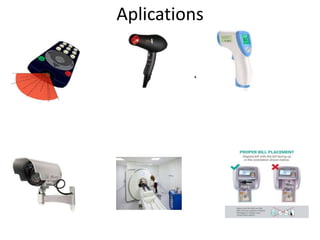
Aplications
4
7
Refrence
• Theophanides, T., 2012. Introduction to infrared
spectroscopy. Infrared Spectroscopy-Materials
Science, Engineering and Technology, pp.1-10.
• Amin, M.T. and Han, M.Y., 2009. Roof-harvested
rainwater for potable purposes: application of solar
collector disinfection (SOCO-DIS). Water
research, 43(20), pp.5225-5235.
8
infrared radiation pptx

infrared radiation pptx

  • 1.
    Outline introduction…………………………………………………….1 what is infraredradiation?…………………………….…2 how do infrared rays work?................................3 Application of infrared radiation………………….…..4 Reference………………………………………………………...6
  • 2.
    Introduction Almost all ofthe energy available at Earth’s surface comes from the sun. The sun gets its energy from the process of nuclear fusion. This process occurs in the sun’s core or nteriorgreati British astronomer Sir William Herschel with the discovery of infrared radiation in 1800. 2
  • 3.
    What is infraredradiation? Infrared radiation (IR), also called infrared light, is a form of electromagnetic (EM) radiation Infrared (IR) has wavelengths λ between 750 nm and 1 mm, which corresponds to a frequency range from 300 GHz to 400 THz. 3
  • 4.
    How do infraredrays work? An infrared camera detects the thermal energy or heat emitted by the scene being observed and converts it into an electronic signal. This signal is then processed to produce an image. The heat captured by an infrared camera can be measured with a high degree of precision. 4
  • 5.
  • 6.
  • 7.
    Refrence • Theophanides, T.,2012. Introduction to infrared spectroscopy. Infrared Spectroscopy-Materials Science, Engineering and Technology, pp.1-10. • Amin, M.T. and Han, M.Y., 2009. Roof-harvested rainwater for potable purposes: application of solar collector disinfection (SOCO-DIS). Water research, 43(20), pp.5225-5235. 8