School Science Projects
based on Experiments
           wdpd¾h ysrdka wurfialr
 jk yd mdßißl úoHd wOHhkdxYh"
                      wOHhkdxYh
                      wOHhkd Yh"
      YS% chj¾Okmqr úYaj úoHd,h
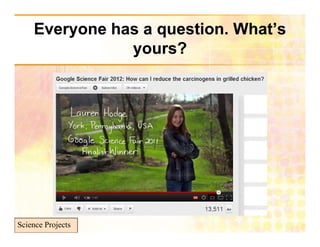
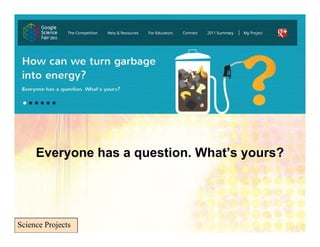
Everyone has a question. What’s
               yours?
               yours?


Science Projects
I live in Mainland China..
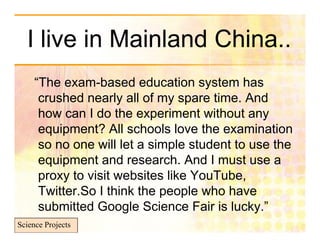
     “The exam-based education system has
      crushed nearly all of my spare time. And
      how can I do the experiment without any
      equipment? All schools love the examination
      so no one will let a simple student to use the
      equipment and research. And I must use a
      proxy to visit websites like YouTube,
      Twitter.So I think the people who have
      submitted Google Science Fair is lucky.”
Science Projects
Types of Projects from Teachers’
                          Teachers’
   Guide of NIE
      Survey
      Community Development
                 y        p
      Solving a problem
      Modernization of a product
      Construction of product models
      New discoveries


Science Projects
Aim of this Presentation

                   Guide you to do
                     Hypothesis
                   based research

Science Projects
Two forms of scientific method

  Experimental projects employs numerical
  E     i     t l    j t        l         i l
    data and graphs, (change one parameter
    and collect data)
  Descriptive projects gathers information
    through visual observation and interviewing
                                   interviewing.
    (assessing biodiversity etc.)

  Experimental Projects are discussed here.

Science Projects
Steps in Science Fair
        Projects
            Select a Topic
            Gather Information
            Make a Hypothesis.
            Design, Conduct, collect data
             from an Experiment.
            Reach a Conclusion (based on
                 )
             data)

Science Projects
1 Th R
      The Research Topic
                 hT i
       Your research question i what you h
        Y            h       ti is h t         hope t
                                                    to
        figure out.
       Select a topic familiar to you or get advice from a
        scientist.

       Eg- How growth rate differ in open grown trees
        and in plantation grown trees?
       Comparison of growth rates in open grown tress
        and in plantation grown trees.


Science Projects
1 Th R
      The Research Topic
                 hT i
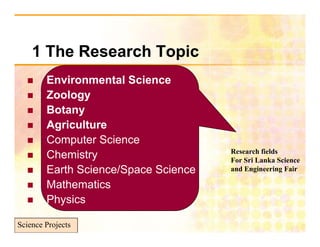
       Environmental Science
        E i         t lS i
       Zoology
       Botany
       Agriculture
       Computer Science
                                      Research fields
       Chemistry                     For Sri Lanka Science
       Earth Science/Space Science   and Engineering Fair

       Mathematics
       Physics

Science Projects
2. Gather I f
    2 G th Information
                  ti
       Learn everything about th t i (R i
        L           thi   b t the topic. (Review
        Literature)

       From book, magazines, the internet, talk to
        p p
        people and experts
                     p

       Initial Observations


Science Projects
3. Make a Hypothesis
             yp

       The h
        Th hypothesis i what you expect t
                 th i is h t             t to
        happen in your experiment. (possible
        answer to the problem)

       For th
        F the research question about t
                        h     ti   b t tree
        growth (above), the hypothesis might be,
        "Open grown trees grow faster compared
         Open
        with forest grown trees"

Science Projects
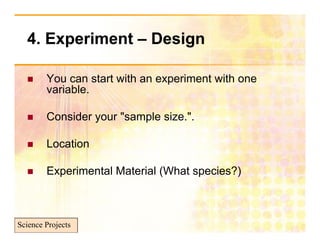
4. Experiment – Design
       p              g

       You can start with an experiment with one
        variable.

       Consider your "sample size.".

       Location

       Experimental Material (What species?)


Science Projects
4. Experiment – Design
       p              g

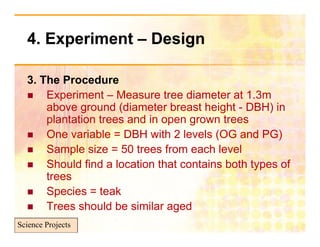
  3. The P
  3 Th Procedured
     Experiment – Measure tree diameter at 1.3m
      above ground (diameter breast height - DBH) in
      plantation trees and in open grown trees
     One variable = DBH with 2 levels (OG and PG)
                                         (           )
     Sample size = 50 trees from each level
     Should find a location that contains both types of
                                                 y
      trees
     Species = teak
     Trees should be similar aged
Science Projects
4.
4 Experiment – Design
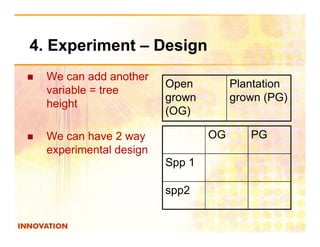
   We can add another
                          Open         Plantation
    variable = tree
                          grown        grown (PG)
    height
       g
                          (OG)

   We can have 2 way             OG      PG
    experimental design
                          Spp 1

                          spp2
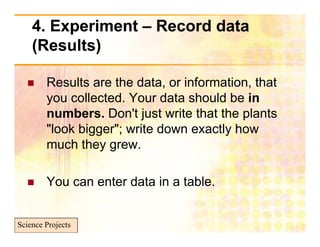
4. Experiment – Record data
    (Results)

       Results are the data, or information, that
        you collected. Your data should be in
        numbers. Don't just write that the plants
        "look bigger"; write down exactly how
        much they grew.

       You can enter data in a table.


Science Projects
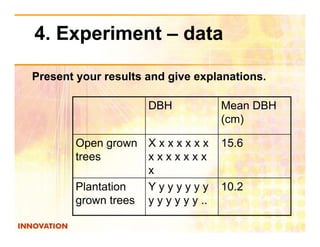
4. Experiment – data

Present your results and give explanations
                              explanations.

                      DBH            Mean DBH
                                     (cm)

        Open grown X x x x x x x
        O                            15.6
                                     15 6
        trees       xxxxxxx
                    x
        Plantation  Yyyyyyy          10.2
        grown trees y y y y y y ..
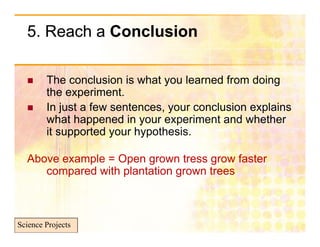
5. Reach a Conclusion

       The
        Th conclusion i what you l
                   l i is h t       learned f
                                          d from d i
                                                 doing
        the experiment.
       In just a few sentences your conclusion explains
                      sentences,
        what happened in your experiment and whether
        it supported your hypothesis.

  Above example = Open grown tress grow faster
     compared with plantation grown trees


Science Projects
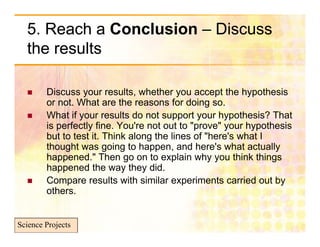
5. Reach a Conclusion – Discuss
  the results

       Discuss your results, whether you accept the hypothesis
        or not. What are the reasons for doing so.
       What if your results do not support your hypothesis? That
        is perfectly fine. You're not out to "prove" your hypothesis
        but to test it. Think along the lines of "here's what I
                                                  here s
        thought was going to happen, and here's what actually
        happened." Then go on to explain why you think things
        happened the way they did.
       Compare results with similar experiments carried out by
        others.


Science Projects
What makes a good science p j
               g            project?


     Look for original ideas.


     Have a well-defined objective
                            j


     Understanding of the basic science b hi d th
      U d      t di  f th b i      i     behind the
      project topic.


Science Projects
What makes a good science p j
               g            project?

     Support your conclusion with with data and
      S       t        l i     ith ith d t     d
      results

     Put enough time and energy into your project.

     Clearly present your work. Judges look for well-
      written abstracts with easy-to-follow visual aids
                                y
      and clear and concise answers.


Science Projects
Present your findings

       Report to School
       Young Environment Symposium
       Sri Lanka Science and Engineering Fair
       Intel International Science and
        Engineering Fair (Intel ISEF), USA
       Google Science Fair Projects


Science Projects
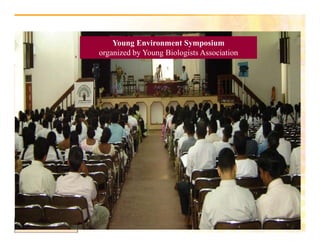
Young Environment Sy pos u
                        ou g v o e Symposium
                   organized by Young Biologists Association


Science Projects
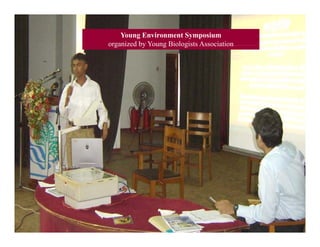
Young Environment Symposium
                   organized by Young Biologists Association


Science Projects
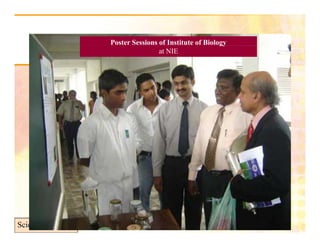
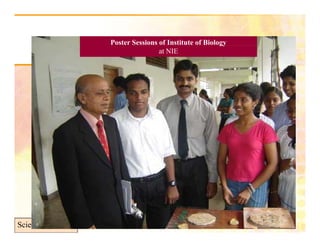
Poster Sessions of Institute of Biology
                                                        gy
                                   at NIE


Science Projects
Poster Sessions of Institute of Biology
                                                        gy
                                   at NIE


Science Projects
Science Projects
Science Projects
Sri Lanka Science & Engineering Fair
  (SLSEF)

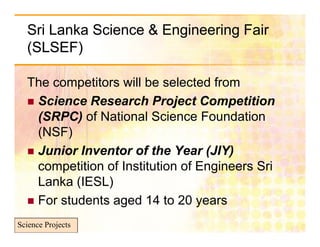
  The competitors will be selected from
   Science Research Project Competition
                              j
    (SRPC) of National Science Foundation
    (NSF)
   Junior Inventor of the Year (JIY)
    competition of Institution of Engineers Sri
    Lanka (IESL)
   For students aged 14 to 20 years

Science Projects
Sri Lanka Science & Engineering Fair
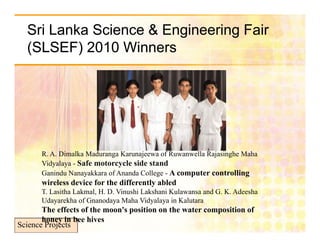
  (SLSEF) 2010 Winners


       R. A. Dimalka Maduranga Karunajeewa of Ruwanwella Rajasinghe Maha
       Vidyalaya - Safe motorcycle side stand
       Ganindu Nanayakkara of Ananda College - A computer controlling
                                                                  lli
       wireless device for the differently abled
       T. Lasitha Lakmal, H. D. Vinushi Lakshani Kulawansa and G. K. Adeesha
       Udayarekha of Gnanodaya Maha Vidyalaya in Kalutara
       The effects of the moon's position on the water composition of
       honey in bee hives
Science Projects
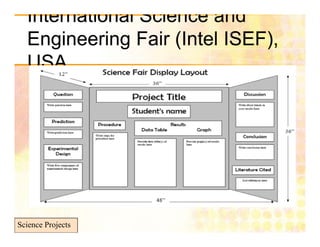
International Science and
  Engineering Fair (
     g       g      (Intel ISEF),
                               ),
  USA


Science Projects
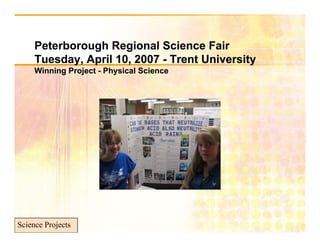
Peterborough Regional Science Fair
     Tuesday, April 10, 2007 - Trent University
     Winning Project - Physical Science


Science Projects
Everyone has a question. What’s yours?


Science Projects
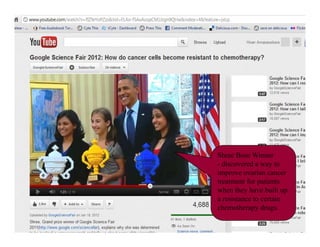
How do cancer cells become resistant to
                                Shree Bose Winner
                                - discovered a way to
                chemotherapy? iimprove ovarian cancer
                                             i
                                       treatment for patients
                                       when they have built up
                                       a resistance to certain
                                       chemotherapy drugs.

Science Projects
Google Science Fair
     g

   http://www.google.com/sciencefair/
   Students aged 13 to 18 can enter
              g
   Create a project site and submit it by 1 April
    2012.


Science Projects
More details

   www.studentlanka.com
   www.facebook.com/ybasrilanka
                       y
   www.facebook.com/studentlanka
   https://www facebook com/events/33796224
    https://www.facebook.com/events/33796224
    2912330/


Science Projects
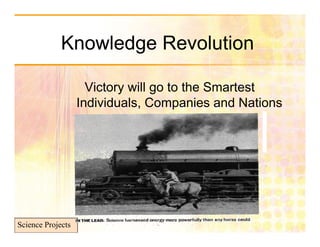
Knowledge Revolution

                     Victory will go to the Smartest
                   Individuals, Companies and Nations
                              ,       p


Science Projects

School Science Projects based on Experiments

  • 1.
    School Science Projects basedon Experiments wdpd¾h ysrdka wurfialr jk yd mdßißl úoHd wOHhkdxYh" wOHhkdxYh wOHhkd Yh" YS% chj¾Okmqr úYaj úoHd,h
  • 2.
    Everyone has aquestion. What’s yours? yours? Science Projects
  • 3.
    I live inMainland China.. “The exam-based education system has crushed nearly all of my spare time. And how can I do the experiment without any equipment? All schools love the examination so no one will let a simple student to use the equipment and research. And I must use a proxy to visit websites like YouTube, Twitter.So I think the people who have submitted Google Science Fair is lucky.” Science Projects
  • 4.
    Types of Projectsfrom Teachers’ Teachers’ Guide of NIE  Survey  Community Development y p  Solving a problem  Modernization of a product  Construction of product models  New discoveries Science Projects
  • 5.
    Aim of thisPresentation Guide you to do Hypothesis based research Science Projects
  • 6.
    Two forms ofscientific method Experimental projects employs numerical E i t l j t l i l data and graphs, (change one parameter and collect data) Descriptive projects gathers information through visual observation and interviewing interviewing. (assessing biodiversity etc.) Experimental Projects are discussed here. Science Projects
  • 7.
    Steps in ScienceFair Projects  Select a Topic  Gather Information  Make a Hypothesis.  Design, Conduct, collect data from an Experiment.  Reach a Conclusion (based on ) data) Science Projects
  • 8.
    1 Th R The Research Topic hT i  Your research question i what you h Y h ti is h t hope t to figure out.  Select a topic familiar to you or get advice from a scientist.  Eg- How growth rate differ in open grown trees and in plantation grown trees?  Comparison of growth rates in open grown tress and in plantation grown trees. Science Projects
  • 9.
    1 Th R The Research Topic hT i  Environmental Science E i t lS i  Zoology  Botany  Agriculture  Computer Science Research fields  Chemistry For Sri Lanka Science  Earth Science/Space Science and Engineering Fair  Mathematics  Physics Science Projects
  • 10.
    2. Gather If 2 G th Information ti  Learn everything about th t i (R i L thi b t the topic. (Review Literature)  From book, magazines, the internet, talk to p p people and experts p  Initial Observations Science Projects
  • 11.
    3. Make aHypothesis yp  The h Th hypothesis i what you expect t th i is h t t to happen in your experiment. (possible answer to the problem)  For th F the research question about t h ti b t tree growth (above), the hypothesis might be, "Open grown trees grow faster compared Open with forest grown trees" Science Projects
  • 12.
    4. Experiment –Design p g  You can start with an experiment with one variable.  Consider your "sample size.".  Location  Experimental Material (What species?) Science Projects
  • 13.
    4. Experiment –Design p g 3. The P 3 Th Procedured  Experiment – Measure tree diameter at 1.3m above ground (diameter breast height - DBH) in plantation trees and in open grown trees  One variable = DBH with 2 levels (OG and PG) ( )  Sample size = 50 trees from each level  Should find a location that contains both types of y trees  Species = teak  Trees should be similar aged Science Projects
  • 14.
    4. 4 Experiment –Design  We can add another Open Plantation variable = tree grown grown (PG) height g (OG)  We can have 2 way OG PG experimental design Spp 1 spp2
  • 15.
    4. Experiment –Record data (Results)  Results are the data, or information, that you collected. Your data should be in numbers. Don't just write that the plants "look bigger"; write down exactly how much they grew.  You can enter data in a table. Science Projects
  • 16.
    4. Experiment –data Present your results and give explanations explanations. DBH Mean DBH (cm) Open grown X x x x x x x O 15.6 15 6 trees xxxxxxx x Plantation Yyyyyyy 10.2 grown trees y y y y y y ..
  • 17.
    5. Reach aConclusion  The Th conclusion i what you l l i is h t learned f d from d i doing the experiment.  In just a few sentences your conclusion explains sentences, what happened in your experiment and whether it supported your hypothesis. Above example = Open grown tress grow faster compared with plantation grown trees Science Projects
  • 18.
    5. Reach aConclusion – Discuss the results  Discuss your results, whether you accept the hypothesis or not. What are the reasons for doing so.  What if your results do not support your hypothesis? That is perfectly fine. You're not out to "prove" your hypothesis but to test it. Think along the lines of "here's what I here s thought was going to happen, and here's what actually happened." Then go on to explain why you think things happened the way they did.  Compare results with similar experiments carried out by others. Science Projects
  • 19.
    What makes agood science p j g project?  Look for original ideas.  Have a well-defined objective j  Understanding of the basic science b hi d th U d t di f th b i i behind the project topic. Science Projects
  • 20.
    What makes agood science p j g project?  Support your conclusion with with data and S t l i ith ith d t d results  Put enough time and energy into your project.  Clearly present your work. Judges look for well- written abstracts with easy-to-follow visual aids y and clear and concise answers. Science Projects
  • 21.
    Present your findings  Report to School  Young Environment Symposium  Sri Lanka Science and Engineering Fair  Intel International Science and Engineering Fair (Intel ISEF), USA  Google Science Fair Projects Science Projects
  • 22.
    Young Environment Sypos u ou g v o e Symposium organized by Young Biologists Association Science Projects
  • 23.
    Young Environment Symposium organized by Young Biologists Association Science Projects
  • 24.
    Poster Sessions ofInstitute of Biology gy at NIE Science Projects
  • 25.
    Poster Sessions ofInstitute of Biology gy at NIE Science Projects
  • 26.
  • 27.
  • 28.
    Sri Lanka Science& Engineering Fair (SLSEF) The competitors will be selected from  Science Research Project Competition j (SRPC) of National Science Foundation (NSF)  Junior Inventor of the Year (JIY) competition of Institution of Engineers Sri Lanka (IESL)  For students aged 14 to 20 years Science Projects
  • 29.
    Sri Lanka Science& Engineering Fair (SLSEF) 2010 Winners R. A. Dimalka Maduranga Karunajeewa of Ruwanwella Rajasinghe Maha Vidyalaya - Safe motorcycle side stand Ganindu Nanayakkara of Ananda College - A computer controlling lli wireless device for the differently abled T. Lasitha Lakmal, H. D. Vinushi Lakshani Kulawansa and G. K. Adeesha Udayarekha of Gnanodaya Maha Vidyalaya in Kalutara The effects of the moon's position on the water composition of honey in bee hives Science Projects
  • 30.
    International Science and Engineering Fair ( g g (Intel ISEF), ), USA Science Projects
  • 31.
    Peterborough Regional ScienceFair Tuesday, April 10, 2007 - Trent University Winning Project - Physical Science Science Projects
  • 32.
    Everyone has aquestion. What’s yours? Science Projects
  • 33.
    How do cancercells become resistant to Shree Bose Winner - discovered a way to chemotherapy? iimprove ovarian cancer i treatment for patients when they have built up a resistance to certain chemotherapy drugs. Science Projects
  • 34.
    Google Science Fair g  http://www.google.com/sciencefair/  Students aged 13 to 18 can enter g  Create a project site and submit it by 1 April 2012. Science Projects
  • 35.
    More details  www.studentlanka.com  www.facebook.com/ybasrilanka y  www.facebook.com/studentlanka  https://www facebook com/events/33796224 https://www.facebook.com/events/33796224 2912330/ Science Projects
  • 36.
    Knowledge Revolution Victory will go to the Smartest Individuals, Companies and Nations , p Science Projects