What is curriculum? 
• Curriculum is said to be a very ill-defined term 
(Huang, 1991). 
• It may carry different meanings when used by 
teachers, schools and academics. What makes 
the matter worse is that it is used interchangably 
with terms like syllabus, examination syllabus 
and instruction (Chang, 1998). 
• In this session, we would try to clarify what it is.
Syllabus and Curriculum 
• "A syllabus is typically a list of content areas 
which are to be assessed.” (Print, 1993) 
• "A curriculum shows by what kind of 
educational activities the teacher will fulfill the 
requirements of the syllabus.... The curriculum 
is primarily concerned with method and 
therefore with education; it is made up of 
pedagogical directives, intended to provide 
assistance, advice, suggestions and 
information to assist the teachers in carrying 
out his task successfully.." (Dottrens, 1962).
• "The curriculum usually contains a 
statement of aims of specific objectives, 
it indicates some selection and 
organization of content, it either implies 
or manifest certain patterns of learning 
and teaching, whether because the 
objectives demand them or because the 
content organization require them. 
Finally it induces a program of evaluation 
of the outcomes." (Taba, 1952)
• "...learning takes place through the 
experiences the learner has ... 'learning 
experience' is not the same as the 
content with which a course deals... [The 
curriculum consists of] ... all of the 
learning of students which is planned by 
and directed by the school to attain its 
educational goals." (Tyler, 1949)
• "Some claim that a curriculum is the 
content or objectives for which schools 
hold students accountable. Others 
claim that a curriculum is the set of 
instructional strategies teaches plan to 
use." (Posner, 1995, p.5)
Reflection 
What are the major elements 
of curriculum?
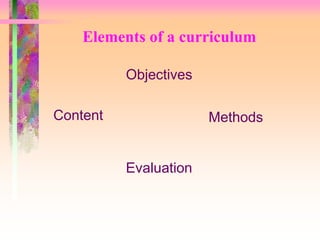
Elements of a curriculum 
Objectives 
Content Methods 
Evaluation
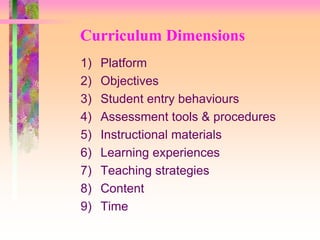
Curriculum Dimensions 
1) Platform 
2) Objectives 
3) Student entry behaviours 
4) Assessment tools & procedures 
5) Instructional materials 
6) Learning experiences 
7) Teaching strategies 
8) Content 
9) Time
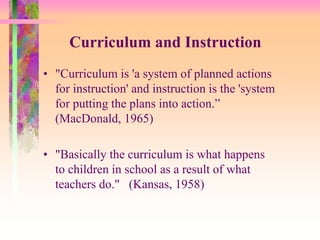
Curriculum and Instruction 
• "Curriculum is 'a system of planned actions 
for instruction' and instruction is the 'system 
for putting the plans into action.” 
(MacDonald, 1965) 
• "Basically the curriculum is what happens 
to children in school as a result of what 
teachers do." (Kansas, 1958)
• "By 'curriculum' we mean the planned 
experiences offered to the learner under the 
guidance of the school.” (Wheeler, 1967) 
• "Instruction is the delivery of information 
and activities learners' attainment of 
intended, specific learning goals. In other 
words, instruction is the conduct of 
activities that we focused on learners 
learning specific things." (Smith & Ragan, 
1993, p.2)
• "A curriculum consists of all those learnings 
intended for a group of student or group of 
students." (Goodlad, 1963) 
• "When people speak of 'the school curriculum'... 
they include not only the available subject 
curricular but also all the other educational 
encounters -- relating to personal relationships, 
moral attitudes, social habits and so forth -- 
offered by the school. In this sense, in fact, the 
curriculum is as wide as the entire set of chosen 
activities by which the school seeks to achieve 
its educating purposes..." 
(Becher & Maclure, 1978)
Reflection 
Which of the above definition 
is more appropriate?
• School curriculum and 
subject curriculum 
• Formal, informal and 
hidden curriculum 
• Learning experiences
Reflection 
• What is hidden curriculum? 
• Is there anything wrong with the term? 
• Have you considered the importance 
of informal and hidden curriculum? 
• Could you quote some examples of 
hidden curriculum in your school?
Hidden curriculum 
• unstudied curriculum 
• implicit curriculum 
• invisible curriculum 
• unwritten curriculum 
• covert curriculum 
• latent curriculum 
• silent curriculum 
• the by-products of schooling 
• what schooling does to people
Major meanings of hidden curriculum 
• The unofficial expectations, implicit 
but expected messages 
• unintended learning outcomes 
• implicit messages arising from the 
structure of schooling 
• created by the students 
Portelli, 1993
School: edu. institution which 
provides educative experience 
• What knowledge is most worthwhile? 
• Why is it worthwhile? 
• How is it acquired or created? 
• Where should it be taught? 
• When should it be taught? 
• For whom? 
Schubert, 1986
Basic questions underlying 
curriculum work 
1) Who should be educated? 
2) What should be the goals of education? 
3) What should be the content of education? 
4) Should the content be organized as child-centered, 
society-centered, subject-centered, or some 
variations such as child-in-society? 
5) How should objectives be formulated and evaluated? 
6) Should there be multiple organizations and 
alternative forms of school programs?
7) What systems and materials need to be 
developed to achieve successful and efficient 
experiences for children? 
8) Who should be responsible for designing and 
developing the curriculum? 
9) Who should be responsible for instructional 
methodology? 
10) Who should be responsible for evaluation? 
Longstreet & Shane, 1993, p.41
“No single definition of curriculum 
is accepted among practitioners 
of the field.” 
Longstreet & Shane, 1993, p.47

Hidden curriculum

  • 1.
    What is curriculum? • Curriculum is said to be a very ill-defined term (Huang, 1991). • It may carry different meanings when used by teachers, schools and academics. What makes the matter worse is that it is used interchangably with terms like syllabus, examination syllabus and instruction (Chang, 1998). • In this session, we would try to clarify what it is.
  • 2.
    Syllabus and Curriculum • "A syllabus is typically a list of content areas which are to be assessed.” (Print, 1993) • "A curriculum shows by what kind of educational activities the teacher will fulfill the requirements of the syllabus.... The curriculum is primarily concerned with method and therefore with education; it is made up of pedagogical directives, intended to provide assistance, advice, suggestions and information to assist the teachers in carrying out his task successfully.." (Dottrens, 1962).
  • 3.
    • "The curriculumusually contains a statement of aims of specific objectives, it indicates some selection and organization of content, it either implies or manifest certain patterns of learning and teaching, whether because the objectives demand them or because the content organization require them. Finally it induces a program of evaluation of the outcomes." (Taba, 1952)
  • 4.
    • "...learning takesplace through the experiences the learner has ... 'learning experience' is not the same as the content with which a course deals... [The curriculum consists of] ... all of the learning of students which is planned by and directed by the school to attain its educational goals." (Tyler, 1949)
  • 5.
    • "Some claimthat a curriculum is the content or objectives for which schools hold students accountable. Others claim that a curriculum is the set of instructional strategies teaches plan to use." (Posner, 1995, p.5)
  • 6.
    Reflection What arethe major elements of curriculum?
  • 7.
    Elements of acurriculum Objectives Content Methods Evaluation
  • 8.
    Curriculum Dimensions 1)Platform 2) Objectives 3) Student entry behaviours 4) Assessment tools & procedures 5) Instructional materials 6) Learning experiences 7) Teaching strategies 8) Content 9) Time
  • 9.
    Curriculum and Instruction • "Curriculum is 'a system of planned actions for instruction' and instruction is the 'system for putting the plans into action.” (MacDonald, 1965) • "Basically the curriculum is what happens to children in school as a result of what teachers do." (Kansas, 1958)
  • 10.
    • "By 'curriculum'we mean the planned experiences offered to the learner under the guidance of the school.” (Wheeler, 1967) • "Instruction is the delivery of information and activities learners' attainment of intended, specific learning goals. In other words, instruction is the conduct of activities that we focused on learners learning specific things." (Smith & Ragan, 1993, p.2)
  • 11.
    • "A curriculumconsists of all those learnings intended for a group of student or group of students." (Goodlad, 1963) • "When people speak of 'the school curriculum'... they include not only the available subject curricular but also all the other educational encounters -- relating to personal relationships, moral attitudes, social habits and so forth -- offered by the school. In this sense, in fact, the curriculum is as wide as the entire set of chosen activities by which the school seeks to achieve its educating purposes..." (Becher & Maclure, 1978)
  • 12.
    Reflection Which ofthe above definition is more appropriate?
  • 13.
    • School curriculumand subject curriculum • Formal, informal and hidden curriculum • Learning experiences
  • 14.
    Reflection • Whatis hidden curriculum? • Is there anything wrong with the term? • Have you considered the importance of informal and hidden curriculum? • Could you quote some examples of hidden curriculum in your school?
  • 15.
    Hidden curriculum •unstudied curriculum • implicit curriculum • invisible curriculum • unwritten curriculum • covert curriculum • latent curriculum • silent curriculum • the by-products of schooling • what schooling does to people
  • 16.
    Major meanings ofhidden curriculum • The unofficial expectations, implicit but expected messages • unintended learning outcomes • implicit messages arising from the structure of schooling • created by the students Portelli, 1993
  • 17.
    School: edu. institutionwhich provides educative experience • What knowledge is most worthwhile? • Why is it worthwhile? • How is it acquired or created? • Where should it be taught? • When should it be taught? • For whom? Schubert, 1986
  • 18.
    Basic questions underlying curriculum work 1) Who should be educated? 2) What should be the goals of education? 3) What should be the content of education? 4) Should the content be organized as child-centered, society-centered, subject-centered, or some variations such as child-in-society? 5) How should objectives be formulated and evaluated? 6) Should there be multiple organizations and alternative forms of school programs?
  • 19.
    7) What systemsand materials need to be developed to achieve successful and efficient experiences for children? 8) Who should be responsible for designing and developing the curriculum? 9) Who should be responsible for instructional methodology? 10) Who should be responsible for evaluation? Longstreet & Shane, 1993, p.41
  • 20.
    “No single definitionof curriculum is accepted among practitioners of the field.” Longstreet & Shane, 1993, p.47