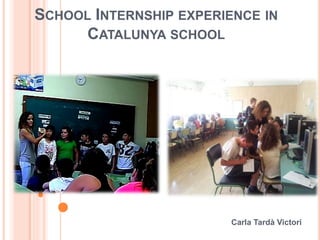
SCHOOL INTERNSHIP EXPERIENCE IN
CATALUNYA SCHOOL
Carla Tardà Victori
1. THE SCHOOL
 Name of the school:
Catalunya (Navarcles)
 Public school
 Big school (507 students) with 2 or 3 classrooms
per grade.
 EFL Teaching
- Students start learning English in P3
- 5th and 6th grade Oral classes (1h a week)
- Textbook and worksheets
Monday Tuesday Wednesday Tuesday Friday
9-10 Reinforc. Reinforc. P4-A Reinforc. Reinforc.
Oral 5B Oral 5A
Oral 6B
Oral 5A
10-11 P4-B
11.30-12.30 6B 6A P4-C 5A 5B
15-15.30 5A 5B 6B Reinforc. 6A
15.3-16.30 Reinforc. 5A 6A 5B 6B
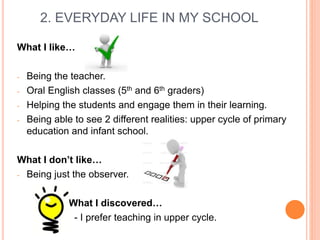
2. EVERYDAY LIFE IN MY SCHOOL
What I like…
- Being the teacher.
- Oral English classes (5th and 6th graders)
- Helping the students and engage them in their learning.
- Being able to see 2 different realities: upper cycle of primary
education and infant school.
What I don’t like…
- Being just the observer.
What I discovered…
- I prefer teaching in upper cycle.
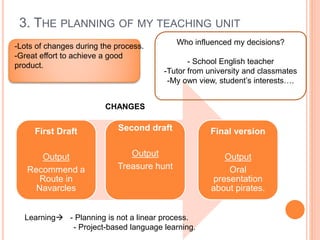
3. THE PLANNING OF MY TEACHING UNIT
First Draft
Output
Recommend a
Route in
Navarcles
Second draft
Output
Treasure hunt
Final version
Output
Oral
presentation
about pirates.
-Lots of changes during the process.
-Great effort to achieve a good
product.
CHANGES
Who influenced my decisions?
- School English teacher
-Tutor from university and classmates
-My own view, student’s interests….
Learning - Planning is not a linear process.
- Project-based language learning.
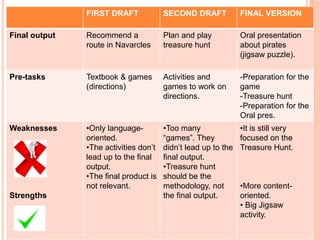
FIRST DRAFT SECOND DRAFT FINAL VERSION
Final output Recommend a
route in Navarcles
Plan and play
treasure hunt
Oral presentation
about pirates
(jigsaw puzzle).
Pre-tasks Textbook & games
(directions)
Activities and
games to work on
directions.
-Preparation for the
game
-Treasure hunt
-Preparation for the
Oral pres.
Weaknesses
Strengths
•Only language-
oriented.
•The activities don’t
lead up to the final
output.
•The final product is
not relevant.
•Too many
“games”. They
didn’t lead up to the
final output.
•Treasure hunt
should be the
methodology, not
the final output.
•It is still very
focused on the
Treasure Hunt.
•More content-
oriented.
• Big Jigsaw
activity.
4. IMPLEMENTATION OF MY TEACHING UNIT
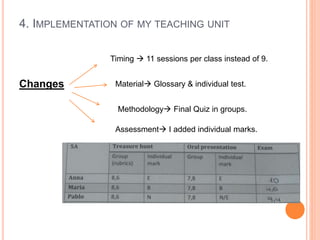
Changes
Timing  11 sessions per class instead of 9.
Material Glossary & individual test.
Methodology Final Quiz in groups.
Assessment I added individual marks.
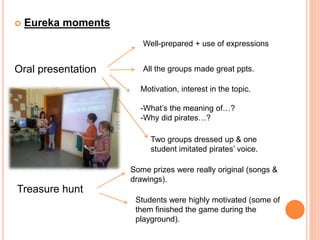
 Eureka moments
Oral presentation
Well-prepared + use of expressions
All the groups made great ppts.
Motivation, interest in the topic.
-What’s the meaning of…?
-Why did pirates…?
Two groups dressed up & one
student imitated pirates’ voice.
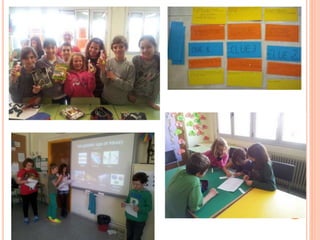
Treasure hunt
Some prizes were really original (songs &
drawings).
Students were highly motivated (some of
them finished the game during the
playground).
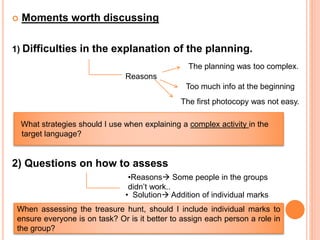
 Moments worth discussing
1) Difficulties in the explanation of the planning.
What strategies should I use when explaining a complex activity in the
target language?
2) Questions on how to assess
Reasons
The planning was too complex.
Too much info at the beginning
The first photocopy was not easy.
•Reasons Some people in the groups
didn’t work..
• Solution Addition of individual marks
When assessing the treasure hunt, should I include individual marks to
ensure everyone is on task? Or is it better to assign each person a role in
the group?
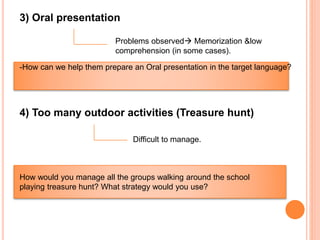
4) Too many outdoor activities (Treasure hunt)
Difficult to manage.
3) Oral presentation
-How can we help them prepare an Oral presentation in the target language?
Problems observed Memorization &low
comprehension (in some cases).
How would you manage all the groups walking around the school
playing treasure hunt? What strategy would you use?
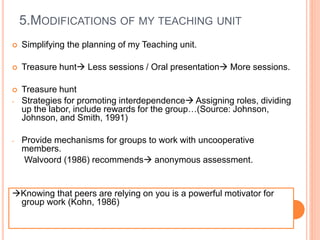
5.MODIFICATIONS OF MY TEACHING UNIT
 Simplifying the planning of my Teaching unit.
 Treasure hunt Less sessions / Oral presentation More sessions.
 Treasure hunt
- Strategies for promoting interdependence Assigning roles, dividing
up the labor, include rewards for the group…(Source: Johnson,
Johnson, and Smith, 1991)
- Provide mechanisms for groups to work with uncooperative
members.
Walvoord (1986) recommends anonymous assessment.
Knowing that peers are relying on you is a powerful motivator for
group work (Kohn, 1986)
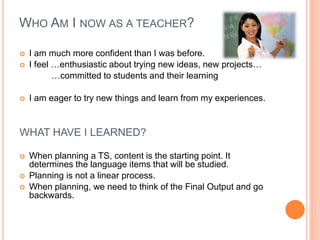
WHO AM I NOW AS A TEACHER?
 I am much more confident than I was before.
 I feel …enthusiastic about trying new ideas, new projects…
…committed to students and their learning
 I am eager to try new things and learn from my experiences.
WHAT HAVE I LEARNED?
 When planning a TS, content is the starting point. It
determines the language items that will be studied.
 Planning is not a linear process.
 When planning, we need to think of the Final Output and go
backwards.
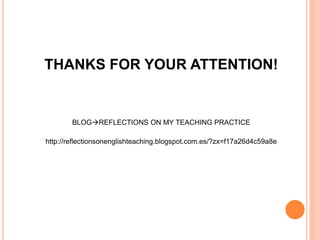
THANKS FOR YOUR ATTENTION!
BLOGREFLECTIONS ON MY TEACHING PRACTICE
http://reflectionsonenglishteaching.blogspot.com.es/?zx=f17a26d4c59a8e
REFERENCES
http://tfsc.uark.edu/193.php
Tools for Teaching by Barbara Gross Davis;Jossey-
Bass Publishers: San Francisco, 1993.

School internship experience at catalunya school

  • 1.
    SCHOOL INTERNSHIP EXPERIENCEIN CATALUNYA SCHOOL Carla Tardà Victori
  • 2.
    1. THE SCHOOL Name of the school: Catalunya (Navarcles)  Public school  Big school (507 students) with 2 or 3 classrooms per grade.  EFL Teaching - Students start learning English in P3 - 5th and 6th grade Oral classes (1h a week) - Textbook and worksheets
  • 3.
    Monday Tuesday WednesdayTuesday Friday 9-10 Reinforc. Reinforc. P4-A Reinforc. Reinforc. Oral 5B Oral 5A Oral 6B Oral 5A 10-11 P4-B 11.30-12.30 6B 6A P4-C 5A 5B 15-15.30 5A 5B 6B Reinforc. 6A 15.3-16.30 Reinforc. 5A 6A 5B 6B 2. EVERYDAY LIFE IN MY SCHOOL
  • 4.
    2. EVERYDAY LIFEIN MY SCHOOL What I like… - Being the teacher. - Oral English classes (5th and 6th graders) - Helping the students and engage them in their learning. - Being able to see 2 different realities: upper cycle of primary education and infant school. What I don’t like… - Being just the observer. What I discovered… - I prefer teaching in upper cycle.
  • 5.
    3. THE PLANNINGOF MY TEACHING UNIT First Draft Output Recommend a Route in Navarcles Second draft Output Treasure hunt Final version Output Oral presentation about pirates. -Lots of changes during the process. -Great effort to achieve a good product. CHANGES Who influenced my decisions? - School English teacher -Tutor from university and classmates -My own view, student’s interests…. Learning - Planning is not a linear process. - Project-based language learning.
  • 6.
    FIRST DRAFT SECONDDRAFT FINAL VERSION Final output Recommend a route in Navarcles Plan and play treasure hunt Oral presentation about pirates (jigsaw puzzle). Pre-tasks Textbook & games (directions) Activities and games to work on directions. -Preparation for the game -Treasure hunt -Preparation for the Oral pres. Weaknesses Strengths •Only language- oriented. •The activities don’t lead up to the final output. •The final product is not relevant. •Too many “games”. They didn’t lead up to the final output. •Treasure hunt should be the methodology, not the final output. •It is still very focused on the Treasure Hunt. •More content- oriented. • Big Jigsaw activity.
  • 7.
    4. IMPLEMENTATION OFMY TEACHING UNIT Changes Timing  11 sessions per class instead of 9. Material Glossary & individual test. Methodology Final Quiz in groups. Assessment I added individual marks.
  • 8.
     Eureka moments Oralpresentation Well-prepared + use of expressions All the groups made great ppts. Motivation, interest in the topic. -What’s the meaning of…? -Why did pirates…? Two groups dressed up & one student imitated pirates’ voice. Treasure hunt Some prizes were really original (songs & drawings). Students were highly motivated (some of them finished the game during the playground).
  • 10.
     Moments worthdiscussing 1) Difficulties in the explanation of the planning. What strategies should I use when explaining a complex activity in the target language? 2) Questions on how to assess Reasons The planning was too complex. Too much info at the beginning The first photocopy was not easy. •Reasons Some people in the groups didn’t work.. • Solution Addition of individual marks When assessing the treasure hunt, should I include individual marks to ensure everyone is on task? Or is it better to assign each person a role in the group?
  • 11.
    4) Too manyoutdoor activities (Treasure hunt) Difficult to manage. 3) Oral presentation -How can we help them prepare an Oral presentation in the target language? Problems observed Memorization &low comprehension (in some cases). How would you manage all the groups walking around the school playing treasure hunt? What strategy would you use?
  • 12.
    5.MODIFICATIONS OF MYTEACHING UNIT  Simplifying the planning of my Teaching unit.  Treasure hunt Less sessions / Oral presentation More sessions.  Treasure hunt - Strategies for promoting interdependence Assigning roles, dividing up the labor, include rewards for the group…(Source: Johnson, Johnson, and Smith, 1991) - Provide mechanisms for groups to work with uncooperative members. Walvoord (1986) recommends anonymous assessment. Knowing that peers are relying on you is a powerful motivator for group work (Kohn, 1986)
  • 13.
    WHO AM INOW AS A TEACHER?  I am much more confident than I was before.  I feel …enthusiastic about trying new ideas, new projects… …committed to students and their learning  I am eager to try new things and learn from my experiences. WHAT HAVE I LEARNED?  When planning a TS, content is the starting point. It determines the language items that will be studied.  Planning is not a linear process.  When planning, we need to think of the Final Output and go backwards.
  • 14.
    THANKS FOR YOURATTENTION! BLOGREFLECTIONS ON MY TEACHING PRACTICE http://reflectionsonenglishteaching.blogspot.com.es/?zx=f17a26d4c59a8e
  • 15.
    REFERENCES http://tfsc.uark.edu/193.php Tools for Teachingby Barbara Gross Davis;Jossey- Bass Publishers: San Francisco, 1993.