INSTITUTO DE FORMACIÓN DOCENTE CONTINUA
LENGUAS VIVAS BARILOCHE (A-052)
Profesorado de Inglés – Opción pedagógica a distancia.
MATERIA: Taller de Práctica Docente
Nombre del alumno: .Nadya Rutherford
Tutor: Aurelia Velazquez
Lesson plan: Kindergarten
ALUMNO RESIDENTE: Nadya Rutherford
Período de Práctica: Nivel Inicial
Sala / Grado / Año - sección: Sala de 5 años
Cantidad de alumnos: 6
Nivel lingüístico del curso: principiantes
Tipo de Planificación: clase
Unidad Temática: animales
Fecha: 15/05/2017
Duración de la clase: 30’
• Teaching points: body parts of animals
• Aims: during this lesson, the students will be able to:
o Identify and say parts of the face
o Use have to refer to a part of the face
o develop their listening skills by listening songs
• Language focus:
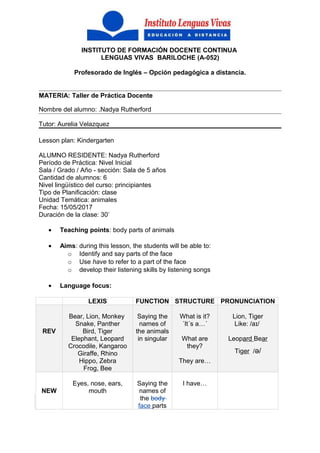
LEXIS FUNCTION STRUCTURE PRONUNCIATION
REV
Bear, Lion, Monkey
Snake, Panther
Bird, Tiger
Elephant, Leopard
Crocodile, Kangaroo
Giraffe, Rhino
Hippo, Zebra
Frog, Bee
Saying the
names of
the animals
in singular
What is it?
´It´s a…´
What are
they?
They are…
Lion, Tiger
Like: /a /ɪ
Leopard Bear
Tiger /ə/
NEW
Eyes, nose, ears,
mouth
Saying the
names of
the body
face parts
I have…
• Teaching approach: based on the Natural Approach (Stephen Krashen) and
the PPP method. The students are encouraged to speak English naturally,
without being forced to do it. Total Physical Response (James Asher) is also
used to sing and dance in class.
• Materials and resources: computer, projector, internet connection,
speakers, a lion puzzle, animal masks made of papers, pencils.
• Pedagogical use of ICT in class: the students watch one video to introduce
the topic of the lesson and make revision. Then, they watch and sing a song
about animal body parts.
• Seating arrangement: the students sit on the floor when we watch videos.
They sit down at the table to draw and play games. In the end, they stand up
to dance the goodbye song.
• Possible problems / difficulties and possible solutions during the class:
in case there wasn´t internet connection, I would download the video before
the class. If it didn´t work, I would sing and use the small cards to present the
animals.
The students may get distracted or not pay attention at some point in the
class. If that happened, I would say: ´1, 2, 3, eyes on me!´
• Potential problems students may have with the language: the students
may not understand one of the words. In that case, I would ask several
students different questions until everybody understands. If someone seemed
not to understand, I would encourage the students to help him or her.
• Assessment: what will be assessed and how: the students singing the
song is a form of assessment as well as the final speaking activity, when the
students are to talk about the animals.
ROUTINE (5´)
Purpose: to engage students, to make them focus on the lesson and to revise
language structures.
Students listen to the following song:
The teacher says: ´Hello everyone! Let´s sing a hello song! (and she calls all the
names of the children)
Hello, hello, what´s you name, what´s you name, what´s you name?
Hello, hello, what´s you name?
(example: Alma)
Hello, Alma
Hello, Alma
How are you?
How are you?
Fine, so-so or bad?
WARM UP: (5´)
Purpose: to prepare the students for the lesson.
The students look at the following picture. The teacher says:
Who is it? (Jorge el Curioso) It´s Curious George, a monkey, yes! It´s a EAR
(pointing at the ear). It´s an EYE (pointing at the eye). It´s a NOSE (pointing at the
nose). It´s a MOUTH (pointing at the mouth).
Transition: The teacher says: we are going to watch a video, OK? (enthusiastically)
PRESENTATION: (5´)
Purpose: to continue showing the students the new contents to learn, to introduce I
HAVE and to guide the students into practice.
The students watch the video and the teacher encourages to point at the parts of the
face, without speaking but just pointing and singing the song:
https://www.youtube.com/watch?v=FGn7nB9tmc0
I have a head, a big fat head
I have a mouth, a big fat mouth
I have two eyes, two big fat eyes
I have two ears, two big fat ears
I have a nose, very small nose
(x2)
Transition: The teacher says: time to play!
DEVELOPMENT (10´)
Purpose: for the students to practise the new items presented in the class.
Before the class started, the teacher hid the parts of a lion in the room. Now, the
teacher shows the students the picture of a lion on the screen but says nothing about
it. The students have to find the parts and do the puzzle to create a lion. The teacher
encourages the students to say what part they found (there are three they won´t be
able to say, so the teacher only says the names in English: body, tail and feet). (5´)
T: Look at this (she has the tail in her hand). It´s from a LION. We need to put it
together (miming). Where are the other parts? (looking around the room, and starts
to look for the pieces). Great, what is it? (It´s a ear). Fantastic! What is it? (it´s an
eye) Wonderful! What is it? (it´s a mouth). Lovely! What is it? (It´s a nose). It´s the
body! They are the feet!
Transition: Excellent! Now, you are going to COLOUR!
The teacher gives the students models of animal masks (elephant, lion and monkey)
on a piece of paper for them to colour. There will be two elephant masks, two lion
masks and two monkey masks. (5´)
T: Look! It´s an elephant. I like elephants! It´s for you. Oh, look! It´s a monkey! I love
monkeys! It´s for you. It´s a lion! I like lions! It´s for you. Now colour it nicely.
The teacher helps the students to put on their masks.
Transition: The teacher says: Excellent! Now, let´s sing with our masks!
CLOSURE (5´)
Purpose: to check the students´ understanding of the topic dealt in the class.
The students watch the video about the monkey again and this time the teacher
encourages them to sing and point at their face parts.
T: Listen, sing and point at your mask (pointing at her face)
Now, it´s time to say goodbye! Let´s sing!
The students love singing this song with their teacher: (different students choose
different animals and they dance like the animal, they take turns and the teacher
points at the next student)
This is the way we say goodbye, we say goodbye, we say goodbye
This is the way we say goodbye, we say goodbye to you
HOMEWORK: The teacher will send an email to the parents in order to tell them
about the videos and the topics the students have worked with.
Querida familia:
Hoy aprendimos a decir las partes de la cara en inglés. Miramos un nuevo video:
https://www.youtube.com/watch?v=FGn7nB9tmc0
Armamos un rompecabezas de un león e hicimos una máscara de un animal de la selva!
Por último, bailamos la canción que aprendimos al principio con nuestras máscaras
puestas. Pueden seguir practicando en casa!
Miss Nadya
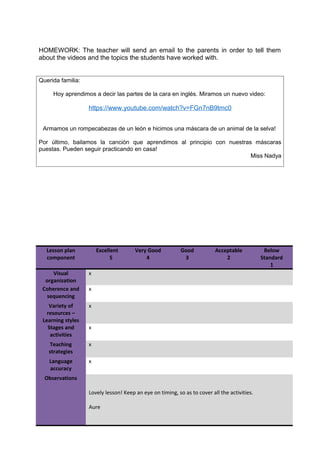
Lesson plan
component
Excellent
5
Very Good
4
Good
3
Acceptable
2
Below
Standard
1
Visual
organization
x
Coherence and
sequencing
x
Variety of
resources –
Learning styles
x
Stages and
activities
x
Teaching
strategies
x
Language
accuracy
x
Observations
Lovely lesson! Keep an eye on timing, so as to cover all the activities.
Aure
HOMEWORK: The teacher will send an email to the parents in order to tell them
about the videos and the topics the students have worked with.
Querida familia:
Hoy aprendimos a decir las partes de la cara en inglés. Miramos un nuevo video:
https://www.youtube.com/watch?v=FGn7nB9tmc0
Armamos un rompecabezas de un león e hicimos una máscara de un animal de la selva!
Por último, bailamos la canción que aprendimos al principio con nuestras máscaras
puestas. Pueden seguir practicando en casa!
Miss Nadya
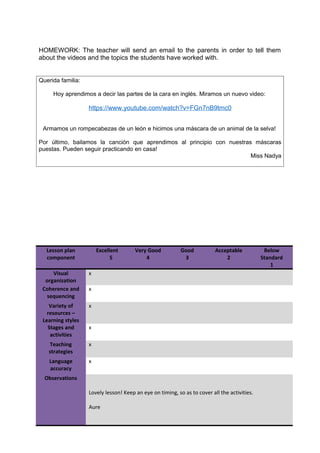
Lesson plan
component
Excellent
5
Very Good
4
Good
3
Acceptable
2
Below
Standard
1
Visual
organization
x
Coherence and
sequencing
x
Variety of
resources –
Learning styles
x
Stages and
activities
x
Teaching
strategies
x
Language
accuracy
x
Observations
Lovely lesson! Keep an eye on timing, so as to cover all the activities.
Aure

Lesson 4

  • 1.
    INSTITUTO DE FORMACIÓNDOCENTE CONTINUA LENGUAS VIVAS BARILOCHE (A-052) Profesorado de Inglés – Opción pedagógica a distancia. MATERIA: Taller de Práctica Docente Nombre del alumno: .Nadya Rutherford Tutor: Aurelia Velazquez Lesson plan: Kindergarten ALUMNO RESIDENTE: Nadya Rutherford Período de Práctica: Nivel Inicial Sala / Grado / Año - sección: Sala de 5 años Cantidad de alumnos: 6 Nivel lingüístico del curso: principiantes Tipo de Planificación: clase Unidad Temática: animales Fecha: 15/05/2017 Duración de la clase: 30’ • Teaching points: body parts of animals • Aims: during this lesson, the students will be able to: o Identify and say parts of the face o Use have to refer to a part of the face o develop their listening skills by listening songs • Language focus: LEXIS FUNCTION STRUCTURE PRONUNCIATION REV Bear, Lion, Monkey Snake, Panther Bird, Tiger Elephant, Leopard Crocodile, Kangaroo Giraffe, Rhino Hippo, Zebra Frog, Bee Saying the names of the animals in singular What is it? ´It´s a…´ What are they? They are… Lion, Tiger Like: /a /ɪ Leopard Bear Tiger /ə/ NEW Eyes, nose, ears, mouth Saying the names of the body face parts I have…
  • 2.
    • Teaching approach:based on the Natural Approach (Stephen Krashen) and the PPP method. The students are encouraged to speak English naturally, without being forced to do it. Total Physical Response (James Asher) is also used to sing and dance in class. • Materials and resources: computer, projector, internet connection, speakers, a lion puzzle, animal masks made of papers, pencils. • Pedagogical use of ICT in class: the students watch one video to introduce the topic of the lesson and make revision. Then, they watch and sing a song about animal body parts. • Seating arrangement: the students sit on the floor when we watch videos. They sit down at the table to draw and play games. In the end, they stand up to dance the goodbye song. • Possible problems / difficulties and possible solutions during the class: in case there wasn´t internet connection, I would download the video before the class. If it didn´t work, I would sing and use the small cards to present the animals. The students may get distracted or not pay attention at some point in the class. If that happened, I would say: ´1, 2, 3, eyes on me!´ • Potential problems students may have with the language: the students may not understand one of the words. In that case, I would ask several students different questions until everybody understands. If someone seemed not to understand, I would encourage the students to help him or her. • Assessment: what will be assessed and how: the students singing the song is a form of assessment as well as the final speaking activity, when the students are to talk about the animals. ROUTINE (5´) Purpose: to engage students, to make them focus on the lesson and to revise language structures. Students listen to the following song: The teacher says: ´Hello everyone! Let´s sing a hello song! (and she calls all the names of the children) Hello, hello, what´s you name, what´s you name, what´s you name? Hello, hello, what´s you name? (example: Alma) Hello, Alma Hello, Alma How are you?
  • 3.
    How are you? Fine,so-so or bad? WARM UP: (5´) Purpose: to prepare the students for the lesson. The students look at the following picture. The teacher says: Who is it? (Jorge el Curioso) It´s Curious George, a monkey, yes! It´s a EAR (pointing at the ear). It´s an EYE (pointing at the eye). It´s a NOSE (pointing at the nose). It´s a MOUTH (pointing at the mouth). Transition: The teacher says: we are going to watch a video, OK? (enthusiastically) PRESENTATION: (5´) Purpose: to continue showing the students the new contents to learn, to introduce I HAVE and to guide the students into practice. The students watch the video and the teacher encourages to point at the parts of the face, without speaking but just pointing and singing the song: https://www.youtube.com/watch?v=FGn7nB9tmc0
  • 4.
    I have ahead, a big fat head I have a mouth, a big fat mouth I have two eyes, two big fat eyes I have two ears, two big fat ears I have a nose, very small nose I have a nose, very small nose (x2) Transition: The teacher says: time to play! DEVELOPMENT (10´) Purpose: for the students to practise the new items presented in the class. Before the class started, the teacher hid the parts of a lion in the room. Now, the teacher shows the students the picture of a lion on the screen but says nothing about it. The students have to find the parts and do the puzzle to create a lion. The teacher encourages the students to say what part they found (there are three they won´t be able to say, so the teacher only says the names in English: body, tail and feet). (5´) T: Look at this (she has the tail in her hand). It´s from a LION. We need to put it together (miming). Where are the other parts? (looking around the room, and starts to look for the pieces). Great, what is it? (It´s a ear). Fantastic! What is it? (it´s an eye) Wonderful! What is it? (it´s a mouth). Lovely! What is it? (It´s a nose). It´s the body! They are the feet! Transition: Excellent! Now, you are going to COLOUR! The teacher gives the students models of animal masks (elephant, lion and monkey) on a piece of paper for them to colour. There will be two elephant masks, two lion masks and two monkey masks. (5´) T: Look! It´s an elephant. I like elephants! It´s for you. Oh, look! It´s a monkey! I love monkeys! It´s for you. It´s a lion! I like lions! It´s for you. Now colour it nicely.
  • 5.
    The teacher helpsthe students to put on their masks. Transition: The teacher says: Excellent! Now, let´s sing with our masks! CLOSURE (5´) Purpose: to check the students´ understanding of the topic dealt in the class. The students watch the video about the monkey again and this time the teacher encourages them to sing and point at their face parts. T: Listen, sing and point at your mask (pointing at her face) Now, it´s time to say goodbye! Let´s sing! The students love singing this song with their teacher: (different students choose different animals and they dance like the animal, they take turns and the teacher points at the next student) This is the way we say goodbye, we say goodbye, we say goodbye This is the way we say goodbye, we say goodbye to you
  • 6.
    HOMEWORK: The teacherwill send an email to the parents in order to tell them about the videos and the topics the students have worked with. Querida familia: Hoy aprendimos a decir las partes de la cara en inglés. Miramos un nuevo video: https://www.youtube.com/watch?v=FGn7nB9tmc0 Armamos un rompecabezas de un león e hicimos una máscara de un animal de la selva! Por último, bailamos la canción que aprendimos al principio con nuestras máscaras puestas. Pueden seguir practicando en casa! Miss Nadya Lesson plan component Excellent 5 Very Good 4 Good 3 Acceptable 2 Below Standard 1 Visual organization x Coherence and sequencing x Variety of resources – Learning styles x Stages and activities x Teaching strategies x Language accuracy x Observations Lovely lesson! Keep an eye on timing, so as to cover all the activities. Aure
  • 7.
    HOMEWORK: The teacherwill send an email to the parents in order to tell them about the videos and the topics the students have worked with. Querida familia: Hoy aprendimos a decir las partes de la cara en inglés. Miramos un nuevo video: https://www.youtube.com/watch?v=FGn7nB9tmc0 Armamos un rompecabezas de un león e hicimos una máscara de un animal de la selva! Por último, bailamos la canción que aprendimos al principio con nuestras máscaras puestas. Pueden seguir practicando en casa! Miss Nadya Lesson plan component Excellent 5 Very Good 4 Good 3 Acceptable 2 Below Standard 1 Visual organization x Coherence and sequencing x Variety of resources – Learning styles x Stages and activities x Teaching strategies x Language accuracy x Observations Lovely lesson! Keep an eye on timing, so as to cover all the activities. Aure