School-Based
Drug Prevention
By:
Jill Bassett, Caroline Creekmuir,
Traci Hart, & Lauren Tower
School-Based
Drug Prevention
 Prevention
 Refers to the strategies & processes that reduce, delay, or
eliminate the probability of developing alcohol, tobacco, & drug
use disorders.
 Since most ATOD use begins before age 20, schools
are the primary institution with access to this age group.
Additionally, the most common prevention strategy has
been education, which is compatible with schools’ goals.
School-Based
Drug Prevention
 Most inteventions are aimed at children & adolescents 10-16 years
old (when most people start using).
 Because the majority of youth experiment with substances (especially
A & T), prevention needs to target all students.
 Since risk factors are present years before use begins, prevention
activities need to start in elementary school and be periodically
reinforced as students grow and encounter new social situations &
pressures.
 Programs designed to meet developmental needs of students should be
offered at each grade level without oversaturating students to the point
they discount the information.
Preventative Interventions
 Primary Interventions
 Secondary Interventions
 Three Categories of Interventions:
1. Universal
2. Selective
3. Indicated
Preventative Interventions
 Ideally based on scientific knowledge about the
prevalence of drug use in the target population,
the age of first use, determinants of drug use,
patterns of drug use, mental health problems in
the past specific population, and a theoretical
view of the intervention components that may
change behavior.
Goals of Prevention
Interventions
 Increasing Knowledge About Drugs
 Reducing the Risk of Drugs
 Delaying the Onset of First Use
 Reducing Abuse of Drugs
 Minimizing the Harm Caused by the Use of
Drugs
Key Elements of Effective School-
Based Prevention Programs
 Effects of Program Should Have Been Proven
 Accurate & Developmentally Appropriate Info About
Drugs
 Interactive Delivery Methods
 Social Influence Model
 Normative Education
 Social Skills Training
 Teacher Training/Support
Key Elements of Effective School-
Based Prevention Programs
 Adequate Coverage of Material & Follow-Up
 Culturally Sensitive Strategies
 Broadening School-Based Activities to Include
Families, Community, etc.
 Methods of Evaluation
D.A.R.E.
Drug Abuse Resistance Education
 History of D.A.R.E.
 Initially Founded in Los Angeles, 1983
 Improving America’s Schools Act 1994
 In the 1996 State of the Union Address, President Bill
Clinton singled out D.A.R.E. for praise
 Two years later, the National Institute of Justice
presented it’s Report to the United States Congress and
concluded that “D.A.R.E. does not work to reduce
substance abuse.”
D.A.R.E. is…
 Part of the “War on Drugs”
 An international education program
 The most widely used of all programs
Goals of D.A.R.E.
 To humanize the police
 To allow students to see officers in a helping role
 To open lines of communication between law
enforcement and youth
 Have officers serve as educators
The Program
 D.A.R.E. is designed to provide students with
the skills and knowledge to avoid:
 Substance use/abuse
 Violence and gang involvement
About the Program
 Ten week in-school curriculum
 A police officer led series of classroom lessons
that teaches children from kindergarten through
twelfth grade
 Those individuals that choose to lead the lessons
are specially trained
D.A.R.E. America
 National non-profit organization
 Serves as a resource to communities, helping to
establish and improve local D.A.R.E. programs
 Provides officer training
 Creates national awareness for D.A.R.E.
Criticisms
 Ineffective
 Opposite Effect
 No Proof
 D.A.R.E.’s research
Research
 Mixed results throughout literature
 Teaching styles and approach
 Instructor Type (officer vs. teacher)
 Long-term vs. Short-term results
 Perceptions
Life-Skills Training:
Overview
 Research Validated Program
 Elementary, Middle, H.S. Levels
 Develops Skills and Confidence
 Reduces Risk of Substance Use/Abuse
Life Skills Training
 Skills to cope with peer pressure.
 Improves self-esteem/confidence.
 Coping with anxiety effectively.
 Teaches immediate consequences of substance
abuse.
 Enhances behavioral and cognitive competence.
Components
 Drug Resistance Skills
 Personal Self-Management Skills
 General Social Skills
Proven Effective With:
 White middle-class students
 Ethnic minority students
 Inner-city urban populations
 Suburban populations
 Rural populations
Implementation
 Settings
 Teaching Strategies
 Classroom Set-Up
Program Providers
 To maximize effectiveness, choose wisely:
 Provider
 Setting
Classroom Program
Providers
 Teachers
 School Counselors
 Prevention Specialists
 Health Professionals
 Mental Health Professionals
 Social Workers
 Community Youth Educators
 Law Enforcement Officers
 Older Peer Leaders
Other Effective Drug Prevention
Programs
 Elementary School
 Caring School Community Program: strengthens
children’s sense of community (or connection to
school).
 Skills, Opportunity, & Recognition (SOAR): Enhances
protective factors.
 Brain Power! Junior Scientists Program: Teaches
students about biological aspects of drug abuse.
Other Effective Drug Prevention
Programs
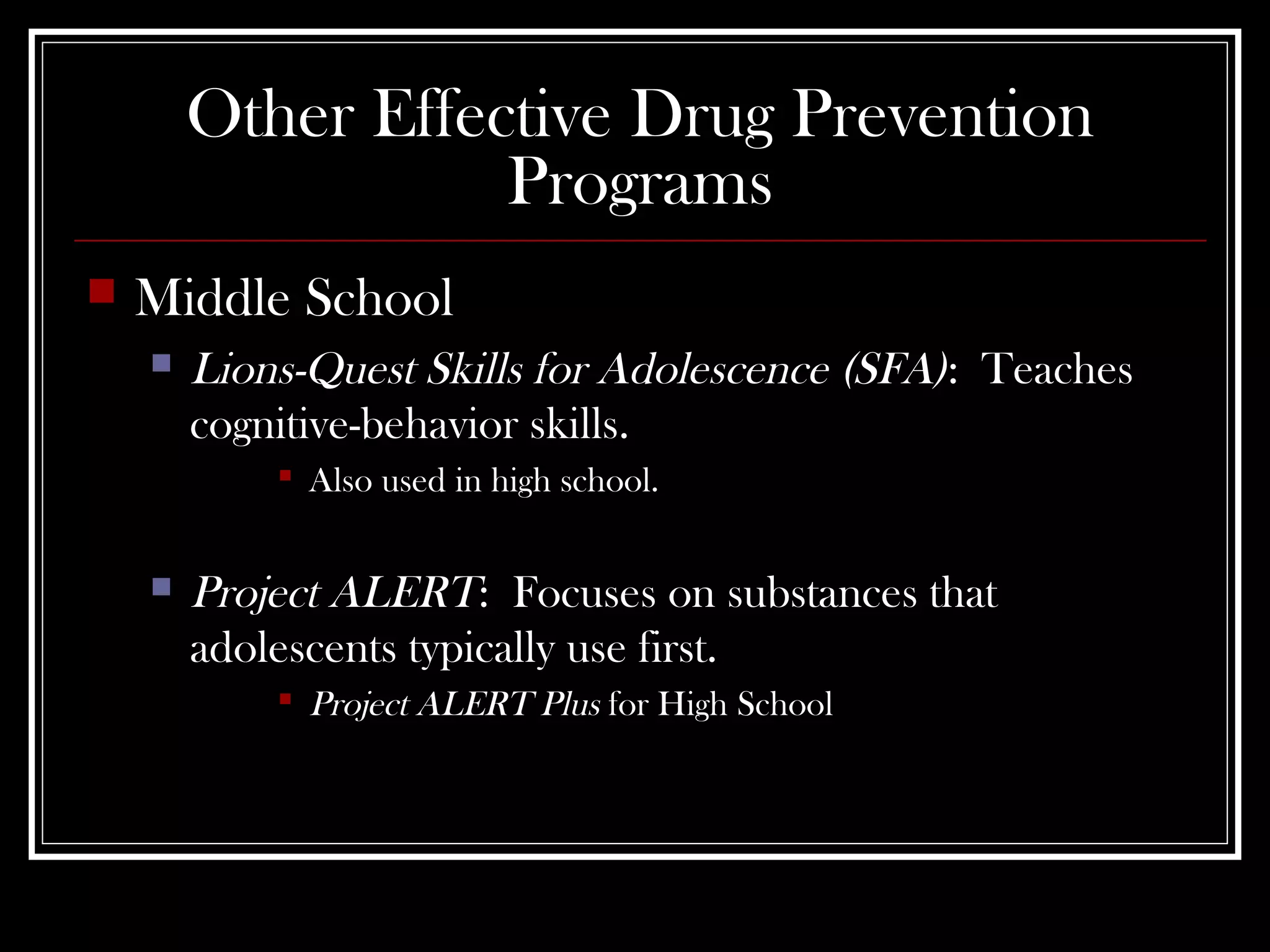
 Middle School
 Lions-Quest Skills for Adolescence (SFA): Teaches
cognitive-behavior skills.
 Also used in high school.
 Project ALERT: Focuses on substances that
adolescents typically use first.
 Project ALERT Plus for High School
Other Effective Drug Prevention
Programs
 Middle School cont’
 Project STAR: Targets schools, parents, community
organizations, and health policymakers.
 Mind Over Matter: Teaches biological effects of drug
abuse on the body and brain.
Other Effective Drug Prevention
Programs
 Mentor Programs
 Big Brothers/Big Sisters of America: The oldest and
largest youth mentoring organization in the U.S.
 Across Ages: Encourages elders mentoring youth,
community service, life-skills, and family activities.
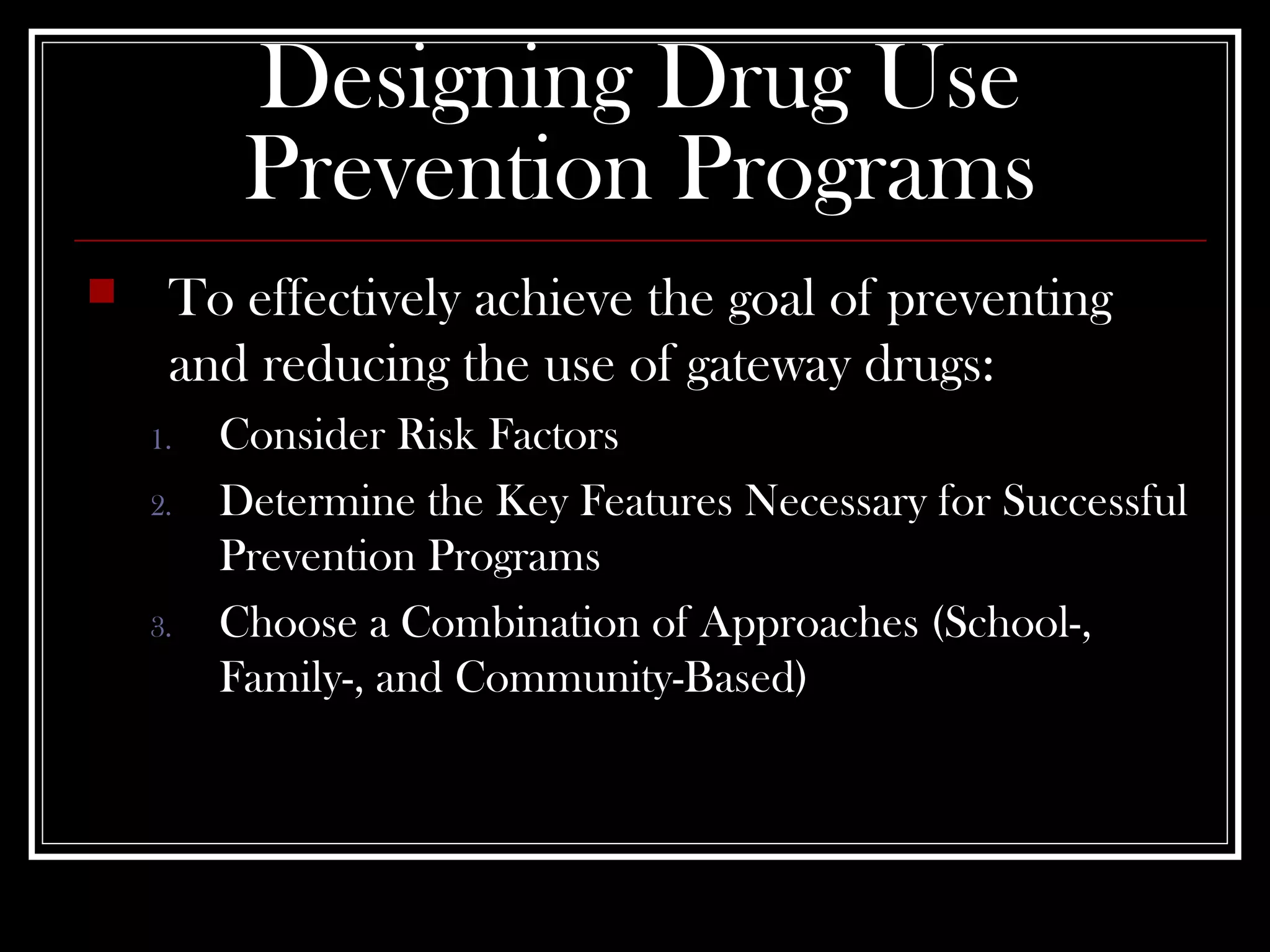
Designing Drug Use
Prevention Programs
 To effectively achieve the goal of preventing
and reducing the use of gateway drugs:
1. Consider Risk Factors
2. Determine the Key Features Necessary for Successful
Prevention Programs
3. Choose a Combination of Approaches (School-,
Family-, and Community-Based)
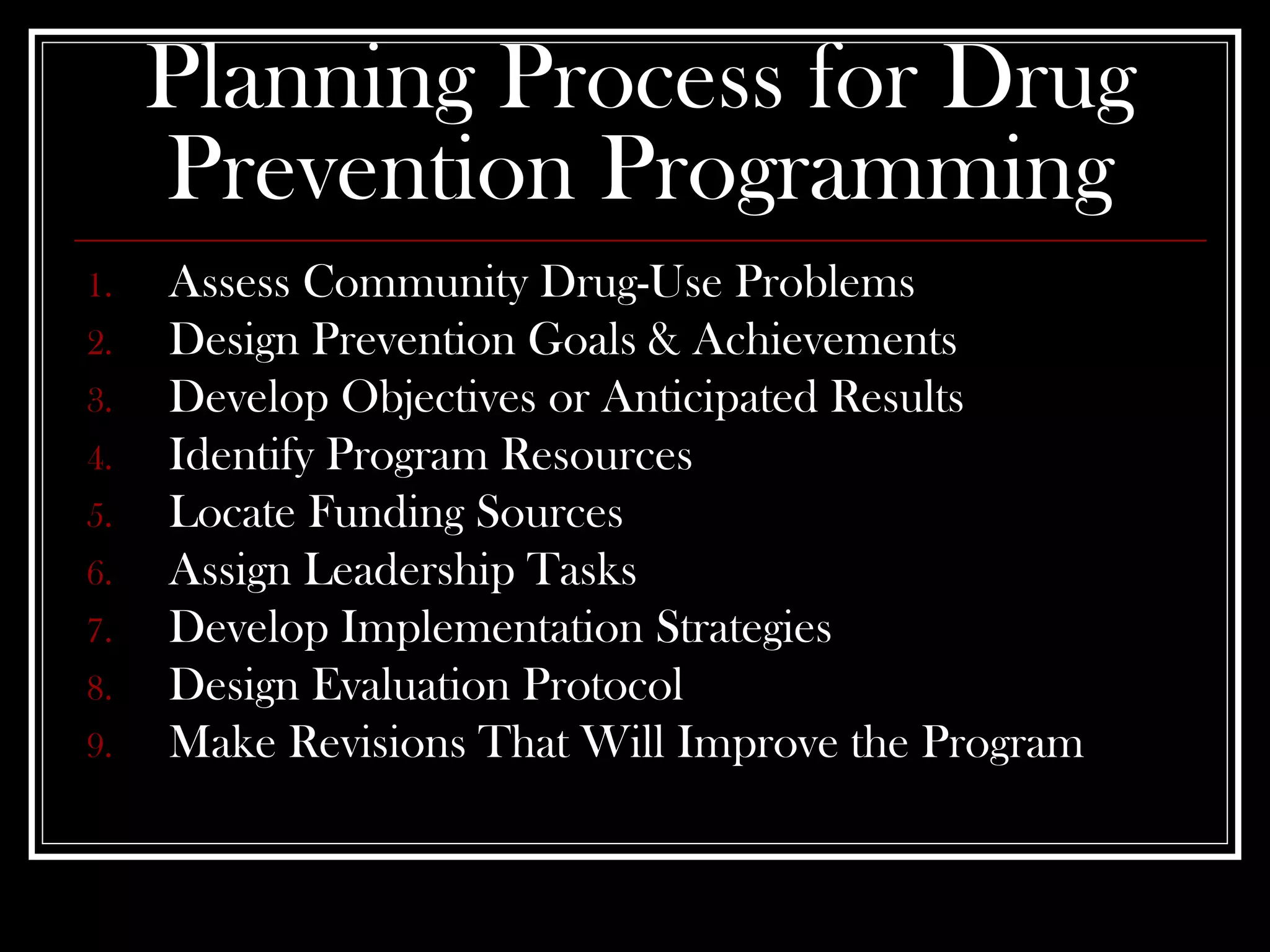
Planning Process for Drug
Prevention Programming
1. Assess Community Drug-Use Problems
2. Design Prevention Goals & Achievements
3. Develop Objectives or Anticipated Results
4. Identify Program Resources
5. Locate Funding Sources
6. Assign Leadership Tasks
7. Develop Implementation Strategies
8. Design Evaluation Protocol
9. Make Revisions That Will Improve the Program
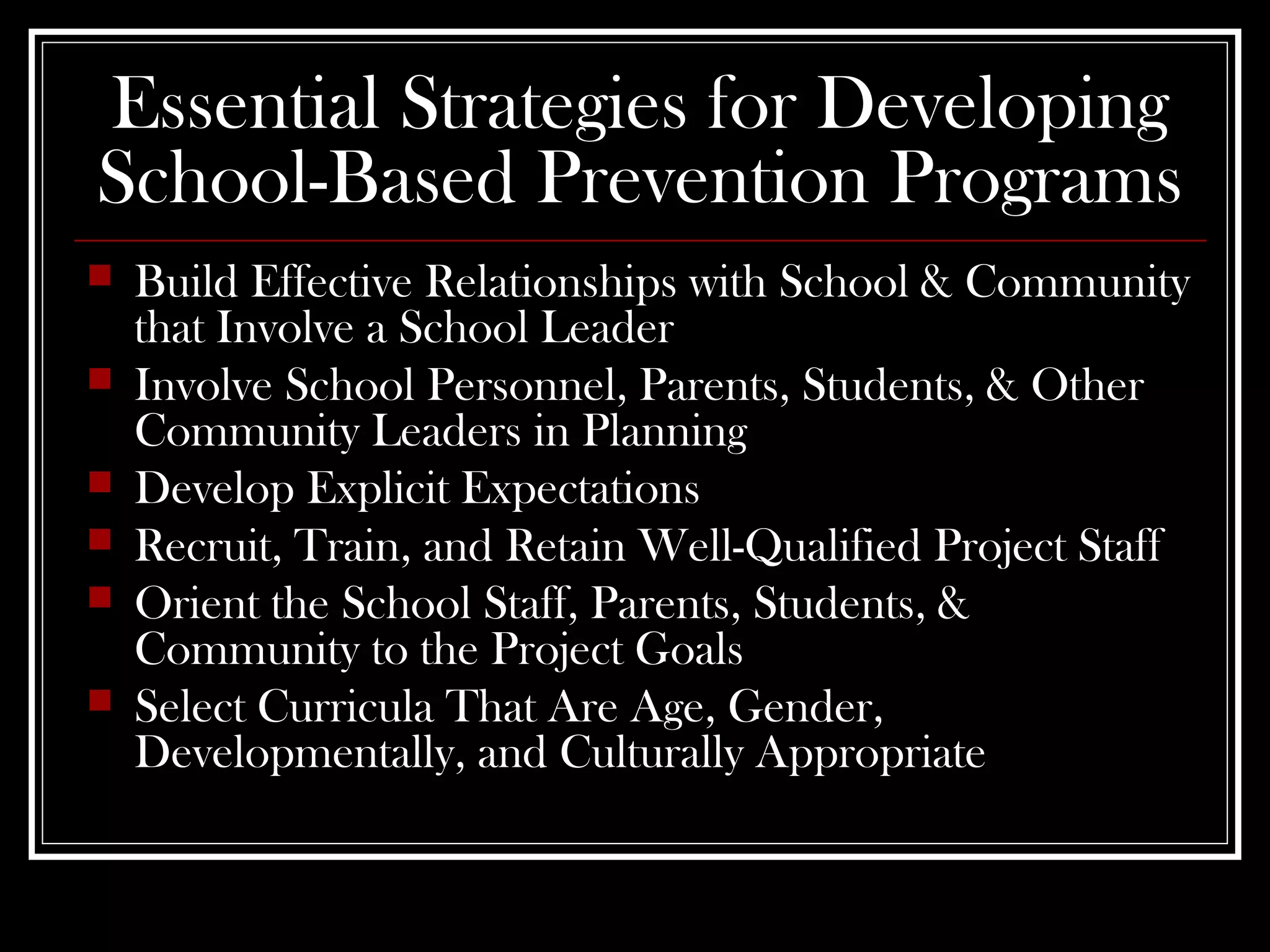
Essential Strategies for Developing
School-Based Prevention Programs
 Build Effective Relationships with School & Community
that Involve a School Leader
 Involve School Personnel, Parents, Students, & Other
Community Leaders in Planning
 Develop Explicit Expectations
 Recruit, Train, and Retain Well-Qualified Project Staff
 Orient the School Staff, Parents, Students, &
Community to the Project Goals
 Select Curricula That Are Age, Gender,
Developmentally, and Culturally Appropriate
Essential Strategies for Developing
School-Based Prevention Programs
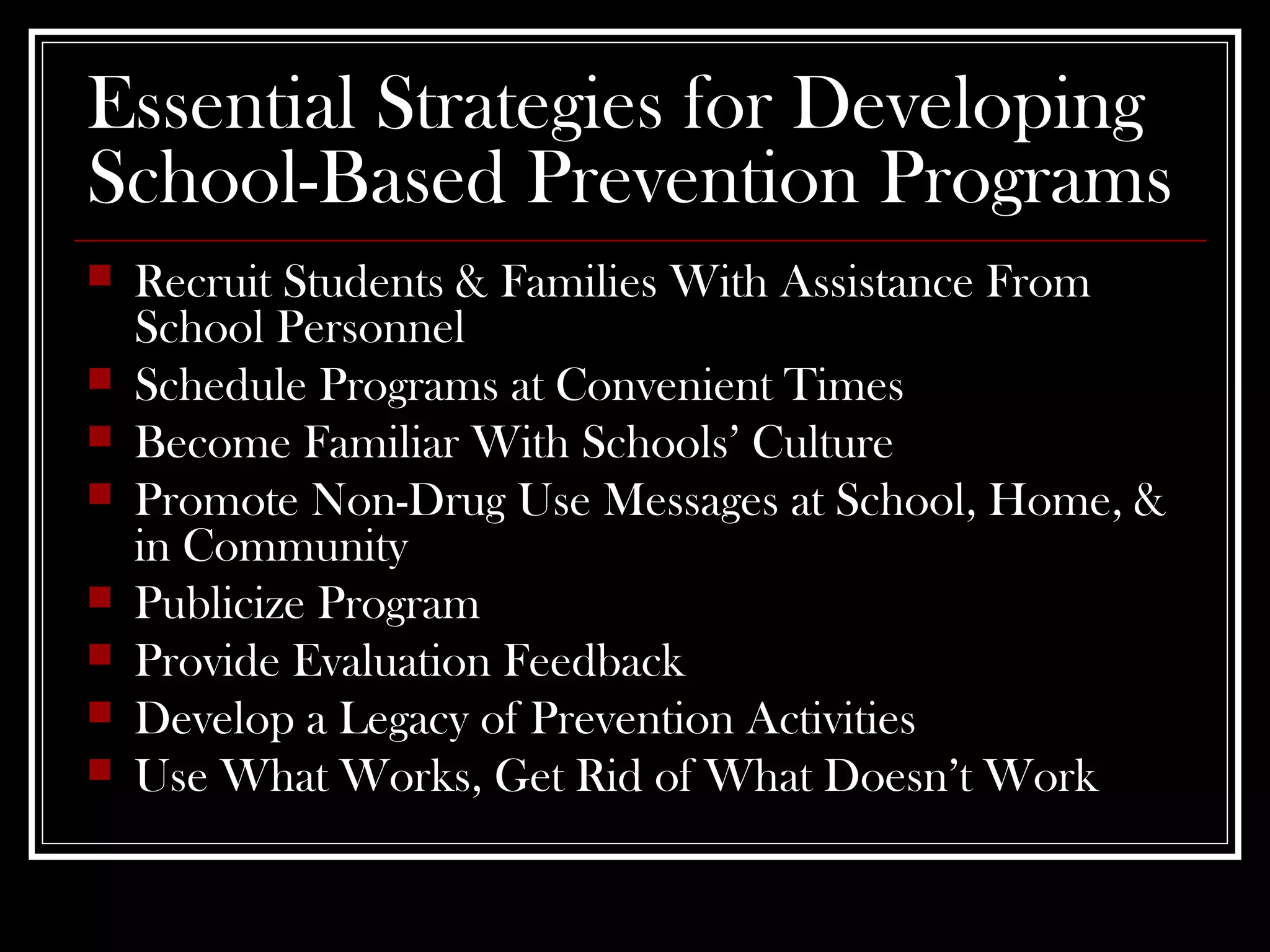
 Recruit Students & Families With Assistance From
School Personnel
 Schedule Programs at Convenient Times
 Become Familiar With Schools’ Culture
 Promote Non-Drug Use Messages at School, Home, &
in Community
 Publicize Program
 Provide Evaluation Feedback
 Develop a Legacy of Prevention Activities
 Use What Works, Get Rid of What Doesn’t Work
References
 Bosworth, K. (1997). Drug abuse prevention: School-based strategies that work.
Retrieved November 7, 2007 from http://www.ericdigests.org/1998-1/drug.htm
 Burke, M. (2002). School-based substance abuse prevention: Political finger-
pointing does not work. Federal Probation, 66 (2), 66-71.
 Cuijpers, P. (2003). Three decades of drug prevention research. Drugs: Education,
Prevention, and Policy, 10 (1), 7-20.
 Des Jarlais, D.C., Sloboda, Z., & Friedman, S.R. (2006). Diffusion of the D.A.R.E.
and syringe exchange programs. American Journal of Public Health, 96, 1354-1357.
 Donnermeyer, J.F. (1998). Educator perceptions of the D.A.R.E. officer. Journal of
Alcohol and Drug Education, 44, 1-17.
 Drug Abuse Resistance Education (n.d.). Retrieved November 11, 2007 from
http://www.dare.com/home/default.asp
 Drug Abuse Resistance Education America (n.d.). National prevention study
supports value of D.A.R.E. delivery network. Retrieved November 11, 2007 from
http://www.dare.com
References
 Gruber, C.A. (n.d.). Another positive evaluation of D.A.R.E. Retrieved November
11, 2007 from http://www.dare.com
 Montoya, I.D., Atkinson, J., & McFaden, W.C. (2003). Best characteristics of
adolescent gateway drug prevention programs. Journal of Addictions Nursing, 14
(2), 75-83.
 NIDA (2003). Prevention drug abuse among children and adolescents, 2nd
edition.
Bethesda, Maryland: National Institutes of Health.
 NIDA develops drug prevention program for elementary students (2002).
Alcoholism & Drug Abuse Weekly, Retrieved November 11, 2007.
 SAMHSA (2004). Prevention pathways. Retrieved November 11, 2007 from
http://www.preventionpathways.samhsa.gov/programs.htm
 Zagumny, M.J. & Thompson, M.K. (1997). Does D.A.R.E. work? An evaluation in
rural Tennessee. Journal of Alcohol and Drug Education, 42, 32-41.
 Zavela, K.J. (2002). Developing effective school-based drug abuse prevention
programs. American Journal of Health & Behavior, 26 (4), 252-265.

School based drug prevention

  • 1.
    School-Based Drug Prevention By: Jill Bassett,Caroline Creekmuir, Traci Hart, & Lauren Tower
  • 2.
    School-Based Drug Prevention  Prevention Refers to the strategies & processes that reduce, delay, or eliminate the probability of developing alcohol, tobacco, & drug use disorders.  Since most ATOD use begins before age 20, schools are the primary institution with access to this age group. Additionally, the most common prevention strategy has been education, which is compatible with schools’ goals.
  • 3.
    School-Based Drug Prevention  Mostinteventions are aimed at children & adolescents 10-16 years old (when most people start using).  Because the majority of youth experiment with substances (especially A & T), prevention needs to target all students.  Since risk factors are present years before use begins, prevention activities need to start in elementary school and be periodically reinforced as students grow and encounter new social situations & pressures.  Programs designed to meet developmental needs of students should be offered at each grade level without oversaturating students to the point they discount the information.
  • 4.
    Preventative Interventions  PrimaryInterventions  Secondary Interventions  Three Categories of Interventions: 1. Universal 2. Selective 3. Indicated
  • 5.
    Preventative Interventions  Ideallybased on scientific knowledge about the prevalence of drug use in the target population, the age of first use, determinants of drug use, patterns of drug use, mental health problems in the past specific population, and a theoretical view of the intervention components that may change behavior.
  • 6.
    Goals of Prevention Interventions Increasing Knowledge About Drugs  Reducing the Risk of Drugs  Delaying the Onset of First Use  Reducing Abuse of Drugs  Minimizing the Harm Caused by the Use of Drugs
  • 7.
    Key Elements ofEffective School- Based Prevention Programs  Effects of Program Should Have Been Proven  Accurate & Developmentally Appropriate Info About Drugs  Interactive Delivery Methods  Social Influence Model  Normative Education  Social Skills Training  Teacher Training/Support
  • 8.
    Key Elements ofEffective School- Based Prevention Programs  Adequate Coverage of Material & Follow-Up  Culturally Sensitive Strategies  Broadening School-Based Activities to Include Families, Community, etc.  Methods of Evaluation
  • 9.
    D.A.R.E. Drug Abuse ResistanceEducation  History of D.A.R.E.  Initially Founded in Los Angeles, 1983  Improving America’s Schools Act 1994  In the 1996 State of the Union Address, President Bill Clinton singled out D.A.R.E. for praise  Two years later, the National Institute of Justice presented it’s Report to the United States Congress and concluded that “D.A.R.E. does not work to reduce substance abuse.”
  • 10.
    D.A.R.E. is…  Partof the “War on Drugs”  An international education program  The most widely used of all programs
  • 11.
    Goals of D.A.R.E. To humanize the police  To allow students to see officers in a helping role  To open lines of communication between law enforcement and youth  Have officers serve as educators
  • 12.
    The Program  D.A.R.E.is designed to provide students with the skills and knowledge to avoid:  Substance use/abuse  Violence and gang involvement
  • 13.
    About the Program Ten week in-school curriculum  A police officer led series of classroom lessons that teaches children from kindergarten through twelfth grade  Those individuals that choose to lead the lessons are specially trained
  • 14.
    D.A.R.E. America  Nationalnon-profit organization  Serves as a resource to communities, helping to establish and improve local D.A.R.E. programs  Provides officer training  Creates national awareness for D.A.R.E.
  • 15.
    Criticisms  Ineffective  OppositeEffect  No Proof  D.A.R.E.’s research
  • 16.
    Research  Mixed resultsthroughout literature  Teaching styles and approach  Instructor Type (officer vs. teacher)  Long-term vs. Short-term results  Perceptions
  • 17.
    Life-Skills Training: Overview  ResearchValidated Program  Elementary, Middle, H.S. Levels  Develops Skills and Confidence  Reduces Risk of Substance Use/Abuse
  • 18.
    Life Skills Training Skills to cope with peer pressure.  Improves self-esteem/confidence.  Coping with anxiety effectively.  Teaches immediate consequences of substance abuse.  Enhances behavioral and cognitive competence.
  • 19.
    Components  Drug ResistanceSkills  Personal Self-Management Skills  General Social Skills
  • 20.
    Proven Effective With: White middle-class students  Ethnic minority students  Inner-city urban populations  Suburban populations  Rural populations
  • 21.
    Implementation  Settings  TeachingStrategies  Classroom Set-Up
  • 22.
    Program Providers  Tomaximize effectiveness, choose wisely:  Provider  Setting
  • 23.
    Classroom Program Providers  Teachers School Counselors  Prevention Specialists  Health Professionals  Mental Health Professionals  Social Workers  Community Youth Educators  Law Enforcement Officers  Older Peer Leaders
  • 25.
    Other Effective DrugPrevention Programs  Elementary School  Caring School Community Program: strengthens children’s sense of community (or connection to school).  Skills, Opportunity, & Recognition (SOAR): Enhances protective factors.  Brain Power! Junior Scientists Program: Teaches students about biological aspects of drug abuse.
  • 26.
    Other Effective DrugPrevention Programs  Middle School  Lions-Quest Skills for Adolescence (SFA): Teaches cognitive-behavior skills.  Also used in high school.  Project ALERT: Focuses on substances that adolescents typically use first.  Project ALERT Plus for High School
  • 27.
    Other Effective DrugPrevention Programs  Middle School cont’  Project STAR: Targets schools, parents, community organizations, and health policymakers.  Mind Over Matter: Teaches biological effects of drug abuse on the body and brain.
  • 28.
    Other Effective DrugPrevention Programs  Mentor Programs  Big Brothers/Big Sisters of America: The oldest and largest youth mentoring organization in the U.S.  Across Ages: Encourages elders mentoring youth, community service, life-skills, and family activities.
  • 29.
    Designing Drug Use PreventionPrograms  To effectively achieve the goal of preventing and reducing the use of gateway drugs: 1. Consider Risk Factors 2. Determine the Key Features Necessary for Successful Prevention Programs 3. Choose a Combination of Approaches (School-, Family-, and Community-Based)
  • 31.
    Planning Process forDrug Prevention Programming 1. Assess Community Drug-Use Problems 2. Design Prevention Goals & Achievements 3. Develop Objectives or Anticipated Results 4. Identify Program Resources 5. Locate Funding Sources 6. Assign Leadership Tasks 7. Develop Implementation Strategies 8. Design Evaluation Protocol 9. Make Revisions That Will Improve the Program
  • 32.
    Essential Strategies forDeveloping School-Based Prevention Programs  Build Effective Relationships with School & Community that Involve a School Leader  Involve School Personnel, Parents, Students, & Other Community Leaders in Planning  Develop Explicit Expectations  Recruit, Train, and Retain Well-Qualified Project Staff  Orient the School Staff, Parents, Students, & Community to the Project Goals  Select Curricula That Are Age, Gender, Developmentally, and Culturally Appropriate
  • 33.
    Essential Strategies forDeveloping School-Based Prevention Programs  Recruit Students & Families With Assistance From School Personnel  Schedule Programs at Convenient Times  Become Familiar With Schools’ Culture  Promote Non-Drug Use Messages at School, Home, & in Community  Publicize Program  Provide Evaluation Feedback  Develop a Legacy of Prevention Activities  Use What Works, Get Rid of What Doesn’t Work
  • 34.
    References  Bosworth, K.(1997). Drug abuse prevention: School-based strategies that work. Retrieved November 7, 2007 from http://www.ericdigests.org/1998-1/drug.htm  Burke, M. (2002). School-based substance abuse prevention: Political finger- pointing does not work. Federal Probation, 66 (2), 66-71.  Cuijpers, P. (2003). Three decades of drug prevention research. Drugs: Education, Prevention, and Policy, 10 (1), 7-20.  Des Jarlais, D.C., Sloboda, Z., & Friedman, S.R. (2006). Diffusion of the D.A.R.E. and syringe exchange programs. American Journal of Public Health, 96, 1354-1357.  Donnermeyer, J.F. (1998). Educator perceptions of the D.A.R.E. officer. Journal of Alcohol and Drug Education, 44, 1-17.  Drug Abuse Resistance Education (n.d.). Retrieved November 11, 2007 from http://www.dare.com/home/default.asp  Drug Abuse Resistance Education America (n.d.). National prevention study supports value of D.A.R.E. delivery network. Retrieved November 11, 2007 from http://www.dare.com
  • 35.
    References  Gruber, C.A.(n.d.). Another positive evaluation of D.A.R.E. Retrieved November 11, 2007 from http://www.dare.com  Montoya, I.D., Atkinson, J., & McFaden, W.C. (2003). Best characteristics of adolescent gateway drug prevention programs. Journal of Addictions Nursing, 14 (2), 75-83.  NIDA (2003). Prevention drug abuse among children and adolescents, 2nd edition. Bethesda, Maryland: National Institutes of Health.  NIDA develops drug prevention program for elementary students (2002). Alcoholism & Drug Abuse Weekly, Retrieved November 11, 2007.  SAMHSA (2004). Prevention pathways. Retrieved November 11, 2007 from http://www.preventionpathways.samhsa.gov/programs.htm  Zagumny, M.J. & Thompson, M.K. (1997). Does D.A.R.E. work? An evaluation in rural Tennessee. Journal of Alcohol and Drug Education, 42, 32-41.  Zavela, K.J. (2002). Developing effective school-based drug abuse prevention programs. American Journal of Health & Behavior, 26 (4), 252-265.