Branches and Jobs
In Science
and
Good Science Discussion
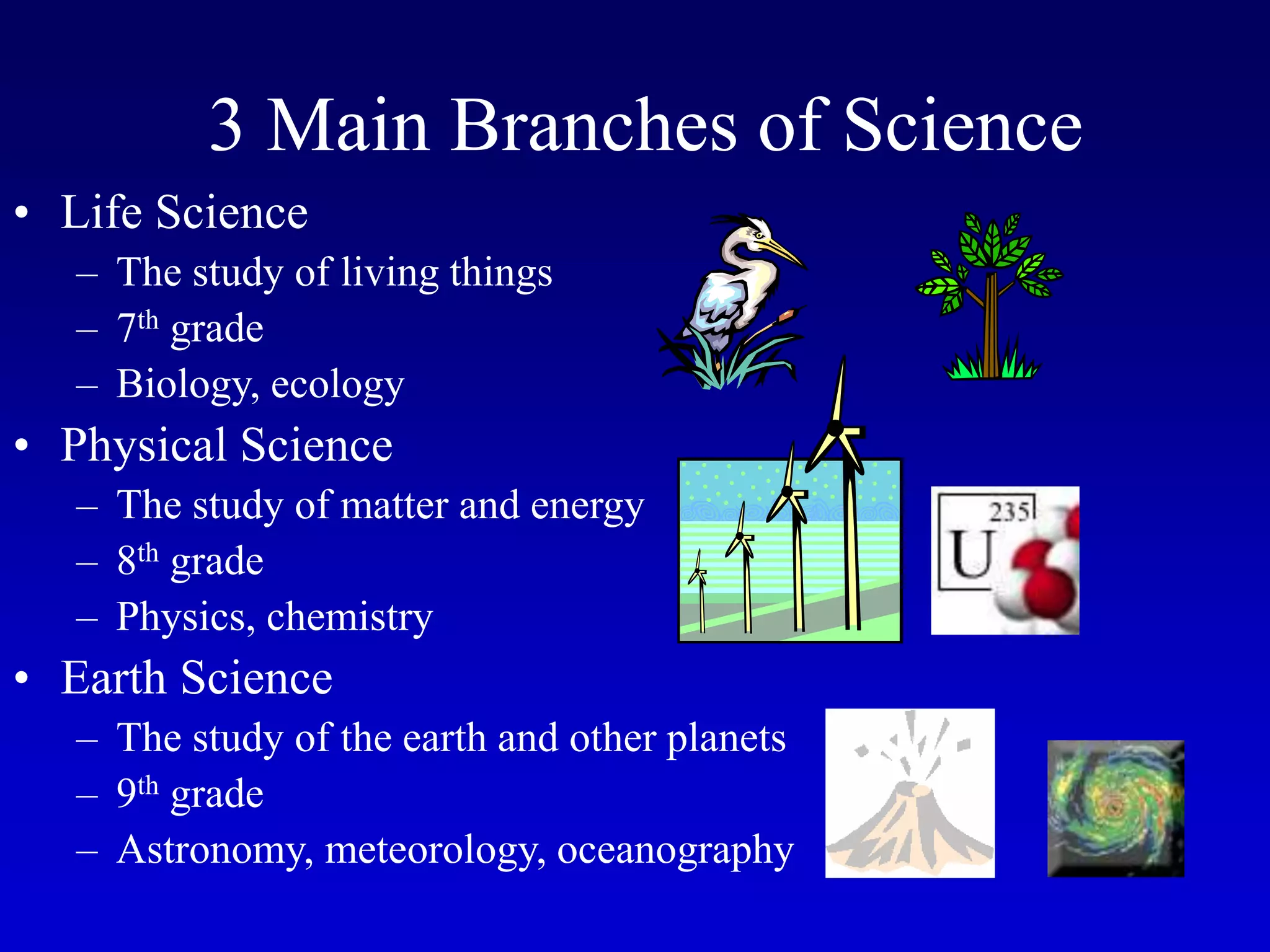
3 Main Branches of Science
• Life Science
– The study of living things
– 7th grade
– Biology, ecology
• Physical Science
– The study of matter and energy
– 8th grade
– Physics, chemistry
• Earth Science
– The study of the earth and other planets
– 9th grade
– Astronomy, meteorology, oceanography
Degrees in Science
– A.A.S. is an Associate of Applied Science
• 1 to 2 years after high school
• Less money, but more jobs
– B.S. is a Bachelor of Science
• 4 to 5 years after high school
• More money than high school education
– M.S. is a Master of Science
• 1 to 4 years after a B.S.
• More money, but less jobs available
– Ph.D is a Doctor of Philosophy
• 4 to 8 years after a B.S.
• More money, but less jobs available
Degrees in Science (con’t)
– M.D. is a Medical Doctor
• 4 years after a B.S.
• The doctor you visit when you are sick
– D.D.S. is a Doctor of Dental Surgery
• 4 years after a B.S.
• The dentist
– D.V.M. is a Doctor of Veterinary Medicine
• 4 years after a B.S.
• The doctor you visit when your pet is sick
Jobs/People in Science
– Scientists (M.S., Ph.D)
• Discover new things
• Discover and describe new laws in science
– Engineers (B.S., M.S., Ph.D.)
• Use existing discoveries to improve our lives
• Use science to improve existing products
– Technicians (Certificate, A.A.S., B.S., M.S.)
• Install, repair, fix, and/or maintain equipment
Good Science Class Discussion
Asking Questions:
•Level 1 Questions
•Level 2 Questions
•Level 3 Questions
Good class discussions involve:
•Active listening of every student
•Staying on topic
•Students who courageously share their
ideas
•Focusing on Level 2 and 3 Questions
•Students responding to other students
•Students asking questions of other
students
•Allowing others to share their points
•Challenging the ideas of others in a
respectful way
Don’t play guess what is on the
teacher’s mind. I want to hear
what you think.
Your ideas and questions are
important!!!
Level 1 Questions
ask to recall facts and information. These questions
have specific answers.
Words typically used: define, recall, recognize,
remember, who, what, where, when, describe,
compare, contrast, rephrase, put in your own
words, explain the main idea
Ex: If we are discussing elements and the periodic
table, you may ask:
• “What is the symbol for hydrogen?”
• “What is the name of the first column of
elements?”
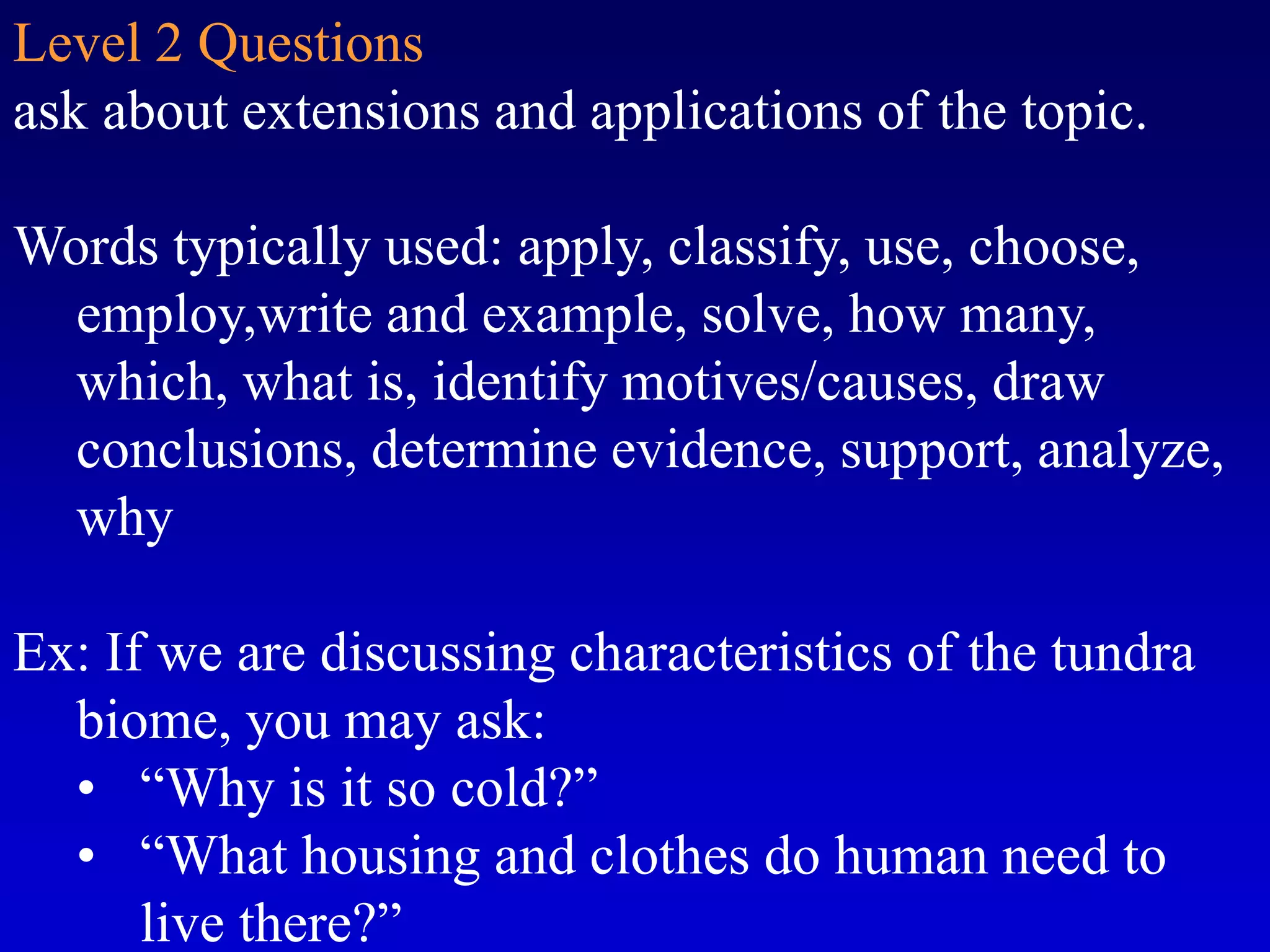
Level 2 Questions
ask about extensions and applications of the topic.
Words typically used: apply, classify, use, choose,
employ,write and example, solve, how many,
which, what is, identify motives/causes, draw
conclusions, determine evidence, support, analyze,
why
Ex: If we are discussing characteristics of the tundra
biome, you may ask:
• “Why is it so cold?”
• “What housing and clothes do human need to
live there?”
Level 3 Questions
ask how to use the information to go beyond the topic.
These questions have no specific answer.
Words typically used: predict, produce, write, design,
develop, synthesize, construct, how can we
improve, what would happen if, can you devise,
how can we solve.
Ex: If we are discussing fossil fuels:
• “What are some alternatives to gasoline?”
• “How will our society need to change when
gasoline is gone in a few years?”

Branches of Science

  • 1.
    Branches and Jobs InScience and Good Science Discussion
  • 3.
    3 Main Branchesof Science • Life Science – The study of living things – 7th grade – Biology, ecology • Physical Science – The study of matter and energy – 8th grade – Physics, chemistry • Earth Science – The study of the earth and other planets – 9th grade – Astronomy, meteorology, oceanography
  • 4.
    Degrees in Science –A.A.S. is an Associate of Applied Science • 1 to 2 years after high school • Less money, but more jobs – B.S. is a Bachelor of Science • 4 to 5 years after high school • More money than high school education – M.S. is a Master of Science • 1 to 4 years after a B.S. • More money, but less jobs available – Ph.D is a Doctor of Philosophy • 4 to 8 years after a B.S. • More money, but less jobs available
  • 5.
    Degrees in Science(con’t) – M.D. is a Medical Doctor • 4 years after a B.S. • The doctor you visit when you are sick – D.D.S. is a Doctor of Dental Surgery • 4 years after a B.S. • The dentist – D.V.M. is a Doctor of Veterinary Medicine • 4 years after a B.S. • The doctor you visit when your pet is sick
  • 6.
    Jobs/People in Science –Scientists (M.S., Ph.D) • Discover new things • Discover and describe new laws in science – Engineers (B.S., M.S., Ph.D.) • Use existing discoveries to improve our lives • Use science to improve existing products – Technicians (Certificate, A.A.S., B.S., M.S.) • Install, repair, fix, and/or maintain equipment
  • 7.
    Good Science ClassDiscussion Asking Questions: •Level 1 Questions •Level 2 Questions •Level 3 Questions
  • 8.
    Good class discussionsinvolve: •Active listening of every student •Staying on topic •Students who courageously share their ideas •Focusing on Level 2 and 3 Questions •Students responding to other students •Students asking questions of other students •Allowing others to share their points •Challenging the ideas of others in a respectful way
  • 9.
    Don’t play guesswhat is on the teacher’s mind. I want to hear what you think. Your ideas and questions are important!!!
  • 10.
    Level 1 Questions askto recall facts and information. These questions have specific answers. Words typically used: define, recall, recognize, remember, who, what, where, when, describe, compare, contrast, rephrase, put in your own words, explain the main idea Ex: If we are discussing elements and the periodic table, you may ask: • “What is the symbol for hydrogen?” • “What is the name of the first column of elements?”
  • 11.
    Level 2 Questions askabout extensions and applications of the topic. Words typically used: apply, classify, use, choose, employ,write and example, solve, how many, which, what is, identify motives/causes, draw conclusions, determine evidence, support, analyze, why Ex: If we are discussing characteristics of the tundra biome, you may ask: • “Why is it so cold?” • “What housing and clothes do human need to live there?”
  • 12.
    Level 3 Questions askhow to use the information to go beyond the topic. These questions have no specific answer. Words typically used: predict, produce, write, design, develop, synthesize, construct, how can we improve, what would happen if, can you devise, how can we solve. Ex: If we are discussing fossil fuels: • “What are some alternatives to gasoline?” • “How will our society need to change when gasoline is gone in a few years?”