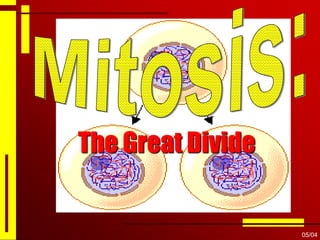
The Great Divide
05/04
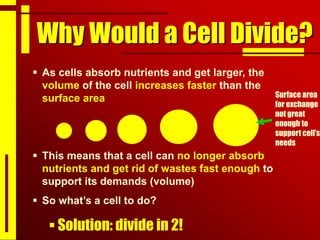
Why Would a Cell Divide?
 As cells absorb nutrients and get larger, the
volume of the cell increases faster than the
surface area
 This means that a cell can no longer absorb
nutrients and get rid of wastes fast enough to
support its demands (volume)
 So what’s a cell to do?
Solution: divide in 2!
Surface area
for exchange
not great
enough to
support cell’s
needs
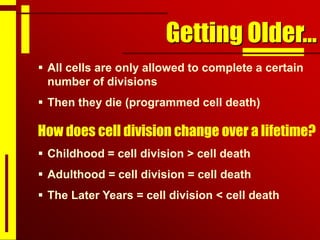
Getting Older…
 All cells are only allowed to complete a certain
number of divisions
 Then they die (programmed cell death)
How does cell division change over a lifetime?
 Childhood = cell division > cell death
 Adulthood = cell division = cell death
 The Later Years = cell division < cell death
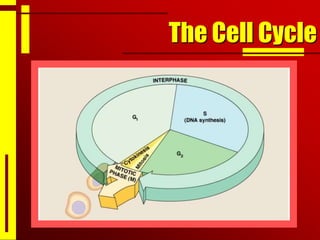
The Cell Cycle
Stages of the Cell Cycle
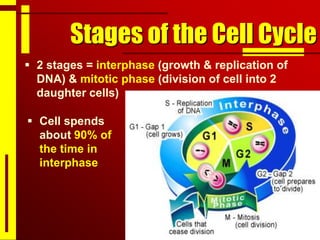
 2 stages = interphase (growth & replication of
DNA) & mitotic phase (division of cell into 2
daughter cells)
 Cell spends
about 90% of
the time in
interphase
Interphase
 Divided into 3 phases:
 G1 (1st gap) = small cell is absorbing nutrients,
growing & doing its job (i.e. making proteins)
 S (synthesis) = cell is continuing to grow &
duplicates its DNA (i.e. chromosomes) in
preparation for making duplicate cells during
mitosis
 G2 (2nd gap) = cell keeps growing & doing its job
(i.e. making proteins); it grows too big…solution
= divide in 2
Mitosis: A Closer Look
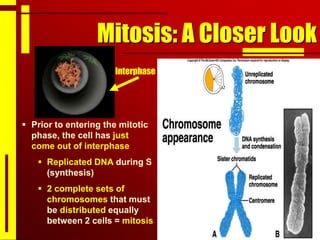
 Prior to entering the mitotic
phase, the cell has just
come out of interphase
 Replicated DNA during S
(synthesis)
 2 complete sets of
chromosomes that must
be distributed equally
between 2 cells = mitosis
Interphase
The Mitotic Phase
 Equal distribution of 2 sets of chromosomes (DNA)
into 2 identical daughter cells
 Divided into 4 stages of Mitosis:
 Prophase
 Metaphase
 Anaphase
 Telophase
 Cytokinesis
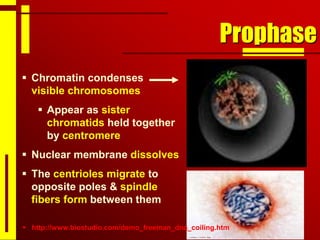
Prophase
 Chromatin condenses
visible chromosomes
 Appear as sister
chromatids held together
by centromere
 Nuclear membrane dissolves
 The centrioles migrate to
opposite poles & spindle
fibers form between them
 http://www.biostudio.com/demo_freeman_dna_coiling.htm
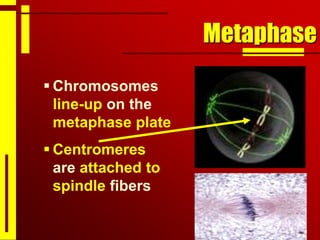
Metaphase
 Chromosomes
line-up on the
metaphase plate
 Centromeres
are attached to
spindle fibers
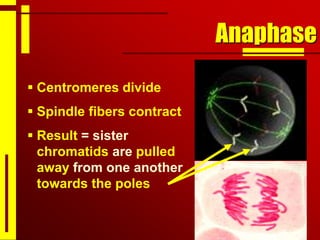
Anaphase
 Centromeres divide
 Spindle fibers contract
 Result = sister
chromatids are pulled
away from one another
towards the poles
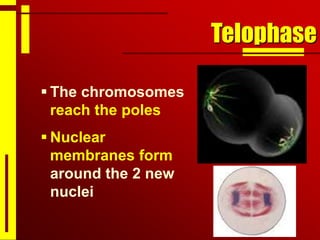
Telophase
 The chromosomes
reach the poles
 Nuclear
membranes form
around the 2 new
nuclei
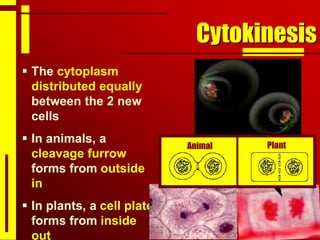
Cytokinesis
 The cytoplasm
distributed equally
between the 2 new
cells
 In animals, a
cleavage furrow
forms from outside
in
 In plants, a cell plate
forms from inside
out
Plant
Animal
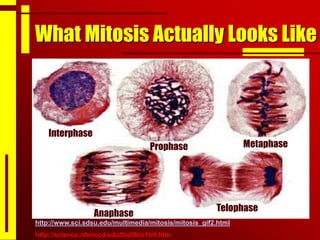
What Mitosis Actually Looks Like
Interphase
Prophase Metaphase
Anaphase
Telophase
http://www.sci.sdsu.edu/multimedia/mitosis/mitosis_gif2.html
http://science.nhmccd.edu/biol/bio1int.htm
Summary of Mitosis
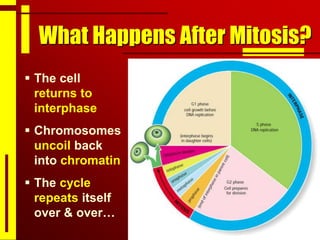
What Happens After Mitosis?
 The cell
returns to
interphase
 Chromosomes
uncoil back
into chromatin
 The cycle
repeats itself
over & over…

Mitosis.ppt

  • 1.
  • 2.
    Why Would aCell Divide?  As cells absorb nutrients and get larger, the volume of the cell increases faster than the surface area  This means that a cell can no longer absorb nutrients and get rid of wastes fast enough to support its demands (volume)  So what’s a cell to do? Solution: divide in 2! Surface area for exchange not great enough to support cell’s needs
  • 3.
    Getting Older…  Allcells are only allowed to complete a certain number of divisions  Then they die (programmed cell death) How does cell division change over a lifetime?  Childhood = cell division > cell death  Adulthood = cell division = cell death  The Later Years = cell division < cell death
  • 4.
  • 5.
    Stages of theCell Cycle  2 stages = interphase (growth & replication of DNA) & mitotic phase (division of cell into 2 daughter cells)  Cell spends about 90% of the time in interphase
  • 6.
    Interphase  Divided into3 phases:  G1 (1st gap) = small cell is absorbing nutrients, growing & doing its job (i.e. making proteins)  S (synthesis) = cell is continuing to grow & duplicates its DNA (i.e. chromosomes) in preparation for making duplicate cells during mitosis  G2 (2nd gap) = cell keeps growing & doing its job (i.e. making proteins); it grows too big…solution = divide in 2
  • 7.
    Mitosis: A CloserLook  Prior to entering the mitotic phase, the cell has just come out of interphase  Replicated DNA during S (synthesis)  2 complete sets of chromosomes that must be distributed equally between 2 cells = mitosis Interphase
  • 8.
    The Mitotic Phase Equal distribution of 2 sets of chromosomes (DNA) into 2 identical daughter cells  Divided into 4 stages of Mitosis:  Prophase  Metaphase  Anaphase  Telophase  Cytokinesis
  • 9.
    Prophase  Chromatin condenses visiblechromosomes  Appear as sister chromatids held together by centromere  Nuclear membrane dissolves  The centrioles migrate to opposite poles & spindle fibers form between them  http://www.biostudio.com/demo_freeman_dna_coiling.htm
  • 10.
    Metaphase  Chromosomes line-up onthe metaphase plate  Centromeres are attached to spindle fibers
  • 11.
    Anaphase  Centromeres divide Spindle fibers contract  Result = sister chromatids are pulled away from one another towards the poles
  • 12.
    Telophase  The chromosomes reachthe poles  Nuclear membranes form around the 2 new nuclei
  • 13.
    Cytokinesis  The cytoplasm distributedequally between the 2 new cells  In animals, a cleavage furrow forms from outside in  In plants, a cell plate forms from inside out Plant Animal
  • 14.
    What Mitosis ActuallyLooks Like Interphase Prophase Metaphase Anaphase Telophase http://www.sci.sdsu.edu/multimedia/mitosis/mitosis_gif2.html http://science.nhmccd.edu/biol/bio1int.htm
  • 15.
  • 16.
    What Happens AfterMitosis?  The cell returns to interphase  Chromosomes uncoil back into chromatin  The cycle repeats itself over & over…