Schokland Agreement IICD and partners:   Making a difference Seminar, Institute of Social Studies 10 June 2008
Vision and mission People are at the heart of our work in development - their needs – their involvement – and their future. IICD envisions a world in which people take responsibility for their own future in a sustainable manner and in which all sectors of society, particularly the poor, can enjoy the benefits of development. Using ICT to empower people, engaging them to improve their living standards and quality of life, is IICD’s mission.
Profile IICD Independent non-profit organisation specialised in ICT for development founded by the Ministry of Foreign Affairs (1996)  Currently involved in Bolivia, Burkina Faso, Ecuador, Ghana, Jamaica, Mali, Tanzania, Uganda and Zambia Focussing on agriculture, education, health, governance and environment Financially supported by Governments, NGO’s & private sector partners
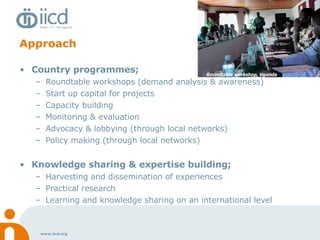
Approach Country programmes;  Roundtable workshops (demand analysis & awareness) Start up capital for projects Capacity building Monitoring & evaluation  Advocacy & lobbying (through local networks) Policy making (through local networks) Knowledge sharing & expertise building; Harvesting and dissemination of experiences Practical research Learning and knowledge sharing on an international level Roundtable workshop, Uganda
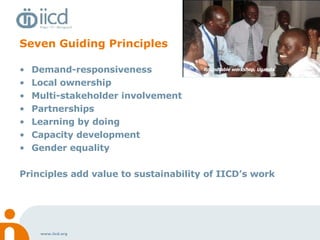
Seven Guiding Principles Demand-responsiveness Local ownership  Multi-stakeholder involvement Partnerships Learning by doing Capacity development Gender equality Principles add value to sustainability of IICD’s work Roundtable workshop, Uganda
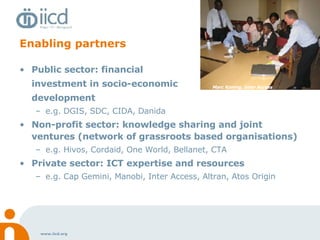
Enabling partners Public sector: financial  investment in socio-economic  development  e.g. DGIS, SDC, CIDA, Danida Non-profit sector: knowledge sharing and joint ventures (network of grassroots based organisations) e.g. Hivos, Cordaid, One World, Bellanet, CTA  Private sector: ICT expertise and resources  e.g. Cap Gemini, Manobi, Inter Access, Altran, Atos Origin  Telecentre, Ghana Marc Koning, Inter Access
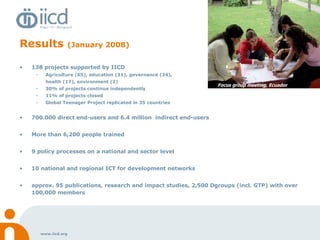
Results  (January 2008) 138 projects supported by IICD Agriculture (65), education (31), governance (24),  health (17), environment (2) 30% of projects continue independently 11% of projects closed  Global Teenager Project replicated in 35 countries 700.000 direct end-users and 6.4 million  indirect end-users More than 6,200 people trained 9 policy processes on a national and sector level 10 national and regional ICT for development networks approx. 95 publications, research and impact studies, 2,500 Dgroups (incl. GTP) with over 100,000 members  Monitoring & evaluation, Burkna Faso Focus group meeting, Ecuador
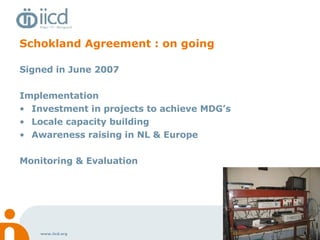
Schokland Agreement : on going Signed in June 2007 Implementation Investment in projects to achieve MDG’s Locale capacity building Awareness raising in NL & Europe Monitoring & Evaluation
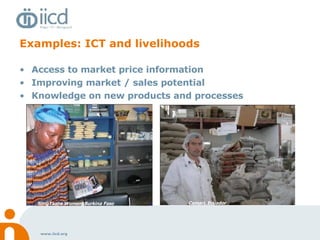
Examples: ICT and livelihoods Access to market price information Improving market / sales potential Knowledge on new products and processes Camari, Ecuador SongTaaba Women, Burkina Faso
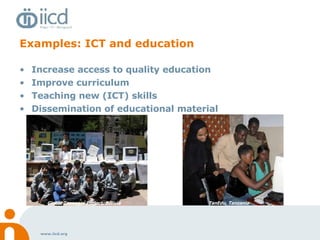
Examples: ICT and education Increase access to quality education Improve curriculum Teaching new (ICT) skills Dissemination of educational material  Global Teenager Project, Bolivia TanEdu, Tanzania
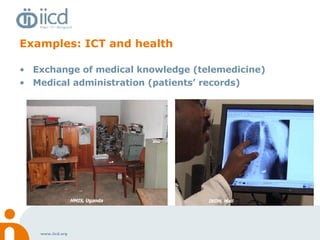
Examples: ICT and health Exchange of medical knowledge (telemedicine) Medical administration (patients’ records) Kinondoni, Tanzania IKON, Mali HMIS, Uganda IKON, Mali
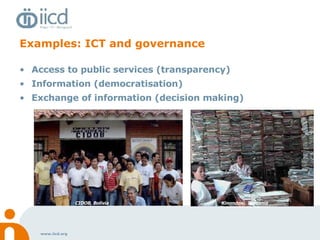
Examples: ICT and governance Access to public services (transparency) Information (democratisation) Exchange of information (decision making) Kinondoni, Tanzania Districtnet, Uganda CIDOB, Bolivia Kinondoni, Tanzania
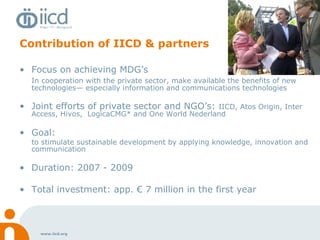
Contribution of IICD & partners Focus on achieving MDG’s In cooperation with the private sector, make available the benefits of new technologies— especially information and communications technologies Joint efforts of private sector and NGO’s:  IICD, Atos Origin, Inter Access, Hivos,  LogicaCMG* and One World Nederland Goal:  to stimulate sustainable development by applying knowledge, innovation and communication Duration: 2007 - 2009 Total investment: app. € 7 million in the first year
IICD partners Atos Origin Learning Solutions Partner of IICD since 2007 (ICT and education) Inter Access Partner of IICD since 2006 (ICT and governance) Hivos Enabling partner since 2000. Collaboration in the field of livelihoods, governance and democratisation. Also: lobbying and awareness raising with regard to ICT4D One World Nederland Partner since 2003. Joint activities to increase the awareness of the general audience for the added value of ICT for sustainable development
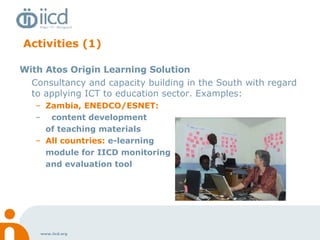
Activities (1) With Atos Origin Learning Solution Consultancy and capacity building in the South with regard to applying ICT to education sector. Examples: Zambia, ENEDCO/ESNET:   content development  of teaching materials  All countries:  e-learning  module for IICD monitoring  and evaluation tool
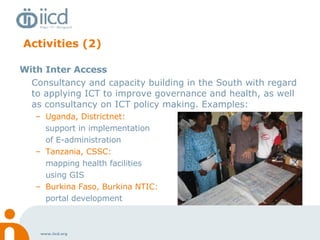
Activities (2) With Inter Access Consultancy and capacity building in the South with regard to applying ICT to improve governance and health, as well as consultancy on ICT policy making. Examples: Uganda, Districtnet:  support in implementation  of E-administration Tanzania, CSSC:  mapping health facilities  using GIS Burkina Faso, Burkina NTIC:   portal development
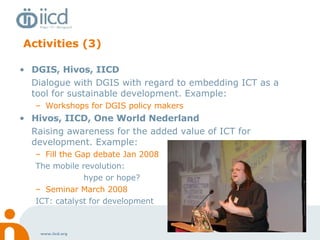
Activities (3) DGIS, Hivos, IICD Dialogue with DGIS with regard to embedding ICT as a tool for sustainable development. Example: Workshops for DGIS policy makers Hivos, IICD, One World Nederland Raising awareness for the added value of ICT for development. Example: Fill the Gap debate Jan 2008 The mobile revolution:  hype or hope? Seminar March 2008 ICT: catalyst for development
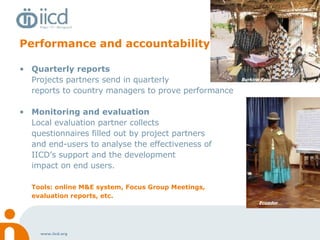
Performance and accountability Quarterly reports Projects partners send in quarterly  reports to country managers to prove performance Monitoring and evaluation Local evaluation partner collects  questionnaires filled out by project partners  and end-users to analyse the effectiveness of  IICD’s support and the development  impact on end users.  Tools: online M&E system, Focus Group Meetings,  evaluation reports, etc. Burkina Faso Ecuador
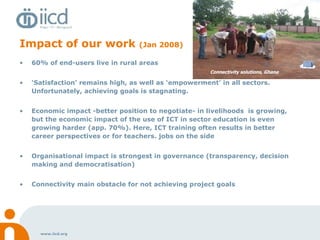
Impact of our work  (Jan 2008) 60% of end-users live in rural areas ‘ Satisfaction’ remains high, as well as ‘empowerment’ in all sectors. Unfortunately, achieving goals is stagnating. Economic impact -better position to negotiate- in livelihoods  is growing, but the economic impact of the use of ICT in sector education is even growing harder (app. 70%). Here, ICT training often results in better career perspectives or for teachers. jobs on the side Organisational impact is strongest in governance (transparency, decision making and democratisation)  Connectivity main obstacle for not achieving project goals Connectivity solutions, Ghana
 
 
ICT and development is all about  people  It is not about technology, it is about getting  connected It is about  empowerment , so people can shape their own future It is about  partnerships : together, we can make a world of difference People – ICT – Development

Schokland Agreement: IICD and partners making a difference

  • 1.
    Schokland Agreement IICDand partners: Making a difference Seminar, Institute of Social Studies 10 June 2008
  • 2.
    Vision and missionPeople are at the heart of our work in development - their needs – their involvement – and their future. IICD envisions a world in which people take responsibility for their own future in a sustainable manner and in which all sectors of society, particularly the poor, can enjoy the benefits of development. Using ICT to empower people, engaging them to improve their living standards and quality of life, is IICD’s mission.
  • 3.
    Profile IICD Independentnon-profit organisation specialised in ICT for development founded by the Ministry of Foreign Affairs (1996) Currently involved in Bolivia, Burkina Faso, Ecuador, Ghana, Jamaica, Mali, Tanzania, Uganda and Zambia Focussing on agriculture, education, health, governance and environment Financially supported by Governments, NGO’s & private sector partners
  • 4.
    Approach Country programmes; Roundtable workshops (demand analysis & awareness) Start up capital for projects Capacity building Monitoring & evaluation Advocacy & lobbying (through local networks) Policy making (through local networks) Knowledge sharing & expertise building; Harvesting and dissemination of experiences Practical research Learning and knowledge sharing on an international level Roundtable workshop, Uganda
  • 5.
    Seven Guiding PrinciplesDemand-responsiveness Local ownership Multi-stakeholder involvement Partnerships Learning by doing Capacity development Gender equality Principles add value to sustainability of IICD’s work Roundtable workshop, Uganda
  • 6.
    Enabling partners Publicsector: financial investment in socio-economic development e.g. DGIS, SDC, CIDA, Danida Non-profit sector: knowledge sharing and joint ventures (network of grassroots based organisations) e.g. Hivos, Cordaid, One World, Bellanet, CTA Private sector: ICT expertise and resources e.g. Cap Gemini, Manobi, Inter Access, Altran, Atos Origin Telecentre, Ghana Marc Koning, Inter Access
  • 7.
    Results (January2008) 138 projects supported by IICD Agriculture (65), education (31), governance (24), health (17), environment (2) 30% of projects continue independently 11% of projects closed Global Teenager Project replicated in 35 countries 700.000 direct end-users and 6.4 million indirect end-users More than 6,200 people trained 9 policy processes on a national and sector level 10 national and regional ICT for development networks approx. 95 publications, research and impact studies, 2,500 Dgroups (incl. GTP) with over 100,000 members Monitoring & evaluation, Burkna Faso Focus group meeting, Ecuador
  • 8.
    Schokland Agreement :on going Signed in June 2007 Implementation Investment in projects to achieve MDG’s Locale capacity building Awareness raising in NL & Europe Monitoring & Evaluation
  • 9.
    Examples: ICT andlivelihoods Access to market price information Improving market / sales potential Knowledge on new products and processes Camari, Ecuador SongTaaba Women, Burkina Faso
  • 10.
    Examples: ICT andeducation Increase access to quality education Improve curriculum Teaching new (ICT) skills Dissemination of educational material Global Teenager Project, Bolivia TanEdu, Tanzania
  • 11.
    Examples: ICT andhealth Exchange of medical knowledge (telemedicine) Medical administration (patients’ records) Kinondoni, Tanzania IKON, Mali HMIS, Uganda IKON, Mali
  • 12.
    Examples: ICT andgovernance Access to public services (transparency) Information (democratisation) Exchange of information (decision making) Kinondoni, Tanzania Districtnet, Uganda CIDOB, Bolivia Kinondoni, Tanzania
  • 13.
    Contribution of IICD& partners Focus on achieving MDG’s In cooperation with the private sector, make available the benefits of new technologies— especially information and communications technologies Joint efforts of private sector and NGO’s: IICD, Atos Origin, Inter Access, Hivos, LogicaCMG* and One World Nederland Goal: to stimulate sustainable development by applying knowledge, innovation and communication Duration: 2007 - 2009 Total investment: app. € 7 million in the first year
  • 14.
    IICD partners AtosOrigin Learning Solutions Partner of IICD since 2007 (ICT and education) Inter Access Partner of IICD since 2006 (ICT and governance) Hivos Enabling partner since 2000. Collaboration in the field of livelihoods, governance and democratisation. Also: lobbying and awareness raising with regard to ICT4D One World Nederland Partner since 2003. Joint activities to increase the awareness of the general audience for the added value of ICT for sustainable development
  • 15.
    Activities (1) WithAtos Origin Learning Solution Consultancy and capacity building in the South with regard to applying ICT to education sector. Examples: Zambia, ENEDCO/ESNET: content development of teaching materials All countries: e-learning module for IICD monitoring and evaluation tool
  • 16.
    Activities (2) WithInter Access Consultancy and capacity building in the South with regard to applying ICT to improve governance and health, as well as consultancy on ICT policy making. Examples: Uganda, Districtnet: support in implementation of E-administration Tanzania, CSSC: mapping health facilities using GIS Burkina Faso, Burkina NTIC: portal development
  • 17.
    Activities (3) DGIS,Hivos, IICD Dialogue with DGIS with regard to embedding ICT as a tool for sustainable development. Example: Workshops for DGIS policy makers Hivos, IICD, One World Nederland Raising awareness for the added value of ICT for development. Example: Fill the Gap debate Jan 2008 The mobile revolution: hype or hope? Seminar March 2008 ICT: catalyst for development
  • 18.
    Performance and accountabilityQuarterly reports Projects partners send in quarterly reports to country managers to prove performance Monitoring and evaluation Local evaluation partner collects questionnaires filled out by project partners and end-users to analyse the effectiveness of IICD’s support and the development impact on end users. Tools: online M&E system, Focus Group Meetings, evaluation reports, etc. Burkina Faso Ecuador
  • 19.
    Impact of ourwork (Jan 2008) 60% of end-users live in rural areas ‘ Satisfaction’ remains high, as well as ‘empowerment’ in all sectors. Unfortunately, achieving goals is stagnating. Economic impact -better position to negotiate- in livelihoods is growing, but the economic impact of the use of ICT in sector education is even growing harder (app. 70%). Here, ICT training often results in better career perspectives or for teachers. jobs on the side Organisational impact is strongest in governance (transparency, decision making and democratisation) Connectivity main obstacle for not achieving project goals Connectivity solutions, Ghana
  • 20.
  • 21.
  • 22.
    ICT and developmentis all about people It is not about technology, it is about getting connected It is about empowerment , so people can shape their own future It is about partnerships : together, we can make a world of difference People – ICT – Development