Denise Besai
Project Coordinator,CARDI
ICTObservatory Meeting – Strengthening e-agriculture strategies in ACP countries
24-26 April, 2013
The Netherlands
 AboutCARDI
 ICTs in the agricultural Research Process
 Knowledge sharing and collaboration tools in the
Agricultural Research Cycle
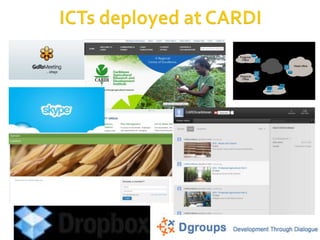
 ICTs deployed at CARDI
 Challenges to ICT Deployment at CARDI
 Early Initiatives
 What has CARDI been doing….
 Project: Using ICTs to strengthen agricultural value chains in
the Caribbean
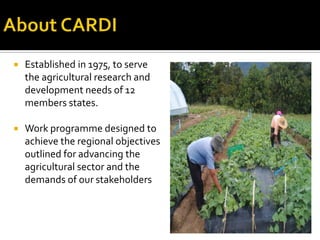
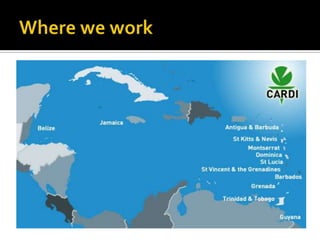
 Established in 1975, to serve
the agricultural research and
development needs of 12
members states.
 Work programme designed to
achieve the regional objectives
outlined for advancing the
agricultural sector and the
demands of our stakeholders
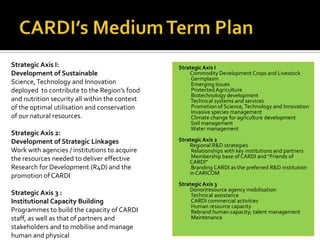
Strategic Axis I:
Development of Sustainable
Science, Technology and Innovation
deployed to contribute to the Region’s food
and nutrition security all within the context
of the optimal utilisation and conservation
of our natural resources.
Strategic Axis 2:
Development of Strategic Linkages
Work with agencies / institutions to acquire
the resources needed to deliver effective
Research for Development (R4D) and the
promotion of CARDI
Strategic Axis 3 :
Institutional Capacity Building
Programmes to build the capacity of CARDI
staff, as well as that of partners and
stakeholders and to mobilise and manage
human and physical
Strategic Axis I
 Commodity Development Crops and Livestock
 Germplasm
 Emerging Issues
 Protected Agriculture
 Biotechnology development
 Technical systems and services
 Promotion of Science,Technology and Innovation
 Invasive species management
 Climate change for agriculture development
 Soil management
 Water management
Strategic Axis 2
 Regional R&D strategies
 Relationships with key institutions and partners
 Membership base of CARDI and “Friends of
CARDI”
 Branding CARDI as the preferred R&D institution
in CARICOM
Strategic Axis 3
 Donor/resource agency mobilisation
 Technical assistance
 CARDI commercial activities
 Human resource capacity
 Rebrand human capacity; talent management
 Maintenance
 Information and CommunicationTechnologies:
 Makes the research process more inclusive and focused
 Facilitates greater collaboration (conceptualization,
application of results)
 Facilitates access to data, information and knowledge
 Enables the sharing of research results , knowledge
 Encourages participation decision making process
Definition:
Information and Communication Technologies (ICTs) can be
described as a combination of hardware, software and the means
of production that enable the exchange, processing and
management of information and knowledge
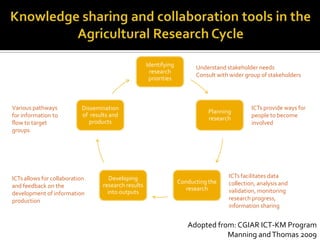
Identifying
research
priorities
Planning
research
Conducting the
research
Developing
research results
into outputs
Dissemination
of results and
products
Understand stakeholder needs
Consult with wider group of stakeholders
ICTs provide ways for
people to become
involved
ICTs facilitates data
collection, analysis and
validation, monitoring
research progress,
information sharing
ICTs allows for collaboration
and feedback on the
development of information
production
Various pathways
for information to
flow to target
groups
Adopted from: CGIAR ICT-KM Program
Manning andThomas 2009
 Inadequate financial resources
 Inadequate human capacity
 Retaining ICT expertise is difficult
 Outsource a number of critical activities: website maintenance,
upgrade and maintenance of infrastructure
 Lack of awareness of new and emerging tools/applications etc.
 Lack of investment in ICT by CARDI cripples researchers from
adopting and using ICT
 Data generated – info. Generated from donor funded not available
to the public – ownership, confidentiality
 Political – need to respond to political directorate. If they don’t see
the need for ICTs then incorporating tools and applications may not
be very easy…
 CAIS (Caribbean Agricultural Information Service)
Designed to provide access to timely, accurate, relevant and
current agricultural information to stakeholders. At the
national level focused on collecting, analysing and
repackaging information.
 Procicaribe (Program for Cooperation of Institutes of
Agricultural Science andTechnology in the Caribbean)
This network linked different agricultural services together
in the Caribbean. It was established with support from
CARDI, IDB, and IICA in 1996. Each regional network had a
regional coordinator and a group of national coordinators
representing the national
programs.
Project Design :
Google docs, email and Skype
E-Discussion (Pre-Workshop):
D-groups platform, to elicit feedback from a diverse range of stakeholders
Workshop :
40 participants, workshop streamed over the internet, proceedings available on
CARDI website, media reports generated and broadcasted across all forms of
the regional media (radio, tv, newspaper)
Development of Policy Briefs
Drafts discussed via GoTo Meeting, usedWeb 2.0 tools to review and finalise
drafts, Policy Briefs and all information generated during the project
available online
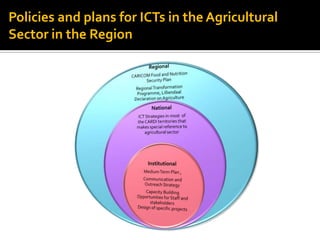
Policies and plans for ICTs in the Agricultural
Sector in the Region
 MediumTerm Plan
 Outreach and communication strategy
 Internal communication
 Strengthen the “weak” linkages between research and
extension
 Capacity building measures with international partners and
the private sector
 Continue to lobby for funding to improve agricultural
information and communication management
 Increased investment in the ICT infrastructure and tools
 Development of Policy Options and engaging on Policy
Dialogue to encourage the adoption of ICTs in agricultural
research
 Deliberately designing and implementing appropriate and
sustainable ICT components in agricultural research and
development projects
 Monitoring and Evaluation (M+E) Unit at CARDI to evaluate
the impact of projects
 A 2 year project that will help us to better understand
ICT uses in agricultural value chains in the Caribbean.
 Activities
 Stakeholder consultation
 ICT Study of the Roots andTubers and Small RuminantsValue
Chain (identify innovative models, projects and recommendations
that can be later shared with other ACP Regions)
 Policy Brief Development
 Media Relations to make public the progress of the project and
the results
 Elements of an e-agriculture strategy will be
identified in the Synthesis report
Factors to be considered:
 Role of youth and women and disenfranchised groups
 Role of the private sector
 Policy environment and ways of strengthening it
 Investment
 Content management – dealing with traditional
knowledge and grassroots groups
Thank you
www.cardi.org
Improving lives through agricultural research

CARDI Presentation

  • 1.
    Denise Besai Project Coordinator,CARDI ICTObservatoryMeeting – Strengthening e-agriculture strategies in ACP countries 24-26 April, 2013 The Netherlands
  • 2.
     AboutCARDI  ICTsin the agricultural Research Process  Knowledge sharing and collaboration tools in the Agricultural Research Cycle  ICTs deployed at CARDI  Challenges to ICT Deployment at CARDI  Early Initiatives  What has CARDI been doing….  Project: Using ICTs to strengthen agricultural value chains in the Caribbean
  • 3.
     Established in1975, to serve the agricultural research and development needs of 12 members states.  Work programme designed to achieve the regional objectives outlined for advancing the agricultural sector and the demands of our stakeholders
  • 5.
    Strategic Axis I: Developmentof Sustainable Science, Technology and Innovation deployed to contribute to the Region’s food and nutrition security all within the context of the optimal utilisation and conservation of our natural resources. Strategic Axis 2: Development of Strategic Linkages Work with agencies / institutions to acquire the resources needed to deliver effective Research for Development (R4D) and the promotion of CARDI Strategic Axis 3 : Institutional Capacity Building Programmes to build the capacity of CARDI staff, as well as that of partners and stakeholders and to mobilise and manage human and physical Strategic Axis I  Commodity Development Crops and Livestock  Germplasm  Emerging Issues  Protected Agriculture  Biotechnology development  Technical systems and services  Promotion of Science,Technology and Innovation  Invasive species management  Climate change for agriculture development  Soil management  Water management Strategic Axis 2  Regional R&D strategies  Relationships with key institutions and partners  Membership base of CARDI and “Friends of CARDI”  Branding CARDI as the preferred R&D institution in CARICOM Strategic Axis 3  Donor/resource agency mobilisation  Technical assistance  CARDI commercial activities  Human resource capacity  Rebrand human capacity; talent management  Maintenance
  • 6.
     Information andCommunicationTechnologies:  Makes the research process more inclusive and focused  Facilitates greater collaboration (conceptualization, application of results)  Facilitates access to data, information and knowledge  Enables the sharing of research results , knowledge  Encourages participation decision making process Definition: Information and Communication Technologies (ICTs) can be described as a combination of hardware, software and the means of production that enable the exchange, processing and management of information and knowledge
  • 7.
    Identifying research priorities Planning research Conducting the research Developing research results intooutputs Dissemination of results and products Understand stakeholder needs Consult with wider group of stakeholders ICTs provide ways for people to become involved ICTs facilitates data collection, analysis and validation, monitoring research progress, information sharing ICTs allows for collaboration and feedback on the development of information production Various pathways for information to flow to target groups Adopted from: CGIAR ICT-KM Program Manning andThomas 2009
  • 9.
     Inadequate financialresources  Inadequate human capacity  Retaining ICT expertise is difficult  Outsource a number of critical activities: website maintenance, upgrade and maintenance of infrastructure  Lack of awareness of new and emerging tools/applications etc.  Lack of investment in ICT by CARDI cripples researchers from adopting and using ICT  Data generated – info. Generated from donor funded not available to the public – ownership, confidentiality  Political – need to respond to political directorate. If they don’t see the need for ICTs then incorporating tools and applications may not be very easy…
  • 10.
     CAIS (CaribbeanAgricultural Information Service) Designed to provide access to timely, accurate, relevant and current agricultural information to stakeholders. At the national level focused on collecting, analysing and repackaging information.  Procicaribe (Program for Cooperation of Institutes of Agricultural Science andTechnology in the Caribbean) This network linked different agricultural services together in the Caribbean. It was established with support from CARDI, IDB, and IICA in 1996. Each regional network had a regional coordinator and a group of national coordinators representing the national programs.
  • 11.
    Project Design : Googledocs, email and Skype E-Discussion (Pre-Workshop): D-groups platform, to elicit feedback from a diverse range of stakeholders Workshop : 40 participants, workshop streamed over the internet, proceedings available on CARDI website, media reports generated and broadcasted across all forms of the regional media (radio, tv, newspaper) Development of Policy Briefs Drafts discussed via GoTo Meeting, usedWeb 2.0 tools to review and finalise drafts, Policy Briefs and all information generated during the project available online
  • 12.
    Policies and plansfor ICTs in the Agricultural Sector in the Region
  • 13.
     MediumTerm Plan Outreach and communication strategy  Internal communication  Strengthen the “weak” linkages between research and extension  Capacity building measures with international partners and the private sector  Continue to lobby for funding to improve agricultural information and communication management  Increased investment in the ICT infrastructure and tools  Development of Policy Options and engaging on Policy Dialogue to encourage the adoption of ICTs in agricultural research
  • 14.
     Deliberately designingand implementing appropriate and sustainable ICT components in agricultural research and development projects  Monitoring and Evaluation (M+E) Unit at CARDI to evaluate the impact of projects
  • 15.
     A 2year project that will help us to better understand ICT uses in agricultural value chains in the Caribbean.  Activities  Stakeholder consultation  ICT Study of the Roots andTubers and Small RuminantsValue Chain (identify innovative models, projects and recommendations that can be later shared with other ACP Regions)  Policy Brief Development  Media Relations to make public the progress of the project and the results
  • 16.
     Elements ofan e-agriculture strategy will be identified in the Synthesis report Factors to be considered:  Role of youth and women and disenfranchised groups  Role of the private sector  Policy environment and ways of strengthening it  Investment  Content management – dealing with traditional knowledge and grassroots groups
  • 17.
    Thank you www.cardi.org Improving livesthrough agricultural research