World Bank Institute
Innovations in Governance Team
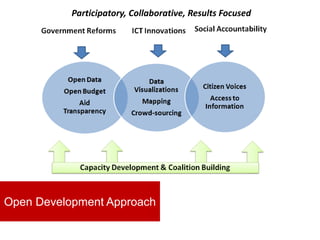
Participatory, Collaborative, Results Focused


Open Development Approach
Transparency and accountability
    •   Transparency
        -- “any attempts (by states or citizens) to place information or processes that
        were previously opaque in the public domain, accessible for use by citizen
        groups, providers or policy makers.” (Joshi, 2010, p.3)
        - Availability, accessibility, usability
        - For some fact, information, or process to be transparent is for it to be open
        and available for examination and scrutiny.

    •   Accountability
        - Answerability of government to the public on its performance
        - Making public sector staff more accountable for their decisions and
        actions.


   Transparency does not
always lead to accountability
Transparency but no Accountability
 • Accountability depends on
    – Degree of political will
    – Degree of pressure on government (national as well
      as international)-who are they answerable to?)
    – Civil society and media capability
    – Presence of free media
    – None of these are ICT issues


Factors necessary for
   Accountability
http://maps.worldbank.org


Enhance Transparency and
   Citizen Engagement
    for Better Results
Easy Access to Project &
     Results Data
Poverty Alleviation Fund
Mapping at the Local Community Level
Georesults
http://maps.worldbank.org/content/georesults


                            AFR         Ethiopia, Kenya, Rwanda
                      • 3 project
                      • 23 Activities


                            EAP         Philippines, Vietnam
                      • 9 projects
                      • 16 Activities


                            ECA         Georgia
                      • 1 project
                      • 11 Activities


                            LAC         Bolivia
                      • 1 Project
                      • 13 Activities


                             SA         Afghanistan, Nepal
                      • 6 projects
                      • 13 Activities
Local Content Drives Feedback
OnTrack- Citizen Feedback
        Platform
Factors necessary for
   Accountability
Know choices and
                           influence change

        Empowered                               Responsive
          People                                 Providers

                             To improve
   Reflect citizen voice
                           quality of service    Provide information
                                                 on performance
       in policymaking

                              Informed
                           Decision Makers


Closing the feedback loop
Monitoring –
             Complaints –     Users assess
            User-identified    predefined
              problems        performance
                                  goals


             Suggestions –    Satisfaction –
            User-identified    Users assess
              methods to        quality of
               improve           services
            service process     provided


Typology of feedback
 collected in Projects
Project                Feedback
                              Cycle                   Type
                             CAS, Identification,
                               Preparation,
                                                      Suggestions
                              Appraisal, Board
                                  Approval


                             Implementation &
                                                      Complaints
                                Supervision


                             Implementation &
                                                      Monitoring
                                Completion


                                 Evaluation           Satisfaction


Where in the project cycle
do we collect feedback?
Visualizing the Results
Nepal- On Track platform
Feedback on specific
  Project activities
Feedback through
multiple channels
Bolivia: La Paz- Urban
  Upgrading Project
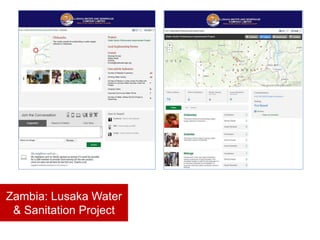
Zambia: Lusaka Water
 & Sanitation Project
Factors for Success
Knowledge


Documenting what we are
      learning
                  Mapping for Results, Kenya
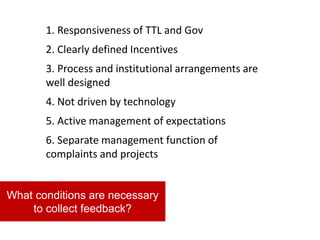
1. Responsiveness of TTL and Gov
       2. Clearly defined Incentives
       3. Process and institutional arrangements are
       well designed
       4. Not driven by technology
       5. Active management of expectations
       6. Separate management function of
       complaints and projects


What conditions are necessary
    to collect feedback?
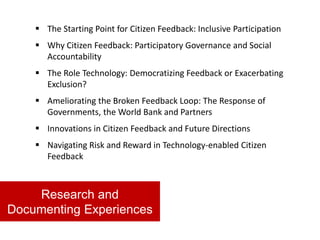
 The Starting Point for Citizen Feedback: Inclusive Participation
     Why Citizen Feedback: Participatory Governance and Social
      Accountability
     The Role Technology: Democratizing Feedback or Exacerbating
      Exclusion?
     Ameliorating the Broken Feedback Loop: The Response of
      Governments, the World Bank and Partners
     Innovations in Citizen Feedback and Future Directions
     Navigating Risk and Reward in Technology-enabled Citizen
      Feedback


    Research and
Documenting Experiences
Empowered Citizens
Bjorn-Soren Gigler
    bgigler@worldbank.org
        Kaushal Jhalla
    Kjhalla@worldbank.org

        Elena Bertusi
       Reena Shresta
      Alexandra Endara


      World Bank Institute
Innovations in Governance Team

On Track ICT- Enabled Citizen Feedback loops

  • 1.
  • 2.
    Participatory, Collaborative, ResultsFocused Open Development Approach
  • 3.
    Transparency and accountability • Transparency -- “any attempts (by states or citizens) to place information or processes that were previously opaque in the public domain, accessible for use by citizen groups, providers or policy makers.” (Joshi, 2010, p.3) - Availability, accessibility, usability - For some fact, information, or process to be transparent is for it to be open and available for examination and scrutiny. • Accountability - Answerability of government to the public on its performance - Making public sector staff more accountable for their decisions and actions. Transparency does not always lead to accountability
  • 4.
    Transparency but noAccountability • Accountability depends on – Degree of political will – Degree of pressure on government (national as well as international)-who are they answerable to?) – Civil society and media capability – Presence of free media – None of these are ICT issues Factors necessary for Accountability
  • 5.
    http://maps.worldbank.org Enhance Transparency and Citizen Engagement for Better Results
  • 6.
    Easy Access toProject & Results Data
  • 7.
    Poverty Alleviation Fund Mappingat the Local Community Level
  • 8.
    Georesults http://maps.worldbank.org/content/georesults AFR Ethiopia, Kenya, Rwanda • 3 project • 23 Activities EAP Philippines, Vietnam • 9 projects • 16 Activities ECA Georgia • 1 project • 11 Activities LAC Bolivia • 1 Project • 13 Activities SA Afghanistan, Nepal • 6 projects • 13 Activities
  • 9.
  • 10.
  • 11.
    Factors necessary for Accountability
  • 12.
    Know choices and influence change Empowered Responsive People Providers To improve Reflect citizen voice quality of service Provide information on performance in policymaking Informed Decision Makers Closing the feedback loop
  • 13.
    Monitoring – Complaints – Users assess User-identified predefined problems performance goals Suggestions – Satisfaction – User-identified Users assess methods to quality of improve services service process provided Typology of feedback collected in Projects
  • 14.
    Project Feedback Cycle Type CAS, Identification, Preparation, Suggestions Appraisal, Board Approval Implementation & Complaints Supervision Implementation & Monitoring Completion Evaluation Satisfaction Where in the project cycle do we collect feedback?
  • 15.
  • 16.
  • 17.
    Feedback on specific Project activities
  • 18.
  • 19.
    Bolivia: La Paz-Urban Upgrading Project
  • 20.
    Zambia: Lusaka Water & Sanitation Project
  • 21.
  • 22.
    Knowledge Documenting what weare learning Mapping for Results, Kenya
  • 23.
    1. Responsiveness ofTTL and Gov 2. Clearly defined Incentives 3. Process and institutional arrangements are well designed 4. Not driven by technology 5. Active management of expectations 6. Separate management function of complaints and projects What conditions are necessary to collect feedback?
  • 24.
     The StartingPoint for Citizen Feedback: Inclusive Participation  Why Citizen Feedback: Participatory Governance and Social Accountability  The Role Technology: Democratizing Feedback or Exacerbating Exclusion?  Ameliorating the Broken Feedback Loop: The Response of Governments, the World Bank and Partners  Innovations in Citizen Feedback and Future Directions  Navigating Risk and Reward in Technology-enabled Citizen Feedback Research and Documenting Experiences
  • 25.
  • 26.
    Bjorn-Soren Gigler bgigler@worldbank.org Kaushal Jhalla Kjhalla@worldbank.org Elena Bertusi Reena Shresta Alexandra Endara World Bank Institute Innovations in Governance Team