E-Inclusion and Media  for Indigenous Peoples Roger Harris Associates Roger W. Harris PhD Roger Harris Associates Hong Kong UNDP Workshop on E-Inclusion and Media for Indigenous Peoples The e-Bario Knowledge Fair 6-8 December 2007 6-8 December 2007 6-8 December 2007 6-8 December 2007 6-8 December 2007 6-8 December 2007 6-8 December 2007
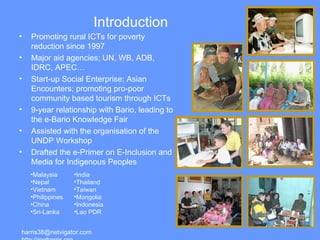
Introduction Malaysia Nepal Vietnam Philippines China Sri-Lanka India Thailand Taiwan Mongolia Indonesia Lao PDR harris38@netvigator.com  http://rogharris.org Promoting rural ICTs for poverty reduction since 1997 Major aid agencies; UN, WB, ADB, IDRC, APEC… Start-up Social Enterprise; Asian Encounters; promoting pro-poor community based tourism through ICTs 9-year relationship with Bario, leading to the e-Bario Knowledge Fair Assisted with the organisation of the UNDP Workshop Drafted the e-Primer on  E-Inclusion and Media for Indigenous Peoples
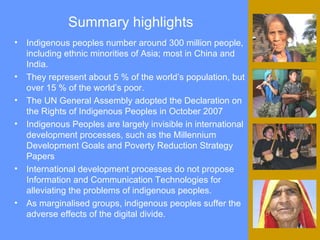
Summary highlights Indigenous peoples number around 300 million people, including ethnic minorities of Asia; most in China and India. They represent about 5 % of the world’s population, but over 15 % of the world’s poor.  The UN General Assembly adopted the Declaration on the Rights of Indigenous Peoples in October 2007   Indigenous Peoples are largely invisible in international development processes, such as the Millennium Development Goals and Poverty Reduction Strategy Papers International development processes  do not propose Information and Communication Technologies for alleviating the problems of indigenous peoples. As marginalised groups, indigenous peoples suffer the adverse effects of the digital divide.
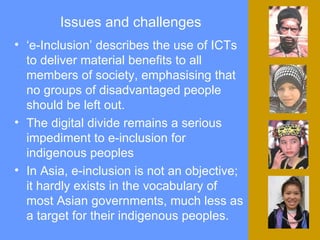
Issues and challenges ‘ e-Inclusion’ describes the use of ICTs to deliver material benefits to all members of society, emphasising that no groups of disadvantaged people should be left out.  The digital divide remains a serious impediment to e-inclusion for indigenous peoples  In Asia, e-inclusion is not an objective; it hardly exists in the vocabulary of most Asian governments, much less as a target for their indigenous peoples.
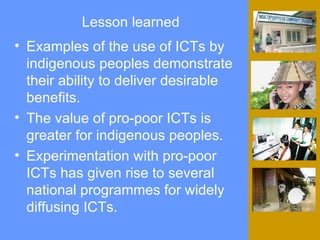
Lesson learned Examples of the use of ICTs by indigenous peoples demonstrate their ability to deliver desirable benefits. The value of pro-poor ICTs is greater for indigenous peoples.  Experimentation with pro-poor ICTs has given rise to several national programmes for widely diffusing ICTs.
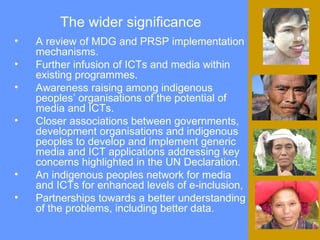
The wider significance A review of MDG and PRSP implementation mechanisms. Further infusion of ICTs and media within existing programmes. Awareness raising among indigenous peoples’ organisations of the potential of media and ICTs. Closer associations between governments, development organisations and indigenous peoples to develop and implement generic media and ICT applications addressing key concerns highlighted in the UN Declaration. An indigenous peoples network for media and ICTs for enhanced levels of e-inclusion, Partnerships towards a better understanding of the problems, including better data.
Thank you Roger Harris Associates Roger W. Harris PhD Roger Harris Associates Hong Kong UNDP Workshop on E-Inclusion and Media for Indigenous Peoples The e-Bario Knowledge Fair 6-8 December 2007

B. Roger Harris E Inclusion For Indigenous Peoples

  • 1.
    E-Inclusion and Media for Indigenous Peoples Roger Harris Associates Roger W. Harris PhD Roger Harris Associates Hong Kong UNDP Workshop on E-Inclusion and Media for Indigenous Peoples The e-Bario Knowledge Fair 6-8 December 2007 6-8 December 2007 6-8 December 2007 6-8 December 2007 6-8 December 2007 6-8 December 2007 6-8 December 2007
  • 2.
    Introduction Malaysia NepalVietnam Philippines China Sri-Lanka India Thailand Taiwan Mongolia Indonesia Lao PDR harris38@netvigator.com http://rogharris.org Promoting rural ICTs for poverty reduction since 1997 Major aid agencies; UN, WB, ADB, IDRC, APEC… Start-up Social Enterprise; Asian Encounters; promoting pro-poor community based tourism through ICTs 9-year relationship with Bario, leading to the e-Bario Knowledge Fair Assisted with the organisation of the UNDP Workshop Drafted the e-Primer on E-Inclusion and Media for Indigenous Peoples
  • 3.
    Summary highlights Indigenouspeoples number around 300 million people, including ethnic minorities of Asia; most in China and India. They represent about 5 % of the world’s population, but over 15 % of the world’s poor. The UN General Assembly adopted the Declaration on the Rights of Indigenous Peoples in October 2007 Indigenous Peoples are largely invisible in international development processes, such as the Millennium Development Goals and Poverty Reduction Strategy Papers International development processes do not propose Information and Communication Technologies for alleviating the problems of indigenous peoples. As marginalised groups, indigenous peoples suffer the adverse effects of the digital divide.
  • 4.
    Issues and challenges‘ e-Inclusion’ describes the use of ICTs to deliver material benefits to all members of society, emphasising that no groups of disadvantaged people should be left out. The digital divide remains a serious impediment to e-inclusion for indigenous peoples In Asia, e-inclusion is not an objective; it hardly exists in the vocabulary of most Asian governments, much less as a target for their indigenous peoples.
  • 5.
    Lesson learned Examplesof the use of ICTs by indigenous peoples demonstrate their ability to deliver desirable benefits. The value of pro-poor ICTs is greater for indigenous peoples. Experimentation with pro-poor ICTs has given rise to several national programmes for widely diffusing ICTs.
  • 6.
    The wider significanceA review of MDG and PRSP implementation mechanisms. Further infusion of ICTs and media within existing programmes. Awareness raising among indigenous peoples’ organisations of the potential of media and ICTs. Closer associations between governments, development organisations and indigenous peoples to develop and implement generic media and ICT applications addressing key concerns highlighted in the UN Declaration. An indigenous peoples network for media and ICTs for enhanced levels of e-inclusion, Partnerships towards a better understanding of the problems, including better data.
  • 7.
    Thank you RogerHarris Associates Roger W. Harris PhD Roger Harris Associates Hong Kong UNDP Workshop on E-Inclusion and Media for Indigenous Peoples The e-Bario Knowledge Fair 6-8 December 2007