ICTs for Education 
P.O. Box 11586 
2502 AN The Hague 
The Netherlands 
visitors address: 
Raamweg 5 
2596 HL The Hague 
The Netherlands 
T. +31 (0)70 - 311 73 11 
F. +31 (0)70 - 311 73 22 
E. information@iicd.org 
www.iicd.org 
People - ICT - Development 
Impact and lessons learned from IICD-supported activities 
This impact study is part of a series of publications on the use of Information and 
Communication Technology (ICT) in various sectors in developing countries. It describes 
the experiences, achievements and lessons learned of the International Institute for 
Communication and Development (IICD) and its partners in using Information and 
Communication Technology (ICT) to enhance education through thirty-two projects and 
ICT policy processes over eight years in Jamaica, Bolivia, Zambia, Burkina Faso, Mali, 
Ghana, Tanzania and Uganda.
ICTs for Education 
Impact and lessons learned from IICD-supported activities
Foreword 
This impact study is part of a series of publications on the use of Information and 
Communication Technology (ICT) in various sectors in developing countries. It describes 
the experiences, achievements and lessons learned of the International Institute for 
Communication and Development (IICD) and its partners in using ICT to enhance 
education through thirty-two projects and ICT policy processes over eight years in 
Jamaica, Bolivia, Zambia, Burkina Faso, Mali, Ghana, Tanzania and Uganda. 
The education sector is crucial for developing the human capital of countries to innovate 
and find solutions for sustained and equitable growth. ICT can be used to improve the 
quality of education by enhancing educational content development, supporting 
administrative processes in schools and other educational establishments, and 
increasing access to education for both teachers and pupils via distance learning. It 
offers opportunities for students and young people, particularly those living in rural 
communities, to broaden their horizons and improve their employment prospects. 
To achieve this, IICD has supported its partners in the South in their efforts to integrate 
appropriate ICTs through a wide variety of education projects that cover areas such as 
teacher training, the development of teaching materials, and educative administration at 
primary, secondary and tertiary levels in Bolivia, Burkina Faso, Ghana, Jamaica, Uganda, 
Tanzania and Zambia. In addition to this, IICD and its partners have also assisted the 
national government in a number of countries with the development of ICT policies 
and strategies. 
This impact study highlights the projects’ achievements and describes the lessons 
learned by IICD and its local partners during this process. By sharing these experiences, 
IICD hopes to contribute to a better understanding within the development community 
of the opportunities and challenges of using ICT in the education sector. 
IICD’s partners play a vital role in implementing, integrating and upscaling the projects. 
We would therefore like to thank all our partner organisations in the South who have 
worked with us to formulate and implement the projects and share the results. In 
addition, we would also like to thank our partners in the North who helped by funding 
the programme and sharing their knowledge, namely the Dutch Directorate-General for 
International Cooperation (DGIS), the United Kingdom Department for International 
Table of contents 
Foreword 3 
Executive Summary 6 
1. Introduction 13 
2. ICT for development and education 16 
3. IICD project experiences with ICT in education 24 
4. Impact of IICD-supported projects in the education sector 42 
5. Practical lessons learned 48 
6. References 55 
Annexes 
Annex 1. About IICD 57 
Annex 2. Millennium Development Goals and targets 59 
Annex 3. Overview of projects and policy processes in the education sector 61 
Annex 4. Partners and partnerships 75 
Annex 5. List of acronyms 80 
ICTs for education
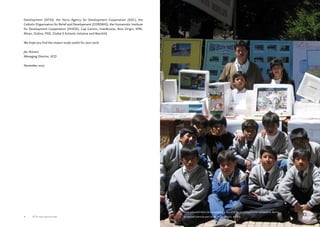
Feria schoolchildren demonstrate the use of ICTs, and in particular computers, during 
an annual event as part of the AYNI project, Bolivia 
Development (DFID), the Swiss Agency for Development Cooperation (SDC), the 
Catholic Organisation for Relief and Development (CORDAID), the Humanistic Institute 
for Development Cooperation (HIVOS), Cap Gemini, InterAccess, Atos Origin, KPN, 
Altran, Ordina, PSO, Global E-Schools Initiative and Warchild. 
We hope you find the impact study useful for your work. 
Jac Stienen, 
Managing Director, IICD 
November 2007 
ICTs for education ICTs for education
Executive Summary 
The study is intended to provide guidance to organisations working in the education sector 
and is directed towards policymakers, ICT practitioners and donor agencies, in particular. 
‘Everyone has the right to education’. 
Art. 26 of the Universal Declaration of Human Rights. 
Education in developing countries 
Developing countries are generally characterised by a rapidly growing, young population. 
Literacy levels are also low combined with high drop-out rates in schools. The cost of 
education is often too high for children to continue with their studies after a certain point. 
Yet, governments give low priority to education which has resulted in limited educational 
facilities and a shortage of qualified teachers in most developing countries. However, in 
order to participate in the global economy and ensure sustainable national development, 
developing countries need to develop a vibrant education system. 
In 2000, the international development community adopted the Millennium Development 
Goals (MDGs) that aim to eliminate global poverty, hunger and inequality by 2015. 
Education receives special attention in MDG2, which focuses on enhancing primary 
education in terms of quality and access; in MDG3, which focuses on women’s access to 
education; and in MDG8, which seeks to promote collaboration and develop a skilled 
workforce. In addition, the Education For All (EFA) principles developed by UNESCO 
provide a more specific set of objectives for the education sector. 
Information and Communication Technologies (ICTs) can be used to achieve the MDGs 
and the EFA principles described above as they can enhance the quality of education across 
the board at primary, secondary and tertiary level and also to support teacher training. 
Finally, ICTs contribute to a more conducive environment through the application of ICT in 
management and administration. 
IICD activities in the education sector 
It is within this context that IICD has been involved in integrating ICTs into the educational 
sectors of eight countries through 32 projects over the past eight years. IICD operates 
through partnerships. Partnerships with international organisations, government agencies, 
ministries, schools, teachers, civil society organisations and the private sector. IICD has 
worked closely with these partners to develop and implement a broad range of educational 
projects that use ICTs to achieve the following: 
• Enhance the quality of teachers and instructors; 
• Improve the learning process by provision of more interactive educational materials; 
• Improve management and administration; 
• Improve young people’s learning skills; 
• Develop a critical mass of knowledge workers; 
• Provide access to ICT in schools. 
As a result of the locally-owned projects that IICD has helped to develop and support, 
educational content has been created and enriched, schools have been provided with an 
ICT infrastructure, and students have become computer-literate and have received 
sufficient training to be able to train others to select, install, maintain and repair hardware 
and software. 
IICD also works with national governments in Bolivia, Burkina Faso, Tanzania and Zambia, 
providing them with guidance and advice on formulating sector-wide ICT policies and 
implementation strategies. In Bolivia, for example, IICD is supporting the government 
with the implementation of a national programme for ICT in education. In these four 
countries, the projects provide empirical and practical experience of how ICTs are being 
applied in an educational context for the governments and are used to gain a better 
understanding of the value of ICT in helping to achieve educational objectives. Increasingly, 
IICD’s project partners are being invited by the Ministry of Education in their respective 
countries to participate in and contribute to the policy formulation and implementation 
process because of their experience with developing and implementing ICT projects in the 
education sector. 
Numerous attempts to introduce ICT into the education sector have been carried 
out, sometimes with good results but also some less successful outcomes. Therefore, 
during this process many lessons learned have been collected and documented to help 
minimise the risk of failure and maximize the chances of success for future activities in the 
education sector. 
The lessons described here are a selection of the lessons presented in chapter 5 and apply 
equally to the different education areas described in this study: primary, secondary and 
tertiary education, teacher training, and technical training focusing on young people and 
workers. 
Lessons about the projects’ impact on the MDGs 
and the EFA initiative 
ICT supports universal access to education - MDG2 and EFA 
There are clear indications that the ICT projects described in this study have made a positive 
contribution towards achieving universal access to education. This is the result of the tangible 
impact of ICT on the quality and efficiency of teaching and learning processes at primary, 
secondary, tertiary and teacher training levels. Evidence gathered during the study shows that 
up to 80% of participants are more aware and feel empowered, while 60% indicated that they 
have experienced a direct improvement in the teaching and learning processes. 
ICTs for education ICTs for education
ICT generates opportunities for adolescents and young people 
in the workplace - MDG8 
ICT as applied in the study contributes to generating skills that prepare adolescents, 
including young entrepreneurs and workers, for employment opportunities in the 21st 
century. This was found in the vocational training projects that train people for specific 
technical jobs. Equally, the training institutions described in the study directly contribute 
to MDG8 by producing knowledge workers with specific ICT skills. In 2007, 75% of the 
participants indicated that they had experienced an improvement in their employment 
opportunities. 
Equal gender opportunities - MDG3 
The study indicates that there is a healthy balance - 45% - of men and women participating 
in the projects, which also contributes to a reduction in gender inequality. Yet despite 
the equal participation of women, they still experience a lower impact compared to their 
male counterparts. 
Lessons associated with the teaching 
and learning processes 
Focus on materials developed by teachers and instructors 
One of the key lessons found in this study is that it is necessary to focus on training 
teachers and instructors to use ICT to develop their own teaching support materials. This 
approach assures ownership by teachers and instructors and enhances the usability of 
products. Many projects still focus on using materials for teachers and students that have 
been developed externally, however, such materials often fall short of providing appropriate 
or relevant content for the local situation. 
Train teachers and instructors in basic ICT and pedagogical skills 
Teachers and instructors need to be trained in basic ICT skills and ICT-based teaching 
methods to feel comfortable about using the materials. It is equally important to train 
them to integrate ICT in their teaching methods. 
Support networking among teachers 
Teachers need to be supported to set up platforms that enable them to share their 
opinions, experiences and teaching materials with other teachers. Face-to-face and virtual 
exchanges are both equally important to motivate teachers and improve the quality of 
local materials. Networking between projects at the country level is also very valuable. 
For this, the national ICT for development networks supported by IICD represent one 
possible approach. Cross-country exchanges are also important as a way to motivate and 
promote the exchange of experiences in ICT for education projects and programmes. 
For more sustained learning, online communities of practice for practitioners can be an 
additional option. 
Use administrative applications as complementary services 
The prospect of managing information more effectively and streamlining internal 
administrative procedures will act as an important incentive for headmasters and 
administrative staff to institutionalise the use of ICT at all levels. While most beneficiaries 
view ICTs for teaching and learning purposes as a priority, the use of ICT to support 
management and administrative procedures is very important. 
Lessons on technology 
Increase access to computers 
Any initiative, be it government, NGO or private sector based, should make lobbying for 
more investments in computers a priority. Most teachers, instructors and students cited 
insufficient access to computers as the main obstacle in ICT for education programmes. 
This is particularly relevant for educational institutions located in the rural areas where the 
school or training institution is often the only access point for computers. Although this 
will require massive investments in the infrastructure, it is nevertheless essential in order 
to guarantee equal access and overcome the digital divide. 
Introduce combined off-line and online based applications 
Access to the Internet is viewed by most as an important tool for education as it allows for 
easier access to online teaching and learning resources. It also facilitates networking 
between teachers and between students. Finally, it is an important tool to exchange 
administrative and management information in the sector. Internet access is recommended 
where services are provided at a low cost and are of acceptable quality. Yet, in many areas 
Internet access is either unavailable or very costly. In such cases, alternative exchange 
modes such as CD ROMS need to be integrated right at the start of a project. 
Search for low-cost solutions 
Even where computer and Internet access is available and affordable, do not develop or 
introduce expensive online education platforms that require high-bandwidth Internet 
access. The widespread availability of free and open access platforms strongly increases 
the feasibility of a dynamic virtual exchange of experiences, opinions and materials. Many 
discussions have taken place in recent years on the use of Open Source Software versus 
proprietary software, but clear-cut answers remain elusive. It is therefore important to 
consider the philosophy as well as the level of convenience and related costs. 
Second-hand computers are offered free-of-charge or at very low cost by various private 
sector and not-for-profit initiatives. However, second-hand computers usually come with 
additional costs for repairs, import taxes and costs to replace missing parts. Alternatives 
are found in the low-cost PCs such as the 100$ computer and similar initiatives by 
the private sector. 
ICTs for education ICTs for education
Lessons on sustainability 
Set up an appropriate organisational structure 
Strategically involving headmasters and parents is necessary for the institutionalisation 
and longer-term sustainability management of ICT facilities. Setting up administrative 
committees to manage ICT facilities has proven to be very effective in ensuring the 
sustainability of ICT initiatives. Beyond the institution, it is important to seek political 
support from the local authorities and the district or national education authorities 
to prepare for longer-term opportunities of funding and to have ICT recognised as part 
of the curriculum. 
Think through a viable financial model before starting 
Make sure that partners identify a locally feasible financial plan. Private training institutions 
may be able to generate sufficient income from trainees to afford more advanced ICTs. 
Larger public teacher-training and training institutions need to define how much of the 
institutional budget can be reserved for the re-current costs of ICT and take this as a 
starting point for an ICT plan. Smaller rural schools or vocational training centres will not 
be able to sustain costly ICT applications and should avoid high recurrent costs right from 
the start. Empirical evidence, however, does show that small institutions can also sustain 
smaller computer labs. Through contributions to the school, the Parent-Teacher 
Associations can be very supportive towards the ICT projects. 
Secure technical capacities at the institutional level 
ICT managers in the participating institutions need to be sufficiently trained to ensure that 
they can maintain and upgrade the ICT facilities on their own without any outside help. As 
it is very difficult to retain ICT-trained managers, institutions need to train a select number 
of enthusiastic teachers and students to ensure that temporary replacements will be on 
hand if needed. 
Sector policy development for education 
Generate awareness on the basis of experiences 
It is important that practitioners with experience in ICT and education promote and raise 
awareness and engage in lobbying activities. Despite the enormous progress made in the 
last decade, there is still a lack of general awareness among policymakers, particularly with 
regard to the development aspects of ICT in the education sector. Support from external 
supporting institutions is found to be important as a complementary instrument in 
awareness and lobbying. The evidence base of IICD-supported projects in education and 
the national ICT4D knowledge sharing networks can contribute to this process. 
Participate in ICT policy and strategy development in education 
A long-term vision on the integration of ICT in education is a clear necessity in order to 
provide guidance and motivation to enthusiastic early adopters and other stakeholders. A 
vision is also crucial to actively plan for the deployment of ICT in the sector. In the longer 
term, the active participation of the government is essential to ensure the sector-wide 
introduction of ICT in education. Government involvement is critical to source additional 
investments in the ICT infrastructure; to integrate ICT in the curriculum; and to facilitate 
the widespread diffusion of materials. 
10 ICTs for education 11 ICTs for education
1. Introduction 
This impact study explores the potential contribution of ICT in the educational sector in 
developing countries. The experiences and lessons learned documented here are placed in 
the context of their contribution to the United Nations Millennium Development Goals 
(MDGs) and UNESCO’s Education for All (EFA) initiative, both of which are widely used 
by international donors and governments in developing countries as a framework for 
setting priorities. 
Information and Communication Technology is a relatively recent instrument in the fight 
to eliminate hunger and poverty. In its 2002 Strategy Paper on ICT1, the World Bank states 
that: ‘information and communication technologies are a key input for economic development 
and growth. They offer opportunities for global integration while retaining the identity of 
traditional societies. ICT can increase the economic and social well-being of poor people, and 
empower individuals and communities. Finally, ICT can enhance the effectiveness, efficiency, 
and transparency of the public sector including the delivery of social services.’ 
The MDGs and EFA targets are formidable but achievable if a concerted and collective 
effort is made. The MDGs in particular aim to ensure that, by 2015, all children, particularly 
girls, underprivileged children, and children from ethnic minorities, will have access to and 
the opportunity to complete, free and compulsory, high quality primary education. 
The EFA framework recognises that to achieve these goals greater cooperation amongst 
the development community and more resources alone will not be enough. New initiatives 
will also need to be employed. One such initiative is to harness the potential of Information 
and Communication Technologies (ICTs). It recognises that, ‘these technologies have great 
potential for knowledge dissemination, effective learning and the development of more efficient 
education services’2 , and identifies a need to tap the potential of ICTs to: 
• Support the professional development of teachers; 
• Improve access to education by remote and disadvantaged communities; 
• Provide opportunities to communicate across classrooms and cultures; and, 
• Strengthen management and administration procedures from the central ministries 
through sub-national levels to the schools. 
While this indicates the importance of ICT for education, other institutions such as the 
World Bank’s InfoDev programme state, ‘There is widespread belief that ICT can and will 
empower teachers and learners (…) However, there are currently very limited, unequivocally 
compelling data to support this belief.’ When examining the integration of ICT in support of 
achieving educational objectives, it can be said that, after almost one decade of using ICT to 
1 Information and Communication Technologies: A World Bank Group Strategy. Washington DC: World Bank Group, 2002. 
2 UNESCO, 2000, Dakar Framework For Action, p. 21: unesdoc.unesco.org/images/0012/001211/121147e.pdf 
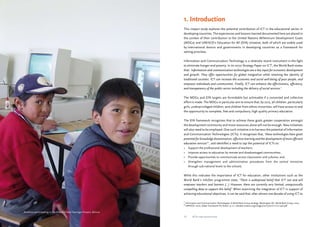
Students participating in the Chaski Global Teenager Project, Bolivia 
12 ICTs for education 13 ICTs for education
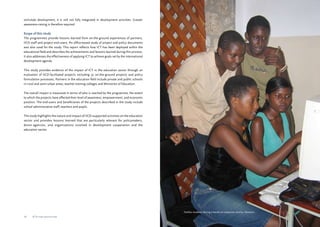
TanEdu students during a hands-on computer course, Tanzania 
stimulate development, it is still not fully integrated in development activities. Greater 
awareness-raising is therefore required. 
Scope of this study 
The programmes provide lessons learned from on-the-ground experiences of partners, 
IICD staff and project end-users. An office-based study of project and policy documents 
was also used for the study. This report reflects how ICT has been deployed within the 
educational field and describes the achievements and lessons learned during this process. 
It also addresses the effectiveness of applying ICT to achieve goals set by the international 
development agenda. 
This study provides evidence of the impact of ICT in the education sector through an 
evaluation of IICD-facilitated projects including 32 on-the-ground projects and policy 
formulation processes. Partners in the education field include private and public schools 
in rural and semi-urban areas, teacher training colleges and Ministries of Education. 
The overall impact is measured in terms of who is reached by the programme, the extent 
to which the projects have affected their level of awareness, empowerment, and economic 
position. The end-users and beneficiaries of the projects described in the study include 
school administrative staff, teachers and pupils. 
The study highlights the nature and impact of IICD-supported activities on the education 
sector and provides lessons learned that are particularly relevant for policymakers, 
donor agencies, and organisations involved in development cooperation and the 
education sector. 
14 ICTs for education 15 ICTs for education
this situation further, the education provided in most schools has not been adjusted 
to and does not correspond with the needs of the national labour market. 
Teacher training, too, is often below par, with few possibilities for teachers to update their 
skills and few incentives for young people to choose teaching as a career in the first place. 
Those who do enter the teaching profession often leave because of poor wages and difficult 
working conditions. 
Only a very small percentage of students enrol at secondary school level and even fewer 
go on to follow tertiary education. Finally, the devastating impact of HIV/AIDS on the 
education sector in developing countries cannot be overstated, from the shortage of 
teachers to the large numbers of children who are forced to leave school prematurely 
either to stay at home with sick relatives or to take up work to sustain their families. 
The international community is trying to redress the situation via international strategic 
frameworks and goals such as the UNESCO’s Education for All declaration and the MDGs 
mentioned earlier. 
MDGs in education and the EFA initiative 
In September 2000, the United Nation’s member states unanimously adopted the 
Millennium Declaration. The Millennium Development Goals (MDGs) were subsequently 
introduced as the framework to structure the development efforts of donors and 
government institutions. A monitoring mechanism measures goals, targets and indicators 
in the pre-defined time-frame of 2000-2015. The goals have been commonly accepted as a 
framework for coordinating and measuring development progress. 
The education sector is crucial for enhancing human and social capital. It is widely 
recognised that education catalyses economic development by improving the skills of 
the labour force. It also stimulates social development by raising awareness and 
motivating people to strive for improvements in the health sector, the environment and 
governance. 
Objectives two and three of the MDGs are derived from UNESCO’s Education For All 
initiative. The initiative has led to the Dakar Framework for Action, which is today considered 
to be the most comprehensive international educational agreement. It commits 
governments to provide quality basic education for all by 2015. The initiative specifies the 
following targets: 
• Expand and improve care and education in early childhood, especially for young children 
who are disadvantaged and at risk. 
• Introduce compulsory free primary schooling for all children, boys and girls, by 2015. 
• Meet the needs of young people by ensuring access to education and the acquisition of 
basic ‘life skills’. 
2. ICT for development and education 
‘Many pupils learn in crowded, poorly furnished and unfinished classrooms, and often have to 
share scarce textbooks. Many teachers are poorly qualified and poorly deployed, but in any 
case are often trying to do a good job with a minimum of basic resources. The curriculum is 
often seen as too diverse and in some ways irrelevant for many of the pupils and their life needs. 
Many teachers, head teachers and other education support staff are also poorly prepared for 
the management and quality assurance tasks demanded of their roles, but are also often trying 
to work to the best of their ability in isolated and under-resourced contexts.’ 
Tanzanian Primary Education Development Plan 2007. 
This chapter illustrates the role that ICTs play in supporting the leading development 
objectives identified by the international development community and national 
governments. While access to education is considered a basic human right, many countries 
are still struggling with poor quality education, insufficient teachers, high levels of illiteracy, 
large numbers of children dropping out of school, and the high cost of education. 
The illiteracy rate in IICD’s focal countries is outlined in Table 1 below. 
Country Population below 
15 years of age 
Illiteracy rate 
Bolivia 35 % 13 % 
Burkina Faso 49 % 73 % 
Ecuador 33 % 7 % 
Ghana 39 % 25 % 
Jamaica 33 % 12 % 
Mali 48 % 53 % 
Tanzania 44 % 22 % 
Uganda 50 % 30 % 
Zambia 46 % 19 % 
The Netherlands 18 % 1 % 
United Kingdom 18 % 1 % 
Table 1. Illiteracy rate in IICD focal countries, as compared to the United Kingdom 
and The Netherlands (Source: CIA The World Fact Book 2006) 
Access to education can be hampered by a number of different factors. The gender balance 
is generally tilted with fewer girls receiving education than boys. People in rural areas have 
less access to the educational system than their peers in urban areas. In addition, the 
educational sector has until recently received rather low levels of political support. This 
has led to chronic under-funding of the education sector as a result of which educational 
establishments across the board are usually ill-equipped and understaffed. To compound 
16 ICTs for education 17 ICTs for education
International development frameworks and ICT task force that acknowledge the potential 
contribution of ICT have been put in place. However, the anecdotal evidence of projects 
needs to be transformed into a more systematic assessment of the impact of ICT. 
Documenting and sharing lessons learned is necessary to derive best practices that can, 
in turn, be used to maximise the impact and effectiveness of future efforts. This study 
aims to provide more comprehensive and empirical evidence of the impact of ICT 
on education. 
Role of ICT in national development strategies 
Within these international development frameworks, individual countries have prepared 
their own Poverty Reduction Strategy Papers (PRSPs), which report on progress 
in achieving specific development objectives. The PRSPs typically include strategies 
and objectives for the educational sector and are closely linked to the EFA goals 
described earlier. 
The introduction of the PRSPs in 2000 have led to a strong focus on primary education in 
recent Sector Wide Approaches (SWAps) of the education sector. Yet, more recently, many 
governments have begun to recognise the need to expand their focus to include secondary 
education and teacher training. SWAps have received an increased level of donor support. 
A SWAp is a process in which sector funding from governments and donors supports a 
single policy and expenditure programme in a given sector under government leadership. 
SWAps in education outline clear goals for the education sector but tend to be less focused 
on the use of ICT. As ICT for education lies at the crossroads of these two policies, 
ample attention is needed to bring them together. A conducive policy environment is 
required in which individual projects can be initiated, results upscaled, and eventually 
incorporated into the mainstream activities of governments and organisations active in 
the education sector. 
Remarkably, the need for ICT training and skills development is often more explicitly 
addressed in national ICT for development strategies than in education sector strategies. 
The ICT strategies are typically more focused on educational needs, than education 
strategies on ICT needs. National ICT policies provide a general framework for the use and 
development of ICT in a country. However, they generally focus on the telecom 
infrastructure and usually fail to address the development dimension, for example: the 
need for capacity building in ICT, or to invest in rural areas, or the sector-specific use of 
ICT. Moreover, they are not sector-specific. 
In light of the above, governments are increasingly seeking to integrate the use of ICT in 
the PRSP and SWAps in education. Examples of this can be found in a growing number of 
countries including Bolivia, Egypt and Namibia, where ICT is now applied on a national 
level as part of the drive for enhanced quality and access to education for all. The 
• Reduce the illiteracy rate among adults by half, with an appropriate level of basic education 
for adults. 
• Eliminate all gender differences in the education system by 2015. 
• Improve the quality of education. 
The Dakar Framework for Action stipulates that in order to achieve these goals the 
development community will need to allocate more resources to the education sector as 
well as start new initiatives in a coherent manner. It addresses the need for primary 
education, but also recognises the role of higher education, particularly in the field of 
teacher training, combined with reforms and good governance in educational systems. 
Role of ICT to achieve international education goals 
Introducing ICT as a tool to support the education sector has initiated substantial 
discussions since the late 1990s. A decade ago the emphasis was on Technical and 
Vocational Education and Training and training teachers. During the last few years an 
increasing number of international development agencies3 have embraced the potential of 
ICT to support the education sector. 
UNESCO has played a major role in spearheading the Education for All initiative to harness 
the potential of ICT. The widely subscribed Dakar Framework for Action recognises that, 
‘these technologies (ICTs) have great potential for knowledge dissemination, effective learning 
and the development of more efficient education services’. 
Furthermore, the United Nations ICT Task Force under Secretary General Kofi Annan 
recognised the potential of ICT for achieving the key Millennium Development Goals. It 
believes that one of the best ways to expand the use of ICT in the developing world is 
through schools and local communities. In 2003, McKinsey & Company were commissioned 
to investigate this further. Based on these results, the Task Force determined that: 
‘…education, especially education enhanced by ICTs, not only sparks economic development 
by improving learners’ skills, but it also enhances social development across the community by 
raising peoples awareness of and their ability to improve their health, their environment, and 
even the way they are governed.’ 
When looking at the integration of ICT to support the achievement of educational 
objectives, it can be found that after almost a decade of using ICT to stimulate development, 
it is not yet fully integrated in development activities and awareness raising is still required. 
Yet, there has been considerable improvement over the past decade. Initial disbelief about 
the potential contribution of ICT for development embodied in comments such as ‘Why 
does a farmer need a computer’?’ and ‘Shouldn’t we focus on clean water first?’ have gradually 
faded away. 
3 Donors and international agencies known for their supportive viewpoint in relation to ICTs include : SIDA, CIDA, 
DANIDA, DGIS, DFID, NORAD, InfoDev, the World Bank, UNESCO and UNDP. 
18 ICTs for education 19 ICTs for education
governments of these countries have realised the contribution that ICT can make towards 
achieving broader development goals such as improved access to, and enhancing the 
quality of, education. To this end, they have developed an ICT for Education strategy. 
The experiences of Bolivia, Burkina Faso, Jamaica, Tanzania, Uganda and Zambia, where 
IICD assists governments in the development of sector-wide ICT strategies in education, 
will be highlighted in the following chapters. 
ICTs for education 
Over the last twenty years, industrialised countries and emerging economies have 
introduced ICT to their educational sector. This has changed the sector substantially and 
has had an enormous impact on the national economic development of the countries in 
question. Dramatic changes in the administrative processes and organisational aspects of 
the sector, including those within the curricula and the methodology of teaching, are 
inconceivable without the use of ICT. 
In IICD’s vision, ICT is a cross-cutting tool that can improve development objectives in key 
development sectors, particularly in education. Often a distinction is made between 
modern ICTs (computer and Internet-based technology) and traditional ICTs (radio, 
printed matter, videos, telephones, and television). However, since traditional media can 
now be digitised, the distinction between the different media is gradually fading. All 
information and communication technologies that support the creation, collection, 
exchange and dissemination of information are equally valid and can play a vital role in 
catalysing the development process. 
In practice, IICD strives to integrate a mixture of both traditional ICTs (radio, television) 
and modern ICTs (email, Internet) in its education programmes including elements of 
radio-based lessons, computer-based training, Internet-based training, or more interactive 
eLearning applications. Choices for combinations of applications are made on the basis of 
the local context considering the cultural, social and economic realities and competencies 
of partner organisations and their beneficiaries. The selected applications are chosen in 
direct consultation with the partners. This means that the ICT solutions chosen do not 
depend on what is technically possible, but rather on what is feasible and appropriate in 
each local context. 
ICT-supported interventions in the education sector 
The contribution that ICT can make to education has been described in detail in a study by 
the United Kingdom Department for International Development (DFID) which carried out 
an in-depth examination of the specific role that ICT can play in achieving the various 
MDGs. It provides details for assessing the contribution that ICT can have across the various 
sectors. The table below lists ICT-supported interventions that are most relevant for the 
education sector and lists the Millennium Development Goals they are helping to realise. 
In Teemu Leinonen’s article ‘A critical history 
of ICT in education’ four phases were outlined 
as critical: 
• Late 1970s - early 1980s: Programming: This was the era in which 
the pedagogical reason to use the computer focused primarily on 
programming, assisting in the development of students’ logic, 
and mathematics skills. 
• Late 1980s - early 1990s: Computer Based Learning: When multimedia 
computers with graphics and sound applications became available, 
the computer began being used to support learning processes in basic 
subjects such as mathematics, reading and writing. 
• Early 1990s: Web-based Learning: The third wave of using ICT in the 
education sector came with the advent of the World Wide Web. The use 
of the Web is partially a product of the challenges in updating content on 
CD-ROMs. Web-based information allows for educational content to be 
updated frequently. 
• Late 1990s: E-Learning: E-learning combines computer-based and web-based 
learning applications for the student. It also provides facilities 
for interaction between the teacher and the student, and between 
students themselves. 
20 ICTs for education 21 ICTs for education
Copperbelt College of Education, Zambia 
MDGs ICT-supported interventions relevant for the education sector 
MDG2: 
Achieve universal 
primary education 
Teacher training: Increase the supply of trained pre-service teachers through 
ICT-enhanced training and by creating teacher networks. 
Teaching and learning in the classroom: Capacity development of teachers 
to empower them to use ICT in the classroom and the development of 
curricula and support materials/resources through ICT. 
Management and administration: Improve the efficiency and effectiveness 
of Ministries of Education and related bodies through the use of ICT for 
management and educational information. 
Policy and strategy: Establish an enabling environment. Improve the 
overall strategic development of education by integrating ICT policies and 
strategies into the SWAps. 
MDG8: 
Develop global 
partnerships for 
development and make 
new technologies, 
especially ICT, available 
Young people’s learning skills: Use ICT to increase the employability of 
young people and empower them to meet the challenges of the knowledge-based 
global economy of the 21st century. 
Knowledge workers: Develop a critical mass of knowledge workers with the 
technical skills to build and maintain the national ICT infrastructure. 
Table 2. ICT-supported interventions in the education sector and the Millennium Development 
Goals they are helping to realise. 
22 ICTs for education 23 ICTs for education
3. IICD project experiences 
with ICT in education 
‘Failure to absorb the growing number of primary school leavers will undermine Universal 
Primary Education and broader national goals like the elimination of poverty.’ 
Yusuf K. Nsubuga, Commissioner for Secondary Education in Uganda. 
This chapter introduces IICD’s approach towards facilitating ICT-enabled development 
in the education sector and illustrates the various ICT for education (ICT4E) projects 
and policy processes supported by IICD and undertaken by local partners in eight 
developing countries. 
IICD’s approach towards facilitating ICT for development 
IICD’s involvement in ICT for development activities, both on a global and local level, is 
based on a complementary set of six guiding principles: demand-responsiveness, multi-stakeholder 
involvement, local ownership, capacity development, partnerships and 
learning by doing. 
To achieve an appropriate level of integration of ICT in education, IICD applies a systematic, 
step-by-step participatory approach towards project and policy development. The whole 
process starts with a Roundtable workshop for 10 to 20 key stakeholders from the 
education sector in a developing country. The workshop participants are asked to 
contemplate the future of the education sector and the long-term challenges and 
opportunities ahead. This provides a realistic context in which they can proceed to identify 
different ways in which ICT applications could be used to improve the sector.4 The next 
step is for the stakeholders to develop their own individual idea further and transform it 
into a concrete project. Out of all the project ideas generated during a Roundtable 
workshop, around 6-10 reach the project formulation stage. 
Once a project has been formulated and officially approved it is then ready for 
implementation. IICD provides support and guidance throughout the project 
implementation phase. The project is further strengthened with on-the-job capacity 
development programmes for administrative staff, teachers and students as well as 
training and advice about technical and organisational matters for the local project 
partners. ICT for development networks in each of the countries bring together project 
partners and governments to share experiences in formulating and implementing ICT-based 
activities and to lobby for the appropriate use of ICT by both private and government 
institutions in the education sector. The implementation of projects and policies is 
combined with a participatory and innovative monitoring and evaluation approach to 
foster learning and assess progress on an annual basis (see Chapter 4). 
Projects that have a pilot function are developed in a participatory and systematic manner. 
The multi-stakeholder Roundtable process enables local partners to generate ideas for, 
and formulate their own, projects. This process is further strengthened by awareness-raising 
and capacity development activities. When a project goes into implementation, 
end-users give their opinions about their own personal satisfaction with the projects and 
the projects’ impact. These opinions are analysed and discussed with the end-users in 
question at Focus Group Discussions. The purpose of the Focus Group Discussions is to 
facilitate learning between project partners and to provide useful lessons learned that can 
be used to improve the project implementation process. 
IICD’s work in the education sector is developed in collaboration with other international 
organisations. For example, ItrainOnline (www.itrainonline.org); a web-based resource 
developed by a partnership of eight development organisations working in ICT and Media 
for Development (IICD, APC, Bellanet FAO, INASP, OneWorld Network, UNESCO and 
Telecentre.org). ItrainOnline offers online training material to improve capacity in the use 
of ICT and was shortlisted in April 2007 by the Online Educational Database (OEDb) as 
one of the top 80 online resources for building or participating in a collaborative educational 
activity. Another important source for partners is the collection of CD ROM-based 
eLearning modules on ICT which are available to IICD training partners and project 
partners so that they can train themselves and use the information in training activities. 
Overview of IICD-supported projects in the education sector 
IICD and its partners have built up a substantial portfolio of 32 ICT projects in education 
in eight countries. The projects are formulated and implemented by government agencies, 
ministries, schools, teachers, civil society organisations and the private sector. 
The projects use ICT to enhance the teaching skills of teachers, increase computer literacy, 
produce digital educational materials, and support management and administrative 
procedures in the education sector. Other projects improve young people’s ability to 
acquire new skills and, in so doing, contribute towards developing a critical mass of 
knowledge workers. For this, partners provide ICT connectivity and equipment, software 
applications and continuous capacity development. 
IICD and its partners also focus on embedding lessons learned from pilot projects within 
national education policies and programmes. In this respect, IICD and its partners work 
closely with national governments, providing guidance and support to them during their 
work to formulate ICT policies and strategies to integrate ICT in SWAps. For this, IICD and 
the Global e-Schools and Communities Initiative (www.gesci.org) entered into a 
partnership to share experiences in supporting governments in the formulation and 
implementation of national ICT for education programmes. 
4 For more information about IICD’s Roundtable process, see: ftp.iicd.org/files/publications//RTbookletIICD.pdf 
24 ICTs for education 25 ICTs for education
While many development programmes focus exclusively on primary level education, IICD’s 
partners have consistently argued for more attention to be given to other educational 
levels: secondary, tertiary, and teacher training colleges. This first became evident during 
the Roundtable workshops facilitated by IICD which enable stakeholders from the 
education sector to set their own ICT priorities and determine which areas would benefit 
most from ICT. As ICT is relatively costly to install, maintain and run, it has to be applied 
selectively to the education system. Inevitably, choices have to be made. 
IICD’s education projects are classified overleaf according to their contribution to MDG2: 
Achieve Universal Primary Education and MDG8: Develop a Global Partnership for 
Development. The chapter goes on to provide examples of some of the education projects 
supported by IICD and uses them to illustrate the many different ways in which ICT 
applications can be introduced successfully in the education sector. A complete overview 
of all IICD-supported projects in the education sector, with brief descriptions of their main 
activities, can be found in the annexes at the back of this publication. 
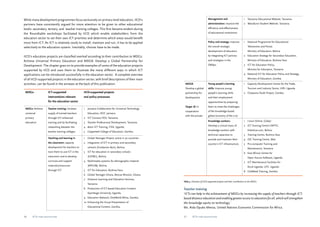
MDGs ICT-supported 
interventions relevant 
for the education sector 
IICD-supported projects 
and policy processes 
MDG2: Achieve 
universal 
primary 
education 
Teacher training: increase 
supply of trained teachers 
through ICT-enhanced 
training and by facilitating 
networking between the 
teacher training colleges. 
1 Jamaica Collaborative for Universal Technology 
Education, IECF, Jamaica 
2 ICT Connect-TED, Tanzania 
3 Teacher Professional Development, Tanzania 
4 Basic ICT Training, ITEK, Uganda 
5 Copperbelt College of Education, Zambia 
Teaching and learning in 
the classroom: capacity 
development for teachers to 
train them to use ICT in the 
classroom and to develop 
curricula and support 
materials/resources 
through ICT. 
1 Global Teenager Project; active in 30 countries 
2 Integration of ICT in primary and secondary 
schools (Fundación Ayni), Bolivia. 
3 ICT for education in secondary schools 
(CEPAC), Bolivia. 
4 Multimedia systems for ethnographic material 
(APCOB), Bolivia. 
5 ICT for Education, Burkina Faso. 
6 Global Teenager Ghana, Rescue Mission, Ghana. 
7 Distance Learning and Education Services, 
Tanzania 
8 Production of ICT-based Education Content, 
Kyambogo University, Uganda. 
9 Education Network, OneWorld Africa, Zambia. 
10 Enhancing the Visual Presentation of 
Educational Content, Zambia. 
Management and 
administration: improve the 
efficiency and effectiveness 
of educational institutions 
26 ICTs for education 27 ICTs for education 
1 Tanzania Educational Website, Tanzania. 
2 Wanafunzi Student Website, Tanzania. 
Policy and strategy: improve 
the overall strategic 
development of education 
by integrating ICT policies 
and strategies in the 
SWAps. 
1 National Programme for Educational 
Telecentres and Portal, 
Ministry of Education, Bolivia 
2 Education Strategy for Secondary Education, 
Ministry of Education, Burkina Faso 
3 ICT for Education Policy, 
Ministry for Education, Tanzania 
4 National ICT for Education Policy and Strategy, 
Ministry of Education, Zambia 
MDG8: 
Develop a global 
partnership for 
development. 
Target 18: In 
cooperation 
with the private 
Young people’s learning 
skills: Improve young 
people’s learning skills 
and their employment 
opportunities by preparing 
them to meet the challenges 
of the knowledge-based 
global economy of the 21st 
1 Capacity Development Centre for the Trade, 
Tourism and Industry Sector, UIRI, Uganda 
2 Chawama Youth Project, Zambia 
Knowledge workers: 
Develop a critical mass of 
knowledge workers with 
technical capacities to 
provide and maintain their 
country’s ICT infrastructure. 
1 I-train Online, Global 
2 ICT Training Centre CAPTIC, 
Enbolivia.com, Bolivia 
3 Training Centre, Burkina Faso 
4 IDC Training Centre, Mali 
5 Pro-computer Training and 
Maintenance, Tanzania 
6 East African Centre for 
Open Source Software, Uganda 
7 ICT Maintenance Facilities for 
Rural Uganda, UTC, Uganda 
8 ColdReed Training, Zambia 
Table 3. Overview of IICD-supported projects and their contribution to the MDGs. 
Teacher training 
‘ICTs can help in the achievement of MDG2 by increasing the supply of teachers through ICT-based 
distance education and enabling greater access to education for all, which will strengthen 
the knowledge equity on technology.’ 
Ms. Aida Opuko Mensa, United Nations Economic Commission for Africa.
IICD has supported a number of projects that focus on improving teacher training. The 
focus on teacher training evolved from the need to secure sufficient human capacity to 
enable an appropriate use of ICT in the education sector. For this, ICT is to be introduced 
as a new subject in the standard curriculum of Teacher Training Colleges so that future 
teachers can leave school with basic ICT skills and knowledge. However, it is even more 
important to secure the integration of ICT in the overall teaching and learning process of 
Teacher Training Colleges. This requires training modules focusing on the development of 
pedagogical competences related to the integration of ICT in the teaching and learning 
processes of future teachers. 
Projects in this category include: 
• Jamaica Collaborative for Universal Technology Education, IECF, Jamaica 
• ICT Connect-TED, Tanzania 
• Teacher’s Professional Development, Tanzania 
• Basic ICT Training, ITEK, Uganda 
• Copperbelt College of Education, Zambia 
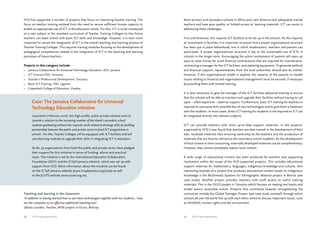
Case: The Jamaica Collaborative for Universal 
Technology Education initiative 
Launched in February 2006, this high-profile, public-private initiative aims to 
‘provide a solution to the increasing number of the island’s secondary school 
students graduating without the requisite work-related technology skills by building 
partnerships between the public and private sector to fund ICT programmes in 
schools’. For this, Teacher Colleges will be equipped with ICT facilities and will 
use elearning modules to upgrade their skills in integrating ICT in education. 
So far, 39 organisations from both the public and private sector have pledged 
their support for this initiative in terms of funding, advice and practical 
input. The initiative is led by the International Education Collaboration 
Foundation (IECF) and the ICT4D Jamaica network, which was set up with 
support from IICD. More information about the initiative can be found 
on the ICT4D Jamaica website (www.ict4djamaica.org/jcute) as well 
as the JCUTE website (www.jcute.org.jm). 
Teaching and learning in the classroom 
‘In addition to having learned how to use these technologies together with my students, I now 
use the computer as an effective additional teaching tool.’ 
(Maria Lourdes, Teacher, AYNI project in Oruro, Bolivia) 
Most primary and secondary schools in Africa and Latin America lack adequately trained 
teachers and have poor quality, or limited access to, learning materials. ICT can assist in 
addressing these challenges. 
First and foremost, this requires ICT facilities to be set up in the schools. As this requires 
an investment in facilities, it is important to ensure that a proper organisational structure 
has been put in place beforehand; one in which headmasters, teachers and parents can 
participate. A proper organisational structure is key to the sustainable use of ICTs in 
schools in the longer term. Encouraging the active involvement of parents will open up 
ways to raise money for small financial contributions that are required for maintenance, 
contracting a manager for the ICT facilities, and replacing equipment. To generate political 
and financial support, representatives from the local authorities should also be invited. 
However, if this organisational model is applied, the capacity of the parents to handle 
issues relating to financial and organisational management must be secured, if necessary 
by providing them with limited training. 
It is also necessary to give the manager of the ICT facilities advanced training to ensure 
that the schools will be able to maintain and upgrade their facilities without having to call 
upon – often expensive – external support. Furthermore, basic ICT training for teachers is 
required to overcome their possible fear of new technologies and to give them a headstart 
over the students. In most cases, direct ICT training for students is not required as ICT can 
be integrated directly into relevant subjects. 
ICT can provide teachers with more up-to-date support materials. In the projects’ 
supported by IICD it was found that teachers are best trained in the development of their 
own, localized materials thus ensuring ownership by the teachers and the production of 
materials that are directly relevant to the secondary school students. As the development 
of local content is time-consuming, externally developed materials can be complementary. 
However, they cannot completely replace local content. 
A wide range of educational content has been produced by teachers and supporting 
institutions within the scope of the IICD-supported projects. This includes educational 
support materials for mathematics, languages, indigenous knowledge and cultures. One 
interesting example of a project that produces educational content based on indigenous 
knowledge is the Multimedia Systems for Ethnographic Material project in Bolivia (see 
case study). Another project provides teachers with swift access to useful training 
materials. This is the DILES project in Tanzania which focuses on making text books and 
model exams accessible online. Projects that contribute towards strengthening the 
curriculum include the Global Teenager Project (see case study overleaf) through which 
schools all over the world link up with each other online to discuss important issues, such 
as HIV/AIDS, human rights and the environment. 
28 ICTs for education 29 ICTs for education
The teachers can also use ICT and digitised materials in the classroom to introduce new 
and more productive ways of teaching and learning. Yet, ICT-based educational material is 
a lot more complex than simply digitising text books and making them available online. It 
requires teachers to be trained not only in basic ICT skills but also in pedagogical skills to 
use online tools and teaching materials in the classroom. 
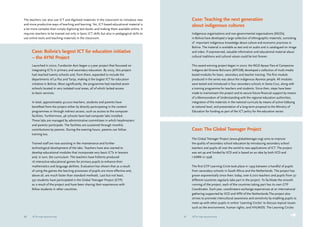
Case: Bolivia’s largest ICT for education initiative 
– the AYNI Project 
Launched in 2000, Fundación Ayni began a 5-year project that focussed on 
integrating ICTs in primary and secondary education. By 2005, this project 
had reached twenty schools and, from there, expanded to include the 
departments of La Paz and Tarija, making it the largest ICT for education 
initiative in Bolivia. Most significantly, the programme had reached seven 
schools located in very isolated rural areas, all of which lacked access 
to basic services. 
In total, approximately 40,000 teachers, students and parents have 
benefited from the project either by directly participating in the content 
programmes or through indirect access, such as access to the computer 
facilities. Furthermore, 46 schools have had computer labs installed. 
These labs are managed by administrative committees in which headmasters 
and parents participate. The facilities are sustained through monthly 
contributions by parents. During the evening hours, parents can follow 
training too. 
Trained staff are now assisting in the maintenance and further 
technological development of the labs. Teachers have also started to 
develop educational modules that incorporate very basic ICTs in lessons 
and, in turn, the curriculum. The teachers have hitherto produced 
16 interactive educational games for primary pupils to enhance their 
mathematics and language abilities. Evaluation has shown that as a result 
of using the games the learning processes of pupils are more effective and, 
above all, are much faster than standard methods. Last but not least, 
350 students have participated in the Global Teenager Project (GTP) 
as a result of the project and have been sharing their experiences with 
fellow students in other countries. 
Case: Teaching the next generation 
about indigenous cultures 
Indigenous organisations and non-governmental organisations (NGOs) 
in Bolivia have developed a large collection of ethnographic materials, consisting 
of important indigenous knowledge about culture and economic practices in 
Bolivia. The material is available as text and on audio and is catalogued on image 
and video. If unpreserved, valuable information and educational material about 
cultural traditions and cultural values could be lost forever. 
This award-winning project began in 2000: the NGO Apoyo Para el Campesino 
Indígena del Oriente Boliviano (APCOB) developed a collection of multi-media 
based modules for basic, secondary and teacher training. The first module 
produced in the series was about the indigenous Ayoreos people. All modules 
were tested and introduced in four secondary schools in Santa Cruz, along with 
a training programme for teachers and students. Since then, steps have been 
made to mainstream the project and to secure future financial support by means 
of a Memorandum of Understanding with the regional education authorities, 
integration of the materials in the national curricula by means of active lobbying 
at national level, and presentation of a long-term proposal to the Ministry of 
Education for funding as part of the ICT policy for the education sector. 
Case: The Global Teenager Project 
The Global Teenager Project (www.globalteenager.org) aims to improve 
the quality of secondary school education by introducing secondary school 
teachers and pupils all over the world to new applications of ICT. The project 
was set up and funded by IICD and is based on an idea by both IICD and 
I-EARN in 1998. 
The first GTP Learning Circle took place in 1999 between a handful of pupils 
from secondary schools in South Africa and the Netherlands. The project has 
grown exponentially since then: today, over 6,000 teachers and pupils from 30 
different countries regularly take part in the project. To facilitate the smooth 
running of the project, each of the countries taking part has its own GTP 
Coordinator. Each year, coordinators exchange experiences at an international 
gathering supported by IICD and KPN of the Netherlands.The project also 
strives to promote intercultural awareness and sensitivity by enabling pupils to 
meet up with other pupils in online ‘Learning Circles’ to discuss topical issues 
such as the environment, human rights, and HIV/AIDS. The Learning Circles 
30 ICTs for education 31 ICTs for education 
➜
facilitate a structured exchange of research questions between and among 
students from different countries to enable them to learn about each others 
local and cultural realities. Currently, English, Spanish and French circles are 
in operation. As a spin-off, other organisations have started a circle in Arabic. 
Case: ICT in secondary schools in Burkina Faso 
The TICE project in Burkina Faso targets twelve secondary schools and 
empowers them to a level at which they will be able to integrate ICTs more 
successfully in their education cycle. This is achieved through awareness-raising, 
by providing capacity development and technical assistance, and 
through content development. Both teachers and students benefit from their 
newly acquired IT-skills. Teachers involved in the project developed the website 
themselves to create a pool of teaching materials that is available online. The 
project also generates experiences that can be fed into the development of the 
Education policy of Burkina Faso. The TICE website (www.tice-burkina.bf) won 
second prize in the national competition for the best website which took place 
during the National Internet 2007 week in Burkina Faso. 
Projects in this category include: 
1 Global Teenager Project, Global 
2 Integration of ICT in primary and secondary schools, Fundación Ayni, Bolivia 
3 ICT for education in secondary schools, CEPAC, Bolivia 
4 ICT for education, TICE, Burkina Faso 
5 Multimedia systems for ethnographic material, APCOB, Bolivia 
6 Global Teenager Ghana, Rescue Mission, Ghana 
7 Distance Learning and Education Services, DILES, Tanzania 
8 ICT-based Education Content, Kyambogo University, Uganda 
9 Education Support Network, One World Africa, Zambia 
10 Enhancing the Visual Presentation of Educational Content, Zambia. 
Management and administration 
Institutional capacity in the education sector needs to be strengthened in order to manage 
and plan activities more effectively. Information is mostly in hardcopy format and is not 
easily accessible. Data about teachers, salaries, student grades, the number of pupils per 
class, and statistical information in general are scattered and are not readily available. The 
scant amount of information that is available tends to be unstructured and dispersed, which 
makes analysis for management purposes difficult. 
The need for educational management systems to provide structured and up-to-date 
information about the educational system is clearly evident. The introduction of ICT to 
support institutional processes is complex and requires organisational changes which, in 
turn, will pose other challenges once they have been implemented. 
IICD has supported two projects that focus on institutional strengthening. The Wanafunzi 
project in Tanzania focuses on information and exchanges that are directly relevant to 
Tanzania’s students. Meanwhile, the Tanzania Educational Website project focuses on 
disseminating information about the educational system to students and parents in 
Tanzania (see case). 
Projects in this category: 
1 Tanzania Educational Website – TANEDU, Tanzania 
2 Wanafunzi Student Website, Tanzania 
Case: Examination results on the Internet 
in Tanzania 
The Tanzania Educational Website project has developed a website and 
newsletter with reliable, accurate and up-to-date information about education 
services around the country. Together with high-profile events, the initial goal 
was for this to become a hub for knowledge sharing in the education sector. 
Information about schools, examination results, school administration, 
and the latest news is disseminated in the education sector. The website 
(www.tanedu.org) has become integral to this, enabling users to navigate their 
way to relevant sources of information as well as exchange ideas. Activities 
include gathering and linking reliable and significant information from local 
and national sources; distributing relevant content to users; facilitating 
dialogue among relevant parties in the education sector around the country; 
and sharing knowledge and communicating information through discussion 
boards and a blog. Very popular parts of the site are the examination results 
section and the school database system: Over 500,000 students and parents 
visit the website following the publication of new examination results. Since 
June 2004, a monthly newsletter has been produced and the off-line version 
has been circulated up-country via a co-operative agreement with Peace Corps 
volunteers, among others. The news bulletin contains articles that are 
mainly targeted at students, teachers and parents. 
32 ICTs for education 33 ICTs for education
Policy and strategy 
It is important to include an ICT dimension in sector policies and implementation 
strategies in the education sector. Engaging in policy dialogues with governments and 
helping them to develop appropriate ICT strategies and implementation frameworks is 
therefore high on IICD’s agenda. The focus is not merely on integrating the more traditional 
ICT aspects of equipment and connectivity, but focuses on integrating ICT in teacher 
training, formal primary, secondary and tertiary education and vocational training as well. 
In addition, ICT to support management and administrative procedures within the 
education sector is also a standard focus area to develop as part of the strategy. 
IICD realises that the policy formulation process is just as important as the final policy 
document itself. It therefore promotes processes that reflect national and international 
policy frameworks and which are based on a participatory multi-stakeholder approach, 
local ownership, and practical experiences. The process in each country has been different 
due to the varying political dimensions. The key success factor in this respect is the political 
support from high-ranking decision-makers in the education sector. Without their support 
the chance that a policy document will be approved is highly remote, let alone that it 
will implemented. 
One important variable is the difference in the range of stakeholders involved in delivering 
education services, including public and private actors at the local and national level. 
Another element to consider is the level of awareness and knowledge amongst key staff at 
the Ministry of Education. Where needed, awareness-raising or training workshops are 
provided to generate interest and ownership at different levels within the ministries. 
Another important element is the presence of a dedicated ICT team or committee within 
the ministry that will lead the strategy formulation or implementation process. 
During these processes, governments too often start from scratch when developing ICT 
strategies or base their assumptions on experiences in other countries. Yet, local 
experiences can provide more close-to-home and appropriate approaches to ICT in 
education. Therefore, individual ICT for education projects, including those of IICD 
partners, serve as a starting point by showcasing the potential of ICT to policymakers and 
decision-makers and demonstrating the benefits that ICTs can bring. 
A good example of this can be found in Burkina Faso: a high-profile Roundtable Workshop 
on ‘How to use and integrate ICT in secondary education’ in July 2006 prompted the 
Ministry of Secondary Education to set up a Task Force to make ICT policy recommendations 
and come up with ideas for ICT projects in 2007. In addition, the project leader of the ICT 
for Education Technologies project, an IICD-supported project, recently became a resource 
person for the Ministry of Secondary Education and is currently helping the ministry to 
formulate policy recommendations. 
IICD is currently supporting the Ministries of Education in their policy and strategy 
formulation and implementation processes in Tanzania, Bolivia, Burkina Faso and Zambia. 
Projects in this category: 
1 National Programme for Educational Telecentres and Portal, Ministry of Education, Bolivia 
2 Education Strategy for Secondary Education, Ministry of Education, Burkina Faso 
3 ICT for Education Policy, Ministry of Education, Tanzania 
4 National ICT for Education Policy and Strategy, Ministry of Education, Zambia 
Case: Developing a national ICT for education 
policy in Tanzania 
In Tanzania, a series of multi-stakeholder workshops were held to help develop 
an ICT policy and implementation strategy for primary and secondary education 
and teacher training. Following the workshops, a smaller group generated the 
key elements of this strategy. In Tanzania, project partners of IICD across the 
education sector have been the catalyst for policy discussions. New initiatives, 
such as the SIDA-sponsored eSchool programme, were integrated into this 
policy study. 
The approach taken was quite novel. The starting point was to focus on the 
interests of the main stakeholders in the sector. These interests and the 
mechanisms to realise them were mapped out in a participatory manner. 
This helped to better define the usefulness of ICT, the areas of policymaking 
required, and provided a much better mutual understanding between all 
those involved. 
Using the latest software, the Innovation Suite of Inpaqt, the maps were 
computerised and areas with the highest impact for ICT were identified. 
For each of the areas, ideas were generated and discussed. Ten areas were 
then prioritised for ICT policy and implementation. 
The workshop activities proved to be resoundingly productive for all 
participants and have since resulted in a national ICT for education policy 
which was officially launched by the Ministry of Education and Vocational 
Training in July 2007. 
34 ICTs for education 35 ICTs for education
Case: Developing an ICT policy for Zambia’s 
education sector 
In Zambia, the Commonwealth of Learning (www.col.org), IICD and 
a Steering Committee for ICT Policy set up by the Ministry of Education 
(www.education.gov.zm) helped the Ministry of Education formulate an 
ICT policy for the education sector. The Zambian Education Strategy for 
2004-07 intends to ‘harness the potential of information technology to 
significantly improve policy formulation, planning, management and the 
delivery of education services and to provide managers, teachers and 
learners with the opportunity to access vast sources of information.’ 
After developing a scan of ICT policies in other countries and continents 
developed with support by the Commonwealth of Learning, a national scan 
was conducted to assess the extent to which ICTs were being used effectively 
in Zambia’s education institutions. In October 2006, the ICT Policy for 
Education was completed and later approved by the Cabinet. In 2007, an ICT 
Strategy and Implementation Plan was finalised and is now awaiting funding 
by the Government of Zambia and other developing partners. 
Case: Implementation of an Educational Telecentre 
and Portal programme in Bolivia 
In Bolivia, IICD’s credibility was established through policy discussions 
concerning the ICT policy in agriculture and through the projects it supports 
in education. This unique combination of experiences led to an invitation 
from the Minister of Education to assist in its policy formulating process. 
Between 2003 and 2005, IICD assisted the Ministry of Education in 
formulating an ICT policy and strategy. In 2006, the Global E-schools 
Initiative provided guidance to the Ministry in the final formulation of the 
strategy. Bolivia’s Education Strategy 2004-2015 includes an objective to 
‘Promote ICT technologies in a diversification of modalities by offering formal 
and alternative education at the initial and primary levels.’ 
The implementation of components of the strategy began in 2006 with 
support from the Dutch, Danish and Swedish governments. The programme 
will set up 1,000 educational telecentres, the first group of which is now 
being implemented. Meanwhile, educational content is being facilitated 
through an Education Portal at (www.educabolivia.bo). 
IICD is supporting the Ministry in the implementation of the programme 
with advice on capacity development, connectivity, and approaches to the 
sustainability of telecentres. In addition, the Ministry will adopt IICD’s 
monitoring and evaluation approach to evaluate the impact of its telecentre 
programme. It is in this area that IICD’s experience in various countries, 
combined with the ICT project experiences of project partners AYNI, APCOB 
and CEPAC which operate projects with 117 schools in various departments 
of Bolivia, played a significant role. Furthermore, partners will make their 
content available to schools all over the country through the Education Portal. 
At the same time, project partners will participate in the government’s 
telecentre programme, thereby benefiting from additional ICT facilities 
and connectivity. 
Improve youth learning skills 
In a world that is increasingly connected and moving towards an information or knowledge-based 
society, new ways of learning are crucial. In this context, learning skills go beyond 
learning through the formal education system. As many young people drop out of formal 
education, ICT can enhance vocational training for early school leavers or unemployed 
adults to help them to gain technical skills. A good example of how IICD catalysed learning 
for this group is found in a DVD used to teach technical skills by two separate projects: the 
Ugandan Industrial Research Institute project (see case below) project in Uganda and the 
Chawama Youth project in Zambia. 
Projects in this category include: 
1 Capacity Development Centre for the Trade, Tourism and Industry Sector, UIRI, Uganda 
2 Chawama Youth Project, Zambia 
Case: Learning how to make yoghurt 
through DVDs in Uganda 
Collaboration with the Ugandan Industrial Research Institute (UIRI) 
focussed on improving the competences of small scale entrepreneurs, 
and small to medium-sized enterprises (SMEs). The over-arching aim: to 
shorten the journey from subsistence farming to information technology 
driven enterprises. 
One interesting solution resulted from the production of a series of around 
30 educational DVDs. Aired in the three UIRI and IICD-funded ICT centres, 
these instructive, light-hearted educational films showed an actor going 
36 ICTs for education 37 ICTs for education 
➜
through the food production processes such as how to make cakes, breads, 
yoghurt, sausages as well as how to maintain hygiene conditions in meat 
processing. Apart from these DVDs, the centres also produced videos on 
post-harvesting techniques and a job-orientation DVD for school-leavers. 
The centres also provide an environment for face-to-face training and courses 
including: instructions to rural businessmen on how to use digital accounting 
tools such as spreadsheets, and accounting and business development 
to secondary school students. 
In 2006, UIRI started its first hands-on course for selected SMEs from 
across Uganda, focussing on quality management, simple bookkeeping and 
ICT basics. Frederick Osana, a small-scale farmer in Mbale, commented that 
the DVDs ‘showed me how to make pineapple/mango yoghurt...now I have new 
sales opportunities.’ He added that, after seeing the demonstrations on the 
computer, he now intends to be trained in ‘bookkeeping, marketing and 
a better way of branding’. 
Case: Skills training for young school-leavers 
in Zambia 
The award-winning Chawama Youth Project in Zambia built a ‘Skills Training 
Centre’ to help young people in the disadvantaged township of Chawama on the 
outskirts of Lusaka. The centre offers short ‘life skills’ courses in subjects such as 
car mechanics, electrical engineering, carpentry, and ICT to improve the young 
people’s chances of finding work or help them become self-employed. Three 
hundred people have been training so far. The centre has also integrated ICT 
components into several courses. For example, teachers now use the Internet to 
find appropriate training material to enhance the content of their courses. They 
access diagrams of engines using Google Images instead of drawing and redrawing 
complex diagrams of engines on the blackboard by hand, student hand-outs 
can be produced quickly and easily, and existing lesson plans can be stored and 
re-used. The Training Centre is also using ICT to streamline its own administrative 
procedures and increase its efficiency. 
Developing a critical mass of knowledge workers 
The introduction of ICT in any country requires adequate human capacity and effective 
local support mechanisms. It is necessary to develop a pool of skilled professionals that 
can install, maintain and repair systems, as well as provide sound advice on hardware and 
software in the educational field. Training in the use ICT provides benefits to a wide range 
of professionals and can provide employment opportunities to students. 
In this area, IICD is helping to build ICT capacity in a number of developing countries by 
strengthening ICT training institutions. These are often private sector entities which, 
in turn, train other project partners and end-users. So far, these local training institutions 
have trained over 10,000 project partners and end-users in information management, 
basic ICT skills, and more advanced applications including cable, wireless and satellite 
connectivity, networking, database development, websites and the latest Web 2.0 
applications. 
Reducing the cost of software, especially when it is used on a massive scale as in the 
educational sector, is one of IICD’s top priorities. The development and promotion of 
Open Source Software (OSS), which is a key objective of the IICD-supported EACOSS 
project in Uganda, is a good example of this. 
Projects in this category include: 
1 ICT Training Centre CAPTIC, Enbolivia.com, Bolivia 
2 Training Centre, Burkina Faso 
3 IDC Training Centre, Mali 
4 East African Centre for Open Source Software, Uganda 
6 ICT Basic Training, Uganda 
7 ColdReed Training, Zambia 
Case: Promoting the Open Source Software 
in East Africa 
The East African Centre for Open Source Software (www.eacoss.org) was set 
up in 2004 to achieve the ambitious goal of kick-starting the widespread use 
of Open Source Software (OSS) in East Africa. In order to achieve this, it 
focussed on a short-term goal: improving the general understanding of the 
role of OSS in the development of the public and private sectors of society. 
A principle focus of the EACOSS centre was to offer training in OSS. In 2005, 
they organised more than twenty OSS courses, brought out an OSS training 
course on CD-ROM, and launched five ‘mirror sites’ to enable local 
computer engineers to download related software. In May that same year, 
EACOSS entered into a formal public-private partnership with Ordina 
(www.ordina.nl), one of the largest ICT companies in the Netherlands. This 
was the first public-private partnership of its kind. In addition, EACOSS has 
38 ICTs for education 39 ICTs for education 
➜
been responsible for organising school-leavers’ training courses, as well as 
facilitating the training given in I-Network’s annual junior camps. 
In a development that confirms the increasing importance and continuing 
success of this project, 2007 saw the announcement by the Linux 
Professional Institute (LPI), of a new affiliate deal with EACOSS. This deal 
is predicted to see a substantial increase in the number of certified IT 
personnel in East Africa, assuring companies that use OSS in their IT 
infrastructure that they will be working with engineers whose skills 
meet an international standard. 
Case: ColdReed ICT Training Centre in Zambia 
Besides offering ICT services, ColdReed focuses on providing systematic 
and dependable training in ICT skills and knowledge in Zambia, and is 
raising awareness about the potential application of ICT for development. 
Educating public, commercial and civil society organisations about ICT and 
open source applications is followed up by quality skills training as well as 
technical support, which up until now has not been available in Zambia at 
all. As Mr Yese Bwalya, Director of ColdReed Training explains: ‘Since 
ColdReed was set up we have trained more than 700 clients in basic and 
advanced ICT skills. In addition to IICD partners, secondary schools, hospitals 
and business groups, we have also trained a number of large national and 
international NGOs such as Transparancy International and the Zambian 
Association of Research and Development.’ For the future, ColdReed is well-positioned 
to pioneer the development and application of ICT for 
development projects and programmes in Zambia. 
Inside one of the Copperbelt College of Education’s computer labs, Zambia 
40 ICTs for education 41 ICTs for education
4. Impact of IICD-supported projects 
on the education sector 
The participatory monitoring and evaluation approach designed by IICD with the help of 
its local partners captures and analyses the level of satisfaction and impact of projects by 
having project partners and the end-users of the projects fill in online questionnaires. For 
the past four years (2003-2007) data has been systematically gathered from 13 supported 
projects in the education sector in six countries. A total of almost 2,000 questionnaires 
among participating teachers and students in education have been collected and analysed. 
Local monitoring and evaluation partners assist local partners in regular data collection 
and analysis of the results. 
It is important to have a continuous mechanism in place to reflect on mistakes and to 
identify and share solutions and best practices to enhance the effectiveness of IICD’s activities 
and those of its partners. Therefore, partners and end-users organise Focus Group Meetings 
where they discuss the findings among themselves, exchange successes and challenges, and 
seek joint solutions to improve the operation and impact of their particular project. It is 
during these Focus Group Meetings that the actual knowledge sharing and exchange of 
experiences takes place amongst all the partners in a given country. 
The results and lessons captured provide good insights into the overall use, satisfaction 
and impact of the education projects described in this publication. 
Who are the beneficiaries? 
A basic question is ‘Who do the projects reach and how do they benefit from the projects?’. 
The data from IICD-supported projects show a varied profile. Not surprisingly, the majority 
of end-users from the education sector are students and teachers. Because of the high 
proportion of students, the target is a young population, 70% of whom are under thirty 
years of age. 
Most of the end-users have incomes that are either around or below the national average. 
One third of the participants come from poor families. This can be attributed to IICD’s 
efforts to locate projects in the rural areas and in the marginalised urban areas. Asked 
whether ICT is favouring access to ICT by more affluent families, 95% of the participants 
confirm that this is not the case. 
The gender balance in the education projects demonstrates that 46% of the participants 
are female. Even though not yet fully equitable, this is an encouraging figure for gender 
balance when it comes to ICT programmes, which are often dominated by male users. This 
can be attributed in part to IICD’s proactive approach towards stimulating project teams 
to involve girls’ schools and female teachers in all the activities it facilitates. 
Building trust among project partners 
and end-users 
One key aspect of the M&E approach is the level of trust that has to be 
nurtured with local partners and end-users to encourage them to discuss 
the failures and challenges they experience with their project openly and 
freely. Initially, IICD noticed that terms such as ‘monitoring’ and ‘evaluation’ 
provoked negative reactions and were often met with resistance and 
unease. Therefore, to overcome any resistance by partners and end-users, 
all financial issues relating to the projects are now dealt with through 
a completely separate process. This separation allows for free speech and 
trust amongst the local project partners. IICD also levelled the playing 
field by placing itself on the line and asking local partners and end-users 
to fill out questionnaires evaluating the assistance and support that it 
provides, particularly during the project formulation and project 
implementation phases. 
The feedback IICD receives enables it to adjust its support to the projects 
accordingly, thereby ensuring that it will be more effective in future. Finally, 
another way to build trust is to begin by discussing the evaluation results 
– the data analysis – at the sector programme level, instead of at the project 
level. In this way, the project partners can get a sense of the impact that their 
project contributes to the sector programme as a whole, which can fill them 
with a sense of pride. At a later stage in the discussion, the project teams are 
eventually willing to discuss the evaluation results of their own projects. 
Why do teachers and students participate? 
It is interesting to know why people use the services provided and to measure their level of 
satisfaction. The survey data show that the main reasons for students and teachers to 
participate in interventions facilitated by IICD are in line with the objectives set by the 
project partners and IICD: 
• To enhance computer literacy or to improve ICT skills. Many people stress the importance 
of ICT or computers in the increasingly modernised and globalised world. 
• To acquire ‘other’ skills such as working in groups and improving their level of English, 
Spanish or French. 
• To improve the quality of education through the improvement of class materials. One point 
mentioned was the lack of (good) teachers and materials in their school. 
• To satisfy their own curiosity about the content of the project. 
• To increase their opportunities on the job market, including preparations for university. 
42 ICTs for education 43 ICTs for education
• To communicate and exchange experiences. 
• To broaden their horizons by getting to know other cultures and learning about other parts 
of the world 
Economic impact 
Empowerment 
Impact on education 
100 
90 
80 
70 
60 
50 
40 
30 
20 
10 
0 
2003 2004 2005 2006 2007 
Awareness 
Table 4. Impact of IICD-supported education projects on end-users 2003-2007.5 
Awareness and empowerment 
The IICD-supported projects clearly increased awareness and empowerment levels among 
the majority of participants. The impact of the education projects over a four-year period 
can be observed in the above graph on impact 2003-2007. Interestingly, the scores for 
awareness and empowerment increased considerably in 2007, indicating a better 
performance of the projects. 
These figures relate to awareness about the potential of ICT as well as to broader issues. 
Content development within these projects contributes to a broadening of personal 
horizons and improved levels of awareness. 
‘Awareness’ does not focus solely on the practical use of ICT, but also on social issues 
such as the risk of HIV/AIDS and environmental problems. The intercultural exchange 
within the Global Teenager Project is a good example of this: thousands of students and 
teachers have been discussing the risk of HIV/ AIDS through the GTP Learning Circles and 
by using the CD-ROM-based HIV/AIDS comic. 
Generally speaking, ‘awareness’ and ‘empowerment’ are the first benefits to be measured 
as it takes more time for projects to have an impact on the quality of education as a whole 
or to improve the economic prospects of the end-users. There are many aspects that have 
to be in place before a project has established an optimal mix of human skills, content and 
infrastructure. It therefore takes time before a project’s impact on end-users can be 
measured effectively. This underscores the need to continue with evaluation activities 
throughout the course of a project in order to adequately measure how its impact develops 
over time. 
Economic impact 
A conducive environment for developing individual skills and competences will ultimately 
improve a country’s prospects for national economic growth and reduce poverty. Preparing 
children for a better future, whilst also improving efficiency levels in the workplace, will 
also boost the economy. Scores are generally low for economic impact in the education 
sector as the effects tend to be felt indirectly. Yet, surprisingly, economic impact is still felt 
by 40%, increasing in 2007 to 75%. With the questions in 2007 reflecting better realities 
on the ground, this figure does not so much reflect an increase in impact, but is a better 
reflection of the real economic impact of the projects. 
However, consistent differences in scores between men and women are duly noted: men 
score higher for economic impact. A possible explanation has been given by the World 
Bank which asserts that in areas such as academic and communication skills girls tend to 
have benefited more, while in the area of technological skills boys have benefited more. 
Impact on education goals 
It is important to know what effect these projects have on reaching educational objectives. 
The vast majority of the end-users state that they had reached their objectives and they 
are positive about the qualitative aspects of the projects, with over 80% of users claiming to 
be satisfied with the ICT training course, materials and quality of the information provided. 
The users revealed that a high percentage – 90% – use the materials and services provided 
by the project at least every week and most of the end-users use the project in an electronic 
format – via a computer, CD or DVD, as opposed to using written materials or information 
provided orally. This use of electronic means has gradually increased over the years from 
60% to 80%. 
Around 60% of end-users perceived a positive impact of the projects on access to, and 
quality of, education. This is attributed to the support provided by the projects in providing 
ICT facilities, development of appropriate content and curricula, and improved teaching 
methods. 
5 The percentages for 2007 are based on different statements from teachers and students that correspond better with the 
realities on the ground. 
44 ICTs for education 45 ICTs for education
Students attending a training session at the East African Centre for Open Source 
Software (EACOSS), Uganda 
This implies that teachers and students perceive more personal satisfaction than a wider 
impact on education. Explanations of lower impact, and thus room for improvement of 
impact, can be found by: 
• The limited satisfaction with Internet access - 60% - and access to sufficient computers. 
Therefore, participation of a larger group of students and thus an institution-wide impact is 
still not reachable. This argument is brought forward strongest in Bolivia, where satisfaction 
with Internet access is considerably lower than in other countries. 
• Lower impact found by teachers and students in rural schools relative to urban schools. This 
is expected to be explained primarily by more limited access to Internet and to computers in 
rural areas, directly affecting the wider impact of the projects. 
• Teachers and students from a number of projects commented on the lack of locally relevant 
content. This was particularly evident in the projects in Zambia. With regard to creating 
locally relevant, high quality content, Mr Musonda, a teacher from Zambia recently summed 
this problem up: ‘Sadly, teachers are still afraid or unable to design their own material. They 
can only use what is already available. For the future it would be helpful to arrange seminars and 
workshops on content development.’ As we have seen, projects in Bolivia, Burkina Faso and 
Ghana have picked up this challenge by training teachers in the development of content. As 
a result we find in these countries a higher impact on education goals. 
• Finally, despite the equal levels of participation by women, a significantly lower impact was 
experienced by this group of end-users. For the moment, no explanation can be found for 
these observations. Therefore, this whole issue needs to be studied in greater detail. 
46 ICTs for education 47 ICTs for education
5. Practical lessons learned 
Numerous attempts to introduce ICT into the education sector have been carried out, 
sometimes with good results but also with some less successful outcomes. Therefore, 
during this process, many lessons learned have been collected and documented to help 
minimize the risk of failure and maximize the chances of success for future activities in the 
education sector. With changing circumstances and new opportunities emerging on the 
horizon, the need for sharing lessons learned on a regular base is clear. 
The lessons described here apply equally to the different education levels and areas 
described in this study: primary, secondary and tertiary education, teacher training, and 
technical training that focuses on adolescents and young workers. 
Lessons learned about the impact of the projects 
on the MDGs and the EFA initiative 
ICT supports universal access to education - MDG2 and EFA 
The study clearly shows that the ICT projects described have made a positive contribution 
towards achieving universal access to education. This is the result of the tangible satisfaction 
and impact of ICT on the quality and efficiency of teaching and learning processes at 
primary, secondary, tertiary and teacher training levels. Evidence gathered in the study 
shows that up to 80% of participants are more aware and feel empowered. Sixty percent of 
the participants indicate experiencing a direct improvement in the teaching and learning 
processes. One important detail that emerged during the course of analysing this data was 
that both teachers and students indicated that ICT can bring inspiration and fun back to the 
teaching and learning processes in the classroom as well as the training room. 
ICT generates opportunities for youths and workers - MDG8 
The way in which ICT is applied in the study contributes to the generation of skills that will 
prepare young people, entrepreneurs and workers for employment opportunities in the 
21st century. This was found to be the case with the vocational training projects which train 
people to perform specific technical jobs. Equally, the training institutions described in the 
study directly contribute to the preparation of knowledge workers with specific ICT skills. 
In 2007, 75% of the participants indicated that they had experienced an improvement in 
their employment opportunities. 
Equal gender opportunities - MDG3 
The study indicates a well-balanced - 45% - participation of women and men in the projects, 
thereby contributing to a reduction in gender inequality. Yet despite the equal participation 
of women, a lower impact level was still recorded for this group of end-users. As there is 
no clear explanation for these observations, this issue needs to be studied in more detail. 
Lessons relating to the teaching and learning processes 
Focus on materials developed by teachers and instructors 
One key lesson learned in this study was the need to focus on training teachers and 
instructors to use ICT to develop their own teaching support materials. This approach 
ensures ownership by teachers and instructors and enhances the usability of products. 
Many projects still focus on using materials for teachers and students that have been 
developed externally. However, these materials often fail to provide appropriate content 
for the local situation. 
As it takes time to develop local content, external content can be used to complement 
local materials in order to ensure timely access to a sufficient supply of materials in different 
subject matters. When introducing external materials, make sure that teachers are included 
in discussions about the applicability of materials and allow for possible modifications. 
Select content areas on the basis of needs and priorities 
Educational organisations need to make well-considered and discerning choices about the 
courses that are most relevant for their own specific needs and where ICT can really add 
value. This will help to manage expectations and channel efforts in the right direction. In 
many projects, partners began by setting up an ambitious plan to completely digitise all 
the content in every teaching and training area. Yet, developing materials is a highly 
complex and time-consuming activity in practice. 
In the case of specific ICT training, it is important to examine the requirements and needs 
of the government or the private sector. It is only then that graduates will be able to 
increase their job opportunities. Matching offer and demand is crucial: this is true not 
only for the requirements needed today but also for the skills that will be required in the 
near future. 
Train teachers and instructors in basic ICT and pedagogical skills 
Teachers and instructors need to be trained in basic ICT skills and ICT-based teaching 
methods in order to feel comfortable about using the materials. With the odd exception, 
on the whole, teachers are afraid of ICTs. It is equally important to train them to integrate 
ICT in their teaching methods. Ensure, therefore, that people can apply their knowledge 
immediately after training. All too often, teachers or other officials receive training but 
cannot, or will not, use the skills once they have obtained them. 
Support networking among teachers 
Teachers need to be supported in their efforts to set up discussion platforms which will 
enable them to share opinions, experiences, and materials with fellow-teachers. Face-to- 
48 ICTs for education 49 ICTs for education
face and virtual exchanges are important, both to motivate teachers and to improve the 
quality of local materials. They allow teachers to develop their own networks. These 
mechanisms are vital to ensure that teachers remain motivated, to apply lessons learned, 
and to share knowledge and experiences between practitioners at the national and 
international level. 
Use administrative applications as complementary services 
More effective and efficient administration and management information will help to 
motivate headmasters and administrative staff to institutionalise the use of ICT across the 
board in all educational institutions. While most beneficiaries view using ICTs for teaching 
and learning purposes as a priority, using ICT to support management and administrative 
procedures is also very important. 
It was therefore found that training needs go beyond the training of teachers and 
instructors; management and administrative staff also require basic ICT training so that 
this can become an integral part of a school’s administrative procedure. 
Lessons on technology 
Increase access to computers 
Any initiative, be it government, NGO or private sector-based, should make lobbying for 
more investments in computers a priority. Most teachers, instructors and students 
indicated that the main obstacle blocking the effective use of ICT in educational 
programmes was the lack of sufficient access to computers. This is even more relevant for 
educational institutions in rural areas where the school or training institution is often the 
only access point to computers. While this requires a massive investment in infrastructure, 
it is essential to guarantee more equal access and to overcome the digital divide. 
Introduce combined off-line and online-based applications 
Access to the Internet was considered to be an important tool for education by most 
people as it allows for easier access to online teaching and learning resources. It also 
facilitates networking between teachers and between students. Finally, it is an important 
tool for the exchange of administrative and management information in the sector. 
Internet access is recommended where services can be provided at a low cost and are of 
satisfactory quality. Yet, in many areas, Internet access is still unavailable or very costly. In 
these cases, alternative exchange modes such as CD-ROMS need to be integrated right at 
the very beginning of a project. Try to find partners nearby at an early stage who have the 
necessary ICT infrastructure so that the content can be used in a meaningful way. 
Search for low-cost solutions 
Even where computer and Internet access is available and affordable, do not develop or 
introduce expensive online education platforms that require high-bandwidth Internet 
access. The broad availability of free and open access platforms strongly increases the 
feasibility of a dynamic virtual exchange of experiences, opinions and materials. Be aware 
that students and teachers often have very different perceptions about which technologies 
are desirable, appropriate and necessary, and which are not. Even a basic email list can be 
very effective in terms of networking and keeping teachers and students motivated 
Low-cost solutions that serve a larger number of teachers and students are crucial. 
Second-hand computers are offered free-of-charge or at a very low cost by various private 
sector and not-for-profit initiatives. However, second-hand computers usually come with 
additional costs for repairs, import taxes and costs to replace missing parts. Alternatives 
are found in the low-cost PCs such as the 100$ computer and similar initiatives by the 
private sector. Lobbying for lower or zero taxes on imports of ICT is another way of reducing 
costs for the education sector. 
Many discussions have taken place in recent years concerning the use of Open Source 
Software versus proprietary software, but clear-cut answers remain elusive. It is important 
to consider the philosophy as well as the level of convenience and related costs. 
To assist in decision-making for different technology solutions, it is recommended to 
calculate the Total Cost of Ownership which not only incorporates the initial investment 
but also training and maintenance costs such as those developed by the Global E-schools 
Initiative (www.gesci.org). 
Lessons on sustainability 
Set up an appropriate organisational structure 
Strategically involving headmasters and parents is necessary for the institutionalisation 
and longer-term sustainability management of ICT facilities. Setting up administrative 
committees to manage ICT facilities has proven to be very effective in ensuring the 
sustainability of ICT initiatives. 
While in many cases access to ICT is limited to a small group of interested teachers and 
students, participation of a larger group of administrative staff, teachers and students in 
projects is crucial to ensure the widespread institutionalisation and integration of ICT in 
educational institutions. 
Beyond the institution, it is important to seek political support from local authorities and 
district or national education authorities to prepare for longer-term opportunities related 
to funding and recognizing ICT as part of the curriculum. 
50 ICTs for education 51 ICTs for education
Think through a viable financial model before you begin 
Make sure that partners identify a locally feasible financial plan. This starts with choosing 
ICTs that can be sustained by the financial capabilities of the educational establishment or 
training institution concerned. Even though external funding can initially finance 
investments in infrastructure, it is necessary that the institution can take up recurrent 
costs including salaries of the ICT manager or teachers, office costs, Internet service costs, 
and maintenance. 
Private training institutions may be able to generate sufficient income from trainees to be 
able to invest in more advanced ICTs. Larger public teacher training colleges and training 
institutions need to guard against making rash judgements about the potential revenue 
from ICT and related training. These institutions define how much of the institutional 
budget can be reserved for the recurrent costs of ICT and take this as a starting point for 
an ICT plan. 
Smaller rural schools or vocational training centres will not be able to sustain costly 
ICT applications and should avoid high recurrent costs right from the start. The experiences 
that have been described, however, do indicate that smaller institutions too can sustain 
smaller computer labs. Contributions made to the school by the Parent-Teacher 
Associations can also go a long way towards supporting ICT projects. It is often the 
case that once a small computer lab has been installed and made available to the 
children, smaller contributions can sustain recurrent costs and investments in new or 
additional computers. 
Secure technical capacities at the institutional level 
ICT managers in the participating institutions need to be sufficiently trained to ensure that 
they can maintain and upgrade the ICT facilities on their own without any outside help. As 
it is hard to retain ICT-trained managers, institutions need to train a core group of 
interested teachers and students as well to ensure that temporary replacements are 
available if needed. 
Different skills are required to train staff and teachers and to maintain ICT at the national, 
district and local (school) level. A network of skilled individuals needs to be in place in order 
for each person to assist and share new skills. As the ICT sector is constantly changing, 
staff members will need to be retrained regularly and have their existing skills upgraded. 
Lessons on sector policy development for education 
Generate awareness on the basis of experiences 
It is important to promote and facilitate awareness and lobby activities by practitioners 
with experiences in ICT and education. Despite the enormous progress made during the 
last decade, there is still a general lack of awareness among policymakers, particularly 
concerning the development aspects of ICT in the education sector. Often people associate 
ICT only with an ICT infrastructure and an ICT literate workforce. Other aspects such as 
rural access, capacity development and the use of ICT in curricula need to be addressed. 
For many of the project partners involved, the lack of interest and recognition from the 
government was found to be a strong de-motivating factor. 
Field visits made by policymakers to local projects and presentations by headmasters and 
teachers who are actively involved in a project have been proven to be effective. Support 
from external supporting institutions was found to be important as a complementary 
instrument in awareness raising and lobbying. The evidence base of IICD-supported 
projects in education and the national ICT4D knowledge sharing networks can contribute 
to this process. 
Participate in developing the national ICT policy and implementation strategy for 
education 
A long-term vision with regard to integrating ICT in education is a clear necessity in order 
to provide guidance and motivation to enthusiastic early adopters and other stakeholders. 
A vision is also crucial in order to deploy ICT effectively throughout the sector. 
In the longer term, the active participation of the government is essential to ensure the 
sector-wide introduction of ICT in education. Government involvement is critical to source 
additional investments in the ICT infrastructure; to integrate ICT in the curriculum; and to 
facilitate the widespread diffusion of materials. 
A frequent drawback during the initial stages of formulating an ICT policy is that there are 
often no clear lines of responsibility for ICT at the different ministerial levels. Therefore, it 
is important to set up a clear organisational structure for ICT to galvanise the formulation 
process and, eventually, the implementation process. 
It is equally important to train Ministry staff, both at the decision-making level and the 
technical level, in order to inculcate sufficient understanding of the possibilities and 
limitations of ICT for education. The strategy has to be integrated in the Ministry’s overall 
short-term and long-term education objectives, therefore a link must be made between 
the decision-makers and the technical staff as well. 
A participatory policy-making process involving discussions and reflections by various 
stakeholders will ensure that governments take on board the needs of private sector 
partners and educational institutions at local level. Local educational institutions with ICT 
experience in the sector can also assist in the ICT formulation and implementation 
processes. This will enable successful projects in the sector to find recognition for their 
efforts. It also creates a win –win situation where the government gains access to on-the-ground 
experiences and lessons learned and project partners in turn have the possibility 
to access additional funding opportunities. 
52 ICTs for education 53 ICTs for education
Support the certification of educational materials 
National governments or a recognised educational body should certify new ICT-based 
materials in the sector. This process can prove to be rather challenging and time-consuming. 
However, certification can be helpful if an institute is planning to request 
financial support from the government to help it produce more materials and distribute 
them more widely, for example. If it proves difficult to obtain certification, try to use the 
materials as extra-curricular materials or lobby the headmasters and the Parents and 
Teachers Association for support. 
Lessons on monitoring and evaluation 
Set up a monitoring and evaluation approach before you start 
It is essential to introduce a monitoring and evaluation approach for projects right from 
the start to facilitate learning, particularly during the implementation process. IICD’s 
participatory and learning-based evaluation system described in this study serves as a 
good example of how this can be done in practice. 
Find methods to increase peer-to-peer learning 
Networking between projects at the country level is very valuable. For this, the national 
ICT for development networks supported by IICD provide a possible approach. Cross-country 
exchanges are also important to motivate and promote the exchange of experiences 
with regard to ICT for education projects and programmes. This can be accomplished 
through the participation of partners in South-South Learning Exchanges, such as those 
set up by IICD and HIVOS, as well as through their participation in international 
conferences, particularly the E-learning conferences. For more sustained learning, 
online communities of practice for practitioners, such as those facilitated by dgroups 
(www dgroups.org), can be an additional option. 
6. References 
Teemu Leinonen, A critical history of ICT in education and where we are heading. 
Central Intelligence Agency, The World Fact Book, 2006. 
Educa-ICT4D, www.ict-in-class.net. 
Eldis, www.eldis.org/ict/education.htm. 
InfoDev Knowledge Maps, ICTs in Education. What do we know about the effective uses of 
information and communication technologies in education in developing countries?, 
November 2005. 
IICD, ‘Making the most of experience in ICTs for development’, IICD Strategic Framework 
2006- 2010, May 2005. 
I4D magazine, Adapted from DFID ‘The significance of information and communication 
technologies for reducing poverty, January 2002’, February 2005. 
IICD, The IICD Roundtable Process: Lessons learned from facilitating ICT-enabled 
development, www.iicd.org/files/publications/RTbookletIICD.pdf 
WSIS, Report on the WSIS stocktaking, 2005. 
UN ICT Task Force Series 9, Harnessing the Potential of ICT for Education – A Multi-stakeholder 
Approach, 2005. 
UNESCO, the Dakar Framework for Action, Education for All: Meeting our Collective 
Commitments, unesdoc.unesco.org/images/0012/001211/121147e.pdf. 
One Laptop per Child (OLP), www.laptop.org. 
54 ICTs for education 55 ICTs for education
Annex 1 - About IICD 
With the right tools, people in developing countries can considerably improve their 
livelihoods and quality of life. Better access to information and communication technologies 
(ICT) is particularly vital in enabling them to achieve their goals. That is why the 
International Institute for Communication and Development (IICD) creates practical and 
sustainable solutions that connect people and enable them to benefit from ICT. As an 
independent not-for-profit foundation, we put knowledge, innovation and finance to work 
with partners from the public, private and not-for profit sectors. Together, we can make a 
world of difference. 
IICD is active in Africa, Latin America and the Caribbean, where we create and enhance 
development opportunities in education, livelihood, good governance, health and 
the environment. Our approach includes linking local, national and international 
organisations as well as formulating and implementing ICT-supported development 
policies and projects. 
IICD was established by the Netherlands Ministry for Development Cooperation in 1996. 
Our core funders include the Dutch Directorate-General for International Cooperation 
(DGIS), the United Kingdom Department for International Development (DFID) and the 
Swiss Agency for Development and Cooperation (SDC). 
Guiding Principles 
IICD’s approach to ICT-enabled development is built on seven guiding principles: 
1 Ownership, whereby IICD’s local partners are ultimately responsible (and willing to be 
responsible) for the results of IICD-supported activities. This takes place on a national 
level where local organisations take responsibility for the overall Country Programmes. 
At the project and policy level, individual implementing organisations already ‘own’ 
the projects they have developed. In both cases, the owners also need to make sure 
that their partners or beneficiaries take ownership of the plans and results. 
2 Demand responsiveness. ‘Pro-poor’ activities must respond to local demands and 
offer location-specific solutions. By involving the ‘consumers’ - doctors, teachers, 
62 ICTs for agricultural livelihoods ICTs for agricultural livelihoods 63 policy makers 
or poor people - IICD ensures that the ICT activity is kept close to the ‘market’ and 
therefore relevant and demand responsive. 
3 Multi-stakeholder involvement. Public, private and non-profit actors are actively 
involved in the identification, formulation and implementation of activities. Efforts 
are made by IICD to maintain a balance among its participating partners and it 
encourages approaches that safeguard open and full participation to avoid situations 
where stronger partners dominate or manipulate the process. 
TanEdu students. The TanEdu project aims to become a focal point for knowledge 
sharing in the education sector via a website, newsletter and high-level events 
56 ICTs for education 57 ICTs for education
Annex 2 - Millennium Development Goals 
Goals and targets 
Goal 1 Eradicate extreme poverty and hunger 
Target 1. Halve, between 1990 and 2015, the proportion of people whose income 
is less than $1 a day 
Target 2. Halve, between 1990 and 2015, the proportion of people who suffer 
from hunger 
Goal 2 Achieve universal primary education 
Target 3. Ensure that, by 2015, children everywhere, boys and girls alike, will be able 
to complete a full course of primary schooling 
Goal 3 Promote gender equality and empower women 
Target 4. Eliminate gender disparity in primary and secondary education, preferably 
by 2005, and in all levels of education no later than 2015 
Goal 4 Reduce child mortality 
Target 5. Reduce by two-thirds, between 1990 and 2015, the under-five mortality rate 
Goal 5 Improve maternal health 
Target 6. Reduce by three-quarters, between 1990 and 2015, the maternal mortality ratio 
Goal 6 Combat HIV/AIDS, malaria, and other diseases 
Target 7. Have halted by 2015 and begun to reverse the spread of HIV/AIDS 
Target 8. Have halted by 2015 and begun to reverse the incidence of malaria and 
other major diseases 
Goal 7 Ensure environmental sustainability 
Target 9. Integrate the principles of sustainable development into country policies 
and programs and reverse the loss of environmental resources 
Target 10. Halve, by 2015, the proportion of people without sustainable access to safe 
drinking water and basic sanitation 
Target 11. Have achieved by 2020 a significant improvement in the lives of at least 
100 million slum dwellers 
Goal 8 Develop a global partnership for development 
Target 12. Develop further an open, rule-based, predictable, non-discriminatory trading 
and financial system (includes a commitment to good governance, development, and 
poverty reduction (both nationally and internationally) 
Target 13. Address the special needs of the Least Developed Countries (includes tariff 
and quota-free access for Least Developed Countries’ exports, enhanced program 
4 Capacity development. When necessary, IICD helps its local partners to acquire the 
institutional capacities and individual skills required to make effective use of ICTs 
for development purposes. 
5 Partnerships. Joining with other organisations is the only feasible way for IICD to 
fulfill its mission. Consequently, IICD works with various kinds of local partners, the 
change agents that work with and for poor people. Responding to real local demands, 
they devise and implement suitable development and poverty-reducing interventions, 
including any uses of ICTs. They are the owners of the activities that IICD supports. 
Strengthening the ability of these partners to understand and apply ICTs for 
development is essential. Beyond and behind these partners, various enabling 
partners from the private, public or non-profit sector, share expertise and contribute 
financial resources to help ensure that local activities are sustainable. 
6 Learning by doing. This is an area with a growing demand for concrete lessons and 
tools that can be borrowed, adapted if necessary, and applied. On a practical level 
this means strengthening the monitoring and evaluation capabilities of local IICD 
partners. It also means generating and disseminating knowledge and lessons learned 
for the wider benefit of IICD’s partner organisations in particular, as well as for 
national policy makers and the international community in general. 
7 Gender equality. Women are prominent stakeholders in the social change process 
as they comprise the larger percentage of disadvantaged groups. Despite the 
important role women play in livelihoods and economic development, men continue 
to dominate decision-making, capacity development and content development. 
Therefore, IICD stimulates project partners proactively to incorporate the needs of 
strong end-users – women – during the analysis of the project design. 
58 ICTs for education 59 ICTs for education
Annex 3 - Overview of projects and policy 
processes in the education sector 
Country-by country overview of IICD-supported projects in the education sector 
Bolivia 
Project: Multimedia Systems for Ethnographic Materials 
Owner: Apoyo Para el Campesino Indígena del Oriente Boliviano (APCOB) 
Phase: Implementation 
If unpreserved, valuable information and educational material about cultural traditions 
and cultural values could be lost forever. Therefore, indigenous organisations and non-governmental 
organisations (NGOs) in Bolivia have developed a large collection of 
ethnographic materials, consisting of important indigenous knowledge about culture 
and economic practices in Bolivia. This project uses modern, interactive multimedia 
applications (videos, CD ROMS, audio images) to develop school materials about 
these indigenous cultures for use in primary and secondary schools. The materials 
enrich classes in different subjects such as history, geography, culture and languages. 
This award-winning project began in 2000 when the project owner, a local NGO 
called Apoyo Para el Campesino Indígena del Oriente Boliviano (APCOB), developed 
a collection of multi-media based modules for basic, secondary and teacher training. 
The first module produced in the series was about the indigenous Ayoreos people. All 
modules were tested and introduced in four secondary schools in Santa Cruz, along 
with a training programme for teachers and students. Since then, steps have been 
made to mainstream the project and to secure future financial support by means of a 
memorandum of understanding with the regional education authorities, integration of 
the materials in the national curricula by means of active lobbying at national level, and 
presentation of a long-term proposal to the Ministry of Education for funding as part of 
the ICT policy for the education sector. 
Project: Chaski II/Global Teenager Project, Oruro 
Owner: Fundación Ayni 
Phase: Implementation 
Started in 2000, Fundacion Ayni participated with a limited number of schools in the 
English language Learning Circles. In 2002, a 5-year project started with twenty schools 
participating in the project in the department of Oruro. Seven schools are located in 
highly isolated rural areas that all lack access to basic services. In total, approximately 
40,000 students and parents benefit from the project through direct participation in 
the content programmes or by means of indirect access, merely through using the 
computer facilities. Five schools participate in the Global Teenager Project as well as 
in a more basic ICT programme which focuses on integrating ICT for every-day use 
of debt relief for heavily indebted poor countries (HIPCs) and cancellation of official 
bilateral debt, and more generous official development assistance for countries 
committed to poverty reduction) 
Target 14. Address the special needs of landlocked developing countries and 
small island developing states (through the Program of Action for the Sustainable 
Development of Small Island Developing States and 22nd General Assembly 
provisions) 
Target 15. Deal comprehensively with the debt problems of developing countries 
through national and international measures in order to make debt sustainable in 
the long term. Some of the indicators listed below are monitored separately for the 
least developed countries, Africa, landlocked developing countries, and small island 
developing states 
Target 16. In cooperation with developing countries, develop and implement strategies 
for decent and productive work for youth 
Target 17. In cooperation with pharmaceutical companies, provide access to affordable 
essential drugs in developing countries 
Target 18. In cooperation with the private sector, make available the benefits of new 
technologies, especially information and communications technologies 
60 ICTs for education 61 ICTs for education
Project: Training Centre 
Owner: Zongos Consulting and Productions (ZCP) 
Phase: Implementation 
This project set out to establish a high quality ICT training centre in the capital, 
Ouagadougou in 2003. Within two years the centre had become fully operational and 
was able to sustain itself financially. Today, the ZCP Training Centre offers ‘total ICT 
solutions’ to its clients (ranging from development, installation, and maintenance to 
capacity development and training). This service has proved to be very popular and 
the centre’s client base continues to grow at an exponential rate. 
Project: Global Teenager Project 
Owner: Zongos Consulting and Productions (ZCP) 
Phase: Formulation 
The Global Teenager project aims to improve the quality of secondary school 
education by introducing schools worldwide to new applications of Information 
and Communication Technology (ICT)-media and to promote inter-cultural awareness 
and sensitivity by opening up regular, lively classroom debates in a safe, structured 
environment, comprising secondary school pupils from all over the world. Since the 
first pilot experiment in 1999 between South Africa and the Netherlands, the Global 
Teenager Project has expanded to 30 countries, each with a country coordinator. 
The project involves around 3,000 teachers and students from 200 classes. 
Ghana 
Project: Centre ICT Training 
Owner: Internet Society of Ghana (ISOC) 
Phase: Independent continuation 
In order to bridge the existing gap between training and employment in Ghana 
and the West African sub-region the Centre for ICT Training (CITC) was founded to 
provide training on emerging ICTs. The institution is geared towards building local ICT 
capacity, thereby halting the increasing dependency on foreign experts to service ICT 
facilities. CICT focuses on technical training in order to deliver urgently needed certified 
engineers, programmers and software developers. 
Project: Global Teenager Ghana 
Owner: Rescue Mission Ghana 
Phase: Implementation 
Since its inception in Ghana in 2000, the Global Teenager Project Ghana (GTP Ghana) 
has involved over 30 schools and communities in the collaborative project called the 
Learning Circle: a capacity building and professional online teacher development 
programme. The project forms part of the international network of virtual students and 
in the classroom. The project seeks active collaboration with the government body 
responsible for education on the departmental level. 
Project: CAPTIC Training Centre 
Owner: EnBolivia.com 
Phase: Implementation 
This project focuses on establishing a training centre in La Paz. The target group of 
the centre includes participants who are active in the HIVOS-IICD ICT for Development 
Programme and other organisations contributing to development, notably NGOs, 
grass-root organisations, government bodies and small and medium-sized enterprises 
(SMEs). The capacity development courses are fully customized to the needs of the 
individual trainee and the organisation and are focused on directly applying the skills 
learned to the working environment. This produces, unlike many of the ongoing 
training programmes in Bolivia, continuity and consistency in capacity development 
in the area of ICT. 
Burkina Faso 
Project: ICTs for education (TICE) 
Owner: Zongos Consulting and Productions (ZCP) 
Phase: Independent continuation 
This two-year project was launched in October 2004. It targeted 10 secondary 
schools (five in the capital and five in the rural towns). The objective was to help 
them integrate ICTs into their day-to-day operations by raising awareness about the 
benefits of ICTs, providing training and technical assistance, and through content 
development. Thanks to the project, more than a hundred teachers and pupils have 
attended workshops on website development; LANs have been installed by the project 
owner, ZCP, in schools in Dedougou, Po, Ouahigouya, Fada n’Gourma, Banfora and 
Ougadougou; computers have been donated and installed in schools in Ouahigouya, 
Dori and Ougadougou; and basic computer training has been provided to teachers and 
pupils in all ten schools. Despite a number of organizational, financial and technical 
difficulties encountered in some of the schools taking part, the project has been a 
success. Some of the most impressive highlights are: In June 2006, the TICE website 
won 2nd prize in a national competition for the best website; The TICE project leader 
has become a resource person for the Ministry of Secondary Education and helped with 
the formulation of policy recommendations at the end of 2006 and the beginning of 
2007; thanks to the project leader, an enthusiastic core group of teachers and school 
managers with a keen interest in ICT has formed. 
62 ICTs for education 63 ICTs for education
Project: Jamaica Collaborative for Universal Technology Education (J CUTE) 
Owner: Jamaica Collaborative for Universal Technology Education (J CUTE) 
Phase: Implementation 
The JCUTE initiative aims to initiate a universal technology education programme 
which is driven by a Public–Private Partnership (PPP) led by the International Education 
Collaborative Foundation (IECF) and ICT4D Jamaica. This high-profile, public-private 
initiative has its own page on the ICT4D Jamaica website: (www.ict4djamaica.org/ 
jcute), as well as its own URL: (www.jcute.org.jm/). Its mission is ‘to provide a solution 
to the increasing number of the island’s secondary school students graduating without the 
requisite work-related technology skills by building partnerships between the public and 
private sector to fund ICT programmes in schools’. At the end of 2006, four new partners 
joined bringing the total number of private-public partners taking part in this massive 
public-private partnership to 39. One of the new partners is the United Way of Jamaica 
(www.unitedwayja.org); a not-for-profit, private organization based in Kingston that 
raises funds for the entire voluntary sector in Jamaica. United Way was founded in 1985 
and has so far allocated over Jam.$ 330 million to 3,146 projects island-wide. JCUTE 
is now in the process of formulating a strategic plan with long-term and short-term 
goals. It has also started to systematically document its experiences to keep an accurate 
and continuous record of all the lessons learned by the partners during the process of 
developing and implementing this initiative. 
Mali 
Project: Global Teenager Project 
Owner: SchoolNet Africa 
Phase: Independent continuation 
The Global Teenager project aims to improve the quality of secondary school 
education by introducing schools worldwide to new applications of Information and 
Communication Technology (ICT)-media and to promote inter-cultural awareness 
and sensitivity by opening up regular, lively classroom debates in a safe, structured 
environment, comprising secondary school pupils from all over the world. Since the 
first pilot experiment in 1999 between South Africa and the Netherlands, the Global 
Teenager Project has expanded to 30 countries, each with a country coordinator. 
The project involves around 3,000 teachers and students from 200 classes. 
Project: IDC Training Centre 
Owner: IDC 
Phase: Independent continuation 
The ICT Training Centre was set up in Bamako in May, 2004. It is doing so well that its 
staff can barely keep up with the ever-increasing demand for courses, despite hiring 
new staff members. The centre hopes to be able to sustain itself financially by 2007 
teachers under the umbrella of the Global Teenager Project (GTP).The main aim of the 
Global Teenager Project Ghana is to build the capacity of teachers and students to use ICT 
tools to improve learning in the classroom and to enhance cross-cultural understanding. 
More specifically, the Global Teenager Project focuses on training teachers and students to 
use ICT knowledge and skills in improving classroom learning. The project also intends to 
complement the Government of Ghana’s policy of integrating ICT in schools. 
Since 2006, Rescue Mission Ghana, the organisation that coordinates GTP Ghana, has 
been trying to find external sponsors to finance the highly popular activities carried out 
under the project. Local companies are generally reluctant to provide funding, however 
they are prepared to donate some of their products instead. The project team also drew 
up a five-year proposal which has now been distributed to development partners and 
local private companies. 
Despite these difficulties in securing funding, the project continues to thrive. Today, 25 
schools, 50 teachers, and more than 150 secondary school students in Ghana regularly 
take part in GTP activities, notably the virtual online discussions (called Learning Circles), 
with other GTP Ghana schools both at home and abroad. The Learning circles take place 
twice a year: from March to May and from September to December. Other activities 
carried out under GTP Ghana include school fairs, the Mtandao Africa Web Development 
Contest, awards and certification days, debates, lectures, and symposia. 
At the end of 2006, the GTP Ghana project team also developed a partnership with 
IEARN so that 10 GTP Ghana teachers could enrol in a professional online teacher 
training programme on how ICT could be integrated into education. 
Jamaica 6 
Project: Global Teenager Project 
Owner: Jamaica Computer Society Education Foundation (JCSEF) 
Phase: Implementation 
The Global Teenager project aims to improve the quality of secondary school 
education by introducing schools worldwide to new applications of Information and 
Communication Technology (ICT)-media and to promote inter-cultural awareness 
and sensitivity by opening up regular, lively classroom debates in a safe, structured 
environment, comprising secondary school pupils from all over the world. Since the 
first pilot experiment in 1999 between South Africa and the Netherlands, the Global 
Teenager Project has expanded to 30 countries, each with a country coordinator. 
The project involves around 3,000 teachers and students from 200 classes. 
6 As the Jamaica country programme is in the Shared Dialogue phase, all projects are continuing independently of IICD 
or the lessons learned have been integrated, in whole or in part, in new initiatives. 
64 ICTs for education 65 ICTs for education
Project: Pro-computer Training and Maintenance 
Owner: Tanzania Computer Literacy for Secondary Schools Trust Fund (TCLSS-TF) 
Phase: Implementation 
This project was implemented by the Tanzania Computer Literacy for Secondary 
Schools Trust Fund (TCLSS-TF); an organisation that procures and refurbishes 
computers for secondary schools and sets up computer laboratories. The key 
elements of the project can be listed as follows: procuring computers; repairing 
and improving used computers; training technicians; distributing (lease/sale) and 
networking in schools; servicing and maintaining school computers; linking with 
trainers and content providers in ICT; marketing and creating ICT awareness; and using 
ICTs to improve the administration and management infrastructure in schools and 
teacher training colleges. 
Project: ICT Connect-TED 
Owner: Teacher Training Colleges, Agency for the Development of Education 
Management (ADEM) 
Phase: Implementation 
This project was formally launched in Bagamoyo in September 2003 with a series of 
ICT training activities for the principals of all (44) Tanzanian Teacher Training Colleges 
(TTCs) and their technicians. This project enabled the installation of computers in all 
of Tanzania’s TTCs and linked them to the Internet. Today, the project is integrated 
in a large-scale project run by the Ministry of Education in cooperation with Sida, 
providing thin client systems and ICT training to all TTCs. 
Project: Wanafunzi Student Website 
Owner: Atanas Cosmas 
Phase: Implementation 
The students website (www.StudentTan.org) or in Kiswahili: (www.wanafunzi.org) 
was launched early December 2004 during a memorable event which was attended by 
representatives from the Ministry of Education and a large group of secondary school 
students. The website helps students realize the benefits of ICT by providing them with 
a one-stop online resource centre for educational information that targets secondary 
and tertiary level students. Through the website, students can communicate with 
experts and each other on a wide range of subjects from HIV/AIDS to ICTs. 
Project: Teacher professional development 
Owner: Bright Education Trust 
Phase: Implementation 
One of the main problems in Tanzania’s education sector today is the low quality of 
teaching; this is partly due to lack of materials, the low level of education of some 
teachers, and a lack of incentives and enthusiasm. The traditional ‘Chalk and Talk’ 
method with no conducive atmosphere for students to work and learn by themselves 
and is well on the way to achieving this. The centre also provides training and technical 
support to many of IICD’s project partners. The main goal of the project is to further 
strengthen the quality of ICT-training services in Mali and to become self-sustaining 
within 1-2 years. 
Tanzania 
Project: Distance Learning and Education Services (DILES) 
Owner: Distance Learning and Education Services (DILES) 
Phase: Implementation 
IICD is working with a Tanzanian NGO called Distance Learning and Education Services 
(DiLES) to implement the Distance Learning and Education Services (DILES) project 
of the same name. This project aims to develop and distribute low cost educational 
materials. The DILES website (www.distancelearning-tz.org) gives secondary school 
students direct and free access to lesson notes based on text books, and model 
exam questions and answers. The project also plans to distribute materials in the 
rural areas. Due to a lack of connectivity in the remote regions of Tanzania, materials 
are distributed in hard-copy format in co-operation with volunteers from the Peace 
Corps. A great deal of time and attention has been given to the quality of the materials 
developed and disseminated. In co-operation with experienced teachers, the project has 
developed copies of high quality materials for O-level schools in different subjects such 
as Kiswahili, Mathematics, Physics and English. The most attractive products are past 
exams presented in the form of questions and answers. 
Project: Educational Website 
Owner: Tanzania Education and Information Services (TanEdu) 
Phase: Implementation 
This project aims to provide timely, accurate and reliable information about education 
services throughout Tanzania. The project should become the focal point for knowledge 
sharing in the education sector of the country. It envisages creating many links and 
discussion boards that will enable end-users to navigate the web and find their way to 
helpful sources about information and the effective exchange of ideas. Project activities 
include gathering and linking quality information from local and national sources, 
bringing rich and varied relevant content closer to the end-users, facilitating dialogue 
among stakeholders in the education sector, providing ICT awareness-raising and 
training sessions, sharing knowledge and vital data, communicating easily through 
discussion boards and blogs. This is done via a website (www.tanedu.org), a newsletter, 
ICT training courses and by organizing high-level events. 
66 ICTs for education 67 ICTs for education
Project: ICTs in Vocational Education 
Owner: Uganda Institute of Information and Communications Technology (UICT) 
Phase: Independent continuation 
Beyond offering basic training courses, the ICTs in Vocational Education project in 
Uganda, managed by the Uganda Institute for Communication Technology (UICT), 
aims to contribute to the modernisation of vocational education by introducing an 
ICT curriculum in three technical colleges. The project aims to provide basic ICT 
skills to students of the Technical Colleges, develop ICT technical support skills 
amongst selected students, and introduce a new diploma course in ‘ICT Installation 
and Maintenance’. The project has proved to be financially sustainable by offering 
maintenance services to the local community. 
Project: ICT-based Education Content (PIBEC) 
Owner: Kyambogo University 
Phase: Implementation 
This project, which is run by Kyambogo University (KYU), uses ICTs to develop urgently 
needed educational materials for secondary schools and National Teachers’ Colleges 
(NTCs) throughout Uganda. Its main focus is on developing educational content. For 
example, it aims to create over 21 modules for all O-level subjects and place them on 
CD-ROMs so that they can be used by other NTCs and secondary schools. Around 16 
modules have been produced so far. To make the project sustainable, large numbers 
of Kyambogo university staff as well as staff from the NTCs have been trained to 
produce their own ICT-based content for these educational materials. The goal is to 
make abridged versions of the finished products available as printed pamphlets, via 
a website, on CD-ROMs, and through intranet web servers. The project is currently 
focussing on improving the quality of the content of the educational products 
developed under the project and setting up an effective dissemination strategy. IICD 
support for the project formally ended in November 2006 and the project is now self-sustaining. 
Some interesting ‘lessons learned’ by the project team are that 1) identifying 
and organising customer-led programmes can help to generate funds to sustain the 
project; 2) Procuring equipment is a time-consuming and tedious process; 3) writers 
need to be motivated, either through financial rewards or by receiving academic 
recognition for their work. 
Project: ICT Basic Training 
Owner: Kyambogo University 
Phase: Independent continuation 
The ICT Basic Training project is run by the Institute for Teacher Education (ITEK) 
at Kyambogo University, in Kampala, Uganda. Through the project an ICT training 
course module has been developed for pre-service teachers. This has involved setting 
up two computer labs, writing training materials and producing a CD-ROM of (mainly 
pre-service) training materials. The project, which was intended as a demonstration 
needs to be changed to be in line with current worldwide trends. There is a need to 
introduce Group teaching, which will allow interaction among students; planned and 
structured lessons with key points, by teachers; on-screen presentations by teachers 
using ICT tools which will highlight relevant theories, pictures and functions; the 
possibility of providing additional information from the Internet. ICT opens possibilities 
to renew established ideas and approaches on how to deliver teaching and how 
learning takes place. Life and personal exposure with new ways of learning enlarges the 
possibilities of teachers to improve on the existing teaching methods. It also enables 
them to retrieve other quality materials (for example, from the Distance Learning and 
Education Services) and new information easily or compile their own teaching materials 
with ease. The project therefore aims at providing the knowledge and skills necessary to 
use ICT in teaching to teachers who are already working in the field. It does so through 
short, tailor-made courses on developing competences and capacity building using ICT 
for teaching and learning. In total, around 200 teachers have been trained to use ICT in 
the classroom. The project is now looking for ways to continue its activities. 
Uganda 
Project: East African Center for Open Source Software (EACOSS) 
Owner: East African Center for Open Source Software (EACOSS) 
Phase: Implementation 
‘Africa needs more certified Open Source Software Developers and System Administrators’. 
This was the overriding conclusion of an IICD study in 2003 into the status of Free 
and Open Source Software (FOSS) in Africa. Uganda is an excellent candidate as most 
of its Ministries and Internet Service Providers (ISPs) already run on Linux. The East 
African Centre for Open Source Software (EACOSS) was therefore opened in 2004 as 
part of a joint venture between Martyrs University in Kampala and Linux Solutions Ltd. 
The goal of the centre is to raise awareness about the benefits of FOSS throughout 
the East African region and encourage its use. In February 2005, EACOSS organized 
the first FOSS workshop in Eastern Africa. Today, the centre provides FOSS training 
courses in Basic and Advanced Linux Networking and System Administration and 
offers a variety of FOSS resources, runs an Internet café, and has a dynamic website 
at (www.eocoss.org) that offers Linux distributions via a mirror site. It offers courses 
in Computer Literacy (Open Office), Website Development (Xamp), and Basic and 
Advanced Linux Networking and System Administration. The centre’s relationship with 
the Dutch private sector company, Ordina, was further developed in 2006 and a joint 
Train-the-Trainer project was launched resulting in a total of 3 workshops facilitated by 
consultants from Ordina. 
68 ICTs for education 69 ICTs for education
all over the world. Since the first pilot experiment in 1999 between South Africa and 
the Netherlands, the Global Teenager Project has expanded to 35 countries, each with 
a country coordinator. Today, around 3,000 teachers and students from 200 classes in 
schools throughout the world take part in the GTP project. The Zambian GTP project 
which started with 6 schools is now reaching about 15 schools in Zambia. Today, around 
25 teachers and 300 students in Zambia take part in the Global Teenager Project. 
Project: ColdReed Training 
Owner: ColdReed Communications Ltd. 
Phase: Implementation 
Besides offering ICT services, ColdReed is focusing on systematic and dependable 
training in ICT skills and knowledge in Zambia, and is raising awareness about the 
potential application of Open Source Software (OSS) for Zambian organisations with 
limited purchasing power. Educating public as well as commercial and civil society 
organisations about OSS is complemented by quality skills training and technical 
support in OSS which up until now has only been available to a limited extent in Zambia. 
With its current unique expertise in this field (both in the server and application side), 
and its central position among the local pool of expertise, ColdReed is well-positioned 
to pioneer the development and application of OSS solutions in Zambia. 
Project: Education Network gathering (ESNET) 
Owner: One World Africa (OWA) 
Phase: Implementation 
ESNet (the Education Support Network) is targeting nine secondary high schools 
selected on the basis of the extent of their needs in terms of teaching notes. Willingness 
and technical considerations have also been critical factors during the process of 
selecting schools. The project focuses on notes for at least two subjects per school. 
The nine schools identify the subjects in which improvements are required, then each 
school selects the subject or subjects it contributes material to. Schools nominate 
two teachers to take responsibility for gathering them and sending them by email to 
the OneWorld Edit centre. Teaching notes that are readily available in schools will be 
entered first, while the rest will be entered during the normal course of preparing them. 
The important point is that all the material for a selected subject that is planned to be 
used in class must be entered into the computer and sent to OneWorld Africa before it is 
presented or soon after. At the Editing Centre a team of editors with a solid background 
in teaching and developing educational content is responsible for improving the notes 
before sending them back to the same schools so that they can be deployed. The editors 
are trained by the content manager so that they have the necessary skills to carry out the 
editing. ESNet uses the Train-the-Trainer approach. A copy of the improved set of notes 
is stored at One World Africa. This copy will be used later on for future developments. In 
this way, a pool of resources is created naturally so that other individuals and schools can 
use these notes. At the pilot schools the teachers adapt and print out the notes for pupils 
project, has been successfully mainstreamed within the University with all faculties 
now providing ICT skills training course modules. So far, the project has trained tens 
of thousands of Ugandan teachers since it was first launched in 2001. After five years, 
this project was fully integrated at the University of Kyambogo in 2005. Thanks to 
this project, every year around 550 students are now able to follow courses in Basic 
Computer Use, Internet, Content Development, Word Processing, and Spreadsheets 
on the University campus. 
Project: Capacity Development Centre for the Trade, Tourism and Industry Sector 
Owner: Uganda Industrial Research Trade Institute (UIRI) 
Phase: Implementation 
This project was developed by the Uganda Industrial Research Institute (UIRI) 
(www.uiri.org) and was formally launched on 1 September 2006 by the Minister of 
Industry. It is a spin-off of the Ministry for Trade, Tourism and Industry (MTTI) policy 
process in which the need for customized, cost-effective training for staff members 
of the sector was expressed. The project is providing customized training to 600 staff 
members annually (250 from Kampala and 350 from up-country). Hostel facilities are 
also available to students travelling from far away. 
Project: Global Teenager Project 
Owner: SchoolNet Africa 
Phase: Independent continuation 
The Global Teenager project aims to improve the quality of secondary school 
education by introducing schools worldwide to new applications of Information and 
Communication Technology (ICT)-media and to promote inter-cultural awareness 
and sensitivity by opening up regular, lively classroom debates in a safe, structured 
environment, comprising secondary school pupils from all over the world. Since the 
first pilot experiment in 1999 between South Africa and the Netherlands, the Global 
Teenager Project has expanded to 30 countries, each with a country coordinator. The 
project involves around 3,000 teachers and students from 200 classes. 
Zambia 
Project: Global Teenager Project 
Owner: One World Africa 
Phase: Independent continuation 
The Global Teenager project aims to improve the quality of secondary school education 
by introducing secondary school teachers and students all over the world to new 
applications of Information and Communication Technology (ICT)-media and to 
promote inter-cultural awareness and sensitivity by opening up regular, lively classroom 
debates in a safe, structured environment, comprising secondary school pupils from 
70 ICTs for education 71 ICTs for education
or make their own copies and use existing teaching aids, for example, the blackboard 
or overhead projectors, to reproduce or present them to the class. Today, 515 secondary 
school teachers are taking part in the project and an estimated 11,000 secondary school 
students are benefiting as a result. 
Project: Integration of ICT in the learning process 
Owner: Copperbelt College of Education, Kitwe 
Phase: Implementation 
The Copperbelt College of Education (CBCE) has been training teachers for the junior 
secondary school sector since the early 1970s. The college is in the process of reviewing 
its curriculum while moving from a teacher-centred approach towards the learner-centred 
approach of teaching. The integration of the ICT in the courses is a key part 
of this. It will integrate methodologies of teaching which will, in turn, empower the 
learner to be more actively involved in the learning process. This project emphasizes 
the integration of ICTs in the curriculum and therefore equips the lecturers with the 
necessary teaching skills and knowledge. This fits into the policy of the Ministry of 
Education, which strongly promotes the use of ICTs in the educational system. The 
purpose of the project is to contribute to the improvement of the quality of teaching 
by using ICT to facilitate a learner-centred approach. The project is an integrated 
set of interrelated activities involving the formulation of an institutional ICT policy, 
mainstreaming ICT in the curriculum, adapting content, and using ICT to deliver 
teaching and learning content. The medium-term perspective of the college is to fully 
mainstream project activities within the college. This entails having all departments 
involved and the content of all subjects offered by the college adapted. The college 
expects that in the medium term, the use of project facilities by students and lecturers 
will be increased and that various stakeholders, such as University of Zambia and the 
Ministry of Education, will be fully aware of the college’s activities and will offer the 
necessary support. It is also expected that the other promoters such as E-brain, ESNet, 
ENEDCO and GTP will be linked to activities within the college and that knowledge and 
best practices will be shared. 
Project: Enhancing the Visual Presentation of Educational Content (ENEDCO) 
Owner: Mpelembe Secondary School, Kitwe 
Phase: Implementation 
The main objective of the ENEDCO project is to improve content so that teaching is 
more effective and the project’s principle focus lies in the visual representation of the 
content of existing teaching materials. It involves adding to or substituting certain content 
with visually supported content. The project member creates a variety of visual content 
or, where necessary, obtains this from available sources for a selected set of commonly 
incomprehensible school content. By way of an example: in Biology the functioning of the 
heart is difficult for pupils to comprehend. A three-dimensional image of the heart may 
assist in the understanding of the anatomy and physiology of the heart. Information and 
Communication Technology (ICT) can be used to make this type of content available and, 
more importantly, adaptable. If this is done correctly and efficiently, it is expected that 
the teaching process in itself will be improved and that this, in turn, will have a positive 
impact upon the quality of teaching. This approach is largely supported by the widely-observed 
and accepted fact that pupils understand and retain difficulty concepts more 
easily if these are enhanced by visual representations. 
Country-by-country overview of IICD-supported policy processes in 
the education sector 
Zambia 
ICT4E policy support Zambia 
The Ministry of Education’s ICT policy provides a clear and compelling roadmap to 
drive the use and development of Information and Communication Technology (ICT) 
in the delivery of education and training. The policy complements and builds upon the 
National Vision 2030, the Firth National Development Plan, the National ICT Policy and 
the Ministry of Education Policy ‘Educating our Future’. The policy further provides key 
strategies that are essential for achieving Zambia’s educational development goals. 
As a follow-up to the ICT policy, the Ministry of Education has identified a large number 
of ICT-related programmes and activities to assist Zambia in achieving the goals and 
objectives set forth in the Ministry’s ICT Policy. Many of these programmes can be 
implemented quickly and provide rapid benefits, others lay the foundations on which 
the full ICT Policy Programmes can be implemented in the coming years. Prompt design 
and implementation of the activities that have been identified must be seen as a high 
priority for the Ministry if the ICT Policy is to maintain progress and deliver early results. 
Tanzania 
ICT4E policy support Tanzania 
In Tanzania, a series of multi-stakeholder workshops were held to help develop an ICT 
policy and implementation strategy for primary and secondary education and teacher 
training. Following the workshops, a smaller group generated the key elements of 
this strategy. New initiatives, such as the SIDA-sponsored eSchool programme, were 
integrated into this policy study. The approach taken was quite novel. The starting point 
was to focus on the interests of the main stakeholders in the sector. These interests 
and the mechanisms to realise them were mapped out in a participatory manner. This 
helped to better define the usefulness of ICT, the areas of policymaking required, and 
provided a much better mutual understanding between all those involved. 
72 ICTs for education 73 ICTs for education
Using the latest software (The Innovation Suite of Inpaqt), the maps were 
computerised and areas with the highest impact for ICT were identified. For each of 
the areas, ideas were generated and discussed. Ten areas were then prioritised for ICT 
policy and implementation. 
The workshop activities proved to be resoundingly productive for all participants and 
have since resulted in a national ICT4E policy which was officially launched by the 
Ministry of Education and Vocational Training in July 2007. 
Bolivia 
ICT4E policy support Bolivia 
Between 2003 and 2005, IICD assisted the Ministry of Education in formulating an ICT 
policy and strategy. The implementation of components of the strategy began in 2006 
with support from the Dutch, Danish and Swedish governments. The programme will 
set up 1,000 educational telecentres, the first group of which is now being implemented. 
Meanwhile, IICD is supporting the Ministry in the implementation of the programme 
with advice on capacity development, connectivity, and approaches to the sustainability 
of telecentres. In addition, the Ministry will adopt IICD’s monitoring and evaluation 
approach to evaluate the impact of its telecentre programme. Furthermore, partners 
will make their content available to schools all over the country through the Education 
Portal. At the same time, project partners will participate in the government’s telecentre 
programme, thereby benefiting from additional ICT facilities and connectivity. 
Burkina Faso 
ICT4E policy support Burkina Faso 
An ICT4E policy paper was developed by the Ministry of Secondary Education 
(MESSRS) with the support of IICD in 2006/2007. The policy paper is now being 
integrated in a larger ICT4E strategy for the whole education sector, developed by 
the Ministry of Primary Education (MEBA) and the Ministry of Secondary Education 
(MESSRS) with the support of the Ministry of ICT (MPTIC). 
Annex 4 - Partners and partnerships 
Bolivia 
• Miriam Suarez, Casa de la Mujer 
• Cognos – www.cognos.com 
• Aspire systems – www.aspiresys.com 
• Centro de Promoción Agnopecuario Campesina (CEPAC) – www.cepac.org 
• EnBolivia.com – www.enbolivia.com 
• Apoyo Para el Campesino Indígena del Oriente Boliviano (APCOB) – www.apcob.org.bo 
• Fundación Ayni – www.ayni.nl/es 
• Ministry of Education – www.minedu.gov.bo 
• Capacitación en Tecnologías de Información y Comunicación (CapTIC) 
– www.captic.com 
Burkina Faso 
• Yam Pukri – www.burkina-ntic.org 
• Groupe de Recherches de Formation et de Conseils (GREFCO) 
• Zongo’s Consulting and Productions – www.zcp.bf 
• Ministry of Education – MESSRS 
• TICE – www.tice-burkina.bf 
• TIC EDUC – www.dgroups.org/groups/tic-educ-bf/ 
Mali 
• Mali-NTIC/Togunet – www.mali-ntic.com 
• Mr Porpé Daou, SEC-MALI 
• IDC – www.idc.com 
• Afribone – www.afribone.com 
Ghana 
• GINKS – www.ginks.org 
• Alternative Services Foundation (DASF), 
• Internet Society of Ghana (ISOG) – www.isoc.org.gh 
• Rescue Mission Ghana – www.rescuemission.org.gh 
• Development Alternative Services Foundation – www.dasfghana.org 
• Northern Information Network for Schools – orgs.takingitglobal.org/9871 
• Kofi Annan Centre for Excellence in ICT – www.aitikace.org 
• Ministry of Education – www.ghana.gov.gh/governing/ ministries/social/education 
Jamaica 
• HEART/NTA – www.heart-nta.org 
• JCSEF – www.jcsef.org 
• INFOSERV Institute of Technology – www.infoservinstitute-edu.com 
74 ICTs for education 75 ICTs for education
• ICT4D Jamaica – www.ict4djamaica.org 
• International Education Collaborative Foundation (IECF) – www.iecf.us 
• Ministry of Education – www.moec.gov 
• Jamaica Collaborative for Universal Technology Education (J-CUTE) 
Tanzania 
• SWOPnet – www.swopnet.or.tz 
• Mwanza Community – www.mwanzacommunity.org 
• Mr Frank Tilya 
• Learn-IT – www.learnit.co.tz 
• Dar es Salaam University Computer Centre (UCC) 
• Bright Education Trust Fund 
• Distance Learning and Education Services (DiLES) – www.distancelearning-tz.org 
• Joyous Computer Training 
• Ministry of Education – www.moec.gov.tz 
• Tanzania Free and Open Source Software Association – www.tafossa.or.tz 
• Tanzania Education and Information Services (TanEdu) – www.tanedu.org 
• Tanzania Computer Literacy for Secondary Schools Trust Fund (TCLSS –TF) 
• Teacher Training Colleges, Agency for the Development of Education Management 
(ADEM) – www.tanedu.org/adem.asp 
• Commission for Science and Technology in Tanzania (COSTECH) – www.costech.or.tz 
• SIDA Tanzania – www.sida-sarec.udsm.ac.tz 
• Royal Netherlands Embassy Tanzania – www.netherlands-embassy.go.tz 
Uganda 
• I-Network Uganda – www.i-network.or.ug 
• Kyambogo University – www.kyambogo.ac.ug 
• SchoolNet Africa – www.schoolnetafrica.net 
• Uganda Institute of Information and Communications Technology (UICT) 
– www.uict.ac.ug 
• Uganda Technical College (UTC) Elgon 
• Uganda Technical College (UTC) Masaka 
• Uganda Technical College (UTC) Lira 
• Uganda Technical College (UTC) Bushenyi 
• Uganda Technical College (UTC) Kichwamba Zambia 
• eBrain Forum – www.ebrain.org.zm 
• ColdReed Training – www.coldreedtraining.com 
• Ministry of Education – www.education.gov.zm 
• OneWorld Africa – africa.oneworld.net 
• Ministry of Education – www.education.gov.zm 
• Mpelembe Secondary School Zambia 
• Travaillant vers Une Economie Liberale (TEL) consulting 
• Chawamba Youth Project 
• Copperbelt College of Education 
• Trio Consult - Global Teenager Project Zambia - www.globalteenager-zm.org 
Zambia 
• eBrain Forum – www.ebrain.org.zm 
• ColdReed Training – www.coldreedtraining.com 
• OneWorld Africa – africa.oneworld.net 
• Ministry of Education – www.education.gov.zm 
• Mpelembe Secondary School Zambia 
• Travaillant vers Une Economie Liberale (TEL) consulting 
• Chawamba Youth Project 
• Copperbelt College of Education 
• Trio Consult - Global Teenager Project Zambia - www.globalteenager-zm.org 
Enabling partners (donors) 
• Dutch Directorate-General for International Cooperation (DGIS) – www.minbuza.nl 
• Humanistic Institute for Development Cooperation (Hivos) – www.hivos.nl 
• Catholic Organisation for Relief and Development Aid (Cordaid) – www.cordaid.nl 
• United Kingdom Department for International Development (DFID) – www.dfid.gov.uk 
• KPN – www.kpn.com/ 
• Swiss Agency for Development Cooperation – www.sdc.admin.ch/ 
• Cap Gemini – www.capgemini.com/ 
• InterAccess – www.interaccess.nl 
• Atos Origin – www.atosorigin.com 
• Altran – www.altran.com/ 
• Ordina – www.ordina.nl 
• PSO – www.pso.nl 
• Global E-Schools Initiative – www.gesci.org/ 
• Warchild – www.warchild.nl 
International partners 
• Bellanet, APC, FAO, UNESCO, Telecentres.org, INASP (Itrain Online partnership) 
• Building Communication Opportunities Alliance (BCO) 
• Commonwealth of Learning, Zambia 
• WorLD Ghana en Zimbabwe 
• Landelijk Servicebureau Educatie 
• World Bank Institute 
• Tanzania Global Development Learning Centre 
• World Links Senegal 
• Bellanet 
• Schoolnet Africa – www.schoolnetafrica.net 
76 ICTs for education 77 ICTs for education
International partnerships and collaborations on education 
• Anne Frank Stichting – www.annefrank.nl 
The Anne Frank Stichting is a non-profit, politically unaffiliated organisation that aims 
to preserve Anne Frank’s hiding place and propagate her ideals, not only in relationship 
to the times in which she lived, but also in terms of their current significance. The Anne 
Frank House tries to achieve its objectives particularly by means of education. In the 
Anne Frank House educational programmes are offered to (school) groups. Moreover, 
the Anne Frank Stichting develops teaching materials about the Frank family that aim to 
prepare students for their life in a multicultural society with people from diverse cultural 
backgrounds. 
• GeSCI – www.gesci.org 
GeSCI was founded by the United Nations Information and Communications Technology 
Task Force with the mission to improve education, empower communities and accelerate 
socio-economic development through the widespread deployment of ICTs in schools. 
GeSCI supports developing countries as they create and deliver strategies to harness 
ICTs for education and community growth. The aim of the partnership between IICD and 
GeSCI is to implement cross-country sector collaboration on complementary development 
efforts that utilise ICTs and to disseminate lessons learned in other African countries, 
for the benefit of all. Sharing knowledge and experience is a core part of both partners 
ideology and forms an integral part of this partnership. Practically, IICD strives to further 
policy developments with GeSCI in a number of its focal countries. Full use will be made 
of IICD’s long-established local information networks while its unique monitoring and 
evaluation system will closely monitor a joint ICT policy process in Namibia. IICD will also 
collaborate in the application of GeSCI’s e-learning tools – the Total Cost of Ownership 
Calculator (TCO) and E-LAN, a web based tool for assessing educational content. 
• Schoolnet Africa – www.schoolnetafrica.net 
SchoolNet Africa is one of Africa’s first African-led, African-based non-government 
organisations (NGO) that operates across the continent in its endeavour to 
improve education access, quality and efficiency through the use of information and 
communication technologies (ICTs) in African schools. SchoolNet Africa works mainly 
with learners, teachers, policymakers and practitioners through country-based schoolnet 
organisations across Africa. SchoolNet Africa’s mission is to support national SchoolNets 
throughout Africa by mobilizing resources, building effective partnerships and knowledge 
in promoting education through sustainable use of ICTs in African schools. SchoolNet 
Africa works with IICD in supporting and promoting the activities of the Global Teenager 
Project in all the African countries where it operates. In turn, IICD supports and promotes 
SchoolNet Africa in the African countries where it is active: Burkina Faso, Ghana, Mali, 
Tanzania, Uganda and Zambia. IICD will encourage local Global Teenager networks in 
these countries to participate in other educational activities offered by Schoolnet Africa. 
• SkillSoft 
IICD has an Memorandum of Understanding (MoU) with SkillSoft. SkillSoft is a leading 
provider of enterprise e-learning, with learning resources targeted to business and IT 
professionals. SkillSoft’s multi-modal learning solutions support and enhance the speed 
and effectiveness of formal and informal learning processes all sorts of ICT related 
subjects. IICD training partners can use the Skillsoft materials for free and can use the 
materials with their participants to achieve maximum learning. 
78 ICTs for education 79 ICTs for education
Annex 5 - Acronyms 
APC Association for Progressive Communications 
APCOB Apoyo Para el Campesino Indigena del Oriente Boliviano 
BCO Building Communications Initiative 
CBT computer based training 
CEPAC Centro de Promoción Agnopecuario Campesina (CEPAC) 
CIA Central Intelligence Agency 
DFID Department for International Development (United Kingdom) 
EACOSS East African Centre for Open Source Software 
EFA Education For All 
ESNET education network gathering 
ENEDCO Enhancing the Visual Presentation of Educational Content 
FAO Food and Agriculture Organisation 
GeSCI Global e-Schools and Communications Initiative 
GTP Global Teenager Project 
HIV/AIDS human immunodeficiency virus / acquired immunodeficiency syndrome 
IBT Internet-based training 
ICTs Information and Communication Technologies 
ICT4E ICT for Education 
IECF International Education Collaborative Foundation 
IICD International Institute for Communication and Development 
InfoDev Information for Development Program 
J CUTE Jamaica Collaborative for Universal Technology Education 
MDG Millennium Development Goal 
M&E monitoring and evaluation 
MoU Memorandum of Understanding 
PIBEC Production of ICT Based Education Content 
PRSP Poverty Reduction Strategy Papers 
PTA Parent teacher Association 
SDC Swiss Agency for Development and Cooperation 
SIDA Swedish International Development Cooperation Agency 
SNA Schoolnet Africa 
SWAP Sector Wide Approach 
TANEDU Tanzania Educational website 
TIC technologies de la informacíon y la communicacíon 
TTC Teacher Training Colleges 
UNDP United Nations Development Programme 
UNECA United Nations Economic Commission for Africa 
UNESCO United Nations Educational, Scientific and Cultural Organisation 
TCO total cost of ownership calculator 
WSIS World Summit of Information Society 
80 ICTs for education
Colophon 
International Institute for Communication and Development (IICD) 
Raamweg 5 
P.O. Box 11586 
2502 AN The Hague 
The Netherlands 
Phone: +31 (0)70 311 73 11 
Fax: +31(0)70 311 73 22 
Email: information@iicd.org 
www.iicd.org 
Production: Frans Neuman 
Research and input: Angela Wood, Willem van Deursen, Lisette Gast, Nele 
Blommestein, Anne-Marijke Podt, Stijn van der Krogt, Saskia Harmsen, Deem 
Vermeulen, Hilde Eugelink, James Powell, Annemiek van Schie, Denise Clarke, Wietse 
Bruinsma, Nic Moens, Judith Veldhuizen 
Editing: Theresa Stanton, Anna Gerrard 
Design: Frissewind visuele_communicatie (BNO) Amsterdam 
Photos © IICD and partner organisations 
The cover shows pupils from Rhodes Park School participating in the Global Teenager 
Project, Zambia 
Copyright (c) IICD November 2007

People ic ts for education

  • 1.
    ICTs for Education P.O. Box 11586 2502 AN The Hague The Netherlands visitors address: Raamweg 5 2596 HL The Hague The Netherlands T. +31 (0)70 - 311 73 11 F. +31 (0)70 - 311 73 22 E. information@iicd.org www.iicd.org People - ICT - Development Impact and lessons learned from IICD-supported activities This impact study is part of a series of publications on the use of Information and Communication Technology (ICT) in various sectors in developing countries. It describes the experiences, achievements and lessons learned of the International Institute for Communication and Development (IICD) and its partners in using Information and Communication Technology (ICT) to enhance education through thirty-two projects and ICT policy processes over eight years in Jamaica, Bolivia, Zambia, Burkina Faso, Mali, Ghana, Tanzania and Uganda.
  • 2.
    ICTs for Education Impact and lessons learned from IICD-supported activities
  • 3.
    Foreword This impactstudy is part of a series of publications on the use of Information and Communication Technology (ICT) in various sectors in developing countries. It describes the experiences, achievements and lessons learned of the International Institute for Communication and Development (IICD) and its partners in using ICT to enhance education through thirty-two projects and ICT policy processes over eight years in Jamaica, Bolivia, Zambia, Burkina Faso, Mali, Ghana, Tanzania and Uganda. The education sector is crucial for developing the human capital of countries to innovate and find solutions for sustained and equitable growth. ICT can be used to improve the quality of education by enhancing educational content development, supporting administrative processes in schools and other educational establishments, and increasing access to education for both teachers and pupils via distance learning. It offers opportunities for students and young people, particularly those living in rural communities, to broaden their horizons and improve their employment prospects. To achieve this, IICD has supported its partners in the South in their efforts to integrate appropriate ICTs through a wide variety of education projects that cover areas such as teacher training, the development of teaching materials, and educative administration at primary, secondary and tertiary levels in Bolivia, Burkina Faso, Ghana, Jamaica, Uganda, Tanzania and Zambia. In addition to this, IICD and its partners have also assisted the national government in a number of countries with the development of ICT policies and strategies. This impact study highlights the projects’ achievements and describes the lessons learned by IICD and its local partners during this process. By sharing these experiences, IICD hopes to contribute to a better understanding within the development community of the opportunities and challenges of using ICT in the education sector. IICD’s partners play a vital role in implementing, integrating and upscaling the projects. We would therefore like to thank all our partner organisations in the South who have worked with us to formulate and implement the projects and share the results. In addition, we would also like to thank our partners in the North who helped by funding the programme and sharing their knowledge, namely the Dutch Directorate-General for International Cooperation (DGIS), the United Kingdom Department for International Table of contents Foreword 3 Executive Summary 6 1. Introduction 13 2. ICT for development and education 16 3. IICD project experiences with ICT in education 24 4. Impact of IICD-supported projects in the education sector 42 5. Practical lessons learned 48 6. References 55 Annexes Annex 1. About IICD 57 Annex 2. Millennium Development Goals and targets 59 Annex 3. Overview of projects and policy processes in the education sector 61 Annex 4. Partners and partnerships 75 Annex 5. List of acronyms 80 ICTs for education
  • 4.
    Feria schoolchildren demonstratethe use of ICTs, and in particular computers, during an annual event as part of the AYNI project, Bolivia Development (DFID), the Swiss Agency for Development Cooperation (SDC), the Catholic Organisation for Relief and Development (CORDAID), the Humanistic Institute for Development Cooperation (HIVOS), Cap Gemini, InterAccess, Atos Origin, KPN, Altran, Ordina, PSO, Global E-Schools Initiative and Warchild. We hope you find the impact study useful for your work. Jac Stienen, Managing Director, IICD November 2007 ICTs for education ICTs for education
  • 5.
    Executive Summary Thestudy is intended to provide guidance to organisations working in the education sector and is directed towards policymakers, ICT practitioners and donor agencies, in particular. ‘Everyone has the right to education’. Art. 26 of the Universal Declaration of Human Rights. Education in developing countries Developing countries are generally characterised by a rapidly growing, young population. Literacy levels are also low combined with high drop-out rates in schools. The cost of education is often too high for children to continue with their studies after a certain point. Yet, governments give low priority to education which has resulted in limited educational facilities and a shortage of qualified teachers in most developing countries. However, in order to participate in the global economy and ensure sustainable national development, developing countries need to develop a vibrant education system. In 2000, the international development community adopted the Millennium Development Goals (MDGs) that aim to eliminate global poverty, hunger and inequality by 2015. Education receives special attention in MDG2, which focuses on enhancing primary education in terms of quality and access; in MDG3, which focuses on women’s access to education; and in MDG8, which seeks to promote collaboration and develop a skilled workforce. In addition, the Education For All (EFA) principles developed by UNESCO provide a more specific set of objectives for the education sector. Information and Communication Technologies (ICTs) can be used to achieve the MDGs and the EFA principles described above as they can enhance the quality of education across the board at primary, secondary and tertiary level and also to support teacher training. Finally, ICTs contribute to a more conducive environment through the application of ICT in management and administration. IICD activities in the education sector It is within this context that IICD has been involved in integrating ICTs into the educational sectors of eight countries through 32 projects over the past eight years. IICD operates through partnerships. Partnerships with international organisations, government agencies, ministries, schools, teachers, civil society organisations and the private sector. IICD has worked closely with these partners to develop and implement a broad range of educational projects that use ICTs to achieve the following: • Enhance the quality of teachers and instructors; • Improve the learning process by provision of more interactive educational materials; • Improve management and administration; • Improve young people’s learning skills; • Develop a critical mass of knowledge workers; • Provide access to ICT in schools. As a result of the locally-owned projects that IICD has helped to develop and support, educational content has been created and enriched, schools have been provided with an ICT infrastructure, and students have become computer-literate and have received sufficient training to be able to train others to select, install, maintain and repair hardware and software. IICD also works with national governments in Bolivia, Burkina Faso, Tanzania and Zambia, providing them with guidance and advice on formulating sector-wide ICT policies and implementation strategies. In Bolivia, for example, IICD is supporting the government with the implementation of a national programme for ICT in education. In these four countries, the projects provide empirical and practical experience of how ICTs are being applied in an educational context for the governments and are used to gain a better understanding of the value of ICT in helping to achieve educational objectives. Increasingly, IICD’s project partners are being invited by the Ministry of Education in their respective countries to participate in and contribute to the policy formulation and implementation process because of their experience with developing and implementing ICT projects in the education sector. Numerous attempts to introduce ICT into the education sector have been carried out, sometimes with good results but also some less successful outcomes. Therefore, during this process many lessons learned have been collected and documented to help minimise the risk of failure and maximize the chances of success for future activities in the education sector. The lessons described here are a selection of the lessons presented in chapter 5 and apply equally to the different education areas described in this study: primary, secondary and tertiary education, teacher training, and technical training focusing on young people and workers. Lessons about the projects’ impact on the MDGs and the EFA initiative ICT supports universal access to education - MDG2 and EFA There are clear indications that the ICT projects described in this study have made a positive contribution towards achieving universal access to education. This is the result of the tangible impact of ICT on the quality and efficiency of teaching and learning processes at primary, secondary, tertiary and teacher training levels. Evidence gathered during the study shows that up to 80% of participants are more aware and feel empowered, while 60% indicated that they have experienced a direct improvement in the teaching and learning processes. ICTs for education ICTs for education
  • 6.
    ICT generates opportunitiesfor adolescents and young people in the workplace - MDG8 ICT as applied in the study contributes to generating skills that prepare adolescents, including young entrepreneurs and workers, for employment opportunities in the 21st century. This was found in the vocational training projects that train people for specific technical jobs. Equally, the training institutions described in the study directly contribute to MDG8 by producing knowledge workers with specific ICT skills. In 2007, 75% of the participants indicated that they had experienced an improvement in their employment opportunities. Equal gender opportunities - MDG3 The study indicates that there is a healthy balance - 45% - of men and women participating in the projects, which also contributes to a reduction in gender inequality. Yet despite the equal participation of women, they still experience a lower impact compared to their male counterparts. Lessons associated with the teaching and learning processes Focus on materials developed by teachers and instructors One of the key lessons found in this study is that it is necessary to focus on training teachers and instructors to use ICT to develop their own teaching support materials. This approach assures ownership by teachers and instructors and enhances the usability of products. Many projects still focus on using materials for teachers and students that have been developed externally, however, such materials often fall short of providing appropriate or relevant content for the local situation. Train teachers and instructors in basic ICT and pedagogical skills Teachers and instructors need to be trained in basic ICT skills and ICT-based teaching methods to feel comfortable about using the materials. It is equally important to train them to integrate ICT in their teaching methods. Support networking among teachers Teachers need to be supported to set up platforms that enable them to share their opinions, experiences and teaching materials with other teachers. Face-to-face and virtual exchanges are both equally important to motivate teachers and improve the quality of local materials. Networking between projects at the country level is also very valuable. For this, the national ICT for development networks supported by IICD represent one possible approach. Cross-country exchanges are also important as a way to motivate and promote the exchange of experiences in ICT for education projects and programmes. For more sustained learning, online communities of practice for practitioners can be an additional option. Use administrative applications as complementary services The prospect of managing information more effectively and streamlining internal administrative procedures will act as an important incentive for headmasters and administrative staff to institutionalise the use of ICT at all levels. While most beneficiaries view ICTs for teaching and learning purposes as a priority, the use of ICT to support management and administrative procedures is very important. Lessons on technology Increase access to computers Any initiative, be it government, NGO or private sector based, should make lobbying for more investments in computers a priority. Most teachers, instructors and students cited insufficient access to computers as the main obstacle in ICT for education programmes. This is particularly relevant for educational institutions located in the rural areas where the school or training institution is often the only access point for computers. Although this will require massive investments in the infrastructure, it is nevertheless essential in order to guarantee equal access and overcome the digital divide. Introduce combined off-line and online based applications Access to the Internet is viewed by most as an important tool for education as it allows for easier access to online teaching and learning resources. It also facilitates networking between teachers and between students. Finally, it is an important tool to exchange administrative and management information in the sector. Internet access is recommended where services are provided at a low cost and are of acceptable quality. Yet, in many areas Internet access is either unavailable or very costly. In such cases, alternative exchange modes such as CD ROMS need to be integrated right at the start of a project. Search for low-cost solutions Even where computer and Internet access is available and affordable, do not develop or introduce expensive online education platforms that require high-bandwidth Internet access. The widespread availability of free and open access platforms strongly increases the feasibility of a dynamic virtual exchange of experiences, opinions and materials. Many discussions have taken place in recent years on the use of Open Source Software versus proprietary software, but clear-cut answers remain elusive. It is therefore important to consider the philosophy as well as the level of convenience and related costs. Second-hand computers are offered free-of-charge or at very low cost by various private sector and not-for-profit initiatives. However, second-hand computers usually come with additional costs for repairs, import taxes and costs to replace missing parts. Alternatives are found in the low-cost PCs such as the 100$ computer and similar initiatives by the private sector. ICTs for education ICTs for education
  • 7.
    Lessons on sustainability Set up an appropriate organisational structure Strategically involving headmasters and parents is necessary for the institutionalisation and longer-term sustainability management of ICT facilities. Setting up administrative committees to manage ICT facilities has proven to be very effective in ensuring the sustainability of ICT initiatives. Beyond the institution, it is important to seek political support from the local authorities and the district or national education authorities to prepare for longer-term opportunities of funding and to have ICT recognised as part of the curriculum. Think through a viable financial model before starting Make sure that partners identify a locally feasible financial plan. Private training institutions may be able to generate sufficient income from trainees to afford more advanced ICTs. Larger public teacher-training and training institutions need to define how much of the institutional budget can be reserved for the re-current costs of ICT and take this as a starting point for an ICT plan. Smaller rural schools or vocational training centres will not be able to sustain costly ICT applications and should avoid high recurrent costs right from the start. Empirical evidence, however, does show that small institutions can also sustain smaller computer labs. Through contributions to the school, the Parent-Teacher Associations can be very supportive towards the ICT projects. Secure technical capacities at the institutional level ICT managers in the participating institutions need to be sufficiently trained to ensure that they can maintain and upgrade the ICT facilities on their own without any outside help. As it is very difficult to retain ICT-trained managers, institutions need to train a select number of enthusiastic teachers and students to ensure that temporary replacements will be on hand if needed. Sector policy development for education Generate awareness on the basis of experiences It is important that practitioners with experience in ICT and education promote and raise awareness and engage in lobbying activities. Despite the enormous progress made in the last decade, there is still a lack of general awareness among policymakers, particularly with regard to the development aspects of ICT in the education sector. Support from external supporting institutions is found to be important as a complementary instrument in awareness and lobbying. The evidence base of IICD-supported projects in education and the national ICT4D knowledge sharing networks can contribute to this process. Participate in ICT policy and strategy development in education A long-term vision on the integration of ICT in education is a clear necessity in order to provide guidance and motivation to enthusiastic early adopters and other stakeholders. A vision is also crucial to actively plan for the deployment of ICT in the sector. In the longer term, the active participation of the government is essential to ensure the sector-wide introduction of ICT in education. Government involvement is critical to source additional investments in the ICT infrastructure; to integrate ICT in the curriculum; and to facilitate the widespread diffusion of materials. 10 ICTs for education 11 ICTs for education
  • 8.
    1. Introduction Thisimpact study explores the potential contribution of ICT in the educational sector in developing countries. The experiences and lessons learned documented here are placed in the context of their contribution to the United Nations Millennium Development Goals (MDGs) and UNESCO’s Education for All (EFA) initiative, both of which are widely used by international donors and governments in developing countries as a framework for setting priorities. Information and Communication Technology is a relatively recent instrument in the fight to eliminate hunger and poverty. In its 2002 Strategy Paper on ICT1, the World Bank states that: ‘information and communication technologies are a key input for economic development and growth. They offer opportunities for global integration while retaining the identity of traditional societies. ICT can increase the economic and social well-being of poor people, and empower individuals and communities. Finally, ICT can enhance the effectiveness, efficiency, and transparency of the public sector including the delivery of social services.’ The MDGs and EFA targets are formidable but achievable if a concerted and collective effort is made. The MDGs in particular aim to ensure that, by 2015, all children, particularly girls, underprivileged children, and children from ethnic minorities, will have access to and the opportunity to complete, free and compulsory, high quality primary education. The EFA framework recognises that to achieve these goals greater cooperation amongst the development community and more resources alone will not be enough. New initiatives will also need to be employed. One such initiative is to harness the potential of Information and Communication Technologies (ICTs). It recognises that, ‘these technologies have great potential for knowledge dissemination, effective learning and the development of more efficient education services’2 , and identifies a need to tap the potential of ICTs to: • Support the professional development of teachers; • Improve access to education by remote and disadvantaged communities; • Provide opportunities to communicate across classrooms and cultures; and, • Strengthen management and administration procedures from the central ministries through sub-national levels to the schools. While this indicates the importance of ICT for education, other institutions such as the World Bank’s InfoDev programme state, ‘There is widespread belief that ICT can and will empower teachers and learners (…) However, there are currently very limited, unequivocally compelling data to support this belief.’ When examining the integration of ICT in support of achieving educational objectives, it can be said that, after almost one decade of using ICT to 1 Information and Communication Technologies: A World Bank Group Strategy. Washington DC: World Bank Group, 2002. 2 UNESCO, 2000, Dakar Framework For Action, p. 21: unesdoc.unesco.org/images/0012/001211/121147e.pdf Students participating in the Chaski Global Teenager Project, Bolivia 12 ICTs for education 13 ICTs for education
  • 9.
    TanEdu students duringa hands-on computer course, Tanzania stimulate development, it is still not fully integrated in development activities. Greater awareness-raising is therefore required. Scope of this study The programmes provide lessons learned from on-the-ground experiences of partners, IICD staff and project end-users. An office-based study of project and policy documents was also used for the study. This report reflects how ICT has been deployed within the educational field and describes the achievements and lessons learned during this process. It also addresses the effectiveness of applying ICT to achieve goals set by the international development agenda. This study provides evidence of the impact of ICT in the education sector through an evaluation of IICD-facilitated projects including 32 on-the-ground projects and policy formulation processes. Partners in the education field include private and public schools in rural and semi-urban areas, teacher training colleges and Ministries of Education. The overall impact is measured in terms of who is reached by the programme, the extent to which the projects have affected their level of awareness, empowerment, and economic position. The end-users and beneficiaries of the projects described in the study include school administrative staff, teachers and pupils. The study highlights the nature and impact of IICD-supported activities on the education sector and provides lessons learned that are particularly relevant for policymakers, donor agencies, and organisations involved in development cooperation and the education sector. 14 ICTs for education 15 ICTs for education
  • 10.
    this situation further,the education provided in most schools has not been adjusted to and does not correspond with the needs of the national labour market. Teacher training, too, is often below par, with few possibilities for teachers to update their skills and few incentives for young people to choose teaching as a career in the first place. Those who do enter the teaching profession often leave because of poor wages and difficult working conditions. Only a very small percentage of students enrol at secondary school level and even fewer go on to follow tertiary education. Finally, the devastating impact of HIV/AIDS on the education sector in developing countries cannot be overstated, from the shortage of teachers to the large numbers of children who are forced to leave school prematurely either to stay at home with sick relatives or to take up work to sustain their families. The international community is trying to redress the situation via international strategic frameworks and goals such as the UNESCO’s Education for All declaration and the MDGs mentioned earlier. MDGs in education and the EFA initiative In September 2000, the United Nation’s member states unanimously adopted the Millennium Declaration. The Millennium Development Goals (MDGs) were subsequently introduced as the framework to structure the development efforts of donors and government institutions. A monitoring mechanism measures goals, targets and indicators in the pre-defined time-frame of 2000-2015. The goals have been commonly accepted as a framework for coordinating and measuring development progress. The education sector is crucial for enhancing human and social capital. It is widely recognised that education catalyses economic development by improving the skills of the labour force. It also stimulates social development by raising awareness and motivating people to strive for improvements in the health sector, the environment and governance. Objectives two and three of the MDGs are derived from UNESCO’s Education For All initiative. The initiative has led to the Dakar Framework for Action, which is today considered to be the most comprehensive international educational agreement. It commits governments to provide quality basic education for all by 2015. The initiative specifies the following targets: • Expand and improve care and education in early childhood, especially for young children who are disadvantaged and at risk. • Introduce compulsory free primary schooling for all children, boys and girls, by 2015. • Meet the needs of young people by ensuring access to education and the acquisition of basic ‘life skills’. 2. ICT for development and education ‘Many pupils learn in crowded, poorly furnished and unfinished classrooms, and often have to share scarce textbooks. Many teachers are poorly qualified and poorly deployed, but in any case are often trying to do a good job with a minimum of basic resources. The curriculum is often seen as too diverse and in some ways irrelevant for many of the pupils and their life needs. Many teachers, head teachers and other education support staff are also poorly prepared for the management and quality assurance tasks demanded of their roles, but are also often trying to work to the best of their ability in isolated and under-resourced contexts.’ Tanzanian Primary Education Development Plan 2007. This chapter illustrates the role that ICTs play in supporting the leading development objectives identified by the international development community and national governments. While access to education is considered a basic human right, many countries are still struggling with poor quality education, insufficient teachers, high levels of illiteracy, large numbers of children dropping out of school, and the high cost of education. The illiteracy rate in IICD’s focal countries is outlined in Table 1 below. Country Population below 15 years of age Illiteracy rate Bolivia 35 % 13 % Burkina Faso 49 % 73 % Ecuador 33 % 7 % Ghana 39 % 25 % Jamaica 33 % 12 % Mali 48 % 53 % Tanzania 44 % 22 % Uganda 50 % 30 % Zambia 46 % 19 % The Netherlands 18 % 1 % United Kingdom 18 % 1 % Table 1. Illiteracy rate in IICD focal countries, as compared to the United Kingdom and The Netherlands (Source: CIA The World Fact Book 2006) Access to education can be hampered by a number of different factors. The gender balance is generally tilted with fewer girls receiving education than boys. People in rural areas have less access to the educational system than their peers in urban areas. In addition, the educational sector has until recently received rather low levels of political support. This has led to chronic under-funding of the education sector as a result of which educational establishments across the board are usually ill-equipped and understaffed. To compound 16 ICTs for education 17 ICTs for education
  • 11.
    International development frameworksand ICT task force that acknowledge the potential contribution of ICT have been put in place. However, the anecdotal evidence of projects needs to be transformed into a more systematic assessment of the impact of ICT. Documenting and sharing lessons learned is necessary to derive best practices that can, in turn, be used to maximise the impact and effectiveness of future efforts. This study aims to provide more comprehensive and empirical evidence of the impact of ICT on education. Role of ICT in national development strategies Within these international development frameworks, individual countries have prepared their own Poverty Reduction Strategy Papers (PRSPs), which report on progress in achieving specific development objectives. The PRSPs typically include strategies and objectives for the educational sector and are closely linked to the EFA goals described earlier. The introduction of the PRSPs in 2000 have led to a strong focus on primary education in recent Sector Wide Approaches (SWAps) of the education sector. Yet, more recently, many governments have begun to recognise the need to expand their focus to include secondary education and teacher training. SWAps have received an increased level of donor support. A SWAp is a process in which sector funding from governments and donors supports a single policy and expenditure programme in a given sector under government leadership. SWAps in education outline clear goals for the education sector but tend to be less focused on the use of ICT. As ICT for education lies at the crossroads of these two policies, ample attention is needed to bring them together. A conducive policy environment is required in which individual projects can be initiated, results upscaled, and eventually incorporated into the mainstream activities of governments and organisations active in the education sector. Remarkably, the need for ICT training and skills development is often more explicitly addressed in national ICT for development strategies than in education sector strategies. The ICT strategies are typically more focused on educational needs, than education strategies on ICT needs. National ICT policies provide a general framework for the use and development of ICT in a country. However, they generally focus on the telecom infrastructure and usually fail to address the development dimension, for example: the need for capacity building in ICT, or to invest in rural areas, or the sector-specific use of ICT. Moreover, they are not sector-specific. In light of the above, governments are increasingly seeking to integrate the use of ICT in the PRSP and SWAps in education. Examples of this can be found in a growing number of countries including Bolivia, Egypt and Namibia, where ICT is now applied on a national level as part of the drive for enhanced quality and access to education for all. The • Reduce the illiteracy rate among adults by half, with an appropriate level of basic education for adults. • Eliminate all gender differences in the education system by 2015. • Improve the quality of education. The Dakar Framework for Action stipulates that in order to achieve these goals the development community will need to allocate more resources to the education sector as well as start new initiatives in a coherent manner. It addresses the need for primary education, but also recognises the role of higher education, particularly in the field of teacher training, combined with reforms and good governance in educational systems. Role of ICT to achieve international education goals Introducing ICT as a tool to support the education sector has initiated substantial discussions since the late 1990s. A decade ago the emphasis was on Technical and Vocational Education and Training and training teachers. During the last few years an increasing number of international development agencies3 have embraced the potential of ICT to support the education sector. UNESCO has played a major role in spearheading the Education for All initiative to harness the potential of ICT. The widely subscribed Dakar Framework for Action recognises that, ‘these technologies (ICTs) have great potential for knowledge dissemination, effective learning and the development of more efficient education services’. Furthermore, the United Nations ICT Task Force under Secretary General Kofi Annan recognised the potential of ICT for achieving the key Millennium Development Goals. It believes that one of the best ways to expand the use of ICT in the developing world is through schools and local communities. In 2003, McKinsey & Company were commissioned to investigate this further. Based on these results, the Task Force determined that: ‘…education, especially education enhanced by ICTs, not only sparks economic development by improving learners’ skills, but it also enhances social development across the community by raising peoples awareness of and their ability to improve their health, their environment, and even the way they are governed.’ When looking at the integration of ICT to support the achievement of educational objectives, it can be found that after almost a decade of using ICT to stimulate development, it is not yet fully integrated in development activities and awareness raising is still required. Yet, there has been considerable improvement over the past decade. Initial disbelief about the potential contribution of ICT for development embodied in comments such as ‘Why does a farmer need a computer’?’ and ‘Shouldn’t we focus on clean water first?’ have gradually faded away. 3 Donors and international agencies known for their supportive viewpoint in relation to ICTs include : SIDA, CIDA, DANIDA, DGIS, DFID, NORAD, InfoDev, the World Bank, UNESCO and UNDP. 18 ICTs for education 19 ICTs for education
  • 12.
    governments of thesecountries have realised the contribution that ICT can make towards achieving broader development goals such as improved access to, and enhancing the quality of, education. To this end, they have developed an ICT for Education strategy. The experiences of Bolivia, Burkina Faso, Jamaica, Tanzania, Uganda and Zambia, where IICD assists governments in the development of sector-wide ICT strategies in education, will be highlighted in the following chapters. ICTs for education Over the last twenty years, industrialised countries and emerging economies have introduced ICT to their educational sector. This has changed the sector substantially and has had an enormous impact on the national economic development of the countries in question. Dramatic changes in the administrative processes and organisational aspects of the sector, including those within the curricula and the methodology of teaching, are inconceivable without the use of ICT. In IICD’s vision, ICT is a cross-cutting tool that can improve development objectives in key development sectors, particularly in education. Often a distinction is made between modern ICTs (computer and Internet-based technology) and traditional ICTs (radio, printed matter, videos, telephones, and television). However, since traditional media can now be digitised, the distinction between the different media is gradually fading. All information and communication technologies that support the creation, collection, exchange and dissemination of information are equally valid and can play a vital role in catalysing the development process. In practice, IICD strives to integrate a mixture of both traditional ICTs (radio, television) and modern ICTs (email, Internet) in its education programmes including elements of radio-based lessons, computer-based training, Internet-based training, or more interactive eLearning applications. Choices for combinations of applications are made on the basis of the local context considering the cultural, social and economic realities and competencies of partner organisations and their beneficiaries. The selected applications are chosen in direct consultation with the partners. This means that the ICT solutions chosen do not depend on what is technically possible, but rather on what is feasible and appropriate in each local context. ICT-supported interventions in the education sector The contribution that ICT can make to education has been described in detail in a study by the United Kingdom Department for International Development (DFID) which carried out an in-depth examination of the specific role that ICT can play in achieving the various MDGs. It provides details for assessing the contribution that ICT can have across the various sectors. The table below lists ICT-supported interventions that are most relevant for the education sector and lists the Millennium Development Goals they are helping to realise. In Teemu Leinonen’s article ‘A critical history of ICT in education’ four phases were outlined as critical: • Late 1970s - early 1980s: Programming: This was the era in which the pedagogical reason to use the computer focused primarily on programming, assisting in the development of students’ logic, and mathematics skills. • Late 1980s - early 1990s: Computer Based Learning: When multimedia computers with graphics and sound applications became available, the computer began being used to support learning processes in basic subjects such as mathematics, reading and writing. • Early 1990s: Web-based Learning: The third wave of using ICT in the education sector came with the advent of the World Wide Web. The use of the Web is partially a product of the challenges in updating content on CD-ROMs. Web-based information allows for educational content to be updated frequently. • Late 1990s: E-Learning: E-learning combines computer-based and web-based learning applications for the student. It also provides facilities for interaction between the teacher and the student, and between students themselves. 20 ICTs for education 21 ICTs for education
  • 13.
    Copperbelt College ofEducation, Zambia MDGs ICT-supported interventions relevant for the education sector MDG2: Achieve universal primary education Teacher training: Increase the supply of trained pre-service teachers through ICT-enhanced training and by creating teacher networks. Teaching and learning in the classroom: Capacity development of teachers to empower them to use ICT in the classroom and the development of curricula and support materials/resources through ICT. Management and administration: Improve the efficiency and effectiveness of Ministries of Education and related bodies through the use of ICT for management and educational information. Policy and strategy: Establish an enabling environment. Improve the overall strategic development of education by integrating ICT policies and strategies into the SWAps. MDG8: Develop global partnerships for development and make new technologies, especially ICT, available Young people’s learning skills: Use ICT to increase the employability of young people and empower them to meet the challenges of the knowledge-based global economy of the 21st century. Knowledge workers: Develop a critical mass of knowledge workers with the technical skills to build and maintain the national ICT infrastructure. Table 2. ICT-supported interventions in the education sector and the Millennium Development Goals they are helping to realise. 22 ICTs for education 23 ICTs for education
  • 14.
    3. IICD projectexperiences with ICT in education ‘Failure to absorb the growing number of primary school leavers will undermine Universal Primary Education and broader national goals like the elimination of poverty.’ Yusuf K. Nsubuga, Commissioner for Secondary Education in Uganda. This chapter introduces IICD’s approach towards facilitating ICT-enabled development in the education sector and illustrates the various ICT for education (ICT4E) projects and policy processes supported by IICD and undertaken by local partners in eight developing countries. IICD’s approach towards facilitating ICT for development IICD’s involvement in ICT for development activities, both on a global and local level, is based on a complementary set of six guiding principles: demand-responsiveness, multi-stakeholder involvement, local ownership, capacity development, partnerships and learning by doing. To achieve an appropriate level of integration of ICT in education, IICD applies a systematic, step-by-step participatory approach towards project and policy development. The whole process starts with a Roundtable workshop for 10 to 20 key stakeholders from the education sector in a developing country. The workshop participants are asked to contemplate the future of the education sector and the long-term challenges and opportunities ahead. This provides a realistic context in which they can proceed to identify different ways in which ICT applications could be used to improve the sector.4 The next step is for the stakeholders to develop their own individual idea further and transform it into a concrete project. Out of all the project ideas generated during a Roundtable workshop, around 6-10 reach the project formulation stage. Once a project has been formulated and officially approved it is then ready for implementation. IICD provides support and guidance throughout the project implementation phase. The project is further strengthened with on-the-job capacity development programmes for administrative staff, teachers and students as well as training and advice about technical and organisational matters for the local project partners. ICT for development networks in each of the countries bring together project partners and governments to share experiences in formulating and implementing ICT-based activities and to lobby for the appropriate use of ICT by both private and government institutions in the education sector. The implementation of projects and policies is combined with a participatory and innovative monitoring and evaluation approach to foster learning and assess progress on an annual basis (see Chapter 4). Projects that have a pilot function are developed in a participatory and systematic manner. The multi-stakeholder Roundtable process enables local partners to generate ideas for, and formulate their own, projects. This process is further strengthened by awareness-raising and capacity development activities. When a project goes into implementation, end-users give their opinions about their own personal satisfaction with the projects and the projects’ impact. These opinions are analysed and discussed with the end-users in question at Focus Group Discussions. The purpose of the Focus Group Discussions is to facilitate learning between project partners and to provide useful lessons learned that can be used to improve the project implementation process. IICD’s work in the education sector is developed in collaboration with other international organisations. For example, ItrainOnline (www.itrainonline.org); a web-based resource developed by a partnership of eight development organisations working in ICT and Media for Development (IICD, APC, Bellanet FAO, INASP, OneWorld Network, UNESCO and Telecentre.org). ItrainOnline offers online training material to improve capacity in the use of ICT and was shortlisted in April 2007 by the Online Educational Database (OEDb) as one of the top 80 online resources for building or participating in a collaborative educational activity. Another important source for partners is the collection of CD ROM-based eLearning modules on ICT which are available to IICD training partners and project partners so that they can train themselves and use the information in training activities. Overview of IICD-supported projects in the education sector IICD and its partners have built up a substantial portfolio of 32 ICT projects in education in eight countries. The projects are formulated and implemented by government agencies, ministries, schools, teachers, civil society organisations and the private sector. The projects use ICT to enhance the teaching skills of teachers, increase computer literacy, produce digital educational materials, and support management and administrative procedures in the education sector. Other projects improve young people’s ability to acquire new skills and, in so doing, contribute towards developing a critical mass of knowledge workers. For this, partners provide ICT connectivity and equipment, software applications and continuous capacity development. IICD and its partners also focus on embedding lessons learned from pilot projects within national education policies and programmes. In this respect, IICD and its partners work closely with national governments, providing guidance and support to them during their work to formulate ICT policies and strategies to integrate ICT in SWAps. For this, IICD and the Global e-Schools and Communities Initiative (www.gesci.org) entered into a partnership to share experiences in supporting governments in the formulation and implementation of national ICT for education programmes. 4 For more information about IICD’s Roundtable process, see: ftp.iicd.org/files/publications//RTbookletIICD.pdf 24 ICTs for education 25 ICTs for education
  • 15.
    While many developmentprogrammes focus exclusively on primary level education, IICD’s partners have consistently argued for more attention to be given to other educational levels: secondary, tertiary, and teacher training colleges. This first became evident during the Roundtable workshops facilitated by IICD which enable stakeholders from the education sector to set their own ICT priorities and determine which areas would benefit most from ICT. As ICT is relatively costly to install, maintain and run, it has to be applied selectively to the education system. Inevitably, choices have to be made. IICD’s education projects are classified overleaf according to their contribution to MDG2: Achieve Universal Primary Education and MDG8: Develop a Global Partnership for Development. The chapter goes on to provide examples of some of the education projects supported by IICD and uses them to illustrate the many different ways in which ICT applications can be introduced successfully in the education sector. A complete overview of all IICD-supported projects in the education sector, with brief descriptions of their main activities, can be found in the annexes at the back of this publication. MDGs ICT-supported interventions relevant for the education sector IICD-supported projects and policy processes MDG2: Achieve universal primary education Teacher training: increase supply of trained teachers through ICT-enhanced training and by facilitating networking between the teacher training colleges. 1 Jamaica Collaborative for Universal Technology Education, IECF, Jamaica 2 ICT Connect-TED, Tanzania 3 Teacher Professional Development, Tanzania 4 Basic ICT Training, ITEK, Uganda 5 Copperbelt College of Education, Zambia Teaching and learning in the classroom: capacity development for teachers to train them to use ICT in the classroom and to develop curricula and support materials/resources through ICT. 1 Global Teenager Project; active in 30 countries 2 Integration of ICT in primary and secondary schools (Fundación Ayni), Bolivia. 3 ICT for education in secondary schools (CEPAC), Bolivia. 4 Multimedia systems for ethnographic material (APCOB), Bolivia. 5 ICT for Education, Burkina Faso. 6 Global Teenager Ghana, Rescue Mission, Ghana. 7 Distance Learning and Education Services, Tanzania 8 Production of ICT-based Education Content, Kyambogo University, Uganda. 9 Education Network, OneWorld Africa, Zambia. 10 Enhancing the Visual Presentation of Educational Content, Zambia. Management and administration: improve the efficiency and effectiveness of educational institutions 26 ICTs for education 27 ICTs for education 1 Tanzania Educational Website, Tanzania. 2 Wanafunzi Student Website, Tanzania. Policy and strategy: improve the overall strategic development of education by integrating ICT policies and strategies in the SWAps. 1 National Programme for Educational Telecentres and Portal, Ministry of Education, Bolivia 2 Education Strategy for Secondary Education, Ministry of Education, Burkina Faso 3 ICT for Education Policy, Ministry for Education, Tanzania 4 National ICT for Education Policy and Strategy, Ministry of Education, Zambia MDG8: Develop a global partnership for development. Target 18: In cooperation with the private Young people’s learning skills: Improve young people’s learning skills and their employment opportunities by preparing them to meet the challenges of the knowledge-based global economy of the 21st 1 Capacity Development Centre for the Trade, Tourism and Industry Sector, UIRI, Uganda 2 Chawama Youth Project, Zambia Knowledge workers: Develop a critical mass of knowledge workers with technical capacities to provide and maintain their country’s ICT infrastructure. 1 I-train Online, Global 2 ICT Training Centre CAPTIC, Enbolivia.com, Bolivia 3 Training Centre, Burkina Faso 4 IDC Training Centre, Mali 5 Pro-computer Training and Maintenance, Tanzania 6 East African Centre for Open Source Software, Uganda 7 ICT Maintenance Facilities for Rural Uganda, UTC, Uganda 8 ColdReed Training, Zambia Table 3. Overview of IICD-supported projects and their contribution to the MDGs. Teacher training ‘ICTs can help in the achievement of MDG2 by increasing the supply of teachers through ICT-based distance education and enabling greater access to education for all, which will strengthen the knowledge equity on technology.’ Ms. Aida Opuko Mensa, United Nations Economic Commission for Africa.
  • 16.
    IICD has supporteda number of projects that focus on improving teacher training. The focus on teacher training evolved from the need to secure sufficient human capacity to enable an appropriate use of ICT in the education sector. For this, ICT is to be introduced as a new subject in the standard curriculum of Teacher Training Colleges so that future teachers can leave school with basic ICT skills and knowledge. However, it is even more important to secure the integration of ICT in the overall teaching and learning process of Teacher Training Colleges. This requires training modules focusing on the development of pedagogical competences related to the integration of ICT in the teaching and learning processes of future teachers. Projects in this category include: • Jamaica Collaborative for Universal Technology Education, IECF, Jamaica • ICT Connect-TED, Tanzania • Teacher’s Professional Development, Tanzania • Basic ICT Training, ITEK, Uganda • Copperbelt College of Education, Zambia Case: The Jamaica Collaborative for Universal Technology Education initiative Launched in February 2006, this high-profile, public-private initiative aims to ‘provide a solution to the increasing number of the island’s secondary school students graduating without the requisite work-related technology skills by building partnerships between the public and private sector to fund ICT programmes in schools’. For this, Teacher Colleges will be equipped with ICT facilities and will use elearning modules to upgrade their skills in integrating ICT in education. So far, 39 organisations from both the public and private sector have pledged their support for this initiative in terms of funding, advice and practical input. The initiative is led by the International Education Collaboration Foundation (IECF) and the ICT4D Jamaica network, which was set up with support from IICD. More information about the initiative can be found on the ICT4D Jamaica website (www.ict4djamaica.org/jcute) as well as the JCUTE website (www.jcute.org.jm). Teaching and learning in the classroom ‘In addition to having learned how to use these technologies together with my students, I now use the computer as an effective additional teaching tool.’ (Maria Lourdes, Teacher, AYNI project in Oruro, Bolivia) Most primary and secondary schools in Africa and Latin America lack adequately trained teachers and have poor quality, or limited access to, learning materials. ICT can assist in addressing these challenges. First and foremost, this requires ICT facilities to be set up in the schools. As this requires an investment in facilities, it is important to ensure that a proper organisational structure has been put in place beforehand; one in which headmasters, teachers and parents can participate. A proper organisational structure is key to the sustainable use of ICTs in schools in the longer term. Encouraging the active involvement of parents will open up ways to raise money for small financial contributions that are required for maintenance, contracting a manager for the ICT facilities, and replacing equipment. To generate political and financial support, representatives from the local authorities should also be invited. However, if this organisational model is applied, the capacity of the parents to handle issues relating to financial and organisational management must be secured, if necessary by providing them with limited training. It is also necessary to give the manager of the ICT facilities advanced training to ensure that the schools will be able to maintain and upgrade their facilities without having to call upon – often expensive – external support. Furthermore, basic ICT training for teachers is required to overcome their possible fear of new technologies and to give them a headstart over the students. In most cases, direct ICT training for students is not required as ICT can be integrated directly into relevant subjects. ICT can provide teachers with more up-to-date support materials. In the projects’ supported by IICD it was found that teachers are best trained in the development of their own, localized materials thus ensuring ownership by the teachers and the production of materials that are directly relevant to the secondary school students. As the development of local content is time-consuming, externally developed materials can be complementary. However, they cannot completely replace local content. A wide range of educational content has been produced by teachers and supporting institutions within the scope of the IICD-supported projects. This includes educational support materials for mathematics, languages, indigenous knowledge and cultures. One interesting example of a project that produces educational content based on indigenous knowledge is the Multimedia Systems for Ethnographic Material project in Bolivia (see case study). Another project provides teachers with swift access to useful training materials. This is the DILES project in Tanzania which focuses on making text books and model exams accessible online. Projects that contribute towards strengthening the curriculum include the Global Teenager Project (see case study overleaf) through which schools all over the world link up with each other online to discuss important issues, such as HIV/AIDS, human rights and the environment. 28 ICTs for education 29 ICTs for education
  • 17.
    The teachers canalso use ICT and digitised materials in the classroom to introduce new and more productive ways of teaching and learning. Yet, ICT-based educational material is a lot more complex than simply digitising text books and making them available online. It requires teachers to be trained not only in basic ICT skills but also in pedagogical skills to use online tools and teaching materials in the classroom. Case: Bolivia’s largest ICT for education initiative – the AYNI Project Launched in 2000, Fundación Ayni began a 5-year project that focussed on integrating ICTs in primary and secondary education. By 2005, this project had reached twenty schools and, from there, expanded to include the departments of La Paz and Tarija, making it the largest ICT for education initiative in Bolivia. Most significantly, the programme had reached seven schools located in very isolated rural areas, all of which lacked access to basic services. In total, approximately 40,000 teachers, students and parents have benefited from the project either by directly participating in the content programmes or through indirect access, such as access to the computer facilities. Furthermore, 46 schools have had computer labs installed. These labs are managed by administrative committees in which headmasters and parents participate. The facilities are sustained through monthly contributions by parents. During the evening hours, parents can follow training too. Trained staff are now assisting in the maintenance and further technological development of the labs. Teachers have also started to develop educational modules that incorporate very basic ICTs in lessons and, in turn, the curriculum. The teachers have hitherto produced 16 interactive educational games for primary pupils to enhance their mathematics and language abilities. Evaluation has shown that as a result of using the games the learning processes of pupils are more effective and, above all, are much faster than standard methods. Last but not least, 350 students have participated in the Global Teenager Project (GTP) as a result of the project and have been sharing their experiences with fellow students in other countries. Case: Teaching the next generation about indigenous cultures Indigenous organisations and non-governmental organisations (NGOs) in Bolivia have developed a large collection of ethnographic materials, consisting of important indigenous knowledge about culture and economic practices in Bolivia. The material is available as text and on audio and is catalogued on image and video. If unpreserved, valuable information and educational material about cultural traditions and cultural values could be lost forever. This award-winning project began in 2000: the NGO Apoyo Para el Campesino Indígena del Oriente Boliviano (APCOB) developed a collection of multi-media based modules for basic, secondary and teacher training. The first module produced in the series was about the indigenous Ayoreos people. All modules were tested and introduced in four secondary schools in Santa Cruz, along with a training programme for teachers and students. Since then, steps have been made to mainstream the project and to secure future financial support by means of a Memorandum of Understanding with the regional education authorities, integration of the materials in the national curricula by means of active lobbying at national level, and presentation of a long-term proposal to the Ministry of Education for funding as part of the ICT policy for the education sector. Case: The Global Teenager Project The Global Teenager Project (www.globalteenager.org) aims to improve the quality of secondary school education by introducing secondary school teachers and pupils all over the world to new applications of ICT. The project was set up and funded by IICD and is based on an idea by both IICD and I-EARN in 1998. The first GTP Learning Circle took place in 1999 between a handful of pupils from secondary schools in South Africa and the Netherlands. The project has grown exponentially since then: today, over 6,000 teachers and pupils from 30 different countries regularly take part in the project. To facilitate the smooth running of the project, each of the countries taking part has its own GTP Coordinator. Each year, coordinators exchange experiences at an international gathering supported by IICD and KPN of the Netherlands.The project also strives to promote intercultural awareness and sensitivity by enabling pupils to meet up with other pupils in online ‘Learning Circles’ to discuss topical issues such as the environment, human rights, and HIV/AIDS. The Learning Circles 30 ICTs for education 31 ICTs for education ➜
  • 18.
    facilitate a structuredexchange of research questions between and among students from different countries to enable them to learn about each others local and cultural realities. Currently, English, Spanish and French circles are in operation. As a spin-off, other organisations have started a circle in Arabic. Case: ICT in secondary schools in Burkina Faso The TICE project in Burkina Faso targets twelve secondary schools and empowers them to a level at which they will be able to integrate ICTs more successfully in their education cycle. This is achieved through awareness-raising, by providing capacity development and technical assistance, and through content development. Both teachers and students benefit from their newly acquired IT-skills. Teachers involved in the project developed the website themselves to create a pool of teaching materials that is available online. The project also generates experiences that can be fed into the development of the Education policy of Burkina Faso. The TICE website (www.tice-burkina.bf) won second prize in the national competition for the best website which took place during the National Internet 2007 week in Burkina Faso. Projects in this category include: 1 Global Teenager Project, Global 2 Integration of ICT in primary and secondary schools, Fundación Ayni, Bolivia 3 ICT for education in secondary schools, CEPAC, Bolivia 4 ICT for education, TICE, Burkina Faso 5 Multimedia systems for ethnographic material, APCOB, Bolivia 6 Global Teenager Ghana, Rescue Mission, Ghana 7 Distance Learning and Education Services, DILES, Tanzania 8 ICT-based Education Content, Kyambogo University, Uganda 9 Education Support Network, One World Africa, Zambia 10 Enhancing the Visual Presentation of Educational Content, Zambia. Management and administration Institutional capacity in the education sector needs to be strengthened in order to manage and plan activities more effectively. Information is mostly in hardcopy format and is not easily accessible. Data about teachers, salaries, student grades, the number of pupils per class, and statistical information in general are scattered and are not readily available. The scant amount of information that is available tends to be unstructured and dispersed, which makes analysis for management purposes difficult. The need for educational management systems to provide structured and up-to-date information about the educational system is clearly evident. The introduction of ICT to support institutional processes is complex and requires organisational changes which, in turn, will pose other challenges once they have been implemented. IICD has supported two projects that focus on institutional strengthening. The Wanafunzi project in Tanzania focuses on information and exchanges that are directly relevant to Tanzania’s students. Meanwhile, the Tanzania Educational Website project focuses on disseminating information about the educational system to students and parents in Tanzania (see case). Projects in this category: 1 Tanzania Educational Website – TANEDU, Tanzania 2 Wanafunzi Student Website, Tanzania Case: Examination results on the Internet in Tanzania The Tanzania Educational Website project has developed a website and newsletter with reliable, accurate and up-to-date information about education services around the country. Together with high-profile events, the initial goal was for this to become a hub for knowledge sharing in the education sector. Information about schools, examination results, school administration, and the latest news is disseminated in the education sector. The website (www.tanedu.org) has become integral to this, enabling users to navigate their way to relevant sources of information as well as exchange ideas. Activities include gathering and linking reliable and significant information from local and national sources; distributing relevant content to users; facilitating dialogue among relevant parties in the education sector around the country; and sharing knowledge and communicating information through discussion boards and a blog. Very popular parts of the site are the examination results section and the school database system: Over 500,000 students and parents visit the website following the publication of new examination results. Since June 2004, a monthly newsletter has been produced and the off-line version has been circulated up-country via a co-operative agreement with Peace Corps volunteers, among others. The news bulletin contains articles that are mainly targeted at students, teachers and parents. 32 ICTs for education 33 ICTs for education
  • 19.
    Policy and strategy It is important to include an ICT dimension in sector policies and implementation strategies in the education sector. Engaging in policy dialogues with governments and helping them to develop appropriate ICT strategies and implementation frameworks is therefore high on IICD’s agenda. The focus is not merely on integrating the more traditional ICT aspects of equipment and connectivity, but focuses on integrating ICT in teacher training, formal primary, secondary and tertiary education and vocational training as well. In addition, ICT to support management and administrative procedures within the education sector is also a standard focus area to develop as part of the strategy. IICD realises that the policy formulation process is just as important as the final policy document itself. It therefore promotes processes that reflect national and international policy frameworks and which are based on a participatory multi-stakeholder approach, local ownership, and practical experiences. The process in each country has been different due to the varying political dimensions. The key success factor in this respect is the political support from high-ranking decision-makers in the education sector. Without their support the chance that a policy document will be approved is highly remote, let alone that it will implemented. One important variable is the difference in the range of stakeholders involved in delivering education services, including public and private actors at the local and national level. Another element to consider is the level of awareness and knowledge amongst key staff at the Ministry of Education. Where needed, awareness-raising or training workshops are provided to generate interest and ownership at different levels within the ministries. Another important element is the presence of a dedicated ICT team or committee within the ministry that will lead the strategy formulation or implementation process. During these processes, governments too often start from scratch when developing ICT strategies or base their assumptions on experiences in other countries. Yet, local experiences can provide more close-to-home and appropriate approaches to ICT in education. Therefore, individual ICT for education projects, including those of IICD partners, serve as a starting point by showcasing the potential of ICT to policymakers and decision-makers and demonstrating the benefits that ICTs can bring. A good example of this can be found in Burkina Faso: a high-profile Roundtable Workshop on ‘How to use and integrate ICT in secondary education’ in July 2006 prompted the Ministry of Secondary Education to set up a Task Force to make ICT policy recommendations and come up with ideas for ICT projects in 2007. In addition, the project leader of the ICT for Education Technologies project, an IICD-supported project, recently became a resource person for the Ministry of Secondary Education and is currently helping the ministry to formulate policy recommendations. IICD is currently supporting the Ministries of Education in their policy and strategy formulation and implementation processes in Tanzania, Bolivia, Burkina Faso and Zambia. Projects in this category: 1 National Programme for Educational Telecentres and Portal, Ministry of Education, Bolivia 2 Education Strategy for Secondary Education, Ministry of Education, Burkina Faso 3 ICT for Education Policy, Ministry of Education, Tanzania 4 National ICT for Education Policy and Strategy, Ministry of Education, Zambia Case: Developing a national ICT for education policy in Tanzania In Tanzania, a series of multi-stakeholder workshops were held to help develop an ICT policy and implementation strategy for primary and secondary education and teacher training. Following the workshops, a smaller group generated the key elements of this strategy. In Tanzania, project partners of IICD across the education sector have been the catalyst for policy discussions. New initiatives, such as the SIDA-sponsored eSchool programme, were integrated into this policy study. The approach taken was quite novel. The starting point was to focus on the interests of the main stakeholders in the sector. These interests and the mechanisms to realise them were mapped out in a participatory manner. This helped to better define the usefulness of ICT, the areas of policymaking required, and provided a much better mutual understanding between all those involved. Using the latest software, the Innovation Suite of Inpaqt, the maps were computerised and areas with the highest impact for ICT were identified. For each of the areas, ideas were generated and discussed. Ten areas were then prioritised for ICT policy and implementation. The workshop activities proved to be resoundingly productive for all participants and have since resulted in a national ICT for education policy which was officially launched by the Ministry of Education and Vocational Training in July 2007. 34 ICTs for education 35 ICTs for education
  • 20.
    Case: Developing anICT policy for Zambia’s education sector In Zambia, the Commonwealth of Learning (www.col.org), IICD and a Steering Committee for ICT Policy set up by the Ministry of Education (www.education.gov.zm) helped the Ministry of Education formulate an ICT policy for the education sector. The Zambian Education Strategy for 2004-07 intends to ‘harness the potential of information technology to significantly improve policy formulation, planning, management and the delivery of education services and to provide managers, teachers and learners with the opportunity to access vast sources of information.’ After developing a scan of ICT policies in other countries and continents developed with support by the Commonwealth of Learning, a national scan was conducted to assess the extent to which ICTs were being used effectively in Zambia’s education institutions. In October 2006, the ICT Policy for Education was completed and later approved by the Cabinet. In 2007, an ICT Strategy and Implementation Plan was finalised and is now awaiting funding by the Government of Zambia and other developing partners. Case: Implementation of an Educational Telecentre and Portal programme in Bolivia In Bolivia, IICD’s credibility was established through policy discussions concerning the ICT policy in agriculture and through the projects it supports in education. This unique combination of experiences led to an invitation from the Minister of Education to assist in its policy formulating process. Between 2003 and 2005, IICD assisted the Ministry of Education in formulating an ICT policy and strategy. In 2006, the Global E-schools Initiative provided guidance to the Ministry in the final formulation of the strategy. Bolivia’s Education Strategy 2004-2015 includes an objective to ‘Promote ICT technologies in a diversification of modalities by offering formal and alternative education at the initial and primary levels.’ The implementation of components of the strategy began in 2006 with support from the Dutch, Danish and Swedish governments. The programme will set up 1,000 educational telecentres, the first group of which is now being implemented. Meanwhile, educational content is being facilitated through an Education Portal at (www.educabolivia.bo). IICD is supporting the Ministry in the implementation of the programme with advice on capacity development, connectivity, and approaches to the sustainability of telecentres. In addition, the Ministry will adopt IICD’s monitoring and evaluation approach to evaluate the impact of its telecentre programme. It is in this area that IICD’s experience in various countries, combined with the ICT project experiences of project partners AYNI, APCOB and CEPAC which operate projects with 117 schools in various departments of Bolivia, played a significant role. Furthermore, partners will make their content available to schools all over the country through the Education Portal. At the same time, project partners will participate in the government’s telecentre programme, thereby benefiting from additional ICT facilities and connectivity. Improve youth learning skills In a world that is increasingly connected and moving towards an information or knowledge-based society, new ways of learning are crucial. In this context, learning skills go beyond learning through the formal education system. As many young people drop out of formal education, ICT can enhance vocational training for early school leavers or unemployed adults to help them to gain technical skills. A good example of how IICD catalysed learning for this group is found in a DVD used to teach technical skills by two separate projects: the Ugandan Industrial Research Institute project (see case below) project in Uganda and the Chawama Youth project in Zambia. Projects in this category include: 1 Capacity Development Centre for the Trade, Tourism and Industry Sector, UIRI, Uganda 2 Chawama Youth Project, Zambia Case: Learning how to make yoghurt through DVDs in Uganda Collaboration with the Ugandan Industrial Research Institute (UIRI) focussed on improving the competences of small scale entrepreneurs, and small to medium-sized enterprises (SMEs). The over-arching aim: to shorten the journey from subsistence farming to information technology driven enterprises. One interesting solution resulted from the production of a series of around 30 educational DVDs. Aired in the three UIRI and IICD-funded ICT centres, these instructive, light-hearted educational films showed an actor going 36 ICTs for education 37 ICTs for education ➜
  • 21.
    through the foodproduction processes such as how to make cakes, breads, yoghurt, sausages as well as how to maintain hygiene conditions in meat processing. Apart from these DVDs, the centres also produced videos on post-harvesting techniques and a job-orientation DVD for school-leavers. The centres also provide an environment for face-to-face training and courses including: instructions to rural businessmen on how to use digital accounting tools such as spreadsheets, and accounting and business development to secondary school students. In 2006, UIRI started its first hands-on course for selected SMEs from across Uganda, focussing on quality management, simple bookkeeping and ICT basics. Frederick Osana, a small-scale farmer in Mbale, commented that the DVDs ‘showed me how to make pineapple/mango yoghurt...now I have new sales opportunities.’ He added that, after seeing the demonstrations on the computer, he now intends to be trained in ‘bookkeeping, marketing and a better way of branding’. Case: Skills training for young school-leavers in Zambia The award-winning Chawama Youth Project in Zambia built a ‘Skills Training Centre’ to help young people in the disadvantaged township of Chawama on the outskirts of Lusaka. The centre offers short ‘life skills’ courses in subjects such as car mechanics, electrical engineering, carpentry, and ICT to improve the young people’s chances of finding work or help them become self-employed. Three hundred people have been training so far. The centre has also integrated ICT components into several courses. For example, teachers now use the Internet to find appropriate training material to enhance the content of their courses. They access diagrams of engines using Google Images instead of drawing and redrawing complex diagrams of engines on the blackboard by hand, student hand-outs can be produced quickly and easily, and existing lesson plans can be stored and re-used. The Training Centre is also using ICT to streamline its own administrative procedures and increase its efficiency. Developing a critical mass of knowledge workers The introduction of ICT in any country requires adequate human capacity and effective local support mechanisms. It is necessary to develop a pool of skilled professionals that can install, maintain and repair systems, as well as provide sound advice on hardware and software in the educational field. Training in the use ICT provides benefits to a wide range of professionals and can provide employment opportunities to students. In this area, IICD is helping to build ICT capacity in a number of developing countries by strengthening ICT training institutions. These are often private sector entities which, in turn, train other project partners and end-users. So far, these local training institutions have trained over 10,000 project partners and end-users in information management, basic ICT skills, and more advanced applications including cable, wireless and satellite connectivity, networking, database development, websites and the latest Web 2.0 applications. Reducing the cost of software, especially when it is used on a massive scale as in the educational sector, is one of IICD’s top priorities. The development and promotion of Open Source Software (OSS), which is a key objective of the IICD-supported EACOSS project in Uganda, is a good example of this. Projects in this category include: 1 ICT Training Centre CAPTIC, Enbolivia.com, Bolivia 2 Training Centre, Burkina Faso 3 IDC Training Centre, Mali 4 East African Centre for Open Source Software, Uganda 6 ICT Basic Training, Uganda 7 ColdReed Training, Zambia Case: Promoting the Open Source Software in East Africa The East African Centre for Open Source Software (www.eacoss.org) was set up in 2004 to achieve the ambitious goal of kick-starting the widespread use of Open Source Software (OSS) in East Africa. In order to achieve this, it focussed on a short-term goal: improving the general understanding of the role of OSS in the development of the public and private sectors of society. A principle focus of the EACOSS centre was to offer training in OSS. In 2005, they organised more than twenty OSS courses, brought out an OSS training course on CD-ROM, and launched five ‘mirror sites’ to enable local computer engineers to download related software. In May that same year, EACOSS entered into a formal public-private partnership with Ordina (www.ordina.nl), one of the largest ICT companies in the Netherlands. This was the first public-private partnership of its kind. In addition, EACOSS has 38 ICTs for education 39 ICTs for education ➜
  • 22.
    been responsible fororganising school-leavers’ training courses, as well as facilitating the training given in I-Network’s annual junior camps. In a development that confirms the increasing importance and continuing success of this project, 2007 saw the announcement by the Linux Professional Institute (LPI), of a new affiliate deal with EACOSS. This deal is predicted to see a substantial increase in the number of certified IT personnel in East Africa, assuring companies that use OSS in their IT infrastructure that they will be working with engineers whose skills meet an international standard. Case: ColdReed ICT Training Centre in Zambia Besides offering ICT services, ColdReed focuses on providing systematic and dependable training in ICT skills and knowledge in Zambia, and is raising awareness about the potential application of ICT for development. Educating public, commercial and civil society organisations about ICT and open source applications is followed up by quality skills training as well as technical support, which up until now has not been available in Zambia at all. As Mr Yese Bwalya, Director of ColdReed Training explains: ‘Since ColdReed was set up we have trained more than 700 clients in basic and advanced ICT skills. In addition to IICD partners, secondary schools, hospitals and business groups, we have also trained a number of large national and international NGOs such as Transparancy International and the Zambian Association of Research and Development.’ For the future, ColdReed is well-positioned to pioneer the development and application of ICT for development projects and programmes in Zambia. Inside one of the Copperbelt College of Education’s computer labs, Zambia 40 ICTs for education 41 ICTs for education
  • 23.
    4. Impact ofIICD-supported projects on the education sector The participatory monitoring and evaluation approach designed by IICD with the help of its local partners captures and analyses the level of satisfaction and impact of projects by having project partners and the end-users of the projects fill in online questionnaires. For the past four years (2003-2007) data has been systematically gathered from 13 supported projects in the education sector in six countries. A total of almost 2,000 questionnaires among participating teachers and students in education have been collected and analysed. Local monitoring and evaluation partners assist local partners in regular data collection and analysis of the results. It is important to have a continuous mechanism in place to reflect on mistakes and to identify and share solutions and best practices to enhance the effectiveness of IICD’s activities and those of its partners. Therefore, partners and end-users organise Focus Group Meetings where they discuss the findings among themselves, exchange successes and challenges, and seek joint solutions to improve the operation and impact of their particular project. It is during these Focus Group Meetings that the actual knowledge sharing and exchange of experiences takes place amongst all the partners in a given country. The results and lessons captured provide good insights into the overall use, satisfaction and impact of the education projects described in this publication. Who are the beneficiaries? A basic question is ‘Who do the projects reach and how do they benefit from the projects?’. The data from IICD-supported projects show a varied profile. Not surprisingly, the majority of end-users from the education sector are students and teachers. Because of the high proportion of students, the target is a young population, 70% of whom are under thirty years of age. Most of the end-users have incomes that are either around or below the national average. One third of the participants come from poor families. This can be attributed to IICD’s efforts to locate projects in the rural areas and in the marginalised urban areas. Asked whether ICT is favouring access to ICT by more affluent families, 95% of the participants confirm that this is not the case. The gender balance in the education projects demonstrates that 46% of the participants are female. Even though not yet fully equitable, this is an encouraging figure for gender balance when it comes to ICT programmes, which are often dominated by male users. This can be attributed in part to IICD’s proactive approach towards stimulating project teams to involve girls’ schools and female teachers in all the activities it facilitates. Building trust among project partners and end-users One key aspect of the M&E approach is the level of trust that has to be nurtured with local partners and end-users to encourage them to discuss the failures and challenges they experience with their project openly and freely. Initially, IICD noticed that terms such as ‘monitoring’ and ‘evaluation’ provoked negative reactions and were often met with resistance and unease. Therefore, to overcome any resistance by partners and end-users, all financial issues relating to the projects are now dealt with through a completely separate process. This separation allows for free speech and trust amongst the local project partners. IICD also levelled the playing field by placing itself on the line and asking local partners and end-users to fill out questionnaires evaluating the assistance and support that it provides, particularly during the project formulation and project implementation phases. The feedback IICD receives enables it to adjust its support to the projects accordingly, thereby ensuring that it will be more effective in future. Finally, another way to build trust is to begin by discussing the evaluation results – the data analysis – at the sector programme level, instead of at the project level. In this way, the project partners can get a sense of the impact that their project contributes to the sector programme as a whole, which can fill them with a sense of pride. At a later stage in the discussion, the project teams are eventually willing to discuss the evaluation results of their own projects. Why do teachers and students participate? It is interesting to know why people use the services provided and to measure their level of satisfaction. The survey data show that the main reasons for students and teachers to participate in interventions facilitated by IICD are in line with the objectives set by the project partners and IICD: • To enhance computer literacy or to improve ICT skills. Many people stress the importance of ICT or computers in the increasingly modernised and globalised world. • To acquire ‘other’ skills such as working in groups and improving their level of English, Spanish or French. • To improve the quality of education through the improvement of class materials. One point mentioned was the lack of (good) teachers and materials in their school. • To satisfy their own curiosity about the content of the project. • To increase their opportunities on the job market, including preparations for university. 42 ICTs for education 43 ICTs for education
  • 24.
    • To communicateand exchange experiences. • To broaden their horizons by getting to know other cultures and learning about other parts of the world Economic impact Empowerment Impact on education 100 90 80 70 60 50 40 30 20 10 0 2003 2004 2005 2006 2007 Awareness Table 4. Impact of IICD-supported education projects on end-users 2003-2007.5 Awareness and empowerment The IICD-supported projects clearly increased awareness and empowerment levels among the majority of participants. The impact of the education projects over a four-year period can be observed in the above graph on impact 2003-2007. Interestingly, the scores for awareness and empowerment increased considerably in 2007, indicating a better performance of the projects. These figures relate to awareness about the potential of ICT as well as to broader issues. Content development within these projects contributes to a broadening of personal horizons and improved levels of awareness. ‘Awareness’ does not focus solely on the practical use of ICT, but also on social issues such as the risk of HIV/AIDS and environmental problems. The intercultural exchange within the Global Teenager Project is a good example of this: thousands of students and teachers have been discussing the risk of HIV/ AIDS through the GTP Learning Circles and by using the CD-ROM-based HIV/AIDS comic. Generally speaking, ‘awareness’ and ‘empowerment’ are the first benefits to be measured as it takes more time for projects to have an impact on the quality of education as a whole or to improve the economic prospects of the end-users. There are many aspects that have to be in place before a project has established an optimal mix of human skills, content and infrastructure. It therefore takes time before a project’s impact on end-users can be measured effectively. This underscores the need to continue with evaluation activities throughout the course of a project in order to adequately measure how its impact develops over time. Economic impact A conducive environment for developing individual skills and competences will ultimately improve a country’s prospects for national economic growth and reduce poverty. Preparing children for a better future, whilst also improving efficiency levels in the workplace, will also boost the economy. Scores are generally low for economic impact in the education sector as the effects tend to be felt indirectly. Yet, surprisingly, economic impact is still felt by 40%, increasing in 2007 to 75%. With the questions in 2007 reflecting better realities on the ground, this figure does not so much reflect an increase in impact, but is a better reflection of the real economic impact of the projects. However, consistent differences in scores between men and women are duly noted: men score higher for economic impact. A possible explanation has been given by the World Bank which asserts that in areas such as academic and communication skills girls tend to have benefited more, while in the area of technological skills boys have benefited more. Impact on education goals It is important to know what effect these projects have on reaching educational objectives. The vast majority of the end-users state that they had reached their objectives and they are positive about the qualitative aspects of the projects, with over 80% of users claiming to be satisfied with the ICT training course, materials and quality of the information provided. The users revealed that a high percentage – 90% – use the materials and services provided by the project at least every week and most of the end-users use the project in an electronic format – via a computer, CD or DVD, as opposed to using written materials or information provided orally. This use of electronic means has gradually increased over the years from 60% to 80%. Around 60% of end-users perceived a positive impact of the projects on access to, and quality of, education. This is attributed to the support provided by the projects in providing ICT facilities, development of appropriate content and curricula, and improved teaching methods. 5 The percentages for 2007 are based on different statements from teachers and students that correspond better with the realities on the ground. 44 ICTs for education 45 ICTs for education
  • 25.
    Students attending atraining session at the East African Centre for Open Source Software (EACOSS), Uganda This implies that teachers and students perceive more personal satisfaction than a wider impact on education. Explanations of lower impact, and thus room for improvement of impact, can be found by: • The limited satisfaction with Internet access - 60% - and access to sufficient computers. Therefore, participation of a larger group of students and thus an institution-wide impact is still not reachable. This argument is brought forward strongest in Bolivia, where satisfaction with Internet access is considerably lower than in other countries. • Lower impact found by teachers and students in rural schools relative to urban schools. This is expected to be explained primarily by more limited access to Internet and to computers in rural areas, directly affecting the wider impact of the projects. • Teachers and students from a number of projects commented on the lack of locally relevant content. This was particularly evident in the projects in Zambia. With regard to creating locally relevant, high quality content, Mr Musonda, a teacher from Zambia recently summed this problem up: ‘Sadly, teachers are still afraid or unable to design their own material. They can only use what is already available. For the future it would be helpful to arrange seminars and workshops on content development.’ As we have seen, projects in Bolivia, Burkina Faso and Ghana have picked up this challenge by training teachers in the development of content. As a result we find in these countries a higher impact on education goals. • Finally, despite the equal levels of participation by women, a significantly lower impact was experienced by this group of end-users. For the moment, no explanation can be found for these observations. Therefore, this whole issue needs to be studied in greater detail. 46 ICTs for education 47 ICTs for education
  • 26.
    5. Practical lessonslearned Numerous attempts to introduce ICT into the education sector have been carried out, sometimes with good results but also with some less successful outcomes. Therefore, during this process, many lessons learned have been collected and documented to help minimize the risk of failure and maximize the chances of success for future activities in the education sector. With changing circumstances and new opportunities emerging on the horizon, the need for sharing lessons learned on a regular base is clear. The lessons described here apply equally to the different education levels and areas described in this study: primary, secondary and tertiary education, teacher training, and technical training that focuses on adolescents and young workers. Lessons learned about the impact of the projects on the MDGs and the EFA initiative ICT supports universal access to education - MDG2 and EFA The study clearly shows that the ICT projects described have made a positive contribution towards achieving universal access to education. This is the result of the tangible satisfaction and impact of ICT on the quality and efficiency of teaching and learning processes at primary, secondary, tertiary and teacher training levels. Evidence gathered in the study shows that up to 80% of participants are more aware and feel empowered. Sixty percent of the participants indicate experiencing a direct improvement in the teaching and learning processes. One important detail that emerged during the course of analysing this data was that both teachers and students indicated that ICT can bring inspiration and fun back to the teaching and learning processes in the classroom as well as the training room. ICT generates opportunities for youths and workers - MDG8 The way in which ICT is applied in the study contributes to the generation of skills that will prepare young people, entrepreneurs and workers for employment opportunities in the 21st century. This was found to be the case with the vocational training projects which train people to perform specific technical jobs. Equally, the training institutions described in the study directly contribute to the preparation of knowledge workers with specific ICT skills. In 2007, 75% of the participants indicated that they had experienced an improvement in their employment opportunities. Equal gender opportunities - MDG3 The study indicates a well-balanced - 45% - participation of women and men in the projects, thereby contributing to a reduction in gender inequality. Yet despite the equal participation of women, a lower impact level was still recorded for this group of end-users. As there is no clear explanation for these observations, this issue needs to be studied in more detail. Lessons relating to the teaching and learning processes Focus on materials developed by teachers and instructors One key lesson learned in this study was the need to focus on training teachers and instructors to use ICT to develop their own teaching support materials. This approach ensures ownership by teachers and instructors and enhances the usability of products. Many projects still focus on using materials for teachers and students that have been developed externally. However, these materials often fail to provide appropriate content for the local situation. As it takes time to develop local content, external content can be used to complement local materials in order to ensure timely access to a sufficient supply of materials in different subject matters. When introducing external materials, make sure that teachers are included in discussions about the applicability of materials and allow for possible modifications. Select content areas on the basis of needs and priorities Educational organisations need to make well-considered and discerning choices about the courses that are most relevant for their own specific needs and where ICT can really add value. This will help to manage expectations and channel efforts in the right direction. In many projects, partners began by setting up an ambitious plan to completely digitise all the content in every teaching and training area. Yet, developing materials is a highly complex and time-consuming activity in practice. In the case of specific ICT training, it is important to examine the requirements and needs of the government or the private sector. It is only then that graduates will be able to increase their job opportunities. Matching offer and demand is crucial: this is true not only for the requirements needed today but also for the skills that will be required in the near future. Train teachers and instructors in basic ICT and pedagogical skills Teachers and instructors need to be trained in basic ICT skills and ICT-based teaching methods in order to feel comfortable about using the materials. With the odd exception, on the whole, teachers are afraid of ICTs. It is equally important to train them to integrate ICT in their teaching methods. Ensure, therefore, that people can apply their knowledge immediately after training. All too often, teachers or other officials receive training but cannot, or will not, use the skills once they have obtained them. Support networking among teachers Teachers need to be supported in their efforts to set up discussion platforms which will enable them to share opinions, experiences, and materials with fellow-teachers. Face-to- 48 ICTs for education 49 ICTs for education
  • 27.
    face and virtualexchanges are important, both to motivate teachers and to improve the quality of local materials. They allow teachers to develop their own networks. These mechanisms are vital to ensure that teachers remain motivated, to apply lessons learned, and to share knowledge and experiences between practitioners at the national and international level. Use administrative applications as complementary services More effective and efficient administration and management information will help to motivate headmasters and administrative staff to institutionalise the use of ICT across the board in all educational institutions. While most beneficiaries view using ICTs for teaching and learning purposes as a priority, using ICT to support management and administrative procedures is also very important. It was therefore found that training needs go beyond the training of teachers and instructors; management and administrative staff also require basic ICT training so that this can become an integral part of a school’s administrative procedure. Lessons on technology Increase access to computers Any initiative, be it government, NGO or private sector-based, should make lobbying for more investments in computers a priority. Most teachers, instructors and students indicated that the main obstacle blocking the effective use of ICT in educational programmes was the lack of sufficient access to computers. This is even more relevant for educational institutions in rural areas where the school or training institution is often the only access point to computers. While this requires a massive investment in infrastructure, it is essential to guarantee more equal access and to overcome the digital divide. Introduce combined off-line and online-based applications Access to the Internet was considered to be an important tool for education by most people as it allows for easier access to online teaching and learning resources. It also facilitates networking between teachers and between students. Finally, it is an important tool for the exchange of administrative and management information in the sector. Internet access is recommended where services can be provided at a low cost and are of satisfactory quality. Yet, in many areas, Internet access is still unavailable or very costly. In these cases, alternative exchange modes such as CD-ROMS need to be integrated right at the very beginning of a project. Try to find partners nearby at an early stage who have the necessary ICT infrastructure so that the content can be used in a meaningful way. Search for low-cost solutions Even where computer and Internet access is available and affordable, do not develop or introduce expensive online education platforms that require high-bandwidth Internet access. The broad availability of free and open access platforms strongly increases the feasibility of a dynamic virtual exchange of experiences, opinions and materials. Be aware that students and teachers often have very different perceptions about which technologies are desirable, appropriate and necessary, and which are not. Even a basic email list can be very effective in terms of networking and keeping teachers and students motivated Low-cost solutions that serve a larger number of teachers and students are crucial. Second-hand computers are offered free-of-charge or at a very low cost by various private sector and not-for-profit initiatives. However, second-hand computers usually come with additional costs for repairs, import taxes and costs to replace missing parts. Alternatives are found in the low-cost PCs such as the 100$ computer and similar initiatives by the private sector. Lobbying for lower or zero taxes on imports of ICT is another way of reducing costs for the education sector. Many discussions have taken place in recent years concerning the use of Open Source Software versus proprietary software, but clear-cut answers remain elusive. It is important to consider the philosophy as well as the level of convenience and related costs. To assist in decision-making for different technology solutions, it is recommended to calculate the Total Cost of Ownership which not only incorporates the initial investment but also training and maintenance costs such as those developed by the Global E-schools Initiative (www.gesci.org). Lessons on sustainability Set up an appropriate organisational structure Strategically involving headmasters and parents is necessary for the institutionalisation and longer-term sustainability management of ICT facilities. Setting up administrative committees to manage ICT facilities has proven to be very effective in ensuring the sustainability of ICT initiatives. While in many cases access to ICT is limited to a small group of interested teachers and students, participation of a larger group of administrative staff, teachers and students in projects is crucial to ensure the widespread institutionalisation and integration of ICT in educational institutions. Beyond the institution, it is important to seek political support from local authorities and district or national education authorities to prepare for longer-term opportunities related to funding and recognizing ICT as part of the curriculum. 50 ICTs for education 51 ICTs for education
  • 28.
    Think through aviable financial model before you begin Make sure that partners identify a locally feasible financial plan. This starts with choosing ICTs that can be sustained by the financial capabilities of the educational establishment or training institution concerned. Even though external funding can initially finance investments in infrastructure, it is necessary that the institution can take up recurrent costs including salaries of the ICT manager or teachers, office costs, Internet service costs, and maintenance. Private training institutions may be able to generate sufficient income from trainees to be able to invest in more advanced ICTs. Larger public teacher training colleges and training institutions need to guard against making rash judgements about the potential revenue from ICT and related training. These institutions define how much of the institutional budget can be reserved for the recurrent costs of ICT and take this as a starting point for an ICT plan. Smaller rural schools or vocational training centres will not be able to sustain costly ICT applications and should avoid high recurrent costs right from the start. The experiences that have been described, however, do indicate that smaller institutions too can sustain smaller computer labs. Contributions made to the school by the Parent-Teacher Associations can also go a long way towards supporting ICT projects. It is often the case that once a small computer lab has been installed and made available to the children, smaller contributions can sustain recurrent costs and investments in new or additional computers. Secure technical capacities at the institutional level ICT managers in the participating institutions need to be sufficiently trained to ensure that they can maintain and upgrade the ICT facilities on their own without any outside help. As it is hard to retain ICT-trained managers, institutions need to train a core group of interested teachers and students as well to ensure that temporary replacements are available if needed. Different skills are required to train staff and teachers and to maintain ICT at the national, district and local (school) level. A network of skilled individuals needs to be in place in order for each person to assist and share new skills. As the ICT sector is constantly changing, staff members will need to be retrained regularly and have their existing skills upgraded. Lessons on sector policy development for education Generate awareness on the basis of experiences It is important to promote and facilitate awareness and lobby activities by practitioners with experiences in ICT and education. Despite the enormous progress made during the last decade, there is still a general lack of awareness among policymakers, particularly concerning the development aspects of ICT in the education sector. Often people associate ICT only with an ICT infrastructure and an ICT literate workforce. Other aspects such as rural access, capacity development and the use of ICT in curricula need to be addressed. For many of the project partners involved, the lack of interest and recognition from the government was found to be a strong de-motivating factor. Field visits made by policymakers to local projects and presentations by headmasters and teachers who are actively involved in a project have been proven to be effective. Support from external supporting institutions was found to be important as a complementary instrument in awareness raising and lobbying. The evidence base of IICD-supported projects in education and the national ICT4D knowledge sharing networks can contribute to this process. Participate in developing the national ICT policy and implementation strategy for education A long-term vision with regard to integrating ICT in education is a clear necessity in order to provide guidance and motivation to enthusiastic early adopters and other stakeholders. A vision is also crucial in order to deploy ICT effectively throughout the sector. In the longer term, the active participation of the government is essential to ensure the sector-wide introduction of ICT in education. Government involvement is critical to source additional investments in the ICT infrastructure; to integrate ICT in the curriculum; and to facilitate the widespread diffusion of materials. A frequent drawback during the initial stages of formulating an ICT policy is that there are often no clear lines of responsibility for ICT at the different ministerial levels. Therefore, it is important to set up a clear organisational structure for ICT to galvanise the formulation process and, eventually, the implementation process. It is equally important to train Ministry staff, both at the decision-making level and the technical level, in order to inculcate sufficient understanding of the possibilities and limitations of ICT for education. The strategy has to be integrated in the Ministry’s overall short-term and long-term education objectives, therefore a link must be made between the decision-makers and the technical staff as well. A participatory policy-making process involving discussions and reflections by various stakeholders will ensure that governments take on board the needs of private sector partners and educational institutions at local level. Local educational institutions with ICT experience in the sector can also assist in the ICT formulation and implementation processes. This will enable successful projects in the sector to find recognition for their efforts. It also creates a win –win situation where the government gains access to on-the-ground experiences and lessons learned and project partners in turn have the possibility to access additional funding opportunities. 52 ICTs for education 53 ICTs for education
  • 29.
    Support the certificationof educational materials National governments or a recognised educational body should certify new ICT-based materials in the sector. This process can prove to be rather challenging and time-consuming. However, certification can be helpful if an institute is planning to request financial support from the government to help it produce more materials and distribute them more widely, for example. If it proves difficult to obtain certification, try to use the materials as extra-curricular materials or lobby the headmasters and the Parents and Teachers Association for support. Lessons on monitoring and evaluation Set up a monitoring and evaluation approach before you start It is essential to introduce a monitoring and evaluation approach for projects right from the start to facilitate learning, particularly during the implementation process. IICD’s participatory and learning-based evaluation system described in this study serves as a good example of how this can be done in practice. Find methods to increase peer-to-peer learning Networking between projects at the country level is very valuable. For this, the national ICT for development networks supported by IICD provide a possible approach. Cross-country exchanges are also important to motivate and promote the exchange of experiences with regard to ICT for education projects and programmes. This can be accomplished through the participation of partners in South-South Learning Exchanges, such as those set up by IICD and HIVOS, as well as through their participation in international conferences, particularly the E-learning conferences. For more sustained learning, online communities of practice for practitioners, such as those facilitated by dgroups (www dgroups.org), can be an additional option. 6. References Teemu Leinonen, A critical history of ICT in education and where we are heading. Central Intelligence Agency, The World Fact Book, 2006. Educa-ICT4D, www.ict-in-class.net. Eldis, www.eldis.org/ict/education.htm. InfoDev Knowledge Maps, ICTs in Education. What do we know about the effective uses of information and communication technologies in education in developing countries?, November 2005. IICD, ‘Making the most of experience in ICTs for development’, IICD Strategic Framework 2006- 2010, May 2005. I4D magazine, Adapted from DFID ‘The significance of information and communication technologies for reducing poverty, January 2002’, February 2005. IICD, The IICD Roundtable Process: Lessons learned from facilitating ICT-enabled development, www.iicd.org/files/publications/RTbookletIICD.pdf WSIS, Report on the WSIS stocktaking, 2005. UN ICT Task Force Series 9, Harnessing the Potential of ICT for Education – A Multi-stakeholder Approach, 2005. UNESCO, the Dakar Framework for Action, Education for All: Meeting our Collective Commitments, unesdoc.unesco.org/images/0012/001211/121147e.pdf. One Laptop per Child (OLP), www.laptop.org. 54 ICTs for education 55 ICTs for education
  • 30.
    Annex 1 -About IICD With the right tools, people in developing countries can considerably improve their livelihoods and quality of life. Better access to information and communication technologies (ICT) is particularly vital in enabling them to achieve their goals. That is why the International Institute for Communication and Development (IICD) creates practical and sustainable solutions that connect people and enable them to benefit from ICT. As an independent not-for-profit foundation, we put knowledge, innovation and finance to work with partners from the public, private and not-for profit sectors. Together, we can make a world of difference. IICD is active in Africa, Latin America and the Caribbean, where we create and enhance development opportunities in education, livelihood, good governance, health and the environment. Our approach includes linking local, national and international organisations as well as formulating and implementing ICT-supported development policies and projects. IICD was established by the Netherlands Ministry for Development Cooperation in 1996. Our core funders include the Dutch Directorate-General for International Cooperation (DGIS), the United Kingdom Department for International Development (DFID) and the Swiss Agency for Development and Cooperation (SDC). Guiding Principles IICD’s approach to ICT-enabled development is built on seven guiding principles: 1 Ownership, whereby IICD’s local partners are ultimately responsible (and willing to be responsible) for the results of IICD-supported activities. This takes place on a national level where local organisations take responsibility for the overall Country Programmes. At the project and policy level, individual implementing organisations already ‘own’ the projects they have developed. In both cases, the owners also need to make sure that their partners or beneficiaries take ownership of the plans and results. 2 Demand responsiveness. ‘Pro-poor’ activities must respond to local demands and offer location-specific solutions. By involving the ‘consumers’ - doctors, teachers, 62 ICTs for agricultural livelihoods ICTs for agricultural livelihoods 63 policy makers or poor people - IICD ensures that the ICT activity is kept close to the ‘market’ and therefore relevant and demand responsive. 3 Multi-stakeholder involvement. Public, private and non-profit actors are actively involved in the identification, formulation and implementation of activities. Efforts are made by IICD to maintain a balance among its participating partners and it encourages approaches that safeguard open and full participation to avoid situations where stronger partners dominate or manipulate the process. TanEdu students. The TanEdu project aims to become a focal point for knowledge sharing in the education sector via a website, newsletter and high-level events 56 ICTs for education 57 ICTs for education
  • 31.
    Annex 2 -Millennium Development Goals Goals and targets Goal 1 Eradicate extreme poverty and hunger Target 1. Halve, between 1990 and 2015, the proportion of people whose income is less than $1 a day Target 2. Halve, between 1990 and 2015, the proportion of people who suffer from hunger Goal 2 Achieve universal primary education Target 3. Ensure that, by 2015, children everywhere, boys and girls alike, will be able to complete a full course of primary schooling Goal 3 Promote gender equality and empower women Target 4. Eliminate gender disparity in primary and secondary education, preferably by 2005, and in all levels of education no later than 2015 Goal 4 Reduce child mortality Target 5. Reduce by two-thirds, between 1990 and 2015, the under-five mortality rate Goal 5 Improve maternal health Target 6. Reduce by three-quarters, between 1990 and 2015, the maternal mortality ratio Goal 6 Combat HIV/AIDS, malaria, and other diseases Target 7. Have halted by 2015 and begun to reverse the spread of HIV/AIDS Target 8. Have halted by 2015 and begun to reverse the incidence of malaria and other major diseases Goal 7 Ensure environmental sustainability Target 9. Integrate the principles of sustainable development into country policies and programs and reverse the loss of environmental resources Target 10. Halve, by 2015, the proportion of people without sustainable access to safe drinking water and basic sanitation Target 11. Have achieved by 2020 a significant improvement in the lives of at least 100 million slum dwellers Goal 8 Develop a global partnership for development Target 12. Develop further an open, rule-based, predictable, non-discriminatory trading and financial system (includes a commitment to good governance, development, and poverty reduction (both nationally and internationally) Target 13. Address the special needs of the Least Developed Countries (includes tariff and quota-free access for Least Developed Countries’ exports, enhanced program 4 Capacity development. When necessary, IICD helps its local partners to acquire the institutional capacities and individual skills required to make effective use of ICTs for development purposes. 5 Partnerships. Joining with other organisations is the only feasible way for IICD to fulfill its mission. Consequently, IICD works with various kinds of local partners, the change agents that work with and for poor people. Responding to real local demands, they devise and implement suitable development and poverty-reducing interventions, including any uses of ICTs. They are the owners of the activities that IICD supports. Strengthening the ability of these partners to understand and apply ICTs for development is essential. Beyond and behind these partners, various enabling partners from the private, public or non-profit sector, share expertise and contribute financial resources to help ensure that local activities are sustainable. 6 Learning by doing. This is an area with a growing demand for concrete lessons and tools that can be borrowed, adapted if necessary, and applied. On a practical level this means strengthening the monitoring and evaluation capabilities of local IICD partners. It also means generating and disseminating knowledge and lessons learned for the wider benefit of IICD’s partner organisations in particular, as well as for national policy makers and the international community in general. 7 Gender equality. Women are prominent stakeholders in the social change process as they comprise the larger percentage of disadvantaged groups. Despite the important role women play in livelihoods and economic development, men continue to dominate decision-making, capacity development and content development. Therefore, IICD stimulates project partners proactively to incorporate the needs of strong end-users – women – during the analysis of the project design. 58 ICTs for education 59 ICTs for education
  • 32.
    Annex 3 -Overview of projects and policy processes in the education sector Country-by country overview of IICD-supported projects in the education sector Bolivia Project: Multimedia Systems for Ethnographic Materials Owner: Apoyo Para el Campesino Indígena del Oriente Boliviano (APCOB) Phase: Implementation If unpreserved, valuable information and educational material about cultural traditions and cultural values could be lost forever. Therefore, indigenous organisations and non-governmental organisations (NGOs) in Bolivia have developed a large collection of ethnographic materials, consisting of important indigenous knowledge about culture and economic practices in Bolivia. This project uses modern, interactive multimedia applications (videos, CD ROMS, audio images) to develop school materials about these indigenous cultures for use in primary and secondary schools. The materials enrich classes in different subjects such as history, geography, culture and languages. This award-winning project began in 2000 when the project owner, a local NGO called Apoyo Para el Campesino Indígena del Oriente Boliviano (APCOB), developed a collection of multi-media based modules for basic, secondary and teacher training. The first module produced in the series was about the indigenous Ayoreos people. All modules were tested and introduced in four secondary schools in Santa Cruz, along with a training programme for teachers and students. Since then, steps have been made to mainstream the project and to secure future financial support by means of a memorandum of understanding with the regional education authorities, integration of the materials in the national curricula by means of active lobbying at national level, and presentation of a long-term proposal to the Ministry of Education for funding as part of the ICT policy for the education sector. Project: Chaski II/Global Teenager Project, Oruro Owner: Fundación Ayni Phase: Implementation Started in 2000, Fundacion Ayni participated with a limited number of schools in the English language Learning Circles. In 2002, a 5-year project started with twenty schools participating in the project in the department of Oruro. Seven schools are located in highly isolated rural areas that all lack access to basic services. In total, approximately 40,000 students and parents benefit from the project through direct participation in the content programmes or by means of indirect access, merely through using the computer facilities. Five schools participate in the Global Teenager Project as well as in a more basic ICT programme which focuses on integrating ICT for every-day use of debt relief for heavily indebted poor countries (HIPCs) and cancellation of official bilateral debt, and more generous official development assistance for countries committed to poverty reduction) Target 14. Address the special needs of landlocked developing countries and small island developing states (through the Program of Action for the Sustainable Development of Small Island Developing States and 22nd General Assembly provisions) Target 15. Deal comprehensively with the debt problems of developing countries through national and international measures in order to make debt sustainable in the long term. Some of the indicators listed below are monitored separately for the least developed countries, Africa, landlocked developing countries, and small island developing states Target 16. In cooperation with developing countries, develop and implement strategies for decent and productive work for youth Target 17. In cooperation with pharmaceutical companies, provide access to affordable essential drugs in developing countries Target 18. In cooperation with the private sector, make available the benefits of new technologies, especially information and communications technologies 60 ICTs for education 61 ICTs for education
  • 33.
    Project: Training Centre Owner: Zongos Consulting and Productions (ZCP) Phase: Implementation This project set out to establish a high quality ICT training centre in the capital, Ouagadougou in 2003. Within two years the centre had become fully operational and was able to sustain itself financially. Today, the ZCP Training Centre offers ‘total ICT solutions’ to its clients (ranging from development, installation, and maintenance to capacity development and training). This service has proved to be very popular and the centre’s client base continues to grow at an exponential rate. Project: Global Teenager Project Owner: Zongos Consulting and Productions (ZCP) Phase: Formulation The Global Teenager project aims to improve the quality of secondary school education by introducing schools worldwide to new applications of Information and Communication Technology (ICT)-media and to promote inter-cultural awareness and sensitivity by opening up regular, lively classroom debates in a safe, structured environment, comprising secondary school pupils from all over the world. Since the first pilot experiment in 1999 between South Africa and the Netherlands, the Global Teenager Project has expanded to 30 countries, each with a country coordinator. The project involves around 3,000 teachers and students from 200 classes. Ghana Project: Centre ICT Training Owner: Internet Society of Ghana (ISOC) Phase: Independent continuation In order to bridge the existing gap between training and employment in Ghana and the West African sub-region the Centre for ICT Training (CITC) was founded to provide training on emerging ICTs. The institution is geared towards building local ICT capacity, thereby halting the increasing dependency on foreign experts to service ICT facilities. CICT focuses on technical training in order to deliver urgently needed certified engineers, programmers and software developers. Project: Global Teenager Ghana Owner: Rescue Mission Ghana Phase: Implementation Since its inception in Ghana in 2000, the Global Teenager Project Ghana (GTP Ghana) has involved over 30 schools and communities in the collaborative project called the Learning Circle: a capacity building and professional online teacher development programme. The project forms part of the international network of virtual students and in the classroom. The project seeks active collaboration with the government body responsible for education on the departmental level. Project: CAPTIC Training Centre Owner: EnBolivia.com Phase: Implementation This project focuses on establishing a training centre in La Paz. The target group of the centre includes participants who are active in the HIVOS-IICD ICT for Development Programme and other organisations contributing to development, notably NGOs, grass-root organisations, government bodies and small and medium-sized enterprises (SMEs). The capacity development courses are fully customized to the needs of the individual trainee and the organisation and are focused on directly applying the skills learned to the working environment. This produces, unlike many of the ongoing training programmes in Bolivia, continuity and consistency in capacity development in the area of ICT. Burkina Faso Project: ICTs for education (TICE) Owner: Zongos Consulting and Productions (ZCP) Phase: Independent continuation This two-year project was launched in October 2004. It targeted 10 secondary schools (five in the capital and five in the rural towns). The objective was to help them integrate ICTs into their day-to-day operations by raising awareness about the benefits of ICTs, providing training and technical assistance, and through content development. Thanks to the project, more than a hundred teachers and pupils have attended workshops on website development; LANs have been installed by the project owner, ZCP, in schools in Dedougou, Po, Ouahigouya, Fada n’Gourma, Banfora and Ougadougou; computers have been donated and installed in schools in Ouahigouya, Dori and Ougadougou; and basic computer training has been provided to teachers and pupils in all ten schools. Despite a number of organizational, financial and technical difficulties encountered in some of the schools taking part, the project has been a success. Some of the most impressive highlights are: In June 2006, the TICE website won 2nd prize in a national competition for the best website; The TICE project leader has become a resource person for the Ministry of Secondary Education and helped with the formulation of policy recommendations at the end of 2006 and the beginning of 2007; thanks to the project leader, an enthusiastic core group of teachers and school managers with a keen interest in ICT has formed. 62 ICTs for education 63 ICTs for education
  • 34.
    Project: Jamaica Collaborativefor Universal Technology Education (J CUTE) Owner: Jamaica Collaborative for Universal Technology Education (J CUTE) Phase: Implementation The JCUTE initiative aims to initiate a universal technology education programme which is driven by a Public–Private Partnership (PPP) led by the International Education Collaborative Foundation (IECF) and ICT4D Jamaica. This high-profile, public-private initiative has its own page on the ICT4D Jamaica website: (www.ict4djamaica.org/ jcute), as well as its own URL: (www.jcute.org.jm/). Its mission is ‘to provide a solution to the increasing number of the island’s secondary school students graduating without the requisite work-related technology skills by building partnerships between the public and private sector to fund ICT programmes in schools’. At the end of 2006, four new partners joined bringing the total number of private-public partners taking part in this massive public-private partnership to 39. One of the new partners is the United Way of Jamaica (www.unitedwayja.org); a not-for-profit, private organization based in Kingston that raises funds for the entire voluntary sector in Jamaica. United Way was founded in 1985 and has so far allocated over Jam.$ 330 million to 3,146 projects island-wide. JCUTE is now in the process of formulating a strategic plan with long-term and short-term goals. It has also started to systematically document its experiences to keep an accurate and continuous record of all the lessons learned by the partners during the process of developing and implementing this initiative. Mali Project: Global Teenager Project Owner: SchoolNet Africa Phase: Independent continuation The Global Teenager project aims to improve the quality of secondary school education by introducing schools worldwide to new applications of Information and Communication Technology (ICT)-media and to promote inter-cultural awareness and sensitivity by opening up regular, lively classroom debates in a safe, structured environment, comprising secondary school pupils from all over the world. Since the first pilot experiment in 1999 between South Africa and the Netherlands, the Global Teenager Project has expanded to 30 countries, each with a country coordinator. The project involves around 3,000 teachers and students from 200 classes. Project: IDC Training Centre Owner: IDC Phase: Independent continuation The ICT Training Centre was set up in Bamako in May, 2004. It is doing so well that its staff can barely keep up with the ever-increasing demand for courses, despite hiring new staff members. The centre hopes to be able to sustain itself financially by 2007 teachers under the umbrella of the Global Teenager Project (GTP).The main aim of the Global Teenager Project Ghana is to build the capacity of teachers and students to use ICT tools to improve learning in the classroom and to enhance cross-cultural understanding. More specifically, the Global Teenager Project focuses on training teachers and students to use ICT knowledge and skills in improving classroom learning. The project also intends to complement the Government of Ghana’s policy of integrating ICT in schools. Since 2006, Rescue Mission Ghana, the organisation that coordinates GTP Ghana, has been trying to find external sponsors to finance the highly popular activities carried out under the project. Local companies are generally reluctant to provide funding, however they are prepared to donate some of their products instead. The project team also drew up a five-year proposal which has now been distributed to development partners and local private companies. Despite these difficulties in securing funding, the project continues to thrive. Today, 25 schools, 50 teachers, and more than 150 secondary school students in Ghana regularly take part in GTP activities, notably the virtual online discussions (called Learning Circles), with other GTP Ghana schools both at home and abroad. The Learning circles take place twice a year: from March to May and from September to December. Other activities carried out under GTP Ghana include school fairs, the Mtandao Africa Web Development Contest, awards and certification days, debates, lectures, and symposia. At the end of 2006, the GTP Ghana project team also developed a partnership with IEARN so that 10 GTP Ghana teachers could enrol in a professional online teacher training programme on how ICT could be integrated into education. Jamaica 6 Project: Global Teenager Project Owner: Jamaica Computer Society Education Foundation (JCSEF) Phase: Implementation The Global Teenager project aims to improve the quality of secondary school education by introducing schools worldwide to new applications of Information and Communication Technology (ICT)-media and to promote inter-cultural awareness and sensitivity by opening up regular, lively classroom debates in a safe, structured environment, comprising secondary school pupils from all over the world. Since the first pilot experiment in 1999 between South Africa and the Netherlands, the Global Teenager Project has expanded to 30 countries, each with a country coordinator. The project involves around 3,000 teachers and students from 200 classes. 6 As the Jamaica country programme is in the Shared Dialogue phase, all projects are continuing independently of IICD or the lessons learned have been integrated, in whole or in part, in new initiatives. 64 ICTs for education 65 ICTs for education
  • 35.
    Project: Pro-computer Trainingand Maintenance Owner: Tanzania Computer Literacy for Secondary Schools Trust Fund (TCLSS-TF) Phase: Implementation This project was implemented by the Tanzania Computer Literacy for Secondary Schools Trust Fund (TCLSS-TF); an organisation that procures and refurbishes computers for secondary schools and sets up computer laboratories. The key elements of the project can be listed as follows: procuring computers; repairing and improving used computers; training technicians; distributing (lease/sale) and networking in schools; servicing and maintaining school computers; linking with trainers and content providers in ICT; marketing and creating ICT awareness; and using ICTs to improve the administration and management infrastructure in schools and teacher training colleges. Project: ICT Connect-TED Owner: Teacher Training Colleges, Agency for the Development of Education Management (ADEM) Phase: Implementation This project was formally launched in Bagamoyo in September 2003 with a series of ICT training activities for the principals of all (44) Tanzanian Teacher Training Colleges (TTCs) and their technicians. This project enabled the installation of computers in all of Tanzania’s TTCs and linked them to the Internet. Today, the project is integrated in a large-scale project run by the Ministry of Education in cooperation with Sida, providing thin client systems and ICT training to all TTCs. Project: Wanafunzi Student Website Owner: Atanas Cosmas Phase: Implementation The students website (www.StudentTan.org) or in Kiswahili: (www.wanafunzi.org) was launched early December 2004 during a memorable event which was attended by representatives from the Ministry of Education and a large group of secondary school students. The website helps students realize the benefits of ICT by providing them with a one-stop online resource centre for educational information that targets secondary and tertiary level students. Through the website, students can communicate with experts and each other on a wide range of subjects from HIV/AIDS to ICTs. Project: Teacher professional development Owner: Bright Education Trust Phase: Implementation One of the main problems in Tanzania’s education sector today is the low quality of teaching; this is partly due to lack of materials, the low level of education of some teachers, and a lack of incentives and enthusiasm. The traditional ‘Chalk and Talk’ method with no conducive atmosphere for students to work and learn by themselves and is well on the way to achieving this. The centre also provides training and technical support to many of IICD’s project partners. The main goal of the project is to further strengthen the quality of ICT-training services in Mali and to become self-sustaining within 1-2 years. Tanzania Project: Distance Learning and Education Services (DILES) Owner: Distance Learning and Education Services (DILES) Phase: Implementation IICD is working with a Tanzanian NGO called Distance Learning and Education Services (DiLES) to implement the Distance Learning and Education Services (DILES) project of the same name. This project aims to develop and distribute low cost educational materials. The DILES website (www.distancelearning-tz.org) gives secondary school students direct and free access to lesson notes based on text books, and model exam questions and answers. The project also plans to distribute materials in the rural areas. Due to a lack of connectivity in the remote regions of Tanzania, materials are distributed in hard-copy format in co-operation with volunteers from the Peace Corps. A great deal of time and attention has been given to the quality of the materials developed and disseminated. In co-operation with experienced teachers, the project has developed copies of high quality materials for O-level schools in different subjects such as Kiswahili, Mathematics, Physics and English. The most attractive products are past exams presented in the form of questions and answers. Project: Educational Website Owner: Tanzania Education and Information Services (TanEdu) Phase: Implementation This project aims to provide timely, accurate and reliable information about education services throughout Tanzania. The project should become the focal point for knowledge sharing in the education sector of the country. It envisages creating many links and discussion boards that will enable end-users to navigate the web and find their way to helpful sources about information and the effective exchange of ideas. Project activities include gathering and linking quality information from local and national sources, bringing rich and varied relevant content closer to the end-users, facilitating dialogue among stakeholders in the education sector, providing ICT awareness-raising and training sessions, sharing knowledge and vital data, communicating easily through discussion boards and blogs. This is done via a website (www.tanedu.org), a newsletter, ICT training courses and by organizing high-level events. 66 ICTs for education 67 ICTs for education
  • 36.
    Project: ICTs inVocational Education Owner: Uganda Institute of Information and Communications Technology (UICT) Phase: Independent continuation Beyond offering basic training courses, the ICTs in Vocational Education project in Uganda, managed by the Uganda Institute for Communication Technology (UICT), aims to contribute to the modernisation of vocational education by introducing an ICT curriculum in three technical colleges. The project aims to provide basic ICT skills to students of the Technical Colleges, develop ICT technical support skills amongst selected students, and introduce a new diploma course in ‘ICT Installation and Maintenance’. The project has proved to be financially sustainable by offering maintenance services to the local community. Project: ICT-based Education Content (PIBEC) Owner: Kyambogo University Phase: Implementation This project, which is run by Kyambogo University (KYU), uses ICTs to develop urgently needed educational materials for secondary schools and National Teachers’ Colleges (NTCs) throughout Uganda. Its main focus is on developing educational content. For example, it aims to create over 21 modules for all O-level subjects and place them on CD-ROMs so that they can be used by other NTCs and secondary schools. Around 16 modules have been produced so far. To make the project sustainable, large numbers of Kyambogo university staff as well as staff from the NTCs have been trained to produce their own ICT-based content for these educational materials. The goal is to make abridged versions of the finished products available as printed pamphlets, via a website, on CD-ROMs, and through intranet web servers. The project is currently focussing on improving the quality of the content of the educational products developed under the project and setting up an effective dissemination strategy. IICD support for the project formally ended in November 2006 and the project is now self-sustaining. Some interesting ‘lessons learned’ by the project team are that 1) identifying and organising customer-led programmes can help to generate funds to sustain the project; 2) Procuring equipment is a time-consuming and tedious process; 3) writers need to be motivated, either through financial rewards or by receiving academic recognition for their work. Project: ICT Basic Training Owner: Kyambogo University Phase: Independent continuation The ICT Basic Training project is run by the Institute for Teacher Education (ITEK) at Kyambogo University, in Kampala, Uganda. Through the project an ICT training course module has been developed for pre-service teachers. This has involved setting up two computer labs, writing training materials and producing a CD-ROM of (mainly pre-service) training materials. The project, which was intended as a demonstration needs to be changed to be in line with current worldwide trends. There is a need to introduce Group teaching, which will allow interaction among students; planned and structured lessons with key points, by teachers; on-screen presentations by teachers using ICT tools which will highlight relevant theories, pictures and functions; the possibility of providing additional information from the Internet. ICT opens possibilities to renew established ideas and approaches on how to deliver teaching and how learning takes place. Life and personal exposure with new ways of learning enlarges the possibilities of teachers to improve on the existing teaching methods. It also enables them to retrieve other quality materials (for example, from the Distance Learning and Education Services) and new information easily or compile their own teaching materials with ease. The project therefore aims at providing the knowledge and skills necessary to use ICT in teaching to teachers who are already working in the field. It does so through short, tailor-made courses on developing competences and capacity building using ICT for teaching and learning. In total, around 200 teachers have been trained to use ICT in the classroom. The project is now looking for ways to continue its activities. Uganda Project: East African Center for Open Source Software (EACOSS) Owner: East African Center for Open Source Software (EACOSS) Phase: Implementation ‘Africa needs more certified Open Source Software Developers and System Administrators’. This was the overriding conclusion of an IICD study in 2003 into the status of Free and Open Source Software (FOSS) in Africa. Uganda is an excellent candidate as most of its Ministries and Internet Service Providers (ISPs) already run on Linux. The East African Centre for Open Source Software (EACOSS) was therefore opened in 2004 as part of a joint venture between Martyrs University in Kampala and Linux Solutions Ltd. The goal of the centre is to raise awareness about the benefits of FOSS throughout the East African region and encourage its use. In February 2005, EACOSS organized the first FOSS workshop in Eastern Africa. Today, the centre provides FOSS training courses in Basic and Advanced Linux Networking and System Administration and offers a variety of FOSS resources, runs an Internet café, and has a dynamic website at (www.eocoss.org) that offers Linux distributions via a mirror site. It offers courses in Computer Literacy (Open Office), Website Development (Xamp), and Basic and Advanced Linux Networking and System Administration. The centre’s relationship with the Dutch private sector company, Ordina, was further developed in 2006 and a joint Train-the-Trainer project was launched resulting in a total of 3 workshops facilitated by consultants from Ordina. 68 ICTs for education 69 ICTs for education
  • 37.
    all over theworld. Since the first pilot experiment in 1999 between South Africa and the Netherlands, the Global Teenager Project has expanded to 35 countries, each with a country coordinator. Today, around 3,000 teachers and students from 200 classes in schools throughout the world take part in the GTP project. The Zambian GTP project which started with 6 schools is now reaching about 15 schools in Zambia. Today, around 25 teachers and 300 students in Zambia take part in the Global Teenager Project. Project: ColdReed Training Owner: ColdReed Communications Ltd. Phase: Implementation Besides offering ICT services, ColdReed is focusing on systematic and dependable training in ICT skills and knowledge in Zambia, and is raising awareness about the potential application of Open Source Software (OSS) for Zambian organisations with limited purchasing power. Educating public as well as commercial and civil society organisations about OSS is complemented by quality skills training and technical support in OSS which up until now has only been available to a limited extent in Zambia. With its current unique expertise in this field (both in the server and application side), and its central position among the local pool of expertise, ColdReed is well-positioned to pioneer the development and application of OSS solutions in Zambia. Project: Education Network gathering (ESNET) Owner: One World Africa (OWA) Phase: Implementation ESNet (the Education Support Network) is targeting nine secondary high schools selected on the basis of the extent of their needs in terms of teaching notes. Willingness and technical considerations have also been critical factors during the process of selecting schools. The project focuses on notes for at least two subjects per school. The nine schools identify the subjects in which improvements are required, then each school selects the subject or subjects it contributes material to. Schools nominate two teachers to take responsibility for gathering them and sending them by email to the OneWorld Edit centre. Teaching notes that are readily available in schools will be entered first, while the rest will be entered during the normal course of preparing them. The important point is that all the material for a selected subject that is planned to be used in class must be entered into the computer and sent to OneWorld Africa before it is presented or soon after. At the Editing Centre a team of editors with a solid background in teaching and developing educational content is responsible for improving the notes before sending them back to the same schools so that they can be deployed. The editors are trained by the content manager so that they have the necessary skills to carry out the editing. ESNet uses the Train-the-Trainer approach. A copy of the improved set of notes is stored at One World Africa. This copy will be used later on for future developments. In this way, a pool of resources is created naturally so that other individuals and schools can use these notes. At the pilot schools the teachers adapt and print out the notes for pupils project, has been successfully mainstreamed within the University with all faculties now providing ICT skills training course modules. So far, the project has trained tens of thousands of Ugandan teachers since it was first launched in 2001. After five years, this project was fully integrated at the University of Kyambogo in 2005. Thanks to this project, every year around 550 students are now able to follow courses in Basic Computer Use, Internet, Content Development, Word Processing, and Spreadsheets on the University campus. Project: Capacity Development Centre for the Trade, Tourism and Industry Sector Owner: Uganda Industrial Research Trade Institute (UIRI) Phase: Implementation This project was developed by the Uganda Industrial Research Institute (UIRI) (www.uiri.org) and was formally launched on 1 September 2006 by the Minister of Industry. It is a spin-off of the Ministry for Trade, Tourism and Industry (MTTI) policy process in which the need for customized, cost-effective training for staff members of the sector was expressed. The project is providing customized training to 600 staff members annually (250 from Kampala and 350 from up-country). Hostel facilities are also available to students travelling from far away. Project: Global Teenager Project Owner: SchoolNet Africa Phase: Independent continuation The Global Teenager project aims to improve the quality of secondary school education by introducing schools worldwide to new applications of Information and Communication Technology (ICT)-media and to promote inter-cultural awareness and sensitivity by opening up regular, lively classroom debates in a safe, structured environment, comprising secondary school pupils from all over the world. Since the first pilot experiment in 1999 between South Africa and the Netherlands, the Global Teenager Project has expanded to 30 countries, each with a country coordinator. The project involves around 3,000 teachers and students from 200 classes. Zambia Project: Global Teenager Project Owner: One World Africa Phase: Independent continuation The Global Teenager project aims to improve the quality of secondary school education by introducing secondary school teachers and students all over the world to new applications of Information and Communication Technology (ICT)-media and to promote inter-cultural awareness and sensitivity by opening up regular, lively classroom debates in a safe, structured environment, comprising secondary school pupils from 70 ICTs for education 71 ICTs for education
  • 38.
    or make theirown copies and use existing teaching aids, for example, the blackboard or overhead projectors, to reproduce or present them to the class. Today, 515 secondary school teachers are taking part in the project and an estimated 11,000 secondary school students are benefiting as a result. Project: Integration of ICT in the learning process Owner: Copperbelt College of Education, Kitwe Phase: Implementation The Copperbelt College of Education (CBCE) has been training teachers for the junior secondary school sector since the early 1970s. The college is in the process of reviewing its curriculum while moving from a teacher-centred approach towards the learner-centred approach of teaching. The integration of the ICT in the courses is a key part of this. It will integrate methodologies of teaching which will, in turn, empower the learner to be more actively involved in the learning process. This project emphasizes the integration of ICTs in the curriculum and therefore equips the lecturers with the necessary teaching skills and knowledge. This fits into the policy of the Ministry of Education, which strongly promotes the use of ICTs in the educational system. The purpose of the project is to contribute to the improvement of the quality of teaching by using ICT to facilitate a learner-centred approach. The project is an integrated set of interrelated activities involving the formulation of an institutional ICT policy, mainstreaming ICT in the curriculum, adapting content, and using ICT to deliver teaching and learning content. The medium-term perspective of the college is to fully mainstream project activities within the college. This entails having all departments involved and the content of all subjects offered by the college adapted. The college expects that in the medium term, the use of project facilities by students and lecturers will be increased and that various stakeholders, such as University of Zambia and the Ministry of Education, will be fully aware of the college’s activities and will offer the necessary support. It is also expected that the other promoters such as E-brain, ESNet, ENEDCO and GTP will be linked to activities within the college and that knowledge and best practices will be shared. Project: Enhancing the Visual Presentation of Educational Content (ENEDCO) Owner: Mpelembe Secondary School, Kitwe Phase: Implementation The main objective of the ENEDCO project is to improve content so that teaching is more effective and the project’s principle focus lies in the visual representation of the content of existing teaching materials. It involves adding to or substituting certain content with visually supported content. The project member creates a variety of visual content or, where necessary, obtains this from available sources for a selected set of commonly incomprehensible school content. By way of an example: in Biology the functioning of the heart is difficult for pupils to comprehend. A three-dimensional image of the heart may assist in the understanding of the anatomy and physiology of the heart. Information and Communication Technology (ICT) can be used to make this type of content available and, more importantly, adaptable. If this is done correctly and efficiently, it is expected that the teaching process in itself will be improved and that this, in turn, will have a positive impact upon the quality of teaching. This approach is largely supported by the widely-observed and accepted fact that pupils understand and retain difficulty concepts more easily if these are enhanced by visual representations. Country-by-country overview of IICD-supported policy processes in the education sector Zambia ICT4E policy support Zambia The Ministry of Education’s ICT policy provides a clear and compelling roadmap to drive the use and development of Information and Communication Technology (ICT) in the delivery of education and training. The policy complements and builds upon the National Vision 2030, the Firth National Development Plan, the National ICT Policy and the Ministry of Education Policy ‘Educating our Future’. The policy further provides key strategies that are essential for achieving Zambia’s educational development goals. As a follow-up to the ICT policy, the Ministry of Education has identified a large number of ICT-related programmes and activities to assist Zambia in achieving the goals and objectives set forth in the Ministry’s ICT Policy. Many of these programmes can be implemented quickly and provide rapid benefits, others lay the foundations on which the full ICT Policy Programmes can be implemented in the coming years. Prompt design and implementation of the activities that have been identified must be seen as a high priority for the Ministry if the ICT Policy is to maintain progress and deliver early results. Tanzania ICT4E policy support Tanzania In Tanzania, a series of multi-stakeholder workshops were held to help develop an ICT policy and implementation strategy for primary and secondary education and teacher training. Following the workshops, a smaller group generated the key elements of this strategy. New initiatives, such as the SIDA-sponsored eSchool programme, were integrated into this policy study. The approach taken was quite novel. The starting point was to focus on the interests of the main stakeholders in the sector. These interests and the mechanisms to realise them were mapped out in a participatory manner. This helped to better define the usefulness of ICT, the areas of policymaking required, and provided a much better mutual understanding between all those involved. 72 ICTs for education 73 ICTs for education
  • 39.
    Using the latestsoftware (The Innovation Suite of Inpaqt), the maps were computerised and areas with the highest impact for ICT were identified. For each of the areas, ideas were generated and discussed. Ten areas were then prioritised for ICT policy and implementation. The workshop activities proved to be resoundingly productive for all participants and have since resulted in a national ICT4E policy which was officially launched by the Ministry of Education and Vocational Training in July 2007. Bolivia ICT4E policy support Bolivia Between 2003 and 2005, IICD assisted the Ministry of Education in formulating an ICT policy and strategy. The implementation of components of the strategy began in 2006 with support from the Dutch, Danish and Swedish governments. The programme will set up 1,000 educational telecentres, the first group of which is now being implemented. Meanwhile, IICD is supporting the Ministry in the implementation of the programme with advice on capacity development, connectivity, and approaches to the sustainability of telecentres. In addition, the Ministry will adopt IICD’s monitoring and evaluation approach to evaluate the impact of its telecentre programme. Furthermore, partners will make their content available to schools all over the country through the Education Portal. At the same time, project partners will participate in the government’s telecentre programme, thereby benefiting from additional ICT facilities and connectivity. Burkina Faso ICT4E policy support Burkina Faso An ICT4E policy paper was developed by the Ministry of Secondary Education (MESSRS) with the support of IICD in 2006/2007. The policy paper is now being integrated in a larger ICT4E strategy for the whole education sector, developed by the Ministry of Primary Education (MEBA) and the Ministry of Secondary Education (MESSRS) with the support of the Ministry of ICT (MPTIC). Annex 4 - Partners and partnerships Bolivia • Miriam Suarez, Casa de la Mujer • Cognos – www.cognos.com • Aspire systems – www.aspiresys.com • Centro de Promoción Agnopecuario Campesina (CEPAC) – www.cepac.org • EnBolivia.com – www.enbolivia.com • Apoyo Para el Campesino Indígena del Oriente Boliviano (APCOB) – www.apcob.org.bo • Fundación Ayni – www.ayni.nl/es • Ministry of Education – www.minedu.gov.bo • Capacitación en Tecnologías de Información y Comunicación (CapTIC) – www.captic.com Burkina Faso • Yam Pukri – www.burkina-ntic.org • Groupe de Recherches de Formation et de Conseils (GREFCO) • Zongo’s Consulting and Productions – www.zcp.bf • Ministry of Education – MESSRS • TICE – www.tice-burkina.bf • TIC EDUC – www.dgroups.org/groups/tic-educ-bf/ Mali • Mali-NTIC/Togunet – www.mali-ntic.com • Mr Porpé Daou, SEC-MALI • IDC – www.idc.com • Afribone – www.afribone.com Ghana • GINKS – www.ginks.org • Alternative Services Foundation (DASF), • Internet Society of Ghana (ISOG) – www.isoc.org.gh • Rescue Mission Ghana – www.rescuemission.org.gh • Development Alternative Services Foundation – www.dasfghana.org • Northern Information Network for Schools – orgs.takingitglobal.org/9871 • Kofi Annan Centre for Excellence in ICT – www.aitikace.org • Ministry of Education – www.ghana.gov.gh/governing/ ministries/social/education Jamaica • HEART/NTA – www.heart-nta.org • JCSEF – www.jcsef.org • INFOSERV Institute of Technology – www.infoservinstitute-edu.com 74 ICTs for education 75 ICTs for education
  • 40.
    • ICT4D Jamaica– www.ict4djamaica.org • International Education Collaborative Foundation (IECF) – www.iecf.us • Ministry of Education – www.moec.gov • Jamaica Collaborative for Universal Technology Education (J-CUTE) Tanzania • SWOPnet – www.swopnet.or.tz • Mwanza Community – www.mwanzacommunity.org • Mr Frank Tilya • Learn-IT – www.learnit.co.tz • Dar es Salaam University Computer Centre (UCC) • Bright Education Trust Fund • Distance Learning and Education Services (DiLES) – www.distancelearning-tz.org • Joyous Computer Training • Ministry of Education – www.moec.gov.tz • Tanzania Free and Open Source Software Association – www.tafossa.or.tz • Tanzania Education and Information Services (TanEdu) – www.tanedu.org • Tanzania Computer Literacy for Secondary Schools Trust Fund (TCLSS –TF) • Teacher Training Colleges, Agency for the Development of Education Management (ADEM) – www.tanedu.org/adem.asp • Commission for Science and Technology in Tanzania (COSTECH) – www.costech.or.tz • SIDA Tanzania – www.sida-sarec.udsm.ac.tz • Royal Netherlands Embassy Tanzania – www.netherlands-embassy.go.tz Uganda • I-Network Uganda – www.i-network.or.ug • Kyambogo University – www.kyambogo.ac.ug • SchoolNet Africa – www.schoolnetafrica.net • Uganda Institute of Information and Communications Technology (UICT) – www.uict.ac.ug • Uganda Technical College (UTC) Elgon • Uganda Technical College (UTC) Masaka • Uganda Technical College (UTC) Lira • Uganda Technical College (UTC) Bushenyi • Uganda Technical College (UTC) Kichwamba Zambia • eBrain Forum – www.ebrain.org.zm • ColdReed Training – www.coldreedtraining.com • Ministry of Education – www.education.gov.zm • OneWorld Africa – africa.oneworld.net • Ministry of Education – www.education.gov.zm • Mpelembe Secondary School Zambia • Travaillant vers Une Economie Liberale (TEL) consulting • Chawamba Youth Project • Copperbelt College of Education • Trio Consult - Global Teenager Project Zambia - www.globalteenager-zm.org Zambia • eBrain Forum – www.ebrain.org.zm • ColdReed Training – www.coldreedtraining.com • OneWorld Africa – africa.oneworld.net • Ministry of Education – www.education.gov.zm • Mpelembe Secondary School Zambia • Travaillant vers Une Economie Liberale (TEL) consulting • Chawamba Youth Project • Copperbelt College of Education • Trio Consult - Global Teenager Project Zambia - www.globalteenager-zm.org Enabling partners (donors) • Dutch Directorate-General for International Cooperation (DGIS) – www.minbuza.nl • Humanistic Institute for Development Cooperation (Hivos) – www.hivos.nl • Catholic Organisation for Relief and Development Aid (Cordaid) – www.cordaid.nl • United Kingdom Department for International Development (DFID) – www.dfid.gov.uk • KPN – www.kpn.com/ • Swiss Agency for Development Cooperation – www.sdc.admin.ch/ • Cap Gemini – www.capgemini.com/ • InterAccess – www.interaccess.nl • Atos Origin – www.atosorigin.com • Altran – www.altran.com/ • Ordina – www.ordina.nl • PSO – www.pso.nl • Global E-Schools Initiative – www.gesci.org/ • Warchild – www.warchild.nl International partners • Bellanet, APC, FAO, UNESCO, Telecentres.org, INASP (Itrain Online partnership) • Building Communication Opportunities Alliance (BCO) • Commonwealth of Learning, Zambia • WorLD Ghana en Zimbabwe • Landelijk Servicebureau Educatie • World Bank Institute • Tanzania Global Development Learning Centre • World Links Senegal • Bellanet • Schoolnet Africa – www.schoolnetafrica.net 76 ICTs for education 77 ICTs for education
  • 41.
    International partnerships andcollaborations on education • Anne Frank Stichting – www.annefrank.nl The Anne Frank Stichting is a non-profit, politically unaffiliated organisation that aims to preserve Anne Frank’s hiding place and propagate her ideals, not only in relationship to the times in which she lived, but also in terms of their current significance. The Anne Frank House tries to achieve its objectives particularly by means of education. In the Anne Frank House educational programmes are offered to (school) groups. Moreover, the Anne Frank Stichting develops teaching materials about the Frank family that aim to prepare students for their life in a multicultural society with people from diverse cultural backgrounds. • GeSCI – www.gesci.org GeSCI was founded by the United Nations Information and Communications Technology Task Force with the mission to improve education, empower communities and accelerate socio-economic development through the widespread deployment of ICTs in schools. GeSCI supports developing countries as they create and deliver strategies to harness ICTs for education and community growth. The aim of the partnership between IICD and GeSCI is to implement cross-country sector collaboration on complementary development efforts that utilise ICTs and to disseminate lessons learned in other African countries, for the benefit of all. Sharing knowledge and experience is a core part of both partners ideology and forms an integral part of this partnership. Practically, IICD strives to further policy developments with GeSCI in a number of its focal countries. Full use will be made of IICD’s long-established local information networks while its unique monitoring and evaluation system will closely monitor a joint ICT policy process in Namibia. IICD will also collaborate in the application of GeSCI’s e-learning tools – the Total Cost of Ownership Calculator (TCO) and E-LAN, a web based tool for assessing educational content. • Schoolnet Africa – www.schoolnetafrica.net SchoolNet Africa is one of Africa’s first African-led, African-based non-government organisations (NGO) that operates across the continent in its endeavour to improve education access, quality and efficiency through the use of information and communication technologies (ICTs) in African schools. SchoolNet Africa works mainly with learners, teachers, policymakers and practitioners through country-based schoolnet organisations across Africa. SchoolNet Africa’s mission is to support national SchoolNets throughout Africa by mobilizing resources, building effective partnerships and knowledge in promoting education through sustainable use of ICTs in African schools. SchoolNet Africa works with IICD in supporting and promoting the activities of the Global Teenager Project in all the African countries where it operates. In turn, IICD supports and promotes SchoolNet Africa in the African countries where it is active: Burkina Faso, Ghana, Mali, Tanzania, Uganda and Zambia. IICD will encourage local Global Teenager networks in these countries to participate in other educational activities offered by Schoolnet Africa. • SkillSoft IICD has an Memorandum of Understanding (MoU) with SkillSoft. SkillSoft is a leading provider of enterprise e-learning, with learning resources targeted to business and IT professionals. SkillSoft’s multi-modal learning solutions support and enhance the speed and effectiveness of formal and informal learning processes all sorts of ICT related subjects. IICD training partners can use the Skillsoft materials for free and can use the materials with their participants to achieve maximum learning. 78 ICTs for education 79 ICTs for education
  • 42.
    Annex 5 -Acronyms APC Association for Progressive Communications APCOB Apoyo Para el Campesino Indigena del Oriente Boliviano BCO Building Communications Initiative CBT computer based training CEPAC Centro de Promoción Agnopecuario Campesina (CEPAC) CIA Central Intelligence Agency DFID Department for International Development (United Kingdom) EACOSS East African Centre for Open Source Software EFA Education For All ESNET education network gathering ENEDCO Enhancing the Visual Presentation of Educational Content FAO Food and Agriculture Organisation GeSCI Global e-Schools and Communications Initiative GTP Global Teenager Project HIV/AIDS human immunodeficiency virus / acquired immunodeficiency syndrome IBT Internet-based training ICTs Information and Communication Technologies ICT4E ICT for Education IECF International Education Collaborative Foundation IICD International Institute for Communication and Development InfoDev Information for Development Program J CUTE Jamaica Collaborative for Universal Technology Education MDG Millennium Development Goal M&E monitoring and evaluation MoU Memorandum of Understanding PIBEC Production of ICT Based Education Content PRSP Poverty Reduction Strategy Papers PTA Parent teacher Association SDC Swiss Agency for Development and Cooperation SIDA Swedish International Development Cooperation Agency SNA Schoolnet Africa SWAP Sector Wide Approach TANEDU Tanzania Educational website TIC technologies de la informacíon y la communicacíon TTC Teacher Training Colleges UNDP United Nations Development Programme UNECA United Nations Economic Commission for Africa UNESCO United Nations Educational, Scientific and Cultural Organisation TCO total cost of ownership calculator WSIS World Summit of Information Society 80 ICTs for education
  • 43.
    Colophon International Institutefor Communication and Development (IICD) Raamweg 5 P.O. Box 11586 2502 AN The Hague The Netherlands Phone: +31 (0)70 311 73 11 Fax: +31(0)70 311 73 22 Email: information@iicd.org www.iicd.org Production: Frans Neuman Research and input: Angela Wood, Willem van Deursen, Lisette Gast, Nele Blommestein, Anne-Marijke Podt, Stijn van der Krogt, Saskia Harmsen, Deem Vermeulen, Hilde Eugelink, James Powell, Annemiek van Schie, Denise Clarke, Wietse Bruinsma, Nic Moens, Judith Veldhuizen Editing: Theresa Stanton, Anna Gerrard Design: Frissewind visuele_communicatie (BNO) Amsterdam Photos © IICD and partner organisations The cover shows pupils from Rhodes Park School participating in the Global Teenager Project, Zambia Copyright (c) IICD November 2007