SCHIZOPHRENIA
• What is Schizophrenia?
• Types
• Causes
• Pathophysiology
• Symptoms
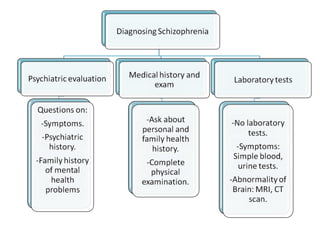
• Diagnosis
• Treatment
• Prevention
• Case study
• Conclusion
• References
Table of Content
What is Schizophrenia?
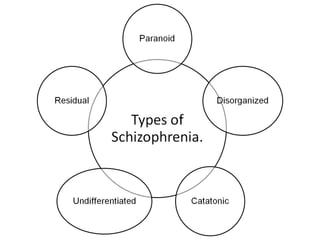
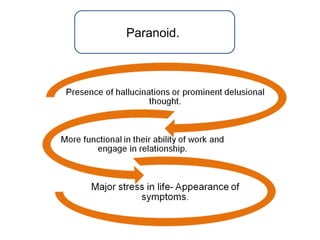
Paranoid.
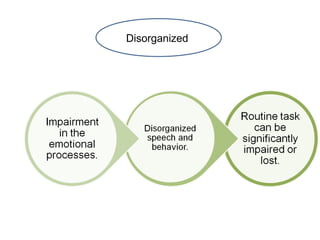
Disorganized
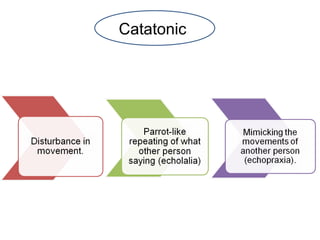
Catatonic
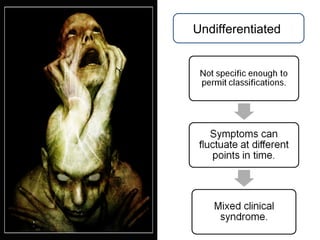
Undifferentiated
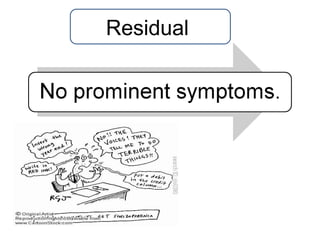
Residual
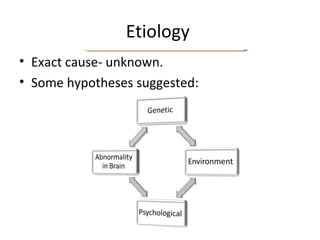
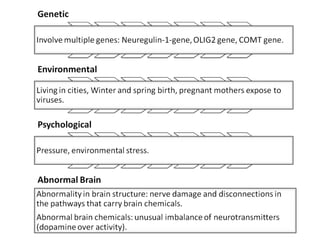
Etiology
• Exact cause- unknown.
• Some hypotheses suggested:
Pathophysiology
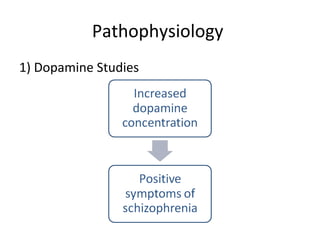
1) Dopamine Studies
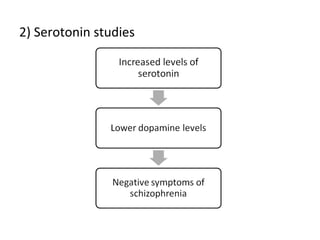
2) Serotonin studies
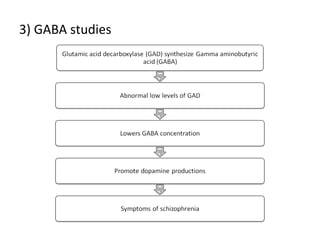
3) GABA studies
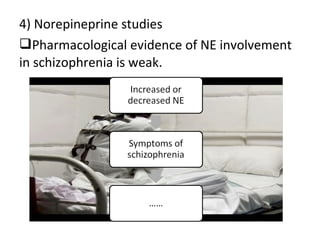
4) Norepineprine studies
Pharmacological evidence of NE involvement
in schizophrenia is weak.
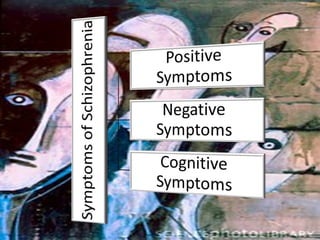
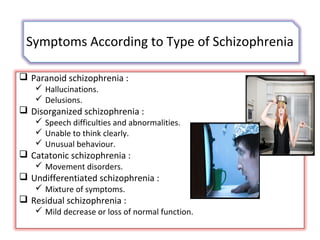
Symptoms According to Type of Schizophrenia
 Paranoid schizophrenia :
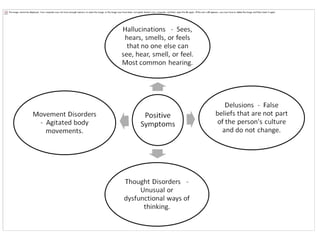
 Hallucinations.
 Delusions.
 Disorganized schizophrenia :
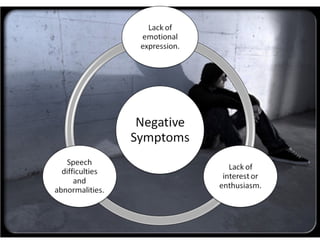
 Speech difficulties and abnormalities.
 Unable to think clearly.
 Unusual behaviour.
 Catatonic schizophrenia :
 Movement disorders.
 Undifferentiated schizophrenia :
 Mixture of symptoms.
 Residual schizophrenia :
 Mild decrease or loss of normal function.
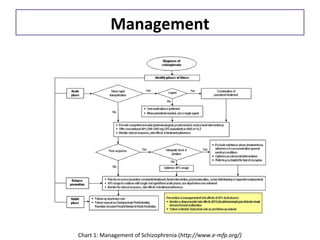
Management
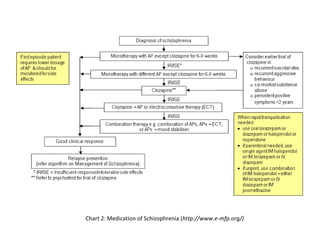
Chart 1: Management of Schizophrenia (http://www.e-mfp.org/)
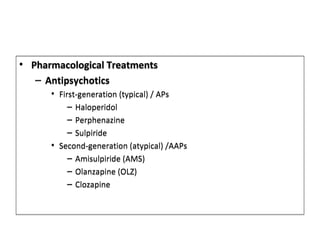
Treatment
• Pharmacological TreatmentsPharmacological Treatments
– Antipsychotics
• First-generation (typical) / APs
– Haloperidol
– Perphenazine
– Sulpiride
• Second-generation (atypical) /AAPs
– Amisulpiride (AMS)
– Olanzapine (OLZ)
– Clozapine
• Pharmacological TreatmentsPharmacological Treatments
– Antipsychotics
• First-generation (typical) / APs
– Haloperidol
– Perphenazine
– Sulpiride
• Second-generation (atypical) /AAPs
– Amisulpiride (AMS)
– Olanzapine (OLZ)
– Clozapine
Chart 2: Medication of Schizophrenia (http://www.e-mfp.org/)
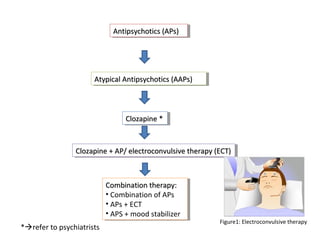
Antipsychotics (APs)Antipsychotics (APs)Antipsychotics (APs)Antipsychotics (APs)
Atypical Antipsychotics (AAPs)Atypical Antipsychotics (AAPs)Atypical Antipsychotics (AAPs)Atypical Antipsychotics (AAPs)
Clozapine *Clozapine *Clozapine *Clozapine *
Clozapine + AP/ electroconvulsive therapy (ECT)Clozapine + AP/ electroconvulsive therapy (ECT)Clozapine + AP/ electroconvulsive therapy (ECT)Clozapine + AP/ electroconvulsive therapy (ECT)
Combination therapy:Combination therapy:
• Combination of APs
• APs + ECT
• APS + mood stabilizer
Combination therapy:Combination therapy:
• Combination of APs
• APs + ECT
• APS + mood stabilizer
*refer to psychiatrists
Figure1: Electroconvulsive therapy
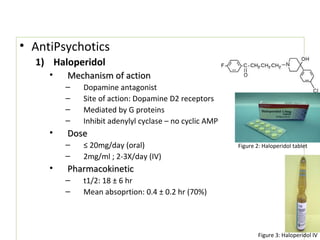
• AntiPsychotics
1) Haloperidol
• Mechanism of actionMechanism of action
– Dopamine antagonist
– Site of action: Dopamine D2 receptors
– Mediated by G proteins
– Inhibit adenylyl cyclase – no cyclic AMP
• DoseDose
– ≤ 20mg/day (oral)
– 2mg/ml ; 2-3X/day (IV)
• PharmacokineticPharmacokinetic
– t1/2: 18 ± 6 hr
– Mean absoprtion: 0.4 ± 0.2 hr (70%)
• AntiPsychotics
1) Haloperidol
• Mechanism of actionMechanism of action
– Dopamine antagonist
– Site of action: Dopamine D2 receptors
– Mediated by G proteins
– Inhibit adenylyl cyclase – no cyclic AMP
• DoseDose
– ≤ 20mg/day (oral)
– 2mg/ml ; 2-3X/day (IV)
• PharmacokineticPharmacokinetic
– t1/2: 18 ± 6 hr
– Mean absoprtion: 0.4 ± 0.2 hr (70%)
Figure 2: Haloperidol tablet
Figure 3: Haloperidol IV
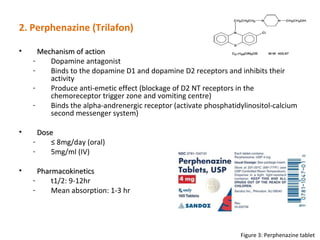
2. Perphenazine (Trilafon)
• Mechanism of actionMechanism of action
- Dopamine antagonist
- Binds to the dopamine D1 and dopamine D2 receptors and inhibits their
activity
- Produce anti-emetic effect (blockage of D2 NT receptors in the
chemoreceptor trigger zone and vomiting centre)
- Binds the alpha-andrenergic receptor (activate phosphatidylinositol-calcium
second messenger system)
• DoseDose
- ≤ 8mg/day (oral)
- 5mg/ml (IV)
• PharmacokineticsPharmacokinetics
- t1/2: 9-12hr
- Mean absorption: 1-3 hr
Figure 3: Perphenazine tablet
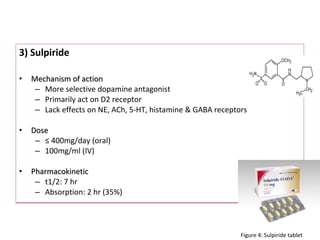
3) Sulpiride
• Mechanism of actionMechanism of action
– More selective dopamine antagonist
– Primarily act on D2 receptor
– Lack effects on NE, ACh, 5-HT, histamine & GABA receptors
• DoseDose
– ≤ 400mg/day (oral)
– 100mg/ml (IV)
• PharmacokineticPharmacokinetic
– t1/2: 7 hr
– Absorption: 2 hr (35%)
3) Sulpiride
• Mechanism of actionMechanism of action
– More selective dopamine antagonist
– Primarily act on D2 receptor
– Lack effects on NE, ACh, 5-HT, histamine & GABA receptors
• DoseDose
– ≤ 400mg/day (oral)
– 100mg/ml (IV)
• PharmacokineticPharmacokinetic
– t1/2: 7 hr
– Absorption: 2 hr (35%)
Figure 4: Sulpiride tablet
• Atypical AntiPsychotics
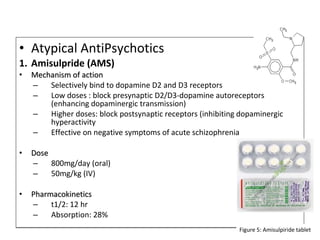
1. Amisulpride (AMS)
• Mechanism of actionMechanism of action
– Selectively bind to dopamine D2 and D3 receptors
– Low doses : block presynaptic D2/D3-dopamine autoreceptors
(enhancing dopaminergic transmission)
– Higher doses: block postsynaptic receptors (inhibiting dopaminergic
hyperactivity
– Effective on negative symptoms of acute schizophrenia
• DoseDose
– 800mg/day (oral)
– 50mg/kg (IV)
• PharmacokineticsPharmacokinetics
– t1/2: 12 hr
– Absorption: 28%
• Atypical AntiPsychotics
1. Amisulpride (AMS)
• Mechanism of actionMechanism of action
– Selectively bind to dopamine D2 and D3 receptors
– Low doses : block presynaptic D2/D3-dopamine autoreceptors
(enhancing dopaminergic transmission)
– Higher doses: block postsynaptic receptors (inhibiting dopaminergic
hyperactivity
– Effective on negative symptoms of acute schizophrenia
• DoseDose
– 800mg/day (oral)
– 50mg/kg (IV)
• PharmacokineticsPharmacokinetics
– t1/2: 12 hr
– Absorption: 28%
Figure 5: Amisulpiride tablet
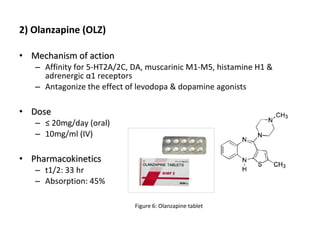
2) Olanzapine (OLZ)
• Mechanism of actionMechanism of action
– Affinity for 5-HT2A/2C, DA, muscarinic M1-M5, histamine H1 &
adrenergic α1 receptors
– Antagonize the effect of levodopa & dopamine agonists
• DoseDose
– ≤ 20mg/day (oral)
– 10mg/ml (IV)
• PharmacokineticsPharmacokinetics
– t1/2: 33 hr
– Absorption: 45%
Figure 6: Olanzapine tablet
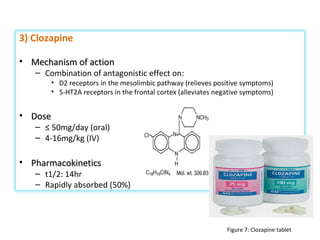
3) Clozapine
• Mechanism of actionMechanism of action
– Combination of antagonistic effect on:
• D2 receptors in the mesolimbic pathway (relieves positive symptoms)
• 5-HT2A receptors in the frontal cortex (alleviates negative symptoms)
• DoseDose
– ≤ 50mg/day (oral)
– 4-16mg/kg (IV)
• PharmacokineticsPharmacokinetics
– t1/2: 14hr
– Rapidly absorbed (50%)
Figure 7: Clozapine tablet
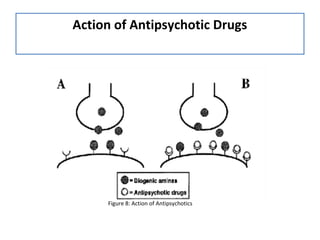
Action of Antipsychotic Drugs
Figure 8: Action of Antipsychotics
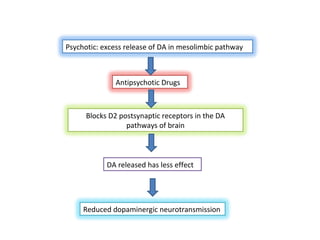
Blocks D2 postsynaptic receptors in the DA
pathways of brain
Antipsychotic Drugs
DA released has less effect
Psychotic: excess release of DA in mesolimbic pathway
Reduced dopaminergic neurotransmission
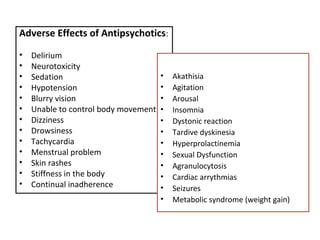
Adverse Effects of Antipsychotics:
• Delirium
• Neurotoxicity
• Sedation
• Hypotension
• Blurry vision
• Unable to control body movement
• Dizziness
• Drowsiness
• Tachycardia
• Menstrual problem
• Skin rashes
• Stiffness in the body
• Continual inadherence
• Akathisia
• Agitation
• Arousal
• Insomnia
• Dystonic reaction
• Tardive dyskinesia
• Hyperprolactinemia
• Sexual Dysfunction
• Agranulocytosis
• Cardiac arrythmias
• Seizures
• Metabolic syndrome (weight gain)
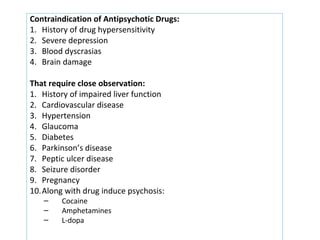
Contraindication of Antipsychotic Drugs:
1. History of drug hypersensitivity
2. Severe depression
3. Blood dyscrasias
4. Brain damage
That require close observation:
1. History of impaired liver function
2. Cardiovascular disease
3. Hypertension
4. Glaucoma
5. Diabetes
6. Parkinson’s disease
7. Peptic ulcer disease
8. Seizure disorder
9. Pregnancy
10.Along with drug induce psychosis:
– Cocaine
– Amphetamines
– L-dopa
Contraindication of Antipsychotic Drugs:
1. History of drug hypersensitivity
2. Severe depression
3. Blood dyscrasias
4. Brain damage
That require close observation:
1. History of impaired liver function
2. Cardiovascular disease
3. Hypertension
4. Glaucoma
5. Diabetes
6. Parkinson’s disease
7. Peptic ulcer disease
8. Seizure disorder
9. Pregnancy
10.Along with drug induce psychosis:
– Cocaine
– Amphetamines
– L-dopa
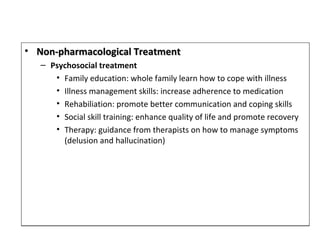
• Non-pharmacological TreatmentNon-pharmacological Treatment
– Psychosocial treatment
• Family education: whole family learn how to cope with illness
• Illness management skills: increase adherence to medication
• Rehabiliation: promote better communication and coping skills
• Social skill training: enhance quality of life and promote recovery
• Therapy: guidance from therapists on how to manage symptoms
(delusion and hallucination)
• Non-pharmacological TreatmentNon-pharmacological Treatment
– Psychosocial treatment
• Family education: whole family learn how to cope with illness
• Illness management skills: increase adherence to medication
• Rehabiliation: promote better communication and coping skills
• Social skill training: enhance quality of life and promote recovery
• Therapy: guidance from therapists on how to manage symptoms
(delusion and hallucination)
Prevention
• Primary PreventionPrimary Prevention
– Modify potential exposure
– Preventing risks factors of schizophrenia
• Secondary PreventionSecondary Prevention
– Modify the course of an illness by early intervention
– Detecting and treating early psychosis
• Tertiary PreventionTertiary Prevention
– Reduce the burden of established disorder
– Optimizing treatment and rehabilitation
• Primary PreventionPrimary Prevention
– Modify potential exposure
– Preventing risks factors of schizophrenia
• Secondary PreventionSecondary Prevention
– Modify the course of an illness by early intervention
– Detecting and treating early psychosis
• Tertiary PreventionTertiary Prevention
– Reduce the burden of established disorder
– Optimizing treatment and rehabilitation
CASE STUDY
Background
- 5 ½ year old girl
- Strange behavior and speech
- Not eating/dressing herself
- Alternate crying and laughing without reason
- Increased level of hyperactivity
- Not sleeping and talking to herself until late hours
- Not talking and responding to anyone
-x
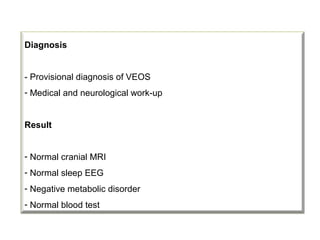
Diagnosis
- Provisional diagnosis of VEOS
- Medical and neurological work-up
Result
- Normal cranial MRI
- Normal sleep EEG
- Negative metabolic disorder
- Normal blood test
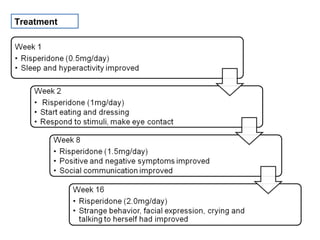
Treatment
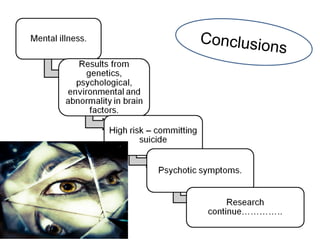
Conclusions

What is schizophrenia

  • 1.
  • 2.
    • What isSchizophrenia? • Types • Causes • Pathophysiology • Symptoms • Diagnosis • Treatment • Prevention • Case study • Conclusion • References Table of Content
  • 3.
  • 6.
  • 7.
  • 8.
  • 9.
  • 10.
  • 11.
    Etiology • Exact cause-unknown. • Some hypotheses suggested:
  • 13.
  • 14.
  • 15.
  • 16.
    4) Norepineprine studies Pharmacologicalevidence of NE involvement in schizophrenia is weak.
  • 21.
    Symptoms According toType of Schizophrenia  Paranoid schizophrenia :  Hallucinations.  Delusions.  Disorganized schizophrenia :  Speech difficulties and abnormalities.  Unable to think clearly.  Unusual behaviour.  Catatonic schizophrenia :  Movement disorders.  Undifferentiated schizophrenia :  Mixture of symptoms.  Residual schizophrenia :  Mild decrease or loss of normal function.
  • 23.
    Management Chart 1: Managementof Schizophrenia (http://www.e-mfp.org/)
  • 24.
    Treatment • Pharmacological TreatmentsPharmacologicalTreatments – Antipsychotics • First-generation (typical) / APs – Haloperidol – Perphenazine – Sulpiride • Second-generation (atypical) /AAPs – Amisulpiride (AMS) – Olanzapine (OLZ) – Clozapine • Pharmacological TreatmentsPharmacological Treatments – Antipsychotics • First-generation (typical) / APs – Haloperidol – Perphenazine – Sulpiride • Second-generation (atypical) /AAPs – Amisulpiride (AMS) – Olanzapine (OLZ) – Clozapine
  • 25.
    Chart 2: Medicationof Schizophrenia (http://www.e-mfp.org/)
  • 26.
    Antipsychotics (APs)Antipsychotics (APs)Antipsychotics(APs)Antipsychotics (APs) Atypical Antipsychotics (AAPs)Atypical Antipsychotics (AAPs)Atypical Antipsychotics (AAPs)Atypical Antipsychotics (AAPs) Clozapine *Clozapine *Clozapine *Clozapine * Clozapine + AP/ electroconvulsive therapy (ECT)Clozapine + AP/ electroconvulsive therapy (ECT)Clozapine + AP/ electroconvulsive therapy (ECT)Clozapine + AP/ electroconvulsive therapy (ECT) Combination therapy:Combination therapy: • Combination of APs • APs + ECT • APS + mood stabilizer Combination therapy:Combination therapy: • Combination of APs • APs + ECT • APS + mood stabilizer *refer to psychiatrists Figure1: Electroconvulsive therapy
  • 27.
    • AntiPsychotics 1) Haloperidol •Mechanism of actionMechanism of action – Dopamine antagonist – Site of action: Dopamine D2 receptors – Mediated by G proteins – Inhibit adenylyl cyclase – no cyclic AMP • DoseDose – ≤ 20mg/day (oral) – 2mg/ml ; 2-3X/day (IV) • PharmacokineticPharmacokinetic – t1/2: 18 ± 6 hr – Mean absoprtion: 0.4 ± 0.2 hr (70%) • AntiPsychotics 1) Haloperidol • Mechanism of actionMechanism of action – Dopamine antagonist – Site of action: Dopamine D2 receptors – Mediated by G proteins – Inhibit adenylyl cyclase – no cyclic AMP • DoseDose – ≤ 20mg/day (oral) – 2mg/ml ; 2-3X/day (IV) • PharmacokineticPharmacokinetic – t1/2: 18 ± 6 hr – Mean absoprtion: 0.4 ± 0.2 hr (70%) Figure 2: Haloperidol tablet Figure 3: Haloperidol IV
  • 28.
    2. Perphenazine (Trilafon) •Mechanism of actionMechanism of action - Dopamine antagonist - Binds to the dopamine D1 and dopamine D2 receptors and inhibits their activity - Produce anti-emetic effect (blockage of D2 NT receptors in the chemoreceptor trigger zone and vomiting centre) - Binds the alpha-andrenergic receptor (activate phosphatidylinositol-calcium second messenger system) • DoseDose - ≤ 8mg/day (oral) - 5mg/ml (IV) • PharmacokineticsPharmacokinetics - t1/2: 9-12hr - Mean absorption: 1-3 hr Figure 3: Perphenazine tablet
  • 29.
    3) Sulpiride • Mechanismof actionMechanism of action – More selective dopamine antagonist – Primarily act on D2 receptor – Lack effects on NE, ACh, 5-HT, histamine & GABA receptors • DoseDose – ≤ 400mg/day (oral) – 100mg/ml (IV) • PharmacokineticPharmacokinetic – t1/2: 7 hr – Absorption: 2 hr (35%) 3) Sulpiride • Mechanism of actionMechanism of action – More selective dopamine antagonist – Primarily act on D2 receptor – Lack effects on NE, ACh, 5-HT, histamine & GABA receptors • DoseDose – ≤ 400mg/day (oral) – 100mg/ml (IV) • PharmacokineticPharmacokinetic – t1/2: 7 hr – Absorption: 2 hr (35%) Figure 4: Sulpiride tablet
  • 30.
    • Atypical AntiPsychotics 1.Amisulpride (AMS) • Mechanism of actionMechanism of action – Selectively bind to dopamine D2 and D3 receptors – Low doses : block presynaptic D2/D3-dopamine autoreceptors (enhancing dopaminergic transmission) – Higher doses: block postsynaptic receptors (inhibiting dopaminergic hyperactivity – Effective on negative symptoms of acute schizophrenia • DoseDose – 800mg/day (oral) – 50mg/kg (IV) • PharmacokineticsPharmacokinetics – t1/2: 12 hr – Absorption: 28% • Atypical AntiPsychotics 1. Amisulpride (AMS) • Mechanism of actionMechanism of action – Selectively bind to dopamine D2 and D3 receptors – Low doses : block presynaptic D2/D3-dopamine autoreceptors (enhancing dopaminergic transmission) – Higher doses: block postsynaptic receptors (inhibiting dopaminergic hyperactivity – Effective on negative symptoms of acute schizophrenia • DoseDose – 800mg/day (oral) – 50mg/kg (IV) • PharmacokineticsPharmacokinetics – t1/2: 12 hr – Absorption: 28% Figure 5: Amisulpiride tablet
  • 31.
    2) Olanzapine (OLZ) •Mechanism of actionMechanism of action – Affinity for 5-HT2A/2C, DA, muscarinic M1-M5, histamine H1 & adrenergic α1 receptors – Antagonize the effect of levodopa & dopamine agonists • DoseDose – ≤ 20mg/day (oral) – 10mg/ml (IV) • PharmacokineticsPharmacokinetics – t1/2: 33 hr – Absorption: 45% Figure 6: Olanzapine tablet
  • 32.
    3) Clozapine • Mechanismof actionMechanism of action – Combination of antagonistic effect on: • D2 receptors in the mesolimbic pathway (relieves positive symptoms) • 5-HT2A receptors in the frontal cortex (alleviates negative symptoms) • DoseDose – ≤ 50mg/day (oral) – 4-16mg/kg (IV) • PharmacokineticsPharmacokinetics – t1/2: 14hr – Rapidly absorbed (50%) Figure 7: Clozapine tablet
  • 33.
    Action of AntipsychoticDrugs Figure 8: Action of Antipsychotics
  • 34.
    Blocks D2 postsynapticreceptors in the DA pathways of brain Antipsychotic Drugs DA released has less effect Psychotic: excess release of DA in mesolimbic pathway Reduced dopaminergic neurotransmission
  • 35.
    Adverse Effects ofAntipsychotics: • Delirium • Neurotoxicity • Sedation • Hypotension • Blurry vision • Unable to control body movement • Dizziness • Drowsiness • Tachycardia • Menstrual problem • Skin rashes • Stiffness in the body • Continual inadherence • Akathisia • Agitation • Arousal • Insomnia • Dystonic reaction • Tardive dyskinesia • Hyperprolactinemia • Sexual Dysfunction • Agranulocytosis • Cardiac arrythmias • Seizures • Metabolic syndrome (weight gain)
  • 36.
    Contraindication of AntipsychoticDrugs: 1. History of drug hypersensitivity 2. Severe depression 3. Blood dyscrasias 4. Brain damage That require close observation: 1. History of impaired liver function 2. Cardiovascular disease 3. Hypertension 4. Glaucoma 5. Diabetes 6. Parkinson’s disease 7. Peptic ulcer disease 8. Seizure disorder 9. Pregnancy 10.Along with drug induce psychosis: – Cocaine – Amphetamines – L-dopa Contraindication of Antipsychotic Drugs: 1. History of drug hypersensitivity 2. Severe depression 3. Blood dyscrasias 4. Brain damage That require close observation: 1. History of impaired liver function 2. Cardiovascular disease 3. Hypertension 4. Glaucoma 5. Diabetes 6. Parkinson’s disease 7. Peptic ulcer disease 8. Seizure disorder 9. Pregnancy 10.Along with drug induce psychosis: – Cocaine – Amphetamines – L-dopa
  • 37.
    • Non-pharmacological TreatmentNon-pharmacologicalTreatment – Psychosocial treatment • Family education: whole family learn how to cope with illness • Illness management skills: increase adherence to medication • Rehabiliation: promote better communication and coping skills • Social skill training: enhance quality of life and promote recovery • Therapy: guidance from therapists on how to manage symptoms (delusion and hallucination) • Non-pharmacological TreatmentNon-pharmacological Treatment – Psychosocial treatment • Family education: whole family learn how to cope with illness • Illness management skills: increase adherence to medication • Rehabiliation: promote better communication and coping skills • Social skill training: enhance quality of life and promote recovery • Therapy: guidance from therapists on how to manage symptoms (delusion and hallucination)
  • 38.
    Prevention • Primary PreventionPrimaryPrevention – Modify potential exposure – Preventing risks factors of schizophrenia • Secondary PreventionSecondary Prevention – Modify the course of an illness by early intervention – Detecting and treating early psychosis • Tertiary PreventionTertiary Prevention – Reduce the burden of established disorder – Optimizing treatment and rehabilitation • Primary PreventionPrimary Prevention – Modify potential exposure – Preventing risks factors of schizophrenia • Secondary PreventionSecondary Prevention – Modify the course of an illness by early intervention – Detecting and treating early psychosis • Tertiary PreventionTertiary Prevention – Reduce the burden of established disorder – Optimizing treatment and rehabilitation
  • 39.
    CASE STUDY Background - 5½ year old girl - Strange behavior and speech - Not eating/dressing herself - Alternate crying and laughing without reason - Increased level of hyperactivity - Not sleeping and talking to herself until late hours - Not talking and responding to anyone -x
  • 40.
    Diagnosis - Provisional diagnosisof VEOS - Medical and neurological work-up Result - Normal cranial MRI - Normal sleep EEG - Negative metabolic disorder - Normal blood test
  • 41.
  • 42.