CONSUMER MOTIVATION AFFECT, & PERSONALITY Motivation: theories of motivation Affect: affect and consumer behavior structure of emotions Personality: personality theory Aaker’s brand personality
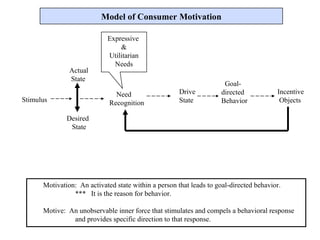
Model of Consumer Motivation Stimulus Actual State Desired State Need Recognition Drive State Goal- directed Behavior Incentive Objects Motivation:  An activated state within a person that leads to goal-directed behavior. ***  It is the reason for behavior. Motive:  An unobservable inner force that stimulates and compels a behavioral response  and provides specific direction to that response. Expressive  & Utilitarian Needs
Basic Theories of Motivation (How to figure out  WHY ) Broad Theories of Motivation: Explain general behaviors (e.g., need for affiliation) Mid-range Theories of Motivation: Explain more specific behaviors (e.g., need for caffeine)
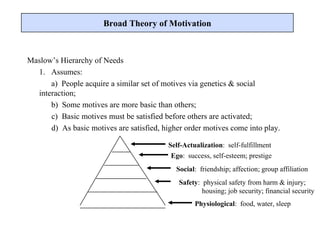
Maslow’s Hierarchy of Needs 1.  Assumes:   a)  People acquire a similar set of motives via genetics & social interaction;   b)  Some motives are more basic than others; c)  Basic motives must be satisfied before others are activated; d)  As basic motives are satisfied, higher order motives come into play. Broad Theory of Motivation Physiological :  food, water, sleep Safety :  physical safety from harm & injury; housing; job security; financial security Social :  friendship; affection; group affiliation Ego :  success, self-esteem; prestige Self-Actualization :  self-fulfillment
Midrange Theories of Motivation Summary of Psychological Motives Relevant to Marketing: Opponent-Process Theory Optimum Stimulation Levels Hedonic Experiences Maintain Behavioral Freedom Risk: Seek or Avoid Attribute Causality
Opponent Process Theory A stimulus eliciting an immediate positive or negative emotion is followed by a feeling opposite to that initial emotion Midrange Theories of Motivation Optimum Stimulation Theory Desire to maintain an optimal level of stimulation motivates action Hedonic Experiences  Consumption of products/services designed to create fantasies, enhance sensory stimulation, or elicit emotional reactions Related to optimum stimulation levels
Motivation to Maintain Behavioral Freedom People want to maintain a sense of freedom Psychological Reactance negative motivational state that results when a person’s behavioral freedom has been threatened Midrange Theories of Motivation: Maintain Behavioral Freedom
Perceived Risk – consumer’s perception of the overall negativity of a course of action  - consists of negative outcomes and probability of these outcomes occurring Risks include: - financial - social - physical - time - performance - opportunity - psychological Avoid or Seek Risk
People seek out reasons to explain why things turn out as they do Negative Product or Service Experiences Was the cause internal or external? Your fault or the company’s? BIRGing and CORFing Motivation to Attribute Causality
Motivation Theory and Marketing Strategy Consumers do not buy products; instead they buy  motive satisfaction  or  problem solutions . Managers must discover the motives that their product and brands can satisfy and develop marketing mixes around these motives.
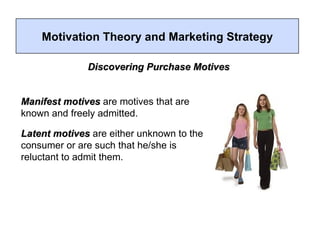
Motivation Theory and Marketing Strategy Manifest motives  are motives that are known and freely admitted. Latent motives  are either unknown to the consumer or are such that he/she is reluctant to admit them.  Discovering Purchase Motives
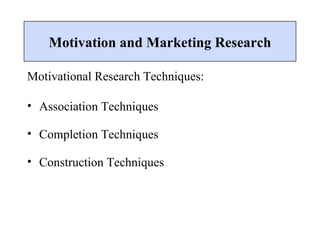
Motivational Research Techniques: Association Techniques Completion Techniques Construction Techniques Motivation and Marketing Research
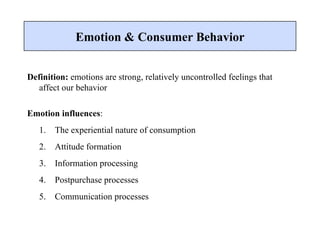
Definition:  emotions are strong, relatively uncontrolled feelings that affect our behavior Emotion influences : 1.  The experiential nature of consumption 2.  Attitude formation 3.  Information processing 4.  Postpurchase processes 5.  Communication processes Emotion & Consumer Behavior
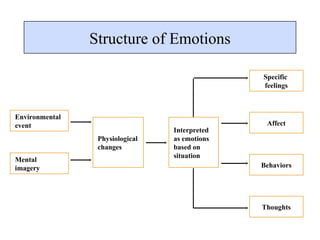
Structure of Emotions Interpreted as emotions based on situation Physiological changes Mental imagery Environmental event Thoughts Behaviors Affect Specific  feelings
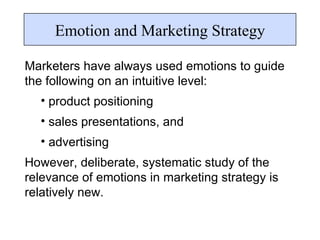
Marketers have always used emotions to guide the following on an intuitive level: product positioning sales presentations, and  advertising  However, deliberate, systematic study of the relevance of emotions in marketing strategy is relatively new. Emotion and Marketing Strategy
Emotion, Product Positioning, and Advertising When should you use it? Potential Problems?
Emotions and Branding A great brand concept can change a companies entire future. Biggest misconception in branding is the belief that branding is about market share when it is really about “mind and emotions share” What constitutes a great brand concept today? Understanding people’s emotional needs and desires is key to success.
Personality Definition:  personality refers to a person’s consistent behavior or response to recurring situations Assumptions of individual personality theories (trait theory): All individuals have internal characteristics or traits There are consistent and measurable differences between people on these characteristics
Personality Approaches: Trait theory – consistent set of traits or factors dominated consumer behavior research Psychoanalytic (Freud) – unconscious nature of personality Evolutionary – certain behavioral propensities were likely to survive Biological – anatomy and physiology Behavioral and Social Learning Theory – personality exclusively a function of environment Best Approach: Study the person, situation and behavior
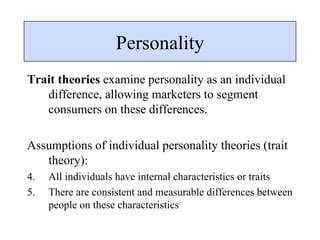
Trait theories  examine personality as an individual difference, allowing marketers to segment consumers on these differences. Assumptions of individual personality theories (trait theory): All individuals have internal characteristics or traits There are consistent and measurable differences between people on these characteristics Personality
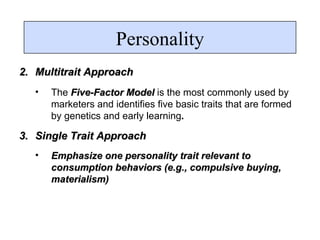
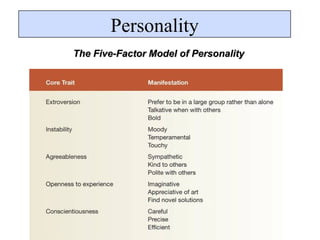
Multitrait Approach The  Five-Factor Model  is the most commonly used by marketers and identifies five basic traits that are formed by genetics and early learning . Single Trait Approach Emphasize one personality trait relevant to consumption behaviors (e.g., compulsive buying, materialism) Personality
The Five-Factor Model of Personality Personality
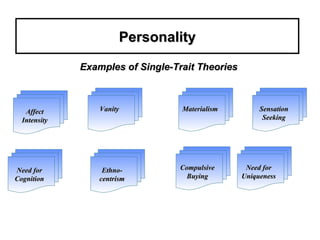
Personality Examples of Single-Trait Theories Vanity Materialism Sensation Seeking Compulsive Buying Affect Intensity Ethno-centrism Need for Cognition Need for Uniqueness
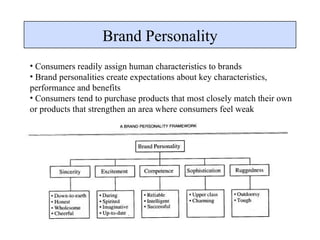
Brand Personality Consumers readily assign human characteristics to brands Brand personalities create expectations about key characteristics, performance and benefits Consumers tend to purchase products that most closely match their own or products that strengthen an area where consumers feel weak

Motives, Emotion, personality

  • 1.
    CONSUMER MOTIVATION AFFECT,& PERSONALITY Motivation: theories of motivation Affect: affect and consumer behavior structure of emotions Personality: personality theory Aaker’s brand personality
  • 2.
    Model of ConsumerMotivation Stimulus Actual State Desired State Need Recognition Drive State Goal- directed Behavior Incentive Objects Motivation: An activated state within a person that leads to goal-directed behavior. *** It is the reason for behavior. Motive: An unobservable inner force that stimulates and compels a behavioral response and provides specific direction to that response. Expressive & Utilitarian Needs
  • 3.
    Basic Theories ofMotivation (How to figure out WHY ) Broad Theories of Motivation: Explain general behaviors (e.g., need for affiliation) Mid-range Theories of Motivation: Explain more specific behaviors (e.g., need for caffeine)
  • 4.
    Maslow’s Hierarchy ofNeeds 1. Assumes: a) People acquire a similar set of motives via genetics & social interaction; b) Some motives are more basic than others; c) Basic motives must be satisfied before others are activated; d) As basic motives are satisfied, higher order motives come into play. Broad Theory of Motivation Physiological : food, water, sleep Safety : physical safety from harm & injury; housing; job security; financial security Social : friendship; affection; group affiliation Ego : success, self-esteem; prestige Self-Actualization : self-fulfillment
  • 5.
    Midrange Theories ofMotivation Summary of Psychological Motives Relevant to Marketing: Opponent-Process Theory Optimum Stimulation Levels Hedonic Experiences Maintain Behavioral Freedom Risk: Seek or Avoid Attribute Causality
  • 6.
    Opponent Process TheoryA stimulus eliciting an immediate positive or negative emotion is followed by a feeling opposite to that initial emotion Midrange Theories of Motivation Optimum Stimulation Theory Desire to maintain an optimal level of stimulation motivates action Hedonic Experiences Consumption of products/services designed to create fantasies, enhance sensory stimulation, or elicit emotional reactions Related to optimum stimulation levels
  • 7.
    Motivation to MaintainBehavioral Freedom People want to maintain a sense of freedom Psychological Reactance negative motivational state that results when a person’s behavioral freedom has been threatened Midrange Theories of Motivation: Maintain Behavioral Freedom
  • 8.
    Perceived Risk –consumer’s perception of the overall negativity of a course of action - consists of negative outcomes and probability of these outcomes occurring Risks include: - financial - social - physical - time - performance - opportunity - psychological Avoid or Seek Risk
  • 9.
    People seek outreasons to explain why things turn out as they do Negative Product or Service Experiences Was the cause internal or external? Your fault or the company’s? BIRGing and CORFing Motivation to Attribute Causality
  • 10.
    Motivation Theory andMarketing Strategy Consumers do not buy products; instead they buy motive satisfaction or problem solutions . Managers must discover the motives that their product and brands can satisfy and develop marketing mixes around these motives.
  • 11.
    Motivation Theory andMarketing Strategy Manifest motives are motives that are known and freely admitted. Latent motives are either unknown to the consumer or are such that he/she is reluctant to admit them. Discovering Purchase Motives
  • 12.
    Motivational Research Techniques:Association Techniques Completion Techniques Construction Techniques Motivation and Marketing Research
  • 13.
    Definition: emotionsare strong, relatively uncontrolled feelings that affect our behavior Emotion influences : 1. The experiential nature of consumption 2. Attitude formation 3. Information processing 4. Postpurchase processes 5. Communication processes Emotion & Consumer Behavior
  • 14.
    Structure of EmotionsInterpreted as emotions based on situation Physiological changes Mental imagery Environmental event Thoughts Behaviors Affect Specific feelings
  • 15.
    Marketers have alwaysused emotions to guide the following on an intuitive level: product positioning sales presentations, and advertising However, deliberate, systematic study of the relevance of emotions in marketing strategy is relatively new. Emotion and Marketing Strategy
  • 16.
    Emotion, Product Positioning,and Advertising When should you use it? Potential Problems?
  • 17.
    Emotions and BrandingA great brand concept can change a companies entire future. Biggest misconception in branding is the belief that branding is about market share when it is really about “mind and emotions share” What constitutes a great brand concept today? Understanding people’s emotional needs and desires is key to success.
  • 18.
    Personality Definition: personality refers to a person’s consistent behavior or response to recurring situations Assumptions of individual personality theories (trait theory): All individuals have internal characteristics or traits There are consistent and measurable differences between people on these characteristics
  • 19.
    Personality Approaches: Traittheory – consistent set of traits or factors dominated consumer behavior research Psychoanalytic (Freud) – unconscious nature of personality Evolutionary – certain behavioral propensities were likely to survive Biological – anatomy and physiology Behavioral and Social Learning Theory – personality exclusively a function of environment Best Approach: Study the person, situation and behavior
  • 20.
    Trait theories examine personality as an individual difference, allowing marketers to segment consumers on these differences. Assumptions of individual personality theories (trait theory): All individuals have internal characteristics or traits There are consistent and measurable differences between people on these characteristics Personality
  • 21.
    Multitrait Approach The Five-Factor Model is the most commonly used by marketers and identifies five basic traits that are formed by genetics and early learning . Single Trait Approach Emphasize one personality trait relevant to consumption behaviors (e.g., compulsive buying, materialism) Personality
  • 22.
    The Five-Factor Modelof Personality Personality
  • 23.
    Personality Examples ofSingle-Trait Theories Vanity Materialism Sensation Seeking Compulsive Buying Affect Intensity Ethno-centrism Need for Cognition Need for Uniqueness
  • 24.
    Brand Personality Consumersreadily assign human characteristics to brands Brand personalities create expectations about key characteristics, performance and benefits Consumers tend to purchase products that most closely match their own or products that strengthen an area where consumers feel weak