4 - 1
Consumer Behaviour
Ninth Canadian Edition
Chapter 4
Motivation and Affect
Copyright © 2024 Pearson Canada Inc.
Copyright © 2024 Pearson Canada Inc. 4 - 2
Chapter Objectives
When you finish reading this chapter, you will understand
why?
4.1 Various consumer needs influence consumer behaviour.
4.2 It is important for marketers to understand the motivation
process.
4.3 Involvement with a product, the marketing message,
and/or the purchase situation are all important
considerations.
4.4 Consumers can experience different types of affective
responses, which can influence consumption
behaviours.
Copyright © 2024 Pearson Canada Inc. 4 - 3
Classifying Consumer Needs (Specific
Needs and Buying Behaviour) (1 of 2)
• Need for achievement: Value personal
accomplishment; place a premium on products that
signify success
• Need for Affiliation: Need for relevant products and
services to alleviate loneliness
• Need for Power: Control one’s environment. Focus on
products that have mastery over surroundings
• Need for uniqueness: To assert one’s individual
identity.
Copyright © 2024 Pearson Canada Inc. 4 - 4
Classifying Consumer Needs (Specific
Needs and Buying Behaviour) (2 of 2)
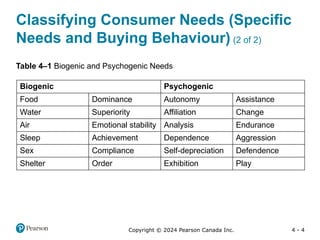
Table 4–1 Biogenic and Psychogenic Needs
Biogenic Psychogenic
Food Dominance Autonomy Assistance
Water Superiority Affiliation Change
Air Emotional stability Analysis Endurance
Sleep Achievement Dependence Aggression
Sex Compliance Self-depreciation Defendence
Shelter Order Exhibition Play
Copyright © 2024 Pearson Canada Inc. 4 - 5
Levels of Needs in the Maslow Hierarchy
FIGURE 4–1 Levels of Needs in the Maslow Hierarchy
Copyright © 2024 Pearson Canada Inc. 4 - 6
Motivational Process (1 of 2)
Motivation
• Process that leads people to behave as they do.
A want is a manifestation of a
need. This ad from Mydoh, a
money management app for
kids designed to help them
learn money skills, shows that
banks recognize that kids are
learning to set goals and save
toward them. They aim to
position themselves as the
“want” to help kids and
parents achieve those
banking goals.
Copyright © 2024 Pearson Canada Inc. 4 - 7
Motivational Process (2 of 2)
• Occurs when a need is aroused that the consumer
wishes to satisfy
• Forces that drive us to buy/use products
– Goal: Consumer’s desired end-state
– Want: Manifestation of consumer need
Copyright © 2024 Pearson Canada Inc. 4 - 8
Motivation and Goal Fulfillment (1 of 2)
• Goal Setting that is SMART can help consumers to
reach their goals: Nike and the Running Room
• Sometimes consumers decrease effort when they get
closer to the goal
• Goals can be unconsciously activated: The Apple
brand name activates the need to be unique and
different
Copyright © 2024 Pearson Canada Inc. 4 - 9
Motivation and Goal Fulfillment (2 of 2)
Incidental brand exposure, such as seeing an advertisement or a product, can activate
consumer goals. The Apple brand can activate the motivation to be unique and different.
Copyright © 2024 Pearson Canada Inc. 4 - 10
Motivational Strength (1 of 4)
Motivational Strength
• Degree of willingness to expend energy to reach a
goal.
• Drive theory: Biological needs that produce
unpleasant states of arousal (e.g., hunger)
• Homeostasis: A balanced state
• Expectancy theory: Behaviour is pulled by
expectations of achieving desirable outcomes
• Needs vs. wants
Copyright © 2024 Pearson Canada Inc. 4 - 11
Motivational Strength (2 of 4)
• There are two basic theoretical categories that
account for motivational strength:
Drive theory
• Biological needs that produce unpleasant states of
arousal (e.g., hunger)
Homeostasis: A balanced state
Expectancy theory
• Behaviour is pulled by expectations of achieving
desirable outcomes
Needs vs. wants
Copyright © 2024 Pearson Canada Inc. 4 - 12
Motivational Strength (3 of 4)
• There are two basic theoretical categories that
account for motivational strength: drive and
expectancy theory
Drive theory
• Biological needs that produce unpleasant states of
arousal (e.g., hunger)
• Homeostasis: A balanced state
• People often do things that increase a drive state
rather than decrease it.
Copyright © 2024 Pearson Canada Inc. 4 - 13
Motivational Strength (4 of 4)
Expectancy theory
• Behaviour is pulled by expectations of achieving
desirable outcomes
– positive consequences
– positive incentives could include things like money or
even social status
Copyright © 2024 Pearson Canada Inc. 4 - 14
Motivational Direction (Needs vs.
Wants) (1 of 2)
Way to satisfy needs…
• depends on the individual’s unique history and
learning experiences and his or her cultural
environment.
• hedonic consumption as an influence on consumers’
choices
• this term refers to the: multisensory, fantasy, and
emotional aspects of consumers’ interactions with
products
Copyright © 2024 Pearson Canada Inc. 4 - 15
Motivational Direction (Needs vs.
Wants) (2 of 2)
Types of Needs:
Biogenic
• Biological needs, such as for air, water, food
Psychogenic
• Need for status, power, affiliation
Utilitarian
• Need for tangible attributes of a product, such as miles per
gallon in a car or calories in a cheeseburger
Hedonic
• Needs for excitement, self-confidence, fantasy
Copyright © 2024 Pearson Canada Inc. 4 - 16
Motivational Conflicts
Goal valence:
– Positively valued goal: Approach
– Negatively valued goal: Avoid
 Deodorant and mouthwash
• Positive and negative motives often conflict with one
another
Copyright © 2024 Pearson Canada Inc. 4 - 17
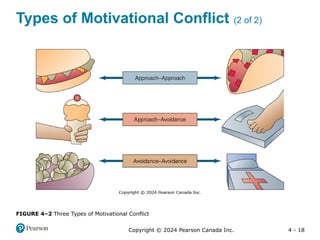
Types of Motivational Conflict (1 of 2)
• Two desirable alternatives
• Cognitive dissonance
• Positive & negative aspects of desired product
• Guilt of desire occurs
• Facing a choice with two undesirable alternatives
Copyright © 2024 Pearson Canada Inc. 4 - 18
Types of Motivational Conflict (2 of 2)
FIGURE 4–2 Three Types of Motivational Conflict
Copyright © 2024 Pearson Canada Inc. 4 - 19
Consumer Involvement
Involvement
• Perceived relevance of an object based on one’s
needs, values, and interests
• not everyone is motivated to the same extent…
• involvement is a motivational construct, it can be
triggered by one or more of the different antecedents
shown in Figure 4–3
Copyright © 2024 Pearson Canada Inc. 4 - 20
Conceptualizing Involvement
FIGURE 4–3 Conceptualizing Involvement
Copyright © 2024 Pearson Canada Inc. 4 - 21
Levels of Involvement: Inertia and Flow
State (1 of 2)
• Inertia: Consumption at the low end of involvement
– We make decisions out of habit (lack of motivation)
• Flow state: True involvement with a product
– Playfulness
– Being in control
– Concentration/focused attention
– Mental enjoyment of activity for its own sake
– Distorted sense of time
– Match between challenge at hand and one’s skills
Copyright © 2024 Pearson Canada Inc. 4 - 22
Levels of Involvement: Inertia and Flow
State (2 of 2)
Table 4–2 Foote, Cone, and Belding’s Involvement and Product Typology
Cognitive Affective
Level of
involvement
High • Vehicles
• Computers
Media: print online, information
based
• Jewellery
• Sports equipment
Media: longer videos,
image-based
Low • Weekly groceries
• Household cleansers
Media: short videos, point-of-sale
reminders
• Candy
• Liquor
Media: POS attention-
grabbing
Adapted from Richard Vaughn, “How Advertising Works: A Planning Model,” Journal of Advertising Research 20
(October 1980): 31. See also Judith Lynne Zaichkowsky, “The Emotional Side of Product Involvement,” in Advances in
Consumer Research, eds. Paul Anderson and Melanie Wallendorf (Provo, UT: Association for Consumer Research,
1986), 32–35.
Copyright © 2024 Pearson Canada Inc. 4 - 23
The Many Faces of Involvement
(Product Involvement)
• Product involvement: Consumer’s level of interest in a
product
• Many sales promotions attempt to increase product
involvement
Mass customization
• Customization and personalization of products and
services for individual customers at a mass production
price
Copyright © 2024 Pearson Canada Inc. 4 - 24
The Many Faces of Involvement
(Message-Response Involvement)
Message-Response Involvement
• The medium through which the message is
communicated can increase consumer involvement.
• Celebrity endorsements
• User-generated content
• Marketers connect with consumers in real time via
social media about events as they are happening
Copyright © 2024 Pearson Canada Inc. 4 - 25
The Many Faces of Involvement
(Purchase Situation Involvement)
Purchase situation involvement
• Differences that occur when buying the same object
for different contexts.
• Example: wedding gift
– For boss: purchase expensive vase to show that you
want to impress boss
– For cousin you don’t like: purchase inexpensive vase to
show you’re indifferent
Copyright © 2024 Pearson Canada Inc. 4 - 26
Segmenting by Involvement Levels
• Allows consumer researchers to capture the diversity
of the involvement construct, and it also allows for
involvement to be used as a basis for market
segmentation.
Copyright © 2024 Pearson Canada Inc. 4 - 27
Strategies to Increase Involvement
The marketer can enhance the consumer’s
motivation to process relevant information fairly
easily by using one or more of the following
techniques:
• Appeal to consumers’ hedonic needs
• Use novel stimuli
• Use prominent stimuli
• Include celebrity endorsers
• Build a bond with consumers by maintaining an
ongoing relationship
Copyright © 2024 Pearson Canada Inc. 4 - 28
Types of Affective Responses
Affect
• Refers to the experience of emotionally-laden states,
which can range from evaluations, to moods, to full-
blown emotions.
• Evaluations – valenced (i.e., positive or negative)
reactions to events and objects, that are not
accompanied by high levels of arousal.
• Moods – involve temporary positive or negative affective
states accompanied by moderate levels of arousal.
• Emotions – tend to be more intense and are often
related to a specific triggering event.
Copyright © 2024 Pearson Canada Inc. 4 - 29
Types of Affective States
• Negative state relief
– Helping can relieve
negative moods
• Mood congruency
– Positive moods lead
– to more positive
evaluations
Copyright © 2024 Pearson Canada Inc. 4 - 30
Discrete Emotions (Happiness)
Happiness
• A mental state of well-being characterized by positive
emotions
– Materialism and happiness
– Materialism vs Experiential purchases
– Spending money on others vs. the self
Copyright © 2024 Pearson Canada Inc. 4 - 31
Discrete Emotions (Envy)
Envy
• A negative emotion associated with the desire to
reduce the gap between oneself and someone who is
superior on some dimension
– Benign vs. malicious envy
Copyright © 2024 Pearson Canada Inc. 4 - 32
Discrete Emotions (Guilt)
Guilt
• An individual’s unpleasant emotional state associated
with possible objections to his or her actions, inaction,
circumstances, or intentions
– Guilt appeals – can backfire if too extreme
– In retail contexts
Copyright © 2024 Pearson Canada Inc. 4 - 33
Discrete Emotions (Embarrassment)
Embarrassment
• Driven by a concern for what others are thinking
– Unwanted events communicate undesired
information about oneself to others
– Sometimes dependent on product category

Chapter 9 - Consumer Behaviour Michael Solomon

  • 1.
    4 - 1 ConsumerBehaviour Ninth Canadian Edition Chapter 4 Motivation and Affect Copyright © 2024 Pearson Canada Inc.
  • 2.
    Copyright © 2024Pearson Canada Inc. 4 - 2 Chapter Objectives When you finish reading this chapter, you will understand why? 4.1 Various consumer needs influence consumer behaviour. 4.2 It is important for marketers to understand the motivation process. 4.3 Involvement with a product, the marketing message, and/or the purchase situation are all important considerations. 4.4 Consumers can experience different types of affective responses, which can influence consumption behaviours.
  • 3.
    Copyright © 2024Pearson Canada Inc. 4 - 3 Classifying Consumer Needs (Specific Needs and Buying Behaviour) (1 of 2) • Need for achievement: Value personal accomplishment; place a premium on products that signify success • Need for Affiliation: Need for relevant products and services to alleviate loneliness • Need for Power: Control one’s environment. Focus on products that have mastery over surroundings • Need for uniqueness: To assert one’s individual identity.
  • 4.
    Copyright © 2024Pearson Canada Inc. 4 - 4 Classifying Consumer Needs (Specific Needs and Buying Behaviour) (2 of 2) Table 4–1 Biogenic and Psychogenic Needs Biogenic Psychogenic Food Dominance Autonomy Assistance Water Superiority Affiliation Change Air Emotional stability Analysis Endurance Sleep Achievement Dependence Aggression Sex Compliance Self-depreciation Defendence Shelter Order Exhibition Play
  • 5.
    Copyright © 2024Pearson Canada Inc. 4 - 5 Levels of Needs in the Maslow Hierarchy FIGURE 4–1 Levels of Needs in the Maslow Hierarchy
  • 6.
    Copyright © 2024Pearson Canada Inc. 4 - 6 Motivational Process (1 of 2) Motivation • Process that leads people to behave as they do. A want is a manifestation of a need. This ad from Mydoh, a money management app for kids designed to help them learn money skills, shows that banks recognize that kids are learning to set goals and save toward them. They aim to position themselves as the “want” to help kids and parents achieve those banking goals.
  • 7.
    Copyright © 2024Pearson Canada Inc. 4 - 7 Motivational Process (2 of 2) • Occurs when a need is aroused that the consumer wishes to satisfy • Forces that drive us to buy/use products – Goal: Consumer’s desired end-state – Want: Manifestation of consumer need
  • 8.
    Copyright © 2024Pearson Canada Inc. 4 - 8 Motivation and Goal Fulfillment (1 of 2) • Goal Setting that is SMART can help consumers to reach their goals: Nike and the Running Room • Sometimes consumers decrease effort when they get closer to the goal • Goals can be unconsciously activated: The Apple brand name activates the need to be unique and different
  • 9.
    Copyright © 2024Pearson Canada Inc. 4 - 9 Motivation and Goal Fulfillment (2 of 2) Incidental brand exposure, such as seeing an advertisement or a product, can activate consumer goals. The Apple brand can activate the motivation to be unique and different.
  • 10.
    Copyright © 2024Pearson Canada Inc. 4 - 10 Motivational Strength (1 of 4) Motivational Strength • Degree of willingness to expend energy to reach a goal. • Drive theory: Biological needs that produce unpleasant states of arousal (e.g., hunger) • Homeostasis: A balanced state • Expectancy theory: Behaviour is pulled by expectations of achieving desirable outcomes • Needs vs. wants
  • 11.
    Copyright © 2024Pearson Canada Inc. 4 - 11 Motivational Strength (2 of 4) • There are two basic theoretical categories that account for motivational strength: Drive theory • Biological needs that produce unpleasant states of arousal (e.g., hunger) Homeostasis: A balanced state Expectancy theory • Behaviour is pulled by expectations of achieving desirable outcomes Needs vs. wants
  • 12.
    Copyright © 2024Pearson Canada Inc. 4 - 12 Motivational Strength (3 of 4) • There are two basic theoretical categories that account for motivational strength: drive and expectancy theory Drive theory • Biological needs that produce unpleasant states of arousal (e.g., hunger) • Homeostasis: A balanced state • People often do things that increase a drive state rather than decrease it.
  • 13.
    Copyright © 2024Pearson Canada Inc. 4 - 13 Motivational Strength (4 of 4) Expectancy theory • Behaviour is pulled by expectations of achieving desirable outcomes – positive consequences – positive incentives could include things like money or even social status
  • 14.
    Copyright © 2024Pearson Canada Inc. 4 - 14 Motivational Direction (Needs vs. Wants) (1 of 2) Way to satisfy needs… • depends on the individual’s unique history and learning experiences and his or her cultural environment. • hedonic consumption as an influence on consumers’ choices • this term refers to the: multisensory, fantasy, and emotional aspects of consumers’ interactions with products
  • 15.
    Copyright © 2024Pearson Canada Inc. 4 - 15 Motivational Direction (Needs vs. Wants) (2 of 2) Types of Needs: Biogenic • Biological needs, such as for air, water, food Psychogenic • Need for status, power, affiliation Utilitarian • Need for tangible attributes of a product, such as miles per gallon in a car or calories in a cheeseburger Hedonic • Needs for excitement, self-confidence, fantasy
  • 16.
    Copyright © 2024Pearson Canada Inc. 4 - 16 Motivational Conflicts Goal valence: – Positively valued goal: Approach – Negatively valued goal: Avoid  Deodorant and mouthwash • Positive and negative motives often conflict with one another
  • 17.
    Copyright © 2024Pearson Canada Inc. 4 - 17 Types of Motivational Conflict (1 of 2) • Two desirable alternatives • Cognitive dissonance • Positive & negative aspects of desired product • Guilt of desire occurs • Facing a choice with two undesirable alternatives
  • 18.
    Copyright © 2024Pearson Canada Inc. 4 - 18 Types of Motivational Conflict (2 of 2) FIGURE 4–2 Three Types of Motivational Conflict
  • 19.
    Copyright © 2024Pearson Canada Inc. 4 - 19 Consumer Involvement Involvement • Perceived relevance of an object based on one’s needs, values, and interests • not everyone is motivated to the same extent… • involvement is a motivational construct, it can be triggered by one or more of the different antecedents shown in Figure 4–3
  • 20.
    Copyright © 2024Pearson Canada Inc. 4 - 20 Conceptualizing Involvement FIGURE 4–3 Conceptualizing Involvement
  • 21.
    Copyright © 2024Pearson Canada Inc. 4 - 21 Levels of Involvement: Inertia and Flow State (1 of 2) • Inertia: Consumption at the low end of involvement – We make decisions out of habit (lack of motivation) • Flow state: True involvement with a product – Playfulness – Being in control – Concentration/focused attention – Mental enjoyment of activity for its own sake – Distorted sense of time – Match between challenge at hand and one’s skills
  • 22.
    Copyright © 2024Pearson Canada Inc. 4 - 22 Levels of Involvement: Inertia and Flow State (2 of 2) Table 4–2 Foote, Cone, and Belding’s Involvement and Product Typology Cognitive Affective Level of involvement High • Vehicles • Computers Media: print online, information based • Jewellery • Sports equipment Media: longer videos, image-based Low • Weekly groceries • Household cleansers Media: short videos, point-of-sale reminders • Candy • Liquor Media: POS attention- grabbing Adapted from Richard Vaughn, “How Advertising Works: A Planning Model,” Journal of Advertising Research 20 (October 1980): 31. See also Judith Lynne Zaichkowsky, “The Emotional Side of Product Involvement,” in Advances in Consumer Research, eds. Paul Anderson and Melanie Wallendorf (Provo, UT: Association for Consumer Research, 1986), 32–35.
  • 23.
    Copyright © 2024Pearson Canada Inc. 4 - 23 The Many Faces of Involvement (Product Involvement) • Product involvement: Consumer’s level of interest in a product • Many sales promotions attempt to increase product involvement Mass customization • Customization and personalization of products and services for individual customers at a mass production price
  • 24.
    Copyright © 2024Pearson Canada Inc. 4 - 24 The Many Faces of Involvement (Message-Response Involvement) Message-Response Involvement • The medium through which the message is communicated can increase consumer involvement. • Celebrity endorsements • User-generated content • Marketers connect with consumers in real time via social media about events as they are happening
  • 25.
    Copyright © 2024Pearson Canada Inc. 4 - 25 The Many Faces of Involvement (Purchase Situation Involvement) Purchase situation involvement • Differences that occur when buying the same object for different contexts. • Example: wedding gift – For boss: purchase expensive vase to show that you want to impress boss – For cousin you don’t like: purchase inexpensive vase to show you’re indifferent
  • 26.
    Copyright © 2024Pearson Canada Inc. 4 - 26 Segmenting by Involvement Levels • Allows consumer researchers to capture the diversity of the involvement construct, and it also allows for involvement to be used as a basis for market segmentation.
  • 27.
    Copyright © 2024Pearson Canada Inc. 4 - 27 Strategies to Increase Involvement The marketer can enhance the consumer’s motivation to process relevant information fairly easily by using one or more of the following techniques: • Appeal to consumers’ hedonic needs • Use novel stimuli • Use prominent stimuli • Include celebrity endorsers • Build a bond with consumers by maintaining an ongoing relationship
  • 28.
    Copyright © 2024Pearson Canada Inc. 4 - 28 Types of Affective Responses Affect • Refers to the experience of emotionally-laden states, which can range from evaluations, to moods, to full- blown emotions. • Evaluations – valenced (i.e., positive or negative) reactions to events and objects, that are not accompanied by high levels of arousal. • Moods – involve temporary positive or negative affective states accompanied by moderate levels of arousal. • Emotions – tend to be more intense and are often related to a specific triggering event.
  • 29.
    Copyright © 2024Pearson Canada Inc. 4 - 29 Types of Affective States • Negative state relief – Helping can relieve negative moods • Mood congruency – Positive moods lead – to more positive evaluations
  • 30.
    Copyright © 2024Pearson Canada Inc. 4 - 30 Discrete Emotions (Happiness) Happiness • A mental state of well-being characterized by positive emotions – Materialism and happiness – Materialism vs Experiential purchases – Spending money on others vs. the self
  • 31.
    Copyright © 2024Pearson Canada Inc. 4 - 31 Discrete Emotions (Envy) Envy • A negative emotion associated with the desire to reduce the gap between oneself and someone who is superior on some dimension – Benign vs. malicious envy
  • 32.
    Copyright © 2024Pearson Canada Inc. 4 - 32 Discrete Emotions (Guilt) Guilt • An individual’s unpleasant emotional state associated with possible objections to his or her actions, inaction, circumstances, or intentions – Guilt appeals – can backfire if too extreme – In retail contexts
  • 33.
    Copyright © 2024Pearson Canada Inc. 4 - 33 Discrete Emotions (Embarrassment) Embarrassment • Driven by a concern for what others are thinking – Unwanted events communicate undesired information about oneself to others – Sometimes dependent on product category

Editor's Notes

  • #1 If this PowerPoint presentation contains mathematical equations, you may need to check that your computer has the following installed: 1) MathType Plugin 2) Math Player (free versions available) 3) NVDA Reader (free versions available)
  • #3 LO 4.1 Various consumer needs influence consumer behaviour.
  • #4 LO 4.1 Various consumer needs influence consumer behaviour.
  • #5 LO 4.1 Various consumer needs influence consumer behaviour.
  • #6 LO 4.2 It is important for marketers to understand the motivation process.
  • #7 LO 4.2 It is important for marketers to understand the motivation process.
  • #8 LO 4.2 It is important for marketers to understand the motivation process.
  • #9 LO 4.2 It is important for marketers to understand the motivation process.
  • #10 LO 4.2 It is important for marketers to understand the motivation process.
  • #11 LO 4.2 It is important for marketers to understand the motivation process.
  • #12 LO 4.2 It is important for marketers to understand the motivation process.
  • #13 LO 4.2 It is important for marketers to understand the motivation process.
  • #14 LO 4.2 It is important for marketers to understand the motivation process.
  • #15 LO 4.2 It is important for marketers to understand the motivation process.
  • #16 LO 4.2 It is important for marketers to understand the motivation process.
  • #17 LO 4.2 It is important for marketers to understand the motivation process.
  • #18 LO 4.2 It is important for marketers to understand the motivation process.
  • #19 LO 4.3 Involvement with a product, the marketing message, and/or the purchase situation are all important considerations.
  • #20 LO 4.3 Involvement with a product, the marketing message, and/or the purchase situation are all important considerations.
  • #21 LO 4.3 Involvement with a product, the marketing message, and/or the purchase situation are all important considerations.
  • #22 LO 4.3 Involvement with a product, the marketing message, and/or the purchase situation are all important considerations.
  • #23 LO 4.3 Involvement with a product, the marketing message, and/or the purchase situation are all important considerations.
  • #24 LO 4.3 Involvement with a product, the marketing message, and/or the purchase situation are all important considerations.
  • #25 LO 4.3 Involvement with a product, the marketing message, and/or the purchase situation are all important considerations.
  • #26 LO 4.3 Involvement with a product, the marketing message, and/or the purchase situation are all important considerations.
  • #27 LO 4.3 Involvement with a product, the marketing message, and/or the purchase situation are all important considerations.
  • #28 LO 4.4 Consumers can experience different types of affective responses, which can influence consumption behaviours.
  • #29 LO 4.4 Consumers can experience different types of affective responses, which can influence consumption behaviours.
  • #30 LO 4.4 Consumers can experience different types of affective responses, which can influence consumption behaviours.
  • #31 LO 4.4 Consumers can experience different types of affective responses, which can influence consumption behaviours.
  • #32 LO 4.4 Consumers can experience different types of affective responses, which can influence consumption behaviours.
  • #33 LO 4.4 Consumers can experience different types of affective responses, which can influence consumption behaviours.