Copyright 2009 John Wiley & Sons, Inc.
Chapter 9
Resource Allocation
Critical Path Method—Crashing a
Project
 Time and cost are interrelated
 The faster an activity is completed, the
more it costs
 Change the schedule and you change
the budget
 Thus many activities can be speeded
up by spending more money
What is Crashing / Crunching?
 To speed up, or expedite, a project
 Of course, the resources to do this must be
available
 Crunching a project changes the schedule
for all activities
 This will have an impact on schedules for all
the subcontractors
 Crunching a project often introduces
unanticipated problems
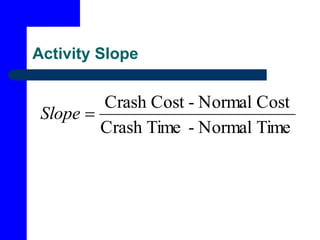
Activity Slope
Time
Normal
-
Time
Crash
Cost
Normal
-
Cost
Crash

Slope
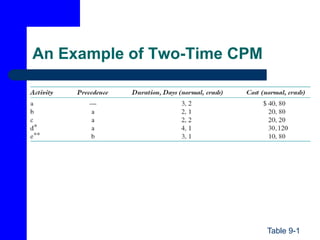
An Example of Two-Time CPM
Table 9-1
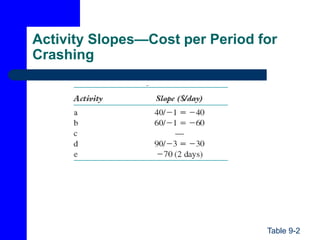
Activity Slopes—Cost per Period for
Crashing
Table 9-2
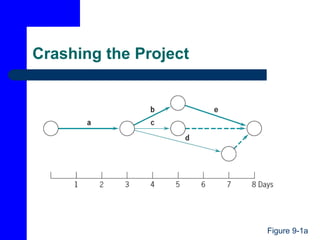
Crashing the Project
Figure 9-1a
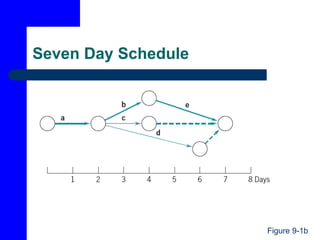
Seven Day Schedule
Figure 9-1b
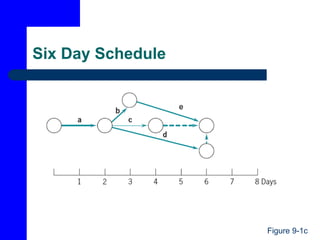
Six Day Schedule
Figure 9-1c
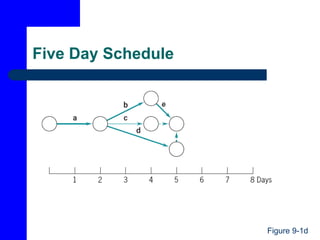
Five Day Schedule
Figure 9-1d
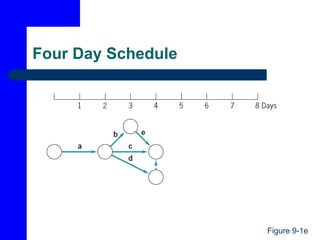
Four Day Schedule
Figure 9-1e
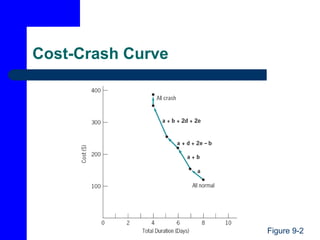
Cost-Crash Curve
Figure 9-2
The Resource Allocation Problem
 As discussed, CPM/PERT ignore resource
utilization and availability
 With external resources, this may not be a
problem
 It is, however, a concern with internal
resources
 Schedules need to be evaluated in terms of
both time and resources
Resource Allocation
 It is common to see the resource allocation
problem in terms of manpower, but it can
apply to equipment and capital as well
 Resource allocation in project management
is very similar to capacity planning in
production management
 Both the approaches to the problem and
potential solutions to the problem are very
similar
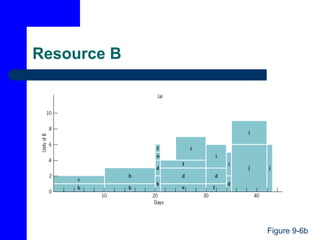
Resource Loading
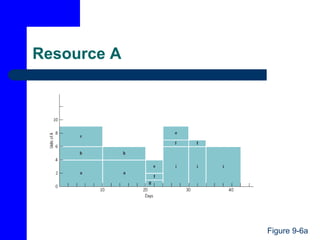
 Resource loading describes the amount
of resources an existing schedule
requires
 Gives an understanding of the
demands a project will make of a firm’s
resources
Resource A
Figure 9-6a
Resource B
Figure 9-6b
Resource Leveling
 Less hands-on management is required
 May be able to use just-in-time
inventory
 Improves morale
 Fewer personnel problems
Resource Leveling Continued
 When an activity has slack, we can move
that activity to shift its resource usage
 May also be possible to alter the sequence of
activities to levelize resources
 Small projects can be levelized by hand
 Software can levelize resources for larger
projects
 Large projects with multiple resources are
very complex to levelize
Constrained Resource Scheduling
Heuristic
Approach
An approach, such as a
rule of thumb, that yields
a good solution that may
or may not be optimal.
Optimization
Approach
An approach, such as
linear programming, that
yields the one best
solution.
Heuristic Methods
 The only feasible way on large projects
 While not optimal, the schedules are very
good
 Take the CPM/PERT schedule as a baseline
 They sequentially step through the schedule
trying to move resource requirements around
to levelize them
 Resources are moved around based on one
or more priority rules
Common Priority Rules
 As soon as possible
 As late as possible
 Shortest task first
 Most resources first
 Minimum slack first
 Most critical followers
 Most successors
 Arbitrary
Heuristic Methods Continued
 These are just the common ones
 There are many more
 The heuristic can either start at the
beginning and work forwards
 Or it can start at the end and work
backwards
Optimization Methods
 Finds the one best solution
 Uses either linear programming or
enumeration
 Not all projects can be optimized
 Approaches only work with small to
medium projects
Multi-Project Scheduling and Resource
Allocation
 Scheduling and resource allocation problems
increase with more than one project
 The greater the number of projects, the greater the
problems
 One way is to consider each project as part of a
much larger project
 However, different projects have different goals so
combining may not make sense
 Must also tell us if there are resources to tackle new
projects we are considering
Standards to Measure Schedule
Effectiveness
1. Schedule slippage
2. Resource utilization
3. In-process inventory
Schedule Slippage
 The time past a project’s due date when the
project is completed
 Slippage may cause penalties
 Different projects will have different penalties
 Expediting one project can cause others to
slip
 Taking on a new project can cause existing
projects to slip
Resource Utilization
 The percentage of a resource that is
actually used
 We want a schedule that smoothes out
the dips and peaks of resource
utilization
 This is especially true of labor, where
hiring and firing is expensive
In-Process Inventory
 This is the amount of work waiting to be
processed because there is a shortage
of some resource
 Similar to WIP in manufacturing
 The cost here is holding cost
Heuristic Techniques
 Multi-projects are too complex for
optimization approaches
 Many of the heuristics are extensions of
the ones used for one project
Additional Priority Rules
 Resource scheduling method
 Minimum late finish time
 Greatest resource demand
 Greatest resource utilization
 Most possible jobs
Goldratt’s Critical Chain
1. Optimism
2. Capacity should be equal to demand
3. The “Student Syndrome”
4. Multitasking to reduce idle time
5. Assuming network complexity makes no difference
6. Management cutting time to “motivate” workers
7. Game playing
8. Early finishes not canceling out late finishes
Given the following information
regarding a construction project.
Required
Find the all-normal schedule and cost.
Find the all-crash schedule and cost.
Find the total cost required to expedite all
activities from all-normal to all-crash.
Find the least-cost plan for the all-crash time
schedule.
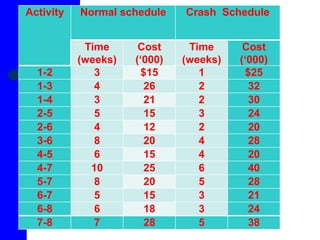
Activity Normal schedule Crash Schedule
Time
(weeks)
Cost
(‘000)
Time
(weeks)
Cost
(‘000)
1-2 3 $15 1 $25
1-3 4 26 2 32
1-4 3 21 2 30
2-5 5 15 3 24
2-6 4 12 2 20
3-6 8 20 4 28
4-5 6 15 4 20
4-7 10 25 6 40
5-7 8 20 5 28
6-7 5 15 3 21
6-8 6 18 3 24
7-8 7 28 5 38

-PM-09-7.ppt

  • 1.
    Copyright 2009 JohnWiley & Sons, Inc. Chapter 9 Resource Allocation
  • 2.
    Critical Path Method—Crashinga Project  Time and cost are interrelated  The faster an activity is completed, the more it costs  Change the schedule and you change the budget  Thus many activities can be speeded up by spending more money
  • 3.
    What is Crashing/ Crunching?  To speed up, or expedite, a project  Of course, the resources to do this must be available  Crunching a project changes the schedule for all activities  This will have an impact on schedules for all the subcontractors  Crunching a project often introduces unanticipated problems
  • 4.
  • 5.
    An Example ofTwo-Time CPM Table 9-1
  • 6.
    Activity Slopes—Cost perPeriod for Crashing Table 9-2
  • 7.
  • 8.
  • 9.
  • 10.
  • 11.
  • 12.
  • 13.
    The Resource AllocationProblem  As discussed, CPM/PERT ignore resource utilization and availability  With external resources, this may not be a problem  It is, however, a concern with internal resources  Schedules need to be evaluated in terms of both time and resources
  • 14.
    Resource Allocation  Itis common to see the resource allocation problem in terms of manpower, but it can apply to equipment and capital as well  Resource allocation in project management is very similar to capacity planning in production management  Both the approaches to the problem and potential solutions to the problem are very similar
  • 15.
    Resource Loading  Resourceloading describes the amount of resources an existing schedule requires  Gives an understanding of the demands a project will make of a firm’s resources
  • 16.
  • 17.
  • 18.
    Resource Leveling  Lesshands-on management is required  May be able to use just-in-time inventory  Improves morale  Fewer personnel problems
  • 19.
    Resource Leveling Continued When an activity has slack, we can move that activity to shift its resource usage  May also be possible to alter the sequence of activities to levelize resources  Small projects can be levelized by hand  Software can levelize resources for larger projects  Large projects with multiple resources are very complex to levelize
  • 20.
    Constrained Resource Scheduling Heuristic Approach Anapproach, such as a rule of thumb, that yields a good solution that may or may not be optimal. Optimization Approach An approach, such as linear programming, that yields the one best solution.
  • 21.
    Heuristic Methods  Theonly feasible way on large projects  While not optimal, the schedules are very good  Take the CPM/PERT schedule as a baseline  They sequentially step through the schedule trying to move resource requirements around to levelize them  Resources are moved around based on one or more priority rules
  • 22.
    Common Priority Rules As soon as possible  As late as possible  Shortest task first  Most resources first  Minimum slack first  Most critical followers  Most successors  Arbitrary
  • 23.
    Heuristic Methods Continued These are just the common ones  There are many more  The heuristic can either start at the beginning and work forwards  Or it can start at the end and work backwards
  • 24.
    Optimization Methods  Findsthe one best solution  Uses either linear programming or enumeration  Not all projects can be optimized  Approaches only work with small to medium projects
  • 25.
    Multi-Project Scheduling andResource Allocation  Scheduling and resource allocation problems increase with more than one project  The greater the number of projects, the greater the problems  One way is to consider each project as part of a much larger project  However, different projects have different goals so combining may not make sense  Must also tell us if there are resources to tackle new projects we are considering
  • 26.
    Standards to MeasureSchedule Effectiveness 1. Schedule slippage 2. Resource utilization 3. In-process inventory
  • 27.
    Schedule Slippage  Thetime past a project’s due date when the project is completed  Slippage may cause penalties  Different projects will have different penalties  Expediting one project can cause others to slip  Taking on a new project can cause existing projects to slip
  • 28.
    Resource Utilization  Thepercentage of a resource that is actually used  We want a schedule that smoothes out the dips and peaks of resource utilization  This is especially true of labor, where hiring and firing is expensive
  • 29.
    In-Process Inventory  Thisis the amount of work waiting to be processed because there is a shortage of some resource  Similar to WIP in manufacturing  The cost here is holding cost
  • 30.
    Heuristic Techniques  Multi-projectsare too complex for optimization approaches  Many of the heuristics are extensions of the ones used for one project
  • 31.
    Additional Priority Rules Resource scheduling method  Minimum late finish time  Greatest resource demand  Greatest resource utilization  Most possible jobs
  • 32.
    Goldratt’s Critical Chain 1.Optimism 2. Capacity should be equal to demand 3. The “Student Syndrome” 4. Multitasking to reduce idle time 5. Assuming network complexity makes no difference 6. Management cutting time to “motivate” workers 7. Game playing 8. Early finishes not canceling out late finishes
  • 33.
    Given the followinginformation regarding a construction project. Required Find the all-normal schedule and cost. Find the all-crash schedule and cost. Find the total cost required to expedite all activities from all-normal to all-crash. Find the least-cost plan for the all-crash time schedule.
  • 34.
    Activity Normal scheduleCrash Schedule Time (weeks) Cost (‘000) Time (weeks) Cost (‘000) 1-2 3 $15 1 $25 1-3 4 26 2 32 1-4 3 21 2 30 2-5 5 15 3 24 2-6 4 12 2 20 3-6 8 20 4 28 4-5 6 15 4 20 4-7 10 25 6 40 5-7 8 20 5 28 6-7 5 15 3 21 6-8 6 18 3 24 7-8 7 28 5 38