Copyright 2009 John Wiley & Sons, Inc.
Chapter 1
Projects in Contemporary
Organizations
Introduction
 Much of project management developed by the
military
– Navy’s Polaris program
– NASA’s space program
– Strategic defense initiative
 Project management has found wide acceptance in
industry
 It has many applications outside of construction
– Managing legal cases
– Managing new product releases
Introduction Continued
 Main forces in driving the acceptance of
project and other forms of management:
1. The exponential growth of human knowledge
2. The growing demand for a broad range of
complex goods and services
3. Increased worldwide competition
 All of these contribute to the need for
organizations to do more and to do it faster
 Project management is one way to do more
faster
Projects Tend to be Large
 Projects tend to be large
– The Channel Tunnel, or Chunnel
– Denver International Airport
– Panama Canal expansion project
– Three Gorges Dam, China
 Projects are getting larger over time
– Flying: balloons  planes  jets  rockets 
reusable rockets
Main Goals of Project Management
1. Time
2. Cost
3. Performance
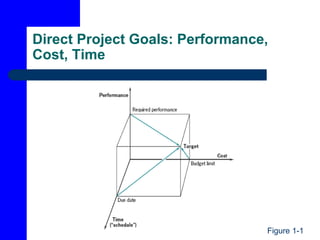
 Time, cost, and performance are all related
on a project
Direct Project Goals: Performance,
Cost, Time
Figure 1-1
Project Management Institute (PMI)
 The Project Management Institute is the
major project management organization
 Founded in 1969
 Grew from 7,500 members in 1990 to over
260,000 in 2007
 The Project Management Journal and PM
Network are the leading project management
journals
Project Manager
 Project manager is the key individual
on a project
 Project manager is like a mini-CEO
 While project manager always has
responsibility, may not have necessary
authority
The Definition of a “Project”
 A ‘Project’ is a temporary endeavour,
having a defined beginning and end
(usually constrained by date, but can
be by funding or deliverables).
 E.g.- hospital, freeways, new website,
movie, insurance policy etc.
Major Characteristics of a Project
 Importance
 Performance
 Life cycle with a finite due date
 Interdependencies
 Uniqueness
 Resources
 Conflict
Why Project Management?
 The main purpose for initiating a project is to
accomplish some goal
 Project management increases the likelihood
of accomplishing that goal
 Project management gives us someone (the
project manager) to spearhead the project
and to hold accountable for its completion
Negative Side to Project Management
 Greater organizational complexity
 Higher probability organizational policy
will be violated
 Says managers cannot accomplish the
desired outcome
 Conflict
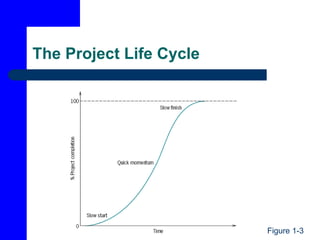
The Project Life Cycle
Figure 1-3
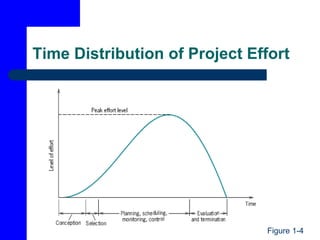
Time Distribution of Project Effort
Figure 1-4
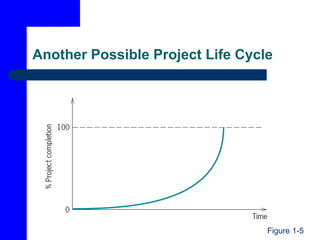
Another Possible Project Life Cycle
Figure 1-5
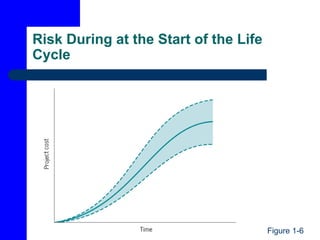
Risk During at the Start of the Life
Cycle
Figure 1-6
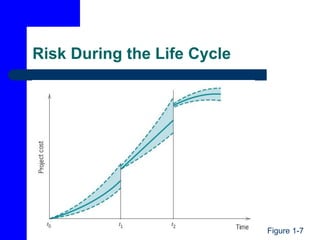
Risk During the Life Cycle
Figure 1-7
The Structure of this Course
 Follows the project life cycle
 Some topics stand-alone
 Other topics incorporated throughout
 Exercises
 Case-studies
 Tutorials
Part I: Project Initiation
1. Projects in Contemporary Organizations
2. Strategic Management and Project
Selection
3. The Project Manager
4. Negotiation and the Management of Conflict
5. The Project in the Organizational Structure
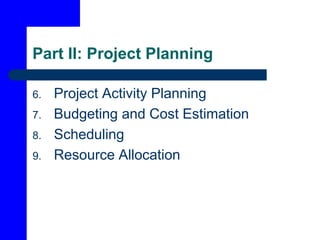
Part II: Project Planning
6. Project Activity Planning
7. Budgeting and Cost Estimation
8. Scheduling
9. Resource Allocation
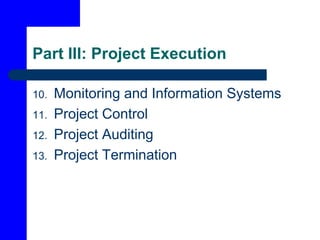
Part III: Project Execution
10. Monitoring and Information Systems
11. Project Control
12. Project Auditing
13. Project Termination

Project-Management-Introduction.ppt

  • 1.
    Copyright 2009 JohnWiley & Sons, Inc. Chapter 1 Projects in Contemporary Organizations
  • 2.
    Introduction  Much ofproject management developed by the military – Navy’s Polaris program – NASA’s space program – Strategic defense initiative  Project management has found wide acceptance in industry  It has many applications outside of construction – Managing legal cases – Managing new product releases
  • 3.
    Introduction Continued  Mainforces in driving the acceptance of project and other forms of management: 1. The exponential growth of human knowledge 2. The growing demand for a broad range of complex goods and services 3. Increased worldwide competition  All of these contribute to the need for organizations to do more and to do it faster  Project management is one way to do more faster
  • 4.
    Projects Tend tobe Large  Projects tend to be large – The Channel Tunnel, or Chunnel – Denver International Airport – Panama Canal expansion project – Three Gorges Dam, China  Projects are getting larger over time – Flying: balloons  planes  jets  rockets  reusable rockets
  • 5.
    Main Goals ofProject Management 1. Time 2. Cost 3. Performance  Time, cost, and performance are all related on a project
  • 6.
    Direct Project Goals:Performance, Cost, Time Figure 1-1
  • 7.
    Project Management Institute(PMI)  The Project Management Institute is the major project management organization  Founded in 1969  Grew from 7,500 members in 1990 to over 260,000 in 2007  The Project Management Journal and PM Network are the leading project management journals
  • 8.
    Project Manager  Projectmanager is the key individual on a project  Project manager is like a mini-CEO  While project manager always has responsibility, may not have necessary authority
  • 9.
    The Definition ofa “Project”  A ‘Project’ is a temporary endeavour, having a defined beginning and end (usually constrained by date, but can be by funding or deliverables).  E.g.- hospital, freeways, new website, movie, insurance policy etc.
  • 10.
    Major Characteristics ofa Project  Importance  Performance  Life cycle with a finite due date  Interdependencies  Uniqueness  Resources  Conflict
  • 11.
    Why Project Management? The main purpose for initiating a project is to accomplish some goal  Project management increases the likelihood of accomplishing that goal  Project management gives us someone (the project manager) to spearhead the project and to hold accountable for its completion
  • 12.
    Negative Side toProject Management  Greater organizational complexity  Higher probability organizational policy will be violated  Says managers cannot accomplish the desired outcome  Conflict
  • 13.
    The Project LifeCycle Figure 1-3
  • 14.
    Time Distribution ofProject Effort Figure 1-4
  • 15.
    Another Possible ProjectLife Cycle Figure 1-5
  • 16.
    Risk During atthe Start of the Life Cycle Figure 1-6
  • 17.
    Risk During theLife Cycle Figure 1-7
  • 18.
    The Structure ofthis Course  Follows the project life cycle  Some topics stand-alone  Other topics incorporated throughout  Exercises  Case-studies  Tutorials
  • 19.
    Part I: ProjectInitiation 1. Projects in Contemporary Organizations 2. Strategic Management and Project Selection 3. The Project Manager 4. Negotiation and the Management of Conflict 5. The Project in the Organizational Structure
  • 20.
    Part II: ProjectPlanning 6. Project Activity Planning 7. Budgeting and Cost Estimation 8. Scheduling 9. Resource Allocation
  • 21.
    Part III: ProjectExecution 10. Monitoring and Information Systems 11. Project Control 12. Project Auditing 13. Project Termination