Case 6: Telsys International:
A Marriage of Two Cultures (Case or
Negotiation Simulation)
1. Ariyo Agus (NIM : 122090022 )
2. Adven T (NIM : 122090004)
3. Ahadian S (NIM : 122090006)
4. Anggi G (NIM : 122090013)
5. Bayu I K (NIM : 122090163)
6. Heru S (NIM : 122090065)
7. M Ryan Faisal (NIM : 122090096)
8. Indah May R (NIM : 122090072)
9. Ridwan M (NIM : 122090116)
10. Robby A C (NIM : 122090124)
11. Satria N (NIM : 122090129)
12. Tri Cahya (NIM : 122090148)
Presented by:
Magister Manajemen © 2010 Trisakti University, MM34 All rights reserved.
Keywords
•Negotiation
•International negotiation
•Bargaining
•Relationship building
•Difference in ideology
•Conflict
•Decision-making
Company Profile
* History *
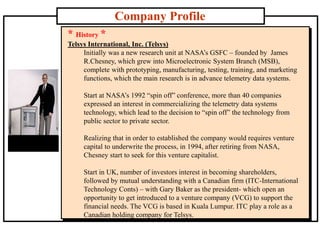
Telsys International, Inc. (Telsys)
Initially was a new research unit at NASA’s GSFC – founded by James
R.Chesney, which grew into Microelectronic System Branch (MSB),
complete with prototyping, manufacturing, testing, training, and marketing
functions, which the main research is in advance telemetry data systems.
Start at NASA’s 1992 “spin off” conference, more than 40 companies
expressed an interest in commercializing the telemetry data systems
technology, which lead to the decision to “spin off” the technology from
public sector to private sector.
Realizing that in order to established the company would requires venture
capital to underwrite the process, in 1994, after retiring from NASA,
Chesney start to seek for this venture capitalist.
Start in UK, number of investors interest in becoming shareholders,
followed by mutual understanding with a Canadian firm (ITC-International
Technology Conts) – with Gary Baker as the president- which open an
opportunity to get introduced to a venture company (VCG) to support the
financial needs. The VCG is based in Kuala Lumpur. ITC play a role as a
Canadian holding company for Telsys.
Company Profile
* History *
Malaysian Venture Capital Group (VCG)
Founded by Dr. Nik Bashshar Ahmad abu Munir (as President and
CEO), which he was initially developed a success asset
management company in US – the company’s investment
were Syariah-based.
The company at least have investment over than $360 million (US)
in managed funds, which focused on f sectors: (1) Banking
and financial investment; (2)Property development and
investment; (3)International Business Trading; and
(4)Information technology.
In information technology sectors, VCG supported by Dr.Kalil
‘Abd Al Wahid, assist the CEO evaluating potential
investment in this area, which received his PhD in Electrical
Engineering from Penn State.
Company Profile
Vision and Mission
Telsys International, Inc. (Telsys)
VISION: Becoming a world leader in telemetry and satellite communications
MISSION:
1. To bring seamlessly interconnect local area and wide area terrestrial networks to space – ground or air
– ground communications networks.
2. To reduce cost and complexity of accessing and processing satellite data for remote sensing and
telecommunications applications.
3. To suite the customer requirements by configuring different sets of standard family components
Malaysian Venture Capital Group (VCG)
VISION: Keeping with the Islamic principle that business activities must be founded on allowable profit
making not interest – earning operation due to syariah principle of islamic investment and financing
interest-earning instruments are not permitted rather than business activities emphasize profit and
risk sharing on selected projects
MISSION:
1. To make a substantial contribution to the development of his country and other developing regions.
2. To become a leader of islamic financial services industry
The Courtship
In February and Mach 1995, VCG executives made their first exploratory trips to
visit Chesney in Maryland, on the advice of Baker from ITC. They like what
they saw: (1) a technology leader in critical area of space data
communications; (2) a small but cohesive group of engineering talent who
believed in technology; and (3) a sense that they could build a business
relationship with Cheasney that would be based on trust.
Finally, Chesney and Montgomery believed they had found a venture capital
partner with whom they could work.
In July 1995 there’s a meeting between Dr. Nik and Chesney for contractual
agreement
Code of Conduct
Vision:
Become a world leader in telemetry for remote satellite communications
Mission:
1. To bring seamlessly interconnect local area and wide are terrestrial network to space - ground or
air - ground communications networks.
2. Reduce cost and complexity of accessing and processing satellite data for remote sensing and
telecommunication applications
3. To suite the customer requirements by configuring different sets of standard family components
Code of Conduct:
1. Indicate your willingness to “give and take” along the negotiation
2. Give your counterpart “on board” the project, so they are truly part of the team, not perceived as
the “opposition”
3. Great respect with counterpart
Philosophy:
1. To serve emerging market demands
2. Makes products ideal for interconnecting broadband networks using commercial communication
satellites
3. Do good while doing well
Developed Issue
• Cross-cultural differences influence management styles in the
following areas:
1. Authority and Decision Making
2. Management Objectives and
Aspirations
3. Communication Styles
4. Formality and Tempo
5. P-Time versus M-Time
6. Negotiations Emphasis
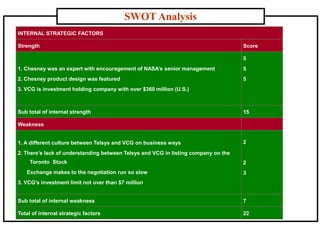
SWOT Analysis
INTERNAL STRATEGIC FACTORS
Strength Score
1. Chesney was an expert with encouragement of NASA’s senior management
2. Chesney product design was featured
3. VCG is investment holding company with over $360 million (U.S.)
5
5
5
Sub total of internal strength 15
Weakness
1. A different culture between Telsys and VCG on business ways
2. There’s lack of understanding between Telsys and VCG in listing company on the
Toronto Stock
Exchange makes to the negotiation run so slow
3. VCG’s investment limit not over than $7 million
2
2
3
Sub total of internal weakness 7
Total of internal strategic factors 22
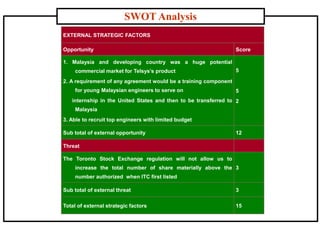
SWOT Analysis
EXTERNAL STRATEGIC FACTORS
Opportunity Score
1. Malaysia and developing country was a huge potential
commercial market for Telsys’s product
2. A requirement of any agreement would be a training component
for young Malaysian engineers to serve on
internship in the United States and then to be transferred to
Malaysia
3. Able to recruit top engineers with limited budget
5
5
2
Sub total of external opportunity 12
Threat
The Toronto Stock Exchange regulation will not allow us to
increase the total number of share materially above the
number authorized when ITC first listed
3
Sub total of external threat 3
Total of external strategic factors 15
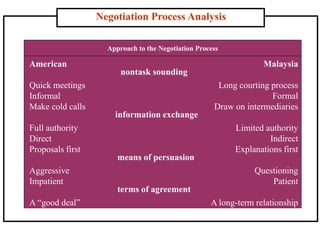
Negotiation Process Analysis
Approach to the Negotiation Process
American
Quick meetings
Informal
Make cold calls
Full authority
Direct
Proposals first
Aggressive
Impatient
A “good deal”
Malaysia
Long courting process
Formal
Draw on intermediaries
Limited authority
Indirect
Explanations first
Questioning
Patient
A long-term relationship
nontask sounding
information exchange
means of persuasion
terms of agreement
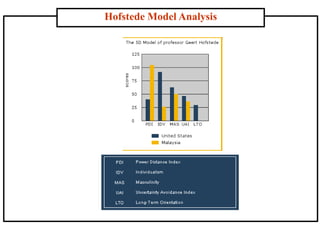
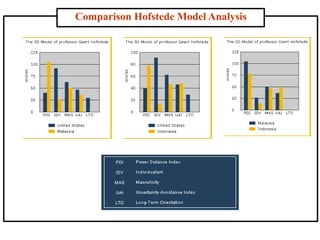
Hofstede Model Analysis
Comparison Hofstede Model Analysis
Differences in Management Styles
Around the World
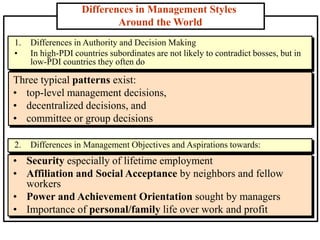
1. Differences in Authority and Decision Making
• In high-PDI countries subordinates are not likely to contradict bosses, but in
low-PDI countries they often do
2. Differences in Management Objectives and Aspirations towards:
Three typical patterns exist:
• top-level management decisions,
• decentralized decisions, and
• committee or group decisions
• Security especially of lifetime employment
• Affiliation and Social Acceptance by neighbors and fellow
workers
• Power and Achievement Orientation sought by managers
• Importance of personal/family life over work and profit
Differences in Management Styles
Around the World
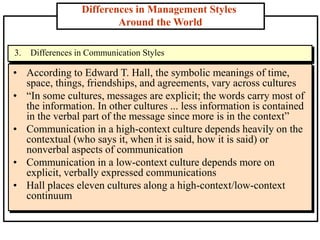
3. Differences in Communication Styles
• According to Edward T. Hall, the symbolic meanings of time,
space, things, friendships, and agreements, vary across cultures
• “In some cultures, messages are explicit; the words carry most of
the information. In other cultures ... less information is contained
in the verbal part of the message since more is in the context”
• Communication in a high-context culture depends heavily on the
contextual (who says it, when it is said, how it is said) or
nonverbal aspects of communication
• Communication in a low-context culture depends more on
explicit, verbally expressed communications
• Hall places eleven cultures along a high-context/low-context
continuum
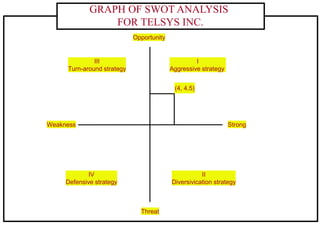
GRAPH OF SWOT ANALYSIS
FOR TELSYS INC.
Opportunity
Threat
Weakness Strong
(4, 4.5)
I
Aggressive strategy
III
Turn-around strategy
II
Diversivication strategy
IV
Defensive strategy
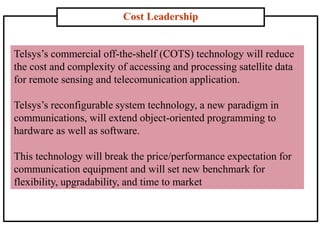
Cost Leadership
Telsys’s commercial off-the-shelf (COTS) technology will reduce
the cost and complexity of accessing and processing satellite data
for remote sensing and telecomunication application.
Telsys’s reconfigurable system technology, a new paradigm in
communications, will extend object-oriented programming to
hardware as well as software.
This technology will break the price/performance expectation for
communication equipment and will set new benchmark for
flexibility, upgradability, and time to market
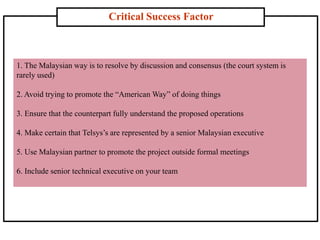
Critical Success Factor
1. The Malaysian way is to resolve by discussion and consensus (the court system is
rarely used)
2. Avoid trying to promote the “American Way” of doing things
3. Ensure that the counterpart fully understand the proposed operations
4. Make certain that Telsys’s are represented by a senior Malaysian executive
5. Use Malaysian partner to promote the project outside formal meetings
6. Include senior technical executive on your team
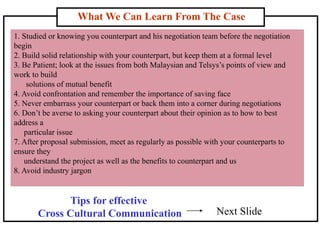
What We Can Learn From The Case
1. Studied or knowing you counterpart and his negotiation team before the negotiation
begin
2. Build solid relationship with your counterpart, but keep them at a formal level
3. Be Patient; look at the issues from both Malaysian and Telsys’s points of view and
work to build
solutions of mutual benefit
4. Avoid confrontation and remember the importance of saving face
5. Never embarrass your counterpart or back them into a corner during negotiations
6. Don’t be averse to asking your counterpart about their opinion as to how to best
address a
particular issue
7. After proposal submission, meet as regularly as possible with your counterparts to
ensure they
understand the project as well as the benefits to counterpart and us
8. Avoid industry jargon
Tips for effective
Cross Cultural Communication Next Slide
Telsys-Case-International-Management.ppt

Telsys-Case-International-Management.ppt

  • 1.
    Case 6: TelsysInternational: A Marriage of Two Cultures (Case or Negotiation Simulation)
  • 2.
    1. Ariyo Agus(NIM : 122090022 ) 2. Adven T (NIM : 122090004) 3. Ahadian S (NIM : 122090006) 4. Anggi G (NIM : 122090013) 5. Bayu I K (NIM : 122090163) 6. Heru S (NIM : 122090065) 7. M Ryan Faisal (NIM : 122090096) 8. Indah May R (NIM : 122090072) 9. Ridwan M (NIM : 122090116) 10. Robby A C (NIM : 122090124) 11. Satria N (NIM : 122090129) 12. Tri Cahya (NIM : 122090148) Presented by: Magister Manajemen © 2010 Trisakti University, MM34 All rights reserved.
  • 3.
  • 4.
    Company Profile * History* Telsys International, Inc. (Telsys) Initially was a new research unit at NASA’s GSFC – founded by James R.Chesney, which grew into Microelectronic System Branch (MSB), complete with prototyping, manufacturing, testing, training, and marketing functions, which the main research is in advance telemetry data systems. Start at NASA’s 1992 “spin off” conference, more than 40 companies expressed an interest in commercializing the telemetry data systems technology, which lead to the decision to “spin off” the technology from public sector to private sector. Realizing that in order to established the company would requires venture capital to underwrite the process, in 1994, after retiring from NASA, Chesney start to seek for this venture capitalist. Start in UK, number of investors interest in becoming shareholders, followed by mutual understanding with a Canadian firm (ITC-International Technology Conts) – with Gary Baker as the president- which open an opportunity to get introduced to a venture company (VCG) to support the financial needs. The VCG is based in Kuala Lumpur. ITC play a role as a Canadian holding company for Telsys.
  • 5.
    Company Profile * History* Malaysian Venture Capital Group (VCG) Founded by Dr. Nik Bashshar Ahmad abu Munir (as President and CEO), which he was initially developed a success asset management company in US – the company’s investment were Syariah-based. The company at least have investment over than $360 million (US) in managed funds, which focused on f sectors: (1) Banking and financial investment; (2)Property development and investment; (3)International Business Trading; and (4)Information technology. In information technology sectors, VCG supported by Dr.Kalil ‘Abd Al Wahid, assist the CEO evaluating potential investment in this area, which received his PhD in Electrical Engineering from Penn State.
  • 6.
    Company Profile Vision andMission Telsys International, Inc. (Telsys) VISION: Becoming a world leader in telemetry and satellite communications MISSION: 1. To bring seamlessly interconnect local area and wide area terrestrial networks to space – ground or air – ground communications networks. 2. To reduce cost and complexity of accessing and processing satellite data for remote sensing and telecommunications applications. 3. To suite the customer requirements by configuring different sets of standard family components Malaysian Venture Capital Group (VCG) VISION: Keeping with the Islamic principle that business activities must be founded on allowable profit making not interest – earning operation due to syariah principle of islamic investment and financing interest-earning instruments are not permitted rather than business activities emphasize profit and risk sharing on selected projects MISSION: 1. To make a substantial contribution to the development of his country and other developing regions. 2. To become a leader of islamic financial services industry
  • 7.
    The Courtship In Februaryand Mach 1995, VCG executives made their first exploratory trips to visit Chesney in Maryland, on the advice of Baker from ITC. They like what they saw: (1) a technology leader in critical area of space data communications; (2) a small but cohesive group of engineering talent who believed in technology; and (3) a sense that they could build a business relationship with Cheasney that would be based on trust. Finally, Chesney and Montgomery believed they had found a venture capital partner with whom they could work. In July 1995 there’s a meeting between Dr. Nik and Chesney for contractual agreement
  • 8.
    Code of Conduct Vision: Becomea world leader in telemetry for remote satellite communications Mission: 1. To bring seamlessly interconnect local area and wide are terrestrial network to space - ground or air - ground communications networks. 2. Reduce cost and complexity of accessing and processing satellite data for remote sensing and telecommunication applications 3. To suite the customer requirements by configuring different sets of standard family components Code of Conduct: 1. Indicate your willingness to “give and take” along the negotiation 2. Give your counterpart “on board” the project, so they are truly part of the team, not perceived as the “opposition” 3. Great respect with counterpart Philosophy: 1. To serve emerging market demands 2. Makes products ideal for interconnecting broadband networks using commercial communication satellites 3. Do good while doing well
  • 9.
    Developed Issue • Cross-culturaldifferences influence management styles in the following areas: 1. Authority and Decision Making 2. Management Objectives and Aspirations 3. Communication Styles 4. Formality and Tempo 5. P-Time versus M-Time 6. Negotiations Emphasis
  • 10.
    SWOT Analysis INTERNAL STRATEGICFACTORS Strength Score 1. Chesney was an expert with encouragement of NASA’s senior management 2. Chesney product design was featured 3. VCG is investment holding company with over $360 million (U.S.) 5 5 5 Sub total of internal strength 15 Weakness 1. A different culture between Telsys and VCG on business ways 2. There’s lack of understanding between Telsys and VCG in listing company on the Toronto Stock Exchange makes to the negotiation run so slow 3. VCG’s investment limit not over than $7 million 2 2 3 Sub total of internal weakness 7 Total of internal strategic factors 22
  • 11.
    SWOT Analysis EXTERNAL STRATEGICFACTORS Opportunity Score 1. Malaysia and developing country was a huge potential commercial market for Telsys’s product 2. A requirement of any agreement would be a training component for young Malaysian engineers to serve on internship in the United States and then to be transferred to Malaysia 3. Able to recruit top engineers with limited budget 5 5 2 Sub total of external opportunity 12 Threat The Toronto Stock Exchange regulation will not allow us to increase the total number of share materially above the number authorized when ITC first listed 3 Sub total of external threat 3 Total of external strategic factors 15
  • 12.
    Negotiation Process Analysis Approachto the Negotiation Process American Quick meetings Informal Make cold calls Full authority Direct Proposals first Aggressive Impatient A “good deal” Malaysia Long courting process Formal Draw on intermediaries Limited authority Indirect Explanations first Questioning Patient A long-term relationship nontask sounding information exchange means of persuasion terms of agreement
  • 13.
  • 14.
  • 15.
    Differences in ManagementStyles Around the World 1. Differences in Authority and Decision Making • In high-PDI countries subordinates are not likely to contradict bosses, but in low-PDI countries they often do 2. Differences in Management Objectives and Aspirations towards: Three typical patterns exist: • top-level management decisions, • decentralized decisions, and • committee or group decisions • Security especially of lifetime employment • Affiliation and Social Acceptance by neighbors and fellow workers • Power and Achievement Orientation sought by managers • Importance of personal/family life over work and profit
  • 16.
    Differences in ManagementStyles Around the World 3. Differences in Communication Styles • According to Edward T. Hall, the symbolic meanings of time, space, things, friendships, and agreements, vary across cultures • “In some cultures, messages are explicit; the words carry most of the information. In other cultures ... less information is contained in the verbal part of the message since more is in the context” • Communication in a high-context culture depends heavily on the contextual (who says it, when it is said, how it is said) or nonverbal aspects of communication • Communication in a low-context culture depends more on explicit, verbally expressed communications • Hall places eleven cultures along a high-context/low-context continuum
  • 17.
    GRAPH OF SWOTANALYSIS FOR TELSYS INC. Opportunity Threat Weakness Strong (4, 4.5) I Aggressive strategy III Turn-around strategy II Diversivication strategy IV Defensive strategy
  • 18.
    Cost Leadership Telsys’s commercialoff-the-shelf (COTS) technology will reduce the cost and complexity of accessing and processing satellite data for remote sensing and telecomunication application. Telsys’s reconfigurable system technology, a new paradigm in communications, will extend object-oriented programming to hardware as well as software. This technology will break the price/performance expectation for communication equipment and will set new benchmark for flexibility, upgradability, and time to market
  • 19.
    Critical Success Factor 1.The Malaysian way is to resolve by discussion and consensus (the court system is rarely used) 2. Avoid trying to promote the “American Way” of doing things 3. Ensure that the counterpart fully understand the proposed operations 4. Make certain that Telsys’s are represented by a senior Malaysian executive 5. Use Malaysian partner to promote the project outside formal meetings 6. Include senior technical executive on your team
  • 20.
    What We CanLearn From The Case 1. Studied or knowing you counterpart and his negotiation team before the negotiation begin 2. Build solid relationship with your counterpart, but keep them at a formal level 3. Be Patient; look at the issues from both Malaysian and Telsys’s points of view and work to build solutions of mutual benefit 4. Avoid confrontation and remember the importance of saving face 5. Never embarrass your counterpart or back them into a corner during negotiations 6. Don’t be averse to asking your counterpart about their opinion as to how to best address a particular issue 7. After proposal submission, meet as regularly as possible with your counterparts to ensure they understand the project as well as the benefits to counterpart and us 8. Avoid industry jargon Tips for effective Cross Cultural Communication Next Slide