Company

LOGO

SCARCITY, WANTS, &
NEEDS

Compiled by Vela Moyo
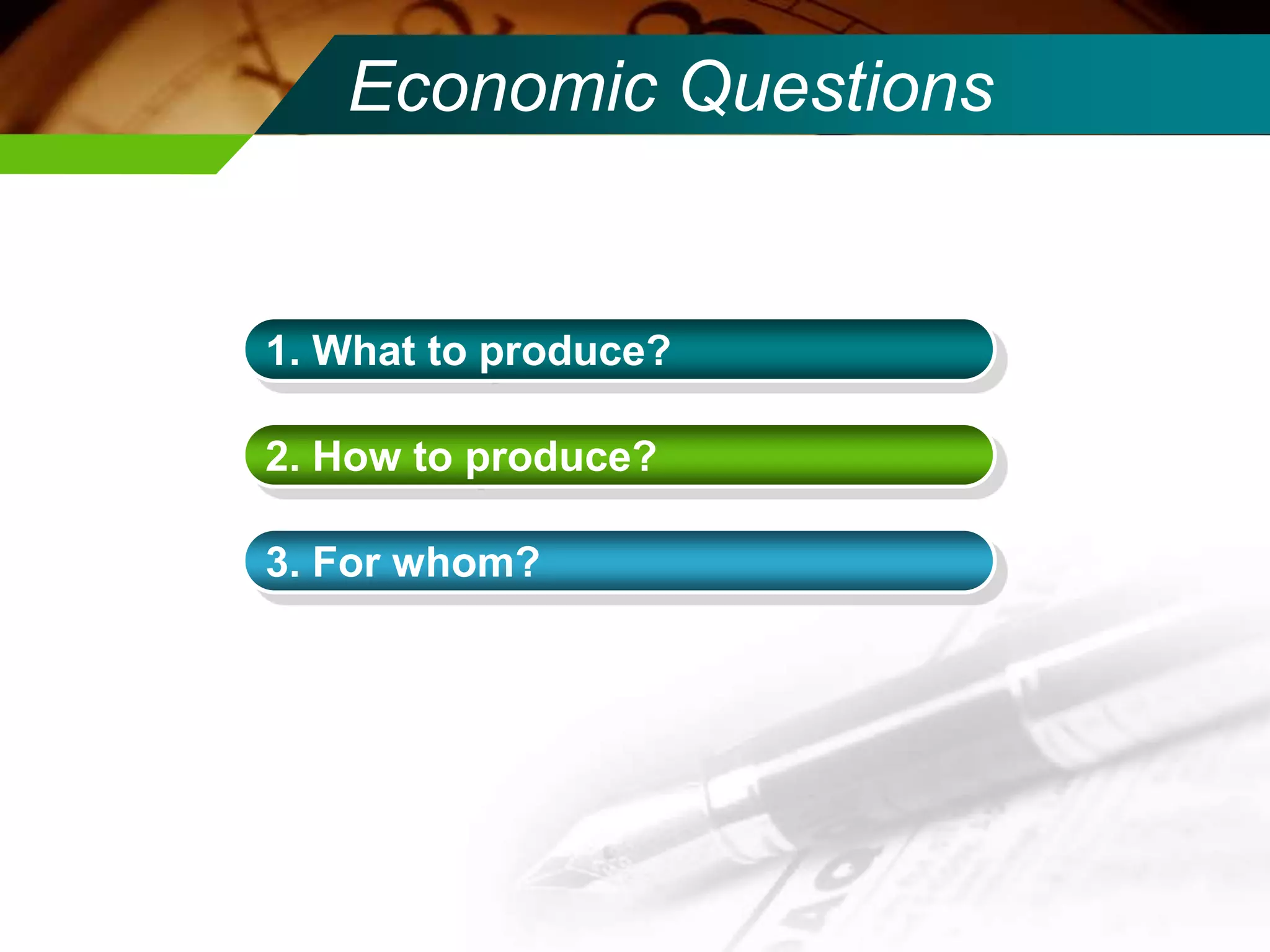
Economic Questions

1. What to produce?
2. How to produce?
3. For whom?
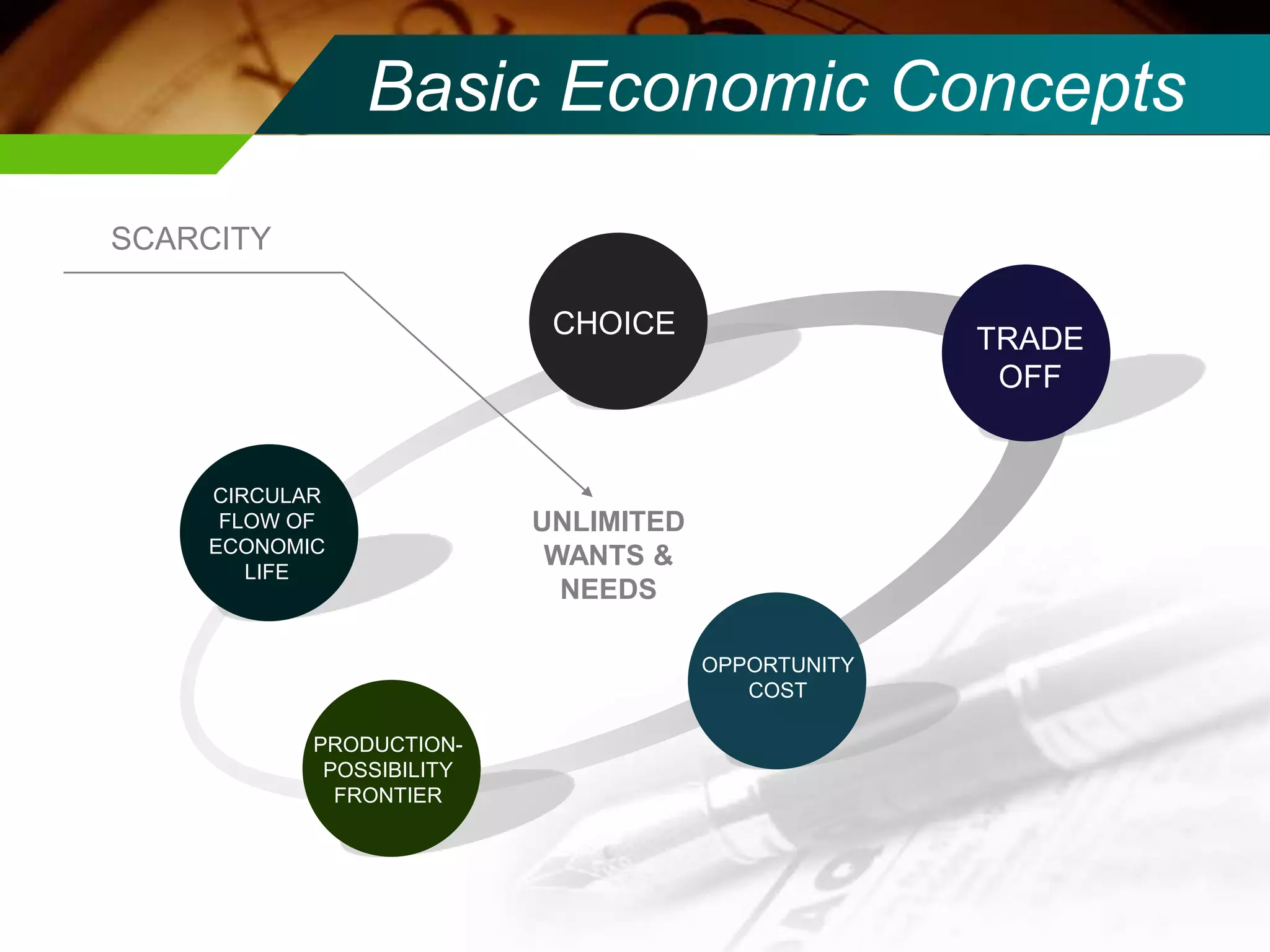
Basic Economic Concepts
SCARCITY
CHOICE

CIRCULAR
FLOW OF
ECONOMIC
LIFE

TRADE
OFF

UNLIMITED
WANTS &
NEEDS
OPPORTUNITY
COST

PRODUCTIONPOSSIBILITY
FRONTIER
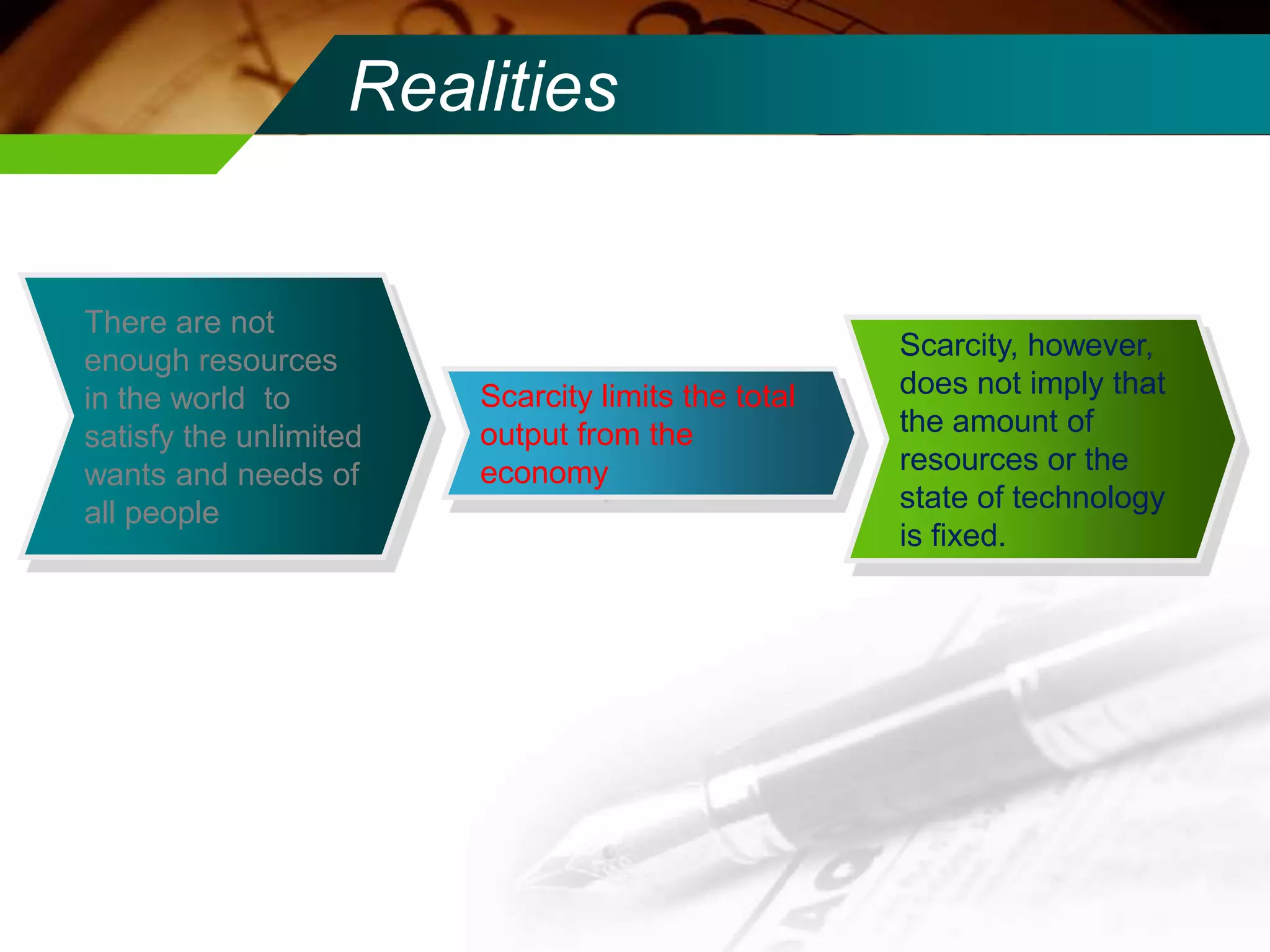
Realities

There are not
enough resources
in the world to
satisfy the unlimited
wants and needs of
all people

Scarcity limits the total
output from the
economy

Scarcity, however,
does not imply that
the amount of
resources or the
state of technology
is fixed.
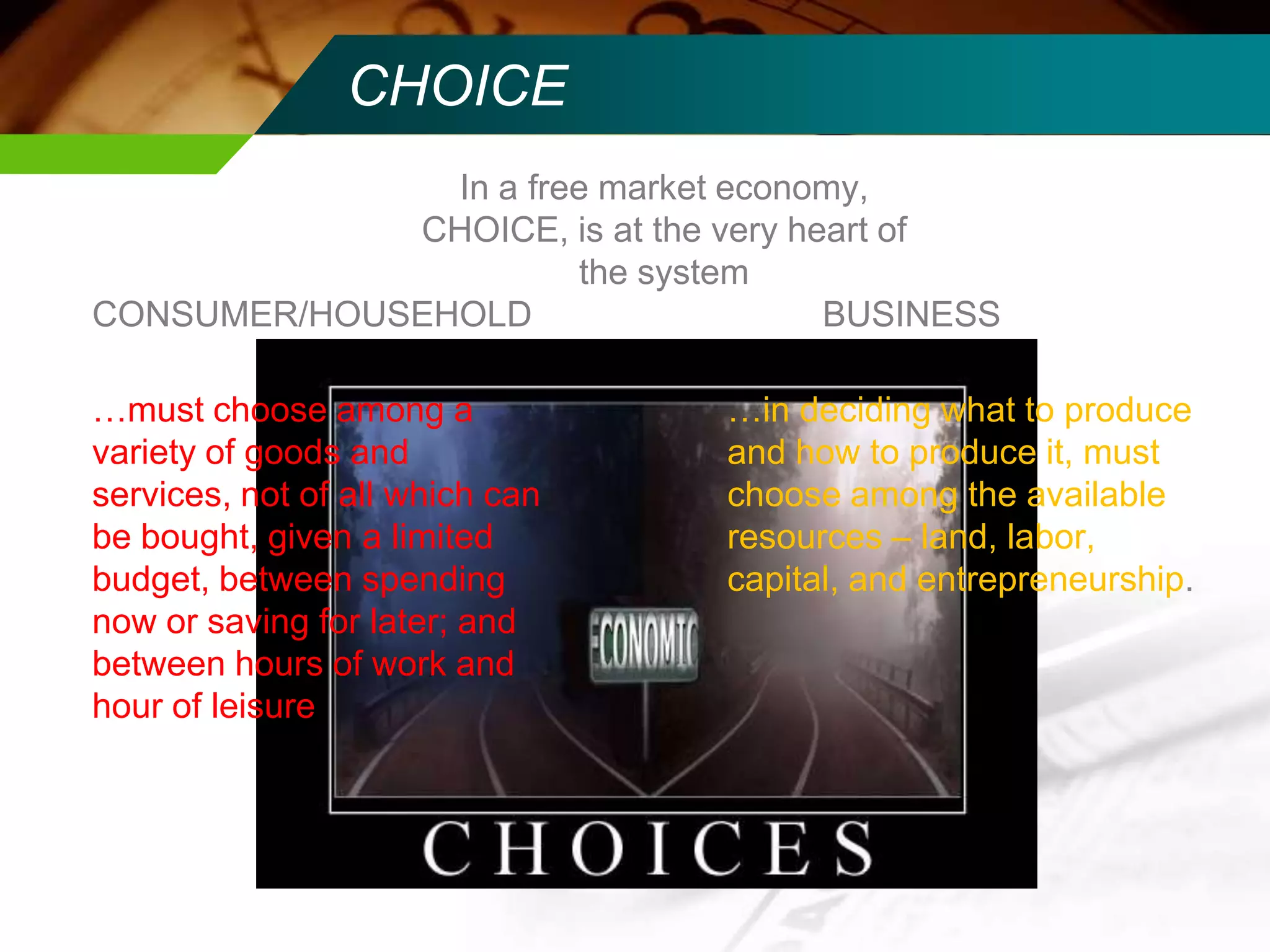
CHOICE
In a free market economy,
CHOICE, is at the very heart of
the system
CONSUMER/HOUSEHOLD
BUSINESS
…must choose among a
variety of goods and
services, not of all which can
be bought, given a limited
budget, between spending
now or saving for later; and
between hours of work and
hour of leisure

…in deciding what to produce
and how to produce it, must
choose among the available
resources – land, labor,
capital, and entrepreneurship.
Trade Off
…it is a choice between
alternatives uses for a given
quantity of resources.
…using one resources for
one purpose means that the
same resources can not be
used for another purpose
…usually consist of
reallocating the
factors of production
used to produce the
goods chosen by the
consumer

The allocation of 30% of the
budget for defense means that
were resources were drawn
away from education, making
the nation’s defense capability
stronger at the expense of
improved education.

…in a country with a weak
economy or a lower standard
of living ,most trade off
decision are not made by the
government but by individual
consumers and producers
The World of Scarcity
“You can’t always get what you want!”
we live in a world of SCARCITY:
society has limited resources, therefore it
cannot produce all goods and services that
people wish to have.
wants always exceed the resources to
satisfy them
Efficiency calls for the effective use the
limited resources to satisfy people’s wants

“when it cannot make anyone economically
better off without making someone else worse off
Scarcity is Different from Shortage
SCARCITY
 embodies the economic
truism that economic
resources are limited
 It is an economic
phenomenon which is
permanent in nature

SHORTAGE
 temporary situation
 It occurs when the supply
of goods and services
runs low resulting from a
greater demand on the
part of the consumer.
Unlimited Wants and Limited Income
What are the things that you would like to have?

as you think about this question more
seriously, you will discover that the list is
almost endless…
it is natural for you to want something more
than you have
if you do not want something more than
you have, you are probably dead
Limited Resources
scarcity of resources is the main reason
why we cannot have everything we want
Source: National Geographic, October 1998

these must be apportioned in such a way
that they will provide the greatest
satisfaction to those who need them
How are you helping make decisions in the
allocation of goods and services in simply
being a consumer, give the fact that we
have limited resources and man have
unlimited wants?
Difference Between Wants and Needs
WANTS
 refers to all things that
people consume if their
income were unlimited
 every has unlimited wants
which cannot be wholly
satisfied because of
limited resources
Reality in the world of scarcity: Every want
that ends up being satisfied causes
one or more wants to remain
unsatisfied

NEEDS
 undefinable from the
standpoint of an
economist
 however, the term need is
used very casually in
most conversation
 what people meant,
usually, is that they want
something they don’t
have.
Company

LOGO

The Economic Problem:
Scarcity and Choice
• Natural Resources – the resources from nature
that are used in production,
including land, raw materials,
and natural process
• Capital Resources – the processed materials,
equipment, and buildings
used in production; also
known as capital
• Human Resources – the efforts of people involved
in production, including
labour and entrepreneurship
Economic Systems

• Economic systems are the basic
arrangements made by societies to solve
the economic problem. They include:
– Command economies
– Laissez-faire economies
– Mixed systems
Economic Systems

• In a command economy, a central government
either directly or indirectly sets output targets,
incomes, and prices.
• In a laissez-faire economy, individuals and
firms pursue their own self-interests without any
central direction or regulation.
Economic Systems

• The central institution of a laissezfaire economy is the free-market
system.
• A market is the institution through
which buyers and sellers interact
and engage in exchange.
CHAPTER

2
Other thoughts
Scarcity and Choice

Prepared by: Fernando Quijano
and Yvonn Quijano

© 2002 Prentice Hall Business Publishing

Principles of Economics, 6/e

Karl Case, Ray Fair
What is Production?
• Production is the process by which resources
are transformed into useful forms.
• Resources, or inputs, refer to anything
provided by nature or previous generations
that can be used directly or indirectly to satisfy
human wants.
• Capital resources

• Human resources
• Natural resources
© 2002 Prentice Hall Business Publishing

Principles of Economics, 6/e

Karl Case, Ray Fair
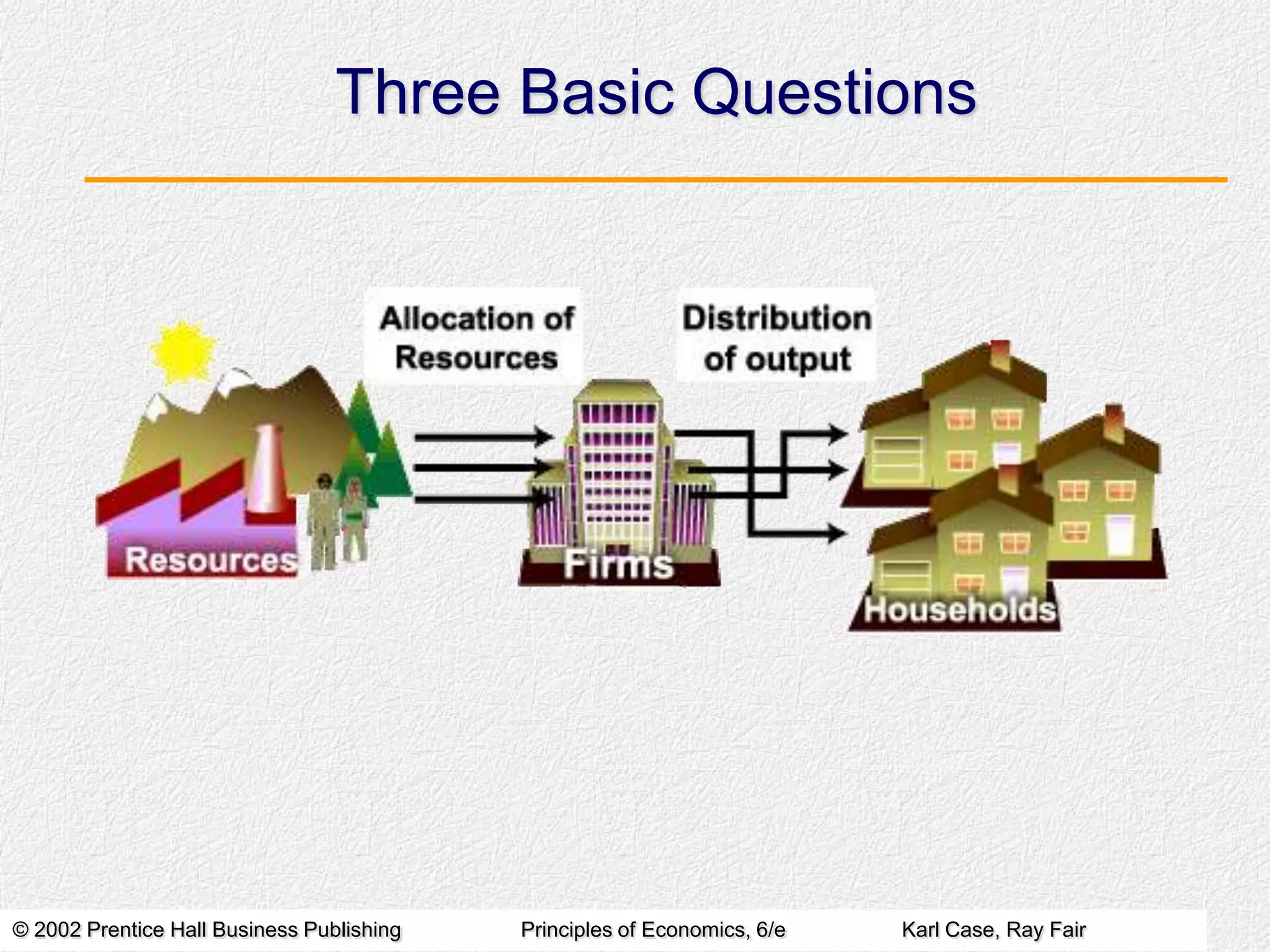
Three Basic Questions
• The mechanics of decision making in a larger economy
are more complex, but the type of decisions that must
be made are nearly identical.

• All societies must decide:
• What will be produced?
• How will it be produced?
• Who will get what is produced?

© 2002 Prentice Hall Business Publishing

Principles of Economics, 6/e

Karl Case, Ray Fair
Three Basic Questions

© 2002 Prentice Hall Business Publishing

Principles of Economics, 6/e

Karl Case, Ray Fair
Specialization, Exchange and
Comparative Advantage
• David Ricardo developed the theory of
comparative advantage to explain the
benefits of specialization and free trade.
The theory is based on the concept of
opportunity cost:
• Opportunity cost is that which we give

up or forgo, when we make a decision or
a choice.

© 2002 Prentice Hall Business Publishing

Principles of Economics, 6/e

Karl Case, Ray Fair
Specialization, Exchange and
Comparative Advantage
• According to the theory of
competitive
advantage, specialization and
free trade will benefit all trading
parties, even those that may be
absolutely more efficient
producers.

© 2002 Prentice Hall Business Publishing

Principles of Economics, 6/e

Karl Case, Ray Fair
Capital Goods and Consumer Goods
• Consumer goods are goods
produced for present
consumption.

• Capital goods are goods used
to produce other goods or
services over time.

© 2002 Prentice Hall Business Publishing

Principles of Economics, 6/e

Karl Case, Ray Fair
The Economic Problem
• The economic problem: Given scarce
resources, how, exactly, do large, complex societies
go about answering the three basic economic
questions?
• Economic systems are the basic arrangements
made by societies to solve the economic problem.
They include:
• Command economies

• Laissez-faire economies
• Mixed systems
© 2002 Prentice Hall Business Publishing

Principles of Economics, 6/e

Karl Case, Ray Fair
AND SOME BASIC CONCEPTS
ANG SAGOT SA TANONG…
WHY DO WE HAVE TO MAKE A CHOICE?
To reach a goal /move forward/ bring change in life /
Give us purpose in life/give us a good future and a better life
& success
Gift of God/ We have the freedom/right to choose/ inevitable/
to make us responsible & independent persons/ choices reflect
our values or morals/ you can not have it all/everything
To know what is wrong or right and learn from them/live with
The consequences of decision/Be on the right track/ path
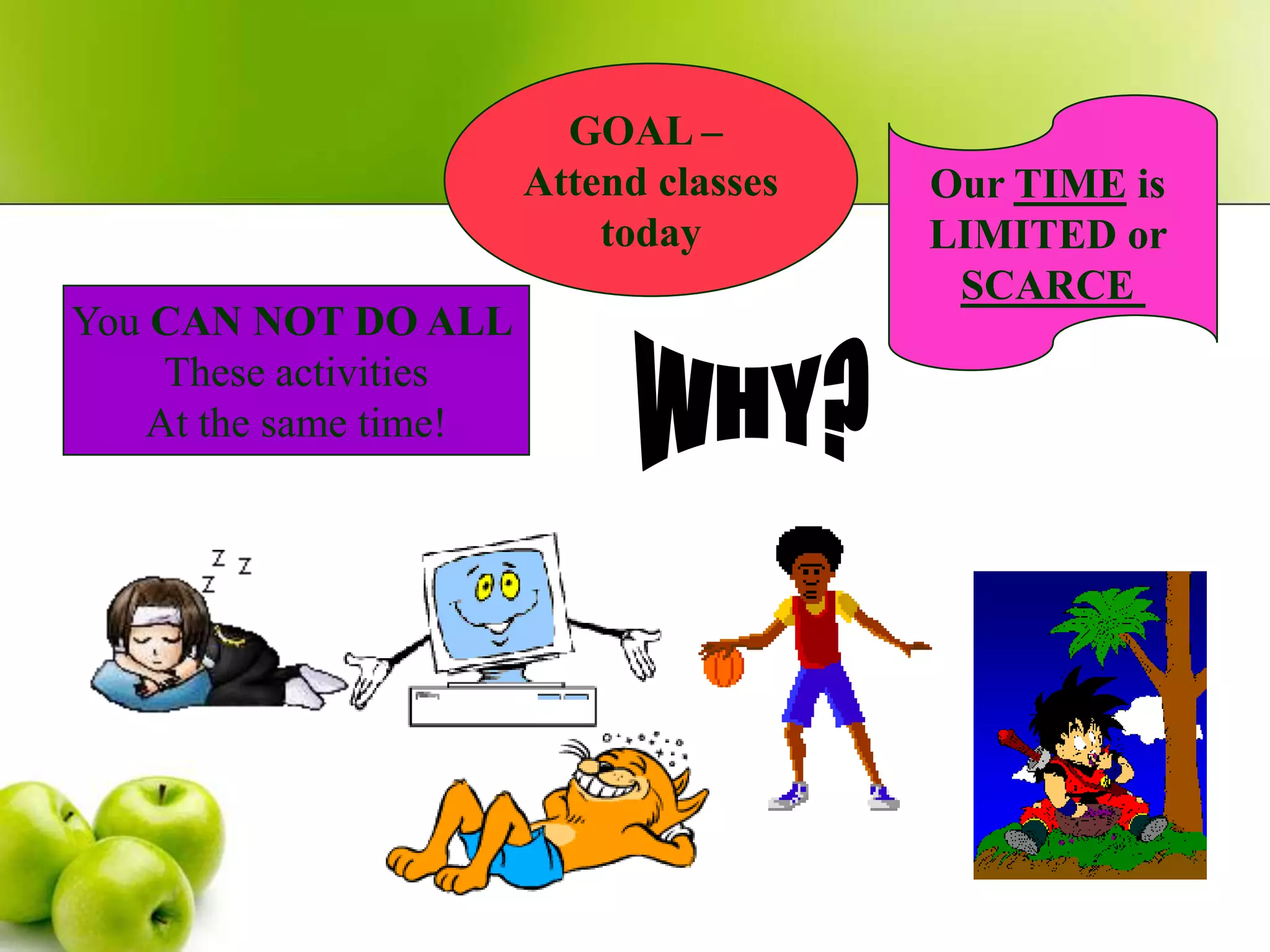
GOAL –
Attend classes
today

You CAN NOT DO ALL
These activities
At the same time!

Our TIME is
LIMITED or
SCARCE
ECON_FACT 1
 SCARCITY

OF RESOURCES
FORCES US TO MAKE A
CHOICE!
 Scarcity is knowing that life
is this __ OR that __ (Yes!)
and not this__ AND__ that (X)
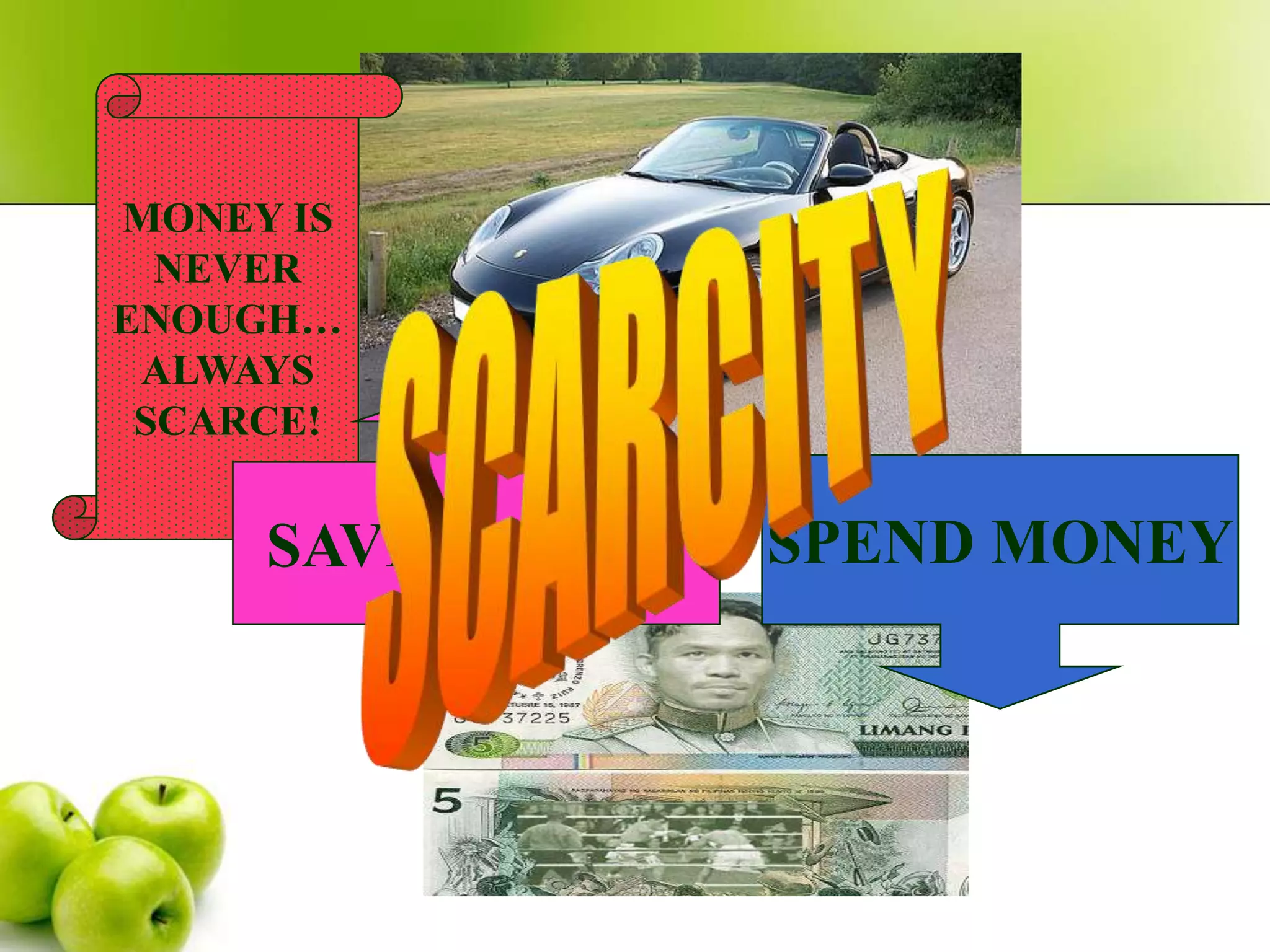
MONEY IS
NEVER
ENOUGH…
ALWAYS
SCARCE!

SAVE MONEY

SPEND MONEY
OPPORTUNITY COST
The cost of something given up in
order to obtain a good
 The next best alternative that is
forgone when we make a decision or
a choice


Cost of the tradeoff is called
OPPORTUNITY COST
LOOKING THROUGH THE EYES
OF SCARCITY…


Choosing one over the other course of
action would cost you to give up the
next best alternative
ECONOMIC WAY OF
THINKING means…
Always thinking of the
OPPORTUNITY COST OF
THE DECISION!
ECONOMIC WAY OF
THINKING means…
Choosing the action or
things that will give more
extra or marginal
benefits
Scarcity and its role
Introduction-:
Scarcity means “of limited
availability”. E.g.
 During Famine period, food is
„scarce‟ i.e. Scarcity of food.




Scarcity is a fundamental
economic problem of having
humans who have unlimited
wants & needs in world of limited
resources.
When will a resource be consider as
‘SCARCE’?
A

c
s
i
a
i
t

r e s o u r c e i s
o n s i d e r e d
c a r c e
wh e n
t s
v a i l a b i l i t y
s n o t e n o u g h
o
me e t
i t s
Factors responsible for
Scarcity of resources-:
1) Limited supply of resources

(natural Scarcity)for example,
 scarcity of water in arid areas like
deserts,
 scarcity of food in famine prone
areas.
Cont‟
 2)

Limited capabilities of
technology or human skill (for
example, those needed for
enhanced production.)
Cont‟
3) Sometimes the insufficiencies are a
result of poor planning and
execution(Artificial scarcity).e.g.
 In arid areas, proper planning is
required for proper supply of water.
Is it Possible to Have no
Scarcity?

If proper planning &
techniques are used for
utilization and supply of
insufficient resource, then
condition of its to be scarce
‘minimizes’.



 If

„needs‟=„have‟
Impact of Scarcity on
Market?







If something is scarce - it will have a
market value.
It will result in inflation.
If the supply of a good or service is low, the
market price will rise, providing there is
sufficient demand from consumers. Whereas
when there is excess supply in a market, we
expect to see prices falling. For example,
If we talk about services,
IITians vs. Engineer from UPTU colleges.
References
Names:
Shubham Singhal
 Akash Bharti
 Fernando Quijano
 Yvonn Quijano
 Mr. Rey Belen

Web-links


http://www.slideshare.net/ssinghalcool/scarcity-of-resources-9607344?qid=b2bee804-33774212-8ce1-c2637e9a84db&v=qf1&b=&from_search=19



http://www.slideshare.net/ssinghalcool/scarcity-of-resources-9607344?qid=a69dd2f3-fc7944e1-87fb-a3008ed700a5&v=qf1&b=&from_search=30



http://www.slideshare.net/reyzter/scarcity-wants-needs?qid=0fe75ae1-812c-44d9-befc4a8d4b230bce&v=qf1&b=&from_search=44



http://www.slideshare.net/JeanBandoja/scarcity-and-choice-1st-term-2011?qid=1c0499e399da-45f3-b3b5-45b9eb9b78bb&v=qf1&b=&from_search=7



http://www.slideshare.net/sap/optimizing-resources-amid-increasing-scarcity?qid=1c0499e399da-45f3-b3b5-45b9eb9b78bb&v=qf1&b=&from_search=11
The End

Thank You

Slideshare repurposing

  • 1.
  • 2.
    Economic Questions 1. Whatto produce? 2. How to produce? 3. For whom?
  • 3.
    Basic Economic Concepts SCARCITY CHOICE CIRCULAR FLOWOF ECONOMIC LIFE TRADE OFF UNLIMITED WANTS & NEEDS OPPORTUNITY COST PRODUCTIONPOSSIBILITY FRONTIER
  • 4.
    Realities There are not enoughresources in the world to satisfy the unlimited wants and needs of all people Scarcity limits the total output from the economy Scarcity, however, does not imply that the amount of resources or the state of technology is fixed.
  • 5.
    CHOICE In a freemarket economy, CHOICE, is at the very heart of the system CONSUMER/HOUSEHOLD BUSINESS …must choose among a variety of goods and services, not of all which can be bought, given a limited budget, between spending now or saving for later; and between hours of work and hour of leisure …in deciding what to produce and how to produce it, must choose among the available resources – land, labor, capital, and entrepreneurship.
  • 6.
    Trade Off …it isa choice between alternatives uses for a given quantity of resources. …using one resources for one purpose means that the same resources can not be used for another purpose …usually consist of reallocating the factors of production used to produce the goods chosen by the consumer The allocation of 30% of the budget for defense means that were resources were drawn away from education, making the nation’s defense capability stronger at the expense of improved education. …in a country with a weak economy or a lower standard of living ,most trade off decision are not made by the government but by individual consumers and producers
  • 7.
    The World ofScarcity “You can’t always get what you want!” we live in a world of SCARCITY: society has limited resources, therefore it cannot produce all goods and services that people wish to have. wants always exceed the resources to satisfy them Efficiency calls for the effective use the limited resources to satisfy people’s wants “when it cannot make anyone economically better off without making someone else worse off
  • 8.
    Scarcity is Differentfrom Shortage SCARCITY  embodies the economic truism that economic resources are limited  It is an economic phenomenon which is permanent in nature SHORTAGE  temporary situation  It occurs when the supply of goods and services runs low resulting from a greater demand on the part of the consumer.
  • 9.
    Unlimited Wants andLimited Income What are the things that you would like to have? as you think about this question more seriously, you will discover that the list is almost endless… it is natural for you to want something more than you have if you do not want something more than you have, you are probably dead
  • 10.
    Limited Resources scarcity ofresources is the main reason why we cannot have everything we want Source: National Geographic, October 1998 these must be apportioned in such a way that they will provide the greatest satisfaction to those who need them How are you helping make decisions in the allocation of goods and services in simply being a consumer, give the fact that we have limited resources and man have unlimited wants?
  • 11.
    Difference Between Wantsand Needs WANTS  refers to all things that people consume if their income were unlimited  every has unlimited wants which cannot be wholly satisfied because of limited resources Reality in the world of scarcity: Every want that ends up being satisfied causes one or more wants to remain unsatisfied NEEDS  undefinable from the standpoint of an economist  however, the term need is used very casually in most conversation  what people meant, usually, is that they want something they don’t have.
  • 12.
  • 13.
    • Natural Resources– the resources from nature that are used in production, including land, raw materials, and natural process • Capital Resources – the processed materials, equipment, and buildings used in production; also known as capital • Human Resources – the efforts of people involved in production, including labour and entrepreneurship
  • 14.
    Economic Systems • Economicsystems are the basic arrangements made by societies to solve the economic problem. They include: – Command economies – Laissez-faire economies – Mixed systems
  • 15.
    Economic Systems • Ina command economy, a central government either directly or indirectly sets output targets, incomes, and prices. • In a laissez-faire economy, individuals and firms pursue their own self-interests without any central direction or regulation.
  • 16.
    Economic Systems • Thecentral institution of a laissezfaire economy is the free-market system. • A market is the institution through which buyers and sellers interact and engage in exchange.
  • 17.
    CHAPTER 2 Other thoughts Scarcity andChoice Prepared by: Fernando Quijano and Yvonn Quijano © 2002 Prentice Hall Business Publishing Principles of Economics, 6/e Karl Case, Ray Fair
  • 18.
    What is Production? •Production is the process by which resources are transformed into useful forms. • Resources, or inputs, refer to anything provided by nature or previous generations that can be used directly or indirectly to satisfy human wants. • Capital resources • Human resources • Natural resources © 2002 Prentice Hall Business Publishing Principles of Economics, 6/e Karl Case, Ray Fair
  • 19.
    Three Basic Questions •The mechanics of decision making in a larger economy are more complex, but the type of decisions that must be made are nearly identical. • All societies must decide: • What will be produced? • How will it be produced? • Who will get what is produced? © 2002 Prentice Hall Business Publishing Principles of Economics, 6/e Karl Case, Ray Fair
  • 20.
    Three Basic Questions ©2002 Prentice Hall Business Publishing Principles of Economics, 6/e Karl Case, Ray Fair
  • 21.
    Specialization, Exchange and ComparativeAdvantage • David Ricardo developed the theory of comparative advantage to explain the benefits of specialization and free trade. The theory is based on the concept of opportunity cost: • Opportunity cost is that which we give up or forgo, when we make a decision or a choice. © 2002 Prentice Hall Business Publishing Principles of Economics, 6/e Karl Case, Ray Fair
  • 22.
    Specialization, Exchange and ComparativeAdvantage • According to the theory of competitive advantage, specialization and free trade will benefit all trading parties, even those that may be absolutely more efficient producers. © 2002 Prentice Hall Business Publishing Principles of Economics, 6/e Karl Case, Ray Fair
  • 23.
    Capital Goods andConsumer Goods • Consumer goods are goods produced for present consumption. • Capital goods are goods used to produce other goods or services over time. © 2002 Prentice Hall Business Publishing Principles of Economics, 6/e Karl Case, Ray Fair
  • 24.
    The Economic Problem •The economic problem: Given scarce resources, how, exactly, do large, complex societies go about answering the three basic economic questions? • Economic systems are the basic arrangements made by societies to solve the economic problem. They include: • Command economies • Laissez-faire economies • Mixed systems © 2002 Prentice Hall Business Publishing Principles of Economics, 6/e Karl Case, Ray Fair
  • 25.
  • 27.
    ANG SAGOT SATANONG… WHY DO WE HAVE TO MAKE A CHOICE? To reach a goal /move forward/ bring change in life / Give us purpose in life/give us a good future and a better life & success Gift of God/ We have the freedom/right to choose/ inevitable/ to make us responsible & independent persons/ choices reflect our values or morals/ you can not have it all/everything To know what is wrong or right and learn from them/live with The consequences of decision/Be on the right track/ path
  • 28.
    GOAL – Attend classes today YouCAN NOT DO ALL These activities At the same time! Our TIME is LIMITED or SCARCE
  • 29.
    ECON_FACT 1  SCARCITY OFRESOURCES FORCES US TO MAKE A CHOICE!  Scarcity is knowing that life is this __ OR that __ (Yes!) and not this__ AND__ that (X)
  • 30.
  • 31.
    OPPORTUNITY COST The costof something given up in order to obtain a good  The next best alternative that is forgone when we make a decision or a choice  Cost of the tradeoff is called OPPORTUNITY COST
  • 32.
    LOOKING THROUGH THEEYES OF SCARCITY…  Choosing one over the other course of action would cost you to give up the next best alternative
  • 33.
    ECONOMIC WAY OF THINKINGmeans… Always thinking of the OPPORTUNITY COST OF THE DECISION!
  • 34.
    ECONOMIC WAY OF THINKINGmeans… Choosing the action or things that will give more extra or marginal benefits
  • 35.
  • 36.
    Introduction-: Scarcity means “oflimited availability”. E.g.  During Famine period, food is „scarce‟ i.e. Scarcity of food.   Scarcity is a fundamental economic problem of having humans who have unlimited wants & needs in world of limited resources.
  • 37.
    When will aresource be consider as ‘SCARCE’? A c s i a i t r e s o u r c e i s o n s i d e r e d c a r c e wh e n t s v a i l a b i l i t y s n o t e n o u g h o me e t i t s
  • 38.
    Factors responsible for Scarcityof resources-: 1) Limited supply of resources (natural Scarcity)for example,  scarcity of water in arid areas like deserts,  scarcity of food in famine prone areas.
  • 39.
    Cont‟  2) Limited capabilitiesof technology or human skill (for example, those needed for enhanced production.)
  • 40.
    Cont‟ 3) Sometimes theinsufficiencies are a result of poor planning and execution(Artificial scarcity).e.g.  In arid areas, proper planning is required for proper supply of water.
  • 41.
    Is it Possibleto Have no Scarcity? If proper planning & techniques are used for utilization and supply of insufficient resource, then condition of its to be scarce ‘minimizes’.   If „needs‟=„have‟
  • 42.
    Impact of Scarcityon Market?     If something is scarce - it will have a market value. It will result in inflation. If the supply of a good or service is low, the market price will rise, providing there is sufficient demand from consumers. Whereas when there is excess supply in a market, we expect to see prices falling. For example, If we talk about services, IITians vs. Engineer from UPTU colleges.
  • 43.
    References Names: Shubham Singhal  AkashBharti  Fernando Quijano  Yvonn Quijano  Mr. Rey Belen 
  • 44.
  • 45.