Chapter 1 Introduction and Mathematical Concepts
Table of Contents The Nature of Physics Units Role of Units in Problem Solving Trigonometry Scalars and Vectors Vector Addition and Subtraction Components of a Vector Addition of Vectors by Means of Components Other Stuff
Chapter 1: Introduction and Mathematical Concepts Section 1 – The Nature of Physics
What is Physics? The “Fundamental Science” Study of matter and how it moves through space-time Applications of concepts such as Energy, and Force The general analysis of the natural world “understand” and  predict  how our universe behaves
Chapter 1: Introduction and Mathematical Concepts Section 2 - Units
Units To “understand” nature, we must first study what it does Must have/use a universal way of describing what nature does Systems of measurement “British” (American) Metric SI
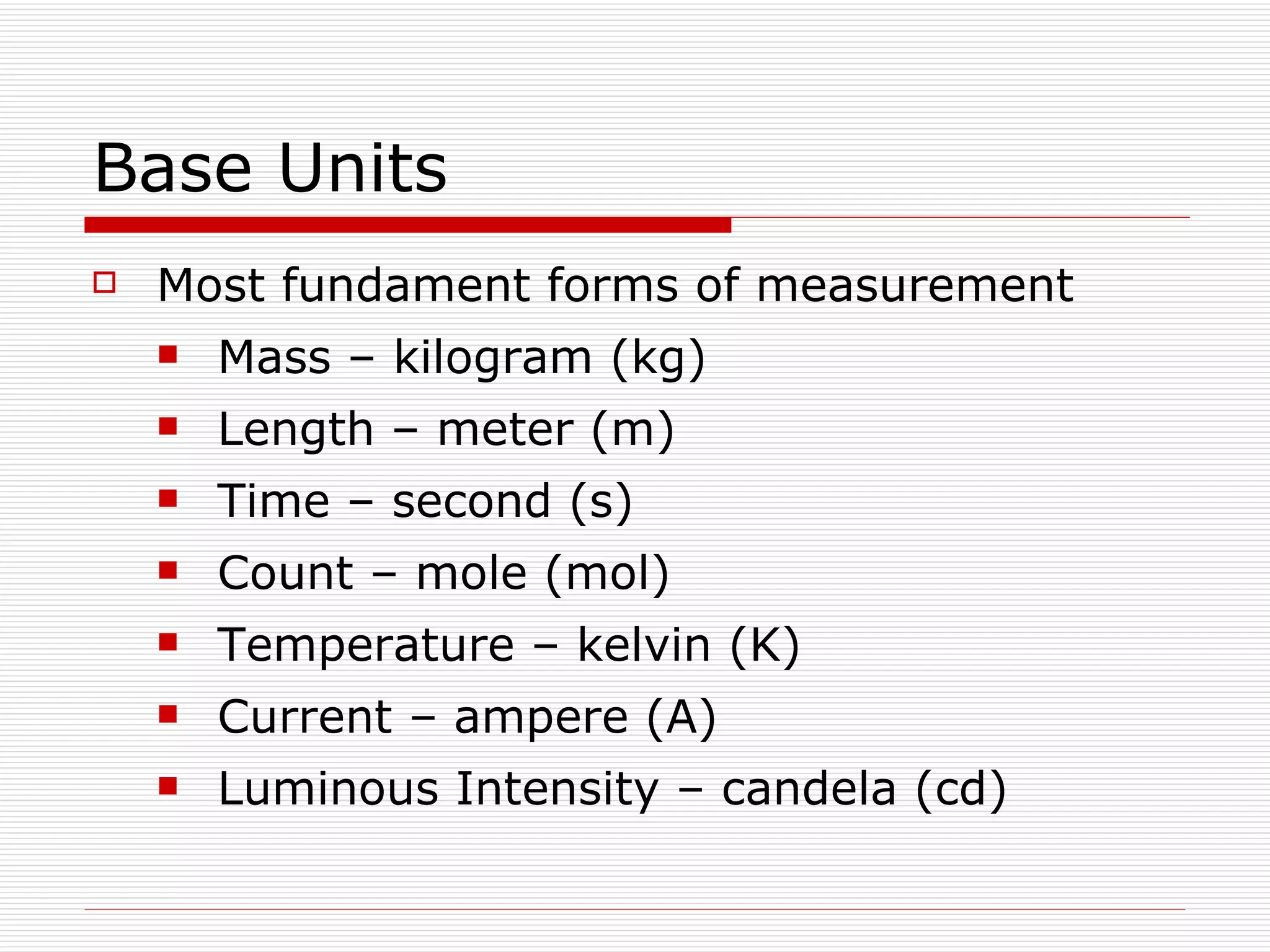
Base Units Most fundament forms of measurement Mass – kilogram (kg) Length – meter (m) Time – second (s) Count – mole (mol) Temperature – kelvin (K) Current – ampere (A) Luminous Intensity – candela (cd)
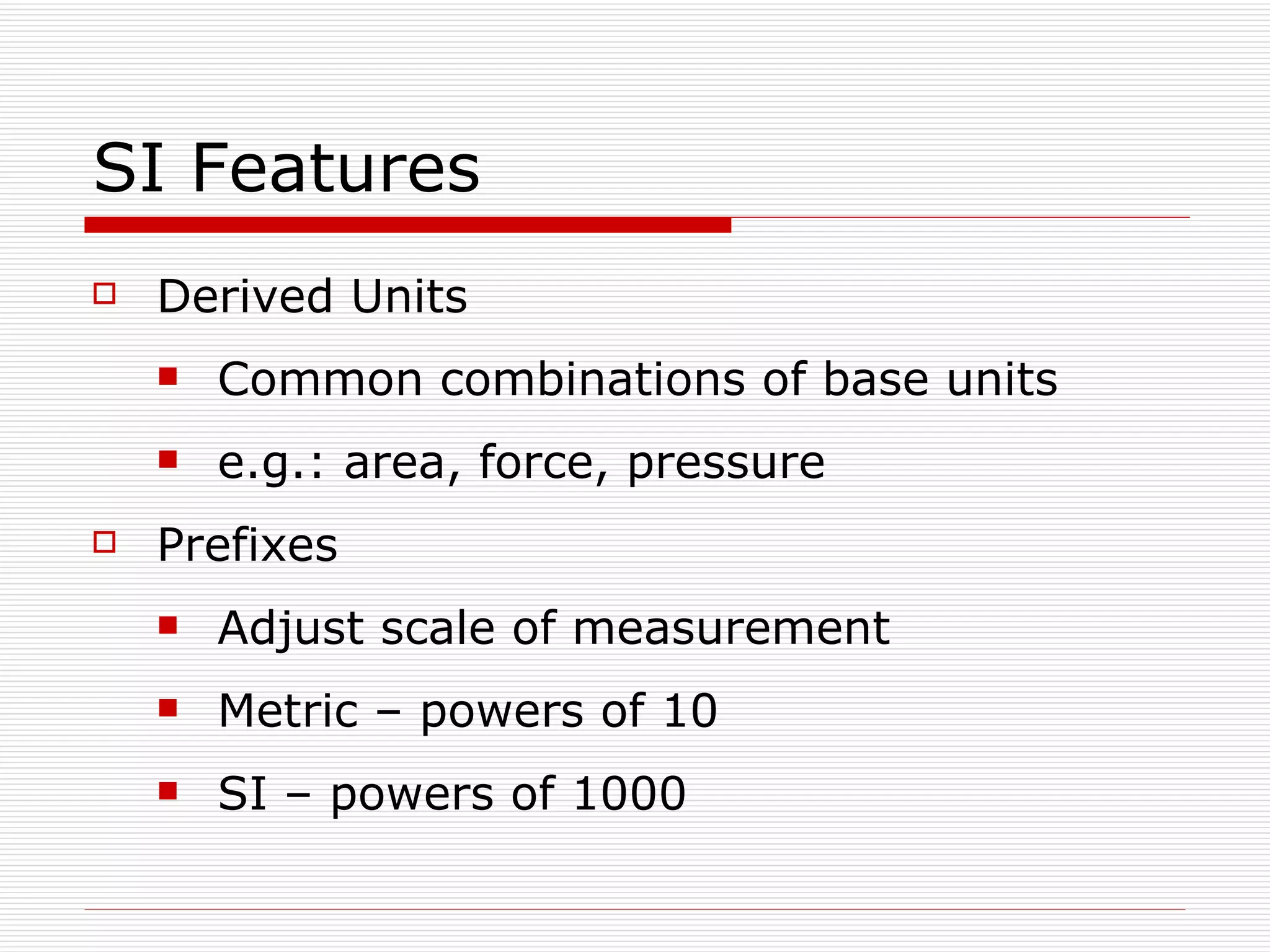
SI Features Derived Units Common combinations of base units e.g.: area, force, pressure Prefixes Adjust scale of measurement Metric – powers of 10 SI – powers of 1000
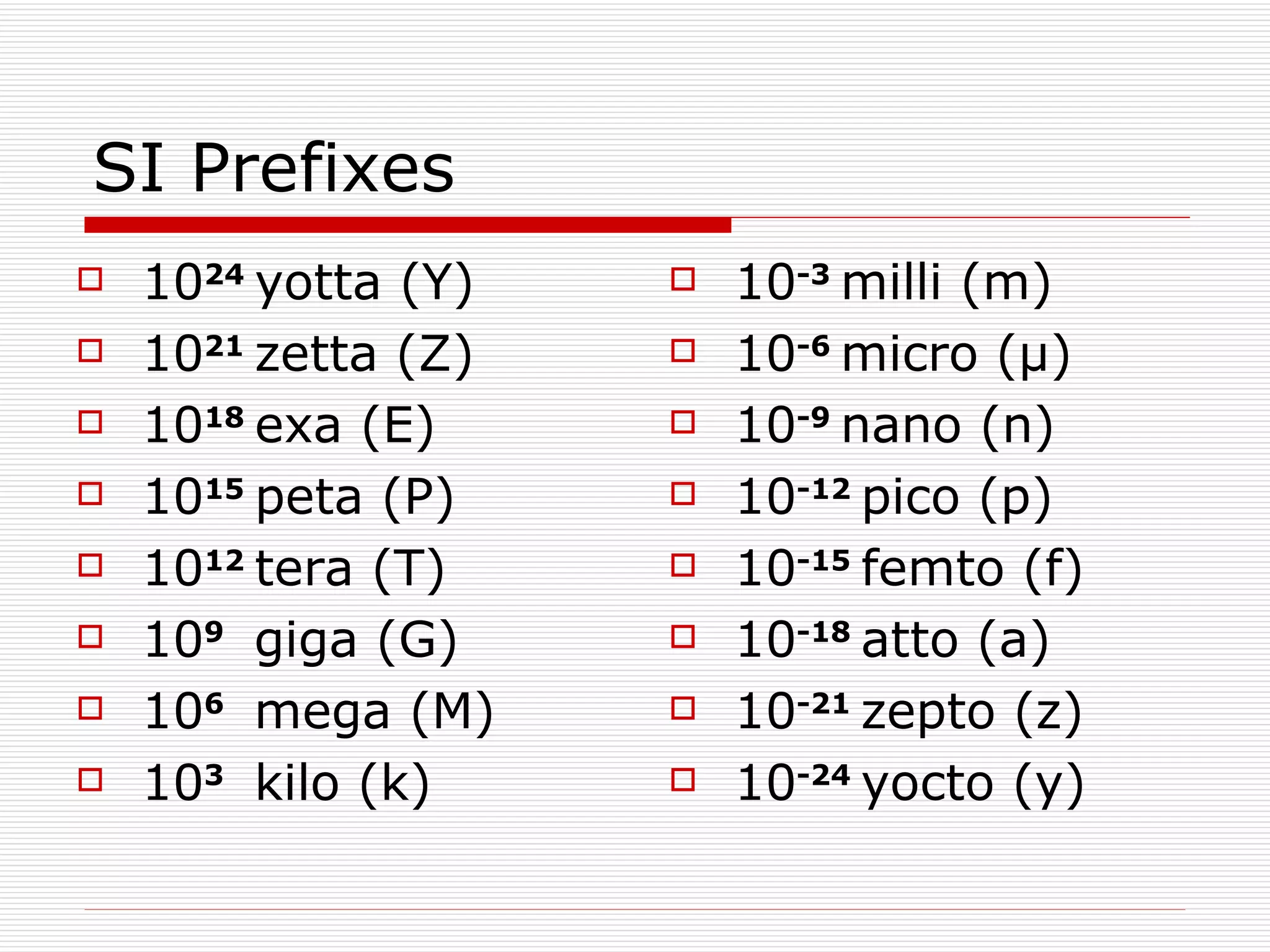
SI Prefixes 10 24   yotta (Y) 10 21   zetta (Z) 10 18   exa (E) 10 15   peta (P) 10 12   tera (T) 10 9   giga (G) 10 6   mega (M) 10 3   kilo (k) 10 -3  milli (m) 10 -6  micro (µ) 10 -9  nano (n) 10 -12  pico (p) 10 -15  femto (f) 10 -18  atto (a) 10 -21  zepto (z) 10 -24  yocto (y)
Chapter 1: Introduction and Mathematical Concepts Section 3  The Role of Units in Problem Solving
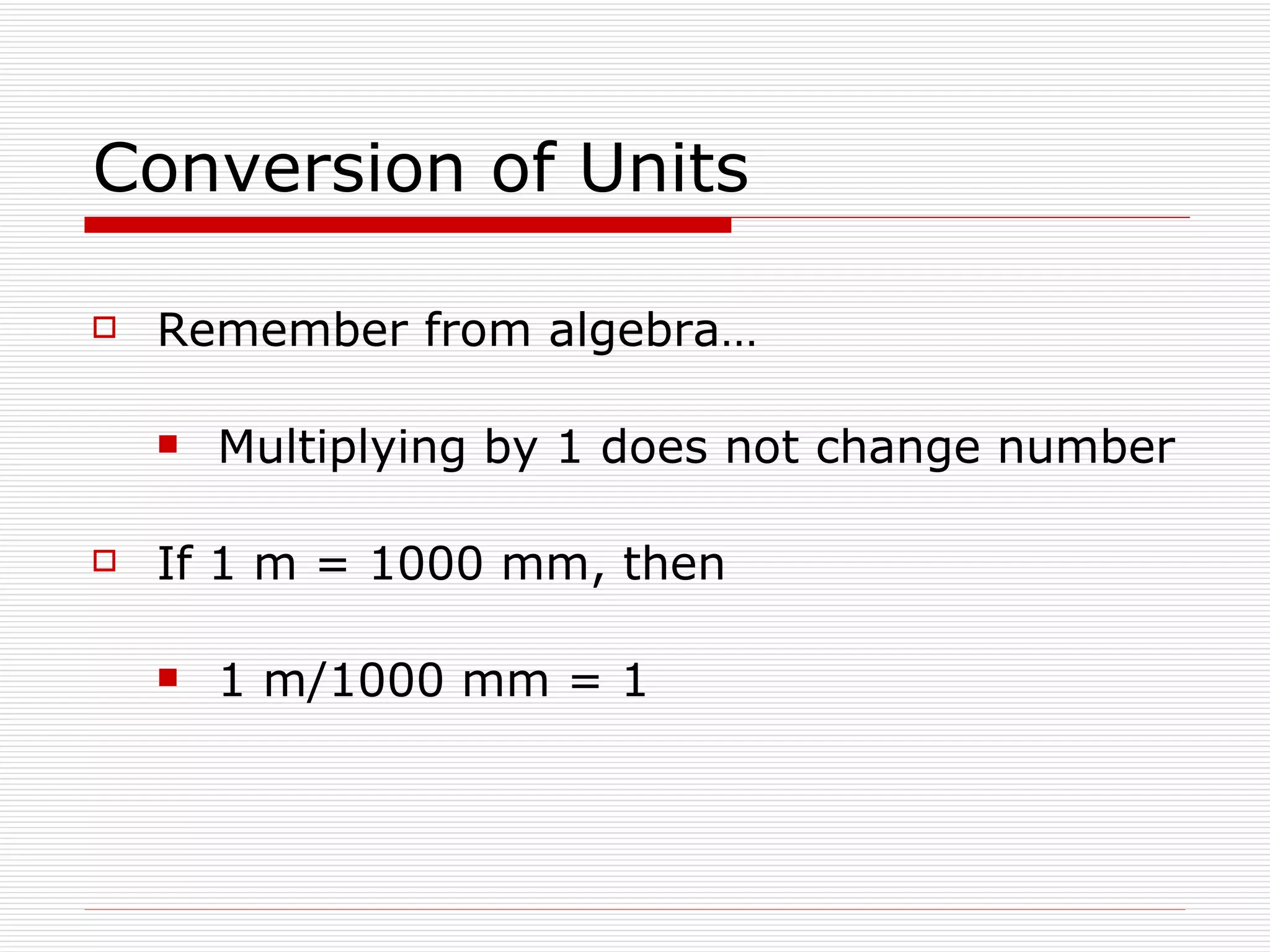
Conversion of Units Remember from algebra… Multiplying by 1 does not change number If 1 m = 1000 mm, then 1 m/1000 mm = 1
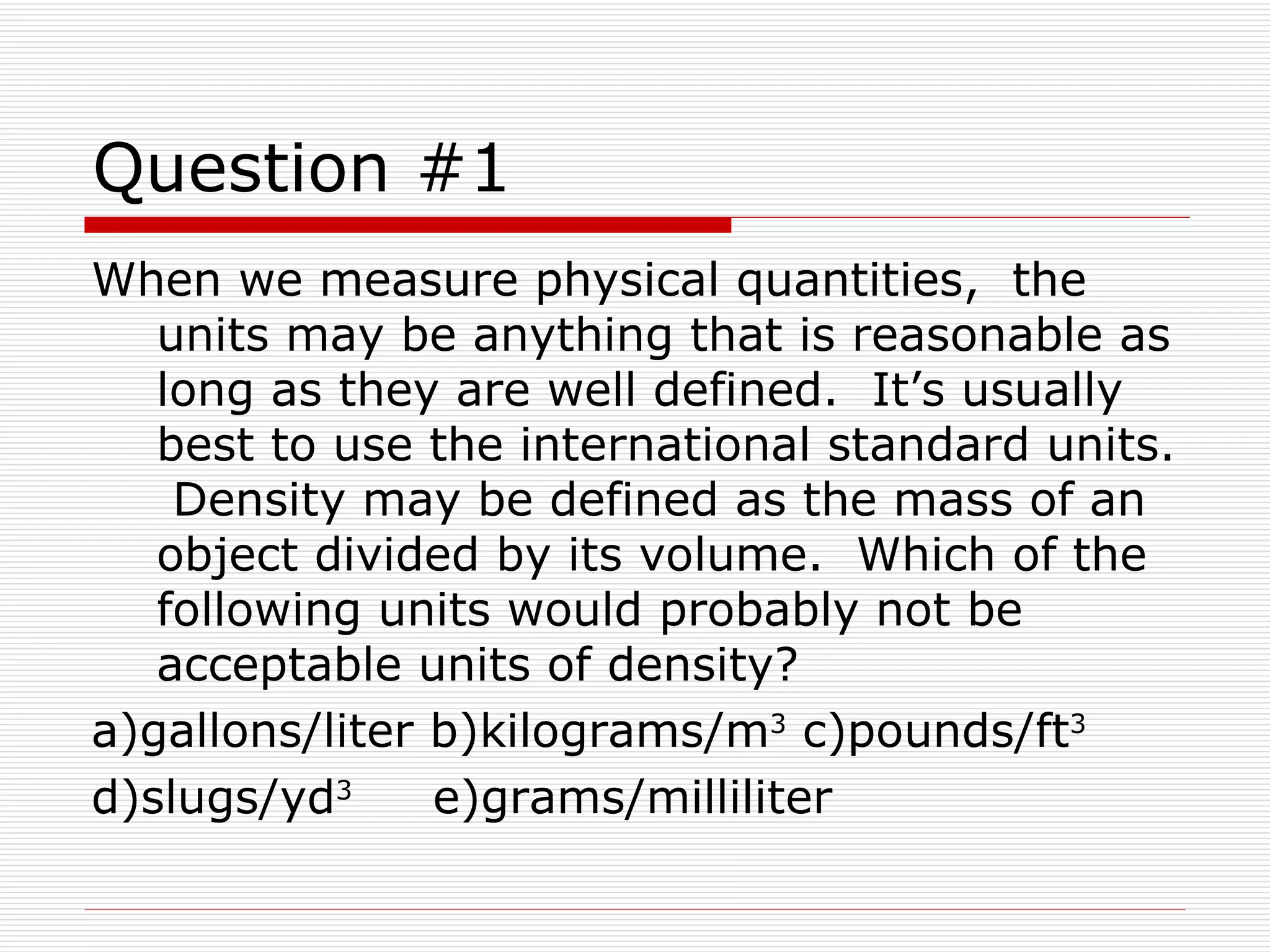
Question #1 When we measure physical quantities,  the units may be anything that is reasonable as long as they are well defined.  It’s usually best to use the international standard units.  Density may be defined as the mass of an object divided by its volume.  Which of the following units would probably not be acceptable units of density? a)gallons/liter b)kilograms/m 3  c)pounds/ft 3   d)slugs/yd 3   e)grams/milliliter
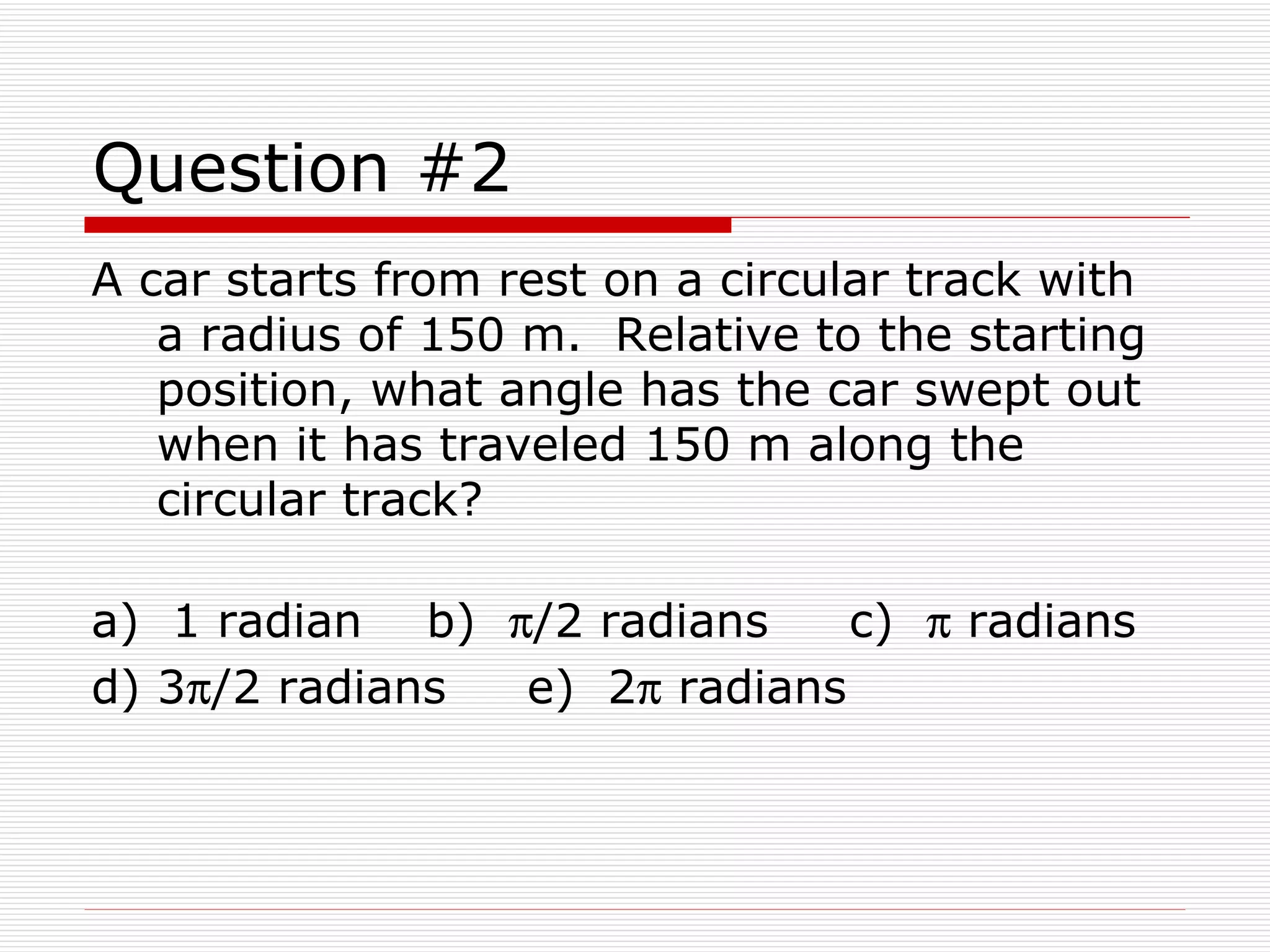
Question #2 A car starts from rest on a circular track with a radius of 150 m.  Relative to the starting position, what angle has the car swept out when it has traveled 150 m along the circular track? a)  1 radian  b)   /2 radians  c)    radians  d) 3  /2 radians  e)  2   radians
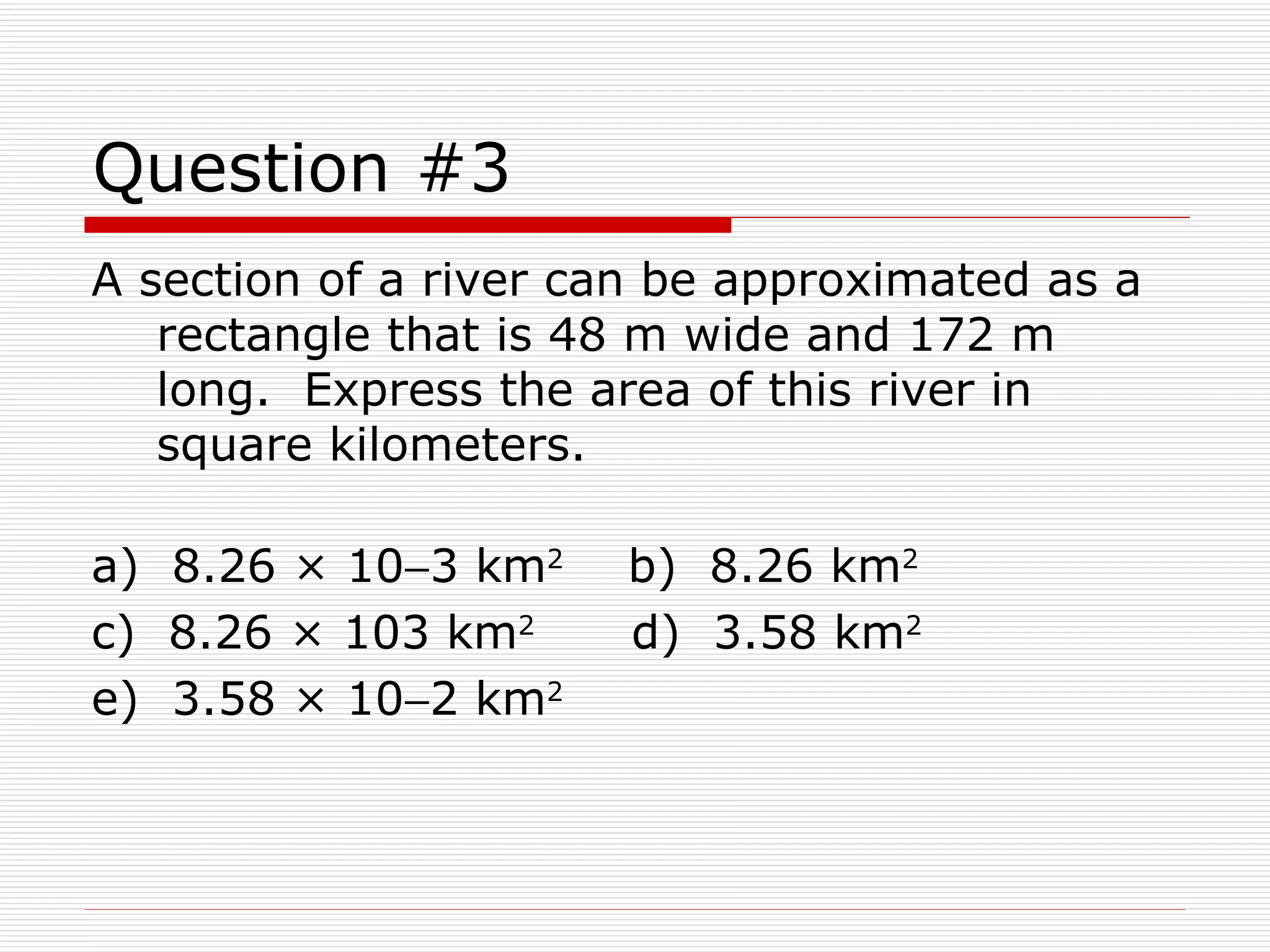
Question #3 A section of a river can be approximated as a rectangle that is 48 m wide and 172 m long.  Express the area of this river in square kilometers. a)  8.26 × 10  3 km 2   b)  8.26 km 2   c)  8.26 × 10³ km 2     d)  3.58 km 2   e)  3.58 × 10  2 km 2
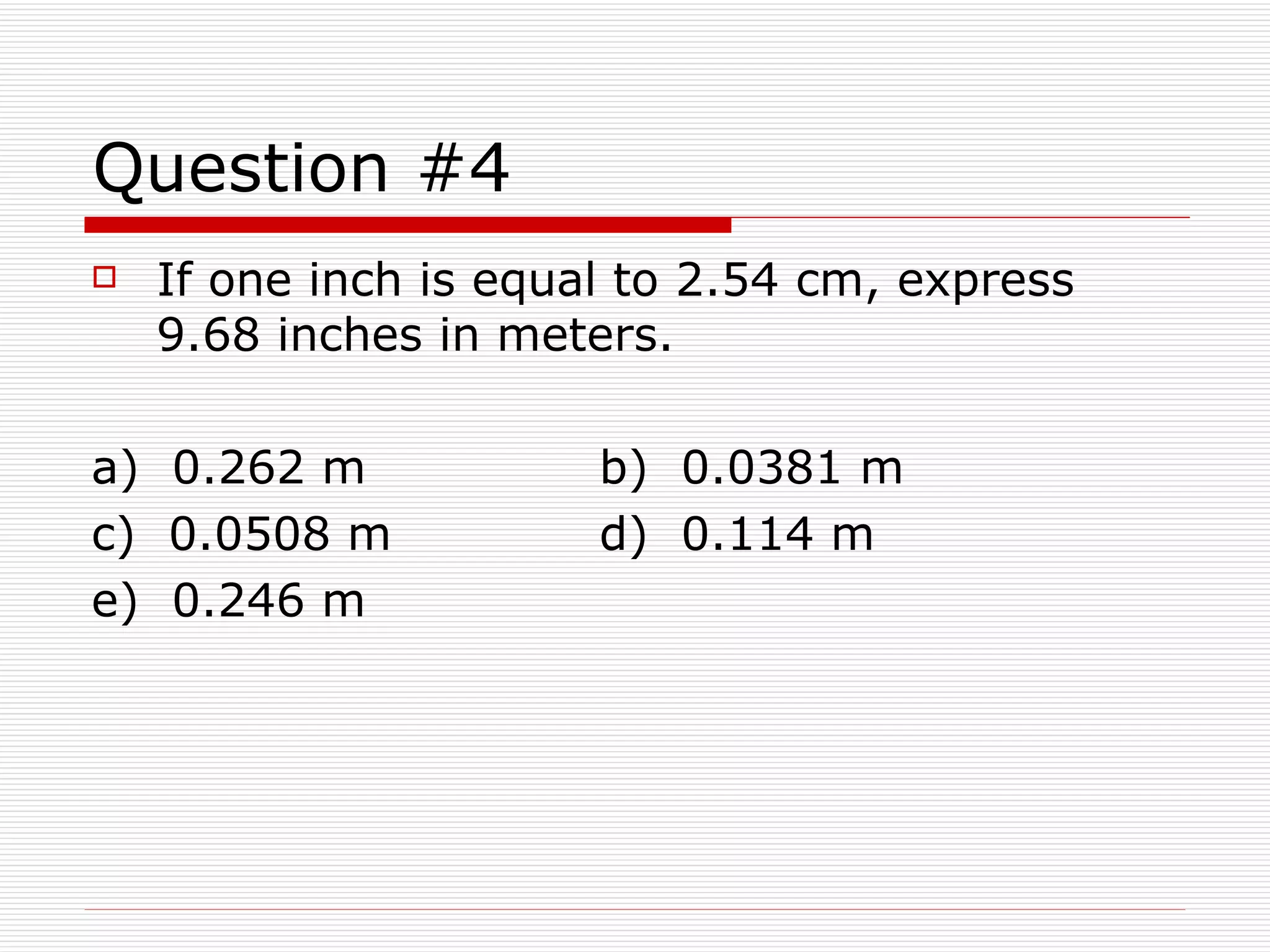
Question #4 If one inch is equal to 2.54 cm, express 9.68 inches in meters. a)  0.262 m  b)  0.0381 m  c)  0.0508 m  d)  0.114 m  e)  0.246 m
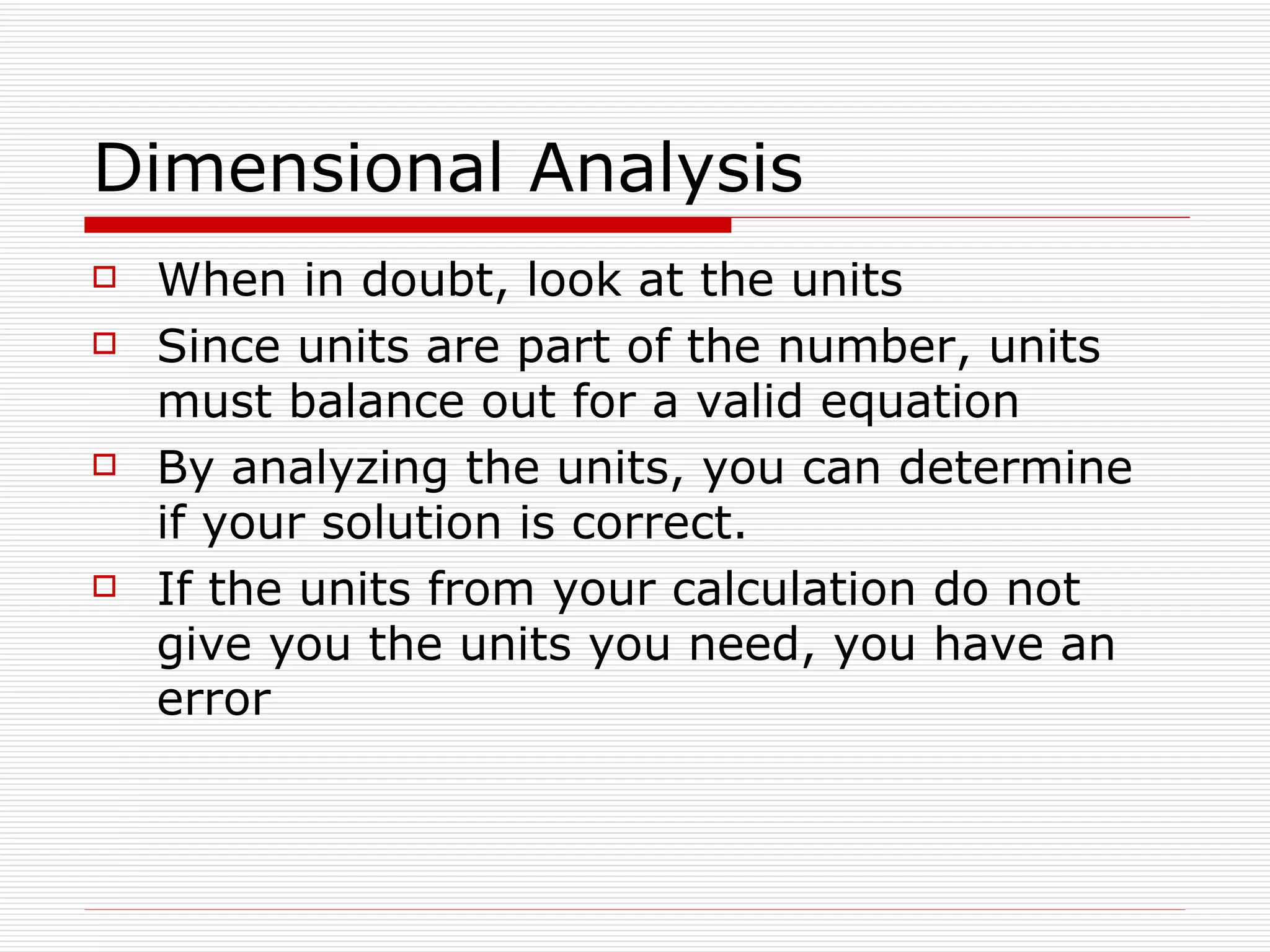
Dimensional Analysis When in doubt, look at the units Since units are part of the number, units must balance out for a valid equation By analyzing the units, you can determine if your solution is correct. If the units from your calculation do not give you the units you need, you have an error
Example DIMENSIONAL ANALYSIS [L] = length  [M] = mass  [T] = time Is the following equation dimensionally correct?
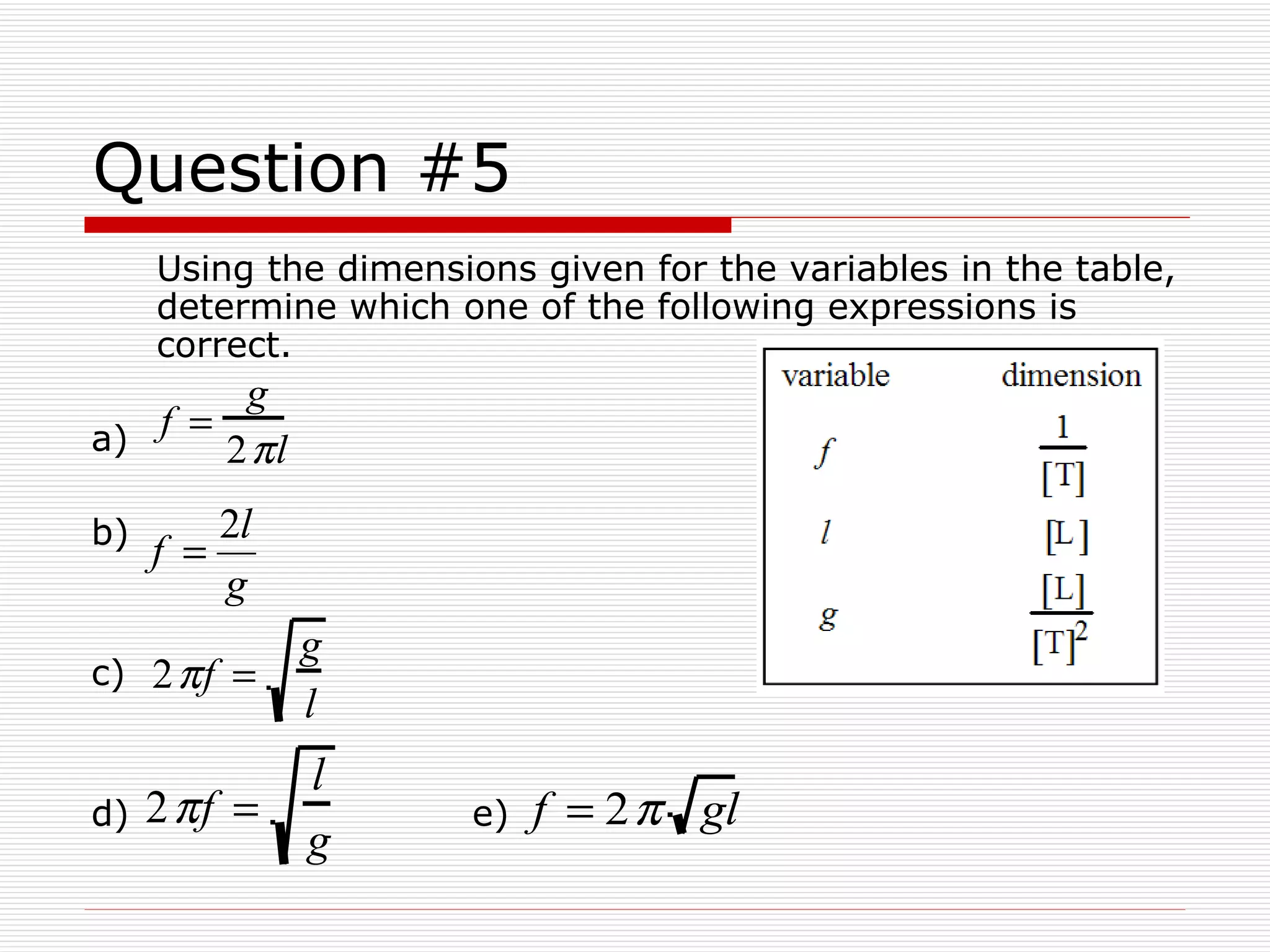
Question #5 Using the dimensions given for the variables in the table, determine which one of the following expressions is correct. a) b) c) d) e)
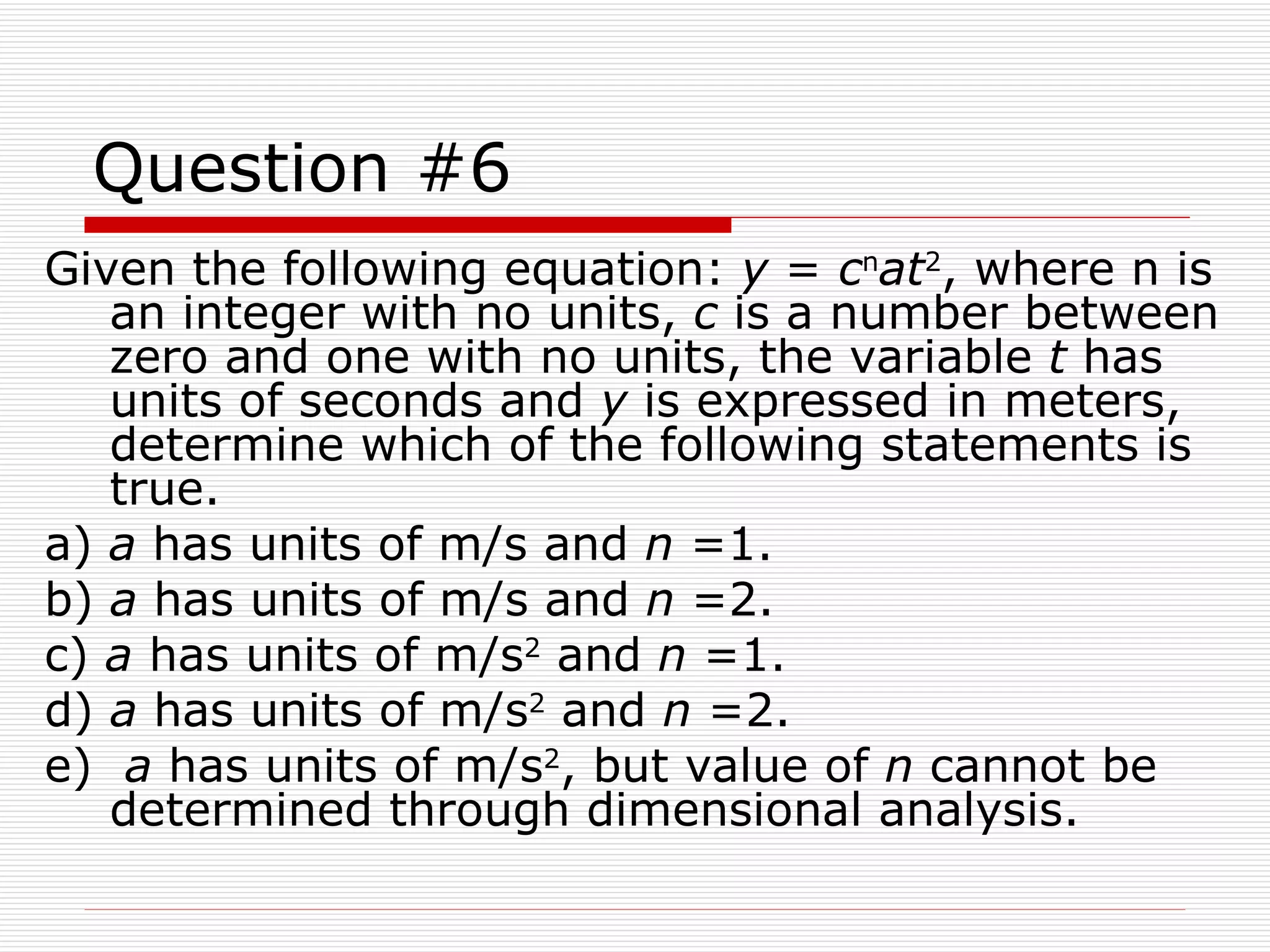
Question #6 Given the following equation:  y  =  c n at 2 , where n is an integer with no units,  c  is a number between zero and one with no units, the variable  t  has units of seconds and  y  is expressed in meters, determine which of the following statements is true. a)  a  has units of m/s and  n  =1. b)  a  has units of m/s and  n  =2. c)  a  has units of m/s 2  and  n  =1. d)  a  has units of m/s 2  and  n  =2. e)  a  has units of m/s 2 , but value of  n  cannot be determined through dimensional analysis.
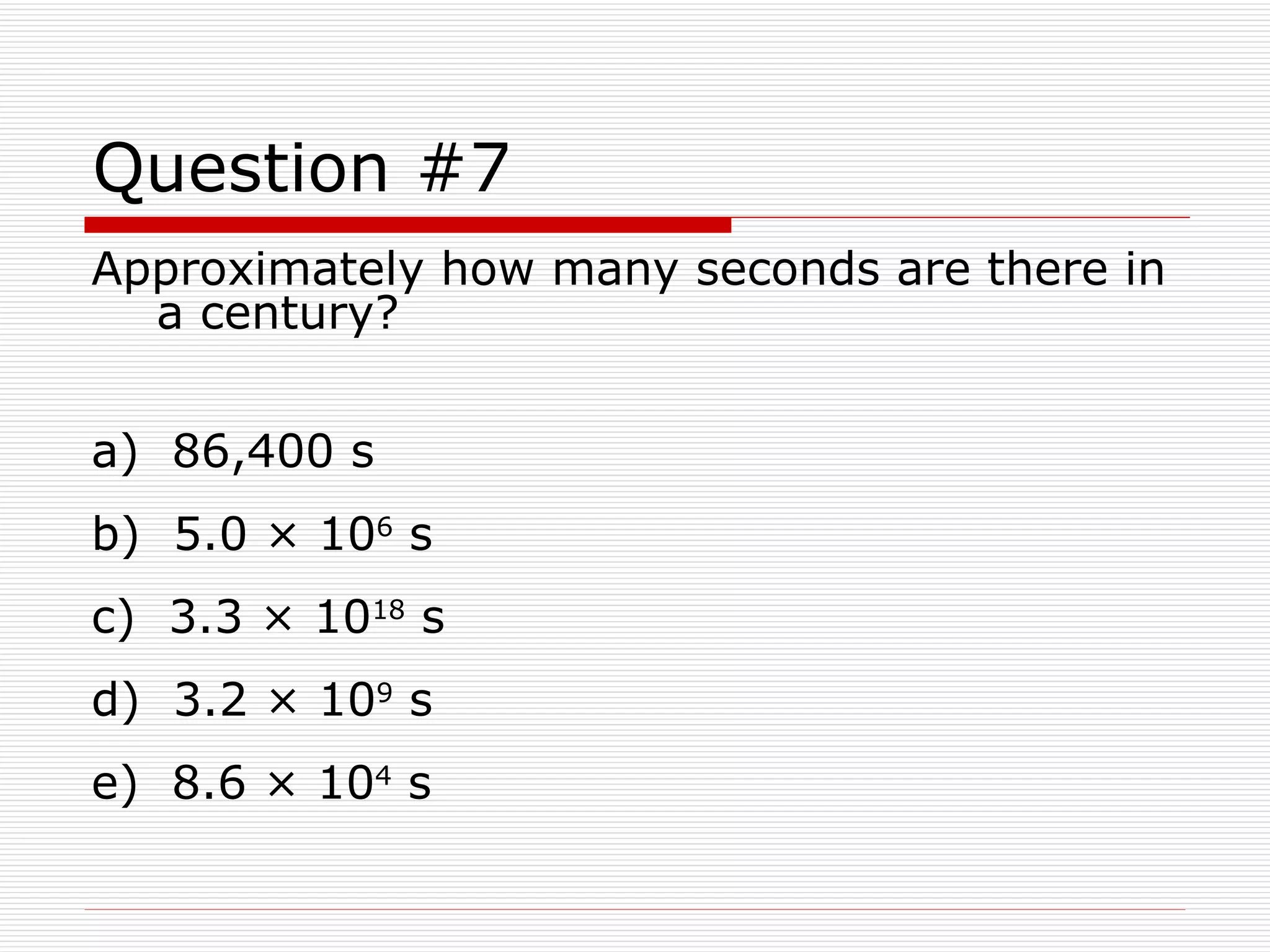
Question #7 Approximately how many seconds are there in a century? a)  86,400 s b)  5.0 × 10 6  s c)  3.3 × 10 18  s d)  3.2 × 10 9  s e)  8.6 × 10 4  s
Chapter 1: Introduction and Mathematical Concepts Section 4 - Trigonometry
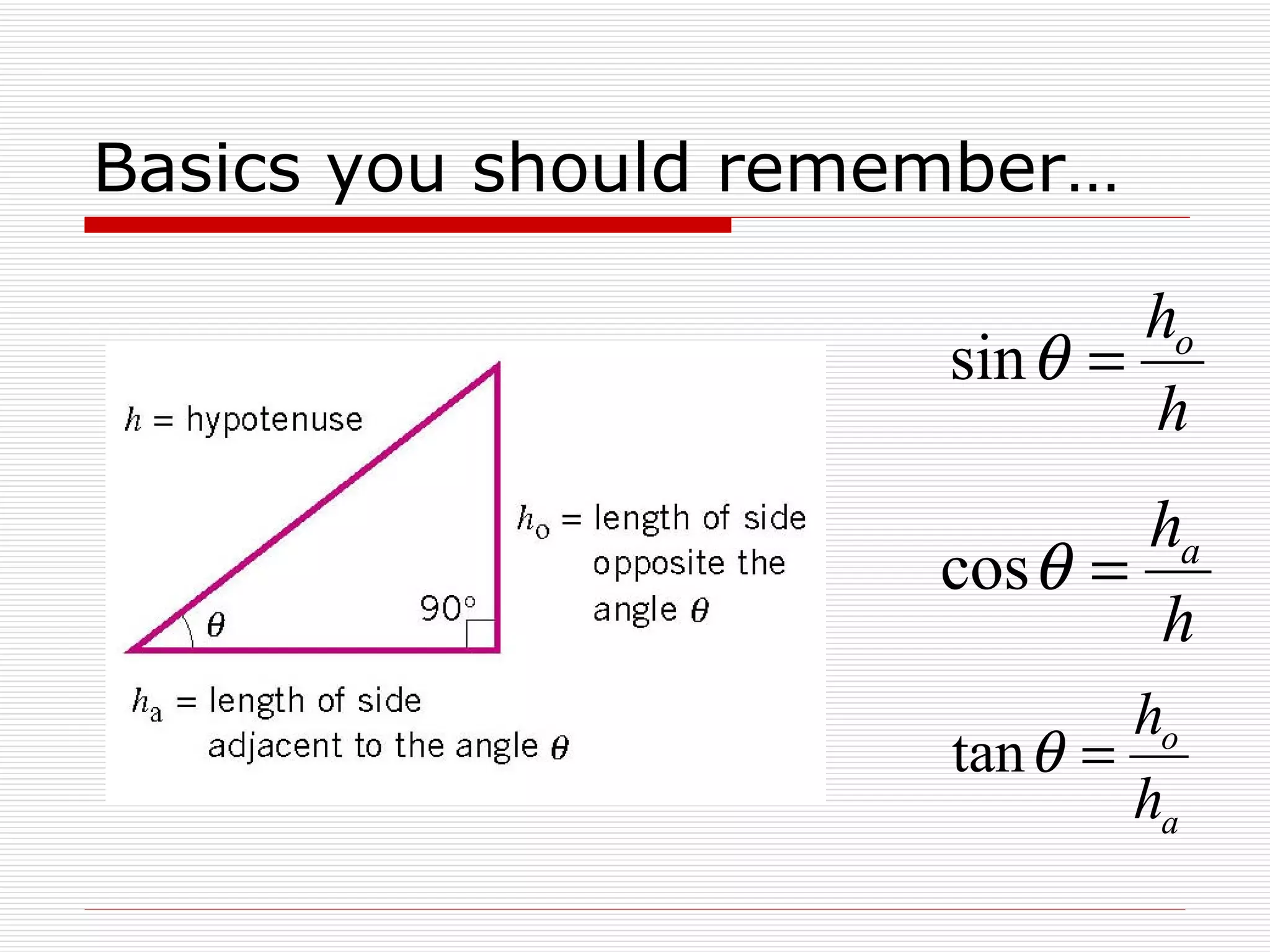
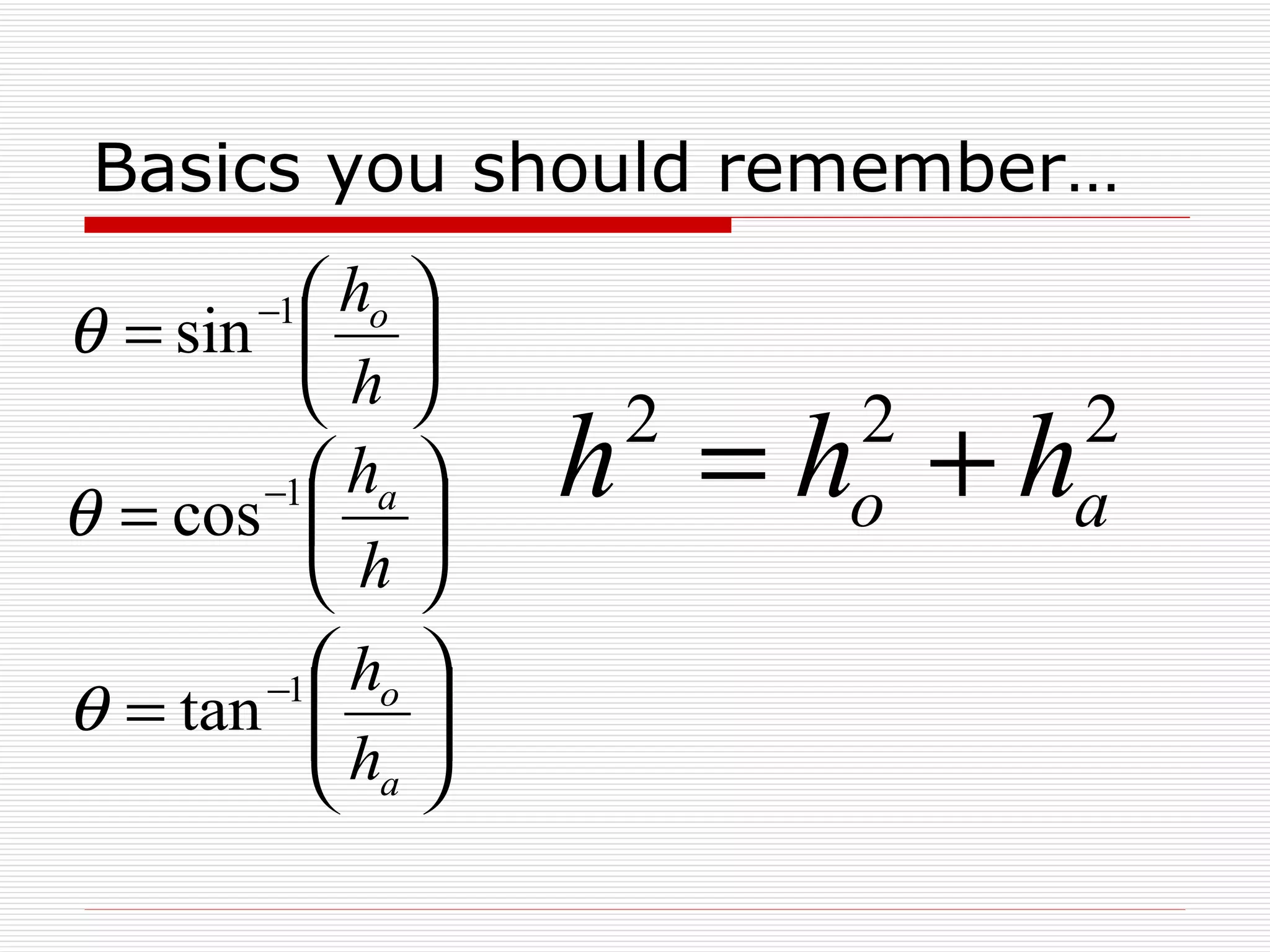
Basics you should remember…
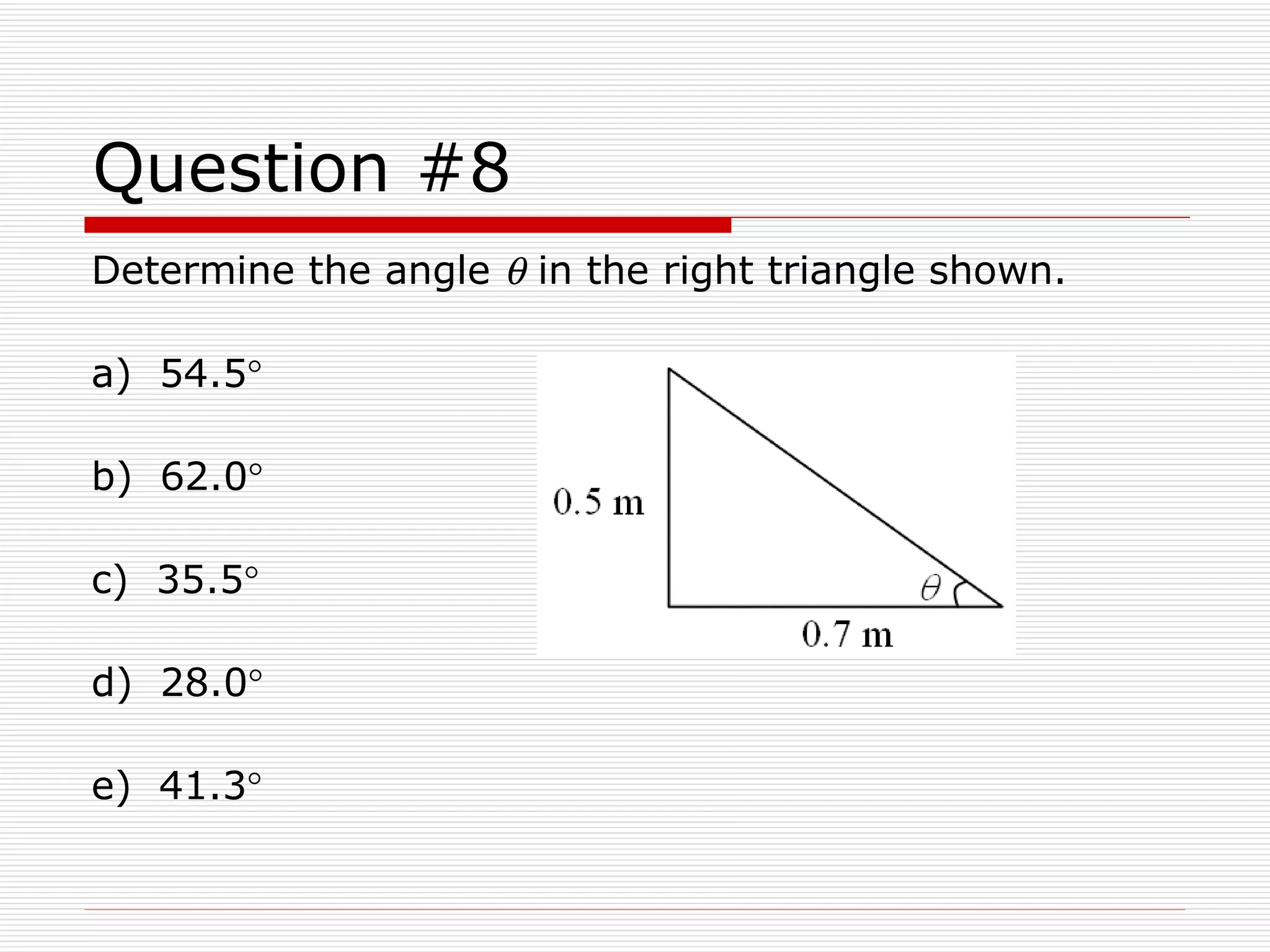
Question #8 Determine the angle    in the right triangle shown. a)  54.5  b)  62.0  c)  35.5  d)  28.0  e)  41.3 
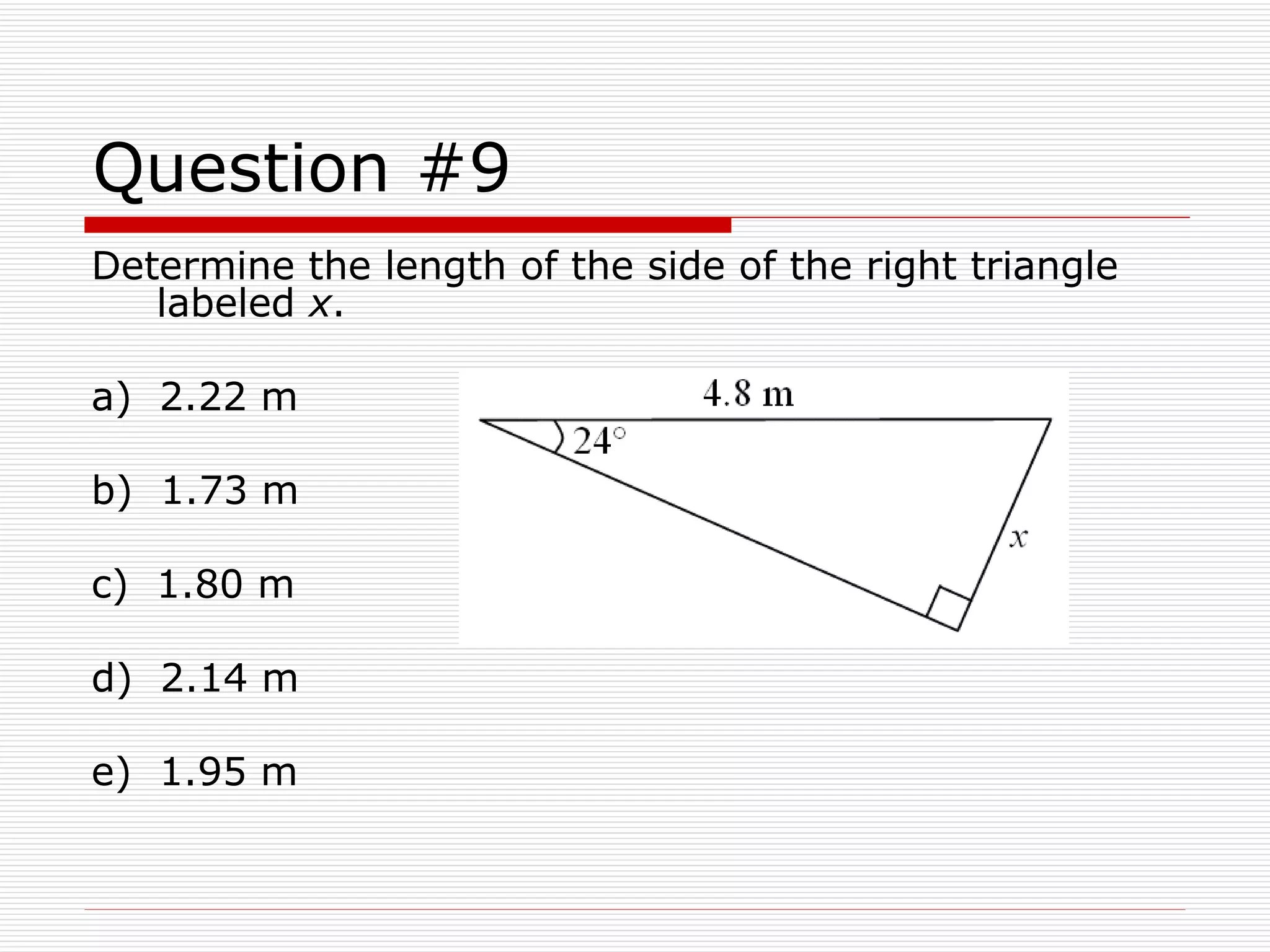
Question #9 Determine the length of the side of the right triangle labeled  x . a)  2.22 m b)  1.73 m c)  1.80 m d)  2.14 m e)  1.95 m
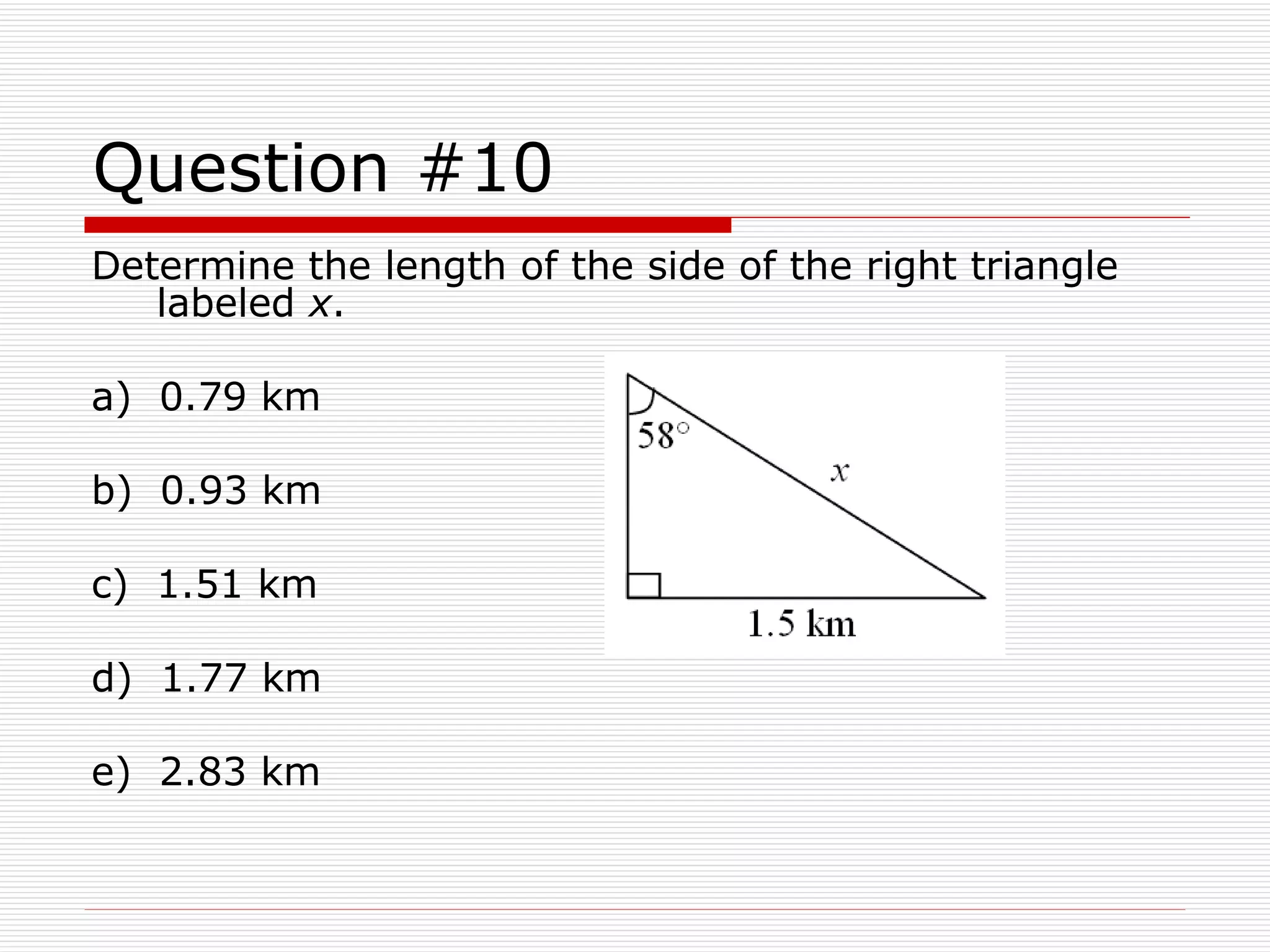
Question #10 Determine the length of the side of the right triangle labeled  x . a)  0.79 km b)  0.93 km c)  1.51 km d)  1.77 km e)  2.83 km
Chapter 1: Introduction and Mathematical Concepts Section 5 – Scalar & Vectors
Scalar & Vector A  scalar   quantity is one that can be described by a single number: temperature, speed, mass A  vector   quantity deals inherently with both magnitude and direction: velocity, force, displacement
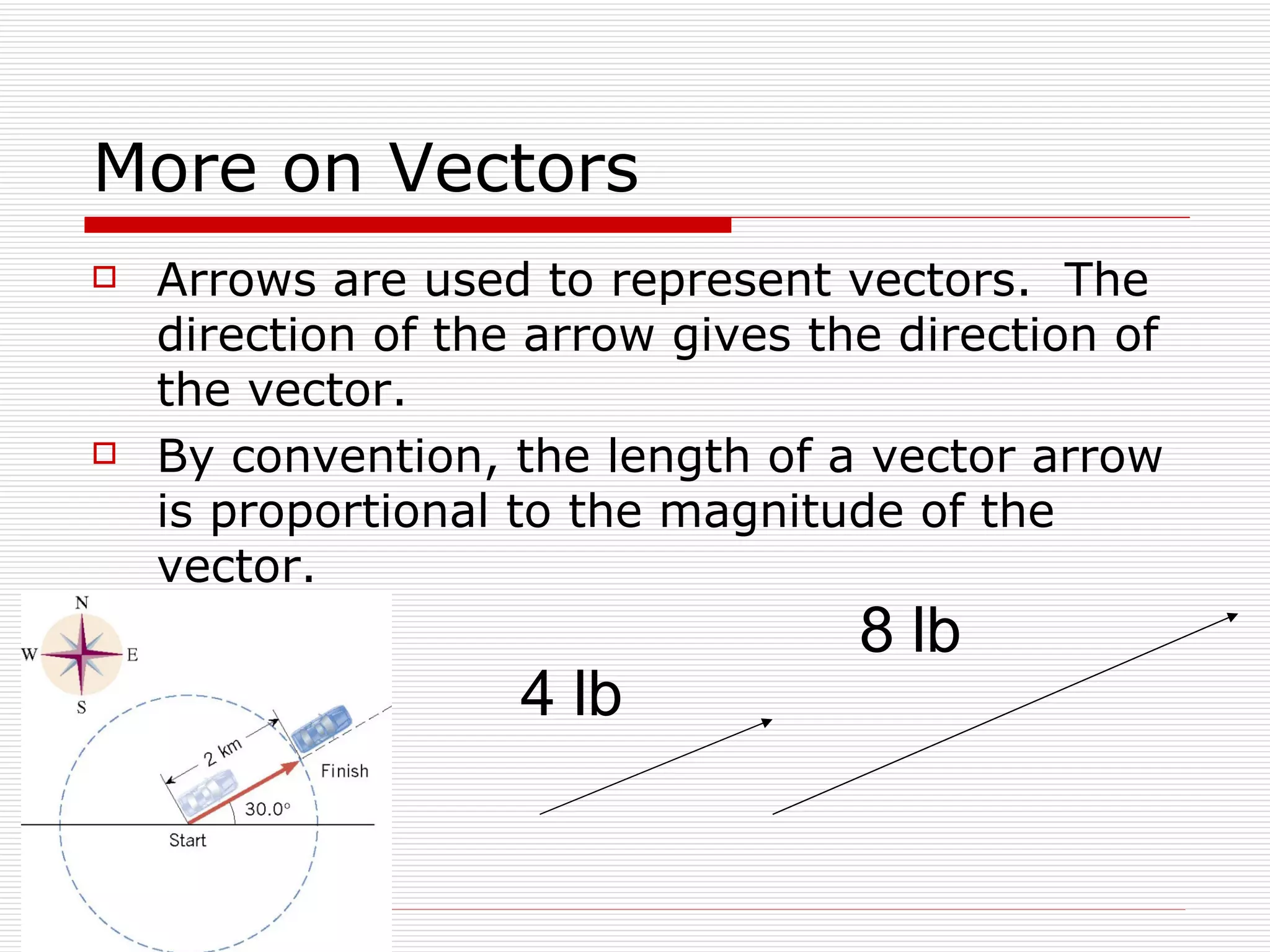
More on Vectors Arrows are used to represent vectors.  The direction of the arrow gives the direction of the vector. By convention, the length of a vector arrow is proportional to the magnitude of the vector. 8 lb 4 lb
Question #11 Which one of the following statements is true concerning scalar quantities? a)  Scalar quantities must be represented by base units. b)  Scalar quantities have both magnitude and direction. c)  Scalar quantities can be added to vector quantities using rules of trigonometry. d)  Scalar quantities can be added to other scalar quantities using rules of trigonometry. e)  Scalar quantities can be added to other scalar quantities using rules of ordinary addition.
Chapter 1: Introduction and Mathematical Concepts Section 6  Vector Addition and Subtraction
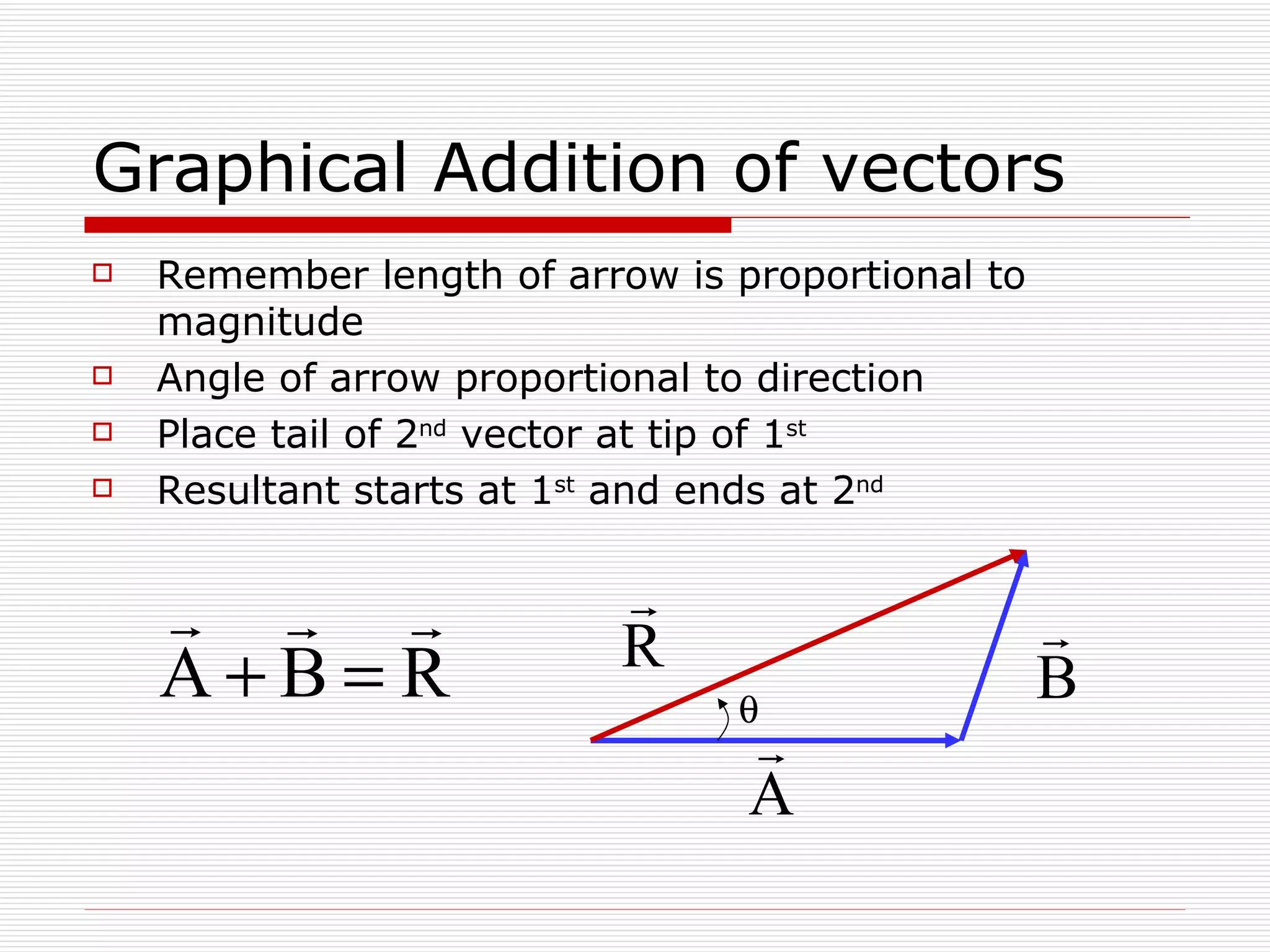
Graphical Addition of vectors Remember length of arrow is proportional to magnitude Angle of arrow proportional to direction Place tail of 2 nd  vector at tip of 1 st   Resultant starts at 1 st  and ends at 2 nd   
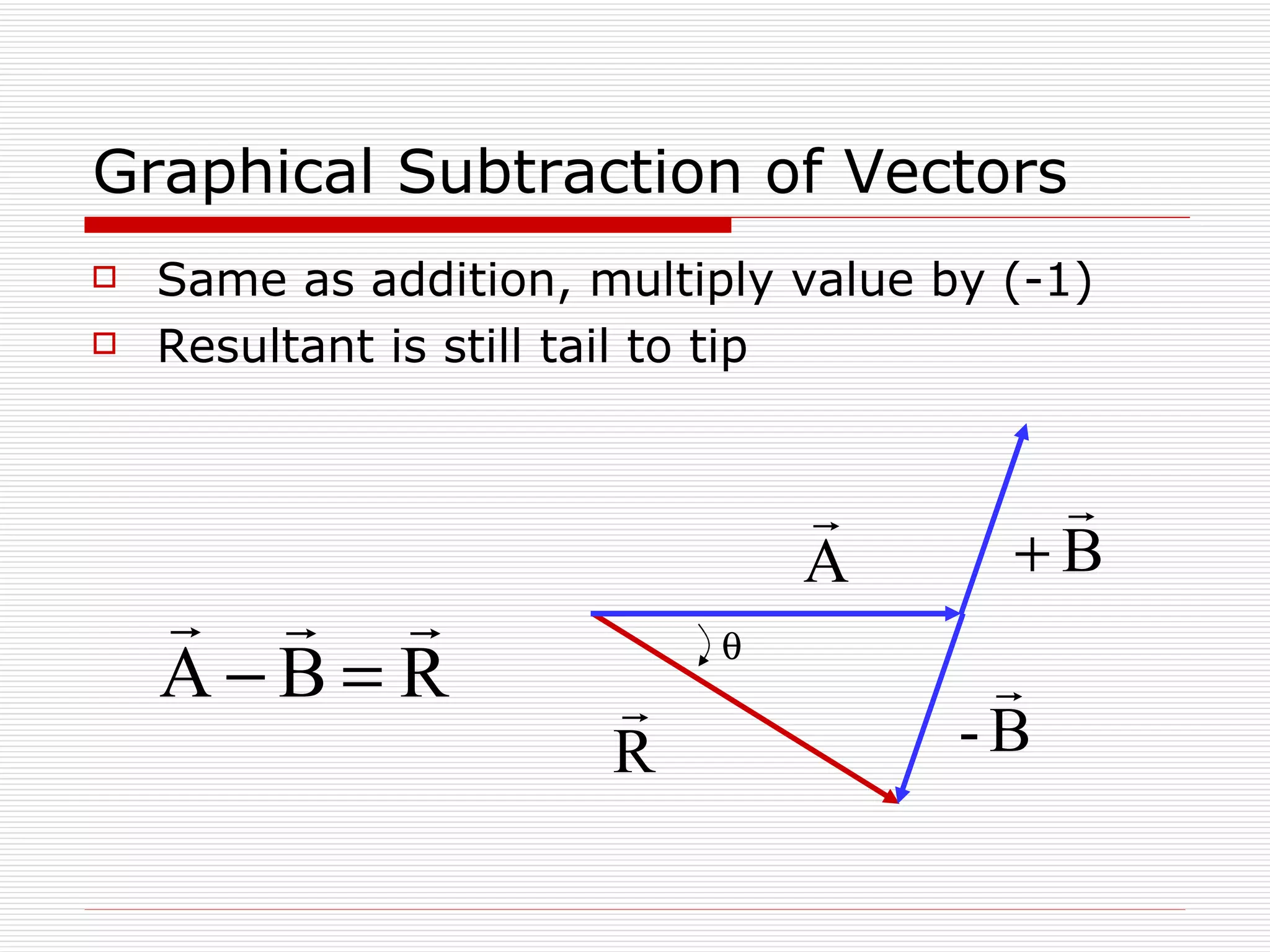
Graphical Subtraction of Vectors Same as addition, multiply value by (-1) Resultant is still tail to tip 
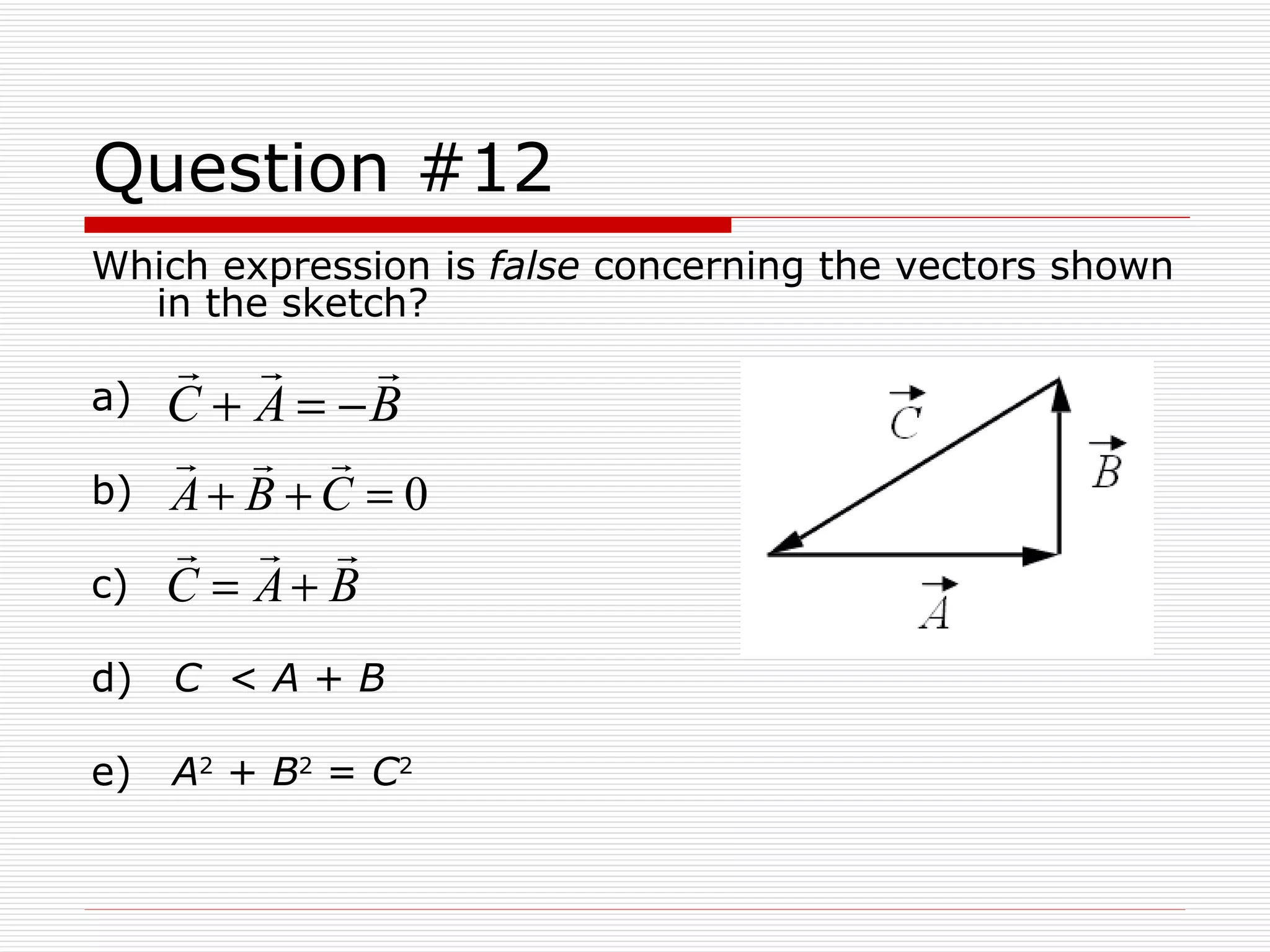
Question #12 Which expression is  false  concerning the vectors shown in the sketch? a) b) c) d)  C   <  A  +  B   e)  A 2  +  B 2  =  C 2
Chapter 1: Introduction and Mathematical Concepts Section 7  Components of a Vector
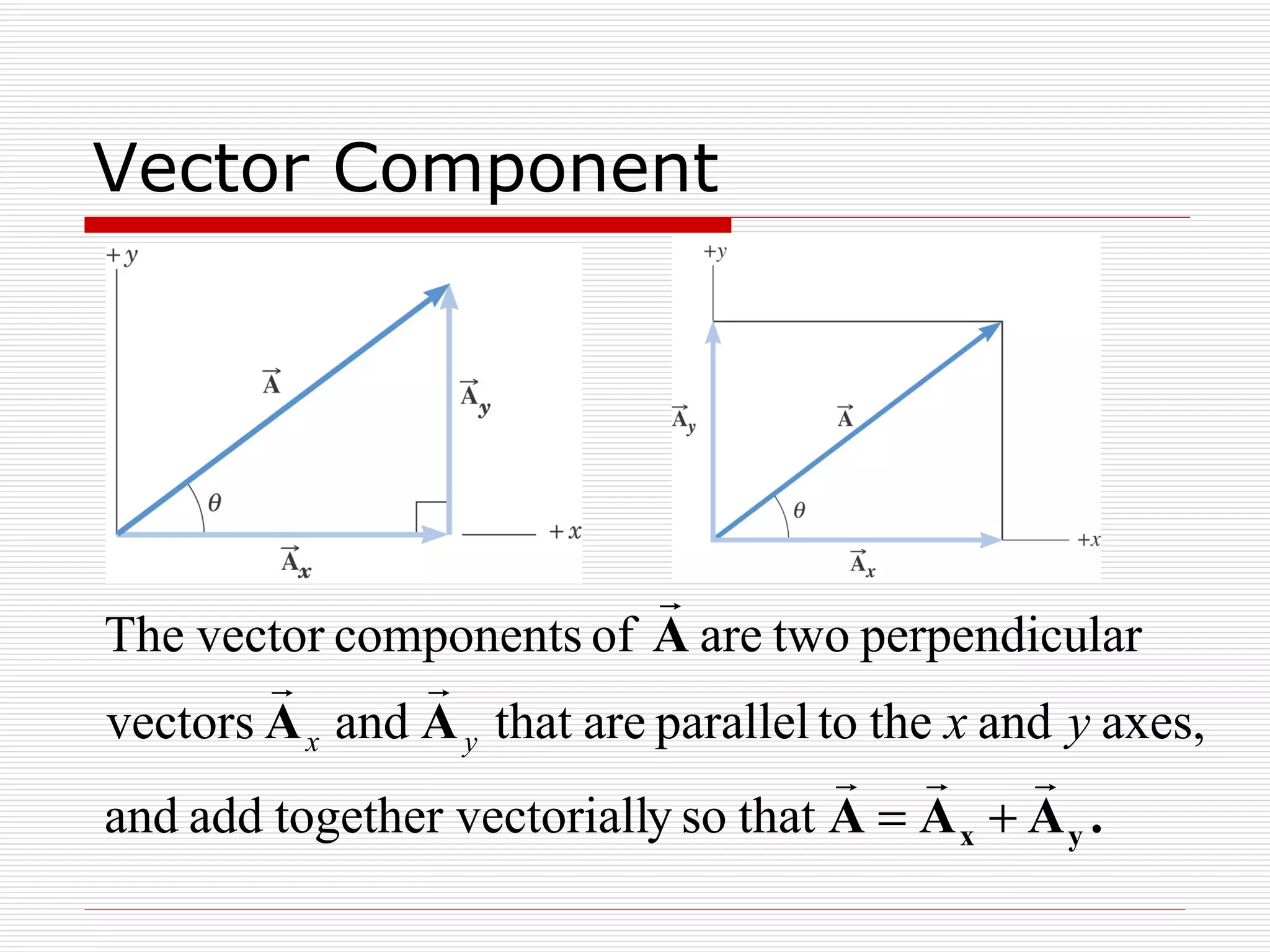
Vector Component
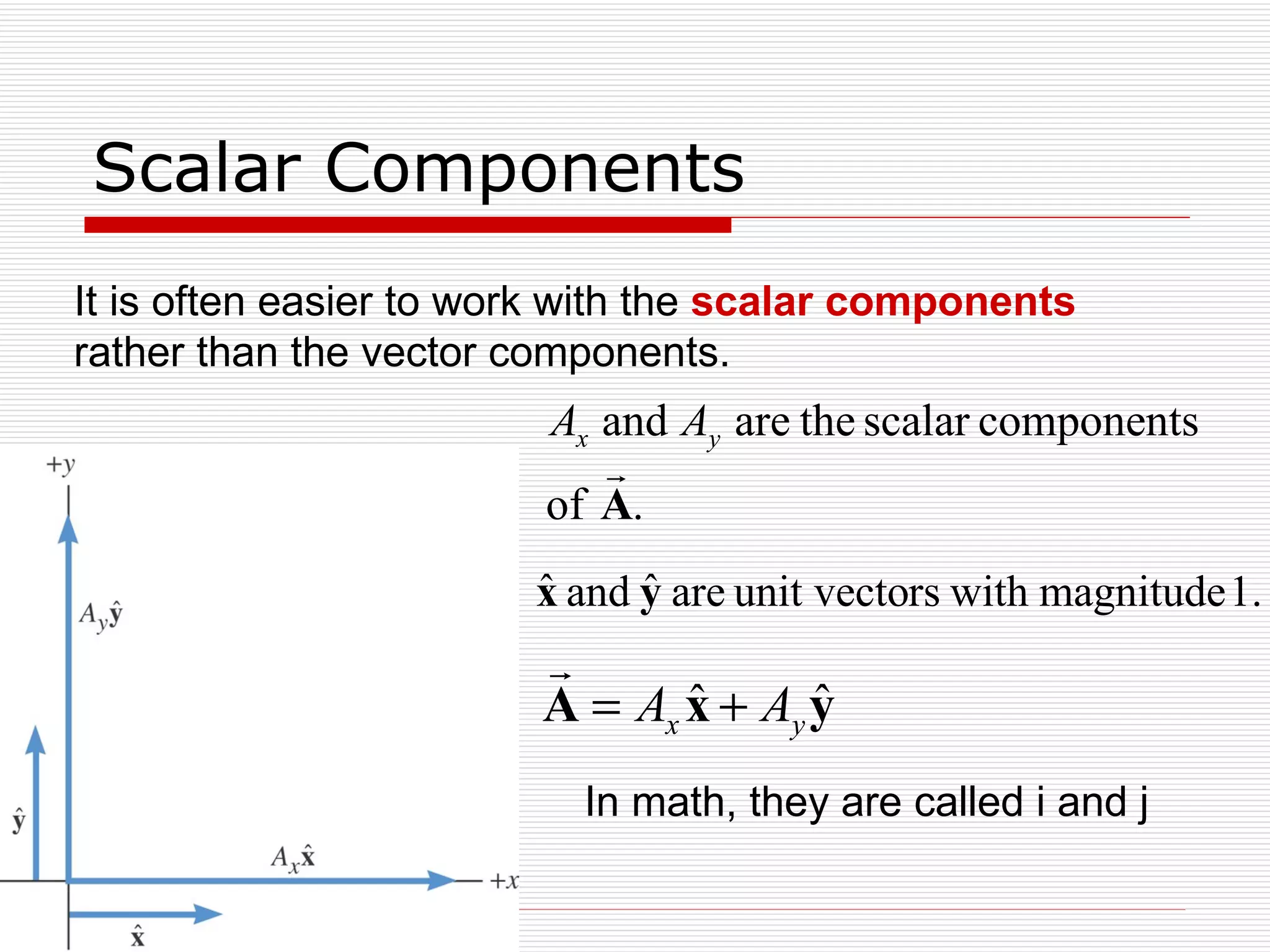
Scalar Components It is often easier to work with the  scalar components   rather than the vector components. In math, they are called i and j
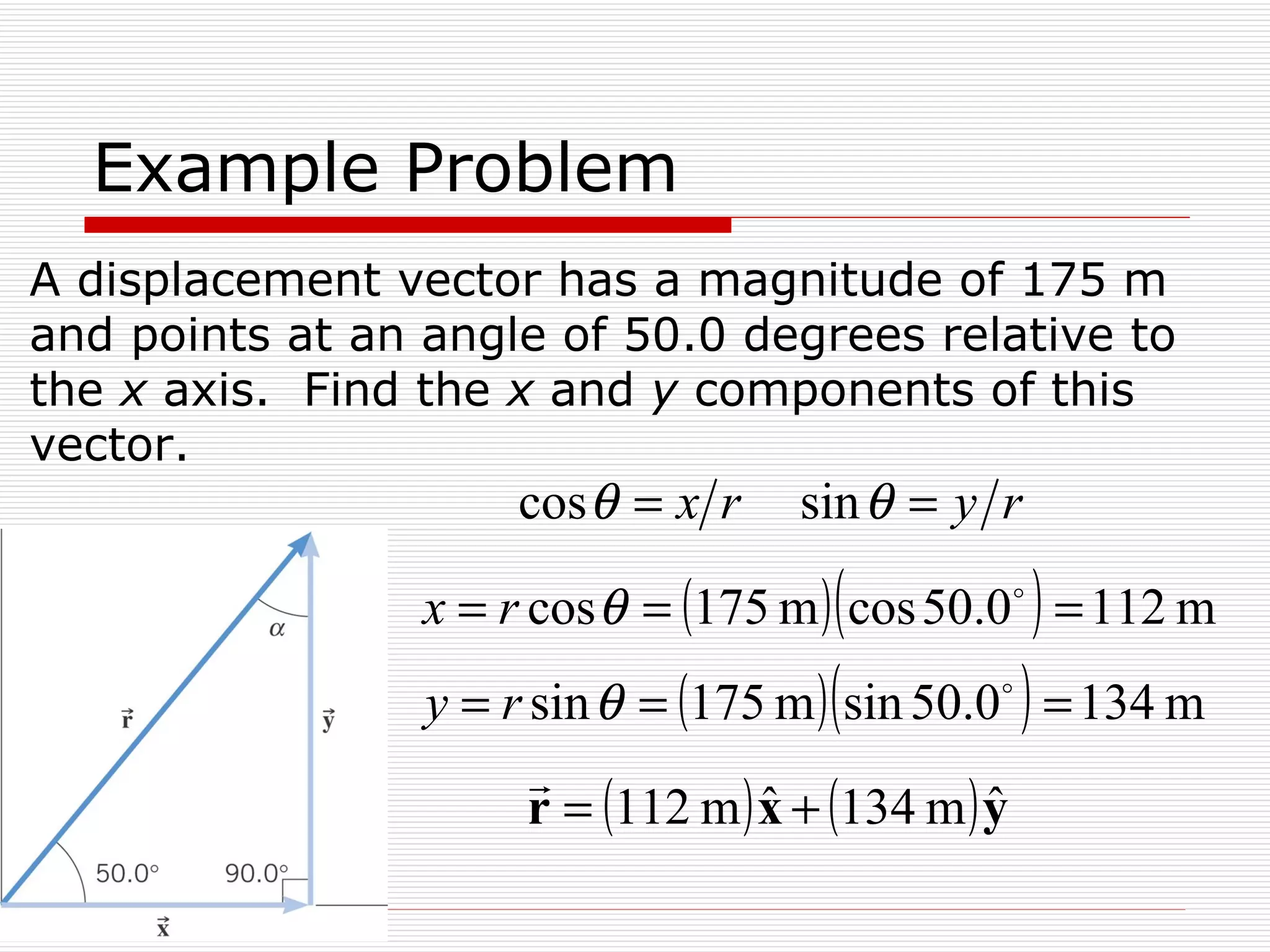
Example Problem A displacement vector has a magnitude of 175 m and points at an angle of 50.0 degrees relative to the  x  axis.  Find the  x  and  y  components of this vector.
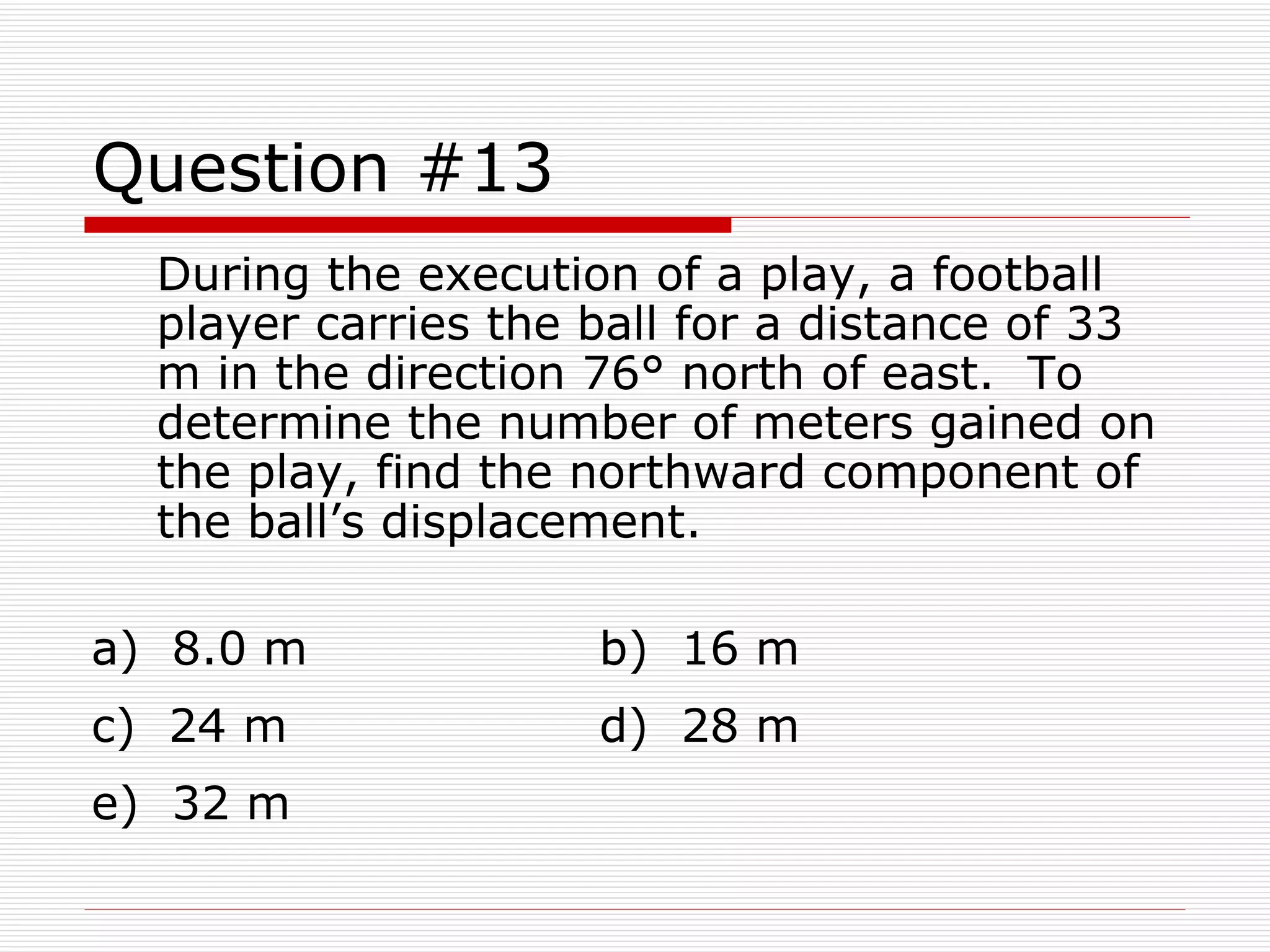
Question #13 During the execution of a play, a football player carries the ball for a distance of 33 m in the direction 76° north of east.  To determine the number of meters gained on the play, find the northward component of the ball’s displacement. a)  8.0 m  b)  16 m  c)  24 m  d)  28 m  e)  32 m
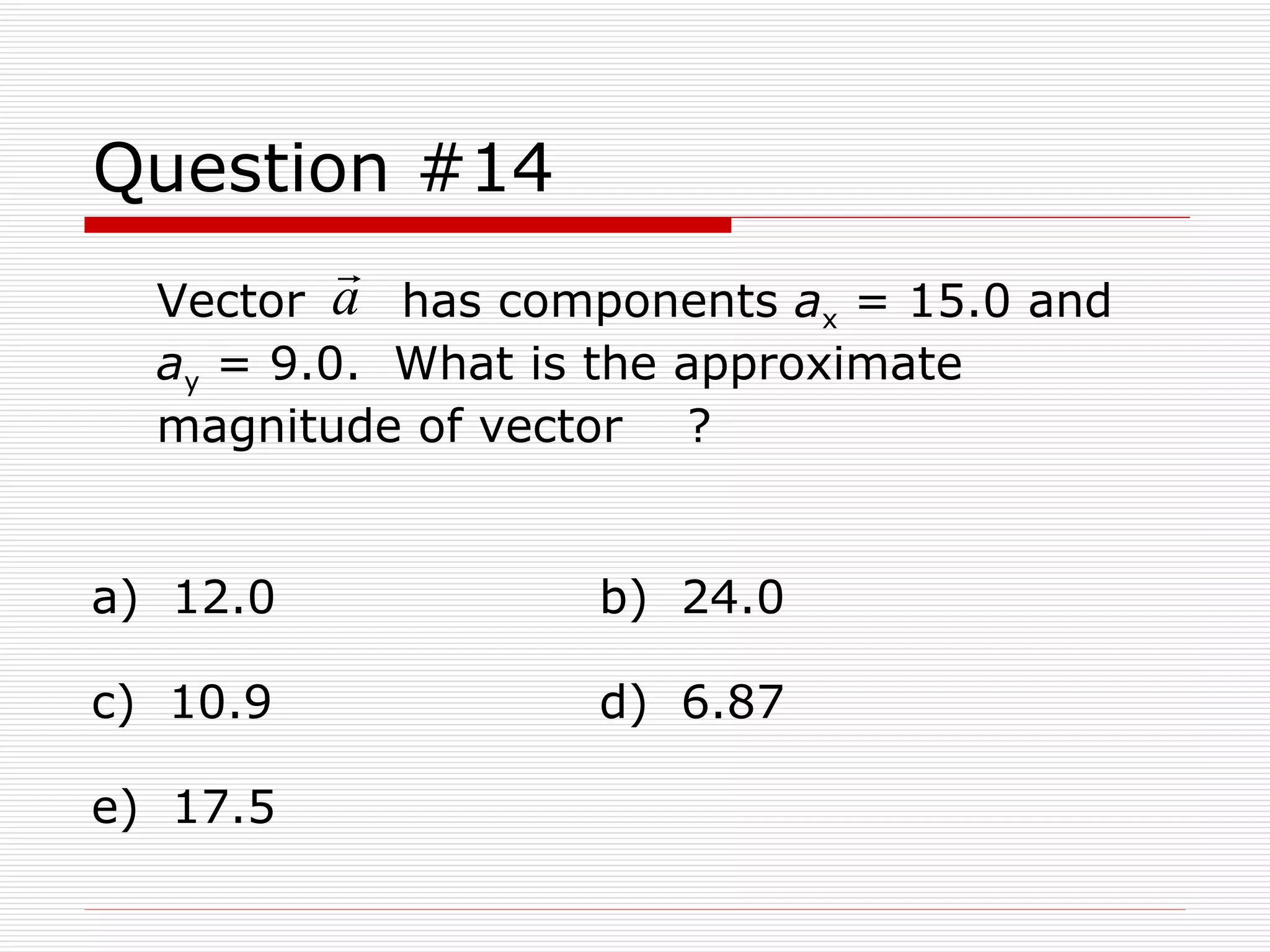
Question #14 Vector  has components  a x  = 15.0 and  a y  = 9.0.  What is the approximate magnitude of vector  ? a)  12.0  b)  24.0  c)  10.9  d)  6.87  e)  17.5
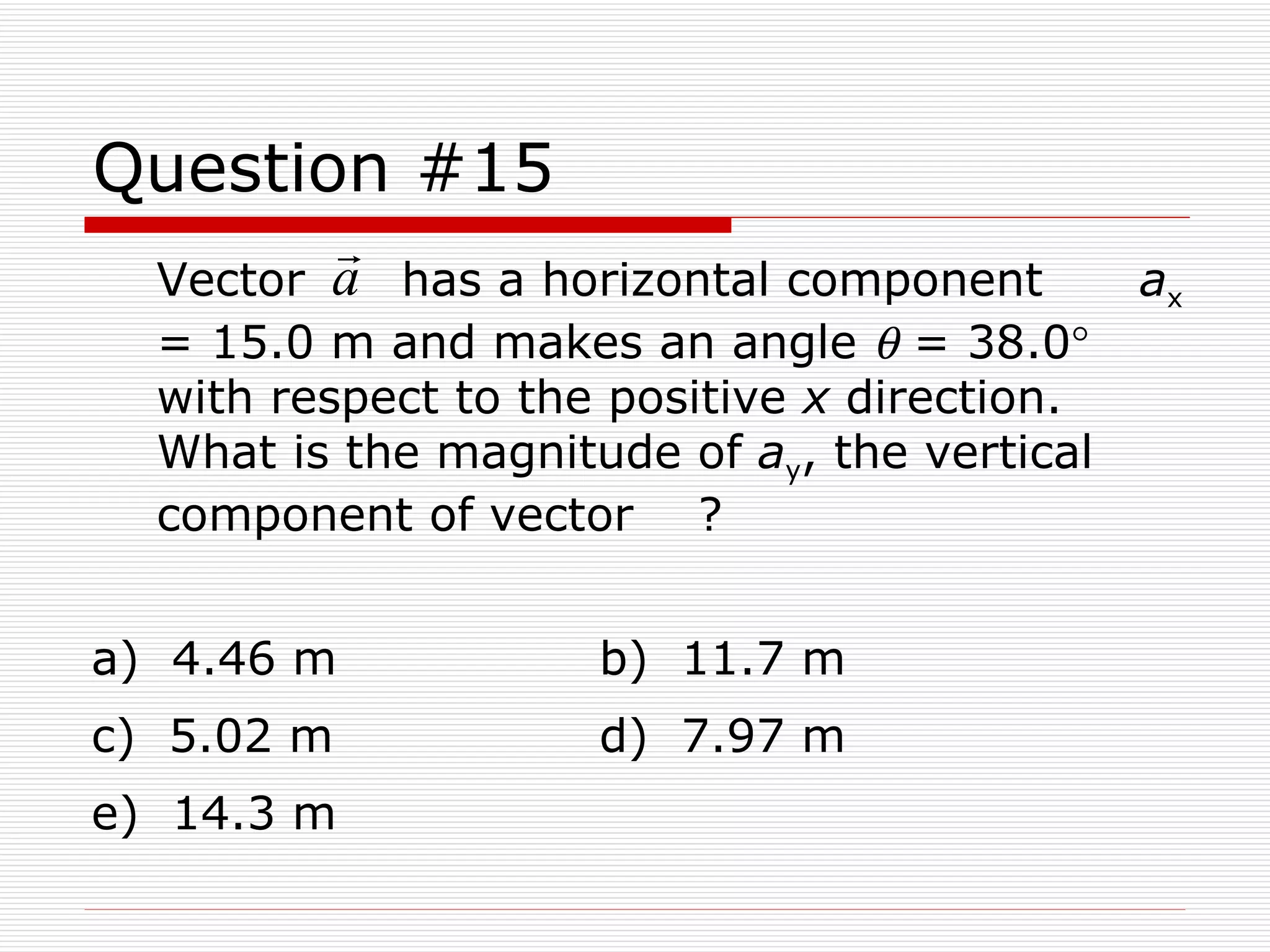
Question #15 Vector  has a horizontal component  a x  = 15.0 m and makes an angle    = 38.0   with respect to the positive  x  direction.  What is the magnitude of  a y , the vertical component of vector  ? a)  4.46 m b)  11.7 m c)  5.02 m d)  7.97 m e)  14.3 m
Chapter 1: Introduction and Mathematical Concepts Section 8  Addition of Vectors by Means of Components
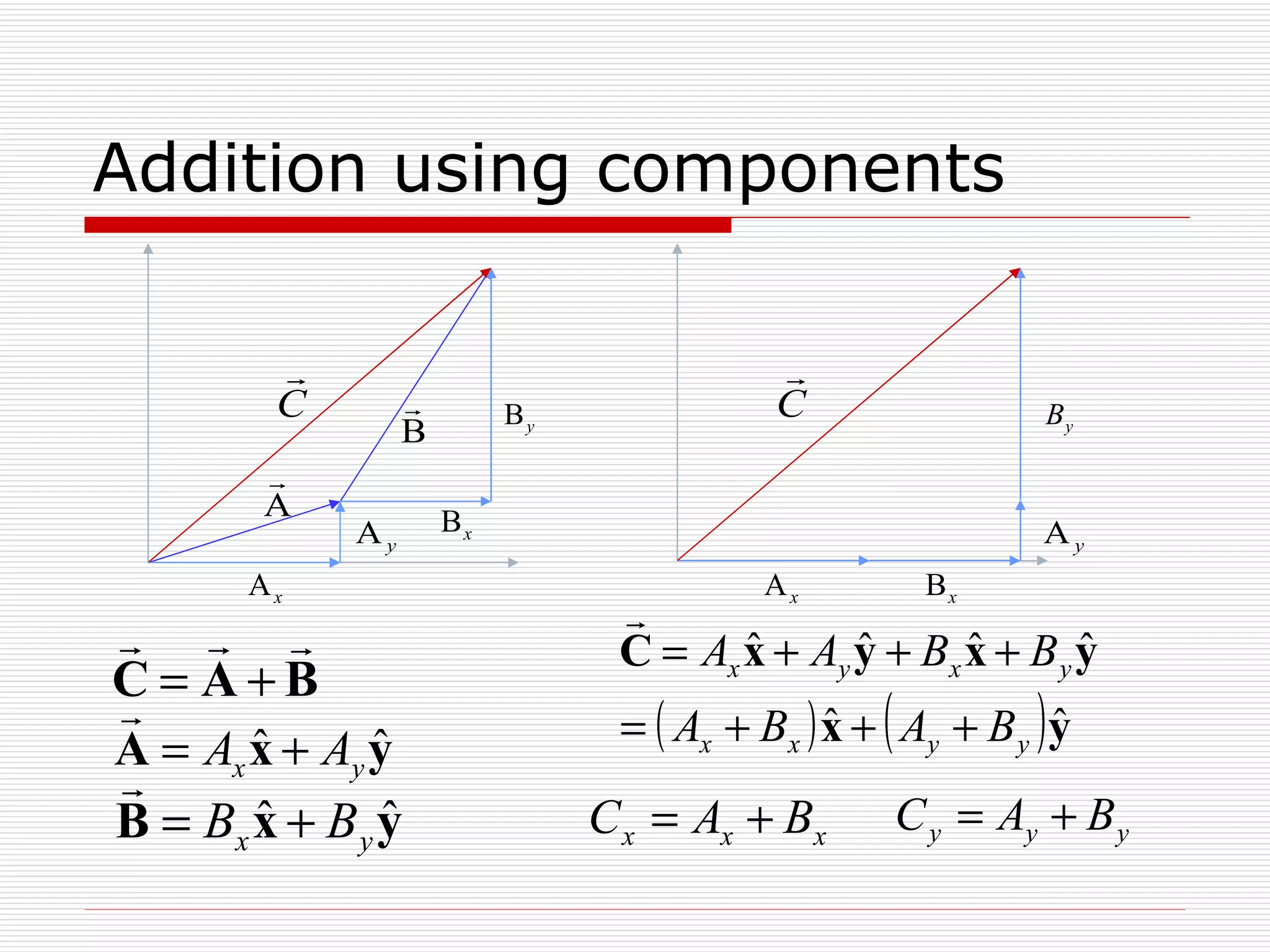
Addition using components
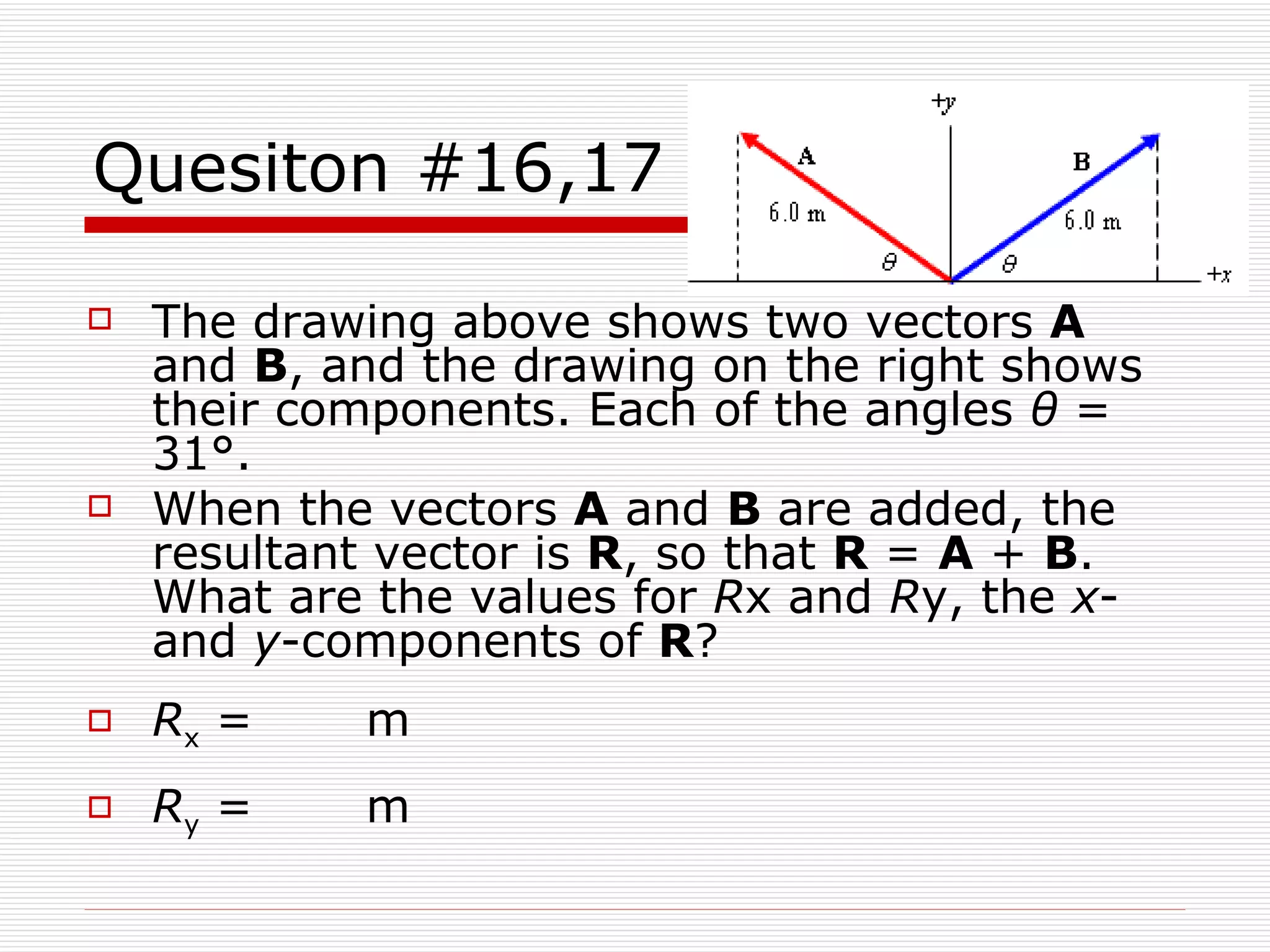
Quesiton #16,17 The drawing above shows two vectors  A  and  B , and the drawing on the right shows their components. Each of the angles  θ  = 31°.  When the vectors  A  and  B  are added, the resultant vector is  R , so that  R  =  A  +  B . What are the values for  R x and  R y, the  x - and  y -components of  R ? R x  =      m R y  =      m
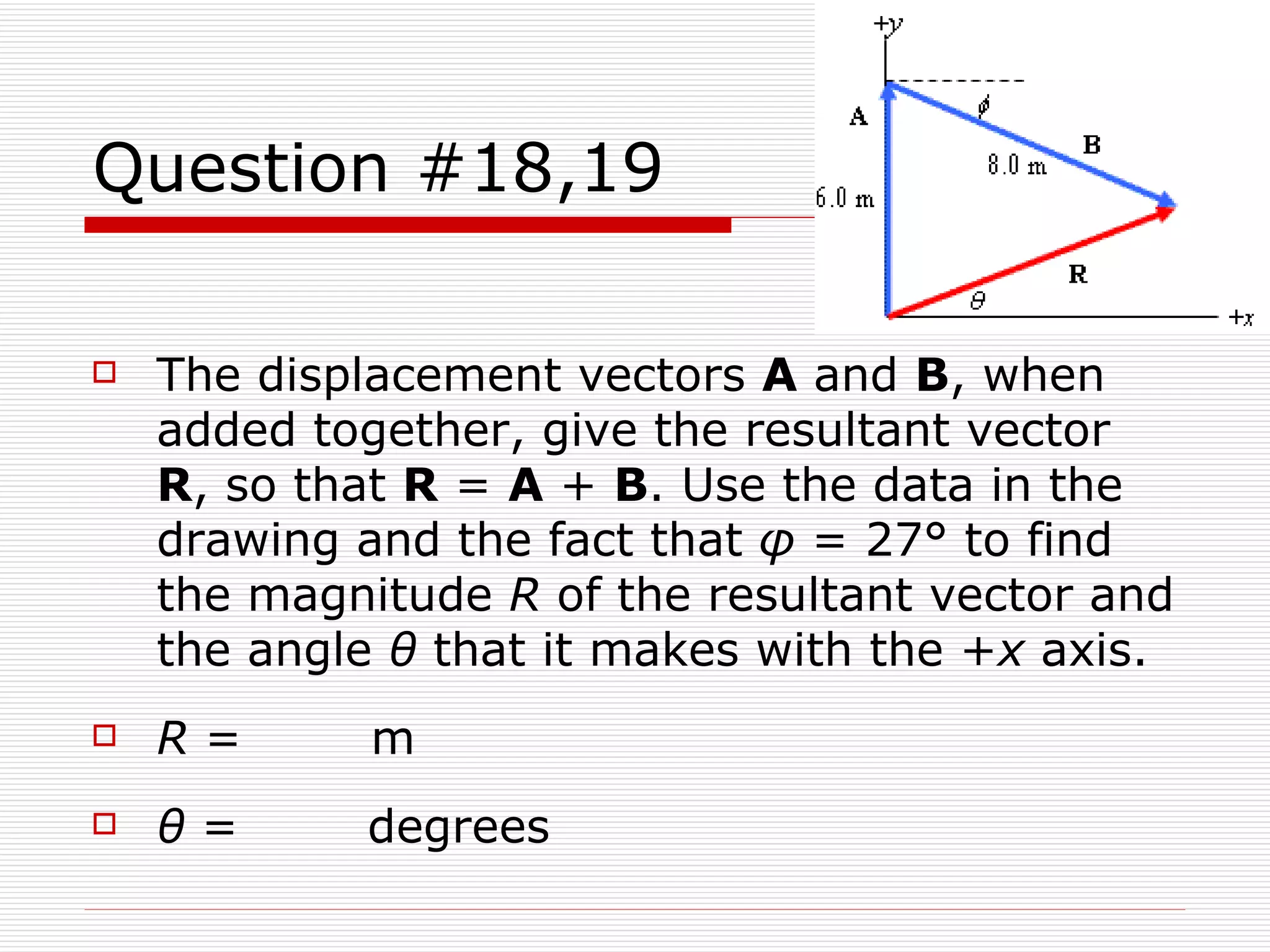
Question #18,19 The displacement vectors  A  and  B , when added together, give the resultant vector  R , so that  R  =  A  +  B . Use the data in the drawing and the fact that  φ  = 27° to find the magnitude  R  of the resultant vector and the angle  θ  that it makes with the + x  axis.  R  =      m θ  =      degrees
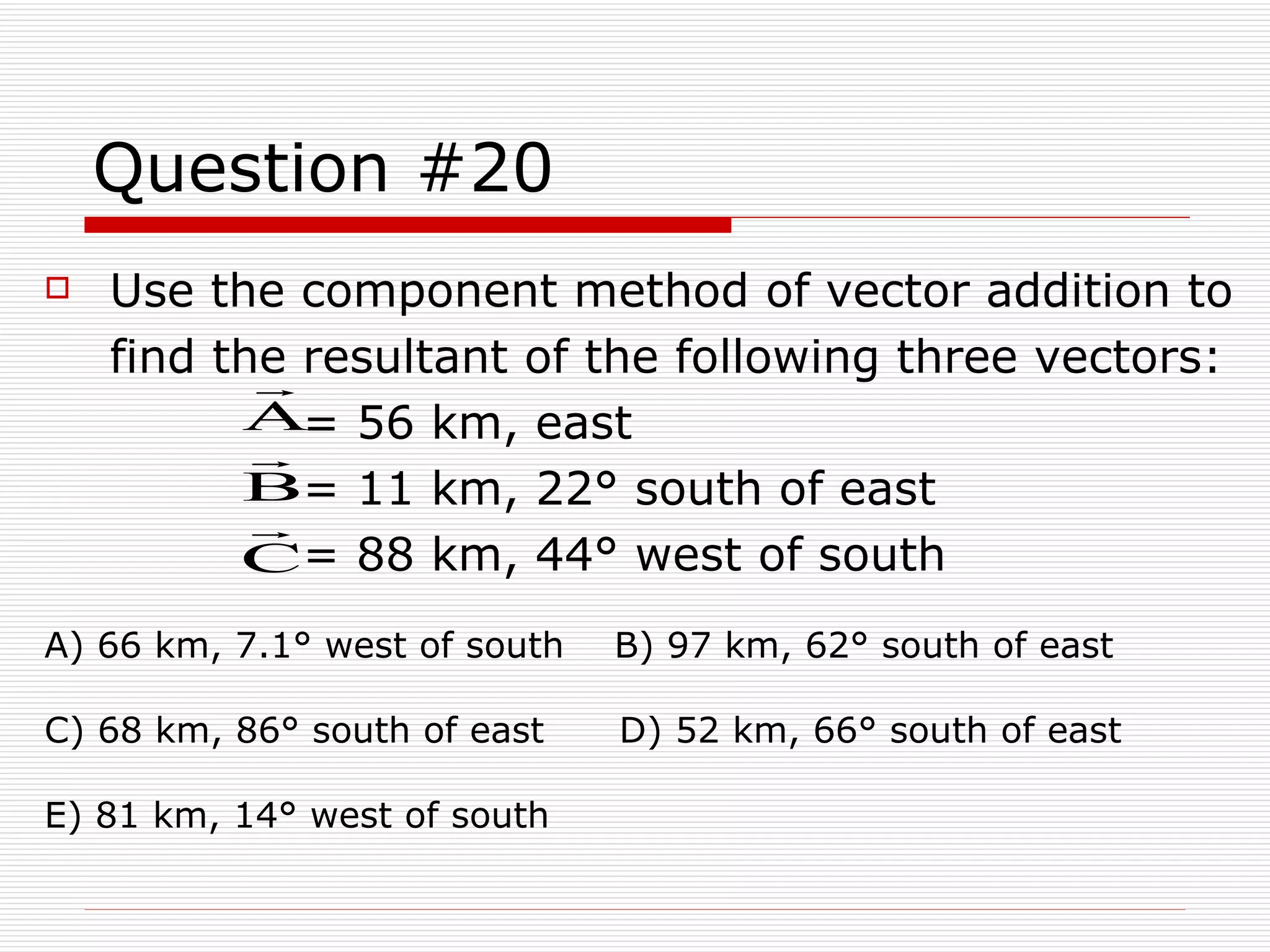
Question #20 Use the component method of vector addition to find the resultant of the following three vectors:             = 56 km, east             = 11 km, 22° south of east             = 88 km, 44° west of south A) 66 km, 7.1° west of south  B) 97 km, 62° south of east  C) 68 km, 86° south of east  D) 52 km, 66° south of east  E) 81 km, 14° west of south
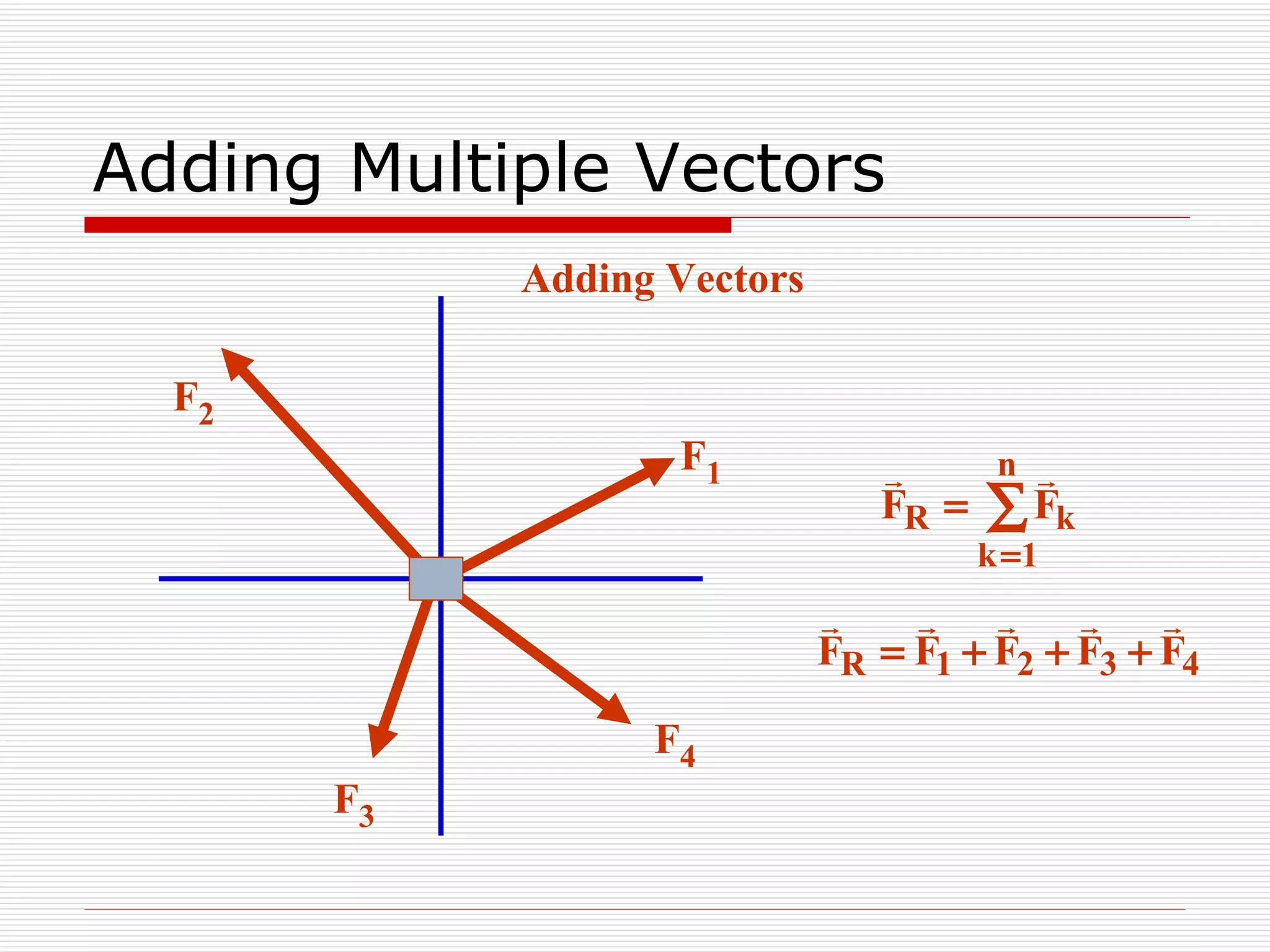
Adding Multiple Vectors Adding Vectors F 2 F 3 F 4 F 1
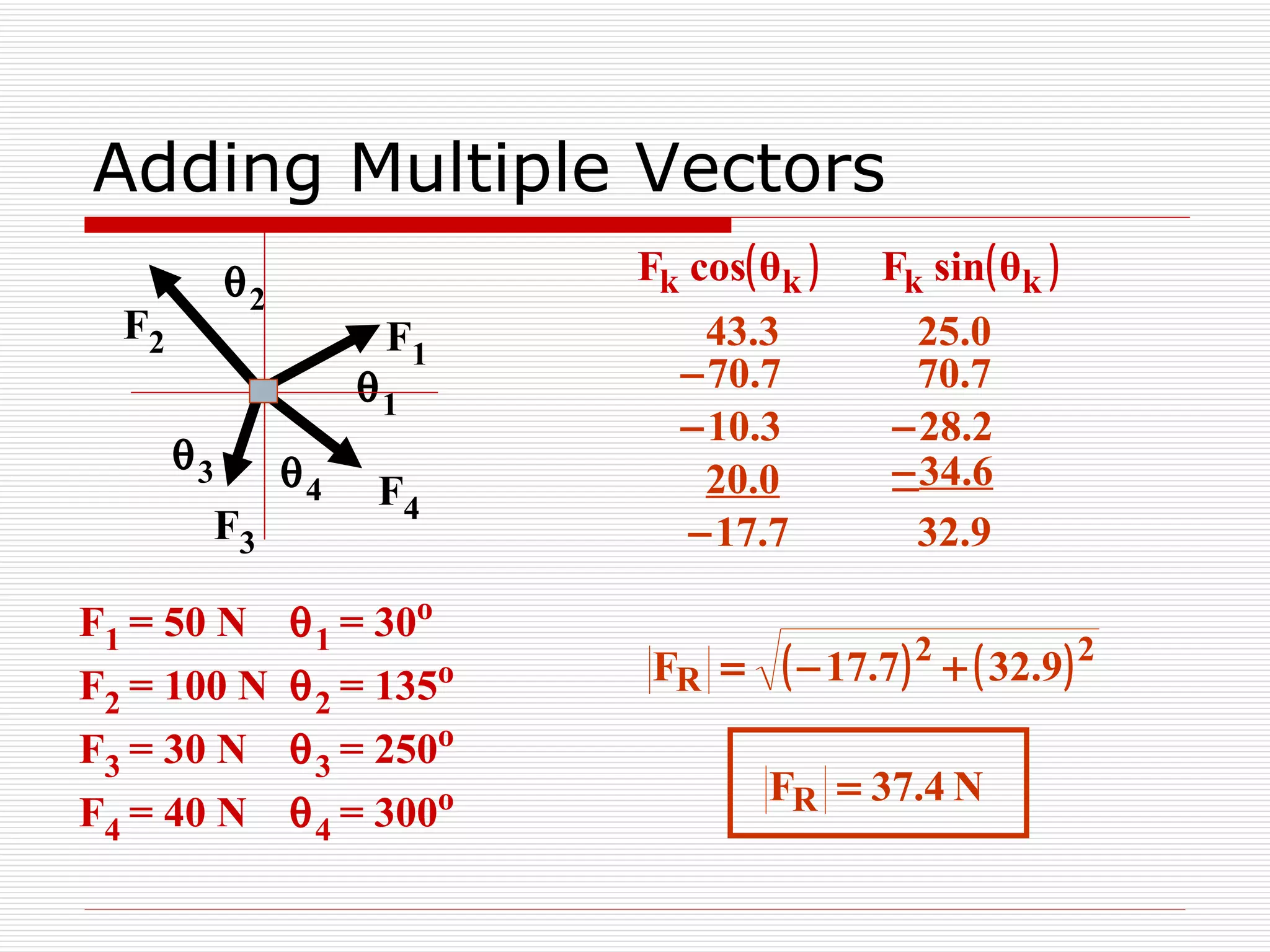
Adding Multiple Vectors F 1 F 2 F 3 F 4  1  2  3  4 F 1  = 50 N   1  = 30 o F 2  = 100 N   2  = 135 o F 3  = 30 N   3  = 250 o F 4  = 40 N   4  = 300 o 43.3 25.0  70.7 70.7  10.3  28.2 20.0  34.6  17.7 32.9
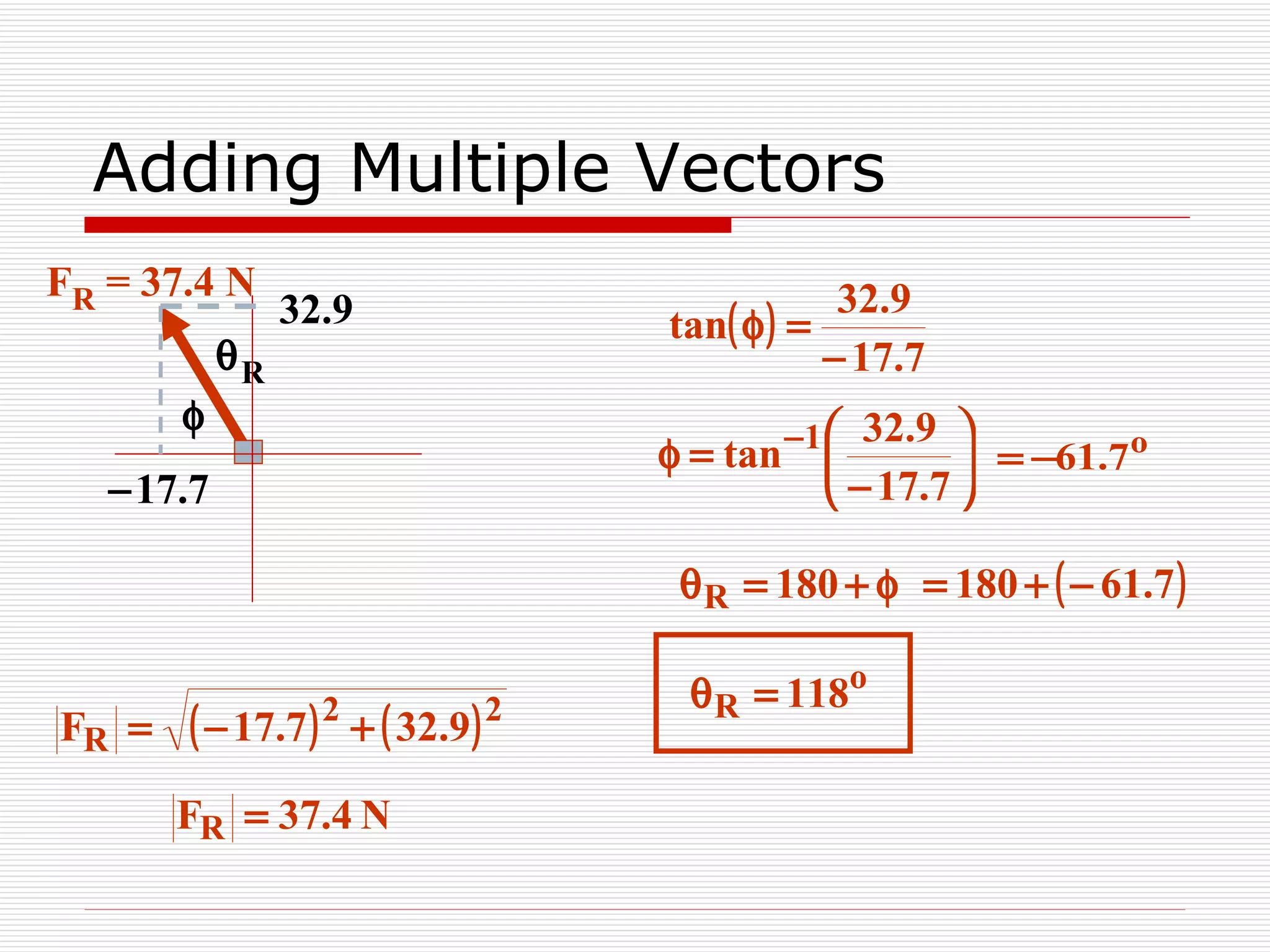
Adding Multiple Vectors F R  = 37.4 N  R   17.7 32.9
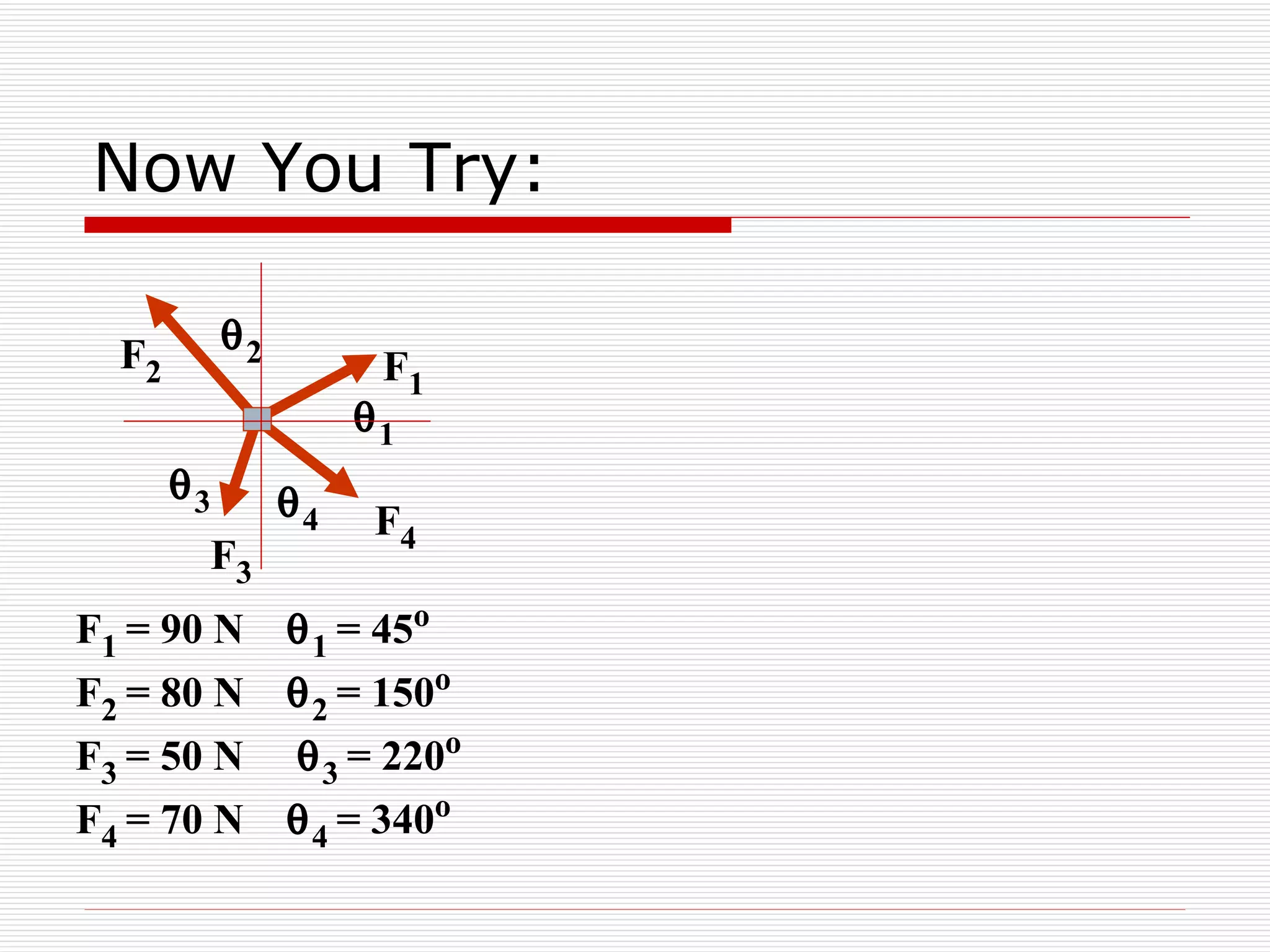
Now You Try: F 1 F 2 F 3 F 4  1  2  3  4 F 1  = 90 N   1  = 45 o F 2  = 80 N   2  = 150 o F 3  = 50 N   3  = 220 o F 4  = 70 N   4  = 340 o
Chapter 1: Introduction and Mathematical Concepts “ Section 9”  Additional Stuff You Should Know
Basic Rules Multiplication of 1 Multiplying a number by 1 doesn’t change it Addition Property of Equality Add the same thing to both sides Multiplication Property of Equality Multiply both sides of equation by same thing “ undo” function on both sides
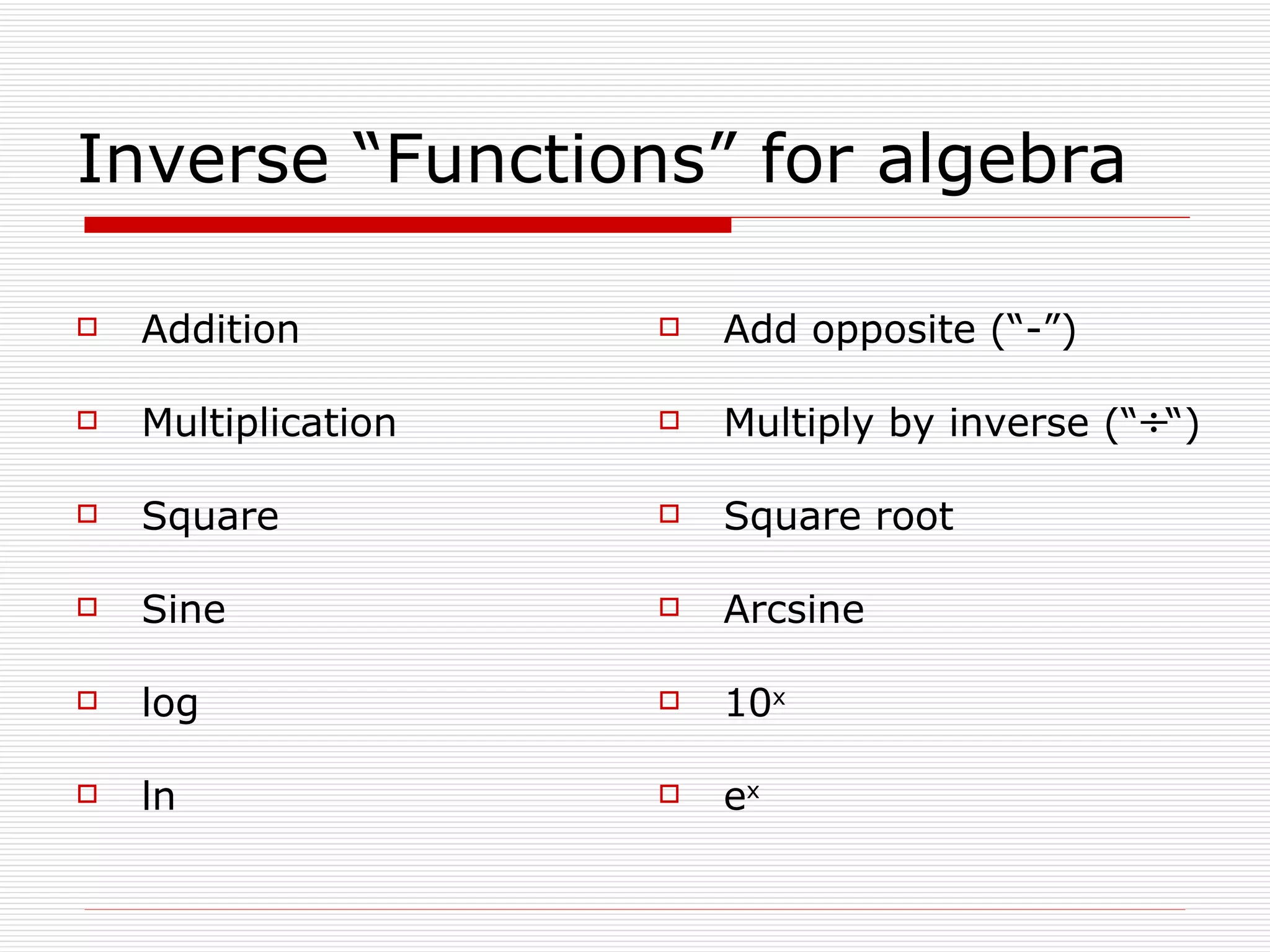
Inverse “Functions” for algebra Addition Multiplication Square Sine log ln Add opposite (“-”) Multiply by inverse Square root Arcsine 10 x e x (“  “)
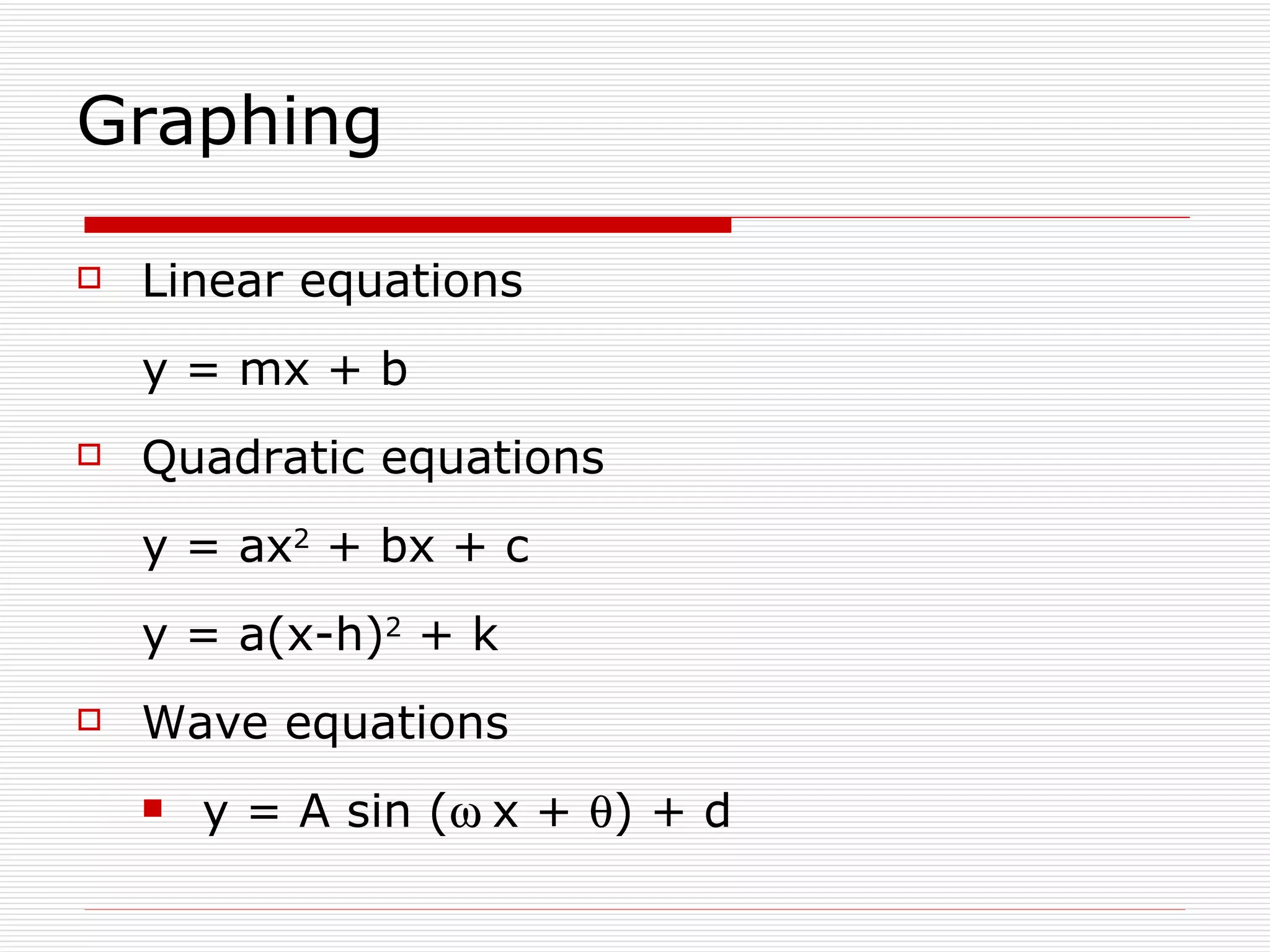
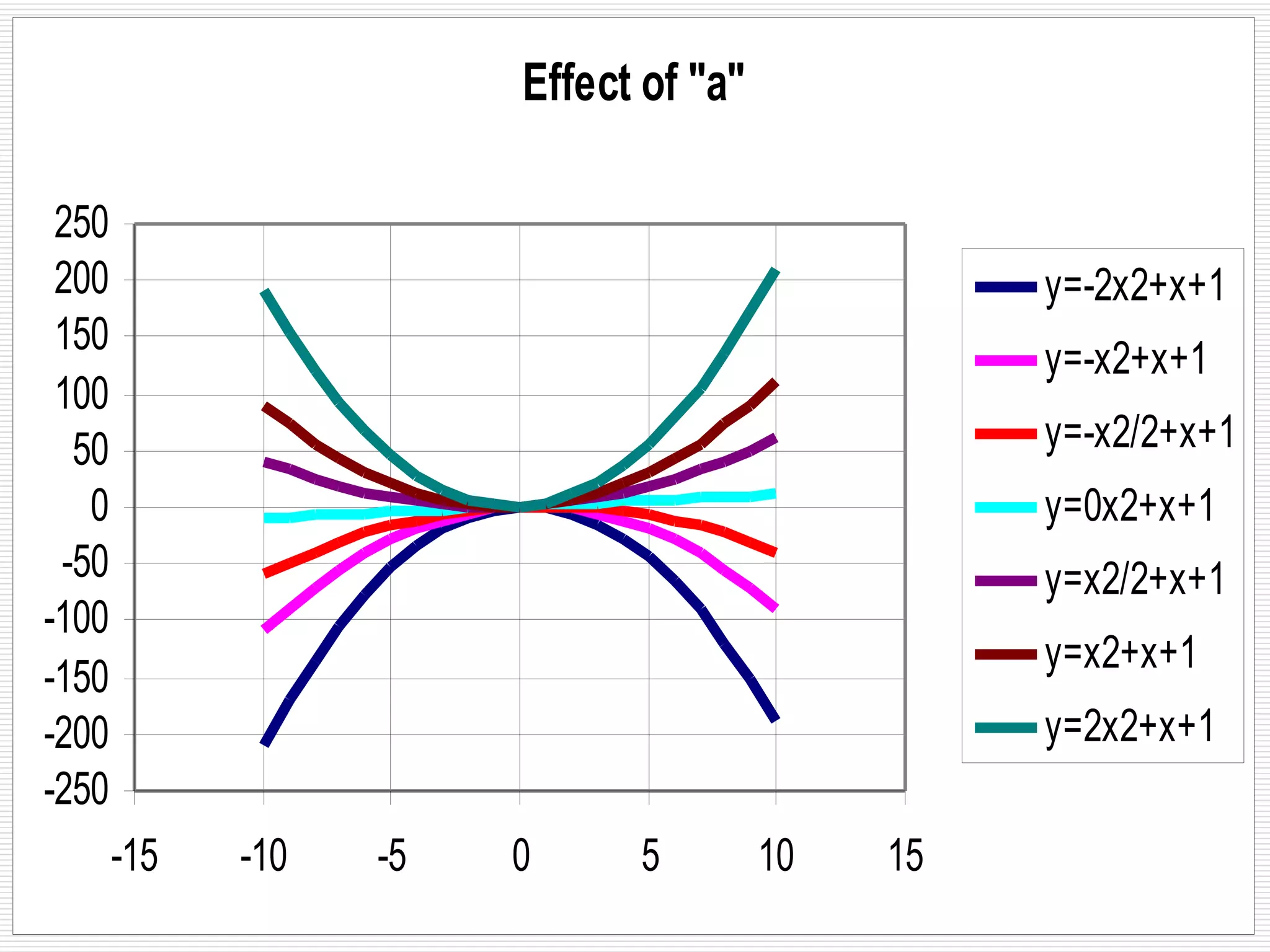
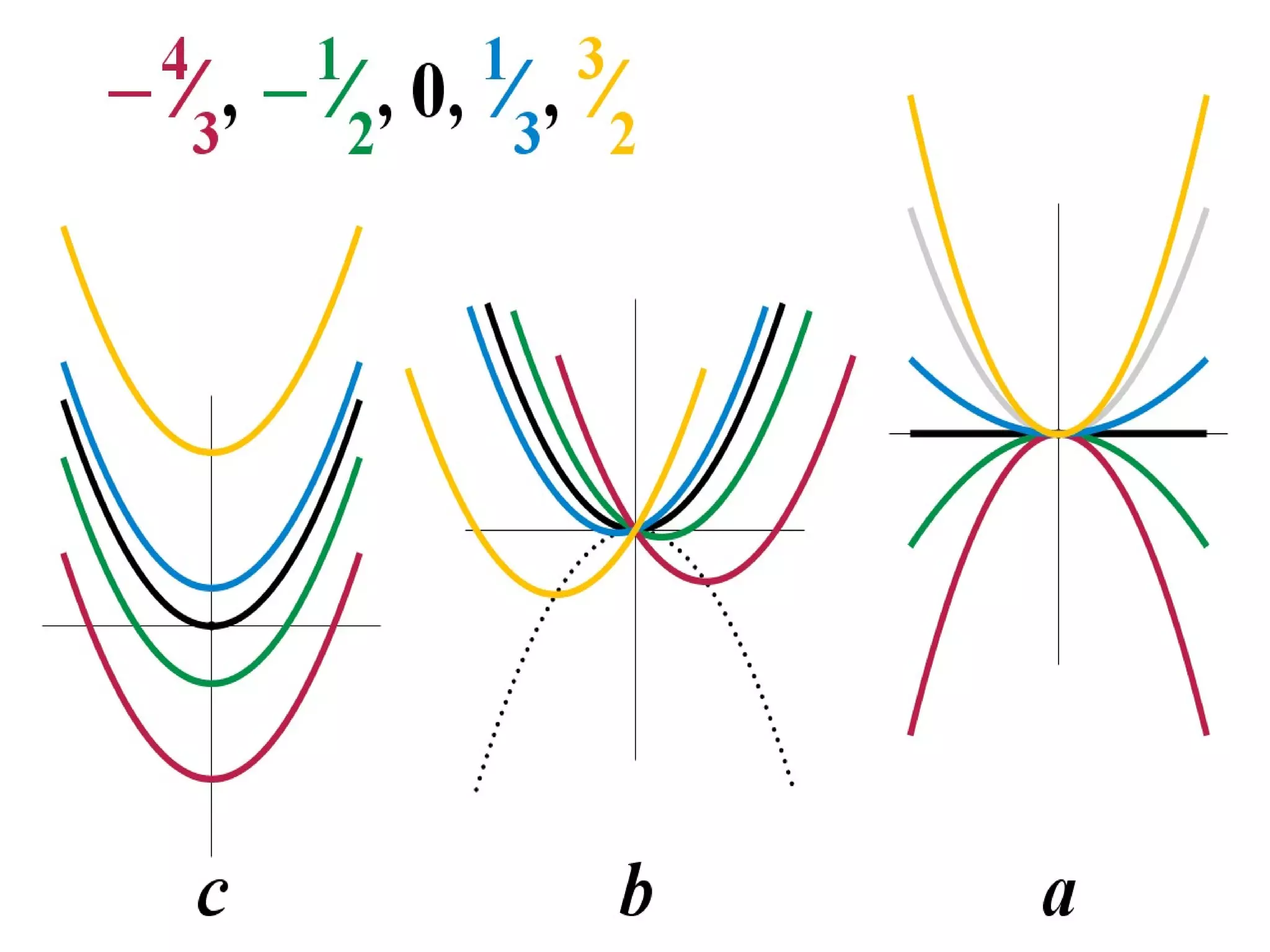
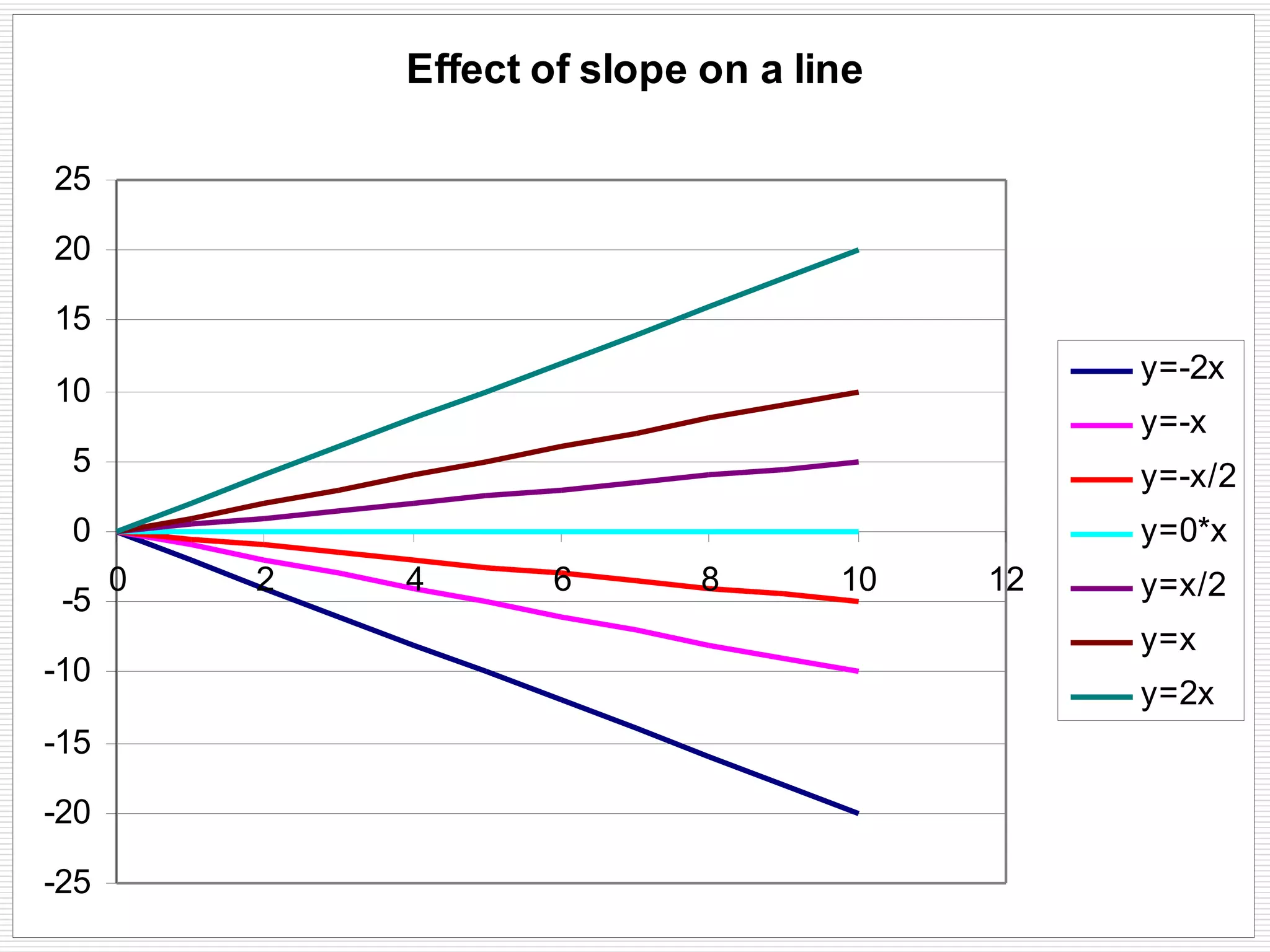
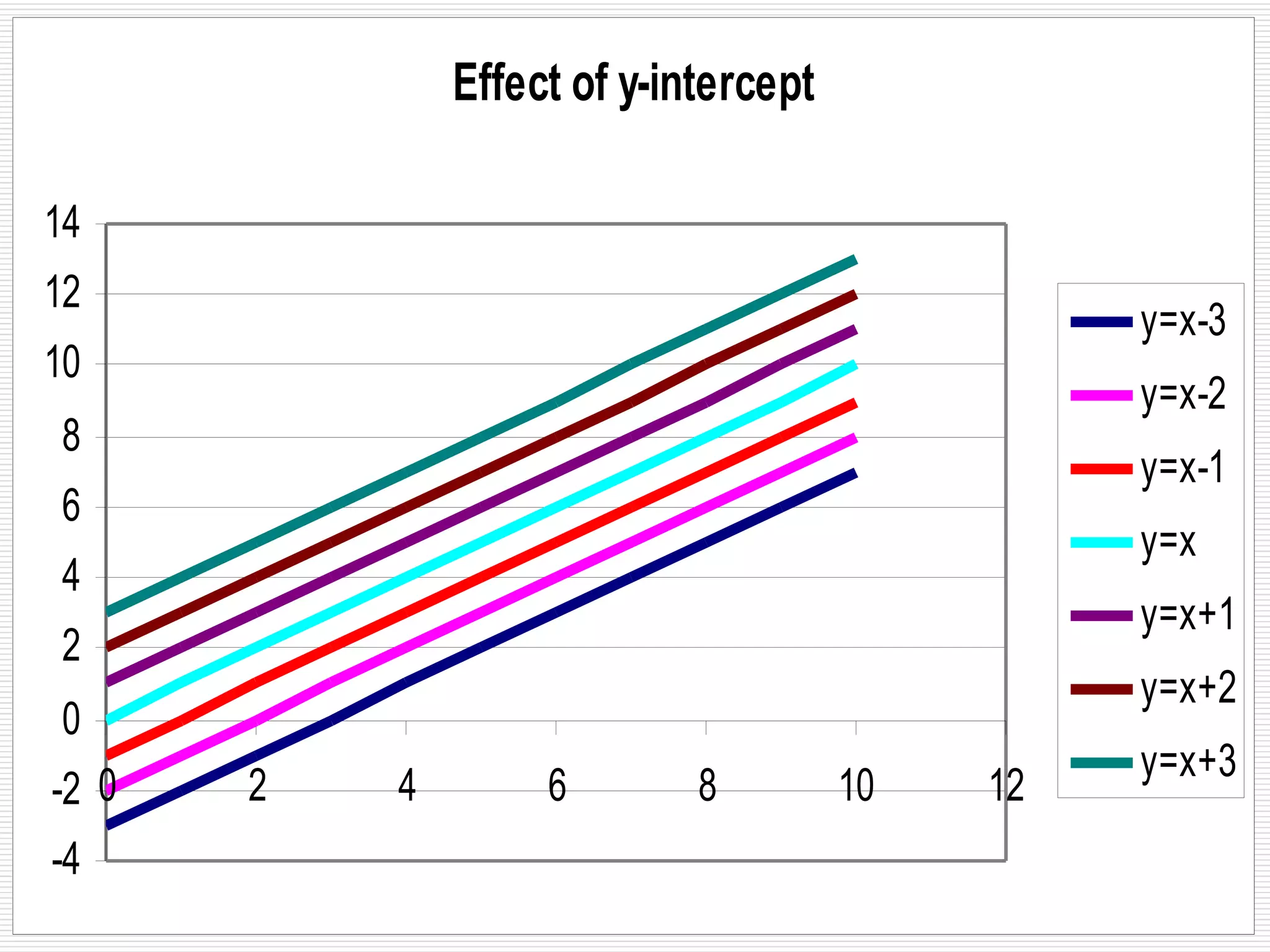
Graphing  Linear equations y = mx + b Quadratic equations y = ax 2  + bx + c y = a(x-h) 2  + k Wave equations y = A sin (  x +   ) + d


END

Ch 1: Introduction and Math Concepts

  • 1.
    Chapter 1 Introductionand Mathematical Concepts
  • 2.
    Table of ContentsThe Nature of Physics Units Role of Units in Problem Solving Trigonometry Scalars and Vectors Vector Addition and Subtraction Components of a Vector Addition of Vectors by Means of Components Other Stuff
  • 3.
    Chapter 1: Introductionand Mathematical Concepts Section 1 – The Nature of Physics
  • 4.
    What is Physics?The “Fundamental Science” Study of matter and how it moves through space-time Applications of concepts such as Energy, and Force The general analysis of the natural world “understand” and predict how our universe behaves
  • 5.
    Chapter 1: Introductionand Mathematical Concepts Section 2 - Units
  • 6.
    Units To “understand”nature, we must first study what it does Must have/use a universal way of describing what nature does Systems of measurement “British” (American) Metric SI
  • 7.
    Base Units Mostfundament forms of measurement Mass – kilogram (kg) Length – meter (m) Time – second (s) Count – mole (mol) Temperature – kelvin (K) Current – ampere (A) Luminous Intensity – candela (cd)
  • 8.
    SI Features DerivedUnits Common combinations of base units e.g.: area, force, pressure Prefixes Adjust scale of measurement Metric – powers of 10 SI – powers of 1000
  • 9.
    SI Prefixes 1024 yotta (Y) 10 21 zetta (Z) 10 18 exa (E) 10 15 peta (P) 10 12 tera (T) 10 9 giga (G) 10 6 mega (M) 10 3 kilo (k) 10 -3 milli (m) 10 -6 micro (µ) 10 -9 nano (n) 10 -12 pico (p) 10 -15 femto (f) 10 -18 atto (a) 10 -21 zepto (z) 10 -24 yocto (y)
  • 10.
    Chapter 1: Introductionand Mathematical Concepts Section 3 The Role of Units in Problem Solving
  • 11.
    Conversion of UnitsRemember from algebra… Multiplying by 1 does not change number If 1 m = 1000 mm, then 1 m/1000 mm = 1
  • 12.
    Question #1 Whenwe measure physical quantities, the units may be anything that is reasonable as long as they are well defined. It’s usually best to use the international standard units. Density may be defined as the mass of an object divided by its volume. Which of the following units would probably not be acceptable units of density? a)gallons/liter b)kilograms/m 3 c)pounds/ft 3 d)slugs/yd 3 e)grams/milliliter
  • 13.
    Question #2 Acar starts from rest on a circular track with a radius of 150 m. Relative to the starting position, what angle has the car swept out when it has traveled 150 m along the circular track? a) 1 radian b)  /2 radians c)  radians d) 3  /2 radians e) 2  radians
  • 14.
    Question #3 Asection of a river can be approximated as a rectangle that is 48 m wide and 172 m long. Express the area of this river in square kilometers. a) 8.26 × 10  3 km 2 b) 8.26 km 2 c) 8.26 × 10³ km 2 d) 3.58 km 2 e) 3.58 × 10  2 km 2
  • 15.
    Question #4 Ifone inch is equal to 2.54 cm, express 9.68 inches in meters. a) 0.262 m b) 0.0381 m c) 0.0508 m d) 0.114 m e) 0.246 m
  • 16.
    Dimensional Analysis Whenin doubt, look at the units Since units are part of the number, units must balance out for a valid equation By analyzing the units, you can determine if your solution is correct. If the units from your calculation do not give you the units you need, you have an error
  • 17.
    Example DIMENSIONAL ANALYSIS[L] = length [M] = mass [T] = time Is the following equation dimensionally correct?
  • 18.
    Question #5 Usingthe dimensions given for the variables in the table, determine which one of the following expressions is correct. a) b) c) d) e)
  • 19.
    Question #6 Giventhe following equation: y = c n at 2 , where n is an integer with no units, c is a number between zero and one with no units, the variable t has units of seconds and y is expressed in meters, determine which of the following statements is true. a) a has units of m/s and n =1. b) a has units of m/s and n =2. c) a has units of m/s 2 and n =1. d) a has units of m/s 2 and n =2. e) a has units of m/s 2 , but value of n cannot be determined through dimensional analysis.
  • 20.
    Question #7 Approximatelyhow many seconds are there in a century? a) 86,400 s b) 5.0 × 10 6 s c) 3.3 × 10 18 s d) 3.2 × 10 9 s e) 8.6 × 10 4 s
  • 21.
    Chapter 1: Introductionand Mathematical Concepts Section 4 - Trigonometry
  • 22.
    Basics you shouldremember…
  • 23.
    Basics you shouldremember…
  • 24.
    Question #8 Determinethe angle  in the right triangle shown. a) 54.5  b) 62.0  c) 35.5  d) 28.0  e) 41.3 
  • 25.
    Question #9 Determinethe length of the side of the right triangle labeled x . a) 2.22 m b) 1.73 m c) 1.80 m d) 2.14 m e) 1.95 m
  • 26.
    Question #10 Determinethe length of the side of the right triangle labeled x . a) 0.79 km b) 0.93 km c) 1.51 km d) 1.77 km e) 2.83 km
  • 27.
    Chapter 1: Introductionand Mathematical Concepts Section 5 – Scalar & Vectors
  • 28.
    Scalar & VectorA scalar quantity is one that can be described by a single number: temperature, speed, mass A vector quantity deals inherently with both magnitude and direction: velocity, force, displacement
  • 29.
    More on VectorsArrows are used to represent vectors. The direction of the arrow gives the direction of the vector. By convention, the length of a vector arrow is proportional to the magnitude of the vector. 8 lb 4 lb
  • 30.
    Question #11 Whichone of the following statements is true concerning scalar quantities? a) Scalar quantities must be represented by base units. b) Scalar quantities have both magnitude and direction. c) Scalar quantities can be added to vector quantities using rules of trigonometry. d) Scalar quantities can be added to other scalar quantities using rules of trigonometry. e) Scalar quantities can be added to other scalar quantities using rules of ordinary addition.
  • 31.
    Chapter 1: Introductionand Mathematical Concepts Section 6 Vector Addition and Subtraction
  • 32.
    Graphical Addition ofvectors Remember length of arrow is proportional to magnitude Angle of arrow proportional to direction Place tail of 2 nd vector at tip of 1 st Resultant starts at 1 st and ends at 2 nd 
  • 33.
    Graphical Subtraction ofVectors Same as addition, multiply value by (-1) Resultant is still tail to tip 
  • 34.
    Question #12 Whichexpression is false concerning the vectors shown in the sketch? a) b) c) d) C < A + B e) A 2 + B 2 = C 2
  • 35.
    Chapter 1: Introductionand Mathematical Concepts Section 7 Components of a Vector
  • 36.
  • 37.
    Scalar Components Itis often easier to work with the scalar components rather than the vector components. In math, they are called i and j
  • 38.
    Example Problem Adisplacement vector has a magnitude of 175 m and points at an angle of 50.0 degrees relative to the x axis. Find the x and y components of this vector.
  • 39.
    Question #13 Duringthe execution of a play, a football player carries the ball for a distance of 33 m in the direction 76° north of east. To determine the number of meters gained on the play, find the northward component of the ball’s displacement. a) 8.0 m b) 16 m c) 24 m d) 28 m e) 32 m
  • 40.
    Question #14 Vector has components a x = 15.0 and a y = 9.0. What is the approximate magnitude of vector ? a) 12.0 b) 24.0 c) 10.9 d) 6.87 e) 17.5
  • 41.
    Question #15 Vector has a horizontal component a x = 15.0 m and makes an angle  = 38.0  with respect to the positive x direction. What is the magnitude of a y , the vertical component of vector ? a) 4.46 m b) 11.7 m c) 5.02 m d) 7.97 m e) 14.3 m
  • 42.
    Chapter 1: Introductionand Mathematical Concepts Section 8 Addition of Vectors by Means of Components
  • 43.
  • 44.
    Quesiton #16,17 Thedrawing above shows two vectors A and B , and the drawing on the right shows their components. Each of the angles θ = 31°. When the vectors A and B are added, the resultant vector is R , so that R = A + B . What are the values for R x and R y, the x - and y -components of R ? R x =     m R y =     m
  • 45.
    Question #18,19 Thedisplacement vectors A and B , when added together, give the resultant vector R , so that R = A + B . Use the data in the drawing and the fact that φ = 27° to find the magnitude R of the resultant vector and the angle θ that it makes with the + x axis. R =     m θ =     degrees
  • 46.
    Question #20 Usethe component method of vector addition to find the resultant of the following three vectors:            = 56 km, east            = 11 km, 22° south of east            = 88 km, 44° west of south A) 66 km, 7.1° west of south B) 97 km, 62° south of east C) 68 km, 86° south of east D) 52 km, 66° south of east E) 81 km, 14° west of south
  • 47.
    Adding Multiple VectorsAdding Vectors F 2 F 3 F 4 F 1
  • 48.
    Adding Multiple VectorsF 1 F 2 F 3 F 4  1  2  3  4 F 1 = 50 N  1 = 30 o F 2 = 100 N  2 = 135 o F 3 = 30 N  3 = 250 o F 4 = 40 N  4 = 300 o 43.3 25.0  70.7 70.7  10.3  28.2 20.0  34.6  17.7 32.9
  • 49.
    Adding Multiple VectorsF R = 37.4 N  R   17.7 32.9
  • 50.
    Now You Try:F 1 F 2 F 3 F 4  1  2  3  4 F 1 = 90 N  1 = 45 o F 2 = 80 N  2 = 150 o F 3 = 50 N  3 = 220 o F 4 = 70 N  4 = 340 o
  • 51.
    Chapter 1: Introductionand Mathematical Concepts “ Section 9” Additional Stuff You Should Know
  • 52.
    Basic Rules Multiplicationof 1 Multiplying a number by 1 doesn’t change it Addition Property of Equality Add the same thing to both sides Multiplication Property of Equality Multiply both sides of equation by same thing “ undo” function on both sides
  • 53.
    Inverse “Functions” foralgebra Addition Multiplication Square Sine log ln Add opposite (“-”) Multiply by inverse Square root Arcsine 10 x e x (“ “)
  • 54.
    Graphing Linearequations y = mx + b Quadratic equations y = ax 2 + bx + c y = a(x-h) 2 + k Wave equations y = A sin (  x +  ) + d
  • 55.
  • 56.
  • 57.
  • 58.
  • 59.