Carbon FootprintingJohn Buckley Managing Director Carbon Footprint Ltd
Things to cover What is all this Carbon stuff?What are we (as a planet) doing about it?UK legislation Your business opportunities & benefitsYour carbon footprintReducing your impact (and costs)Workshop 	“How to calculate your businesses carbon footprint”
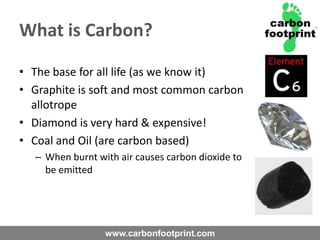
What is Carbon?The base for all life (as we know it)Graphite is soft and most common carbon allotropeDiamond is very hard & expensive!Coal and Oil (are carbon based)When burnt with air causes carbon dioxide to be emitted
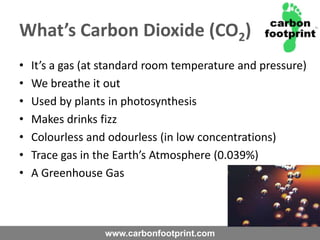
What’s Carbon Dioxide (CO2)It’s a gas (at standard room temperature and pressure)We breathe it outUsed by plants in photosynthesisMakes drinks fizzColourless and odourless (in low concentrations)Trace gas in the Earth’s Atmosphere (0.039%)A Greenhouse Gas
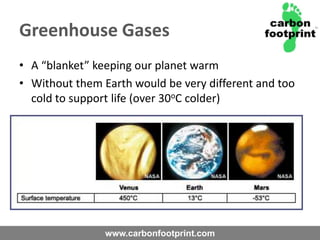
Greenhouse GasesA “blanket” keeping our planet warmWithout them Earth would be very different and too cold to support life (over 30oC colder)
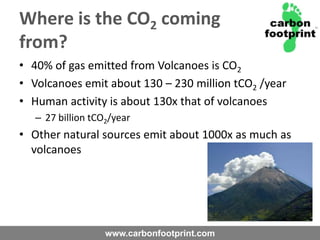
Where is the CO2 coming from?40% of gas emitted from Volcanoes is CO2Volcanoes emit about 130 – 230 million tCO2 /yearHuman activity is about 130x that of volcanoes27 billion tCO2/yearOther natural sources emit about 1000x as much as volcanoes
Worldwide legislationUnited Nations Framework Convention on Climate Change“UNFCCC” or “The Convention”.
The first international law to address climate change
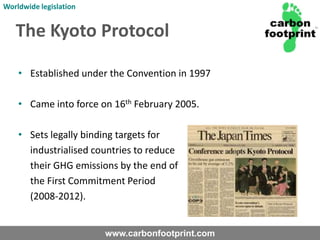
Agreed in 1992 at the Earth Summit in Rio de Janeiro.Worldwide legislationThe Kyoto ProtocolEstablished under the Convention in 1997Came into force on 16th February 2005.Sets legally binding targets for 	industrialised countries to reduce	their GHG emissions by the end of 	the First Commitment Period 	(2008-2012).
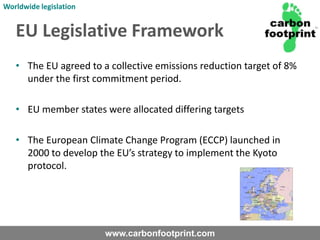
Worldwide legislationEU Legislative FrameworkThe EU agreed to a collective emissions reduction target of 8% under the first commitment period.EU member states were allocated differing targetsThe European Climate Change Program (ECCP) launched in 2000 to develop the EU’s strategy to implement the Kyoto protocol.
UK LegislationThe Climate Change ActThe Climate Change Act received Royal Assent on 26 November 2008.
The first country to legislate a legally binding reduction target of 80% on net 1990 green house gas emission levels by 2050 and by at least 26% by 2020.It includes:5-yearly budget periods.
Committee on climate change.
Powers for Implementation of new emission trading schemes.Regular reporting. UK LegislationThe Carbon Reduction Commitment Energy Efficiency SchemeWhat is it?A UK mandatory cap and trade schemeAiming to cut CO2 emissions by 1.2million tonnes of carbon per year by 2020Does it impact your organisation?Full participant - Organisations with half hourly meter (HHM) readings totalling >6000 MWh a yearRegister and report Meter readings if >3000MWh/year<3000MWh then still need to disclose that you have HHMsWhen?Qualification year was Jan-Dec 2008 electricity use only3 year introductory period starts in April 2010Registration period started in April and runs to Sept
UK legislationBusiness ImplicationsWhat will be required?Annual reporting of emissions
Purchasing of allowances at £12 per tonne
Reducing emissions
Developing an environmental management systemWill there be any benefits (or risks) to businesses?Reputational league table will be published
Recycling Payments- rewards (and penalties)What should you being doing now?Consider the early action metrics – automatic metering & Carbon Trust Standard.
Reduce company emissions
Early Preparation- Make the mistakes now without financial non compliance penalties
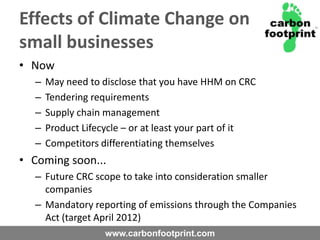
Start saving money on energy bills now!Effects of Climate Change on small businessesNowMay need to disclose that you have HHM on CRCTendering requirementsSupply chain managementProduct Lifecycle – or at least your part of itCompetitors differentiating themselvesComing soon... Future CRC scope to take into consideration smaller companiesMandatory reporting of emissions through the Companies Act (target April 2012)
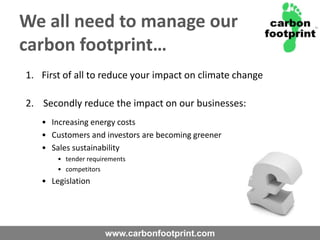
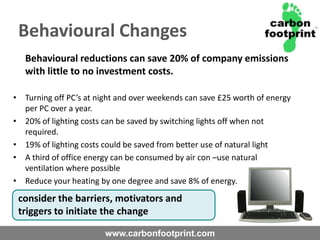
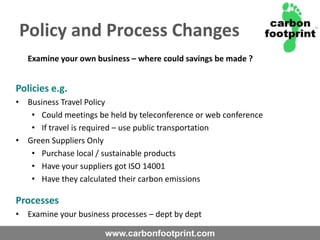
We all need to manage our carbon footprint…First of all to reduce your impact on climate change2.    Secondly reduce the impact on our businesses:Increasing energy costs
Customers and investors are becoming greener
Sales sustainability
tender requirements
competitors

"Carbon Footprinting" by John Buckley, Carbon Footprint Ltd

  • 1.
    Carbon FootprintingJohn BuckleyManaging Director Carbon Footprint Ltd
  • 2.
    Things to coverWhat is all this Carbon stuff?What are we (as a planet) doing about it?UK legislation Your business opportunities & benefitsYour carbon footprintReducing your impact (and costs)Workshop “How to calculate your businesses carbon footprint”
  • 3.
    What is Carbon?Thebase for all life (as we know it)Graphite is soft and most common carbon allotropeDiamond is very hard & expensive!Coal and Oil (are carbon based)When burnt with air causes carbon dioxide to be emitted
  • 4.
    What’s Carbon Dioxide(CO2)It’s a gas (at standard room temperature and pressure)We breathe it outUsed by plants in photosynthesisMakes drinks fizzColourless and odourless (in low concentrations)Trace gas in the Earth’s Atmosphere (0.039%)A Greenhouse Gas
  • 5.
    Greenhouse GasesA “blanket”keeping our planet warmWithout them Earth would be very different and too cold to support life (over 30oC colder)
  • 6.
    Where is theCO2 coming from?40% of gas emitted from Volcanoes is CO2Volcanoes emit about 130 – 230 million tCO2 /yearHuman activity is about 130x that of volcanoes27 billion tCO2/yearOther natural sources emit about 1000x as much as volcanoes
  • 7.
    Worldwide legislationUnited NationsFramework Convention on Climate Change“UNFCCC” or “The Convention”.
  • 8.
    The first internationallaw to address climate change
  • 9.
    Agreed in 1992at the Earth Summit in Rio de Janeiro.Worldwide legislationThe Kyoto ProtocolEstablished under the Convention in 1997Came into force on 16th February 2005.Sets legally binding targets for industrialised countries to reduce their GHG emissions by the end of the First Commitment Period (2008-2012).
  • 10.
    Worldwide legislationEU LegislativeFrameworkThe EU agreed to a collective emissions reduction target of 8% under the first commitment period.EU member states were allocated differing targetsThe European Climate Change Program (ECCP) launched in 2000 to develop the EU’s strategy to implement the Kyoto protocol.
  • 11.
    UK LegislationThe ClimateChange ActThe Climate Change Act received Royal Assent on 26 November 2008.
  • 12.
    The first countryto legislate a legally binding reduction target of 80% on net 1990 green house gas emission levels by 2050 and by at least 26% by 2020.It includes:5-yearly budget periods.
  • 13.
  • 14.
    Powers for Implementationof new emission trading schemes.Regular reporting. UK LegislationThe Carbon Reduction Commitment Energy Efficiency SchemeWhat is it?A UK mandatory cap and trade schemeAiming to cut CO2 emissions by 1.2million tonnes of carbon per year by 2020Does it impact your organisation?Full participant - Organisations with half hourly meter (HHM) readings totalling >6000 MWh a yearRegister and report Meter readings if >3000MWh/year<3000MWh then still need to disclose that you have HHMsWhen?Qualification year was Jan-Dec 2008 electricity use only3 year introductory period starts in April 2010Registration period started in April and runs to Sept
  • 15.
    UK legislationBusiness ImplicationsWhatwill be required?Annual reporting of emissions
  • 16.
    Purchasing of allowancesat £12 per tonne
  • 17.
  • 18.
    Developing an environmentalmanagement systemWill there be any benefits (or risks) to businesses?Reputational league table will be published
  • 19.
    Recycling Payments- rewards(and penalties)What should you being doing now?Consider the early action metrics – automatic metering & Carbon Trust Standard.
  • 20.
  • 21.
    Early Preparation- Makethe mistakes now without financial non compliance penalties
  • 22.
    Start saving moneyon energy bills now!Effects of Climate Change on small businessesNowMay need to disclose that you have HHM on CRCTendering requirementsSupply chain managementProduct Lifecycle – or at least your part of itCompetitors differentiating themselvesComing soon... Future CRC scope to take into consideration smaller companiesMandatory reporting of emissions through the Companies Act (target April 2012)
  • 23.
    We all needto manage our carbon footprint…First of all to reduce your impact on climate change2. Secondly reduce the impact on our businesses:Increasing energy costs
  • 24.
    Customers and investorsare becoming greener
  • 25.
  • 26.
  • 27.

Editor's Notes

  • #17 A carbon footprint is a measure of the impact our activities have on the environment in terms of the amount of green house gases produced, measured in units of carbon dioxide equivalents (CO2e).
  • #24 Hold a competition for ideasGeneral training Switch off schemeClimate Change EventInternal competitions Energy Champion drop in sessions / walk arounds
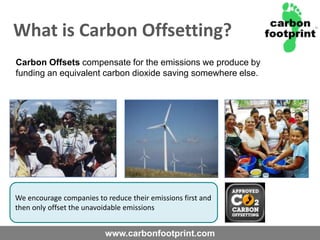
  • #25 Verification This ensures the claimed emissions reduction by the project has been achieved. Verification should be by an accredited independent third party according to an established standard or protocol.Additionality Emission reduction must be in addition to what would have happened if the project was not carried out.Leakage This is an increase or decrease in CO2 emissions beyond the project boundary. Every attempt should be made to decrease it, however if not stopped it is important to subtract this from the overall assessment.Impermanence Only considered of real value if the sequestered emissions remain sequestered and there is avoidance of any potential reversibilityDouble Counting Prevented by use of a registry where credits are accounted for and retired. No credits ought to be sold twice to a final customer, they must be permanently retired.