Carbon Footprint
Group: Sedulous
Md. Belal Hossain
ID: 156
What is Carbon Footprint ?
• Carbon footprint is a horribly abused phrase, so it’s worth spelling out exactly what
it means.
• The term carbon footprint, therefore, is a shorthand to describe the best
estimate that we can get of the full climate change impact of something.
Main Contributors to Carbon Footprint
• Energy
• Industrialization
• Agriculture
• Waste
• Human action
Iftekhar Jahan Mithu
ID: 154
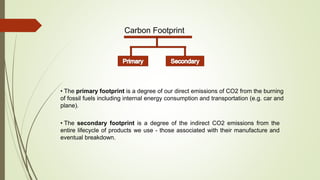
Carbon Footprint
• The primary footprint is a degree of our direct emissions of CO2 from the burning
of fossil fuels including internal energy consumption and transportation (e.g. car and
plane).
• The secondary footprint is a degree of the indirect CO2 emissions from the
entire lifecycle of products we use - those associated with their manufacture and
eventual breakdown.
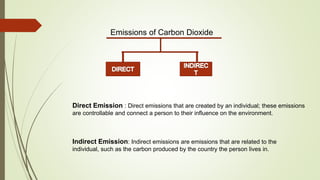
Emissions of Carbon Dioxide
Direct Emission : Direct emissions that are created by an individual; these emissions
are controllable and connect a person to their influence on the environment.
Indirect Emission: Indirect emissions are emissions that are related to the
individual, such as the carbon produced by the country the person lives in.
Md. Selim Hossain
ID: 174
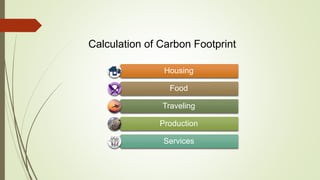
Calculation of Carbon Footprint
Housing
Food
Traveling
Production
Services
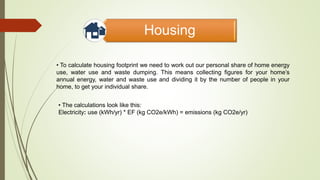
Housing
• To calculate housing footprint we need to work out our personal share of home energy
use, water use and waste dumping. This means collecting figures for your home’s
annual energy, water and waste use and dividing it by the number of people in your
home, to get your individual share.
• The calculations look like this:
Electricity: use (kWh/yr) * EF (kg CO2e/kWh) = emissions (kg CO2e/yr)
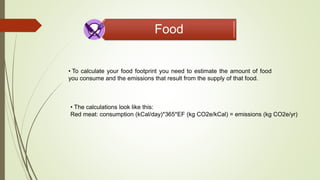
Food
• To calculate your food footprint you need to estimate the amount of food
you consume and the emissions that result from the supply of that food.
• The calculations look like this:
Red meat: consumption (kCal/day)*365*EF (kg CO2e/kCal) = emissions (kg CO2e/yr)
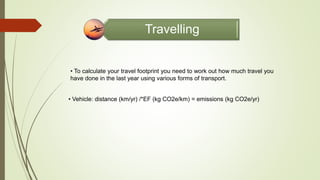
Travelling
• To calculate your travel footprint you need to work out how much travel you
have done in the last year using various forms of transport.
• Vehicle: distance (km/yr) /*EF (kg CO2e/km) = emissions (kg CO2e/yr)
Production
• The method we use for our product footprints is based on how much we spend
each month on new goods. This expenditure is divided up into different product
groups from which we estimate an emissions factor that captures the emissions
arising from the materials, manufacturing and distribution associated with each
product group.
• The calculations look like this:
Electrical: spend ($/month) * 12 * EF (kg CO2e/$) = emissions (kg CO2e/yr)
Services
• The process for calculating our services footprint is very similar to that used in
products footprints. Using monthly expenditures into different groups of services
we can estimate the total footprint.
The calculations look like this:
• Health: spend ($/month) * 12 * EF (kg CO2e/$) = emissions (kg CO2e/yr)
Advantage of Carbon Footprint
• A company can save money by lowering operating costs.
• By completing the carbon footprint, it enables to set targets.
• Companies are increasingly looking at environmental factors in identifying the most
suitable suppliers
• Managers can motivate their staff project (CDP) and report on the companies greenhouse
gas emissions
• Meet the environmental demands of investors and bankers.
• Prepare the company to meet future regulations and legislation from packaging and
transport, to buildings and energy consumption
• Demonstrate commitment to the local community to act responsibly and minimize
environmental pollution.
Riya Biswas
ID: 94
Findings
While preparing this report we have found some traits of carbon footprint.
These are described below:
• Carbon footprint is the sum of all emission of CO2.
• Carbon footprint is calculated for the time period of year.
• Greenhouse gases are normally also taken into account for the carbon footprint.
• The term carbon footprint is a variant of “ecological footprint”.
• Our carbon footprint is usually measured in tons of “CO2 equivalent”.
• Most carbon footprint calculators offer personalized tips on ways to reduce one's greenhouse
gas effect -both direct and indirect. Such as:
 Drive less
 Fly less
 Eat carbon Light
 Reduce waste
Joyanta Kumar Paul
ID: 116
Recommendations
 Minimize driving
 Reduce energy use.
 Reduce water use.
 Composed our food waste.
 Fly less
 Learn more about climate change
 Recycle as much as possible
 Encourage greenhouse reducing practices
To reduce the carbon footprint effect, we can follow these steps:
Jesmin Akter
ID: 26
Conclusion
It simply is not possible to live in the modern world without producing some greenhouse
gases. But it is possible to reduce carbon footprint .
Detrimental Effect on Environment
• Climate Change
• Rising Sea Level
• Health Damage
Go Green Step
• Plant More
• Buy Local Food
• Minimize purchases
Carbon footprint

Carbon footprint

  • 1.
  • 2.
  • 3.
    What is CarbonFootprint ? • Carbon footprint is a horribly abused phrase, so it’s worth spelling out exactly what it means. • The term carbon footprint, therefore, is a shorthand to describe the best estimate that we can get of the full climate change impact of something. Main Contributors to Carbon Footprint • Energy • Industrialization • Agriculture • Waste • Human action
  • 4.
  • 5.
    Carbon Footprint • Theprimary footprint is a degree of our direct emissions of CO2 from the burning of fossil fuels including internal energy consumption and transportation (e.g. car and plane). • The secondary footprint is a degree of the indirect CO2 emissions from the entire lifecycle of products we use - those associated with their manufacture and eventual breakdown.
  • 6.
    Emissions of CarbonDioxide Direct Emission : Direct emissions that are created by an individual; these emissions are controllable and connect a person to their influence on the environment. Indirect Emission: Indirect emissions are emissions that are related to the individual, such as the carbon produced by the country the person lives in.
  • 7.
  • 8.
    Calculation of CarbonFootprint Housing Food Traveling Production Services
  • 9.
    Housing • To calculatehousing footprint we need to work out our personal share of home energy use, water use and waste dumping. This means collecting figures for your home’s annual energy, water and waste use and dividing it by the number of people in your home, to get your individual share. • The calculations look like this: Electricity: use (kWh/yr) * EF (kg CO2e/kWh) = emissions (kg CO2e/yr)
  • 10.
    Food • To calculateyour food footprint you need to estimate the amount of food you consume and the emissions that result from the supply of that food. • The calculations look like this: Red meat: consumption (kCal/day)*365*EF (kg CO2e/kCal) = emissions (kg CO2e/yr)
  • 11.
    Travelling • To calculateyour travel footprint you need to work out how much travel you have done in the last year using various forms of transport. • Vehicle: distance (km/yr) /*EF (kg CO2e/km) = emissions (kg CO2e/yr)
  • 12.
    Production • The methodwe use for our product footprints is based on how much we spend each month on new goods. This expenditure is divided up into different product groups from which we estimate an emissions factor that captures the emissions arising from the materials, manufacturing and distribution associated with each product group. • The calculations look like this: Electrical: spend ($/month) * 12 * EF (kg CO2e/$) = emissions (kg CO2e/yr)
  • 13.
    Services • The processfor calculating our services footprint is very similar to that used in products footprints. Using monthly expenditures into different groups of services we can estimate the total footprint. The calculations look like this: • Health: spend ($/month) * 12 * EF (kg CO2e/$) = emissions (kg CO2e/yr)
  • 14.
    Advantage of CarbonFootprint • A company can save money by lowering operating costs. • By completing the carbon footprint, it enables to set targets. • Companies are increasingly looking at environmental factors in identifying the most suitable suppliers • Managers can motivate their staff project (CDP) and report on the companies greenhouse gas emissions • Meet the environmental demands of investors and bankers. • Prepare the company to meet future regulations and legislation from packaging and transport, to buildings and energy consumption • Demonstrate commitment to the local community to act responsibly and minimize environmental pollution.
  • 15.
  • 16.
    Findings While preparing thisreport we have found some traits of carbon footprint. These are described below: • Carbon footprint is the sum of all emission of CO2. • Carbon footprint is calculated for the time period of year. • Greenhouse gases are normally also taken into account for the carbon footprint. • The term carbon footprint is a variant of “ecological footprint”. • Our carbon footprint is usually measured in tons of “CO2 equivalent”. • Most carbon footprint calculators offer personalized tips on ways to reduce one's greenhouse gas effect -both direct and indirect. Such as:  Drive less  Fly less  Eat carbon Light  Reduce waste
  • 17.
  • 18.
    Recommendations  Minimize driving Reduce energy use.  Reduce water use.  Composed our food waste.  Fly less  Learn more about climate change  Recycle as much as possible  Encourage greenhouse reducing practices To reduce the carbon footprint effect, we can follow these steps:
  • 19.
  • 20.
    Conclusion It simply isnot possible to live in the modern world without producing some greenhouse gases. But it is possible to reduce carbon footprint . Detrimental Effect on Environment • Climate Change • Rising Sea Level • Health Damage Go Green Step • Plant More • Buy Local Food • Minimize purchases