CARBON CREDIT FOR
SUSTAINABLE DEVELOPMENT
Presented by:-
SHABIN LALU
SNGIST
OVERVIEW
2 CARBON CREDIT FOR SUSTAINABLE DEVELOPMENT
• Introduction
• Sustainable Engineering
• Pillars of sustainable development
• Threats of sustainable development
• GHG emissions
• Carbon
• Carbon dioxide emission
• Kyoto Protocol
• Carbon Credit
• Mechanism for Carbon Credit Trading
• Carbon Footprint
• Benefits of Carbon Credit
• Limitations of Carbon Credit
• Case study
• Conclusions
• References
INTRODUCTION
3
 Sustainability engineering: use energy and resources sustainably.
 Increase temperature in earth due to increase emission of green
house gases.
 Industrialization, combustion of fossil fuels are leads to
formation of GHG.
 ‘Kyoto Protocol’ is an agreement requires that the developed
nations reduce emissions of CO2 and 5 other GHG.
 Carbon Credit is a rescue to reduce emission of GHG.
CARBON CREDIT FOR SUSTAINABLE DEVELOPMENT
SUSTAINABILITY ENGINEERING
4
 Sustainability is a term chosen to bridge between
development and environment.
 It is a process of engg. ,where uses of energy and resources
are made in a sustainable manner.
 Activities are sustainable when we:
 Use materials that can be recycled
 Use Consistent sources of energy
CARBON CREDIT FOR SUSTAINABLE DEVELOPMENT
PILLARS OF SUSTAINABLE
DEVELOPMENT
5
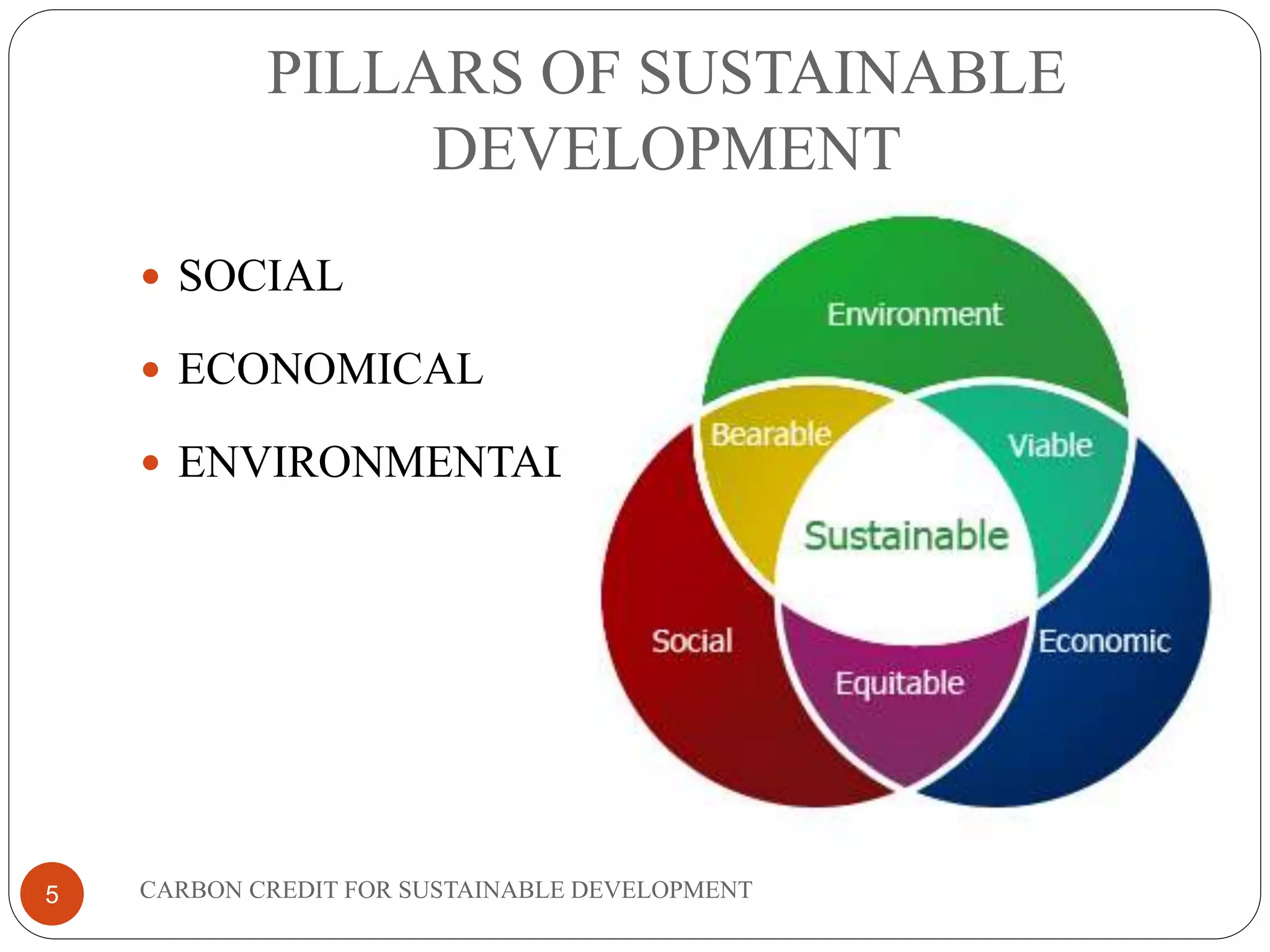
 SOCIAL
 ECONOMICAL
 ENVIRONMENTAL
CARBON CREDIT FOR SUSTAINABLE DEVELOPMENT
THREATS OF SUSTAINABLE
DEVELOPEMENT
6
 Over Population
 Pollution
 Lack of awareness about sustainability.
 Disagree of political agents
CARBON CREDIT FOR SUSTAINABLE DEVELOPMENT
GHG EMISSIONS
7
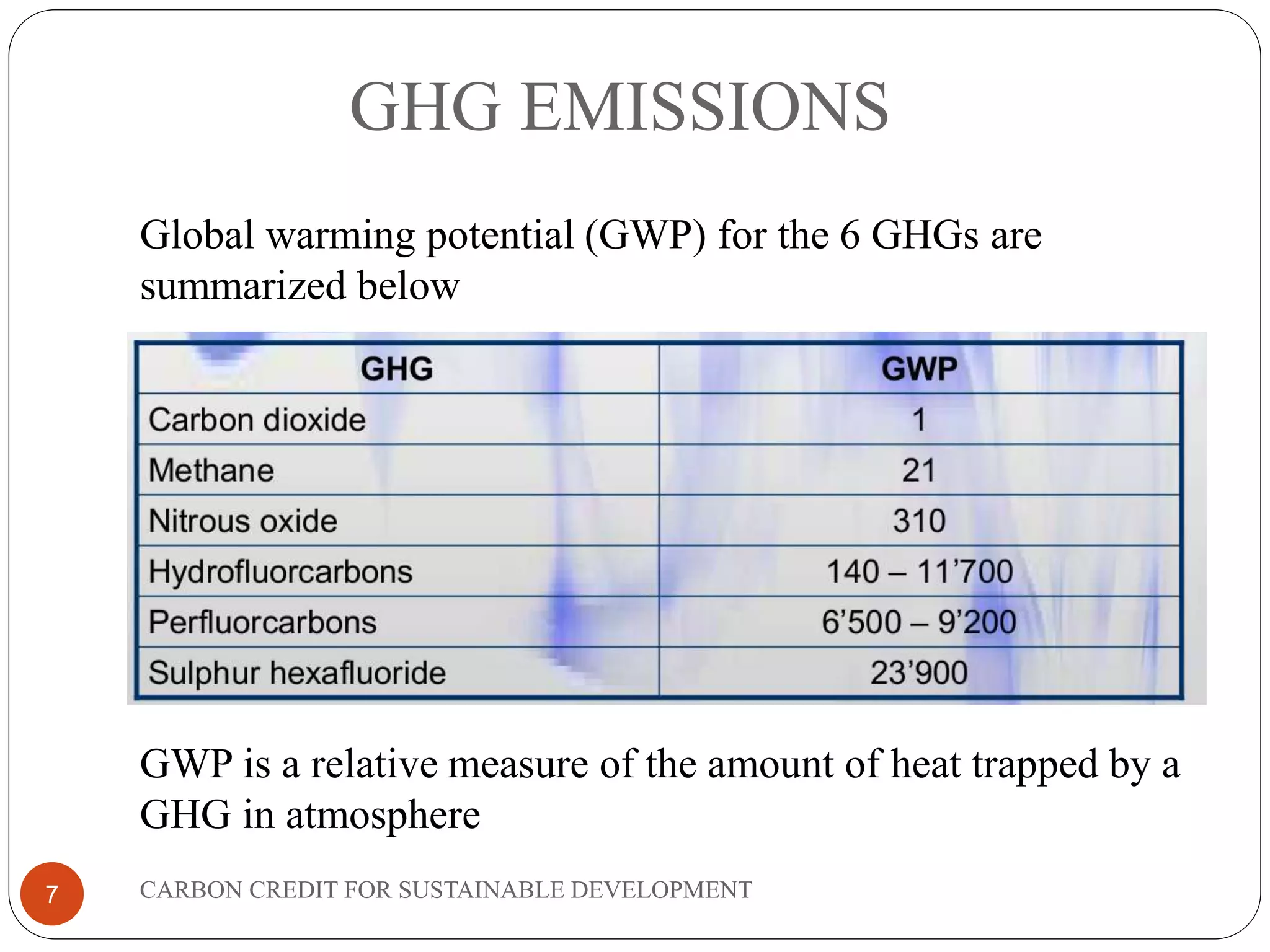
Global warming potential (GWP) for the 6 GHGs are
summarized below
GWP is a relative measure of the amount of heat trapped by a
GHG in atmosphere
CARBON CREDIT FOR SUSTAINABLE DEVELOPMENT
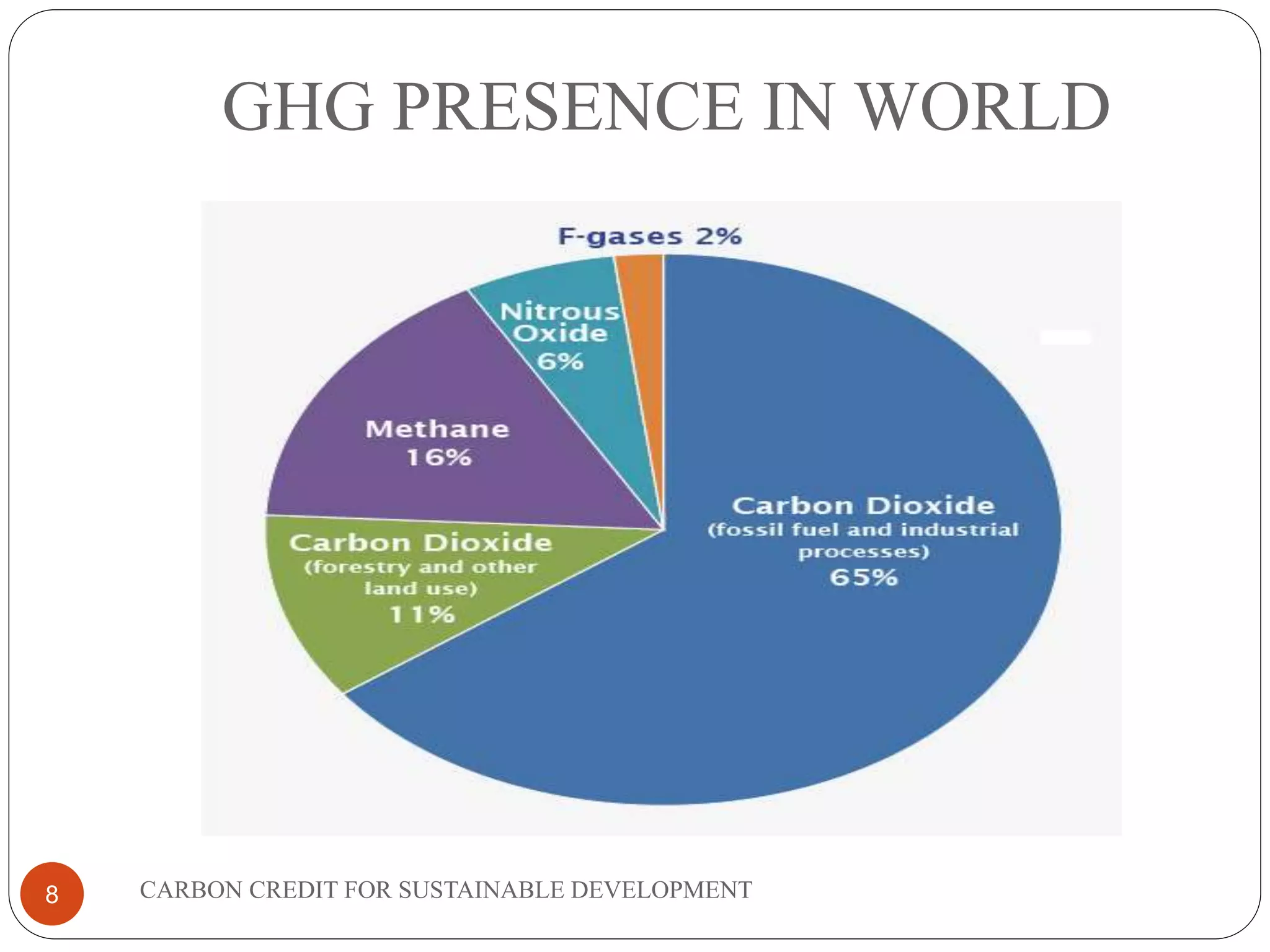
GHG PRESENCE IN WORLD
CARBON CREDIT FOR SUSTAINABLE DEVELOPMENT8
CARBON
9
 Carbon is referred as ‘building block of life’.
 Carbon compounds can exist as :-
 Solids - Diamonds or Coal
 Liquids – crude oil
 Gases – carbon dioxide
 Fossil fuels are burned for energy (combustion)
 Carbon present in the air as CO2 contributes to the ‘Greenhouse
Effect’ consequent ‘global warming’.
CARBON CREDIT FOR SUSTAINABLE DEVELOPMENT
CARBON DIOXIDE EMISSION
10
Emission source Approximate CO2 emissions
Automobiles 2.4 kg/litre
Electricity .75 kg/KWh
Recycling practices adopted in solid waste
practises
386 kg/year
Replacing standard bulbs with CFL 18 kg/year
Plant a tree 10 kg/year
CARBON CREDIT FOR SUSTAINABLE DEVELOPMENT
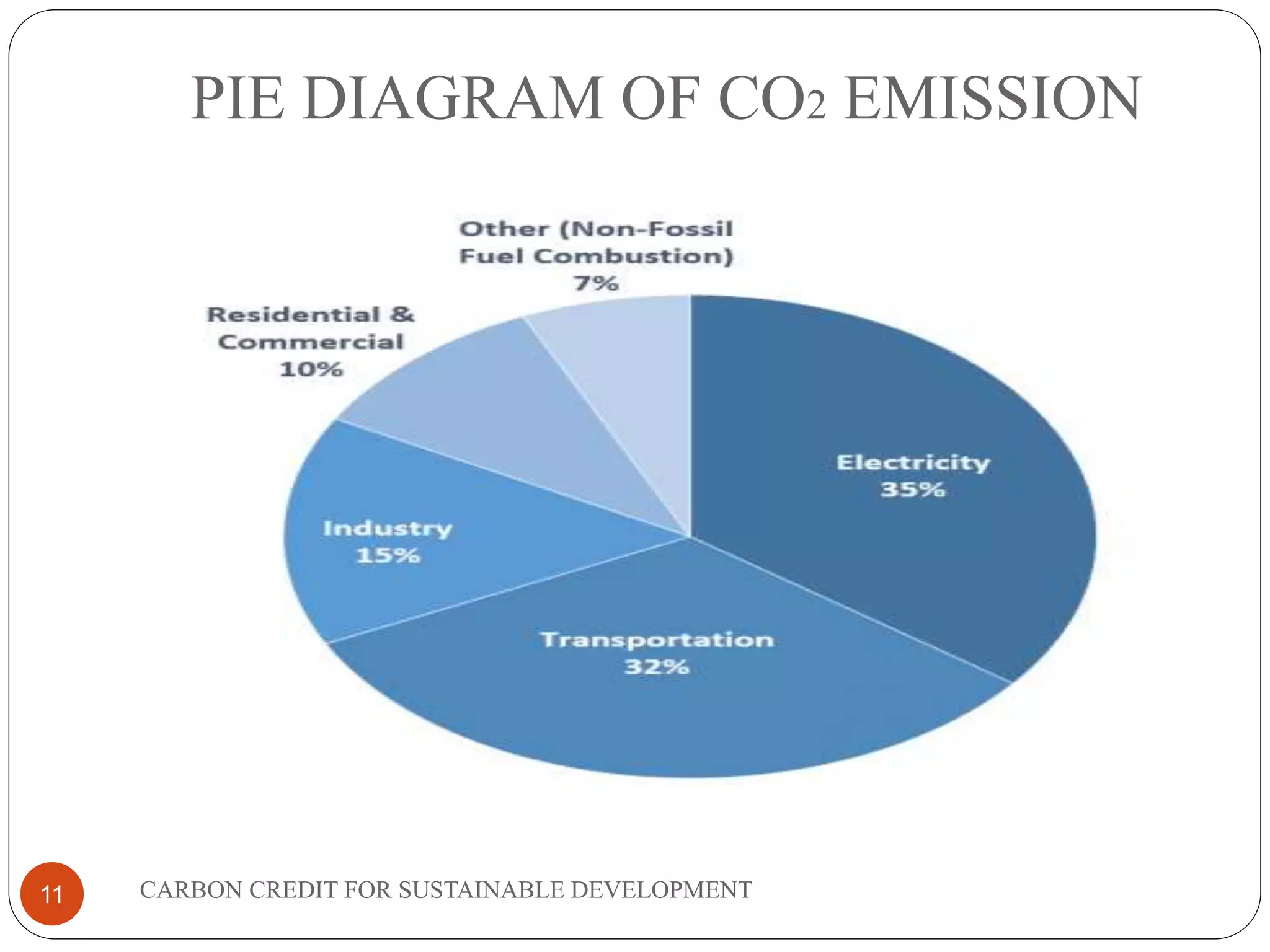
PIE DIAGRAM OF CO2 EMISSION
11 CARBON CREDIT FOR SUSTAINABLE DEVELOPMENT
KYOTO PROTOCOL
12
 Kyoto Protocol is an agreement made under the UNFCCC.
 It is adopted in Kyoto, Japan, on 11 December 1997 and
entered into force on 16 February 2005.
 185 parties of the UNFCCC have signed and ratified the
Protocol.
CARBON CREDIT FOR SUSTAINABLE DEVELOPMENT
Continues…
13
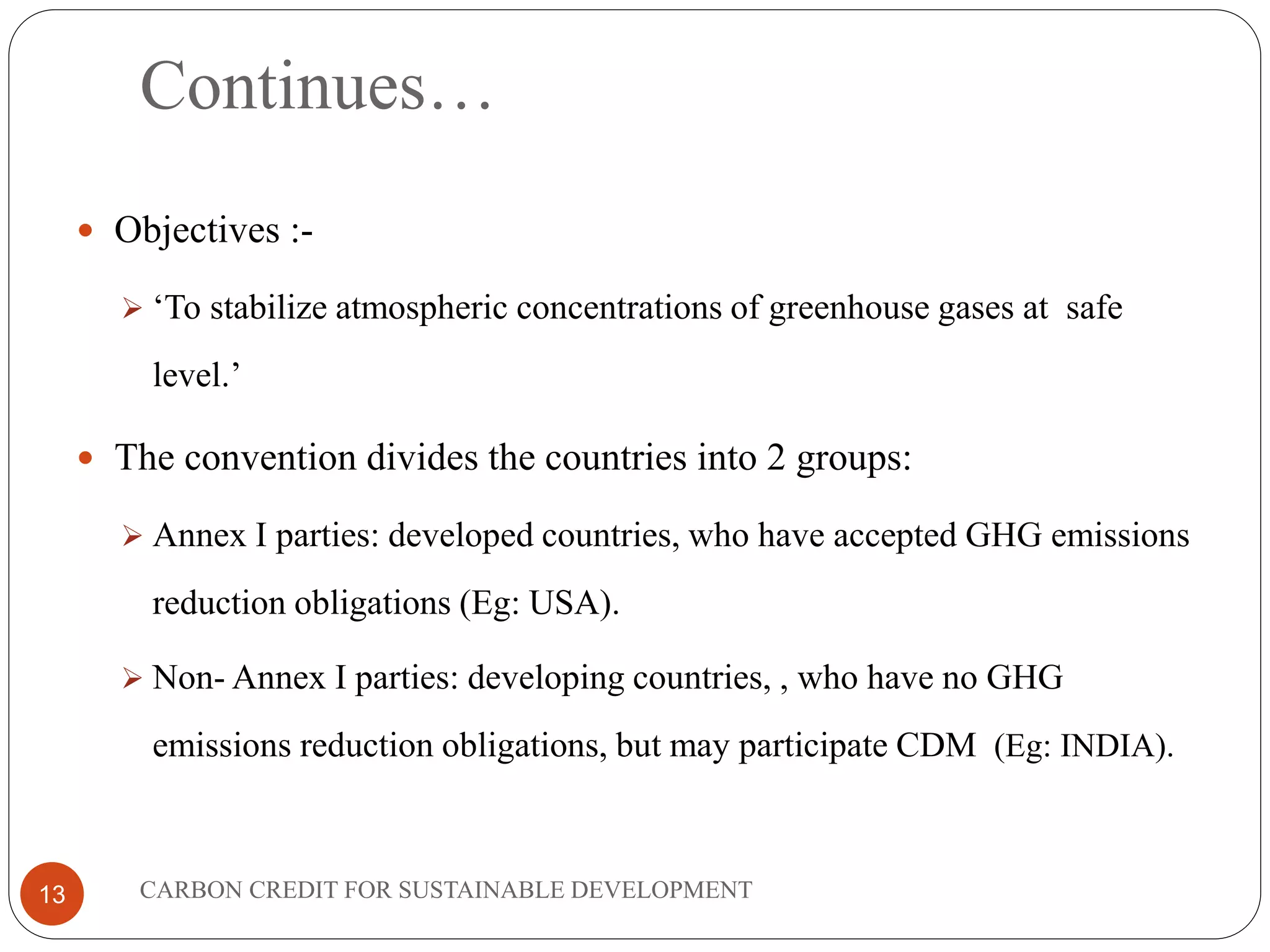
 Objectives :-
 ‘To stabilize atmospheric concentrations of greenhouse gases at safe
level.’
 The convention divides the countries into 2 groups:
 Annex I parties: developed countries, who have accepted GHG emissions
reduction obligations (Eg: USA).
 Non- Annex I parties: developing countries, , who have no GHG
emissions reduction obligations, but may participate CDM (Eg: INDIA).
CARBON CREDIT FOR SUSTAINABLE DEVELOPMENT
CARBON CREDIT
14
 Carbon credit is a permit that allows the holder to emit 1
tonne of CO2.
 The carbon credit system was ratified in concurrence with
the article 17 of Kyoto Protocol.
 One carbon credit is equivalent to reduction of 1 tonne of
CO2 or its equivalent GHG from base line of project
activity.
CARBON CREDIT FOR SUSTAINABLE DEVELOPMENT
WORKING
15
A B
 B emit more CO2 than emission cap. So B buys permits from A.
 A emit less CO2 than emission cap. So A sells permits to B. and
financially rewarded.
CARBON CREDIT FOR SUSTAINABLE
DEVELOPMENT
CALCULATION OF CARBON
CREDIT
16
 Each ton of dry tree (biomass) weight = 1 ton of carbon.
 It is estimated that 1 ton carbon produces 3.67 tons of CO2,
if biomass is burned.
 1 ton of CO2 is not released in to the atmosphere = 1
carbon credit
CARBON CREDIT FOR SUSTAINABLE DEVELOPMENT
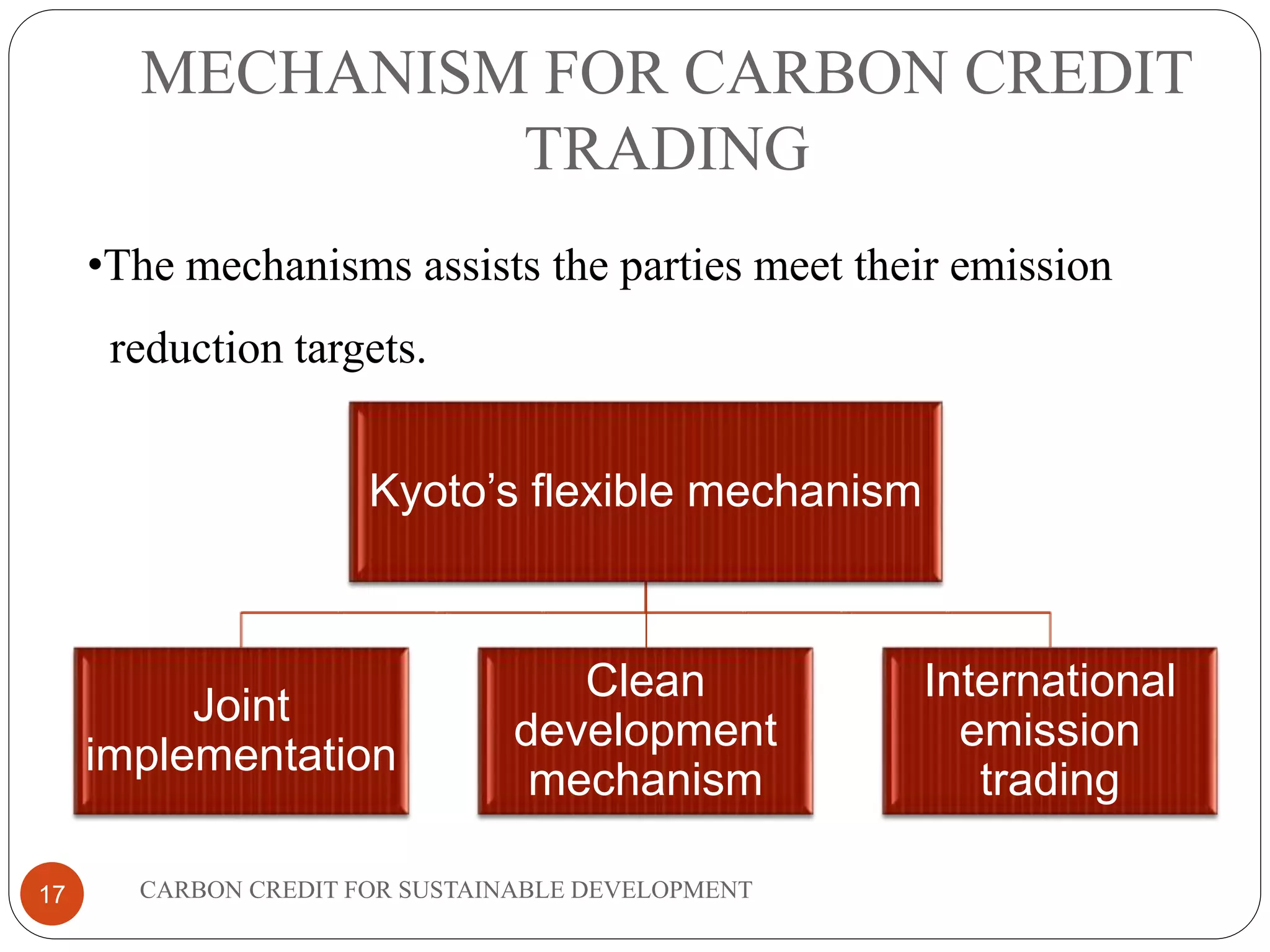
MECHANISM FOR CARBON CREDIT
TRADING
17
Kyoto’s flexible mechanism
Joint
implementation
Clean
development
mechanism
International
emission
trading
•The mechanisms assists the parties meet their emission
reduction targets.
CARBON CREDIT FOR SUSTAINABLE DEVELOPMENT
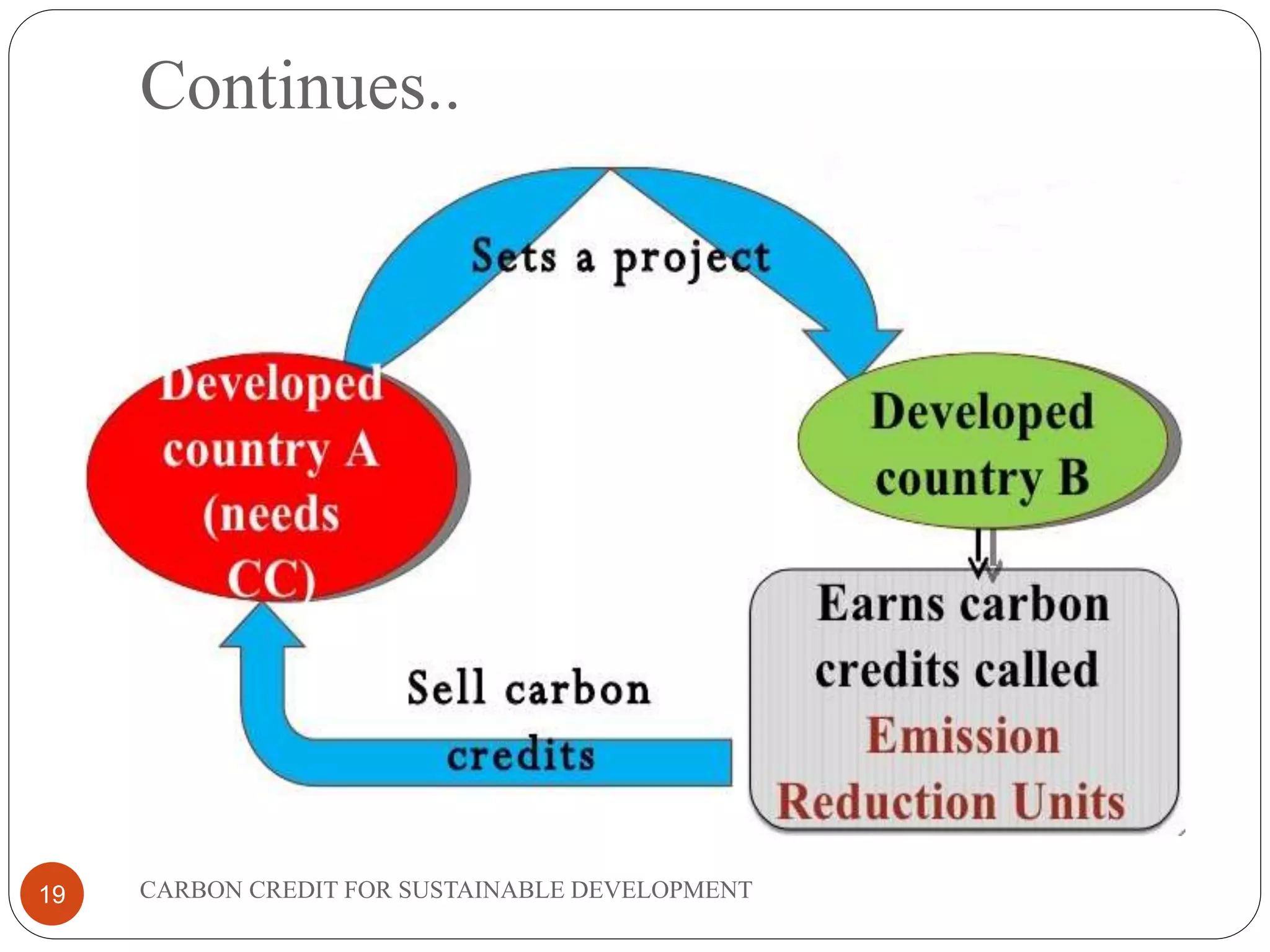
JOINT IMPLEMENTATION (JI)
18
 It is described in Article 6 of the Kyoto Protocol.
 Joint Implementation means transfer of emission reduction
at the project level.
 Here, one Annex I party can invest in a project that reduces
emissions in another Annex I party .
 And receive credit for the emission reductions achieved
through that project.
CARBON CREDIT FOR SUSTAINABLE DEVELOPMENT
Continues..
CARBON CREDIT FOR SUSTAINABLE DEVELOPMENT19
CLEAN DEVELOPMENT
MECHANISM (CDM)
CARBON CREDIT FOR SUSTAINABLE DEVELOPMENT20
 It was established under Article 12 of the Kyoto Protocol.
 Here, one Annex I party can invest in a project that reduces
emissions in non - Annex I party.
 CDM projects also assist host parties in achieving
sustainable development and in contributing to the ultimate
objective of the convention.
Continues…
CARBON CREDIT FOR SUSTAINABLE DEVELOPMENT21
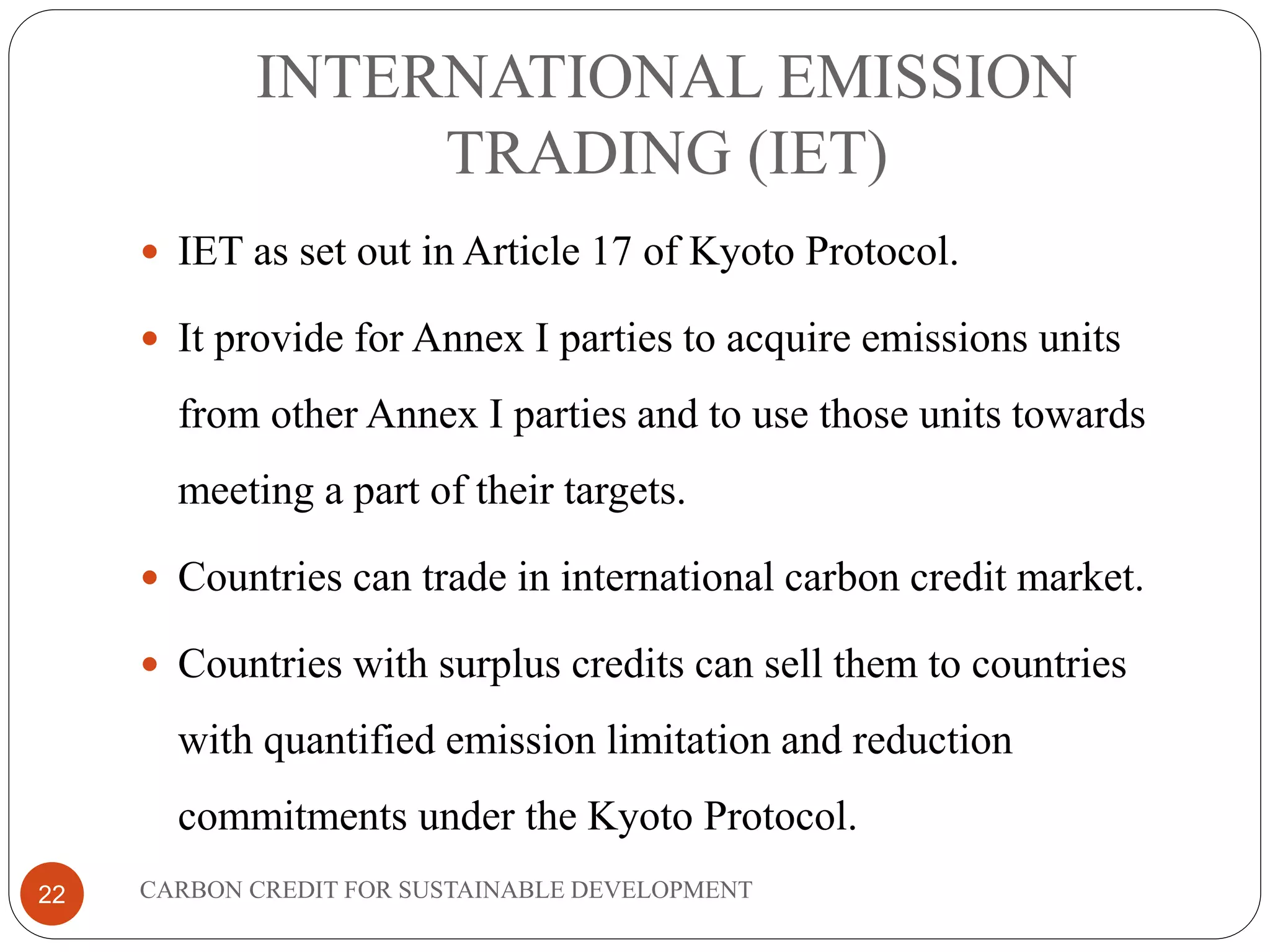
INTERNATIONAL EMISSION
TRADING (IET)
CARBON CREDIT FOR SUSTAINABLE DEVELOPMENT22
 IET as set out in Article 17 of Kyoto Protocol.
 It provide for Annex I parties to acquire emissions units
from other Annex I parties and to use those units towards
meeting a part of their targets.
 Countries can trade in international carbon credit market.
 Countries with surplus credits can sell them to countries
with quantified emission limitation and reduction
commitments under the Kyoto Protocol.
CARBON FOOTPRINT
CARBON CREDIT FOR SUSTAINABLE DEVELOPMENT23
 Carbon footprint is an expression
that describes how much CO2 a
person emits over his/her lifetime.
 Large carbon footprint has harmful
effect on environment.
 Carbon credit is more by reduce
carbon footprint.
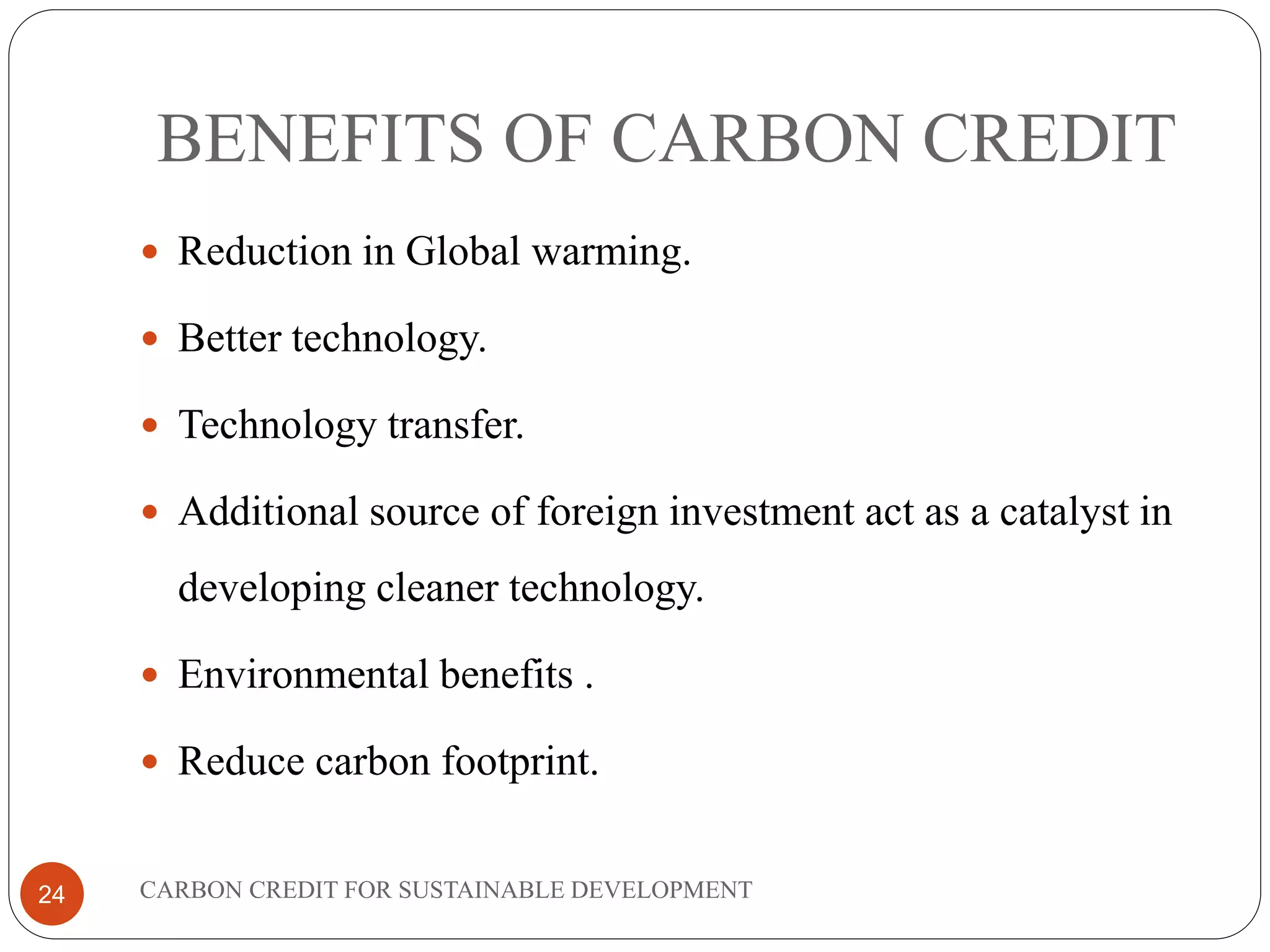
BENEFITS OF CARBON CREDIT
CARBON CREDIT FOR SUSTAINABLE DEVELOPMENT24
 Reduction in Global warming.
 Better technology.
 Technology transfer.
 Additional source of foreign investment act as a catalyst in
developing cleaner technology.
 Environmental benefits .
 Reduce carbon footprint.
LIMITATIONS OF
CARBON CREDITS
CARBON CREDIT FOR SUSTAINABLE DEVELOPMENT25
 Chances of fraudulence go up.
 Meaningful offset project is complex.
BENEFIT TO INDIA
CARBON CREDIT FOR SUSTAINABLE DEVELOPMENT26
 India joined the Kyoto Protocol in August 2002 and it
contributes 25 % of the total world carbon trade.
 The first company to take part in carbon trading was Shree
Pandurang Cooperative Sugar Factory Ltd, Shripur, which
earned Rs. 3.97 crore from the UNFCCC.
CASE STUDY
CARBON CREDIT FOR SUSTAINABLE DEVELOPMENT27
DELHI METRO RAIL CORPORATION LTD.
Continues…
CARBON CREDIT FOR SUSTAINABLE DEVELOPMENT28
 DMRC has become first ever railway project in the world to claim
carbon credit.
 They reduce 30% electricity consumption with regenerative breaking
system in its trains.
 DMRC claimed 4 lakh CERs for a 10 year crediting period starting
Dec,2007.
 This converts to 1.2 crore per year for 10 years.
 DMRC so far has helped in removing more than 91 thousand vehicles
from roads on daily basis.
CONCLUSION
CARBON CREDIT FOR SUSTAINABLE DEVELOPMENT29
 Carbon Credit is an effective tool to earn extra income and
benefits for developing and non developed countries.
 It will reduce emission of GHG and there by improving
environmental stability.
 Carbon Credit greatly contributes towards the fight against
Global warming.
 India is likely to emerge as the biggest sellers and Europe is
going to be the biggest buyers of Carbon Credit.
 It offers green and better world.
REFERENCES
CARBON CREDIT FOR SUSTAINABLE DEVELOPMENT30
 Gawande A.P, Thakare R.R, Haramkar S.S (2014), “Carbon
Credit: Trading With Nature”, International Journal of Chemical
and Physical Sciences, Vol.3 (2), pp. 10-16.
 Amit Mishra, Ravi Jain, Huma Afrin (2014), “Carbon Credit for
Sustainable Development”, Recent Research in Science and
Technology, Vol.6 (1), pp. 09-13.
 Dr. Meenu Maheshwari, Nidhi Goyal (2015), “Carbon Credit
Accounting : A Case Study of Delhi Metro Rail Corporation”.
Pacific Business Review International, Vol. 8 (3), pp. 113-116.
 www.Wikipedia.org
CARBON CREDIT FOR SUSTAINABLE
DEVELOPMENT31

Carbon Credit for Sustainable Development

  • 1.
    CARBON CREDIT FOR SUSTAINABLEDEVELOPMENT Presented by:- SHABIN LALU SNGIST
  • 2.
    OVERVIEW 2 CARBON CREDITFOR SUSTAINABLE DEVELOPMENT • Introduction • Sustainable Engineering • Pillars of sustainable development • Threats of sustainable development • GHG emissions • Carbon • Carbon dioxide emission • Kyoto Protocol • Carbon Credit • Mechanism for Carbon Credit Trading • Carbon Footprint • Benefits of Carbon Credit • Limitations of Carbon Credit • Case study • Conclusions • References
  • 3.
    INTRODUCTION 3  Sustainability engineering:use energy and resources sustainably.  Increase temperature in earth due to increase emission of green house gases.  Industrialization, combustion of fossil fuels are leads to formation of GHG.  ‘Kyoto Protocol’ is an agreement requires that the developed nations reduce emissions of CO2 and 5 other GHG.  Carbon Credit is a rescue to reduce emission of GHG. CARBON CREDIT FOR SUSTAINABLE DEVELOPMENT
  • 4.
    SUSTAINABILITY ENGINEERING 4  Sustainabilityis a term chosen to bridge between development and environment.  It is a process of engg. ,where uses of energy and resources are made in a sustainable manner.  Activities are sustainable when we:  Use materials that can be recycled  Use Consistent sources of energy CARBON CREDIT FOR SUSTAINABLE DEVELOPMENT
  • 5.
    PILLARS OF SUSTAINABLE DEVELOPMENT 5 SOCIAL  ECONOMICAL  ENVIRONMENTAL CARBON CREDIT FOR SUSTAINABLE DEVELOPMENT
  • 6.
    THREATS OF SUSTAINABLE DEVELOPEMENT 6 Over Population  Pollution  Lack of awareness about sustainability.  Disagree of political agents CARBON CREDIT FOR SUSTAINABLE DEVELOPMENT
  • 7.
    GHG EMISSIONS 7 Global warmingpotential (GWP) for the 6 GHGs are summarized below GWP is a relative measure of the amount of heat trapped by a GHG in atmosphere CARBON CREDIT FOR SUSTAINABLE DEVELOPMENT
  • 8.
    GHG PRESENCE INWORLD CARBON CREDIT FOR SUSTAINABLE DEVELOPMENT8
  • 9.
    CARBON 9  Carbon isreferred as ‘building block of life’.  Carbon compounds can exist as :-  Solids - Diamonds or Coal  Liquids – crude oil  Gases – carbon dioxide  Fossil fuels are burned for energy (combustion)  Carbon present in the air as CO2 contributes to the ‘Greenhouse Effect’ consequent ‘global warming’. CARBON CREDIT FOR SUSTAINABLE DEVELOPMENT
  • 10.
    CARBON DIOXIDE EMISSION 10 Emissionsource Approximate CO2 emissions Automobiles 2.4 kg/litre Electricity .75 kg/KWh Recycling practices adopted in solid waste practises 386 kg/year Replacing standard bulbs with CFL 18 kg/year Plant a tree 10 kg/year CARBON CREDIT FOR SUSTAINABLE DEVELOPMENT
  • 11.
    PIE DIAGRAM OFCO2 EMISSION 11 CARBON CREDIT FOR SUSTAINABLE DEVELOPMENT
  • 12.
    KYOTO PROTOCOL 12  KyotoProtocol is an agreement made under the UNFCCC.  It is adopted in Kyoto, Japan, on 11 December 1997 and entered into force on 16 February 2005.  185 parties of the UNFCCC have signed and ratified the Protocol. CARBON CREDIT FOR SUSTAINABLE DEVELOPMENT
  • 13.
    Continues… 13  Objectives :- ‘To stabilize atmospheric concentrations of greenhouse gases at safe level.’  The convention divides the countries into 2 groups:  Annex I parties: developed countries, who have accepted GHG emissions reduction obligations (Eg: USA).  Non- Annex I parties: developing countries, , who have no GHG emissions reduction obligations, but may participate CDM (Eg: INDIA). CARBON CREDIT FOR SUSTAINABLE DEVELOPMENT
  • 14.
    CARBON CREDIT 14  Carboncredit is a permit that allows the holder to emit 1 tonne of CO2.  The carbon credit system was ratified in concurrence with the article 17 of Kyoto Protocol.  One carbon credit is equivalent to reduction of 1 tonne of CO2 or its equivalent GHG from base line of project activity. CARBON CREDIT FOR SUSTAINABLE DEVELOPMENT
  • 15.
    WORKING 15 A B  Bemit more CO2 than emission cap. So B buys permits from A.  A emit less CO2 than emission cap. So A sells permits to B. and financially rewarded. CARBON CREDIT FOR SUSTAINABLE DEVELOPMENT
  • 16.
    CALCULATION OF CARBON CREDIT 16 Each ton of dry tree (biomass) weight = 1 ton of carbon.  It is estimated that 1 ton carbon produces 3.67 tons of CO2, if biomass is burned.  1 ton of CO2 is not released in to the atmosphere = 1 carbon credit CARBON CREDIT FOR SUSTAINABLE DEVELOPMENT
  • 17.
    MECHANISM FOR CARBONCREDIT TRADING 17 Kyoto’s flexible mechanism Joint implementation Clean development mechanism International emission trading •The mechanisms assists the parties meet their emission reduction targets. CARBON CREDIT FOR SUSTAINABLE DEVELOPMENT
  • 18.
    JOINT IMPLEMENTATION (JI) 18 It is described in Article 6 of the Kyoto Protocol.  Joint Implementation means transfer of emission reduction at the project level.  Here, one Annex I party can invest in a project that reduces emissions in another Annex I party .  And receive credit for the emission reductions achieved through that project. CARBON CREDIT FOR SUSTAINABLE DEVELOPMENT
  • 19.
    Continues.. CARBON CREDIT FORSUSTAINABLE DEVELOPMENT19
  • 20.
    CLEAN DEVELOPMENT MECHANISM (CDM) CARBONCREDIT FOR SUSTAINABLE DEVELOPMENT20  It was established under Article 12 of the Kyoto Protocol.  Here, one Annex I party can invest in a project that reduces emissions in non - Annex I party.  CDM projects also assist host parties in achieving sustainable development and in contributing to the ultimate objective of the convention.
  • 21.
    Continues… CARBON CREDIT FORSUSTAINABLE DEVELOPMENT21
  • 22.
    INTERNATIONAL EMISSION TRADING (IET) CARBONCREDIT FOR SUSTAINABLE DEVELOPMENT22  IET as set out in Article 17 of Kyoto Protocol.  It provide for Annex I parties to acquire emissions units from other Annex I parties and to use those units towards meeting a part of their targets.  Countries can trade in international carbon credit market.  Countries with surplus credits can sell them to countries with quantified emission limitation and reduction commitments under the Kyoto Protocol.
  • 23.
    CARBON FOOTPRINT CARBON CREDITFOR SUSTAINABLE DEVELOPMENT23  Carbon footprint is an expression that describes how much CO2 a person emits over his/her lifetime.  Large carbon footprint has harmful effect on environment.  Carbon credit is more by reduce carbon footprint.
  • 24.
    BENEFITS OF CARBONCREDIT CARBON CREDIT FOR SUSTAINABLE DEVELOPMENT24  Reduction in Global warming.  Better technology.  Technology transfer.  Additional source of foreign investment act as a catalyst in developing cleaner technology.  Environmental benefits .  Reduce carbon footprint.
  • 25.
    LIMITATIONS OF CARBON CREDITS CARBONCREDIT FOR SUSTAINABLE DEVELOPMENT25  Chances of fraudulence go up.  Meaningful offset project is complex.
  • 26.
    BENEFIT TO INDIA CARBONCREDIT FOR SUSTAINABLE DEVELOPMENT26  India joined the Kyoto Protocol in August 2002 and it contributes 25 % of the total world carbon trade.  The first company to take part in carbon trading was Shree Pandurang Cooperative Sugar Factory Ltd, Shripur, which earned Rs. 3.97 crore from the UNFCCC.
  • 27.
    CASE STUDY CARBON CREDITFOR SUSTAINABLE DEVELOPMENT27 DELHI METRO RAIL CORPORATION LTD.
  • 28.
    Continues… CARBON CREDIT FORSUSTAINABLE DEVELOPMENT28  DMRC has become first ever railway project in the world to claim carbon credit.  They reduce 30% electricity consumption with regenerative breaking system in its trains.  DMRC claimed 4 lakh CERs for a 10 year crediting period starting Dec,2007.  This converts to 1.2 crore per year for 10 years.  DMRC so far has helped in removing more than 91 thousand vehicles from roads on daily basis.
  • 29.
    CONCLUSION CARBON CREDIT FORSUSTAINABLE DEVELOPMENT29  Carbon Credit is an effective tool to earn extra income and benefits for developing and non developed countries.  It will reduce emission of GHG and there by improving environmental stability.  Carbon Credit greatly contributes towards the fight against Global warming.  India is likely to emerge as the biggest sellers and Europe is going to be the biggest buyers of Carbon Credit.  It offers green and better world.
  • 30.
    REFERENCES CARBON CREDIT FORSUSTAINABLE DEVELOPMENT30  Gawande A.P, Thakare R.R, Haramkar S.S (2014), “Carbon Credit: Trading With Nature”, International Journal of Chemical and Physical Sciences, Vol.3 (2), pp. 10-16.  Amit Mishra, Ravi Jain, Huma Afrin (2014), “Carbon Credit for Sustainable Development”, Recent Research in Science and Technology, Vol.6 (1), pp. 09-13.  Dr. Meenu Maheshwari, Nidhi Goyal (2015), “Carbon Credit Accounting : A Case Study of Delhi Metro Rail Corporation”. Pacific Business Review International, Vol. 8 (3), pp. 113-116.  www.Wikipedia.org
  • 31.
    CARBON CREDIT FORSUSTAINABLE DEVELOPMENT31