Final Presentation
Carbon Management
and Enterprise Resource Planning
R & D
FSU Summer Intern
Jimmy Chen
Presentation outline
1 Carbon Management
1.1 Research Rationale for Carbon Management
1.2 Carbon Footprint
1.3 Life Cycle Assessment
1.4 Supply Chain
1.5 Carbon Management Principles
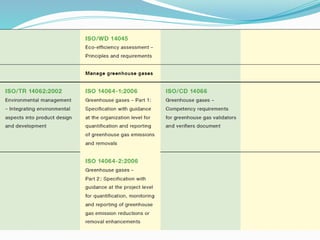
1.6 ISO Standards on Greenhouse Gas and Other
Standards
1.7 Measuring Emissions
1.8 Reducing CO2
1.9 Enterprises Building Goodwill
122 F -
212 F -
Presentation outline
 2 Enterprise Resource Planning
 3 Research & Development
Why Carbon Management ?
What Is Carbon Footprint ?
Materials
Manufacturing
Transportation
Use
Disposal
1
2
3
4
5
CO2
emission
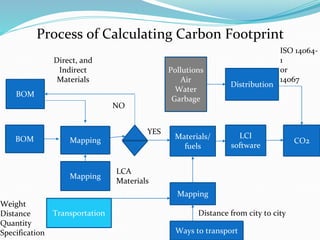
Distance from city to city
Weight
Distance
Quantity
Specification
LCA
Materials
Direct, and
Indirect
Materials
Process of Calculating Carbon Footprint
BOM
BOM Mapping
Mapping
Materials/
fuels
Transportation
Mapping
Ways to transport
LCI
software
CO2
Pollutions
Air
Water
Garbage
Distribution
ISO 14064-
1
or
14067
NO
YES
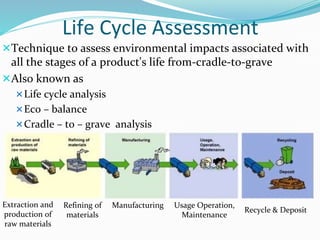
Life Cycle Assessment
Technique to assess environmental impacts associated with
all the stages of a product's life from-cradle-to-grave
Also known as
Life cycle analysis
Eco – balance
Cradle – to – grave analysis
Extraction and
production of
raw materials
Refining of
materials
Manufacturing Usage Operation,
Maintenance
Recycle & Deposit
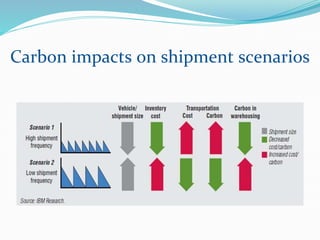
Carbon impacts on shipment scenarios
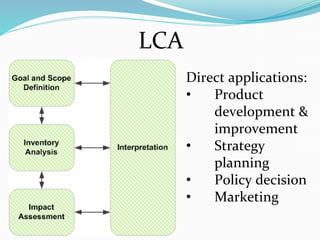
LCA
Direct applications:
• Product
development &
improvement
• Strategy
planning
• Policy decision
• Marketing
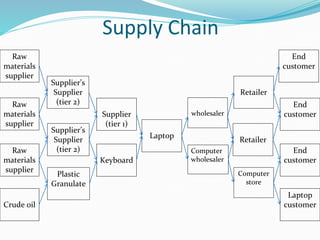
Supply Chain
Raw
materials
supplier
Raw
materials
supplier
Raw
materials
supplier
Crude oil
Plastic
Granulate
Supplier’s
Supplier
(tier 2)
Supplier’s
Supplier
(tier 2)
Keyboard
Supplier
(tier 1)
Laptop
Computer
store
Retailer
Retailer
Computer
wholesaler
End
customer
End
customer
Laptop
customer
End
customer
wholesaler
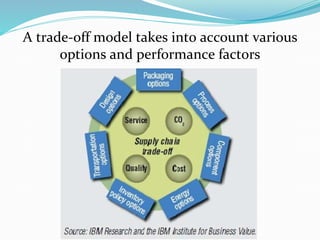
A trade-off model takes into account various
options and performance factors
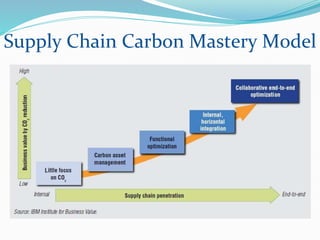
Supply Chain Carbon Mastery Model
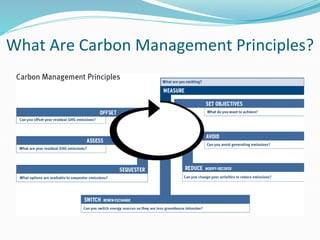
What Are Carbon Management Principles?
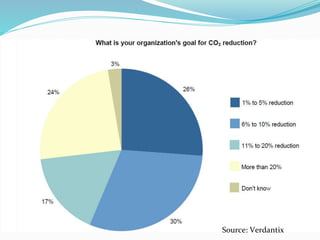
Source: Verdantix
ISO Standards on Carbon Management
International Standards Organization (ISO)
Environmental tools with the following characteristics:
Technically credible
Fulfills stakeholders needs
Facilitates the development of uniform requirements
Promotes efficiency
Supports regulation compliance
Enhances investor confidence
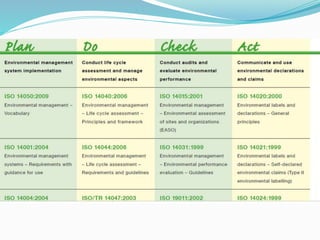
ISO 14001: Life – Cycle – Assessment (LCA)
Identifying and evaluating environmental aspects of
products and services from cradle to the grave (ISO 14004
complements)
ISO 14040: Principles and conduct of LCA studies that
information for reducing overall environmental impact
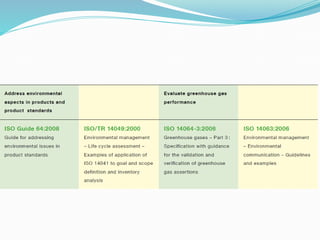
ISO 14064: Accounting and verification standards that sets
requirements to support GHG emission reduction
projects. (14065 complements 14064 by specifying
requirements to accredit or recognize organizational
bodies that undertake GHG validation or verification
using ISO 14064 or other relevant standards or
specifications. (14065 not yet provided)
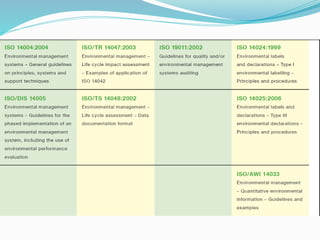
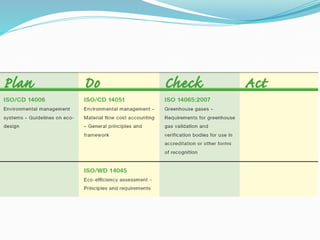
Additional resources (not yet be published)
ISO 14045: Assessing eco-efficiency
ISO 14051: Establishing material flow cost accounting
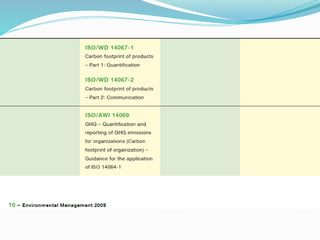
ISO 14067: Quantifying carbon footprint of products to
harmonize methodologies and provide guidance for
communicating the carbon footprint information
ISO 14069: Calculating the carbon footprint
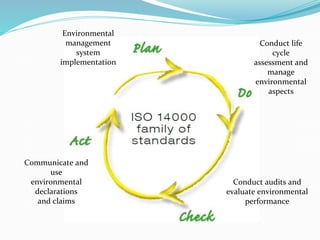
Environmental
management
system
implementation
Conduct life
cycle
assessment and
manage
environmental
aspects
Conduct audits and
evaluate environmental
performance
Communicate and
use
environmental
declarations
and claims
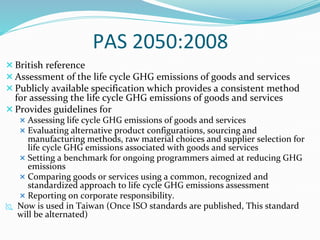
PAS 2050:2008
British reference
Assessment of the life cycle GHG emissions of goods and services
Publicly available specification which provides a consistent method
for assessing the life cycle GHG emissions of goods and services
Provides guidelines for
 Assessing life cycle GHG emissions of goods and services
 Evaluating alternative product configurations, sourcing and
manufacturing methods, raw material choices and supplier selection for
life cycle GHG emissions associated with goods and services
 Setting a benchmark for ongoing programmers aimed at reducing GHG
emissions
 Comparing goods or services using a common, recognized and
standardized approach to life cycle GHG emissions assessment
 Reporting on corporate responsibility.
 Now is used in Taiwan (Once ISO standards are published, This standard
will be alternated)
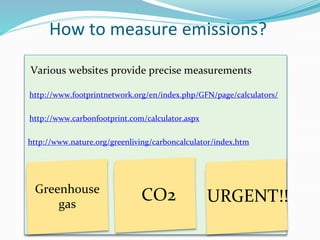
How to measure emissions?
Various websites provide precise measurements
http://www.footprintnetwork.org/en/index.php/GFN/page/calculators/
http://www.carbonfootprint.com/calculator.aspx
http://www.nature.org/greenliving/carboncalculator/index.htm
CO2Greenhouse
gas
URGENT!!
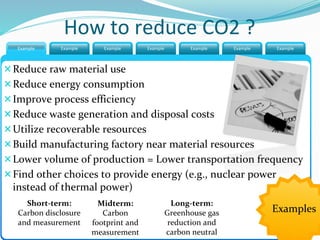
How to reduce CO2 ?
Example ExampleExample Example Example Example Example
Reduce raw material use
Reduce energy consumption
Improve process efficiency
Reduce waste generation and disposal costs
Utilize recoverable resources
Build manufacturing factory near material resources
Lower volume of production = Lower transportation frequency
Find other choices to provide energy (e.g., nuclear power
instead of thermal power)
Short-term:
Carbon disclosure
and measurement
Midterm:
Carbon
footprint and
measurement
Long-term:
Greenhouse gas
reduction and
carbon neutral
Examples
How do enterprises build goodwill?
Enterprises want to know…
Challenges?
How much does it cost?
When will the profits start coming in?
Solutions:
Correct mindset: short term profit versus long term cost
reduction
Establish:
 Brand image
 Socially responsible supplier
 Customer confidence
Challenges among employees:
What does it have to do with us? We are busy enough.
The company is just trying to keep track of our
activities.
The company is just trying to cut cost and reduce our
benefits.
Solutions:
 Arrange meetings to clearly communicate goal
and reasons to achieve carbon neutrality.
Many employees who seem skeptical are actually more
curious once they understand more about the
standards. They will be the ones telling their clients
about it!
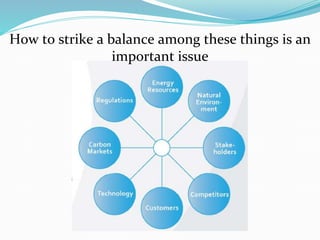
How to strike a balance among these things is an
important issue
Benefits
Without
CO2
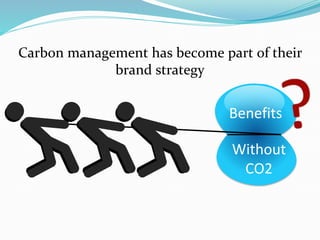
Carbon management has become part of their
brand strategy
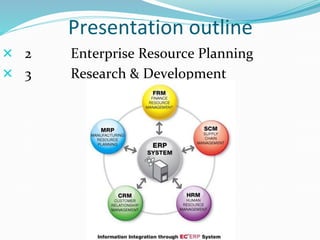
What Is ERP?
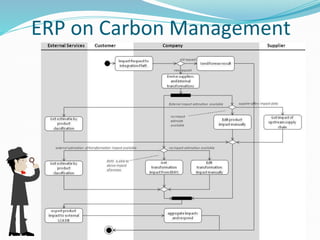
ERP on Carbon Management
Open R&D IssuesExample ExampleExample Example Example Example Example
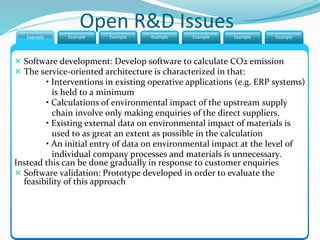
 Software development: Develop software to calculate CO2 emission
 The service-oriented architecture is characterized in that:
• Interventions in existing operative applications (e.g. ERP systems)
is held to a minimum
• Calculations of environmental impact of the upstream supply
chain involve only making enquiries of the direct suppliers.
• Existing external data on environmental impact of materials is
used to as great an extent as possible in the calculation
• An initial entry of data on environmental impact at the level of
individual company processes and materials is unnecessary.
Instead this can be done gradually in response to customer enquiries
 Software validation: Prototype developed in order to evaluate the
feasibility of this approach
Future
MRP
Manufacturing
Resources
planning
CRM
Customer
Relationship
Management
FRM
Finance
Resource
Management
SCM
Supply
Chain
Management
HRM
Human
Resource
Management
CM
Carbon
Management
ERP System
The End of Presentation
Thank you for listening

Final Presentation

  • 1.
    Final Presentation Carbon Management andEnterprise Resource Planning R & D FSU Summer Intern Jimmy Chen
  • 2.
    Presentation outline 1 CarbonManagement 1.1 Research Rationale for Carbon Management 1.2 Carbon Footprint 1.3 Life Cycle Assessment 1.4 Supply Chain 1.5 Carbon Management Principles 1.6 ISO Standards on Greenhouse Gas and Other Standards 1.7 Measuring Emissions 1.8 Reducing CO2 1.9 Enterprises Building Goodwill 122 F - 212 F -
  • 3.
    Presentation outline  2Enterprise Resource Planning  3 Research & Development
  • 4.
  • 5.
    What Is CarbonFootprint ? Materials Manufacturing Transportation Use Disposal 1 2 3 4 5 CO2 emission
  • 6.
    Distance from cityto city Weight Distance Quantity Specification LCA Materials Direct, and Indirect Materials Process of Calculating Carbon Footprint BOM BOM Mapping Mapping Materials/ fuels Transportation Mapping Ways to transport LCI software CO2 Pollutions Air Water Garbage Distribution ISO 14064- 1 or 14067 NO YES
  • 7.
    Life Cycle Assessment Techniqueto assess environmental impacts associated with all the stages of a product's life from-cradle-to-grave Also known as Life cycle analysis Eco – balance Cradle – to – grave analysis Extraction and production of raw materials Refining of materials Manufacturing Usage Operation, Maintenance Recycle & Deposit
  • 8.
    Carbon impacts onshipment scenarios
  • 9.
    LCA Direct applications: • Product development& improvement • Strategy planning • Policy decision • Marketing
  • 10.
    Supply Chain Raw materials supplier Raw materials supplier Raw materials supplier Crude oil Plastic Granulate Supplier’s Supplier (tier2) Supplier’s Supplier (tier 2) Keyboard Supplier (tier 1) Laptop Computer store Retailer Retailer Computer wholesaler End customer End customer Laptop customer End customer wholesaler
  • 11.
    A trade-off modeltakes into account various options and performance factors
  • 12.
    Supply Chain CarbonMastery Model
  • 13.
    What Are CarbonManagement Principles?
  • 14.
  • 15.
    ISO Standards onCarbon Management International Standards Organization (ISO) Environmental tools with the following characteristics: Technically credible Fulfills stakeholders needs Facilitates the development of uniform requirements Promotes efficiency Supports regulation compliance Enhances investor confidence
  • 16.
    ISO 14001: Life– Cycle – Assessment (LCA) Identifying and evaluating environmental aspects of products and services from cradle to the grave (ISO 14004 complements) ISO 14040: Principles and conduct of LCA studies that information for reducing overall environmental impact ISO 14064: Accounting and verification standards that sets requirements to support GHG emission reduction projects. (14065 complements 14064 by specifying requirements to accredit or recognize organizational bodies that undertake GHG validation or verification using ISO 14064 or other relevant standards or specifications. (14065 not yet provided)
  • 17.
    Additional resources (notyet be published) ISO 14045: Assessing eco-efficiency ISO 14051: Establishing material flow cost accounting ISO 14067: Quantifying carbon footprint of products to harmonize methodologies and provide guidance for communicating the carbon footprint information ISO 14069: Calculating the carbon footprint
  • 18.
    Environmental management system implementation Conduct life cycle assessment and manage environmental aspects Conductaudits and evaluate environmental performance Communicate and use environmental declarations and claims
  • 25.
    PAS 2050:2008 British reference Assessmentof the life cycle GHG emissions of goods and services Publicly available specification which provides a consistent method for assessing the life cycle GHG emissions of goods and services Provides guidelines for  Assessing life cycle GHG emissions of goods and services  Evaluating alternative product configurations, sourcing and manufacturing methods, raw material choices and supplier selection for life cycle GHG emissions associated with goods and services  Setting a benchmark for ongoing programmers aimed at reducing GHG emissions  Comparing goods or services using a common, recognized and standardized approach to life cycle GHG emissions assessment  Reporting on corporate responsibility.  Now is used in Taiwan (Once ISO standards are published, This standard will be alternated)
  • 26.
    How to measureemissions? Various websites provide precise measurements http://www.footprintnetwork.org/en/index.php/GFN/page/calculators/ http://www.carbonfootprint.com/calculator.aspx http://www.nature.org/greenliving/carboncalculator/index.htm CO2Greenhouse gas URGENT!!
  • 27.
    How to reduceCO2 ? Example ExampleExample Example Example Example Example Reduce raw material use Reduce energy consumption Improve process efficiency Reduce waste generation and disposal costs Utilize recoverable resources Build manufacturing factory near material resources Lower volume of production = Lower transportation frequency Find other choices to provide energy (e.g., nuclear power instead of thermal power) Short-term: Carbon disclosure and measurement Midterm: Carbon footprint and measurement Long-term: Greenhouse gas reduction and carbon neutral Examples
  • 28.
    How do enterprisesbuild goodwill?
  • 29.
    Enterprises want toknow… Challenges? How much does it cost? When will the profits start coming in? Solutions: Correct mindset: short term profit versus long term cost reduction Establish:  Brand image  Socially responsible supplier  Customer confidence
  • 30.
    Challenges among employees: Whatdoes it have to do with us? We are busy enough. The company is just trying to keep track of our activities. The company is just trying to cut cost and reduce our benefits. Solutions:  Arrange meetings to clearly communicate goal and reasons to achieve carbon neutrality. Many employees who seem skeptical are actually more curious once they understand more about the standards. They will be the ones telling their clients about it!
  • 31.
    How to strikea balance among these things is an important issue
  • 32.
    Benefits Without CO2 Carbon management hasbecome part of their brand strategy
  • 33.
  • 34.
    ERP on CarbonManagement
  • 35.
    Open R&D IssuesExampleExampleExample Example Example Example Example  Software development: Develop software to calculate CO2 emission  The service-oriented architecture is characterized in that: • Interventions in existing operative applications (e.g. ERP systems) is held to a minimum • Calculations of environmental impact of the upstream supply chain involve only making enquiries of the direct suppliers. • Existing external data on environmental impact of materials is used to as great an extent as possible in the calculation • An initial entry of data on environmental impact at the level of individual company processes and materials is unnecessary. Instead this can be done gradually in response to customer enquiries  Software validation: Prototype developed in order to evaluate the feasibility of this approach
  • 36.
  • 37.
    The End ofPresentation Thank you for listening

Editor's Notes

  • #5 Human race is on an sustainable path As the planet heats up, so do regulatory mandates to reduce greenhouse gas emissions worldwide. Much of the opportunity to address CO2 emissions rests on the supply chain, compelling companies to look for new approaches to managing carbon effectively – from sourcing and production, to distribution and product afterlife. The trade-offs in the supply chain are no longer just about cost, service and quality – but cost, service, quality and carbon. By incorporating carbon reduction into their strategy, companies can help reduce their environmental emissions footprint, strengthen their brand image and develop competitive advantage.
  • #6 CO2 emissions from cradle – to – grave Materials: gold, iron, aluminum, and so on Manufacturing: energy. For example: :Thermal power Transportation: CO2 emit by truck Use: For example: Driving car Disposal: burning garbage
  • #8 Many companies want their factory to be located near the materials in order to lower the transportation costs.
  • #11 We can see the supply chain.
  • #29 Caring for the environment by reducing emissions Demonstrating a low carbon footprint and reduced associated environmental impacts. Ensuring GHG emissions are reduced in a sustainable way Taking direct responsibility for reducing GHG emissions where practicable, rather than outsourcing this through offsetting schemes. Reducing non – greenhouse environmental impacts. Embedment – embed the conception that green products are good for us into the customers. (Even though a little more expensive than common product, they will still choose the green products.)
  • #34 integrates internal and external management information across an entire organization, embracing finance/accounting, manufacturing, sales and service, customer relationship management, etc. ERP systems automate this activity with an integrated software application. Its purpose is to facilitate the flow of information between all business functions inside the boundaries of the organization and manage the connections to outside stakeholders.[