Rupak Bhattacharyya et al. (Eds) : ACER 2013,
pp. 135–147, 2013. © CS & IT-CSCP 2013 DOI : 10.5121/csit.2013.3213
SATISFIABILITY METHODS FOR COLOURING
GRAPHS
Munmun Dey1
and Amitava Bagchi2
1
Department of Computer Science and Engineering, Sanaka Educational Trust's
Group of Institutions, Durgapur, West Bengal, India
86munmun@gmail.com
2
Department of Computer Science and Engineering, Heritage Institute of
Technology, West Bengal, India
amitava.bagchi@heritage.edu.in
ABSTRACT
The graph colouring problem can be solved using methods based on Satisfiability (SAT). An
instance of the problem is defined by a Boolean expression written using Boolean variables and
the logical connectives AND, OR and NOT. It has to be determined whether there is an
assignment of TRUE and FALSE values to the variables that makes the entire expression true.A
SAT problem is syntactically and semantically quite simple. Many Constraint Satisfaction
Problems (CSPs)in AI and OR can be formulated in SAT. These make use of two kinds of
searchalgorithms: Deterministic and Randomized.It has been found that deterministic methods
when run on hard CSP instances are frequently very slow in execution.A deterministic method
always outputs a solution in the end, but it can take an enormous amount of time to do so.This
has led to the development of randomized search algorithms like GSAT, which are typically
based on local (i.e., neighbourhood) search. Such methodshave been applied very successfully
to find good solutions to hard decision problems.
KEYWORD
SAT, GSAT, Graph Colouring, Randomized Search Algorithms, CSPs
1. INTRODUCTION
Many problems in Artificial Intelligence (AI) and Operations Research (OR) can be formulated
as Constraint Satisfaction Problems (CSPs). In a CSP, there is a set of variables and a set of
constraints. The variables must be assigned values from specified domains in such a way that all
the given constraints are satisfied. An assignment of values to the variables that satisfies all the
constraints yields a feasible solution. The objective is to find one feasible solution, or in some
cases, all feasible solutions. Sometimes, it is possible to associate a measure of quality with a
feasible solution. In such cases the objective might be to find the feasible solution of highest
quality.
Decision problems such as the Graph Colouring Problem and the Satisfiability Problem (SAT)
can also be viewed as CSPs. The Satisfiability Problem is particularly interesting because it can
be used as a stepping stone for solving other decision problems. Problem instances from domains
such as Graph Colouring can be encoded into SAT and then solved by the help of SAT
algorithms.
136 Computer Science & Information Technology (CS & IT)
The work reported in this report is organized in the remaining chapters as follows. In Chapter 2
we firstexplain graph colouring, then show how a graphcolouringproblem can be formulated and
solved in SAT using a deterministic approach. We also list the program code andthe output.In
Chapter 3we describe how the graphcolouringproblem can be formulated in the GSAT
framework, and show how it can be solved using GSAT with a tabulist. Chapter 4lists the GSAT
Experimental Results. Chapter 5 summarizes the report
2. GRAPH COLOURING
Here only undirected graphs are considered. To colour a graph G means to assigns a colour to
each vertex of G with the restriction that two adjacent vertices are not the same colour.
2.1 Graph Colouring Using SAT
This method is based on propositional logic. Let A = {a1, a2,..., an} be a set of n > 1 Boolean
variables. If a is a variable in A then a and ~a are called literals over A. A truth assignment for A
is a total function t: A → {true, false}. Under any truth assignment, aistrue if and only if ~a is
false, and a and ~~a have identical truth-values. A clause C over A is a set of literals over A. It
represents the disjunction of the literals, and is valid (or satisfied) under a truth assignment if and
only if at least one of its literals is true under the assignment. It is invalid (or unsatisfied) under
the truth assignment if every literal in it is false under the assignment. A set C of clauses over A is
satisfiable if there exist a truth assignment for A such that every clause in C is valid under the
assignment. In the Satisfiability Problem (SAT) we are required to determine whether a given set C
of clauses is satisfiable. In SAT the clauses represent the constraints to be satisfied when assigning
truth-values to the Boolean variables. In SAT, the number of literals in a clause can vary.
2.1.1 SAT formulation
In the SAT formulation there are three types of clauses. A Type 1 clause states that two adjacent
nodes cannot have the same colour. A Type 2 clause states that each node must be assigned at
least one of the available s colours. There is an Extended Formulation that has Type 3 clauses in
addition to Type 1 and Type 2 clauses. A Type 3 clause states that a node can be assigned at most
one of the colours.
Computer Science & Information Technology (CS & IT)
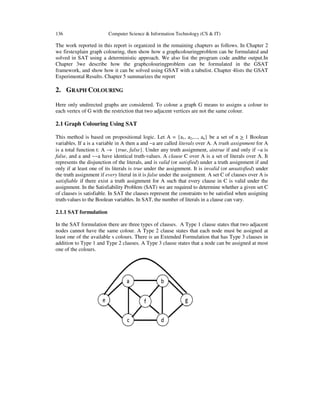
2.1.2 Example
[
Figure 1:Example of an Undirected
Figure 2: Result of the possib
Figure 3: Screenshot of calculating minimum colour needed to
2.2 GraphColouring Problem Using
Graph Coloring Problem can be formulated in the SAT framework
follows:
Step 1. INPUT: a) Number of nodes.
b)Number of edges.
c)Number of colours.
Step 2: Identification of variables
Step 3: Construction of the clauses
Step 4: Assignment of truth value
Step 5:Checking that each clauses
Step 6: Steps 4 and 5 are repeated
Computer Science & Information Technology (CS & IT)
Table 1: Adjacency matrix
Figure 1:Example of an Undirected Graph
Result of the possible colouring of the above graph.
t of calculating minimum colour needed to colour the above graph
roblem Using SAT framework
Problem can be formulated in the SAT framework. The solution steps are as
INPUT: a) Number of nodes.
Identification of variables
clauses
Assignment of truth values to literals
clauses is valid.
ed until all the clauses are true.
0 1 1 0 1 1 0
1 0 0 1 0 1 1
1 0 0 1 1 1 0
0 1 1 0 0 1 1
1 0 1 0 0 0 1
1 1 1 1 0 0 0
0 1 0 1 1 0 0
137
colour the above graph.
The solution steps are as
138 Computer Science & Information Technology (CS & IT)
2.2.1 Example
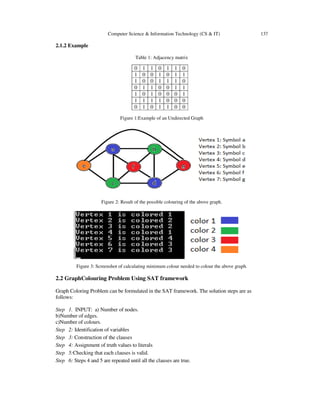
This example will show how a graph coloring problem can be solved using SAT.
Figure 4: Example of an undirected graph with colour
Figure 4 shows a simple graph consisting of 4 nodes and 4 edges. Suppose we have to determine
whether it can be colored with 3 colors named 1, 2 and 3.a1 is true when a is coloured with colour
1 and is false otherwise .We have seen that constraints here are represented by clauses. The
constraint that two adjacent clauses cannot be colored with the same color can be expressed by
the following three
Type 1 clauses:~a1 / ~c1 ~a2 / ~c2 ~a3 / ~c3
As there are 4 edges in total, and there are three Type 1 clauses corresponding to each edge, the
total number of such clauses will be 12.
The constraint that a node must not be left uncolored can be expressed in case of node 1 by the
following
Type 2 clause: a1 / a2 / a3
For four nodes in the graph the total number of Type 2 clauses will be 4.
Type 3 clauses force a node such as node to be colored by a single color. The clauses are as
follows:
Type 3 clauses:~a1 / ~a2 ~a1 / ~a3 ~a3/ ~a2
The number of Type 3 clauses for the graph of Figure 1 will be 12, as there are four nodes and three
colours. Thus the total number of clauses in the graph will be 28 in this case.
2.2.2 Example
We illustrate below how SAT solves a typical satisfiability problem.
Computer Science & Information Technology (CS & IT) 139
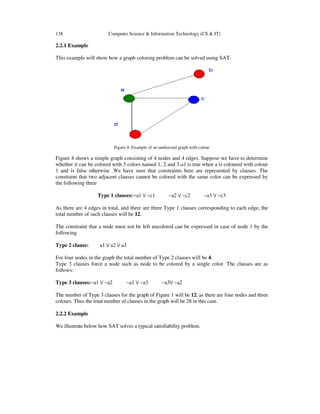
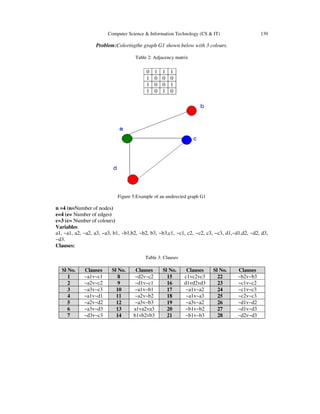
Problem:Coloringthe graph G1 shown below with 3 colours.
Table 2: Adjacency matrix
Figure 5:Example of an undirected graph G1
n =4 (n=Number of nodes)
e=4 (e= Number of edges)
c=3 (c= Number of colours)
Variables
a1, ~a1, a2, ~a2, a3, ~a3, b1, ~b1,b2, ~b2, b3, ~b3,c1, ~c1, c2, ~c2, c3, ~c3, d1,~d1,d2, ~d2, d3,
~d3.
Clauses:
Table 3: Clauses
Sl No. Clauses Sl No. Clauses Sl No. Clauses Sl No. Clauses
1 ~a1v~c1 8 ~d2v~c2 15 c1vc2vc3 22 ~b2v~b3
2 ~a2v~c2 9 ~d1v~c1 16 d1vd2vd3 23 ~c1v~c2
3 ~a3v~c3 10 ~a1v~b1 17 ~a1v~a2 24 ~c1v~c3
4 ~a1v~d1 11 ~a2v~b2 18 ~a1v~a3 25 ~c2v~c3
5 ~a2v~d2 12 ~a3v~b3 19 ~a3v~a2 26 ~d1v~d2
6 ~a3v~d3 13 a1va2va3 20 ~b1v~b2 27 ~d1v~d3
7 ~d3v~c3 14 b1vb2vb3 21 ~b1v~b3 28 ~d2v~d3
0 1 1 1
1 0 0 0
1 0 0 1
1 0 1 0
140 Computer Science & Information Technology (CS & IT)
Figure 6:Screenshot of result for the above example
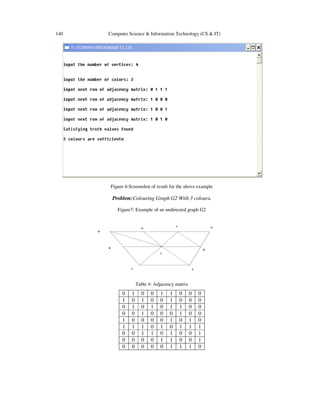
Problem:Colouring Graph G2 With 3 colours.
Figure7: Example of an undirected graph G2
Table 4: Adjacency matrix
0 1 0 0 1 1 0 0 0
1 0 1 0 0 1 0 0 0
0 1 0 1 0 1 1 0 0
0 0 1 0 0 0 1 0 0
1 0 0 0 0 1 0 1 0
1 1 1 0 1 0 1 1 1
0 0 1 1 0 1 0 0 1
0 0 0 0 1 1 0 0 1
0 0 0 0 0 1 1 1 0
Computer Science & Information Technology (CS & IT) 141
n=9 (n=Number of nodes)
e=16 (e= Number of edges)
c=3(c= Number of colours)
Number of Variables:
a1, ~a1, a2, ~a2, a3, ~a3, b1, ~b1 ,b2, ~b2, b3, ~b3 ,c1, ~c1, c2, ~c2, c3, ~c3, d1,~d1 , d2, ~d2, d3,
~d3 , e1, ~e1, e2, ~e2, e3, ~e3 , f1, ~f1, f2, ~f2, f3, ~f3, g1, ~g1, g2, ~g2, g3, ~g3, h1,
~h1, h2, ~h2, h3, ~h3, k1, ~k1, k2, ~k2, k3, ~k3
Number of Clauses:
Table 5: Number of Clauses
Sl No. Clauses Sl No. Clauses Sl No. Clauses Sl No. Clauses
1 ~a1v~b2 20 ~c2v~g2 39 ~f3v~h3 58 ~a1v~a2
2 ~a2v~b2 21 ~c3v~g3 40 ~f1v~k1 59 ~a1v~a3
3 ~a3v~b3 22 ~d1v~g1 41 ~f2v~k2 60 ~a3v~a2
4 ~b1v~c1 23 ~d2v~g2 42 ~f3v~k3 61 ~b1v~b2
5 ~b2v~c2 24 ~d3v~g3 43 ~g1v~k1 62 ~b1v~b3
6 ~b3v~c3 25 ~a1v~e1 44 ~g2v~k2 63 ~b3v~b2
7 ~c1v~d1 26 ~a2v~e2 45 ~g3v~k3 64 ~c1v~c2
8 ~c2v~d2 27 ~a3v~e3 46 ~h1v~k1 65 ~c1v~c3
9 ~c3v~d3 28 ~e1v~f1 47 ~h2v~k2 66 ~c2v~c3
10 ~a1v~f1 29 ~e2v~f2 48 ~h3v~k3 67 ~d1v~d2
11 ~a2v~f2 30 ~e3v~f3 49 a1va2va3 68 ~d1v~d3
12 ~a3v~f3 31 ~f1v~g1 50 b1vb2vb3 69 ~d3v~d2
13 ~b1v~f1 32 ~f2v~g2 51 c1vc2vc3 70 ~e1v~e2
14 ~b2v~f2 33 ~f3v~g3 52 d1vd2vd3 71 ~e1v~e3
15 ~b3v~f3 34 ~e1v~h1 53 e1ve2ve3 72 ~e2v~e3
16 ~c1v~f1 35 ~e2v~h2 54 f1vf2vf3 73 ~f1v~f2
17 ~c2v~f2 36 ~e3v~h3 55 g1vg2vg3 74 ~f1v~f3
18 ~c3v~f3 37 ~f1v~h1 56 h1vh2vh3 75 ~f2v~f3
19 ~c1v~g1 38 ~f2v~h2 57 k1vk2vk3
142 Computer Science & Information Technology (CS & IT)
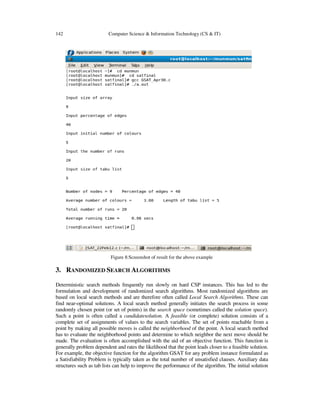
Figure 8:Screenshot of result for the above example
3. RANDOMIZED SEARCH
Deterministic search methods frequently run slowly on hard CSP instances. This has led to the
formulation and development of randomized search algorithms
based on local search methods and are therefore often called
find near-optimal solutions. A local search method generally initiates the search process in some
randomly chosen point (or set of points) in the
Such a point is often called a candidate
complete set of assignments of values to the search variables. The set of points reachable from a
point by making all possible moves is called the
has to evaluate the neighborhood
made. The evaluation is often accomplished with the aid of an objective function. This function is
generally problem dependent and rates the likelihood
For example, the objective function for the algorithm GSAT for any problem instance formulated as
a Satisfiability Problem is typically taken as the total number of unsatisfied clauses. Auxiliary data
structures such as tab lists can help to improve the performance of the algorithm. The initial solution
Computer Science & Information Technology (CS & IT)
Figure 8:Screenshot of result for the above example
EARCH ALGORITHMS
Deterministic search methods frequently run slowly on hard CSP instances. This has led to the
of randomized search algorithms. Most randomized algorithms are
based on local search methods and are therefore often called Local Search Algorithms
optimal solutions. A local search method generally initiates the search process in some
randomly chosen point (or set of points) in the search space (sometimes called the solution space
candidatesolution. A feasible (or complete) solution consists of a
complete set of assignments of values to the search variables. The set of points reachable from a
point by making all possible moves is called the neighborhood of the point. A local searc
neighborhood points and determine to which neighbor the next move should be
made. The evaluation is often accomplished with the aid of an objective function. This function is
generally problem dependent and rates the likelihood that the point leads closer to a feasible solution.
For example, the objective function for the algorithm GSAT for any problem instance formulated as
a Satisfiability Problem is typically taken as the total number of unsatisfied clauses. Auxiliary data
can help to improve the performance of the algorithm. The initial solution
Deterministic search methods frequently run slowly on hard CSP instances. This has led to the
. Most randomized algorithms are
Search Algorithms. These can
optimal solutions. A local search method generally initiates the search process in some
solution space).
(or complete) solution consists of a
complete set of assignments of values to the search variables. The set of points reachable from a
of the point. A local search method
the next move should be
made. The evaluation is often accomplished with the aid of an objective function. This function is
that the point leads closer to a feasible solution.
For example, the objective function for the algorithm GSAT for any problem instance formulated as
a Satisfiability Problem is typically taken as the total number of unsatisfied clauses. Auxiliary data
can help to improve the performance of the algorithm. The initial solution
Computer Science & Information Technology (CS & IT) 143
can be chosen either randomly or by the use of a heuristic. The search then proceeds to a
neighboringpoint and from that point to another neighboring point, and so on in an iterative way.
Although moves are made in a systematic manner, local search algorithms are typically incomplete.
Local search algorithms often make use of stochastic mechanisms.
3.1 Local Search Algorithms
In this section, however, we are concerned only with general local search methods such as GSAT
and Tabu Search.
3.2.1GSAT
The greedy local search procedure GSAT assigns truth values to variables in an effort to satisfy all
the clauses in a given set. At start, the procedure randomly assigns truth-values to variables. This
amounts to picking a solution randomly from the solution space. Typically this truth assignment
fails to satisfy all the clauses. If the truth-value of a variable is flipped (i.e., complemented), the total
number of satisfied clauses will change. Suppose a variable v is flipped. Then the unsatisfied
clauses where v occurs get satisfied. The number of such clauses is represented by make(v). At the
same time, before flipping v, there were some clauses satisfied only by the variable v. As v is
flipped these clauses get unsatisfied. The number of such clauses is given by break(v). The
difference make(v) - break(v) is the net increase in the number of satisfied clauses and is referred to
as gain(v). Flipping a variable means moving to a neighboring point in the solution space. We have
mentioned above that an objective function can help to guide us where to move next in the
neighborhood. In GSAT the value of the function is the number of unsatisfied clauses. GSAT looks
for the variable with the property that its truth-value when flipped causes the largest net decrease in
the number of unsatisfied clauses. It flips the truth-value of this variable, and again looks for such a
variable. Ties are resolved arbitrarily. This is repeated until a satisfying assignment is found. If no
satisfying assignment is found within a specified number of flips (maxflips), the procedure is
restarted with a new initial truth assignment. This cycle is repeated a specified number of times
(maxtries). The algorithm always tries to select the most promising neighbour at each step. It is
therefore called a greedy local search algorithm.
3.3Graph Colouring Problem Using GSAT framework
The solution steps are therefore as follows:
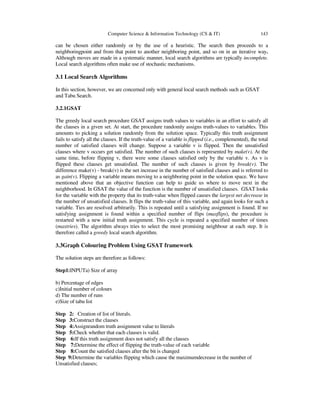
Step1:INPUTa) Size of array
b) Percentage of edges
c)Initial number of colours
d) The number of runs
e)Size of tabu list
Step 2: Creation of list of literals.
Step 3:Construct the clauses
Step 4:Assignrandom truth assignment value to literals
Step 5:Check whether that each clauses is valid.
Step 6:If this truth assignment does not satisfy all the clauses
Step 7:Determine the effect of flipping the truth-value of each variable
Step 8:Count the satisfied clauses after the bit is changed
Step 9:Determine the variables flipping which cause the maximumdecrease in the number of
Unsatisfied clauses;
144 Computer Science & Information Technology (CS & IT)
Select a variable from these set resolving ties arbitrarily;
Flip the selected variable.
Step 10: Repeat Step 4 and Step 5until all the clauses are true.
3.4Procedure GSAT
Anillustrationis done below how GSAT solves a typical satisfiability problem. Consider the
following set of six clauses:
C1: a3 U a4
C2: a5 U ~a4
C3: a1 U a2 U ~a3
C4: ~a1 U ~a3 U ~a5
C5: ~a2 U ~a3
C6: a3 U ~a4
There are five variables a1, a2, a3, a4 and a5. Suppose the initial random truth assignment is as
follows:
a1 = true,a2 = false,a3 = true, a4 = false, a5 = true.
This truth assignment does not satisfy all the clauses; in particular, clause C4 remains unsatisfied.
We must now determine the effect of flipping the truth-value of each variable. Suppose that when a
variable is flipped, make clauses that are currently unsatisfied get satisfied, and breakclauses that
are currently satisfied become unsatisfied. The overall decrease in the number of unsatisfied clauses
is then given by the expression gain = make – break. We have to find the variable with the largest
gain. Here
gain(x1) = 1 – 1 =0,
gain(x2) = 0 – 1 = -1,
gain(x3) = 1 – 1 = 0,
gain(x4) = 0 – 0 = 0,
gain(x5) = 1 – 0 = 1.
We change the truth value of x5 to false since this results in the largest gain, and find as a result that
all the clauses are satisfied.
3.5 Tabu Search Strategy
GSAT can significantly improved by tabu search strategy to ensure that the same variable is not
flipped again and again.Tabulist is initially empty and is implemented as a FIFO queue.The variable
that has just been flipped is inserted into the list.The variable to be flipped next is selected randomly
from among those variables not in the tabulist.Thus some variables are prevented from being
flipped for a limited period of time,determine by the length of the tabulist. Tabu list in GSAT not
only helped to reduce the running time,it helped us to solve some problems that could not be solved
at all without using tabulist.
This chapter describes how randomized algorithms perform local searches. In spite of being
incomplete in nature, a local search method is often preferred over a deterministic search method
when a near-optimal solution has to be found in real time.GSAT algorithms based on local search
have been described in this chapter. These include Tabu Search. The Satisfiability Problem (SAT)
is explained. The most interesting property of the Satisfiability such as Graph Colouring can be
encoded into SAT has been illustrated. Once encoded into SAT, the problem can be solved by the
Computer Science & Information Technology (CS & IT)
use of SAT algorithms and Graph Colouring can b
illustrated with experimental result.
4. EXPERIMENTAL RESULTS
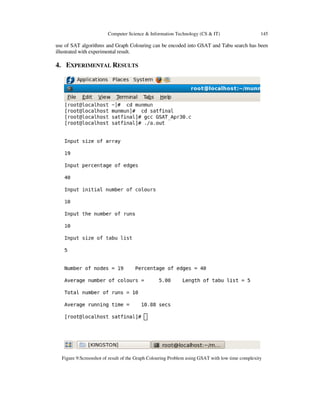
Figure 9:Screenshot of result of the Graph Colouring Problem using GSAT with low time complexity
Computer Science & Information Technology (CS & IT)
and Graph Colouring can be encoded into GSAT and Tabu search has been
experimental result.
ESULTS
Screenshot of result of the Graph Colouring Problem using GSAT with low time complexity
145
and Tabu search has been
Screenshot of result of the Graph Colouring Problem using GSAT with low time complexity
146 Computer Science & Information Technology (CS & IT)
Table 6: Colouring Random Graph with Tabulist
5. CONCLUSION
In this paper both theoretical and experimental studies are done successfully to calculate the
performance of SAT for a Graph coloring problem. The role played by SAT as an intermediate
domain for solving problems. SAT is not sufficient to calculate the minimum number of color
needed to color a graph.SAT technique only extracted that input number of color can sufficient to
color the graph or not. Hera also shows how this problem can be encoded in SAT. Finally, GSAT
method is introduced to use for solving graph coloring problems. GSAT method is enabled to
calculate the number of color need to color a graph. This paper also established a new algorithm
using GSAT which can satisfy the problem with low time complexity.
REFERENCES
[1] Acharyya S, TheSatisfiability Problem: A Constraint Satisfaction Approach, Ph D Thesis, Computer
Science & Engineering, University of Calcutta, 2001
[2] Acharyya S, SAT Algorithms for Colouring Some Special Classes of Graphs: Some Theoretical and
Experimental Results, Journal on Satisfiability, Boolean Modeling and Computation(JSAT),vol 4, no
1, pp 33-55, 2007
[3] Acharyya S &Bagchi A, Local search methods for coloring graphs: Role of tabu list, Artificial
Intelligence: Emerging Trends & Applications (Proc KBCS-2004), International Conf on Knowledge-
Based Computer Systems, Hyderabad, India, Dec 2004, pp 462-472
Computer Science & Information Technology (CS & IT) 147
[4] Selman B,Levesque H J & Mitchell D J, A New Method for Solving Hard SatisfiabilityProblems,
Proc AAAI 92, American Association for Artificial Intelligence, 1992, pp 440 446, 1992
AUTHORS
MunmunDey is an Assistant Professorat Sanaka Educational Trust's Group of
Institutions, Durgapur, West Bengal, India since 2012. She received his M.E degree from
Heritage Institute of Technology in year 2012 and B-Tech degree from Meghnad Saha
Institute of Technology in 2009. Her research interests include the field of Optimization
techniques.
Prof. (Dr.) Amitava Bagchi is a Professor at Heritage Institute of Technology, West Bengal, India. He
received his DSc. degree from MIT, USA. Prof Bagchi has 43 years teaching and Industry experiences. His
research interests include the field of Optimization techniques. He has about 55 referred national and
international publications to her credit.

SATISFIABILITY METHODS FOR COLOURING GRAPHS

  • 1.
    Rupak Bhattacharyya etal. (Eds) : ACER 2013, pp. 135–147, 2013. © CS & IT-CSCP 2013 DOI : 10.5121/csit.2013.3213 SATISFIABILITY METHODS FOR COLOURING GRAPHS Munmun Dey1 and Amitava Bagchi2 1 Department of Computer Science and Engineering, Sanaka Educational Trust's Group of Institutions, Durgapur, West Bengal, India 86munmun@gmail.com 2 Department of Computer Science and Engineering, Heritage Institute of Technology, West Bengal, India amitava.bagchi@heritage.edu.in ABSTRACT The graph colouring problem can be solved using methods based on Satisfiability (SAT). An instance of the problem is defined by a Boolean expression written using Boolean variables and the logical connectives AND, OR and NOT. It has to be determined whether there is an assignment of TRUE and FALSE values to the variables that makes the entire expression true.A SAT problem is syntactically and semantically quite simple. Many Constraint Satisfaction Problems (CSPs)in AI and OR can be formulated in SAT. These make use of two kinds of searchalgorithms: Deterministic and Randomized.It has been found that deterministic methods when run on hard CSP instances are frequently very slow in execution.A deterministic method always outputs a solution in the end, but it can take an enormous amount of time to do so.This has led to the development of randomized search algorithms like GSAT, which are typically based on local (i.e., neighbourhood) search. Such methodshave been applied very successfully to find good solutions to hard decision problems. KEYWORD SAT, GSAT, Graph Colouring, Randomized Search Algorithms, CSPs 1. INTRODUCTION Many problems in Artificial Intelligence (AI) and Operations Research (OR) can be formulated as Constraint Satisfaction Problems (CSPs). In a CSP, there is a set of variables and a set of constraints. The variables must be assigned values from specified domains in such a way that all the given constraints are satisfied. An assignment of values to the variables that satisfies all the constraints yields a feasible solution. The objective is to find one feasible solution, or in some cases, all feasible solutions. Sometimes, it is possible to associate a measure of quality with a feasible solution. In such cases the objective might be to find the feasible solution of highest quality. Decision problems such as the Graph Colouring Problem and the Satisfiability Problem (SAT) can also be viewed as CSPs. The Satisfiability Problem is particularly interesting because it can be used as a stepping stone for solving other decision problems. Problem instances from domains such as Graph Colouring can be encoded into SAT and then solved by the help of SAT algorithms.
  • 2.
    136 Computer Science& Information Technology (CS & IT) The work reported in this report is organized in the remaining chapters as follows. In Chapter 2 we firstexplain graph colouring, then show how a graphcolouringproblem can be formulated and solved in SAT using a deterministic approach. We also list the program code andthe output.In Chapter 3we describe how the graphcolouringproblem can be formulated in the GSAT framework, and show how it can be solved using GSAT with a tabulist. Chapter 4lists the GSAT Experimental Results. Chapter 5 summarizes the report 2. GRAPH COLOURING Here only undirected graphs are considered. To colour a graph G means to assigns a colour to each vertex of G with the restriction that two adjacent vertices are not the same colour. 2.1 Graph Colouring Using SAT This method is based on propositional logic. Let A = {a1, a2,..., an} be a set of n > 1 Boolean variables. If a is a variable in A then a and ~a are called literals over A. A truth assignment for A is a total function t: A → {true, false}. Under any truth assignment, aistrue if and only if ~a is false, and a and ~~a have identical truth-values. A clause C over A is a set of literals over A. It represents the disjunction of the literals, and is valid (or satisfied) under a truth assignment if and only if at least one of its literals is true under the assignment. It is invalid (or unsatisfied) under the truth assignment if every literal in it is false under the assignment. A set C of clauses over A is satisfiable if there exist a truth assignment for A such that every clause in C is valid under the assignment. In the Satisfiability Problem (SAT) we are required to determine whether a given set C of clauses is satisfiable. In SAT the clauses represent the constraints to be satisfied when assigning truth-values to the Boolean variables. In SAT, the number of literals in a clause can vary. 2.1.1 SAT formulation In the SAT formulation there are three types of clauses. A Type 1 clause states that two adjacent nodes cannot have the same colour. A Type 2 clause states that each node must be assigned at least one of the available s colours. There is an Extended Formulation that has Type 3 clauses in addition to Type 1 and Type 2 clauses. A Type 3 clause states that a node can be assigned at most one of the colours.
  • 3.
    Computer Science &Information Technology (CS & IT) 2.1.2 Example [ Figure 1:Example of an Undirected Figure 2: Result of the possib Figure 3: Screenshot of calculating minimum colour needed to 2.2 GraphColouring Problem Using Graph Coloring Problem can be formulated in the SAT framework follows: Step 1. INPUT: a) Number of nodes. b)Number of edges. c)Number of colours. Step 2: Identification of variables Step 3: Construction of the clauses Step 4: Assignment of truth value Step 5:Checking that each clauses Step 6: Steps 4 and 5 are repeated Computer Science & Information Technology (CS & IT) Table 1: Adjacency matrix Figure 1:Example of an Undirected Graph Result of the possible colouring of the above graph. t of calculating minimum colour needed to colour the above graph roblem Using SAT framework Problem can be formulated in the SAT framework. The solution steps are as INPUT: a) Number of nodes. Identification of variables clauses Assignment of truth values to literals clauses is valid. ed until all the clauses are true. 0 1 1 0 1 1 0 1 0 0 1 0 1 1 1 0 0 1 1 1 0 0 1 1 0 0 1 1 1 0 1 0 0 0 1 1 1 1 1 0 0 0 0 1 0 1 1 0 0 137 colour the above graph. The solution steps are as
  • 4.
    138 Computer Science& Information Technology (CS & IT) 2.2.1 Example This example will show how a graph coloring problem can be solved using SAT. Figure 4: Example of an undirected graph with colour Figure 4 shows a simple graph consisting of 4 nodes and 4 edges. Suppose we have to determine whether it can be colored with 3 colors named 1, 2 and 3.a1 is true when a is coloured with colour 1 and is false otherwise .We have seen that constraints here are represented by clauses. The constraint that two adjacent clauses cannot be colored with the same color can be expressed by the following three Type 1 clauses:~a1 / ~c1 ~a2 / ~c2 ~a3 / ~c3 As there are 4 edges in total, and there are three Type 1 clauses corresponding to each edge, the total number of such clauses will be 12. The constraint that a node must not be left uncolored can be expressed in case of node 1 by the following Type 2 clause: a1 / a2 / a3 For four nodes in the graph the total number of Type 2 clauses will be 4. Type 3 clauses force a node such as node to be colored by a single color. The clauses are as follows: Type 3 clauses:~a1 / ~a2 ~a1 / ~a3 ~a3/ ~a2 The number of Type 3 clauses for the graph of Figure 1 will be 12, as there are four nodes and three colours. Thus the total number of clauses in the graph will be 28 in this case. 2.2.2 Example We illustrate below how SAT solves a typical satisfiability problem.
  • 5.
    Computer Science &Information Technology (CS & IT) 139 Problem:Coloringthe graph G1 shown below with 3 colours. Table 2: Adjacency matrix Figure 5:Example of an undirected graph G1 n =4 (n=Number of nodes) e=4 (e= Number of edges) c=3 (c= Number of colours) Variables a1, ~a1, a2, ~a2, a3, ~a3, b1, ~b1,b2, ~b2, b3, ~b3,c1, ~c1, c2, ~c2, c3, ~c3, d1,~d1,d2, ~d2, d3, ~d3. Clauses: Table 3: Clauses Sl No. Clauses Sl No. Clauses Sl No. Clauses Sl No. Clauses 1 ~a1v~c1 8 ~d2v~c2 15 c1vc2vc3 22 ~b2v~b3 2 ~a2v~c2 9 ~d1v~c1 16 d1vd2vd3 23 ~c1v~c2 3 ~a3v~c3 10 ~a1v~b1 17 ~a1v~a2 24 ~c1v~c3 4 ~a1v~d1 11 ~a2v~b2 18 ~a1v~a3 25 ~c2v~c3 5 ~a2v~d2 12 ~a3v~b3 19 ~a3v~a2 26 ~d1v~d2 6 ~a3v~d3 13 a1va2va3 20 ~b1v~b2 27 ~d1v~d3 7 ~d3v~c3 14 b1vb2vb3 21 ~b1v~b3 28 ~d2v~d3 0 1 1 1 1 0 0 0 1 0 0 1 1 0 1 0
  • 6.
    140 Computer Science& Information Technology (CS & IT) Figure 6:Screenshot of result for the above example Problem:Colouring Graph G2 With 3 colours. Figure7: Example of an undirected graph G2 Table 4: Adjacency matrix 0 1 0 0 1 1 0 0 0 1 0 1 0 0 1 0 0 0 0 1 0 1 0 1 1 0 0 0 0 1 0 0 0 1 0 0 1 0 0 0 0 1 0 1 0 1 1 1 0 1 0 1 1 1 0 0 1 1 0 1 0 0 1 0 0 0 0 1 1 0 0 1 0 0 0 0 0 1 1 1 0
  • 7.
    Computer Science &Information Technology (CS & IT) 141 n=9 (n=Number of nodes) e=16 (e= Number of edges) c=3(c= Number of colours) Number of Variables: a1, ~a1, a2, ~a2, a3, ~a3, b1, ~b1 ,b2, ~b2, b3, ~b3 ,c1, ~c1, c2, ~c2, c3, ~c3, d1,~d1 , d2, ~d2, d3, ~d3 , e1, ~e1, e2, ~e2, e3, ~e3 , f1, ~f1, f2, ~f2, f3, ~f3, g1, ~g1, g2, ~g2, g3, ~g3, h1, ~h1, h2, ~h2, h3, ~h3, k1, ~k1, k2, ~k2, k3, ~k3 Number of Clauses: Table 5: Number of Clauses Sl No. Clauses Sl No. Clauses Sl No. Clauses Sl No. Clauses 1 ~a1v~b2 20 ~c2v~g2 39 ~f3v~h3 58 ~a1v~a2 2 ~a2v~b2 21 ~c3v~g3 40 ~f1v~k1 59 ~a1v~a3 3 ~a3v~b3 22 ~d1v~g1 41 ~f2v~k2 60 ~a3v~a2 4 ~b1v~c1 23 ~d2v~g2 42 ~f3v~k3 61 ~b1v~b2 5 ~b2v~c2 24 ~d3v~g3 43 ~g1v~k1 62 ~b1v~b3 6 ~b3v~c3 25 ~a1v~e1 44 ~g2v~k2 63 ~b3v~b2 7 ~c1v~d1 26 ~a2v~e2 45 ~g3v~k3 64 ~c1v~c2 8 ~c2v~d2 27 ~a3v~e3 46 ~h1v~k1 65 ~c1v~c3 9 ~c3v~d3 28 ~e1v~f1 47 ~h2v~k2 66 ~c2v~c3 10 ~a1v~f1 29 ~e2v~f2 48 ~h3v~k3 67 ~d1v~d2 11 ~a2v~f2 30 ~e3v~f3 49 a1va2va3 68 ~d1v~d3 12 ~a3v~f3 31 ~f1v~g1 50 b1vb2vb3 69 ~d3v~d2 13 ~b1v~f1 32 ~f2v~g2 51 c1vc2vc3 70 ~e1v~e2 14 ~b2v~f2 33 ~f3v~g3 52 d1vd2vd3 71 ~e1v~e3 15 ~b3v~f3 34 ~e1v~h1 53 e1ve2ve3 72 ~e2v~e3 16 ~c1v~f1 35 ~e2v~h2 54 f1vf2vf3 73 ~f1v~f2 17 ~c2v~f2 36 ~e3v~h3 55 g1vg2vg3 74 ~f1v~f3 18 ~c3v~f3 37 ~f1v~h1 56 h1vh2vh3 75 ~f2v~f3 19 ~c1v~g1 38 ~f2v~h2 57 k1vk2vk3
  • 8.
    142 Computer Science& Information Technology (CS & IT) Figure 8:Screenshot of result for the above example 3. RANDOMIZED SEARCH Deterministic search methods frequently run slowly on hard CSP instances. This has led to the formulation and development of randomized search algorithms based on local search methods and are therefore often called find near-optimal solutions. A local search method generally initiates the search process in some randomly chosen point (or set of points) in the Such a point is often called a candidate complete set of assignments of values to the search variables. The set of points reachable from a point by making all possible moves is called the has to evaluate the neighborhood made. The evaluation is often accomplished with the aid of an objective function. This function is generally problem dependent and rates the likelihood For example, the objective function for the algorithm GSAT for any problem instance formulated as a Satisfiability Problem is typically taken as the total number of unsatisfied clauses. Auxiliary data structures such as tab lists can help to improve the performance of the algorithm. The initial solution Computer Science & Information Technology (CS & IT) Figure 8:Screenshot of result for the above example EARCH ALGORITHMS Deterministic search methods frequently run slowly on hard CSP instances. This has led to the of randomized search algorithms. Most randomized algorithms are based on local search methods and are therefore often called Local Search Algorithms optimal solutions. A local search method generally initiates the search process in some randomly chosen point (or set of points) in the search space (sometimes called the solution space candidatesolution. A feasible (or complete) solution consists of a complete set of assignments of values to the search variables. The set of points reachable from a point by making all possible moves is called the neighborhood of the point. A local searc neighborhood points and determine to which neighbor the next move should be made. The evaluation is often accomplished with the aid of an objective function. This function is generally problem dependent and rates the likelihood that the point leads closer to a feasible solution. For example, the objective function for the algorithm GSAT for any problem instance formulated as a Satisfiability Problem is typically taken as the total number of unsatisfied clauses. Auxiliary data can help to improve the performance of the algorithm. The initial solution Deterministic search methods frequently run slowly on hard CSP instances. This has led to the . Most randomized algorithms are Search Algorithms. These can optimal solutions. A local search method generally initiates the search process in some solution space). (or complete) solution consists of a complete set of assignments of values to the search variables. The set of points reachable from a of the point. A local search method the next move should be made. The evaluation is often accomplished with the aid of an objective function. This function is that the point leads closer to a feasible solution. For example, the objective function for the algorithm GSAT for any problem instance formulated as a Satisfiability Problem is typically taken as the total number of unsatisfied clauses. Auxiliary data can help to improve the performance of the algorithm. The initial solution
  • 9.
    Computer Science &Information Technology (CS & IT) 143 can be chosen either randomly or by the use of a heuristic. The search then proceeds to a neighboringpoint and from that point to another neighboring point, and so on in an iterative way. Although moves are made in a systematic manner, local search algorithms are typically incomplete. Local search algorithms often make use of stochastic mechanisms. 3.1 Local Search Algorithms In this section, however, we are concerned only with general local search methods such as GSAT and Tabu Search. 3.2.1GSAT The greedy local search procedure GSAT assigns truth values to variables in an effort to satisfy all the clauses in a given set. At start, the procedure randomly assigns truth-values to variables. This amounts to picking a solution randomly from the solution space. Typically this truth assignment fails to satisfy all the clauses. If the truth-value of a variable is flipped (i.e., complemented), the total number of satisfied clauses will change. Suppose a variable v is flipped. Then the unsatisfied clauses where v occurs get satisfied. The number of such clauses is represented by make(v). At the same time, before flipping v, there were some clauses satisfied only by the variable v. As v is flipped these clauses get unsatisfied. The number of such clauses is given by break(v). The difference make(v) - break(v) is the net increase in the number of satisfied clauses and is referred to as gain(v). Flipping a variable means moving to a neighboring point in the solution space. We have mentioned above that an objective function can help to guide us where to move next in the neighborhood. In GSAT the value of the function is the number of unsatisfied clauses. GSAT looks for the variable with the property that its truth-value when flipped causes the largest net decrease in the number of unsatisfied clauses. It flips the truth-value of this variable, and again looks for such a variable. Ties are resolved arbitrarily. This is repeated until a satisfying assignment is found. If no satisfying assignment is found within a specified number of flips (maxflips), the procedure is restarted with a new initial truth assignment. This cycle is repeated a specified number of times (maxtries). The algorithm always tries to select the most promising neighbour at each step. It is therefore called a greedy local search algorithm. 3.3Graph Colouring Problem Using GSAT framework The solution steps are therefore as follows: Step1:INPUTa) Size of array b) Percentage of edges c)Initial number of colours d) The number of runs e)Size of tabu list Step 2: Creation of list of literals. Step 3:Construct the clauses Step 4:Assignrandom truth assignment value to literals Step 5:Check whether that each clauses is valid. Step 6:If this truth assignment does not satisfy all the clauses Step 7:Determine the effect of flipping the truth-value of each variable Step 8:Count the satisfied clauses after the bit is changed Step 9:Determine the variables flipping which cause the maximumdecrease in the number of Unsatisfied clauses;
  • 10.
    144 Computer Science& Information Technology (CS & IT) Select a variable from these set resolving ties arbitrarily; Flip the selected variable. Step 10: Repeat Step 4 and Step 5until all the clauses are true. 3.4Procedure GSAT Anillustrationis done below how GSAT solves a typical satisfiability problem. Consider the following set of six clauses: C1: a3 U a4 C2: a5 U ~a4 C3: a1 U a2 U ~a3 C4: ~a1 U ~a3 U ~a5 C5: ~a2 U ~a3 C6: a3 U ~a4 There are five variables a1, a2, a3, a4 and a5. Suppose the initial random truth assignment is as follows: a1 = true,a2 = false,a3 = true, a4 = false, a5 = true. This truth assignment does not satisfy all the clauses; in particular, clause C4 remains unsatisfied. We must now determine the effect of flipping the truth-value of each variable. Suppose that when a variable is flipped, make clauses that are currently unsatisfied get satisfied, and breakclauses that are currently satisfied become unsatisfied. The overall decrease in the number of unsatisfied clauses is then given by the expression gain = make – break. We have to find the variable with the largest gain. Here gain(x1) = 1 – 1 =0, gain(x2) = 0 – 1 = -1, gain(x3) = 1 – 1 = 0, gain(x4) = 0 – 0 = 0, gain(x5) = 1 – 0 = 1. We change the truth value of x5 to false since this results in the largest gain, and find as a result that all the clauses are satisfied. 3.5 Tabu Search Strategy GSAT can significantly improved by tabu search strategy to ensure that the same variable is not flipped again and again.Tabulist is initially empty and is implemented as a FIFO queue.The variable that has just been flipped is inserted into the list.The variable to be flipped next is selected randomly from among those variables not in the tabulist.Thus some variables are prevented from being flipped for a limited period of time,determine by the length of the tabulist. Tabu list in GSAT not only helped to reduce the running time,it helped us to solve some problems that could not be solved at all without using tabulist. This chapter describes how randomized algorithms perform local searches. In spite of being incomplete in nature, a local search method is often preferred over a deterministic search method when a near-optimal solution has to be found in real time.GSAT algorithms based on local search have been described in this chapter. These include Tabu Search. The Satisfiability Problem (SAT) is explained. The most interesting property of the Satisfiability such as Graph Colouring can be encoded into SAT has been illustrated. Once encoded into SAT, the problem can be solved by the
  • 11.
    Computer Science &Information Technology (CS & IT) use of SAT algorithms and Graph Colouring can b illustrated with experimental result. 4. EXPERIMENTAL RESULTS Figure 9:Screenshot of result of the Graph Colouring Problem using GSAT with low time complexity Computer Science & Information Technology (CS & IT) and Graph Colouring can be encoded into GSAT and Tabu search has been experimental result. ESULTS Screenshot of result of the Graph Colouring Problem using GSAT with low time complexity 145 and Tabu search has been Screenshot of result of the Graph Colouring Problem using GSAT with low time complexity
  • 12.
    146 Computer Science& Information Technology (CS & IT) Table 6: Colouring Random Graph with Tabulist 5. CONCLUSION In this paper both theoretical and experimental studies are done successfully to calculate the performance of SAT for a Graph coloring problem. The role played by SAT as an intermediate domain for solving problems. SAT is not sufficient to calculate the minimum number of color needed to color a graph.SAT technique only extracted that input number of color can sufficient to color the graph or not. Hera also shows how this problem can be encoded in SAT. Finally, GSAT method is introduced to use for solving graph coloring problems. GSAT method is enabled to calculate the number of color need to color a graph. This paper also established a new algorithm using GSAT which can satisfy the problem with low time complexity. REFERENCES [1] Acharyya S, TheSatisfiability Problem: A Constraint Satisfaction Approach, Ph D Thesis, Computer Science & Engineering, University of Calcutta, 2001 [2] Acharyya S, SAT Algorithms for Colouring Some Special Classes of Graphs: Some Theoretical and Experimental Results, Journal on Satisfiability, Boolean Modeling and Computation(JSAT),vol 4, no 1, pp 33-55, 2007 [3] Acharyya S &Bagchi A, Local search methods for coloring graphs: Role of tabu list, Artificial Intelligence: Emerging Trends & Applications (Proc KBCS-2004), International Conf on Knowledge- Based Computer Systems, Hyderabad, India, Dec 2004, pp 462-472
  • 13.
    Computer Science &Information Technology (CS & IT) 147 [4] Selman B,Levesque H J & Mitchell D J, A New Method for Solving Hard SatisfiabilityProblems, Proc AAAI 92, American Association for Artificial Intelligence, 1992, pp 440 446, 1992 AUTHORS MunmunDey is an Assistant Professorat Sanaka Educational Trust's Group of Institutions, Durgapur, West Bengal, India since 2012. She received his M.E degree from Heritage Institute of Technology in year 2012 and B-Tech degree from Meghnad Saha Institute of Technology in 2009. Her research interests include the field of Optimization techniques. Prof. (Dr.) Amitava Bagchi is a Professor at Heritage Institute of Technology, West Bengal, India. He received his DSc. degree from MIT, USA. Prof Bagchi has 43 years teaching and Industry experiences. His research interests include the field of Optimization techniques. He has about 55 referred national and international publications to her credit.