Computer Science Assignment Help
For any help regarding Computer Assignment Help
visit: programminghomeworkhelp.com
Email- support@programminghomeworkhelp.com or call us at-+1 678 648 4277
programminghomeworkhelp.com
Problem 1:
The C++ standard template library provides us with a large number of containers and data structures that we can go ahead and use in our programs. We’ll be learning
how to use a priority queue, which is available in the <queue> header.
The problem we can solve using a priority queue is that of computing a minimum spanning tree. Given a fully connected undirected graph where each edge has a weight,
wewould like to find the set of edges with the least total sum of weights. This may sound abstract; so here’sa concrete scenario:
You’re a civil engineer and you’retrying to figure out the best way to arrange for internet accessin your small island nation of C-Land. There areN (3 ≤ N ≤ 250, 000) towns on
yourisland connectedbyM (N ≤ M ≤ 250, 000) variousroadsand youcanwalk betweenany two townsonthe island bytraversing somesequenceof roads.
However, you’vegot a limited budget and have determined that the cheapest way to arrange for internet access is to build somefiber-optic cables along existing roadways. You have a
list of the costsof laying fiber-optic cable down along any particular road, and want to figure out how much money you’ll need to successfullycomplete the project–meaning that, at
the end, every town will be connected along somesequence of fiber-optic cables.
Luckily, you’re also C-Land’s resident computer scientist, and you remember hearing about Prim’
s algorithm in one of your old programming classes. This algorithm is exactly the
solution to yourproblem, but it requires apriorityqueue...and ta-da! Here’
sthe C++ standard template libraryto the rescue.
If this scenario is still not totally clear, look at the sample input description on the next page. Our input data describing the graph will be arranged as a list of edges (roads
and their fiber-optic cost) and for our program we’ll covert that to an adjacency list: for every node in the graph (town in the country), we’ll have a list of the nodes
(towns) it’sconnected to and the weight (cost of building fiber-optic cable along).
adj[0]→ (1,1.0) (3,3.0)
adj[1]→ (0, 1.0) (2, 6.0) (3, 5.0) (4, 1.0)
. .
This data structure might be a pain to allocate and keep track of everything in C. The C++ STL will simplify things. First, our adjacency list can be represented as a list
of C++ vectors, one for each node. To further simplify and abstract things, we’ve created a wrapper class called AdjacencyList that you can use; it already has a method
written to help with reading the input.
Resource Limits
Yourprogram will be allowed up to 3 seconds of runtime and 32MB of RAM.
programminghomeworkhelp.com
Input Format
Line 1: Twospace-separated integers: N , the number of nodes in the graph, and M , the number of edges.
Lines 2 . . . M : Line i contains three space-separated numbers describing an edge: siand ti , the IDs of the two nodes involved, and wi , the weight of the edge.
Sample input (file mst.in)
6 9
0 1 1.0
1 3 5.0
3 0 3.0
3 4 1.0
1 4 1.0
1 2 6.0
5 2 2.0
2 4 4.0
5 4 4.0
Input Explanation
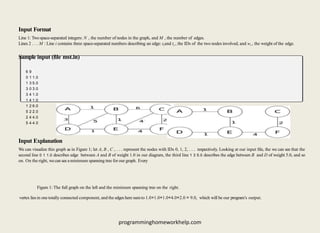
We can visualize this graph as in Figure 1; let A, B , C , . . . represent the nodes with IDs 0, 1, 2, . . . respectively. Looking at our input file, the we can see that the
second line 0 1 1.0 describes edge between A and B of weight 1.0 in our diagram, the third line 1 3 5.0 describes the edge between B and D of weight 5.0, and so
on. On the right, wecan seeaminimum spanning tree for our graph. Every
Figure 1: The full graph on the left and the minimum spanning tree on the right.
vertex liesin one totally connected component, and the edges here sumto 1.0+1.0+1.0+4.0+2.0 = 9.0, which will be our program’s output.
programminghomeworkhelp.com
Output Format
Line 1: Asingle floating-point number printed to at least 8 decimal digits of precision, representing the total weight of a minimum spanning tree for the provided
graph.
Sample output (file mst.out)
9.00000000
Template Code
If you take a look in the provided template file provided in the file mst.data.zip as a basis for your program, you’ll seesome data structures already written for
you.
#include <vector> class State {
size t node;
double dist; public:
State( size t aNode, double aDist ) : node{aNode}, dist{aDist} {} inline size t node() const { return node; }
inline double dist() const { return dist; }
};
class AdjacencyList {
std::vector< std::vector<State> > vert; AdjacencyList() = delete;
public:
AdjacencyList( std::istream &input );
inline size t size() const { return vert.size(); }
inline const std::vector<State>& vert( size t node ) const { return vert[node];
}
void print();
};
Some questions to ask yourself for understanding:
• What does AdjacencyList() = delete; mean? Why did wedo that?
• This is a fairly complicated line:
inline const std::vector<State>& vert( size t node ) const. Justify or question each use of const.
programminghomeworkhelp.com
•Why don’t we need to write our own destructor for the AdjacencyList class?
•How large is a single instance of the State class in memory, most likely?
Think these questions through and ask about anything that you’re unsure of on
Piazza.
Problem 2
programminghomeworkhelp.com
/*
PROG: mst LANG: C++
*/
#include <vector> #include <queue> #include <fstream>
#include <iostream> #include <iomanip> #include
<unordered_map>
class State { size_t _node; double _dist;
public:
State( size_t aNode, double aDist ) :
_node{aNode}, _dist{aDist} {} inline size_t node()const { return
_node; }
inline double dist()const { return
_dist; }
};
class AdjacencyList {
std::vector< std::vector< State> >
_adj;
AdjacencyList() = delete; public:
AdjacencyList( std::istream &input ); inline size_t size() const {
return
_adj.size(); }
inline const std::vector& adj(size_t node ) const { return
_adj[node]; }
void print();
programminghomeworkhelp.com
};
inline bool operator<( const State &a, const State &b ) {
return a.dist() > b.dist();
}
AdjacencyList::AdjacencyList( std::istream &input ) : _adj{} {
size_t nNodes; size_t nEdges; input >> nNodes >> nEdges;
_adj.resize( nNodes );
for( size_t e = 0; e < nEdges; ++e ) { size_t v, w; double weight;
input >> v >> w >> weight;
// Add this edge to both the v and w lists
_adj[v].push_back( State{ w, weight }
);
_adj[w].push_back( State{ v, weight }
);
}
}
void AdjacencyList::print() {
for( size_t i = 0; i < _adj.size(); ++i
) {
std::cout << i << ": ";
for( auto state : _adj[i] ) { std::cout << "(" << state.node() <<
", " << state.dist() << ") ";
programminghomeworkhelp.com
}
std::cout << "n";
}
}
double prim( const AdjacencyList &adj ) { std::unordered_map<int,
bool> visited; std::priority_queue<State> pq;
pq.push( State{ 0, 0.0 } ); double weight = 0.0;
while( visited.size() < adj.size() ) { auto top = pq.top();
pq.pop();
if( visited.count( top.node() ) == 0 )
{
visited[top.node()] = true; weight += top.dist();
for( auto vertex : adj.adj( top.node() ) ) {
pq.push( vertex );
}
}
}
return weight;
}
programminghomeworkhelp.com
int main() {
std::ifstream input{ "mst.in" }; std::ofstream
output{ "mst.out" };
if( input.is_open() ) {
auto adj = AdjacencyList{ input }; output <<
std::fixed <<
std::setprecision( 8 );
output << prim( adj ) << "n";
} else {
std::cerr << "Could not open mst.inn";
return 1;
}
return 0;
}
Below is the output using the test data:
mst:
1: OK [0.004 seconds]
2: OK [0.004 seconds]
3: OK [0.004 seconds]
4: OK [0.006 seconds]
5: OK [0.093 seconds]
6: OK [0.122 seconds]
7: OK [0.227 seconds]
8: OK [0.229 seconds]
9: OK [0.285 seconds]
10: OK [0.287 seconds]
programminghomeworkhelp.com

Computer Science Assignment Help

  • 1.
    Computer Science AssignmentHelp For any help regarding Computer Assignment Help visit: programminghomeworkhelp.com Email- support@programminghomeworkhelp.com or call us at-+1 678 648 4277 programminghomeworkhelp.com
  • 2.
    Problem 1: The C++standard template library provides us with a large number of containers and data structures that we can go ahead and use in our programs. We’ll be learning how to use a priority queue, which is available in the <queue> header. The problem we can solve using a priority queue is that of computing a minimum spanning tree. Given a fully connected undirected graph where each edge has a weight, wewould like to find the set of edges with the least total sum of weights. This may sound abstract; so here’sa concrete scenario: You’re a civil engineer and you’retrying to figure out the best way to arrange for internet accessin your small island nation of C-Land. There areN (3 ≤ N ≤ 250, 000) towns on yourisland connectedbyM (N ≤ M ≤ 250, 000) variousroadsand youcanwalk betweenany two townsonthe island bytraversing somesequenceof roads. However, you’vegot a limited budget and have determined that the cheapest way to arrange for internet access is to build somefiber-optic cables along existing roadways. You have a list of the costsof laying fiber-optic cable down along any particular road, and want to figure out how much money you’ll need to successfullycomplete the project–meaning that, at the end, every town will be connected along somesequence of fiber-optic cables. Luckily, you’re also C-Land’s resident computer scientist, and you remember hearing about Prim’ s algorithm in one of your old programming classes. This algorithm is exactly the solution to yourproblem, but it requires apriorityqueue...and ta-da! Here’ sthe C++ standard template libraryto the rescue. If this scenario is still not totally clear, look at the sample input description on the next page. Our input data describing the graph will be arranged as a list of edges (roads and their fiber-optic cost) and for our program we’ll covert that to an adjacency list: for every node in the graph (town in the country), we’ll have a list of the nodes (towns) it’sconnected to and the weight (cost of building fiber-optic cable along). adj[0]→ (1,1.0) (3,3.0) adj[1]→ (0, 1.0) (2, 6.0) (3, 5.0) (4, 1.0) . . This data structure might be a pain to allocate and keep track of everything in C. The C++ STL will simplify things. First, our adjacency list can be represented as a list of C++ vectors, one for each node. To further simplify and abstract things, we’ve created a wrapper class called AdjacencyList that you can use; it already has a method written to help with reading the input. Resource Limits Yourprogram will be allowed up to 3 seconds of runtime and 32MB of RAM. programminghomeworkhelp.com
  • 3.
    Input Format Line 1:Twospace-separated integers: N , the number of nodes in the graph, and M , the number of edges. Lines 2 . . . M : Line i contains three space-separated numbers describing an edge: siand ti , the IDs of the two nodes involved, and wi , the weight of the edge. Sample input (file mst.in) 6 9 0 1 1.0 1 3 5.0 3 0 3.0 3 4 1.0 1 4 1.0 1 2 6.0 5 2 2.0 2 4 4.0 5 4 4.0 Input Explanation We can visualize this graph as in Figure 1; let A, B , C , . . . represent the nodes with IDs 0, 1, 2, . . . respectively. Looking at our input file, the we can see that the second line 0 1 1.0 describes edge between A and B of weight 1.0 in our diagram, the third line 1 3 5.0 describes the edge between B and D of weight 5.0, and so on. On the right, wecan seeaminimum spanning tree for our graph. Every Figure 1: The full graph on the left and the minimum spanning tree on the right. vertex liesin one totally connected component, and the edges here sumto 1.0+1.0+1.0+4.0+2.0 = 9.0, which will be our program’s output. programminghomeworkhelp.com
  • 4.
    Output Format Line 1:Asingle floating-point number printed to at least 8 decimal digits of precision, representing the total weight of a minimum spanning tree for the provided graph. Sample output (file mst.out) 9.00000000 Template Code If you take a look in the provided template file provided in the file mst.data.zip as a basis for your program, you’ll seesome data structures already written for you. #include <vector> class State { size t node; double dist; public: State( size t aNode, double aDist ) : node{aNode}, dist{aDist} {} inline size t node() const { return node; } inline double dist() const { return dist; } }; class AdjacencyList { std::vector< std::vector<State> > vert; AdjacencyList() = delete; public: AdjacencyList( std::istream &input ); inline size t size() const { return vert.size(); } inline const std::vector<State>& vert( size t node ) const { return vert[node]; } void print(); }; Some questions to ask yourself for understanding: • What does AdjacencyList() = delete; mean? Why did wedo that? • This is a fairly complicated line: inline const std::vector<State>& vert( size t node ) const. Justify or question each use of const. programminghomeworkhelp.com
  • 5.
    •Why don’t weneed to write our own destructor for the AdjacencyList class? •How large is a single instance of the State class in memory, most likely? Think these questions through and ask about anything that you’re unsure of on Piazza. Problem 2 programminghomeworkhelp.com
  • 6.
    /* PROG: mst LANG:C++ */ #include <vector> #include <queue> #include <fstream> #include <iostream> #include <iomanip> #include <unordered_map> class State { size_t _node; double _dist; public: State( size_t aNode, double aDist ) : _node{aNode}, _dist{aDist} {} inline size_t node()const { return _node; } inline double dist()const { return _dist; } }; class AdjacencyList { std::vector< std::vector< State> > _adj; AdjacencyList() = delete; public: AdjacencyList( std::istream &input ); inline size_t size() const { return _adj.size(); } inline const std::vector& adj(size_t node ) const { return _adj[node]; } void print(); programminghomeworkhelp.com
  • 7.
    }; inline bool operator<(const State &a, const State &b ) { return a.dist() > b.dist(); } AdjacencyList::AdjacencyList( std::istream &input ) : _adj{} { size_t nNodes; size_t nEdges; input >> nNodes >> nEdges; _adj.resize( nNodes ); for( size_t e = 0; e < nEdges; ++e ) { size_t v, w; double weight; input >> v >> w >> weight; // Add this edge to both the v and w lists _adj[v].push_back( State{ w, weight } ); _adj[w].push_back( State{ v, weight } ); } } void AdjacencyList::print() { for( size_t i = 0; i < _adj.size(); ++i ) { std::cout << i << ": "; for( auto state : _adj[i] ) { std::cout << "(" << state.node() << ", " << state.dist() << ") "; programminghomeworkhelp.com
  • 8.
    } std::cout << "n"; } } doubleprim( const AdjacencyList &adj ) { std::unordered_map<int, bool> visited; std::priority_queue<State> pq; pq.push( State{ 0, 0.0 } ); double weight = 0.0; while( visited.size() < adj.size() ) { auto top = pq.top(); pq.pop(); if( visited.count( top.node() ) == 0 ) { visited[top.node()] = true; weight += top.dist(); for( auto vertex : adj.adj( top.node() ) ) { pq.push( vertex ); } } } return weight; } programminghomeworkhelp.com
  • 9.
    int main() { std::ifstreaminput{ "mst.in" }; std::ofstream output{ "mst.out" }; if( input.is_open() ) { auto adj = AdjacencyList{ input }; output << std::fixed << std::setprecision( 8 ); output << prim( adj ) << "n"; } else { std::cerr << "Could not open mst.inn"; return 1; } return 0; } Below is the output using the test data: mst: 1: OK [0.004 seconds] 2: OK [0.004 seconds] 3: OK [0.004 seconds] 4: OK [0.006 seconds] 5: OK [0.093 seconds] 6: OK [0.122 seconds] 7: OK [0.227 seconds] 8: OK [0.229 seconds] 9: OK [0.285 seconds] 10: OK [0.287 seconds] programminghomeworkhelp.com