Prepared by:
Biswajit Acharya
AEIE,M.Tech 1st Year
Heritage Institute of
Technology
Satellite Power Station
Present Scenario….
30%
1%34%5%
6%
24%
World Energy Consumption By Source
Coal
Renewables
Petroleum
Nuclear
Hydro
Natural Gas
Satellite Power Station
Satellite Power System Concept…
Satellite Power Station
Why SPS ???
 SPS collects solar power in space. It forms the heart of
Space Based Solar Power (SBSP) concept.
 SPS stores the solar energy in a low orbital satellite which can provide
power to almost any point on earth continuously.
 Higher collection rate;
 More intense sun light can be captured due to absence of air in space;
 They convert solar energy into microwaves and minimizes the losses due
to reflection, absorption and other factors consisting of the rotation of the
earth.
 Environment is not heated because scattering of radiations takes place in
space.
Satellite Power Station
The Thought Process…
 In 1941, science fiction writer Isaac Asimov published a science fiction
short story “Reason”, in which a space station transmitted energy
collected from the sun to various planets using microwave beams.
 In 1968, the Satellite Solar Power System (SSPS) concept was first
brought into limelight.
 In 1973, Peter Glaser brought forward a method of transmitting power
over long distances using microwaves from a very large antenna.
 Between 1978 and 1981, Department of Energy (DoE) and NASA
organized the Satellite Power System Concept Development and
Evaluation Program.
Satellite Power Station
The Thought Process Continued..
 In 1997 , NASA conducted a study to examine the modern state of SBSP
feasibility.
 In 1999, NASA's Space Solar Power Exploratory Research and
Technology program (SERT) was initiated.
 On Nov 2, 2012, China proposed space collaboration with India so that
both can work for long term association with proper funding along with
other willing space faring nations to bring space solar power to earth.
Satellite Power Station
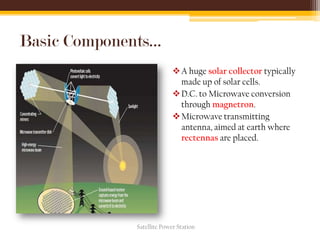
Basic Components…
A huge solar collector typically
made up of solar cells.
D.C. to Microwave conversion
through magnetron.
Microwave transmitting
antenna, aimed at earth where
rectennas are placed.
Satellite Power Station
Solar Cell…
Satellite Power Station
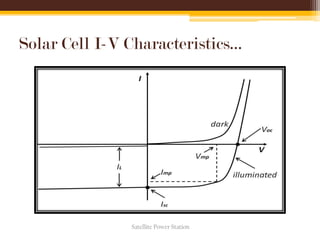
Solar Cell I-V Characteristics…
Satellite Power Station
Power Conversion…
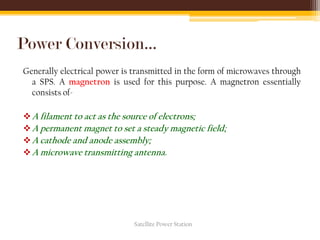
Generally electrical power is transmitted in the form of microwaves through
a SPS. A magnetron is used for this purpose. A magnetron essentially
consists of-
A filament to act as the source of electrons;
A permanent magnet to set a steady magnetic field;
A cathode and anode assembly;
A microwave transmitting antenna.
Satellite Power Station
Construction of Magnetron…
Satellite Power Station
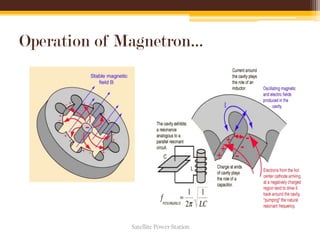
Operation of Magnetron…
Satellite Power Station
Waveguides & Launchers…
 A waveguide is a hollow
conducting tube, through which
electromagnetic waves
propagate. They are mainly of
two types:
-- Rectangular;
-- Circular.
 A launcher is an initial portion of
the waveguide, which couples the
microwave energy into the
waveguide.
Rectangular Waveguide
Waveguide LauncherSatellite Power Station
Power Transmission….
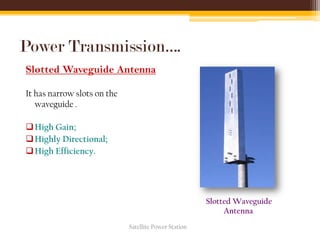
Slotted Waveguide Antenna
It has narrow slots on the
waveguide .
High Gain;
Highly Directional;
High Efficiency.
Slotted Waveguide
Antenna
Satellite Power Station
Power Transmission Contd.….
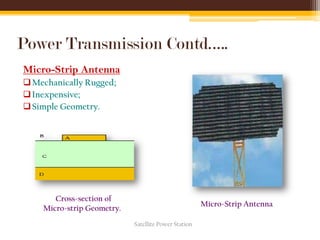
Micro-Strip Antenna
Mechanically Rugged;
Inexpensive;
Simple Geometry.
Cross-section of
Micro-strip Geometry.
Micro-Strip Antenna
Satellite Power Station
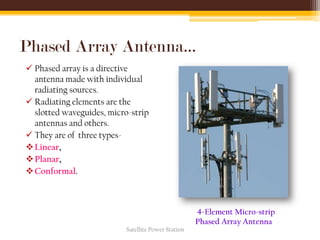
Phased Array Antenna…
 Phased array is a directive
antenna made with individual
radiating sources.
 Radiating elements are the
slotted waveguides, micro-strip
antennas and others.
 They are of three types-
Linear,
Planar,
Conformal.
4-Element Micro-strip
Phased Array Antenna
Satellite Power Station
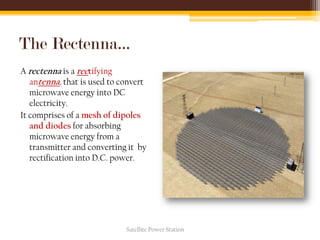
The Rectenna…
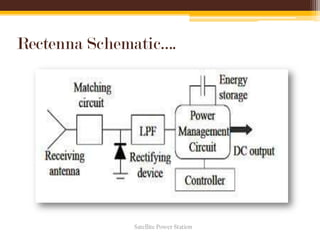
A rectenna is a rectifying
antenna, that is used to convert
microwave energy into DC
electricity.
It comprises of a mesh of dipoles
and diodes for absorbing
microwave energy from a
transmitter and converting it by
rectification into D.C. power.
Satellite Power Station
Rectenna Schematic….
Satellite Power Station
Efficiency of the Rectenna Circuit…
 DC-RF conversion efficiency, which includes losses caused by beam
forming;
 Beam collection efficiency which means ratio of all radiated power to
collected power on a receiving antenna;
 RF-DC conversion efficiency.
Maximum conversion efficiencies anticipated so far are
91.4% at 2.45 GHz and 82% at 5.8 GHz .
Satellite Power Station
Estimation…
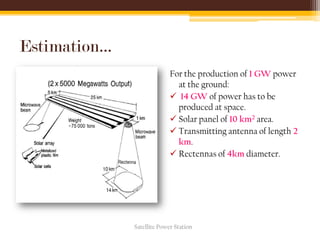
For the production of 1 GW power
at the ground:
 14 GW of power has to be
produced at space.
 Solar panel of 10 km2 area.
 Transmitting antenna of length 2
km.
 Rectennas of 4km diameter.
Satellite Power Station
Challenges…
It takes large area in space.
The large cost of launching a satellite into space (about $100 to $200 per
kg of payload).
Microwave power radiation may interfere with communication line.
Effect of microwave transmission on atmosphere, human
being, ionosphere have to be investigated and evaluated.
Maintenance of space system is a difficult and expensive task.
The large size and corresponding cost of the receiving station on the
ground.
Satellite Power Station
10MW Class SPS…
Satellite Power Station
Conclusion…
Satellite Power Station
References….
 http://es.slideshare.net/niteshmishra05/wirelesspowertransmissionvia
solarpowersatellite
 Research paper on Wireless Power Transmission for Solar Power
Satellite by T.S. Hasarmani.
 Research Journal Radio Science Centre for Space and
Atmosphere, Kyoto University, Japan
 Micro-optical Sensors, A MEMS for electric power generation.
 Energy Information Administration, EIA.
 Microwaves, by K.C Gupta.
 Conference paper by R. Trykozko on Principles of photovoltaic
conversion of solar energy.
Satellite Power Station

Satellite Power Station

  • 1.
    Prepared by: Biswajit Acharya AEIE,M.Tech1st Year Heritage Institute of Technology Satellite Power Station
  • 2.
    Present Scenario…. 30% 1%34%5% 6% 24% World EnergyConsumption By Source Coal Renewables Petroleum Nuclear Hydro Natural Gas Satellite Power Station
  • 3.
    Satellite Power SystemConcept… Satellite Power Station
  • 4.
    Why SPS ??? SPS collects solar power in space. It forms the heart of Space Based Solar Power (SBSP) concept.  SPS stores the solar energy in a low orbital satellite which can provide power to almost any point on earth continuously.  Higher collection rate;  More intense sun light can be captured due to absence of air in space;  They convert solar energy into microwaves and minimizes the losses due to reflection, absorption and other factors consisting of the rotation of the earth.  Environment is not heated because scattering of radiations takes place in space. Satellite Power Station
  • 5.
    The Thought Process… In 1941, science fiction writer Isaac Asimov published a science fiction short story “Reason”, in which a space station transmitted energy collected from the sun to various planets using microwave beams.  In 1968, the Satellite Solar Power System (SSPS) concept was first brought into limelight.  In 1973, Peter Glaser brought forward a method of transmitting power over long distances using microwaves from a very large antenna.  Between 1978 and 1981, Department of Energy (DoE) and NASA organized the Satellite Power System Concept Development and Evaluation Program. Satellite Power Station
  • 6.
    The Thought ProcessContinued..  In 1997 , NASA conducted a study to examine the modern state of SBSP feasibility.  In 1999, NASA's Space Solar Power Exploratory Research and Technology program (SERT) was initiated.  On Nov 2, 2012, China proposed space collaboration with India so that both can work for long term association with proper funding along with other willing space faring nations to bring space solar power to earth. Satellite Power Station
  • 7.
    Basic Components… A hugesolar collector typically made up of solar cells. D.C. to Microwave conversion through magnetron. Microwave transmitting antenna, aimed at earth where rectennas are placed. Satellite Power Station
  • 8.
  • 9.
    Solar Cell I-VCharacteristics… Satellite Power Station
  • 10.
    Power Conversion… Generally electricalpower is transmitted in the form of microwaves through a SPS. A magnetron is used for this purpose. A magnetron essentially consists of- A filament to act as the source of electrons; A permanent magnet to set a steady magnetic field; A cathode and anode assembly; A microwave transmitting antenna. Satellite Power Station
  • 11.
  • 12.
  • 13.
    Waveguides & Launchers… A waveguide is a hollow conducting tube, through which electromagnetic waves propagate. They are mainly of two types: -- Rectangular; -- Circular.  A launcher is an initial portion of the waveguide, which couples the microwave energy into the waveguide. Rectangular Waveguide Waveguide LauncherSatellite Power Station
  • 14.
    Power Transmission…. Slotted WaveguideAntenna It has narrow slots on the waveguide . High Gain; Highly Directional; High Efficiency. Slotted Waveguide Antenna Satellite Power Station
  • 15.
    Power Transmission Contd.…. Micro-StripAntenna Mechanically Rugged; Inexpensive; Simple Geometry. Cross-section of Micro-strip Geometry. Micro-Strip Antenna Satellite Power Station
  • 16.
    Phased Array Antenna… Phased array is a directive antenna made with individual radiating sources.  Radiating elements are the slotted waveguides, micro-strip antennas and others.  They are of three types- Linear, Planar, Conformal. 4-Element Micro-strip Phased Array Antenna Satellite Power Station
  • 17.
    The Rectenna… A rectennais a rectifying antenna, that is used to convert microwave energy into DC electricity. It comprises of a mesh of dipoles and diodes for absorbing microwave energy from a transmitter and converting it by rectification into D.C. power. Satellite Power Station
  • 18.
  • 19.
    Efficiency of theRectenna Circuit…  DC-RF conversion efficiency, which includes losses caused by beam forming;  Beam collection efficiency which means ratio of all radiated power to collected power on a receiving antenna;  RF-DC conversion efficiency. Maximum conversion efficiencies anticipated so far are 91.4% at 2.45 GHz and 82% at 5.8 GHz . Satellite Power Station
  • 20.
    Estimation… For the productionof 1 GW power at the ground:  14 GW of power has to be produced at space.  Solar panel of 10 km2 area.  Transmitting antenna of length 2 km.  Rectennas of 4km diameter. Satellite Power Station
  • 21.
    Challenges… It takes largearea in space. The large cost of launching a satellite into space (about $100 to $200 per kg of payload). Microwave power radiation may interfere with communication line. Effect of microwave transmission on atmosphere, human being, ionosphere have to be investigated and evaluated. Maintenance of space system is a difficult and expensive task. The large size and corresponding cost of the receiving station on the ground. Satellite Power Station
  • 22.
  • 23.
  • 24.
    References….  http://es.slideshare.net/niteshmishra05/wirelesspowertransmissionvia solarpowersatellite  Researchpaper on Wireless Power Transmission for Solar Power Satellite by T.S. Hasarmani.  Research Journal Radio Science Centre for Space and Atmosphere, Kyoto University, Japan  Micro-optical Sensors, A MEMS for electric power generation.  Energy Information Administration, EIA.  Microwaves, by K.C Gupta.  Conference paper by R. Trykozko on Principles of photovoltaic conversion of solar energy. Satellite Power Station
  • 25.