A Technical Seminar
on
“SOLAR POWER SATELLITE”
Presented By Under the Guidance of
B BASAVAPRABHU Dr. Jairaja R
(2GB19ME404) Assistance Professor
Department of Mechanical Engineering in
Government Engineering College
HuvinaHadagali-583219
CONTENTS
 INTRODUCTION
 WHAT IS SPS?
 WHY SPS IS USED?
 GENERAL IDEA ABOUT SPS
 WIRELESS POWER TRANSMISSION
 MICROWAVE POWER TRANSMISSION
 IN ENVIRONMENTAL ISSUES
 ADVANTAGES & DISADVANTAGES
 RECENTLY DEVELOPED
 CONCLUSION
INTRODUCTION
 The new millennium has introduced increased
pressure for finding new Renewable Energy Sources.
 Also the demand of electric power increases at a
much higher pace than other energy demands as the
world is Industrialized and Computerized.
 One of the key technologies needed to enable the
future feasibility of SPS is that of Microwave
Wireless Power Transmission (WPT).
 Solar Power Satellites is known by a variety of other
names such as Satellite Power System, Space Power
Station, Space Power System, Solar Power Station,
Space Solar Power Station etc
WHAT IS SPS?
 Solar power satellites, otherwise known as
powersats, orbit the earth and are designed to
capture solar energy and transmit that energy
to receiving stations that are situated thousands
of miles from each other on the surface of the
earth.
WHY SPS?
 Limitation of renewable energy sources.
 Environmental problems due to fossil fuels.
 Overcome day & night effect and other factors
such as clouds.
 Overcome energy crisis.
 The central feature of this concept was the
creation of a large scale power infrastructure in
space, consisting of about 60 SPS, delivering a
total of about 300GW.
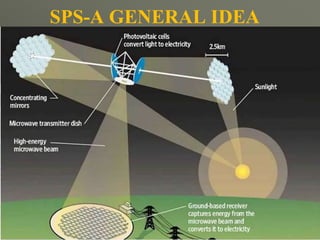
SPS-A GENERAL IDEA
SPS
 Solar Power Satellites would be located in the
geosynchronous orbit.
 The microwaves would be beamed to the Earth’s
surface.
 This direct current can then be converted to 50 or 60
Hz alternating current.
 https://youtu.be/BoxXlF9mepU
WIRELESS POWER
TRANSMISSION
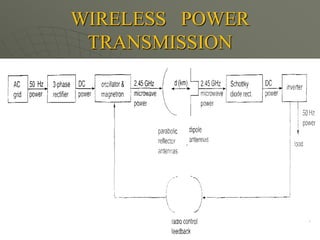
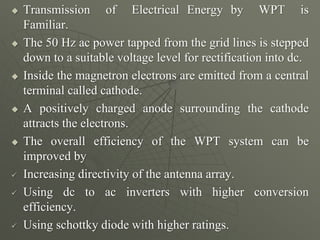
 Transmission of Electrical Energy by WPT is
Familiar.
 The 50 Hz ac power tapped from the grid lines is stepped
down to a suitable voltage level for rectification into dc.
 Inside the magnetron electrons are emitted from a central
terminal called cathode.
 A positively charged anode surrounding the cathode
attracts the electrons.
 The overall efficiency of the WPT system can be
improved by
 Increasing directivity of the antenna array.
 Using dc to ac inverters with higher conversion
efficiency.
 Using schottky diode with higher ratings.
MICROWAVE POWER
TRANSMISSION IN SPS
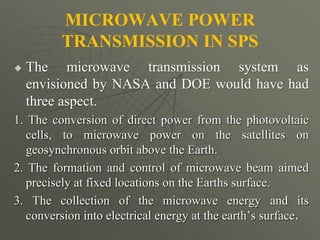
 The microwave transmission system as
envisioned by NASA and DOE would have had
three aspect.
1. The conversion of direct power from the photovoltaic
cells, to microwave power on the satellites on
geosynchronous orbit above the Earth.
2. The formation and control of microwave beam aimed
precisely at fixed locations on the Earths surface.
3. The collection of the microwave energy and its
conversion into electrical energy at the earth’s surface.
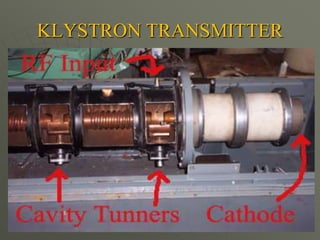
KLYSTRON TRANSMITTER
KLYSTRON
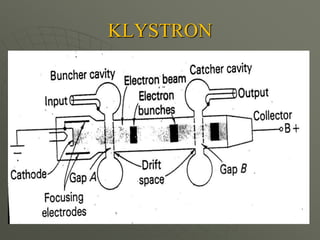
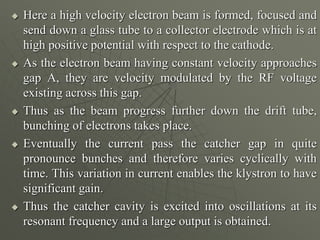
 Here a high velocity electron beam is formed, focused and
send down a glass tube to a collector electrode which is at
high positive potential with respect to the cathode.
 As the electron beam having constant velocity approaches
gap A, they are velocity modulated by the RF voltage
existing across this gap.
 Thus as the beam progress further down the drift tube,
bunching of electrons takes place.
 Eventually the current pass the catcher gap in quite
pronounce bunches and therefore varies cyclically with
time. This variation in current enables the klystron to have
significant gain.
 Thus the catcher cavity is excited into oscillations at its
resonant frequency and a large output is obtained.
RECTENNA
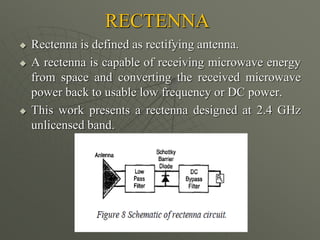
 Rectenna is defined as rectifying antenna.
 A rectenna is capable of receiving microwave energy
from space and converting the received microwave
power back to usable low frequency or DC power.
 This work presents a rectenna designed at 2.4 GHz
unlicensed band.
BEAM CONTROL
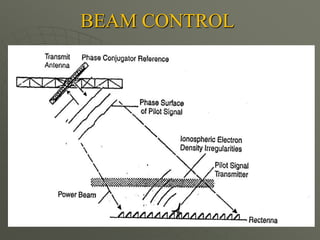
 Key system and safety aspect of WPT in its
ability to control the power beam.
 Retro directive beam control systems have
been the preferred method of achieving
accurate beam pointing.
 If a phase difference exists between the two
signals, the received signal is phase conjugated
and fed back to earth dc-RF converted.
 In the absence of the pilot signal, the transmitter
will automatically phase its power beam, and
the peak power density decreases by the ratio of
the number of transmitter elements.
MICROWAVES
ENVIRONMENTAL ISSUES
 SPS would appear as a very bright star in the
relatively dark night sky.
 On the earth, each rectenna for a full-power
SPS would be about 10km in diameter.
 The classic rectenna design would be
transparent in sunlight, permitting growth and
maintenance of vegetation under the rectenna.
ADVANTAGES
 The full solar irradiation would be available at all times expect
when the sun is eclipsed by the earth.
 The power could be directed to any point on the earth’s
surface.
 The zero gravity and high vacuum condition in space would
allow much lighter, low maintenance structures and collectors
[14].
 The power density would be uninterrupted by darkness,
clouds, or precipitation, which are the problems encountered
with earth based solar arrays.
 The realization of the SPS concept holds great promises for
solving energy crisis
 No moving parts & also No fuel required.
DISADVANTAGES
 The main draw back of solar energy transfer from orbit
is the storage of electricity during off peak demand
hours.
 The frequency of beamed radiation is planned to be at
2.45 GHz and this frequency is used by communication
satellites also.
 The entire structure is massive.
 High cost and require much time for construction.
 Radiation hazards associated with the system.
 Risks involved with multifunction.
RECENTLY DEVELOPED
 The National Space development Agency of Japan
(NASDA) invited two teams of Japanese companies to
submit proposals for a space solar power demonstration
satellite.
 The satellite would be capable of generating between 10
kilowatts and 1 megawatt of power.
 The program is aiming for a launch on the H-2A in 2005
to 2007.
 One of the teams developing design proposals consists of
Mitsubishi Heavy Industries Ltd. and NEC Toshiba
Space Systems Ltd.

CONCLUSION
 SPS will be the central attraction of space and energy
technology.
 The concept of a space solar power system that provides
power to terrestrial markets by microwave beam has
some advantages as an-approach to large-scale so
electrical power generation, but has many technical and
political barriers before it can become economically
feasible.
 A new conceptual approach to the design of the satellite
solar power station is outlined, with the advantages of a
lower initial cost and a better fit of the power generation
profile to the user requirements.
THANK YOU ALL!!

2GB19ME404[1].ppt

  • 1.
    A Technical Seminar on “SOLARPOWER SATELLITE” Presented By Under the Guidance of B BASAVAPRABHU Dr. Jairaja R (2GB19ME404) Assistance Professor Department of Mechanical Engineering in Government Engineering College HuvinaHadagali-583219
  • 2.
    CONTENTS  INTRODUCTION  WHATIS SPS?  WHY SPS IS USED?  GENERAL IDEA ABOUT SPS  WIRELESS POWER TRANSMISSION  MICROWAVE POWER TRANSMISSION  IN ENVIRONMENTAL ISSUES  ADVANTAGES & DISADVANTAGES  RECENTLY DEVELOPED  CONCLUSION
  • 3.
    INTRODUCTION  The newmillennium has introduced increased pressure for finding new Renewable Energy Sources.  Also the demand of electric power increases at a much higher pace than other energy demands as the world is Industrialized and Computerized.  One of the key technologies needed to enable the future feasibility of SPS is that of Microwave Wireless Power Transmission (WPT).  Solar Power Satellites is known by a variety of other names such as Satellite Power System, Space Power Station, Space Power System, Solar Power Station, Space Solar Power Station etc
  • 4.
    WHAT IS SPS? Solar power satellites, otherwise known as powersats, orbit the earth and are designed to capture solar energy and transmit that energy to receiving stations that are situated thousands of miles from each other on the surface of the earth.
  • 5.
    WHY SPS?  Limitationof renewable energy sources.  Environmental problems due to fossil fuels.  Overcome day & night effect and other factors such as clouds.  Overcome energy crisis.  The central feature of this concept was the creation of a large scale power infrastructure in space, consisting of about 60 SPS, delivering a total of about 300GW.
  • 6.
  • 7.
    SPS  Solar PowerSatellites would be located in the geosynchronous orbit.  The microwaves would be beamed to the Earth’s surface.  This direct current can then be converted to 50 or 60 Hz alternating current.  https://youtu.be/BoxXlF9mepU
  • 8.
  • 9.
     Transmission ofElectrical Energy by WPT is Familiar.  The 50 Hz ac power tapped from the grid lines is stepped down to a suitable voltage level for rectification into dc.  Inside the magnetron electrons are emitted from a central terminal called cathode.  A positively charged anode surrounding the cathode attracts the electrons.  The overall efficiency of the WPT system can be improved by  Increasing directivity of the antenna array.  Using dc to ac inverters with higher conversion efficiency.  Using schottky diode with higher ratings.
  • 10.
    MICROWAVE POWER TRANSMISSION INSPS  The microwave transmission system as envisioned by NASA and DOE would have had three aspect. 1. The conversion of direct power from the photovoltaic cells, to microwave power on the satellites on geosynchronous orbit above the Earth. 2. The formation and control of microwave beam aimed precisely at fixed locations on the Earths surface. 3. The collection of the microwave energy and its conversion into electrical energy at the earth’s surface.
  • 11.
  • 12.
  • 13.
     Here ahigh velocity electron beam is formed, focused and send down a glass tube to a collector electrode which is at high positive potential with respect to the cathode.  As the electron beam having constant velocity approaches gap A, they are velocity modulated by the RF voltage existing across this gap.  Thus as the beam progress further down the drift tube, bunching of electrons takes place.  Eventually the current pass the catcher gap in quite pronounce bunches and therefore varies cyclically with time. This variation in current enables the klystron to have significant gain.  Thus the catcher cavity is excited into oscillations at its resonant frequency and a large output is obtained.
  • 14.
    RECTENNA  Rectenna isdefined as rectifying antenna.  A rectenna is capable of receiving microwave energy from space and converting the received microwave power back to usable low frequency or DC power.  This work presents a rectenna designed at 2.4 GHz unlicensed band.
  • 15.
  • 16.
     Key systemand safety aspect of WPT in its ability to control the power beam.  Retro directive beam control systems have been the preferred method of achieving accurate beam pointing.  If a phase difference exists between the two signals, the received signal is phase conjugated and fed back to earth dc-RF converted.  In the absence of the pilot signal, the transmitter will automatically phase its power beam, and the peak power density decreases by the ratio of the number of transmitter elements.
  • 17.
    MICROWAVES ENVIRONMENTAL ISSUES  SPSwould appear as a very bright star in the relatively dark night sky.  On the earth, each rectenna for a full-power SPS would be about 10km in diameter.  The classic rectenna design would be transparent in sunlight, permitting growth and maintenance of vegetation under the rectenna.
  • 18.
    ADVANTAGES  The fullsolar irradiation would be available at all times expect when the sun is eclipsed by the earth.  The power could be directed to any point on the earth’s surface.  The zero gravity and high vacuum condition in space would allow much lighter, low maintenance structures and collectors [14].  The power density would be uninterrupted by darkness, clouds, or precipitation, which are the problems encountered with earth based solar arrays.  The realization of the SPS concept holds great promises for solving energy crisis  No moving parts & also No fuel required.
  • 19.
    DISADVANTAGES  The maindraw back of solar energy transfer from orbit is the storage of electricity during off peak demand hours.  The frequency of beamed radiation is planned to be at 2.45 GHz and this frequency is used by communication satellites also.  The entire structure is massive.  High cost and require much time for construction.  Radiation hazards associated with the system.  Risks involved with multifunction.
  • 20.
    RECENTLY DEVELOPED  TheNational Space development Agency of Japan (NASDA) invited two teams of Japanese companies to submit proposals for a space solar power demonstration satellite.  The satellite would be capable of generating between 10 kilowatts and 1 megawatt of power.  The program is aiming for a launch on the H-2A in 2005 to 2007.  One of the teams developing design proposals consists of Mitsubishi Heavy Industries Ltd. and NEC Toshiba Space Systems Ltd. 
  • 21.
    CONCLUSION  SPS willbe the central attraction of space and energy technology.  The concept of a space solar power system that provides power to terrestrial markets by microwave beam has some advantages as an-approach to large-scale so electrical power generation, but has many technical and political barriers before it can become economically feasible.  A new conceptual approach to the design of the satellite solar power station is outlined, with the advantages of a lower initial cost and a better fit of the power generation profile to the user requirements.
  • 22.