Jane Doe
7th
semester
Electrical Engineering
Regd.no.xxxxxxxxxx
1
2
OUTLINE
 Introduction
 Solar Power Satellite
 Microwave Power Transmission
 Issues
 Conclusion
3
INTRODUCTION
A great concern has been voiced in recent years
over the extensive use of energy, the limited supply
of resources, and pollution of the environment from
the use of present energy conversion systems.
Thus the search for alternative sources of energy is
being encouraged. The solar power satellite
(SPS) concepts envisions using the constant
availability of light in space to generate
baseload electricity on Earth.
4
5
The SPS is a gigantic satellite designed as an
electric power plant orbiting in the Geostationary
Earth Orbit (GEO). It consists of mainly three
segments; solar energy collector to convert the
solar energy into DC (direct current) electricity,
DC-to-microwave convert-er, and large antenna
array to beam down the microwave power to the
ground.
More intense sunlight.
SPS would be illuminated over 99% of the time.
No need for costly storage devices.
Power can be beamed to the location where it is
needed.
No air or water pollution is created in the
process.
6
7
POSSIBLE DESIGNS
www.spacedaily.com/images/solar
-sps-satellite-bg.jpg
8
9
www.ssi.org/assets/images/slide02.jpg
10
PROBLEMS AND POSSIBLE SOLUTIONS
Cost of transporting materials to space can be
minimized by using materials from moon or
asteroids .
Difficulty in construction can be overcome by
using International space station or moon as
construction base.
Routine maintenance can be carried out using
robots.
11
How to transmit power to earth?
12
The beamed microwave power transmission system
can be used to transmit power to earth. Its major
advantage is its ability to transfer energy across
large distances.
Basic Parts of beamed microwave power
transmission system are:-
1.DC to microwave conversion
2.A beam forming antenna.
3.Free space transmission
4.Reception and reconversion to DC
13
Beamed microwave power transmission system
DC to
microwave
conversion
Beam
forming
antenna
Free
space
transmis
sion
Reception
Conversion
to DC
70-90% 70-97% 5-95% 85-92%
Maximum possible DC-DC efficiency --- 76%
Experimental DC-DC efficiency ---54%
14
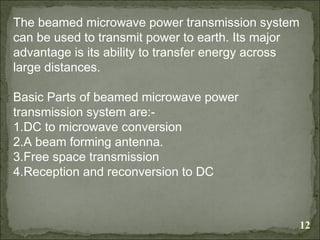
The solar energy collected is converted into electrical
energy by the solar PV cells. To transmit the power to
earth the SPS converts the DC electricity into
microwaves using an onboard cavity magnetron which
is same as an microwave oven magnetron except
being modified so as to provide directional beam with
less noise.
15
Now the microwave produced needs to be transmitted
so as to be received on earth. The efficiency of
transmission, wavelength used and the distance
depends upon the transmitter and receiver aperture.
The relationship between
aperture to aperture
efficiency and character ‫ר‬
16
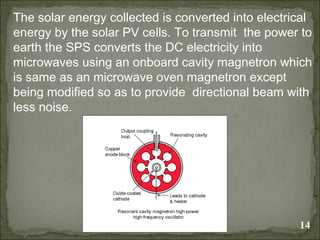
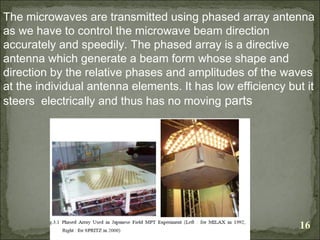
The microwaves are transmitted using phased array antenna
as we have to control the microwave beam direction
accurately and speedily. The phased array is a directive
antenna which generate a beam form whose shape and
direction by the relative phases and amplitudes of the waves
at the individual antenna elements. It has low efficiency but it
steers electrically and thus has no moving parts
17
For accurate target detection and high efficient beam
forming retro-directive system is used. Usually they
have phase conjugate circuits in transmitter or receiver
antenna. A pilot signal transmitted by the target is
received and re-radiated from the phase conjugate
circuit. If the pilot signal is received back by the target
then it is set and power is transmitted.
18
RECTENNA
It is an unique device which spreads over receiv- ing
area and combines the function of antenna and
rectifier. A simple rectenna element consists of a
dipole antenna with an RF diode connected across the
dipole elements. The diode rectifies the AC current
induced in the microwave to produce DC power. The
rectenna will be used as an array for high power MPT
because one rectenna element rectifies a few W only.
The SPS requires a rectenna array whose diameter is
over km. It has an overall efficiency of about 85%. It
has low specific mass of 1-2 kg for each KW of DC
power.
www.powersat.com/image_library.html
20
21
ENVIRONMENTAL ISSUES
A suggested microwave beam would have a
maximum intensity at its center of 23 mW/cm^2,
which is comparable to the OSHA safety limit of
10 mW/cm^2.
Over 95% of the beam energy will fall on the
rectenna. The remaining microwave energy will
be absorbed and dispersed well within standards
currently imposed upon microwave emissions
around the world.
Rectennae are supposed to be located at remote
areas.
22
LEGAL ISSUES
SPS needs to be allocated a slot in the
geosynchronous orbit which has limited capacity.
LEO(Low Earth Orbit) can come as a possible
solution.
Another legal concern of using SPS is whether the
satellites that beam energy to Earth are allowed
under international treaties that prohibit military uses
of outer space.
Microwaves may interfere with the communication
signals.
Handling space debris related to SPS may cause
legal concerns.
Too little is currently known about the technical,
economic and environmental aspects of SPS to
make a decision about it’s deployment. An SPS
research program could ultimately assure an
adequate information base for these decisions. If
future demand growth is expected to be high,
SPS might be needed early in the 21st
century,
and an increase in research effort would be
justified.
23
www.bu.edu/law/central/jd/organizations
www.bvucoepune.edu.in/pdf's
www.sspi.gatech.edu/wptshinohara.pdf
Office of Technology Assessment (OTA),
Princeton, workshop on solar power satellite
www.spacedaily.com
www.ssi.org
www.wikipedia .com
IEEE transactions on microwave theory and
techniques, vol. 40, no. 6, june 1992
24
25
26

Wireless Power Transmission using solar power satellites and microwave power transmission

  • 1.
  • 2.
    2 OUTLINE  Introduction  SolarPower Satellite  Microwave Power Transmission  Issues  Conclusion
  • 3.
    3 INTRODUCTION A great concernhas been voiced in recent years over the extensive use of energy, the limited supply of resources, and pollution of the environment from the use of present energy conversion systems. Thus the search for alternative sources of energy is being encouraged. The solar power satellite (SPS) concepts envisions using the constant availability of light in space to generate baseload electricity on Earth.
  • 4.
  • 5.
    5 The SPS isa gigantic satellite designed as an electric power plant orbiting in the Geostationary Earth Orbit (GEO). It consists of mainly three segments; solar energy collector to convert the solar energy into DC (direct current) electricity, DC-to-microwave convert-er, and large antenna array to beam down the microwave power to the ground.
  • 6.
    More intense sunlight. SPSwould be illuminated over 99% of the time. No need for costly storage devices. Power can be beamed to the location where it is needed. No air or water pollution is created in the process. 6
  • 7.
  • 8.
  • 9.
  • 10.
    10 PROBLEMS AND POSSIBLESOLUTIONS Cost of transporting materials to space can be minimized by using materials from moon or asteroids . Difficulty in construction can be overcome by using International space station or moon as construction base. Routine maintenance can be carried out using robots.
  • 11.
    11 How to transmitpower to earth?
  • 12.
    12 The beamed microwavepower transmission system can be used to transmit power to earth. Its major advantage is its ability to transfer energy across large distances. Basic Parts of beamed microwave power transmission system are:- 1.DC to microwave conversion 2.A beam forming antenna. 3.Free space transmission 4.Reception and reconversion to DC
  • 13.
    13 Beamed microwave powertransmission system DC to microwave conversion Beam forming antenna Free space transmis sion Reception Conversion to DC 70-90% 70-97% 5-95% 85-92% Maximum possible DC-DC efficiency --- 76% Experimental DC-DC efficiency ---54%
  • 14.
    14 The solar energycollected is converted into electrical energy by the solar PV cells. To transmit the power to earth the SPS converts the DC electricity into microwaves using an onboard cavity magnetron which is same as an microwave oven magnetron except being modified so as to provide directional beam with less noise.
  • 15.
    15 Now the microwaveproduced needs to be transmitted so as to be received on earth. The efficiency of transmission, wavelength used and the distance depends upon the transmitter and receiver aperture. The relationship between aperture to aperture efficiency and character ‫ר‬
  • 16.
    16 The microwaves aretransmitted using phased array antenna as we have to control the microwave beam direction accurately and speedily. The phased array is a directive antenna which generate a beam form whose shape and direction by the relative phases and amplitudes of the waves at the individual antenna elements. It has low efficiency but it steers electrically and thus has no moving parts
  • 17.
    17 For accurate targetdetection and high efficient beam forming retro-directive system is used. Usually they have phase conjugate circuits in transmitter or receiver antenna. A pilot signal transmitted by the target is received and re-radiated from the phase conjugate circuit. If the pilot signal is received back by the target then it is set and power is transmitted.
  • 18.
    18 RECTENNA It is anunique device which spreads over receiv- ing area and combines the function of antenna and rectifier. A simple rectenna element consists of a dipole antenna with an RF diode connected across the dipole elements. The diode rectifies the AC current induced in the microwave to produce DC power. The rectenna will be used as an array for high power MPT because one rectenna element rectifies a few W only. The SPS requires a rectenna array whose diameter is over km. It has an overall efficiency of about 85%. It has low specific mass of 1-2 kg for each KW of DC power.
  • 19.
  • 20.
  • 21.
    21 ENVIRONMENTAL ISSUES A suggestedmicrowave beam would have a maximum intensity at its center of 23 mW/cm^2, which is comparable to the OSHA safety limit of 10 mW/cm^2. Over 95% of the beam energy will fall on the rectenna. The remaining microwave energy will be absorbed and dispersed well within standards currently imposed upon microwave emissions around the world. Rectennae are supposed to be located at remote areas.
  • 22.
    22 LEGAL ISSUES SPS needsto be allocated a slot in the geosynchronous orbit which has limited capacity. LEO(Low Earth Orbit) can come as a possible solution. Another legal concern of using SPS is whether the satellites that beam energy to Earth are allowed under international treaties that prohibit military uses of outer space. Microwaves may interfere with the communication signals. Handling space debris related to SPS may cause legal concerns.
  • 23.
    Too little iscurrently known about the technical, economic and environmental aspects of SPS to make a decision about it’s deployment. An SPS research program could ultimately assure an adequate information base for these decisions. If future demand growth is expected to be high, SPS might be needed early in the 21st century, and an increase in research effort would be justified. 23
  • 24.
    www.bu.edu/law/central/jd/organizations www.bvucoepune.edu.in/pdf's www.sspi.gatech.edu/wptshinohara.pdf Office of TechnologyAssessment (OTA), Princeton, workshop on solar power satellite www.spacedaily.com www.ssi.org www.wikipedia .com IEEE transactions on microwave theory and techniques, vol. 40, no. 6, june 1992 24
  • 25.
  • 26.

Editor's Notes

  • #2 RF(radio frequency) energy is another name for radio waves.
  • #4 baseload:no storage required
  • #7 Spring and fall equinox satellite will be in shadow. Centre of sun along earth’s equator.
  • #9 1976
  • #10 Solar power exploratory research and technology(sert) program. Sandwich concept. SERT proposed an inflatable photovoltaic gossamer structure with concentrator lenses or solar heat engines to convert sunlight into electricity.
  • #13 Small wavelength thus less diffraction.
  • #20 www.powersat.com/ image_library.html
  • #22 Occupational safety and health act the transmitter would be too far away and too small to be able to increase the intensity to unsafe Generally perceived as dangerouus as it is used in microwave oven, but it is dangerous only in high intensity. levels, even in principle. Though this would be extremely safe as the power levels would be about equal to the leakage from a microwave oven, and only slightly more than a cell phone, the relatively diffuse microwave beam necessitates a large receiving antenna area for a significant amount of energy to be transmitted.
  • #23 International telecommunication agency geo
  • #24 Experiments in the tens of kilowatts have been performed at Goldstone in California in 1975 and more recently (1997) at Grand Bassin on Reunion Island. In 2008 a long range transmission experiment successfully transmitted 20 watts 92 miles (148 km) from a mountain on Maui to the main island of Hawaii.