CORONA / COVID 19
Introduction
 Coronavirus disease (COVID-19) is an infectious disease
caused by a newly discovered coronavirus.
 Most people infected with the COVID-19 virus will
experience mild to moderate respiratory illness and recover
without requiring special treatment. Older people, and
those with underlying medical problems like cardiovascular
disease, diabetes, chronic respiratory disease, and cancer
are more likely to develop serious illness.
 The best way to prevent and slow down transmission is to be
well informed about the COVID-19 virus, the disease it
causes and how it spreads. Protect yourself and others from
infection by washing your hands or using an alcohol based
rub frequently and not touching your face.
The COVID-19 virus spreads primarily
through droplets of saliva or discharge
from the nose when an infected person
coughs or sneezes, so it’s important
that you also practice respiratory
etiquette (for example, by coughing
into a flexed elbow).
Coronaviruses (CoV) are a large family of
viruses transmitting between animals and
people that cause illness ranging from the
common cold to more severe diseases such as
Middle East respiratory syndrome (MERS-CoV)
and severe acute respiratory syndrome (SARS-
CoV)
INCIDENCE
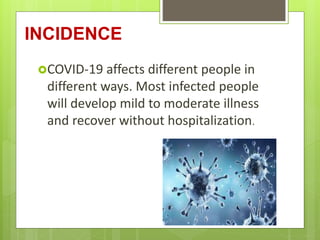
COVID-19 affects different people in
different ways. Most infected people
will develop mild to moderate illness
and recover without hospitalization.
Causes :
Coronavirus disease 2019 (COVID-19) spreads from person to
person mainly through the respiratory route after an infected
person coughs, sneezes, sings, talks or breathes. A new infection
occurs when virus-containing particles exhaled by an infected
person, either respiratory droplets or aerosols, get into the
mouth, nose, or eyes of other people who are in close contact
with the infected person.During human-to-human transmission,
an average 1000 infectious SARS-CoV-2 virions are thought to
initiate a new infection.
1 . Transmission
2 .Virology
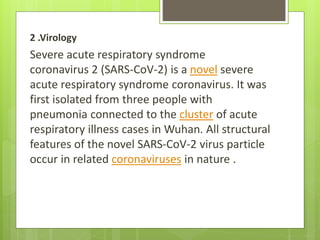
Severe acute respiratory syndrome
coronavirus 2 (SARS-CoV-2) is a novel severe
acute respiratory syndrome coronavirus. It was
first isolated from three people with
pneumonia connected to the cluster of acute
respiratory illness cases in Wuhan. All structural
features of the novel SARS-CoV-2 virus particle
occur in related coronaviruses in nature .
3 . SARS-CoV-2 variants
Three known variants of SARS-CoV-2 are spreading
among global populations As of January 2021,
including the UK Variant first found in London and
Kent, a variant discovered in South Africa, and a
variant discovered in Brazil
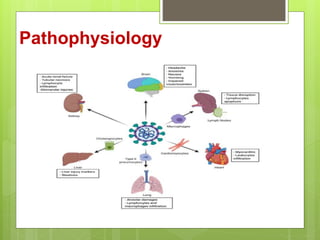
Pathophysiology
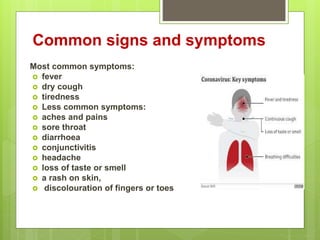
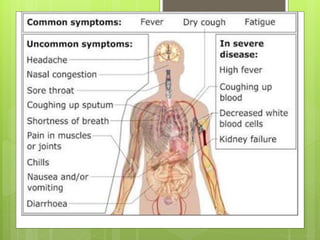
Common signs and symptoms
Most common symptoms:
 fever
 dry cough
 tiredness
 Less common symptoms:
 aches and pains
 sore throat
 diarrhoea
 conjunctivitis
 headache
 loss of taste or smell
 a rash on skin,
 discolouration of fingers or toes
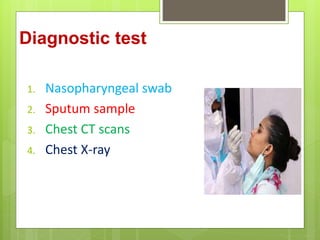
Diagnostic test
1. Nasopharyngeal swab
2. Sputum sample
3. Chest CT scans
4. Chest X-ray
Treatment
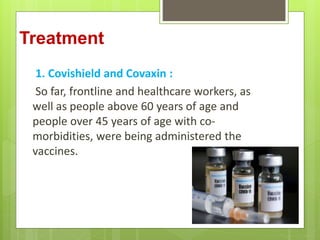
1. Covishield and Covaxin :
So far, frontline and healthcare workers, as
well as people above 60 years of age and
people over 45 years of age with co-
morbidities, were being administered the
vaccines.
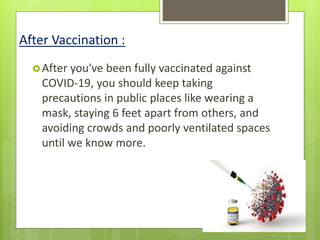
After Vaccination :
After you've been fully vaccinated against
COVID-19, you should keep taking
precautions in public places like wearing a
mask, staying 6 feet apart from others, and
avoiding crowds and poorly ventilated spaces
until we know more.
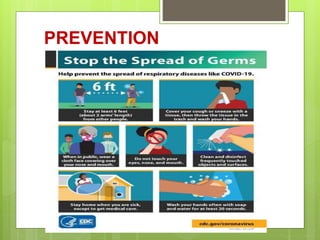
PREVENTION
THANK YOU

Covid 19 or corona ppt slideshare

  • 1.
  • 2.
    Introduction  Coronavirus disease(COVID-19) is an infectious disease caused by a newly discovered coronavirus.  Most people infected with the COVID-19 virus will experience mild to moderate respiratory illness and recover without requiring special treatment. Older people, and those with underlying medical problems like cardiovascular disease, diabetes, chronic respiratory disease, and cancer are more likely to develop serious illness.  The best way to prevent and slow down transmission is to be well informed about the COVID-19 virus, the disease it causes and how it spreads. Protect yourself and others from infection by washing your hands or using an alcohol based rub frequently and not touching your face.
  • 3.
    The COVID-19 virusspreads primarily through droplets of saliva or discharge from the nose when an infected person coughs or sneezes, so it’s important that you also practice respiratory etiquette (for example, by coughing into a flexed elbow).
  • 4.
    Coronaviruses (CoV) area large family of viruses transmitting between animals and people that cause illness ranging from the common cold to more severe diseases such as Middle East respiratory syndrome (MERS-CoV) and severe acute respiratory syndrome (SARS- CoV)
  • 5.
    INCIDENCE COVID-19 affects differentpeople in different ways. Most infected people will develop mild to moderate illness and recover without hospitalization.
  • 6.
    Causes : Coronavirus disease2019 (COVID-19) spreads from person to person mainly through the respiratory route after an infected person coughs, sneezes, sings, talks or breathes. A new infection occurs when virus-containing particles exhaled by an infected person, either respiratory droplets or aerosols, get into the mouth, nose, or eyes of other people who are in close contact with the infected person.During human-to-human transmission, an average 1000 infectious SARS-CoV-2 virions are thought to initiate a new infection. 1 . Transmission
  • 7.
    2 .Virology Severe acuterespiratory syndrome coronavirus 2 (SARS-CoV-2) is a novel severe acute respiratory syndrome coronavirus. It was first isolated from three people with pneumonia connected to the cluster of acute respiratory illness cases in Wuhan. All structural features of the novel SARS-CoV-2 virus particle occur in related coronaviruses in nature .
  • 8.
    3 . SARS-CoV-2variants Three known variants of SARS-CoV-2 are spreading among global populations As of January 2021, including the UK Variant first found in London and Kent, a variant discovered in South Africa, and a variant discovered in Brazil
  • 9.
  • 10.
    Common signs andsymptoms Most common symptoms:  fever  dry cough  tiredness  Less common symptoms:  aches and pains  sore throat  diarrhoea  conjunctivitis  headache  loss of taste or smell  a rash on skin,  discolouration of fingers or toes
  • 12.
    Diagnostic test 1. Nasopharyngealswab 2. Sputum sample 3. Chest CT scans 4. Chest X-ray
  • 13.
    Treatment 1. Covishield andCovaxin : So far, frontline and healthcare workers, as well as people above 60 years of age and people over 45 years of age with co- morbidities, were being administered the vaccines.
  • 14.
    After Vaccination : Afteryou've been fully vaccinated against COVID-19, you should keep taking precautions in public places like wearing a mask, staying 6 feet apart from others, and avoiding crowds and poorly ventilated spaces until we know more.
  • 15.
  • 16.