The Big 5 Questions for the NOW Rapid Fire  Communications Planning Building on the Smart Chart You can do this! * Lifetime Guarantee Included *
What is success? How do you get there? Planning now means success later Do a few things really well – prioritize Stay focused on your goals  Use the media & dissemination strategies to achieve them.
Make a Plan to Communicate Make communications an organizational priority & write it down Think “Dissemination” not “Media Relations” Go beyond the media Own  your target audiences Utilize proven resources/Ask for help Smart Chart Communications Trainings Ask your team
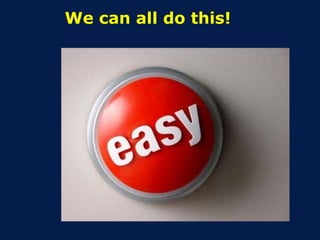
We can all do this!
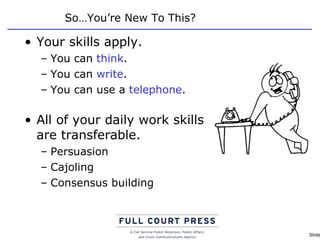
So…You’re New To This? Your skills apply. You can  think . You can  write . You can use a  telephone . All of your daily work skills  are transferable.  Persuasion Cajoling Consensus building
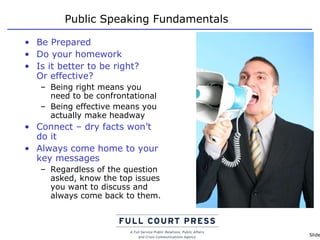
Public Speaking Fundamentals Be Prepared Do your homework Is it better to be right?  Or effective? Being right means you need to be confrontational Being effective means you actually make headway Connect – dry facts won’t do it Always come home to your key messages Regardless of the question asked, know the top issues you want to discuss and always come back to them.
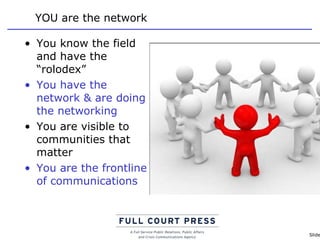
YOU are the network You know the field and have the “rolodex” You have the network & are doing the networking You are visible to communities that matter You are the frontline of communications
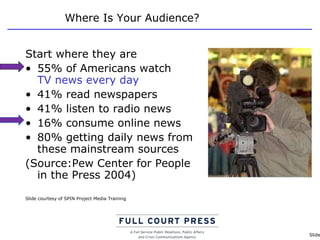
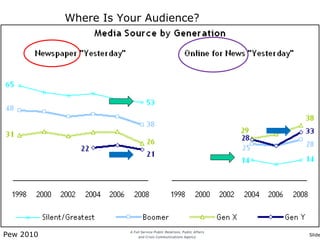
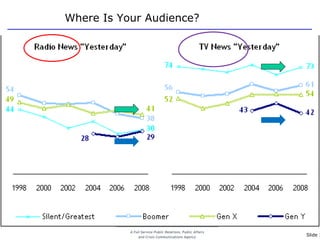
Where Is Your Audience? Start where they are 55% of Americans watch  TV news every day 41% read newspapers 41% listen to radio news 16% consume online news 80% getting daily news from these mainstream sources (Source:Pew Center for People  in the Press 2004) Slide courtesy of SPIN Project Media Training
Where Is Your Audience? Pew 2010
Where Is Your Audience?
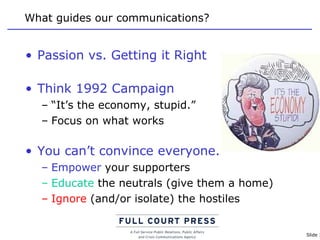
What guides our communications?  Passion vs. Getting it Right Think 1992 Campaign “ It’s the economy, stupid.” Focus on what works You can’t convince everyone.  Empower  your supporters Educate  the neutrals (give them a home) Ignore  (and/or isolate) the hostiles
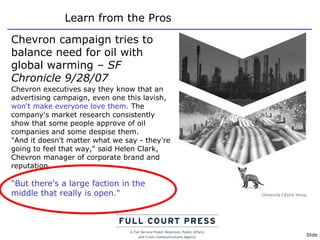
Learn from the Pros Chevron campaign tries to balance need for oil with global warming  – SF Chronicle 9/28/07 Chevron executives say they know that an advertising campaign, even one this lavish,  won't make everyone love them.  The company's market research consistently show that some people approve of oil companies and some despise them. "And it doesn't matter what we say - they're going to feel that way," said Helen Clark, Chevron manager of corporate brand and reputation.  "But there's a large faction in the middle that really is open."
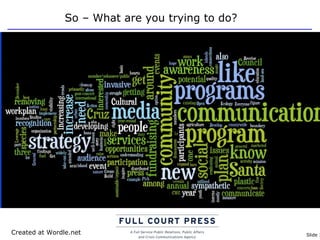
So – What are you trying to do? Created at Wordle.net
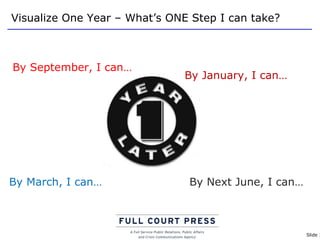
Visualize One Year – What’s ONE Step I can take? By September, I can… By January, I can… By March, I can… By Next June, I can…
THE BIG 5 Questions What objective are you trying to achieve? Can you make it SMART Who is your key Decision Maker?  Who determines your success & who influences him/her? What are our assets / challenges? Given that – who is you target audience & what do they need to hear?  What Tactics are in your toolbox (and one is, social media) & what are your timing/milestones?
What objective are you trying to achieve?  Is is SMART? Specific Measurable Attainable Realistic  Time-bound
What objective are you trying to achieve?  Is is SMART? What is the hardest element to envision? How could you be more specific? What “new” things could you measure?
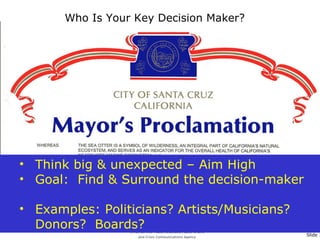
Who Is Your Key Decision Maker? Think big & unexpected – Aim High Goal:  Find & Surround the decision-maker Examples: Politicians? Artists/Musicians?  Donors?  Boards?
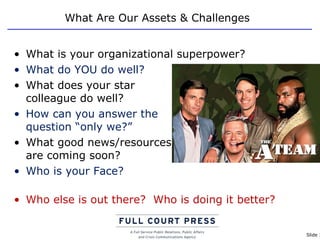
What Are Our Assets & Challenges What is your organizational superpower? What do YOU do well? What does your star  colleague do well? How can you answer the  question “only we?” What good news/resources are coming soon? Who is your Face? Who else is out there?  Who is doing it better?
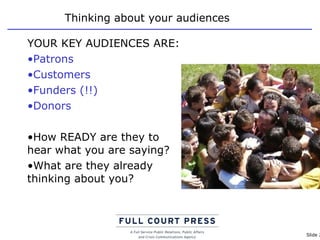
Thinking about your audiences YOUR KEY AUDIENCES ARE: Patrons Customers Funders (!!)  Donors How READY are they to hear what you are saying? What are they already thinking about you?
Thinking about your audiences What other audiences are there? Who else matters – think “narrow” Who influences those audiences – and how can you find them? What are the best ways to reach the audience? Shrink them & Surround them
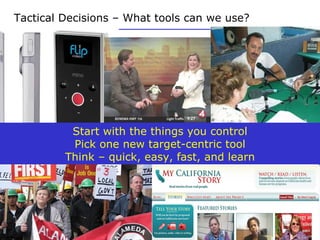
Tactical Decisions – What tools can we use? Start with the things you control Pick one new target-centric tool Think – quick, easy, fast, and learn
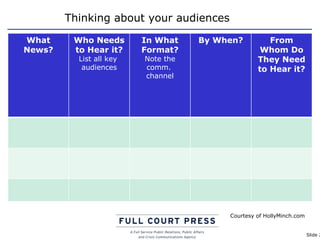
Thinking about your audiences Courtesy of HollyMinch.com What News? Who Needs to Hear it? List all key  audiences In What Format? Note the comm.  channel By When? From Whom Do They Need to Hear it?
BEYOND the Mainstream Media Thinking beyond Where is your target audience? Who do they rely on for information?  How do they make decisions? Strategies for Broader Dissemination Social Media – blogs, social networking, user-created content Direct communications – FIND THEM Attract “listenters” with your expertise Ethnic Media & Specialty Publications
THE BIG 5 Questions What are you trying to achieve? Can you make it SMART Who is your key Decision Maker?  Who determines your success & who influences him/her? What are our assets / challenges? Given that – who is you target audience & what do they need to hear?  What Tactics are in your toolbox (and one is, social media) & what are your timing/milestones?
Additional Resources SpinProject.org – resources, templates, & how-to’s SmartChart.org – tool for building your communications plan
Dan Cohen Principal Full Court Press Communications [email_address] 510-465-8294

Santa cruz

  • 1.
    The Big 5Questions for the NOW Rapid Fire Communications Planning Building on the Smart Chart You can do this! * Lifetime Guarantee Included *
  • 2.
    What is success?How do you get there? Planning now means success later Do a few things really well – prioritize Stay focused on your goals Use the media & dissemination strategies to achieve them.
  • 3.
    Make a Planto Communicate Make communications an organizational priority & write it down Think “Dissemination” not “Media Relations” Go beyond the media Own your target audiences Utilize proven resources/Ask for help Smart Chart Communications Trainings Ask your team
  • 4.
    We can alldo this!
  • 5.
    So…You’re New ToThis? Your skills apply. You can think . You can write . You can use a telephone . All of your daily work skills are transferable. Persuasion Cajoling Consensus building
  • 6.
    Public Speaking FundamentalsBe Prepared Do your homework Is it better to be right? Or effective? Being right means you need to be confrontational Being effective means you actually make headway Connect – dry facts won’t do it Always come home to your key messages Regardless of the question asked, know the top issues you want to discuss and always come back to them.
  • 7.
    YOU are thenetwork You know the field and have the “rolodex” You have the network & are doing the networking You are visible to communities that matter You are the frontline of communications
  • 8.
    Where Is YourAudience? Start where they are 55% of Americans watch TV news every day 41% read newspapers 41% listen to radio news 16% consume online news 80% getting daily news from these mainstream sources (Source:Pew Center for People in the Press 2004) Slide courtesy of SPIN Project Media Training
  • 9.
    Where Is YourAudience? Pew 2010
  • 10.
    Where Is YourAudience?
  • 11.
    What guides ourcommunications? Passion vs. Getting it Right Think 1992 Campaign “ It’s the economy, stupid.” Focus on what works You can’t convince everyone. Empower your supporters Educate the neutrals (give them a home) Ignore (and/or isolate) the hostiles
  • 12.
    Learn from thePros Chevron campaign tries to balance need for oil with global warming – SF Chronicle 9/28/07 Chevron executives say they know that an advertising campaign, even one this lavish, won't make everyone love them. The company's market research consistently show that some people approve of oil companies and some despise them. "And it doesn't matter what we say - they're going to feel that way," said Helen Clark, Chevron manager of corporate brand and reputation. "But there's a large faction in the middle that really is open."
  • 13.
    So – Whatare you trying to do? Created at Wordle.net
  • 14.
    Visualize One Year– What’s ONE Step I can take? By September, I can… By January, I can… By March, I can… By Next June, I can…
  • 15.
    THE BIG 5Questions What objective are you trying to achieve? Can you make it SMART Who is your key Decision Maker? Who determines your success & who influences him/her? What are our assets / challenges? Given that – who is you target audience & what do they need to hear? What Tactics are in your toolbox (and one is, social media) & what are your timing/milestones?
  • 16.
    What objective areyou trying to achieve? Is is SMART? Specific Measurable Attainable Realistic Time-bound
  • 17.
    What objective areyou trying to achieve? Is is SMART? What is the hardest element to envision? How could you be more specific? What “new” things could you measure?
  • 18.
    Who Is YourKey Decision Maker? Think big & unexpected – Aim High Goal: Find & Surround the decision-maker Examples: Politicians? Artists/Musicians? Donors? Boards?
  • 19.
    What Are OurAssets & Challenges What is your organizational superpower? What do YOU do well? What does your star colleague do well? How can you answer the question “only we?” What good news/resources are coming soon? Who is your Face? Who else is out there? Who is doing it better?
  • 20.
    Thinking about youraudiences YOUR KEY AUDIENCES ARE: Patrons Customers Funders (!!) Donors How READY are they to hear what you are saying? What are they already thinking about you?
  • 21.
    Thinking about youraudiences What other audiences are there? Who else matters – think “narrow” Who influences those audiences – and how can you find them? What are the best ways to reach the audience? Shrink them & Surround them
  • 22.
    Tactical Decisions –What tools can we use? Start with the things you control Pick one new target-centric tool Think – quick, easy, fast, and learn
  • 23.
    Thinking about youraudiences Courtesy of HollyMinch.com What News? Who Needs to Hear it? List all key audiences In What Format? Note the comm. channel By When? From Whom Do They Need to Hear it?
  • 24.
    BEYOND the MainstreamMedia Thinking beyond Where is your target audience? Who do they rely on for information? How do they make decisions? Strategies for Broader Dissemination Social Media – blogs, social networking, user-created content Direct communications – FIND THEM Attract “listenters” with your expertise Ethnic Media & Specialty Publications
  • 25.
    THE BIG 5Questions What are you trying to achieve? Can you make it SMART Who is your key Decision Maker? Who determines your success & who influences him/her? What are our assets / challenges? Given that – who is you target audience & what do they need to hear? What Tactics are in your toolbox (and one is, social media) & what are your timing/milestones?
  • 26.
    Additional Resources SpinProject.org– resources, templates, & how-to’s SmartChart.org – tool for building your communications plan
  • 27.
    Dan Cohen PrincipalFull Court Press Communications [email_address] 510-465-8294