What makes good research?
Michele Madden
2
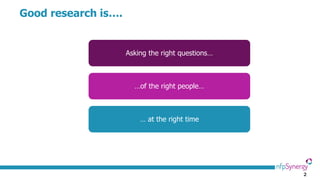
Good research is….
Asking the right questions…
…of the right people…
… at the right time
3
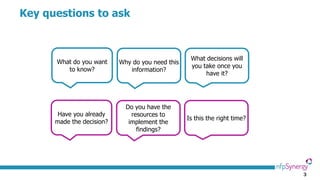
Key questions to ask
What do you want
to know?
Why do you need this
information?
What decisions will
you take once you
have it?
Have you already
made the decision?
Do you have the
resources to
implement the
findings?
Is this the right time?
4
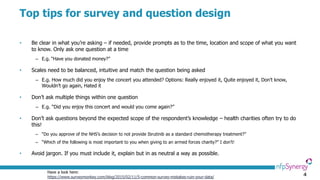
Top tips for survey and question design
• Be clear in what you’re asking – if needed, provide prompts as to the time, location and scope of what you want
to know. Only ask one question at a time
– E.g. “Have you donated money?”
• Scales need to be balanced, intuitive and match the question being asked
– E.g. How much did you enjoy the concert you attended? Options: Really enjoyed it, Quite enjoyed it, Don’t know,
Wouldn’t go again, Hated it
• Don’t ask multiple things within one question
– E.g. “Did you enjoy this concert and would you come again?”
• Don’t ask questions beyond the expected scope of the respondent’s knowledge – health charities often try to do
this!
– “Do you approve of the NHS’s decision to not provide Ibrutinib as a standard chemotherapy treatment?”
– “Which of the following is most important to you when giving to an armed forces charity?” I don’t!
• Avoid jargon. If you must include it, explain but in as neutral a way as possible.
Have a look here:
https://www.surveymonkey.com/blog/2015/02/11/5-common-survey-mistakes-ruin-your-data/
5
More considerations
• Do not ask leading questions!
– “How much do you think you have improved over the last term?”
• Don’t jump around topics – consider the natural flow of the survey
– Explain what’s happening to the respondent
• Subtly reassure respondents it’s ok to answer negatively
– “Some people feel at ease about being around and interacting with people with a disability or sensory impairment condition, while
others find it very uncomfortable. Please select the statement you think would apply to you most when thinking about people with
the following conditions/symptoms”
• If you’ve told respondents what the survey is about, try not to ask questions that seem unrelated
• Demographics can influence how you answer – have them at the end unless needed for quotas
Online Surveys:
• Consider the need for required questions
• Progress bars work best at the bottom and without numbers!
6
Tools
• Basic counting – calls, service users, downloads etc.
• Is there any data that is already being collected that you can use? Remember that not all measures need to be
research based; number of unique visitors to your website, staff turnover or sickness are valid measures.
• SWOT, PESTLE, Competitor mapping (audience, theme and reach)
o Ad hoc and on-going
• Critical friends
• Existing research,
o trends, stats and generic
• Your own knowledge
o ad hoc feedback
o who impressed/disappointed you
• Assessment of previous performance
• One key question – include in different places
7
Reporting
• Be honest and upfront about any weaknesses in the research methodology – people more likely to believe you
• Don’t overuse complex graphs and metrics, make stats and facts accessible in the narrative
• Make it impactful, but not sensationalist
⁻ don’t exaggerate, take things out of context, twist the findings – comes back to bite you!
⁻ be careful with percentages and quotes
⁻ think about the participants – would they want to be represented like this?
• Case studies and quotes
⁻ Ensure they are representative of the data and not the ‘strongest’ or ‘weakest’ example of someone’s feelings
8
There is no ‘perfect’ methodology but these are the
5 things we most often see go wrong…
1. Not planning properly; research planned with no reference to internal timetables – planning, mailing, budgeting,
or not involving the right people
2. Unrealistic timescales – too fast or too slow, or being led by internal deadlines “I’ve promised the trustees….”
3. Over-estimating your ability to reach the target audience; how many people will be willing to take part – ensure
sufficient resources are available to recruit, skewed recruitment – need to work hard to get people to attend/take
part who are representative of the wider group
4. Underestimating how long set up and analysis takes - research is not just about the focus group or questionnaire,
the thinking before and after are as important, these elements always get squeezed
5. Communicating the findings badly
9
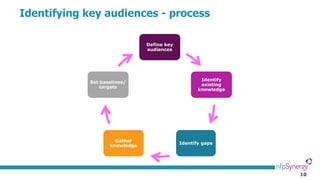
Key audiences
10
Define key
audiences
Identify
existing
knowledge
Identify gaps
Gather
knowledge
Set baselines/
targets
Identifying key audiences - process
11
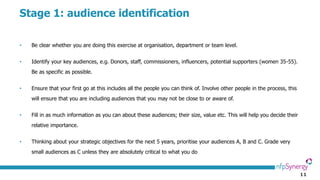
Stage 1: audience identification
• Be clear whether you are doing this exercise at organisation, department or team level.
• Identify your key audiences, e.g. Donors, staff, commissioners, influencers, potential supporters (women 35-55).
Be as specific as possible.
• Ensure that your first go at this includes all the people you can think of. Involve other people in the process, this
will ensure that you are including audiences that you may not be close to or aware of.
• Fill in as much information as you can about these audiences; their size, value etc. This will help you decide their
relative importance.
• Thinking about your strategic objectives for the next 5 years, prioritise your audiences A, B and C. Grade very
small audiences as C unless they are absolutely critical to what you do
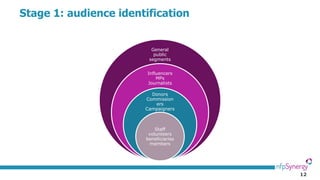
12
General
public
segments
Influencers
MPs
Journalists
Donors
Commission
ers
Campaigners
Staff
volunteers
beneficiaries
members
Stage 1: audience identification
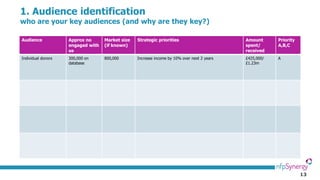
13
1. Audience identification
who are your key audiences (and why are they key?)
Audience Approx no
engaged with
us
Market size
(if known)
Strategic priorities Amount
spent/
received
Priority
A,B,C
Individual donors 300,000 on
database
800,000 Increase income by 10% over next 2 years £425,000/
£1.23m
A
14
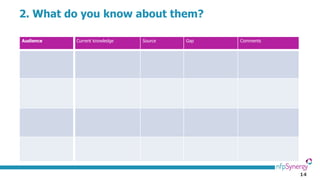
2. What do you know about them?
Audience Current knowledge Source Gap Comments
15
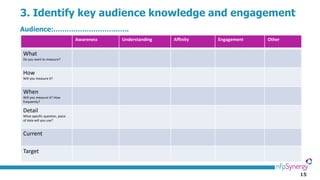
3. Identify key audience knowledge and engagement
Audience:…………………………….
Awareness Understanding Affinity Engagement Other
What
Do you want to measure?
How
Will you measure it?
When
Will you measure it? How
frequently?
Detail
What specific question, piece
of data will you use?
Current
Target
16
2-6 Tenter Ground
Spitalfields
London E1 7NH
www.nfpsynergy.net
+44 (0)20 7426 8888
Michele.madden@nfpsynergy.net
nfpsynergy
nfpsynergy
nfpsynergy
Registered office: 2-6 Tenter Ground Spitalfields London E1 7NH. Registered in England No. 04387900. VAT Registration 839 8186 72
Wales networking group
Audience Insight
Wales Networking Group
05 February 2020
Cardiff
#CCwales
Visit the CharityComms website to view
slides from past events, see what events
we have coming up and to check out
what else we do:
www.charitycomms.org.uk

What makes good research

  • 1.
    What makes goodresearch? Michele Madden
  • 2.
    2 Good research is…. Askingthe right questions… …of the right people… … at the right time
  • 3.
    3 Key questions toask What do you want to know? Why do you need this information? What decisions will you take once you have it? Have you already made the decision? Do you have the resources to implement the findings? Is this the right time?
  • 4.
    4 Top tips forsurvey and question design • Be clear in what you’re asking – if needed, provide prompts as to the time, location and scope of what you want to know. Only ask one question at a time – E.g. “Have you donated money?” • Scales need to be balanced, intuitive and match the question being asked – E.g. How much did you enjoy the concert you attended? Options: Really enjoyed it, Quite enjoyed it, Don’t know, Wouldn’t go again, Hated it • Don’t ask multiple things within one question – E.g. “Did you enjoy this concert and would you come again?” • Don’t ask questions beyond the expected scope of the respondent’s knowledge – health charities often try to do this! – “Do you approve of the NHS’s decision to not provide Ibrutinib as a standard chemotherapy treatment?” – “Which of the following is most important to you when giving to an armed forces charity?” I don’t! • Avoid jargon. If you must include it, explain but in as neutral a way as possible. Have a look here: https://www.surveymonkey.com/blog/2015/02/11/5-common-survey-mistakes-ruin-your-data/
  • 5.
    5 More considerations • Donot ask leading questions! – “How much do you think you have improved over the last term?” • Don’t jump around topics – consider the natural flow of the survey – Explain what’s happening to the respondent • Subtly reassure respondents it’s ok to answer negatively – “Some people feel at ease about being around and interacting with people with a disability or sensory impairment condition, while others find it very uncomfortable. Please select the statement you think would apply to you most when thinking about people with the following conditions/symptoms” • If you’ve told respondents what the survey is about, try not to ask questions that seem unrelated • Demographics can influence how you answer – have them at the end unless needed for quotas Online Surveys: • Consider the need for required questions • Progress bars work best at the bottom and without numbers!
  • 6.
    6 Tools • Basic counting– calls, service users, downloads etc. • Is there any data that is already being collected that you can use? Remember that not all measures need to be research based; number of unique visitors to your website, staff turnover or sickness are valid measures. • SWOT, PESTLE, Competitor mapping (audience, theme and reach) o Ad hoc and on-going • Critical friends • Existing research, o trends, stats and generic • Your own knowledge o ad hoc feedback o who impressed/disappointed you • Assessment of previous performance • One key question – include in different places
  • 7.
    7 Reporting • Be honestand upfront about any weaknesses in the research methodology – people more likely to believe you • Don’t overuse complex graphs and metrics, make stats and facts accessible in the narrative • Make it impactful, but not sensationalist ⁻ don’t exaggerate, take things out of context, twist the findings – comes back to bite you! ⁻ be careful with percentages and quotes ⁻ think about the participants – would they want to be represented like this? • Case studies and quotes ⁻ Ensure they are representative of the data and not the ‘strongest’ or ‘weakest’ example of someone’s feelings
  • 8.
    8 There is no‘perfect’ methodology but these are the 5 things we most often see go wrong… 1. Not planning properly; research planned with no reference to internal timetables – planning, mailing, budgeting, or not involving the right people 2. Unrealistic timescales – too fast or too slow, or being led by internal deadlines “I’ve promised the trustees….” 3. Over-estimating your ability to reach the target audience; how many people will be willing to take part – ensure sufficient resources are available to recruit, skewed recruitment – need to work hard to get people to attend/take part who are representative of the wider group 4. Underestimating how long set up and analysis takes - research is not just about the focus group or questionnaire, the thinking before and after are as important, these elements always get squeezed 5. Communicating the findings badly
  • 9.
  • 10.
  • 11.
    11 Stage 1: audienceidentification • Be clear whether you are doing this exercise at organisation, department or team level. • Identify your key audiences, e.g. Donors, staff, commissioners, influencers, potential supporters (women 35-55). Be as specific as possible. • Ensure that your first go at this includes all the people you can think of. Involve other people in the process, this will ensure that you are including audiences that you may not be close to or aware of. • Fill in as much information as you can about these audiences; their size, value etc. This will help you decide their relative importance. • Thinking about your strategic objectives for the next 5 years, prioritise your audiences A, B and C. Grade very small audiences as C unless they are absolutely critical to what you do
  • 12.
  • 13.
    13 1. Audience identification whoare your key audiences (and why are they key?) Audience Approx no engaged with us Market size (if known) Strategic priorities Amount spent/ received Priority A,B,C Individual donors 300,000 on database 800,000 Increase income by 10% over next 2 years £425,000/ £1.23m A
  • 14.
    14 2. What doyou know about them? Audience Current knowledge Source Gap Comments
  • 15.
    15 3. Identify keyaudience knowledge and engagement Audience:……………………………. Awareness Understanding Affinity Engagement Other What Do you want to measure? How Will you measure it? When Will you measure it? How frequently? Detail What specific question, piece of data will you use? Current Target
  • 16.
    16 2-6 Tenter Ground Spitalfields LondonE1 7NH www.nfpsynergy.net +44 (0)20 7426 8888 Michele.madden@nfpsynergy.net nfpsynergy nfpsynergy nfpsynergy Registered office: 2-6 Tenter Ground Spitalfields London E1 7NH. Registered in England No. 04387900. VAT Registration 839 8186 72
  • 17.
    Wales networking group AudienceInsight Wales Networking Group 05 February 2020 Cardiff #CCwales
  • 18.
    Visit the CharityCommswebsite to view slides from past events, see what events we have coming up and to check out what else we do: www.charitycomms.org.uk