INDIAN
PHILOSOPHY
Indian Philosophy
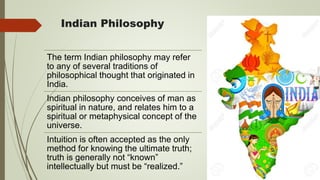
The term Indian philosophy may refer
to any of several traditions of
philosophical thought that originated in
India.
Indian philosophy conceives of man as
spiritual in nature, and relates him to a
spiritual or metaphysical concept of the
universe.
Intuition is often accepted as the only
method for knowing the ultimate truth;
truth is generally not “known”
intellectually but must be “realized.”
Common ideas in the
system of Indian
Philosophy
The reality of world
The reality of self
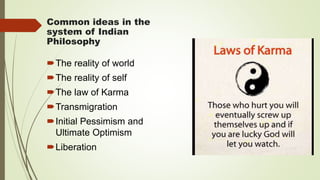
The law of Karma
Transmigration
Initial Pessimism and
Ultimate Optimism
Liberation
Outline of Indian Philosophy
 Vedic Period (2500 B.C. – 600 B.C.)
 Epic Period (600 B.C. – 200 A.D.)
 Sutra Period (200 A.D. – 600 A.D.)
 Scholarly Period (600 A.D. – 1700
A.D.)
 The Modern Period (1700 – present)
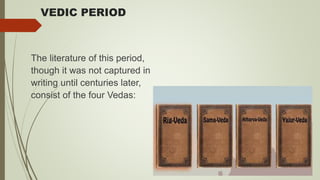
VEDIC PERIOD
The literature of this period,
though it was not captured in
writing until centuries later,
consist of the four Vedas:
Each Veda has four parts
Hymnal portion (mantras)
Ritual portion (brahmanas)
Forest teachings (aranyakas)
Philosophical portion (upanishads)
They were composed around 1500 B.C.
EPIC PERIOD
 This period is characterized by
the informal presentation of
philosophical doctrines through
nonsystematic literature, such as
the great epics, the Ramayana
and the Mahabharata.
 This period includes the rise of
Buddhism, Jainism, and the
concurrent beginnings of the
orthodox schools of Hinduism.
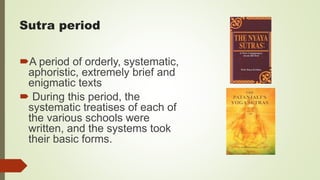
Sutra period
A period of orderly, systematic,
aphoristic, extremely brief and
enigmatic texts
 During this period, the
systematic treatises of each of
the various schools were
written, and the systems took
their basic forms.
Scholastic period
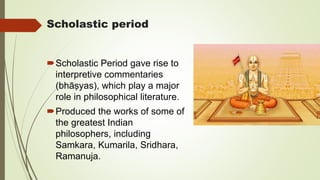
Scholastic Period gave rise to
interpretive commentaries
(bhāṣyas), which play a major
role in philosophical literature.
Produced the works of some of
the greatest Indian
philosophers, including
Samkara, Kumarila, Sridhara,
Ramanuja.
Schools of Indian
Philosophy
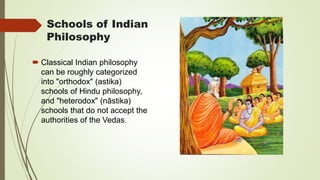
 Classical Indian philosophy
can be roughly categorized
into "orthodox" (astika)
schools of Hindu philosophy,
and "heterodox" (nāstika)
schools that do not accept the
authorities of the Vedas.
Orthodox school
 Nyaya, the school of logic
 Vaisheshika, the atomist school
 Samkhya, the enumeration school
 Yoga, the school of Patanjali (which assumes the metaphysics of
Samkhya)
 Purva Mimamsa (or simply Mimamsa), the tradition of Vedic
exegesis, with emphasis on Vedic ritual, and
 Vedanta (also called Uttara Mimamsa), the Upanishadic tradition,
with emphasis on Vedic philosophy.
Heterodox Schools
Carvaka- Carvaka is a materialistic, skeptical and
atheistic school of thought.
Budhist philosophy- non-theistic system of beliefs
based on the teachings of Siddhartha Gautama, an
Indian prince later known as the Buddha
Jain Philosophy- established by Mahavira in the 6th
Century .
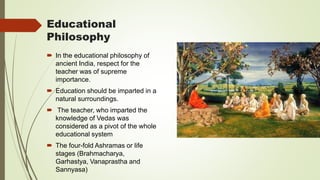
Educational
Philosophy
 In the educational philosophy of
ancient India, respect for the
teacher was of supreme
importance.
 Education should be imparted in a
natural surroundings.
 The teacher, who imparted the
knowledge of Vedas was
considered as a pivot of the whole
educational system
 The four-fold Ashramas or life
stages (Brahmacharya,
Garhastya, Vanaprastha and
Sannyasa)
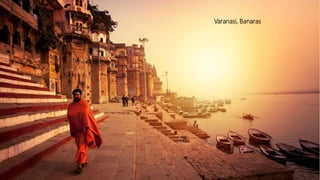
Varanasi, Banaras
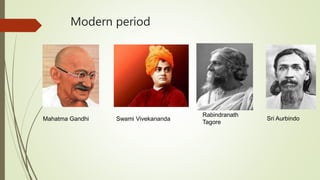
Modern period
Mahatma Gandhi Swami Vivekananda
Rabindranath
Tagore
Sri Aurbindo
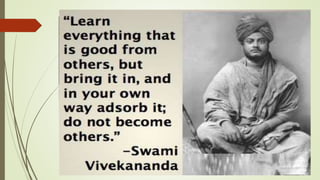
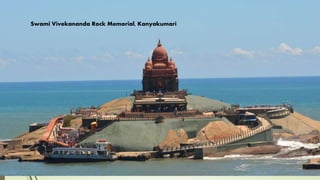
Swami Vivekananda Rock Memorial, Kanyakumari
Discussion
How is Indian Philosophy different from western
Philosophy?
References
 Indian Philosophy. Retrieved from
https://www.philosophybasics.com/general_eastern_indian.html.
 Indian philosophy. Retrieved from
https://www.newworldencyclopedia.org/entry/indian_philosophy
 Historical development of Indian philosophy. Retrieved from
https://www.britannica.com/topic/Indian-philosophy/Historical-development-of-
Indian-philosophy
 Hiriyani.M (1994).Outlines of Indian Philosophy.29-155.
 https://www.youtube.com/watch?v=PnN1bgqnUDc
Thankyou

Indian philosophy

  • 1.
  • 2.
    Indian Philosophy The termIndian philosophy may refer to any of several traditions of philosophical thought that originated in India. Indian philosophy conceives of man as spiritual in nature, and relates him to a spiritual or metaphysical concept of the universe. Intuition is often accepted as the only method for knowing the ultimate truth; truth is generally not “known” intellectually but must be “realized.”
  • 3.
    Common ideas inthe system of Indian Philosophy The reality of world The reality of self The law of Karma Transmigration Initial Pessimism and Ultimate Optimism Liberation
  • 4.
    Outline of IndianPhilosophy  Vedic Period (2500 B.C. – 600 B.C.)  Epic Period (600 B.C. – 200 A.D.)  Sutra Period (200 A.D. – 600 A.D.)  Scholarly Period (600 A.D. – 1700 A.D.)  The Modern Period (1700 – present)
  • 5.
    VEDIC PERIOD The literatureof this period, though it was not captured in writing until centuries later, consist of the four Vedas:
  • 6.
    Each Veda hasfour parts Hymnal portion (mantras) Ritual portion (brahmanas) Forest teachings (aranyakas) Philosophical portion (upanishads) They were composed around 1500 B.C.
  • 7.
    EPIC PERIOD  Thisperiod is characterized by the informal presentation of philosophical doctrines through nonsystematic literature, such as the great epics, the Ramayana and the Mahabharata.  This period includes the rise of Buddhism, Jainism, and the concurrent beginnings of the orthodox schools of Hinduism.
  • 9.
    Sutra period A periodof orderly, systematic, aphoristic, extremely brief and enigmatic texts  During this period, the systematic treatises of each of the various schools were written, and the systems took their basic forms.
  • 10.
    Scholastic period Scholastic Periodgave rise to interpretive commentaries (bhāṣyas), which play a major role in philosophical literature. Produced the works of some of the greatest Indian philosophers, including Samkara, Kumarila, Sridhara, Ramanuja.
  • 11.
    Schools of Indian Philosophy Classical Indian philosophy can be roughly categorized into "orthodox" (astika) schools of Hindu philosophy, and "heterodox" (nāstika) schools that do not accept the authorities of the Vedas.
  • 12.
    Orthodox school  Nyaya,the school of logic  Vaisheshika, the atomist school  Samkhya, the enumeration school  Yoga, the school of Patanjali (which assumes the metaphysics of Samkhya)  Purva Mimamsa (or simply Mimamsa), the tradition of Vedic exegesis, with emphasis on Vedic ritual, and  Vedanta (also called Uttara Mimamsa), the Upanishadic tradition, with emphasis on Vedic philosophy.
  • 13.
    Heterodox Schools Carvaka- Carvakais a materialistic, skeptical and atheistic school of thought. Budhist philosophy- non-theistic system of beliefs based on the teachings of Siddhartha Gautama, an Indian prince later known as the Buddha Jain Philosophy- established by Mahavira in the 6th Century .
  • 14.
    Educational Philosophy  In theeducational philosophy of ancient India, respect for the teacher was of supreme importance.  Education should be imparted in a natural surroundings.  The teacher, who imparted the knowledge of Vedas was considered as a pivot of the whole educational system  The four-fold Ashramas or life stages (Brahmacharya, Garhastya, Vanaprastha and Sannyasa)
  • 15.
  • 16.
    Modern period Mahatma GandhiSwami Vivekananda Rabindranath Tagore Sri Aurbindo
  • 18.
    Swami Vivekananda RockMemorial, Kanyakumari
  • 19.
    Discussion How is IndianPhilosophy different from western Philosophy?
  • 20.
    References  Indian Philosophy.Retrieved from https://www.philosophybasics.com/general_eastern_indian.html.  Indian philosophy. Retrieved from https://www.newworldencyclopedia.org/entry/indian_philosophy  Historical development of Indian philosophy. Retrieved from https://www.britannica.com/topic/Indian-philosophy/Historical-development-of- Indian-philosophy  Hiriyani.M (1994).Outlines of Indian Philosophy.29-155.  https://www.youtube.com/watch?v=PnN1bgqnUDc
  • 21.

Editor's Notes

  • #2 a Persian princess who died on 17 June that year, giving birth to their 14th child-20,000 workers . It is believed that the Taj Mahal was constructed in such a way that the white marble reflects the sky. So, the monument changes its colours during the day.Reportedly, it took 1,000 elephants and an untold number 
  • #3 It takes an introspective approach to reality, concerning itself with knowledge of the inner life and self of man (atmavidya), rather than with the nature and structure of tt is a key concept in Hinduism, and refers to the four proper goals or aims of a human life. The four puruṣārthas are Dharma (righteousness, moral values), Artha (prosperity, economic values), Kama (pleasure, love, psychological values) and Moksha (liberation, spiritual values).[ he physical world. embody the doctrines of karma and rebirth; man must be perfected before he can achieve salvation. 
  • #6 God taught the Vedic hymns to the sages, who then handed them down through generations by word of mouth.
  • #7 Thus mantra is that which protects the mind. religious duties. …..intend to serve as objects of meditation for ascetics who live in forests and deal with mysticism and symbolism.
  • #8 Ramayana two major Sanskrit epics of ancient India, Along with the Mahābhārata, it forms the Hindu Itihasa.(history-religious story that tells what happened in the past) The epic, traditionally ascribed to the Maharshi Valmiki, narrates the life of Rama, the legendary prince of the Kosala Kingdom. It narrates the struggle between two groups of cousins in the Kurukshetra War and the fates of the Kaurava and the Pāṇḍava princes and their is attributed to Vyāsa
  • #10 The doctrines were presented in brief, aphoristic sutras, which some scholars believed were simple aids to memory, intended to evoke the substance of much more elaborate philosophical discussions with which the initiated were already familiar through oral tradition.
  • #11 Because the sutra form is by nature brief, their meanings were not always clear. In some cases, different authors wrote major commentaries on the same sutra-work, but with very different interpretations reflecting their own philosophical positions, and resulting in complete and elaborate philosophical systems of their own Ramanuja accepted that the Vedas are a reliable source of knowledge, then critiqued other schools of Hindu philosophy, including Advaita Vedānta, as having failed in interpreting all of the Vedic texts
  • #12 Orthodox- and they take the ancient Vedas (the oldest sacred texts of Hinduism) as their source and scriptural authority:
  • #13 Nyaya- Its followers believe that obtaining valid knowledge (the four sources of which are perception, inference, comparison and testimony) is the only way to gain release from suffering. The basis of the school's The Vaisheshika and Nyaya schools eventually merged because of their closely related metaphysical theories philosophy is that all objects in the physical universe are reducible to a finite number of atoms, Samkhya is the oldest of the orthodox philosophical systems, and it postulates that \something can never be produced out of nothing.  This universe is the result of the mutual contact of prakriti (nature) and purusha (person).   The practical method of the Yoga philosophy is called the Astanga Yoga (set of eight (asta) limbs (anga)). practice of Astanga Yoga relieves one from the past sins and paves way to liberation. The main objective of the Purva Mimamsa school is to interpret and establish the authority of the Vedas. The Vedanta focus on meditation, self-discipline and spiritual connectivity, more than traditional ritualism. The Vedanta, or Uttara Mimamsa, school concentrates on the philosophical teachings of the Upanishads (mystic or spiritual contemplations within the Vedas), rather than the Brahmanas (instructions for ritual and sacrifice).
  • #14 Jain-the idea that reality is perceived differently from different points of view, and that no single point of view is completely true  those who have infinite knowledge, can know the true answer, and that all others would only know a part of the answer.
  • #15 The basic purpose of education, it was stressed, does not end with the education of the students at the first stage but it should help them move towards the other stages of life. (student), Grihastha (householder)-This ashram is the only one permitting sexual gratification., Vanaprastha (retired)  but all sexual relationships are forbidden. and Sannyasa (renunciate)It should help the individual to understand the processes to engage in self-realization- living a life dependent on God alone. This position is traditionally available only to men who exhibit the qualities of a brahmana. The man would leave home and family and was prohibited from seeing his wife again. Considered civilly dead, he was free to wander, living a life dependent on God alone. 
  • #17 was an Indian Hindu monk. He was a key figure in the introduction of the Indian philosophies of Vedanta and Yoga to the Western world[ poet, musician, and artist. he first non-European to win the Nobel Prize in Literature Sri Aurobindo was an Indian philosopher, yogi, guru, poet, and nationalist. spiritual reformer, introducing his visions on human progress and spiritual evolution. If someone slaps you on one side of your face, turn the other one to him."
  • #19 Swami Vivekananda who is said to have attained enlightenment on the rock. Standing on India's southernmost tip, it was built in 1970