Dr. Vijay Kumar
Faculty, School of Education
Apeejay Stya University
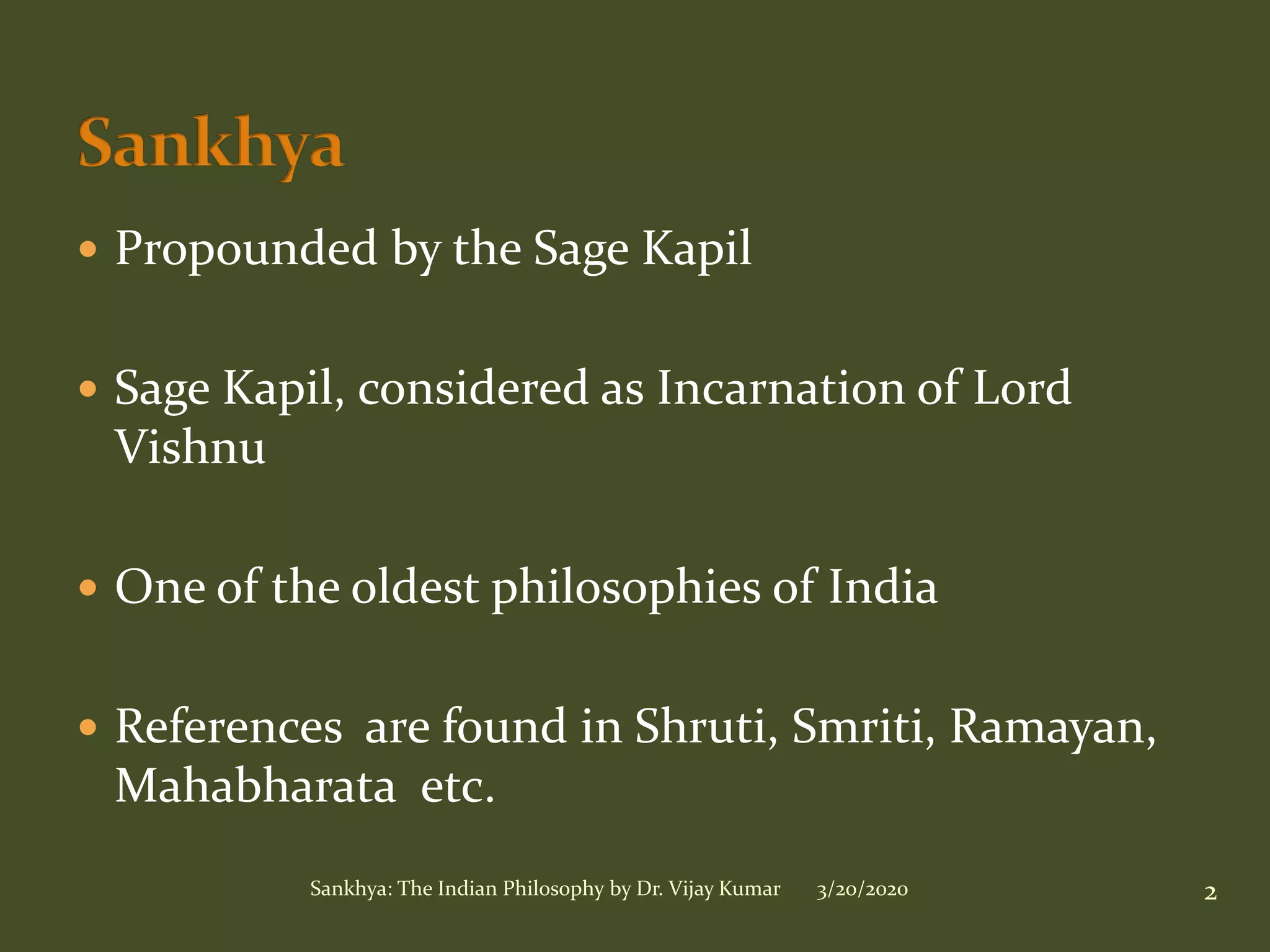
 Propounded by the Sage Kapil
 Sage Kapil, considered as Incarnation of Lord
Vishnu
 One of the oldest philosophies of India
 References are found in Shruti, Smriti, Ramayan,
Mahabharata etc.
3/20/2020Sankhya: The Indian Philosophy by Dr. Vijay Kumar 2
 Interpreted in two ways: as Number and as Knowledge
 Sankhya is concerned with number of elements= 25
 The divine knowledge pertains to the knowledge of
Body (matter) & Soul (Spirit)
3/20/2020Sankhya: The Indian Philosophy by Dr. Vijay Kumar 3
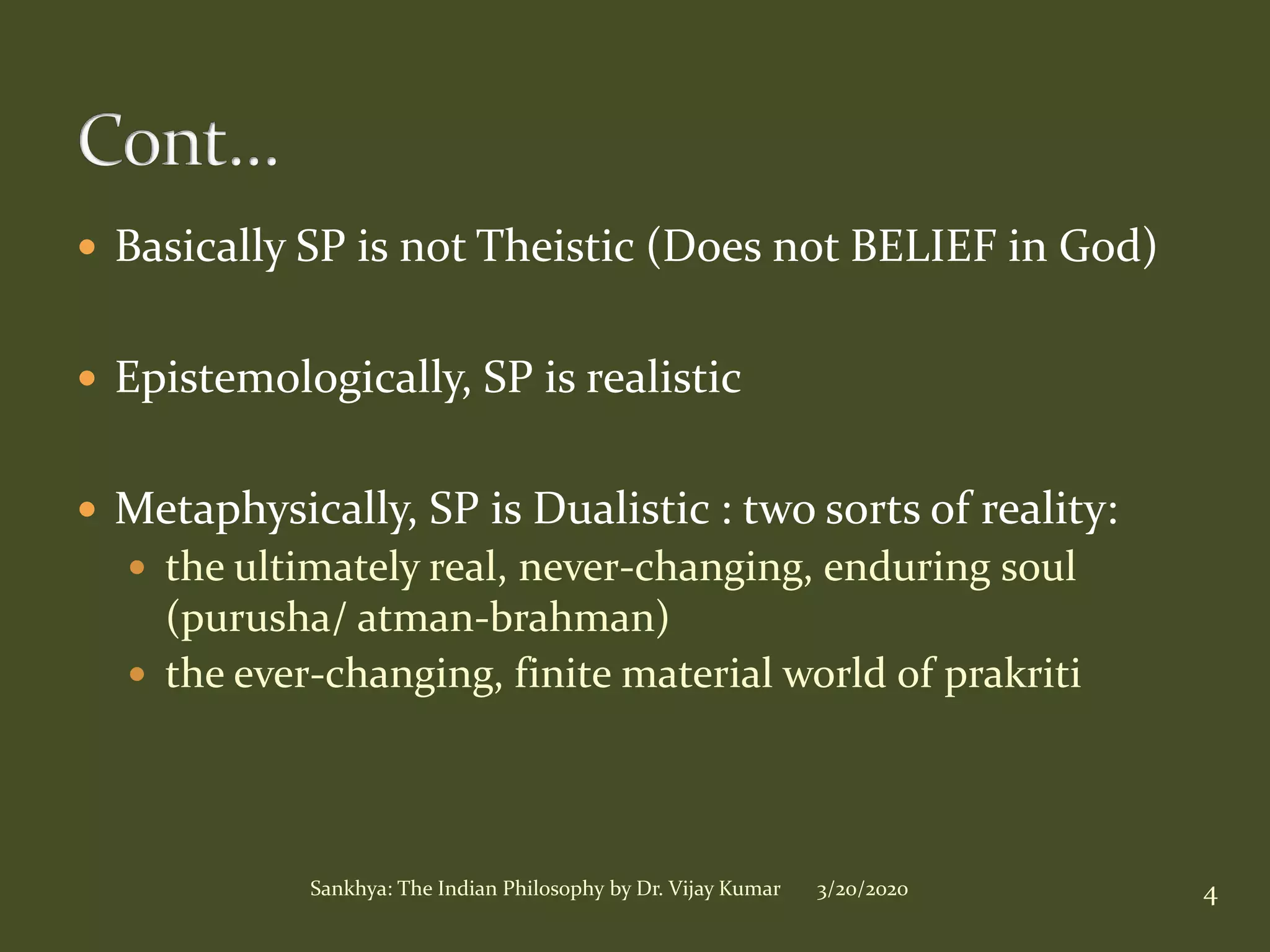
 Basically SP is not Theistic (Does not BELIEF in God)
 Epistemologically, SP is realistic
 Metaphysically, SP is Dualistic : two sorts of reality:
 the ultimately real, never-changing, enduring soul
(purusha/ atman-brahman)
 the ever-changing, finite material world of prakriti
3/20/2020 4Sankhya: The Indian Philosophy by Dr. Vijay Kumar
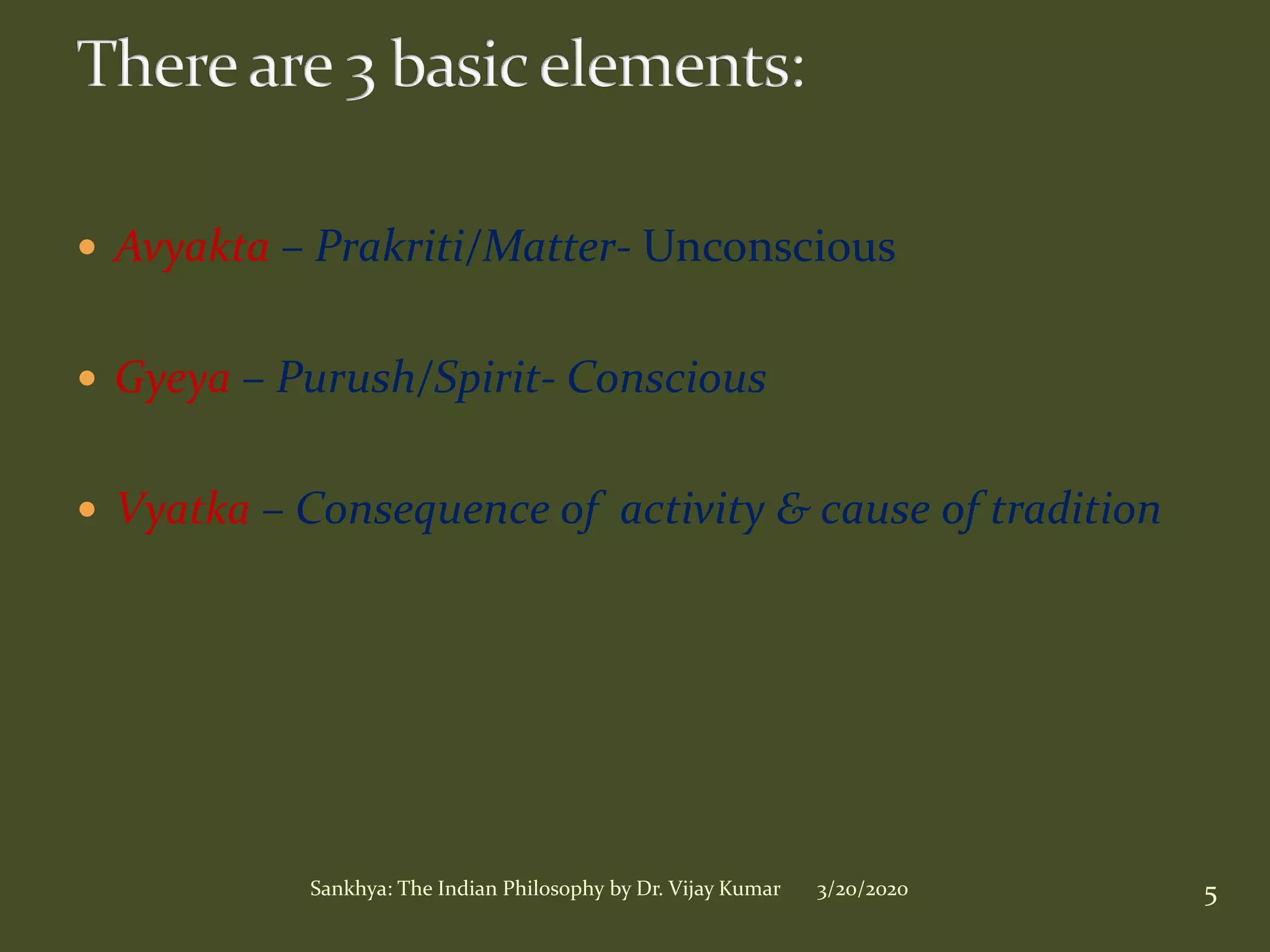
 Avyakta – Prakriti/Matter- Unconscious
 Gyeya – Purush/Spirit- Conscious
 Vyatka – Consequence of activity & cause of tradition
3/20/2020 5Sankhya: The Indian Philosophy by Dr. Vijay Kumar
 Avyatka- Prakriti/Matter 01
 Gyeya- Purush/Spirit 01
(neither Prakriti nor Vikriti)
 Vyatka- 23
3/20/2020 6Sankhya: The Indian Philosophy by Dr. Vijay Kumar
 Vyatka
Vikrit (16)
Defiled form of Prakriti
(comes out of matter)
Hand, Foot, Voice, Anus,
Genitals, Eyes, Ears, Nose,
Tongue, Skin, Mind,
Earth, Water, Energy, Air,
Space
Prakrit-Vikrit (7)
Self-consciousness/ego,
Intellect,
Sound,
Touch,
Form,
Taste, Smell
3/20/2020Sankhya: The Indian Philosophy by Dr. Vijay Kumar 7
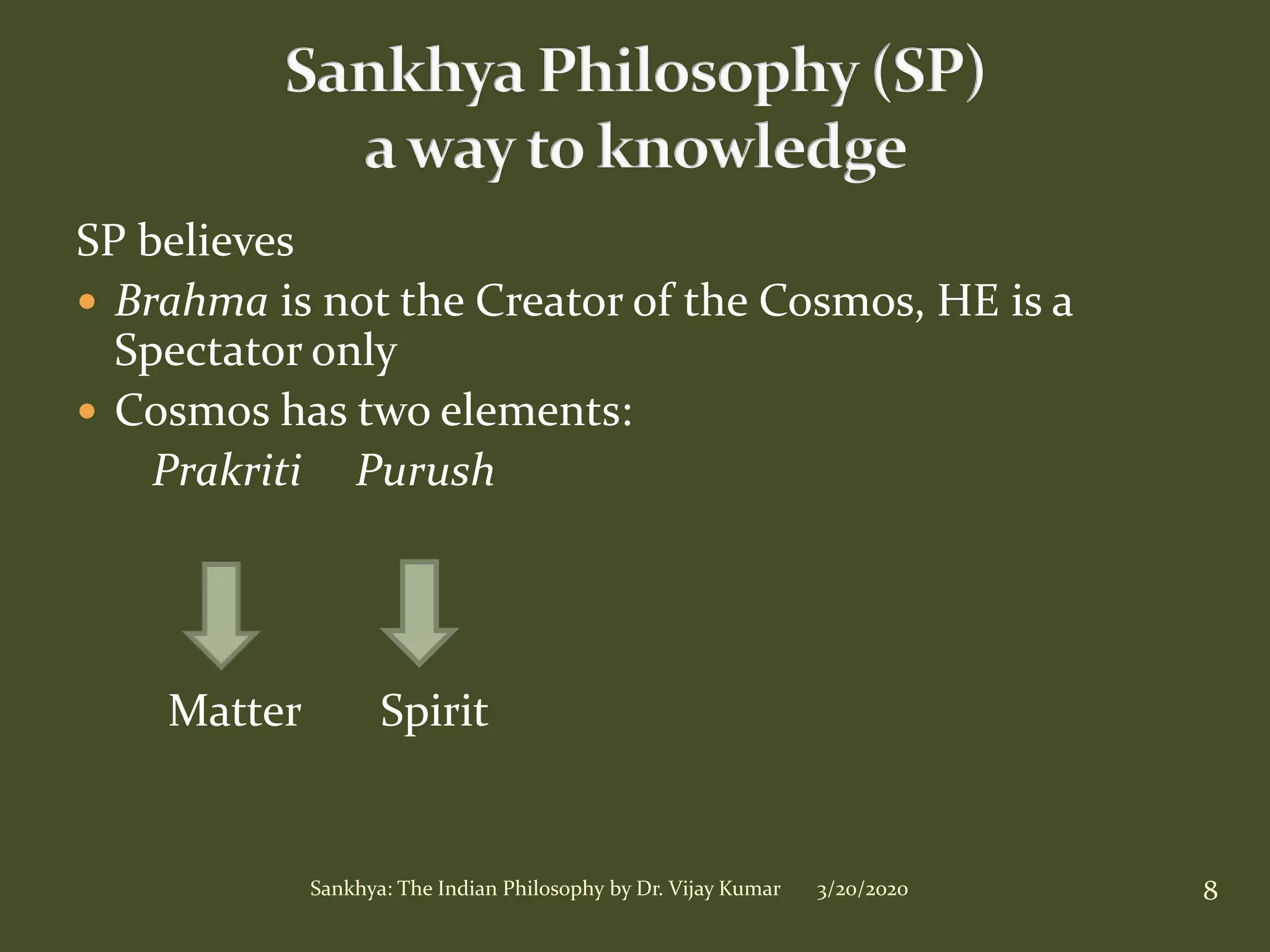
SP believes
 Brahma is not the Creator of the Cosmos, HE is a
Spectator only
 Cosmos has two elements:
Prakriti Purush
Matter Spirit
3/20/2020Sankhya: The Indian Philosophy by Dr. Vijay Kumar 8
 Oldest source of all existence
 It’s a combination of three qualities
SAT RAJ TAM
Satogun Rajogun Tamogun
Light/Knowledge Action/activity inhivition/heaviness, indolence
 Its devoid of consciousness
 There is similarity & union between Action & Cause
3/20/2020Sankhya: The Indian Philosophy by Dr. Vijay Kumar 9
 Conscious, Eternal & Co-operative element of Prakriti
 Its inert but omnipresent.
 Its complete, yet unattached
 SP believes in the Plurality of Purush
 Purush has 3 states:
 Bound(Baddha),
 Free (Mukta) &
 Conscious (Chetan)
 Through its body, it can achieve the Highest Goal i.e.
The Moksha/Salvation
3/20/2020Sankhya: The Indian Philosophy by Dr. Vijay Kumar 10
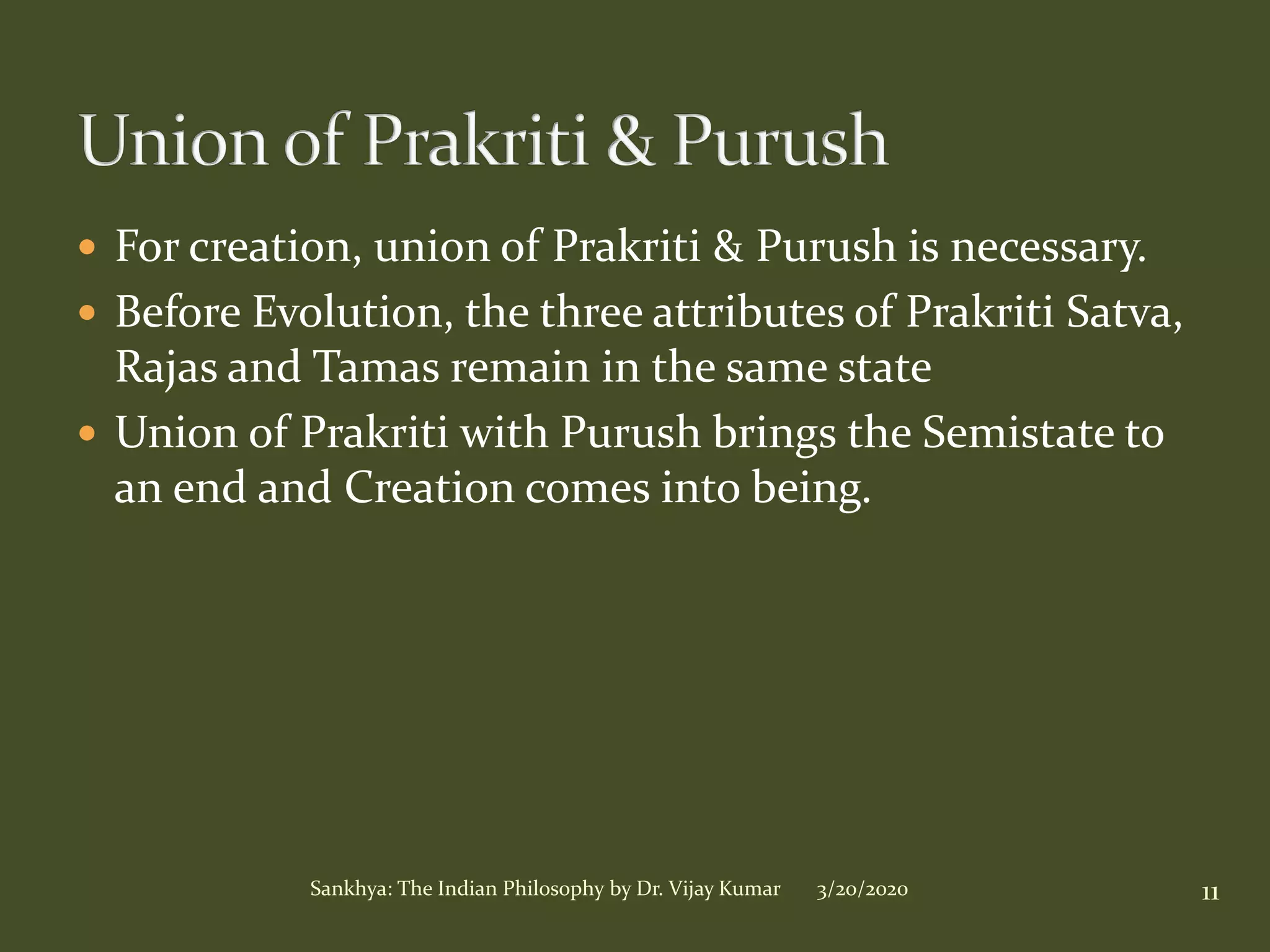
 For creation, union of Prakriti & Purush is necessary.
 Before Evolution, the three attributes of Prakriti Satva,
Rajas and Tamas remain in the same state
 Union of Prakriti with Purush brings the Semistate to
an end and Creation comes into being.
3/20/2020Sankhya: The Indian Philosophy by Dr. Vijay Kumar 11
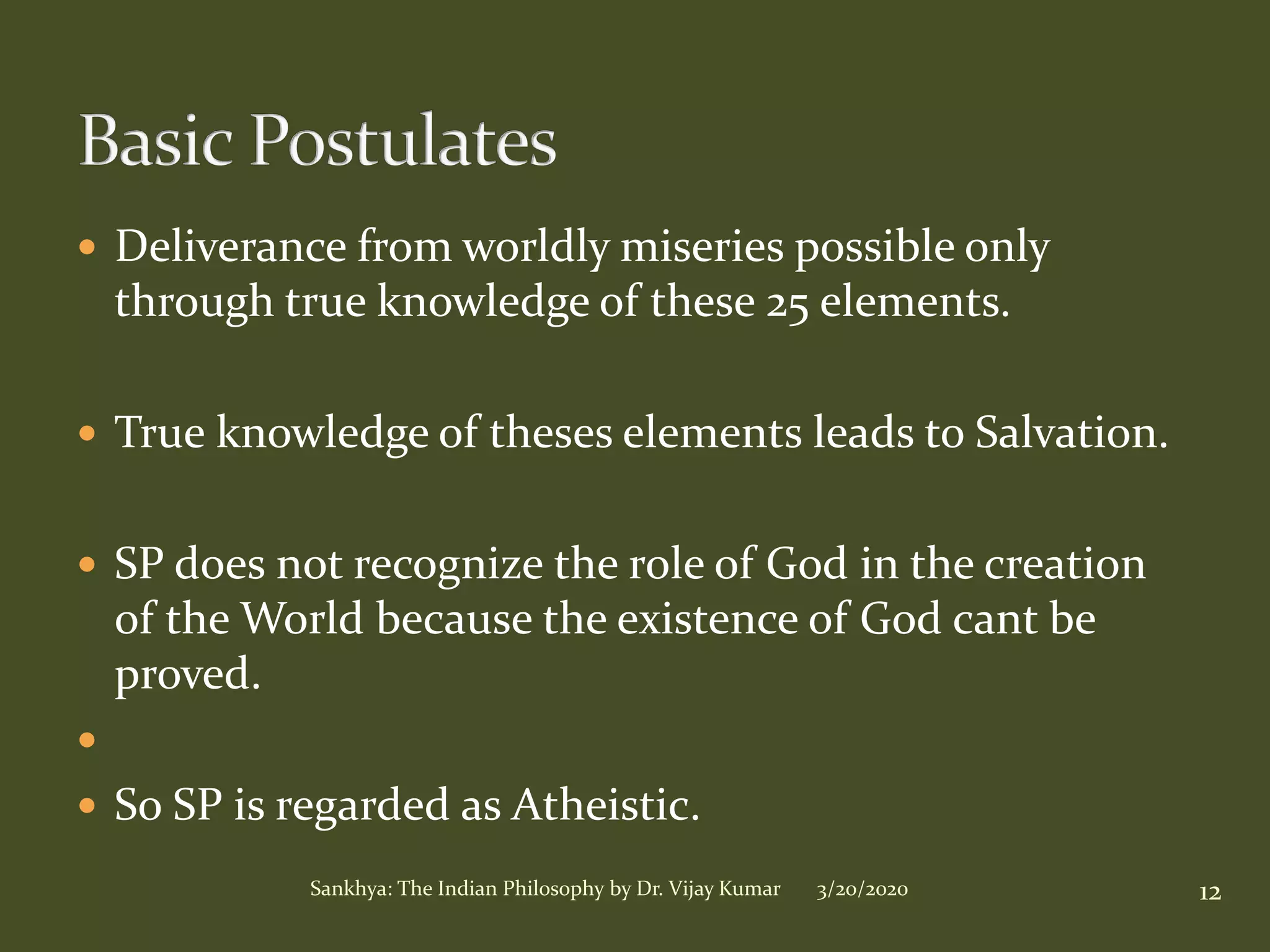
 Deliverance from worldly miseries possible only
through true knowledge of these 25 elements.
 True knowledge of theses elements leads to Salvation.
 SP does not recognize the role of God in the creation
of the World because the existence of God cant be
proved.

 So SP is regarded as Atheistic.
3/20/2020Sankhya: The Indian Philosophy by Dr. Vijay Kumar 12
 Vyatka (Prakriti) & Avyakta have attributes
 To understand these elements, its necessary to understand
activity and consequence i.e.
Cause & Effect Relationship
 When Prakriti is in Balanced state- there is no change,
 Whenever this balance is disturbed activity takes place
 Every Object has some inherent attributes which are
changeable. Theses changes are known as consequences.
Change is a continuous process in these two elements.
 Every object is composed of three attributes –Sat, Raj & Tam.
These 3 attributes are found in different objects in different
proportions.
 Change may be:
 Dharm Parinam- change in Attributes
 Lakshan Parinam- Change in the form
 Avastha Parinam- Change in the Position3/20/2020Sankhya: The Indian Philosophy by Dr. Vijay Kumar 13
 Intellect is born when the light of Purush (Soul) is
reflected upon Prakriti(Matter).
 Prakriti begins to consider itself conscious and the
unattached Purush starts feeling Attached.
 The Imaginary & imposed relationship between
Prakrit and Purush is called bondage.
 To break this bondage & to recognize the separate
existence of Prakrit is known as Salvation (Moksha).
 After assuming this state, Purush considers itself
detached
3/20/2020Sankhya: The Indian Philosophy by Dr. Vijay Kumar 14
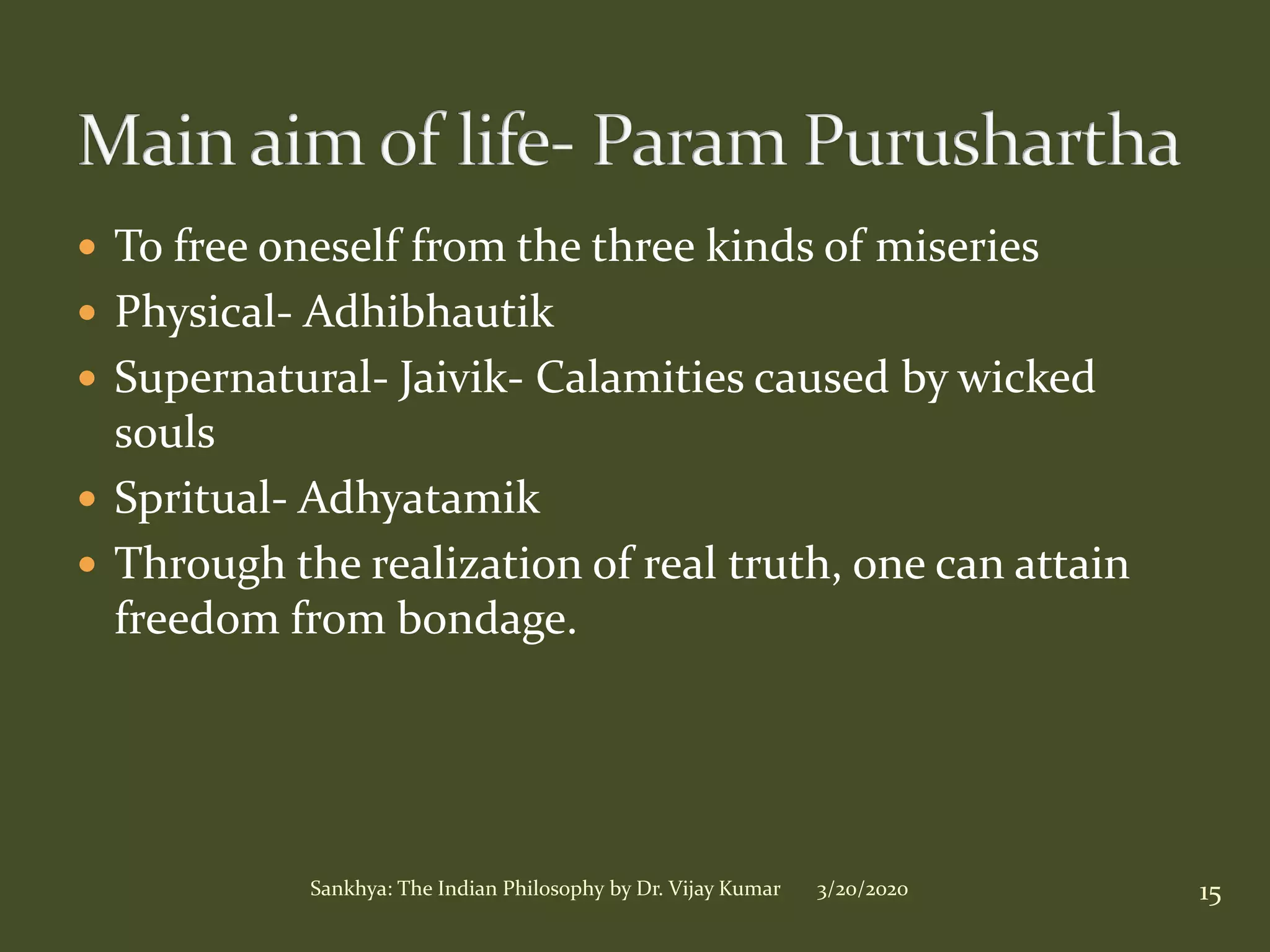
 To free oneself from the three kinds of miseries
 Physical- Adhibhautik
 Supernatural- Jaivik- Calamities caused by wicked
souls
 Spritual- Adhyatamik
 Through the realization of real truth, one can attain
freedom from bondage.
3/20/2020Sankhya: The Indian Philosophy by Dr. Vijay Kumar 15

Sankhya Darshan by Dr. Vijay Kumar, Teacher Educator

  • 1.
    Dr. Vijay Kumar Faculty,School of Education Apeejay Stya University
  • 2.
     Propounded bythe Sage Kapil  Sage Kapil, considered as Incarnation of Lord Vishnu  One of the oldest philosophies of India  References are found in Shruti, Smriti, Ramayan, Mahabharata etc. 3/20/2020Sankhya: The Indian Philosophy by Dr. Vijay Kumar 2
  • 3.
     Interpreted intwo ways: as Number and as Knowledge  Sankhya is concerned with number of elements= 25  The divine knowledge pertains to the knowledge of Body (matter) & Soul (Spirit) 3/20/2020Sankhya: The Indian Philosophy by Dr. Vijay Kumar 3
  • 4.
     Basically SPis not Theistic (Does not BELIEF in God)  Epistemologically, SP is realistic  Metaphysically, SP is Dualistic : two sorts of reality:  the ultimately real, never-changing, enduring soul (purusha/ atman-brahman)  the ever-changing, finite material world of prakriti 3/20/2020 4Sankhya: The Indian Philosophy by Dr. Vijay Kumar
  • 5.
     Avyakta –Prakriti/Matter- Unconscious  Gyeya – Purush/Spirit- Conscious  Vyatka – Consequence of activity & cause of tradition 3/20/2020 5Sankhya: The Indian Philosophy by Dr. Vijay Kumar
  • 6.
     Avyatka- Prakriti/Matter01  Gyeya- Purush/Spirit 01 (neither Prakriti nor Vikriti)  Vyatka- 23 3/20/2020 6Sankhya: The Indian Philosophy by Dr. Vijay Kumar
  • 7.
     Vyatka Vikrit (16) Defiledform of Prakriti (comes out of matter) Hand, Foot, Voice, Anus, Genitals, Eyes, Ears, Nose, Tongue, Skin, Mind, Earth, Water, Energy, Air, Space Prakrit-Vikrit (7) Self-consciousness/ego, Intellect, Sound, Touch, Form, Taste, Smell 3/20/2020Sankhya: The Indian Philosophy by Dr. Vijay Kumar 7
  • 8.
    SP believes  Brahmais not the Creator of the Cosmos, HE is a Spectator only  Cosmos has two elements: Prakriti Purush Matter Spirit 3/20/2020Sankhya: The Indian Philosophy by Dr. Vijay Kumar 8
  • 9.
     Oldest sourceof all existence  It’s a combination of three qualities SAT RAJ TAM Satogun Rajogun Tamogun Light/Knowledge Action/activity inhivition/heaviness, indolence  Its devoid of consciousness  There is similarity & union between Action & Cause 3/20/2020Sankhya: The Indian Philosophy by Dr. Vijay Kumar 9
  • 10.
     Conscious, Eternal& Co-operative element of Prakriti  Its inert but omnipresent.  Its complete, yet unattached  SP believes in the Plurality of Purush  Purush has 3 states:  Bound(Baddha),  Free (Mukta) &  Conscious (Chetan)  Through its body, it can achieve the Highest Goal i.e. The Moksha/Salvation 3/20/2020Sankhya: The Indian Philosophy by Dr. Vijay Kumar 10
  • 11.
     For creation,union of Prakriti & Purush is necessary.  Before Evolution, the three attributes of Prakriti Satva, Rajas and Tamas remain in the same state  Union of Prakriti with Purush brings the Semistate to an end and Creation comes into being. 3/20/2020Sankhya: The Indian Philosophy by Dr. Vijay Kumar 11
  • 12.
     Deliverance fromworldly miseries possible only through true knowledge of these 25 elements.  True knowledge of theses elements leads to Salvation.  SP does not recognize the role of God in the creation of the World because the existence of God cant be proved.   So SP is regarded as Atheistic. 3/20/2020Sankhya: The Indian Philosophy by Dr. Vijay Kumar 12
  • 13.
     Vyatka (Prakriti)& Avyakta have attributes  To understand these elements, its necessary to understand activity and consequence i.e. Cause & Effect Relationship  When Prakriti is in Balanced state- there is no change,  Whenever this balance is disturbed activity takes place  Every Object has some inherent attributes which are changeable. Theses changes are known as consequences. Change is a continuous process in these two elements.  Every object is composed of three attributes –Sat, Raj & Tam. These 3 attributes are found in different objects in different proportions.  Change may be:  Dharm Parinam- change in Attributes  Lakshan Parinam- Change in the form  Avastha Parinam- Change in the Position3/20/2020Sankhya: The Indian Philosophy by Dr. Vijay Kumar 13
  • 14.
     Intellect isborn when the light of Purush (Soul) is reflected upon Prakriti(Matter).  Prakriti begins to consider itself conscious and the unattached Purush starts feeling Attached.  The Imaginary & imposed relationship between Prakrit and Purush is called bondage.  To break this bondage & to recognize the separate existence of Prakrit is known as Salvation (Moksha).  After assuming this state, Purush considers itself detached 3/20/2020Sankhya: The Indian Philosophy by Dr. Vijay Kumar 14
  • 15.
     To freeoneself from the three kinds of miseries  Physical- Adhibhautik  Supernatural- Jaivik- Calamities caused by wicked souls  Spritual- Adhyatamik  Through the realization of real truth, one can attain freedom from bondage. 3/20/2020Sankhya: The Indian Philosophy by Dr. Vijay Kumar 15