





SRUSTI UTPATTHI KRAMA OFSRUSTI UTPATTHI KRAMA OF
SAMKHYASAMKHYA
PRESENTATION BYPRESENTATION BY
Dr. KAMAL.PDr. KAMAL.P
PG SCHOLARPG SCHOLAR
DEPT.OFDEPT.OF
SAMHITA&SIDDHANTASAMHITA&SIDDHANTA
CONTENTSCONTENTS
• IntroductionIntroduction
• DarshanaDarshana
• Samkhya darshanaSamkhya darshana
• Srusti utpatti kramaSrusti utpatti krama
• Triguna nirupanaTriguna nirupana
• Tatwa nirupanaTatwa nirupana
• ConclusionConclusion
INTRODUCTIONINTRODUCTION
 From the eternal time, it has been the question of discussion of the
scholars, that, when, how, why and where the evolution of the
universe came into existence
 Samkhya Darshana has given more importance to evolution process.
it elaborately, clearly discussed and described regarding Tatwas
of Srusti
 Even though Ayurvedists expressed their own views, Ayurveda
mainly incorporated the evolution theory of Samkhya Darshana
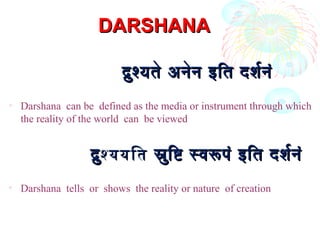
DARSHANADARSHANA
द्रुश्यते अनेन इतित दर्शरनंद्रुश्यते अनेन इतित दर्शरनं
• Darshana can be defined as the media or instrument through which
the reality of the world can be viewed
द्रुद्रुशययितशययित स्रुिष्टि स्वरूपं इतित दर्शरनंस्रुिष्टि स्वरूपं इतित दर्शरनं
• Darshana tells or shows the reality or nature of creation
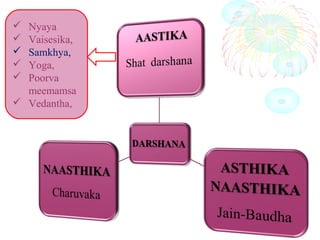
 Nyaya
 Vaisesika,
 Samkhya,
 Yoga,
 Poorva
meemamsa
 Vedantha,
INTRODUCTION TOINTRODUCTION TO
SAMKHYASAMKHYA
DARSHANADARSHANA
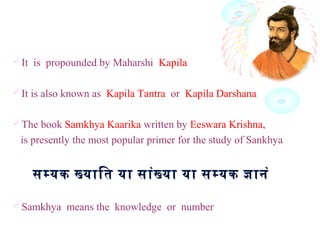
It is propounded by Maharshi Kapila
It is also known as Kapila Tantra or Kapila Darshana
The book Samkhya Kaarika written by Eeswara Krishna,
is presently the most popular primer for the study of Sankhya
समयक खयाित या सांखया या समयक जानंसमयक खयाित या सांखया या समयक जानं
Samkhya means the knowledge or number
 MAIN AIM OF SAMKHYA DARSHANA:MAIN AIM OF SAMKHYA DARSHANA:
 Dukha Nivrutti is the aim of this Darshana , for that it gives
the adequate knowledge about Panchavimshati Tatwa(25),
hence the name is given as Samkhya.
 The ultimate aim of this knowledge is attaining Moksha by
which miseries can be relieved permanently
MAIN PRINCIPLES OFMAIN PRINCIPLES OF
SAMKHYA DARSHANASAMKHYA DARSHANA
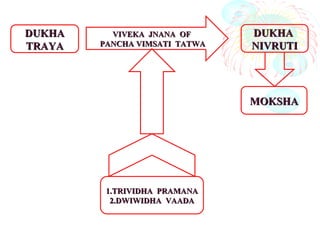
• Dukha TrayaDukha Traya
• Dukha NivruttiDukha Nivrutti
• Srusti & TatwaSrusti & Tatwa
• Trividha PramamaTrividha Pramama
• Dvividha VaadaDvividha Vaada
• TrigunaTriguna
DUKHADUKHA
TRAYATRAYA
VIVEKA JNANA OFVIVEKA JNANA OF
PANCHA VIMSATI TATWAPANCHA VIMSATI TATWA
DUKHADUKHA
NIVRUTINIVRUTI
MOKSHAMOKSHA
1.TRIVIDHA PRAMANA1.TRIVIDHA PRAMANA
2.DWIWIDHA VAADA2.DWIWIDHA VAADA
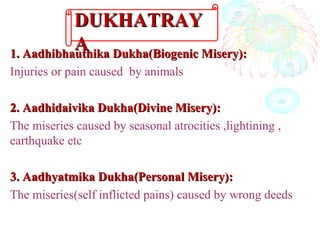
1. Aadhibhauthika Dukha(Biogenic Misery):1. Aadhibhauthika Dukha(Biogenic Misery):
Injuries or pain caused by animals
2. Aadhidaivika Dukha(Divine Misery):2. Aadhidaivika Dukha(Divine Misery):
The miseries caused by seasonal atrocities ,lightining ,
earthquake etc
3. Aadhyatmika Dukha(Personal Misery):3. Aadhyatmika Dukha(Personal Misery):
The miseries(self inflicted pains) caused by wrong deeds
DUKHATRAYDUKHATRAY
AA
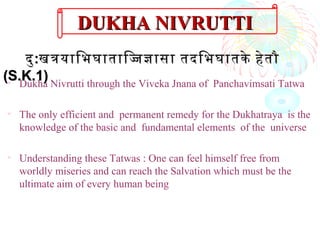
• Dukha Nivrutti through the Viveka Jnana of Panchavimsati Tatwa
• The only efficient and permanent remedy for the Dukhatraya is the
knowledge of the basic and fundamental elements of the universe
• Understanding these Tatwas : One can feel himself free from
worldly miseries and can reach the Salvation which must be the
ultimate aim of every human being
दुदु::खतयािभघातािजजासा तदिभघातके हेतौखतयािभघातािजजासा तदिभघातके हेतौ
(S.K.1)(S.K.1)
DUKHA NIVRUTTIDUKHA NIVRUTTI
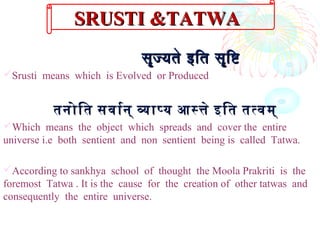
सॄज्यते इतित सॄिष्टिसॄज्यते इतित सॄिष्टि
Srusti means which is Evolved or Produced
तनोित सवारन् वापय आसते इित ततवम्तनोित सवारन् वापय आसते इित ततवम्
Which means the object which spreads and cover the entire
universe i.e both sentient and non sentient being is called Tatwa.
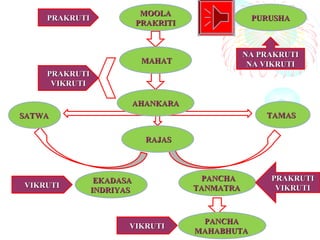
According to sankhya school of thought the Moola Prakriti is the
foremost Tatwa . It is the cause for the creation of other tatwas and
consequently the entire universe.
SRUSTI &TATWASRUSTI &TATWA
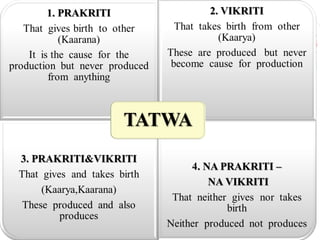
CLASSIFICATION OFCLASSIFICATION OF
TATWATATWA
SRUSTI UTPATTISRUSTI UTPATTI
KRAMAKRAMA
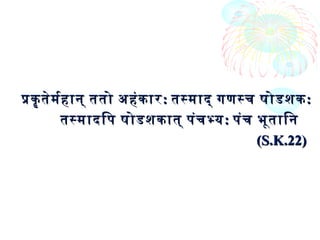
पकॄ तेमरहान् ततो अहंकारपकॄ तेमरहान् ततो अहंकार:: तसमाद् गणसच षोडशकतसमाद् गणसच षोडशक::
तसमादिप षोडशकात् पंचभयतसमादिप षोडशकात् पंचभय:: पंच भूतािनपंच भूतािन
(S.K.22)(S.K.22)
MOOLAMOOLA
PRAKRITIPRAKRITI
PANCHAPANCHA
TANMATRATANMATRA
EKADASAEKADASA
INDRIYASINDRIYAS
RAJASRAJAS
SATWASATWA TAMASTAMAS
AHANKARAAHANKARA
MAHATMAHAT
PURUSHAPURUSHA
PANCHAPANCHA
MAHABHUTAMAHABHUTA
PRAKRUTIPRAKRUTI
VIKRUTIVIKRUTI
VIKRUTIVIKRUTI
PRAKRUTIPRAKRUTI
VIKRUTIVIKRUTI
NA PRAKRUTINA PRAKRUTI
NA VIKRUTINA VIKRUTI
PRAKRUTIPRAKRUTI
VIKRUTIVIKRUTI
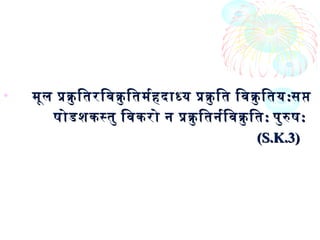
• मूल पकु ितरिवकु ितमरहदाधय पकु ित िवकु ितयमूल पकु ितरिवकु ितमरहदाधय पकु ित िवकु ितय ::सपसप
षोडशकसतु िवकरो न पकु ितनरिवकु ितषोडशकसतु िवकरो न पकु ितनरिवकु ित:: पुरषपुरष::
(S.K.3)(S.K.3)
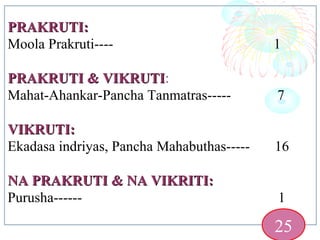
PRAKRUTI:PRAKRUTI:
Moola Prakruti---- 1
PRAKRUTI & VIKRUTIPRAKRUTI & VIKRUTI:
Mahat-Ahankar-Pancha Tanmatras----- 7
VIKRUTI:VIKRUTI:
Ekadasa indriyas, Pancha Mahabuthas----- 16
NA PRAKRUTI & NA VIKRITI:NA PRAKRUTI & NA VIKRITI:
Purusha------ 1
25
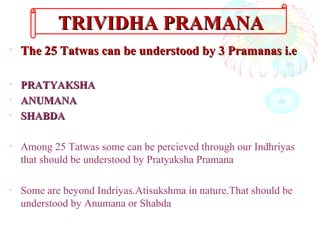
• The 25 Tatwas can be understood by 3 Pramanas i.eThe 25 Tatwas can be understood by 3 Pramanas i.e
• PRATYAKSHAPRATYAKSHA
• ANUMANAANUMANA
• SHABDASHABDA
• Among 25 Tatwas some can be percieved through our Indhriyas
that should be understood by Pratyaksha Pramana
• Some are beyond Indriyas.Atisukshma in nature.That should be
understood by Anumana or Shabda
TRIVIDHA PRAMANATRIVIDHA PRAMANA
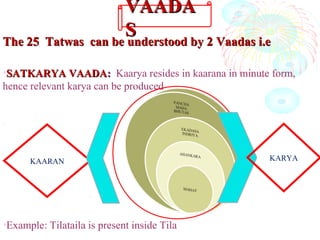
The 25 Tatwas can be understood by 2 Vaadas i.eThe 25 Tatwas can be understood by 2 Vaadas i.e
•SATKARYA VAADASATKARYA VAADA:: Kaarya resides in kaarana in minute form,
hence relevant karya can be produced
•Example: Tilataila is present inside Tila
KARYAKAARAN
VAADAVAADA
SS
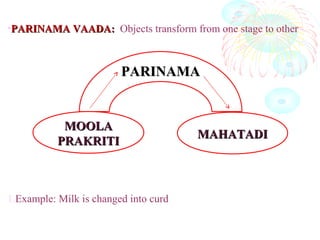
•PARINAMA VAADAPARINAMA VAADA:: Objects transform from one stage to other
1.Example: Milk is changed into curd
MOOLAMOOLA
PRAKRITIPRAKRITI
MAHATADIMAHATADI
PARINAMAPARINAMA
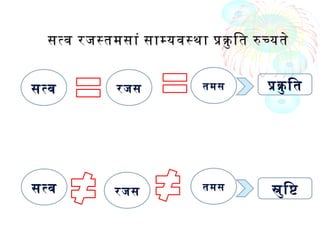
सतव रजसतमसां सामयवसथा पकु ित रचयतेसतव रजसतमसां सामयवसथा पकु ित रचयते
सतवसतव रजसरजस तमसतमस
सतवसतव रजसरजस तमसतमस पकु ितपकु ित
सुिषसुिष
TRIGUNATRIGUNA
NIRUPANANIRUPANA
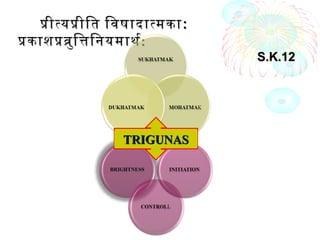
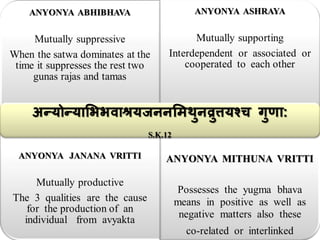
पीतयपीित िवषादातमकापीतयपीित िवषादातमका::
पकाशपवुितिनयमाथरपकाशपवुितिनयमाथर::
S.K.12S.K.12
TRIGUNASTRIGUNAS
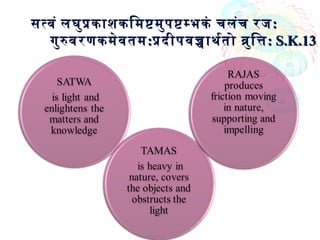
सतवं लघुपकाशकिमषमुपषमभकं चलंच रजसतवं लघुपकाशकिमषमुपषमभकं चलंच रज ::
गुरवरणकमेवतमगुरवरणकमेवतम::पदीपवचाथरतो वुितपदीपवचाथरतो वुित:: S.K.13S.K.13
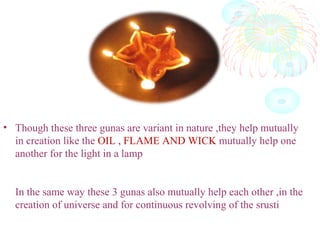
• Though these three gunas are variant in nature ,they help mutually
in creation like the OIL , FLAME AND WICK mutually help one
another for the light in a lamp
In the same way these 3 gunas also mutually help each other ,in the
creation of universe and for continuous revolving of the srusti
TATWA NIRUPANATATWA NIRUPANA
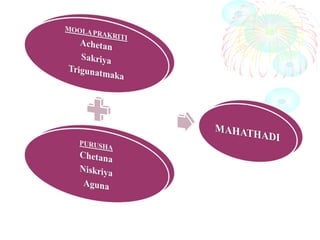
• PRAKRITI – PURUSHAPRAKRITI – PURUSHA
• MAHATMAHAT
• AHANKARAHANKAR
• INDHRIYAINDHRIYA
• TANMATRATANMATRA
• PANCHA MAHABHUTAPANCHA MAHABHUTA
PRAKRITI -PRAKRITI -
PURUSHAPURUSHA
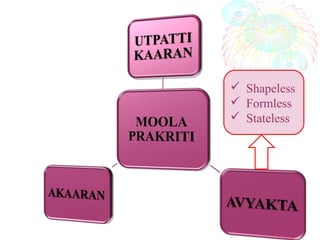
 Shapeless
 Formless
 Stateless
• A doubt may arise why and how Prakriti and
Purusha (avyakta) being apposite and variant
tatwas , to each other unite , and how the Srusti
Vikasa(vyakta) or evolution takes place.
?
The answer is to clear these doubts are available
through Pangvandha nyaya (law of lame and
blind) described in Sankhyakarika as follows..
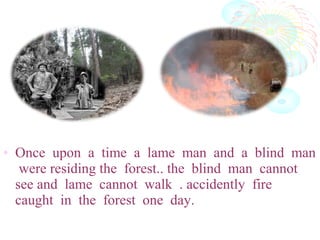
• Once upon a time a lame man and a blind man
were residing the forest.. the blind man cannot
see and lame cannot walk . accidently fire
caught in the forest one day.
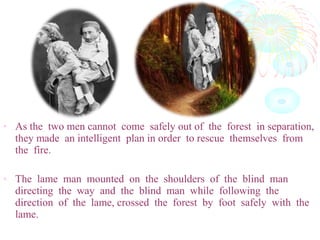
• As the two men cannot come safely out of the forest in separation,
they made an intelligent plan in order to rescue themselves from
the fire.
• The lame man mounted on the shoulders of the blind man
directing the way and the blind man while following the
direction of the lame, crossed the forest by foot safely with the
lame.
 Though Prakriti and Purusha are lame and blind
by nature prakriti and purusha combine with each
other and commence to start the srusti or creation
 In the same manner, the inactive purusha and the
unconscious prakriti cooperate in order to achieve
the objective of creation.
पंगवनधं वदुभयोरिप समयोगपंगवनधं वदुभयोरिप समयोग:: ततकु तततकु त:: सगरसगर::
MAHATMAHAT
First vyakta tatwa
The knowledge required for the identification or conformation
of object is known as mahat
The doubtful knowledge / the knowledge percieved by indriyas,
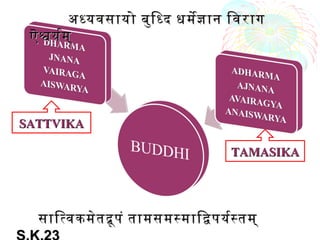
get confirmed or analysed by buddhiव
वहार् मात्र हेतुबुरिद: प
• Buddhi is the main cause for the daily usage of all mental
activities
SATTVIKASATTVIKA
TAMASIKATAMASIKA
अधयवसायो बुिधद धमेजान िवरागअधयवसायो बुिधद धमेजान िवराग
ऎशयरम्ऎशयरम्
साितवकमेतदूपं तामसमसमािदपयरसतम्साितवकमेतदूपं तामसमसमािदपयरसतम्
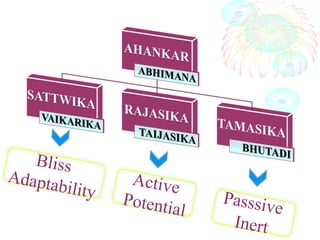
AHANKARAAHANKARA
(EGO)(EGO)
Active
Potential
Passsive
Inert
Bliss
Adaptability
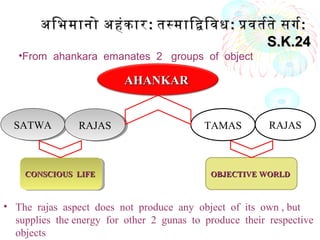
AHANKARAHANKAR
SATWASATWA RAJASRAJAS TAMAS RAJAS
CONSCIOUS LIFECONSCIOUS LIFECONSCIOUS LIFECONSCIOUS LIFE OBJECTIVE WORLDOBJECTIVE WORLD
• The rajas aspect does not produce any object of its own , but
supplies the energy for other 2 gunas to produce their respective
objects
अिभमानो अहंकारअिभमानो अहंकार:: तसमािदिवधतसमािदिवध:: पवतरते सगरपवतरते सगर::
S.K.24S.K.24
•From ahankara emanates 2 groups of object
JJ
NN
AA
NN
EE
NN
DD
RR
II
YY
AA
KK
AA
RR
MM
EE
NN
DD
RR
II
YY
AA
MM
AA
NN
AA
SS
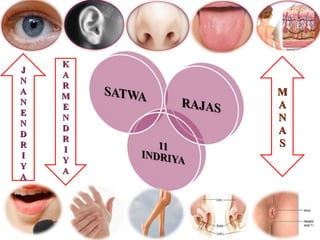
SPARSNASPARSNARASANARASANAGHRANAGHRANASROTRASROTRACAKSHUCAKSHU
INDRIYASINDRIYAS
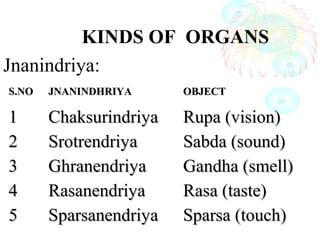
KINDS OF ORGANS
Jnanindriya:
S.NOS.NO JNANINDHRIYAJNANINDHRIYA OBJECTOBJECT
11 ChaksurindriyaChaksurindriya Rupa (vision)Rupa (vision)
22 SrotrendriyaSrotrendriya Sabda (sound)Sabda (sound)
33 GhranendriyaGhranendriya Gandha (smell)Gandha (smell)
44 RasanendriyaRasanendriya Rasa (taste)Rasa (taste)
55 SparsanendriyaSparsanendriya Sparsa (touch)Sparsa (touch)
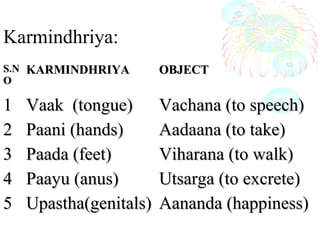
Karmindhriya:
S.NS.N
OO
KARMINDHRIYAKARMINDHRIYA OBJECTOBJECT
11 Vaak (tongue)Vaak (tongue) Vachana (to speech)Vachana (to speech)
22 Paani (hands)Paani (hands) Aadaana (to take)Aadaana (to take)
33 Paada (feet)Paada (feet) Viharana (to walk)Viharana (to walk)
44 Paayu (anus)Paayu (anus) Utsarga (to excrete)Utsarga (to excrete)
55 Upastha(genitals)Upastha(genitals) Aananda (happiness)Aananda (happiness)
UBHAYINDRIYAUBHAYINDRIYA
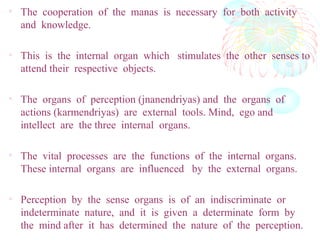
• The cooperation of the manas is necessary for both activity
and knowledge.
• This is the internal organ which stimulates the other senses to
attend their respective objects.
• The organs of perception (jnanendriyas) and the organs of
actions (karmendriyas) are external tools. Mind, ego and
intellect are the three internal organs.
• The vital processes are the functions of the internal organs.
These internal organs are influenced by the external organs.
• Perception by the sense organs is of an indiscriminate or
indeterminate nature, and it is given a determinate form by
the mind after it has determined the nature of the perception.
TT
AA
NN
MM
AA
AA
TT
RR
AA
SS
MM
AA
HH
AA
BB
HH
UU
TT
AA
SS
TANMAATRASTANMAATRAS
&&
MAHABHUTASMAHABHUTAS
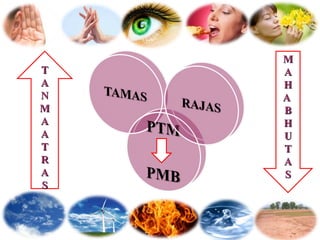
• The elements exist in subtle and gross , being each of five types .
• The gross elements (mahabhutas) arise as a result of combination of
subtle elements
• The tanmatraas are subtle, eternal and unperceivable to senses. they
are also known as avisese, suksma and paramanu
• The gross elements are produced from the subtle elements .
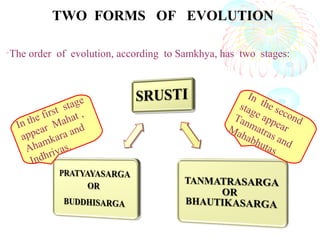
TWO FORMS OF EVOLUTION
•The order of evolution, according to Samkhya, has two stages:
In the first stage
appear Mahat ,
Ahamkara and
Indhriyas.
In the second
stage appear
Tanmatras and
Mahabhutas
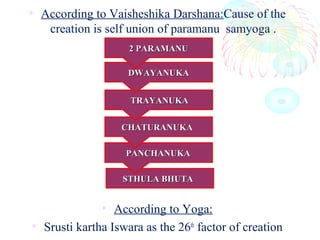
• According to Vaisheshika Darshana:Cause of the
creation is self union of paramanu samyoga .
• According to Yoga:
• Srusti kartha Iswara as the 26th
factor of creation
STHULA BHUTASTHULA BHUTA
PANCHANUKAPANCHANUKA
CHATURANUKACHATURANUKA
TRAYANUKATRAYANUKA
DWAYANUKADWAYANUKA
2 PARAMANU2 PARAMANU
• According to Nyaya:
• Believes Iswara.
• Nimitta Kaarana for Sristi and also cause for the
utilisation of Karma phala.
• According to Charaka:
• Chaturvimsati Tatwa
• No differentiation of Prakriti and Purusha
• Indriyas are not Ahankarika but Bhautika
CONCLUSIONCONCLUSION
• Sankhya Darshana considers Panchavimsati Tatwas for
the Srusti utpatti
• The root cause of Srusti is triguna yuktha Moola prakriti
and Purusha
• The concept of Sristi utpatti krama of Samkhya accepted
by Yoga Darshana,Charaka and Susrutha
PUBLICATIONS
• SAMKHYA - YOGA- PURIFYING THE ELEMENTS OF THE HUMAN
BEING
by Dr.Swami shankardev saraswati
www.yogajournal.com/for_teachers/1556
SANKHYA – YOGA ,PRAKRUTI AND ITS EVOLUTES RETURNING TO
SELF REALIZATION
by Swamy jnaneswara bharati
www.swamij.com/prakriti-purusha-sankhya.htm
MIND DUALISM IN SAMKHYA-YOGA PHILOSOPHY
Paul
Philpapers.org/rec/schmdi
CLASSICAL SAMKHYA –YOGA:AN INDIAN METAPHYSIS OF
EXPERIENCE
Mikel burley
Philpapers.org/rec/burcsa-2
REFERENCES
• Sankhya kaarika-Eswar krishnan
• Ayurveda padartha vijnjaanam-
i. Prof.C.R. Agnives
ii. Dr.D.Lakshmana chary
iii.Dr.Narasimhacharyulu
iv.Dr.Ramasundhar rao
v. Dr.Jyothirmithra acharya
TT
HH
AA
NN KK YY OO UU

Srusti utpatti cosmogny

  • 2.
    SRUSTI UTPATTHI KRAMAOFSRUSTI UTPATTHI KRAMA OF SAMKHYASAMKHYA PRESENTATION BYPRESENTATION BY Dr. KAMAL.PDr. KAMAL.P PG SCHOLARPG SCHOLAR DEPT.OFDEPT.OF SAMHITA&SIDDHANTASAMHITA&SIDDHANTA
  • 3.
    CONTENTSCONTENTS • IntroductionIntroduction • DarshanaDarshana •Samkhya darshanaSamkhya darshana • Srusti utpatti kramaSrusti utpatti krama • Triguna nirupanaTriguna nirupana • Tatwa nirupanaTatwa nirupana • ConclusionConclusion
  • 4.
    INTRODUCTIONINTRODUCTION  From theeternal time, it has been the question of discussion of the scholars, that, when, how, why and where the evolution of the universe came into existence  Samkhya Darshana has given more importance to evolution process. it elaborately, clearly discussed and described regarding Tatwas of Srusti  Even though Ayurvedists expressed their own views, Ayurveda mainly incorporated the evolution theory of Samkhya Darshana
  • 5.
    DARSHANADARSHANA द्रुश्यते अनेन इतितदर्शरनंद्रुश्यते अनेन इतित दर्शरनं • Darshana can be defined as the media or instrument through which the reality of the world can be viewed द्रुद्रुशययितशययित स्रुिष्टि स्वरूपं इतित दर्शरनंस्रुिष्टि स्वरूपं इतित दर्शरनं • Darshana tells or shows the reality or nature of creation
  • 6.
     Nyaya  Vaisesika, Samkhya,  Yoga,  Poorva meemamsa  Vedantha,
  • 7.
  • 8.
    It is propoundedby Maharshi Kapila It is also known as Kapila Tantra or Kapila Darshana The book Samkhya Kaarika written by Eeswara Krishna, is presently the most popular primer for the study of Sankhya समयक खयाित या सांखया या समयक जानंसमयक खयाित या सांखया या समयक जानं Samkhya means the knowledge or number
  • 9.
     MAIN AIMOF SAMKHYA DARSHANA:MAIN AIM OF SAMKHYA DARSHANA:  Dukha Nivrutti is the aim of this Darshana , for that it gives the adequate knowledge about Panchavimshati Tatwa(25), hence the name is given as Samkhya.  The ultimate aim of this knowledge is attaining Moksha by which miseries can be relieved permanently
  • 10.
    MAIN PRINCIPLES OFMAINPRINCIPLES OF SAMKHYA DARSHANASAMKHYA DARSHANA
  • 11.
    • Dukha TrayaDukhaTraya • Dukha NivruttiDukha Nivrutti • Srusti & TatwaSrusti & Tatwa • Trividha PramamaTrividha Pramama • Dvividha VaadaDvividha Vaada • TrigunaTriguna
  • 12.
    DUKHADUKHA TRAYATRAYA VIVEKA JNANA OFVIVEKAJNANA OF PANCHA VIMSATI TATWAPANCHA VIMSATI TATWA DUKHADUKHA NIVRUTINIVRUTI MOKSHAMOKSHA 1.TRIVIDHA PRAMANA1.TRIVIDHA PRAMANA 2.DWIWIDHA VAADA2.DWIWIDHA VAADA
  • 13.
    1. Aadhibhauthika Dukha(BiogenicMisery):1. Aadhibhauthika Dukha(Biogenic Misery): Injuries or pain caused by animals 2. Aadhidaivika Dukha(Divine Misery):2. Aadhidaivika Dukha(Divine Misery): The miseries caused by seasonal atrocities ,lightining , earthquake etc 3. Aadhyatmika Dukha(Personal Misery):3. Aadhyatmika Dukha(Personal Misery): The miseries(self inflicted pains) caused by wrong deeds DUKHATRAYDUKHATRAY AA
  • 14.
    • Dukha Nivruttithrough the Viveka Jnana of Panchavimsati Tatwa • The only efficient and permanent remedy for the Dukhatraya is the knowledge of the basic and fundamental elements of the universe • Understanding these Tatwas : One can feel himself free from worldly miseries and can reach the Salvation which must be the ultimate aim of every human being दुदु::खतयािभघातािजजासा तदिभघातके हेतौखतयािभघातािजजासा तदिभघातके हेतौ (S.K.1)(S.K.1) DUKHA NIVRUTTIDUKHA NIVRUTTI
  • 15.
    सॄज्यते इतित सॄिष्टिसॄज्यतेइतित सॄिष्टि Srusti means which is Evolved or Produced तनोित सवारन् वापय आसते इित ततवम्तनोित सवारन् वापय आसते इित ततवम् Which means the object which spreads and cover the entire universe i.e both sentient and non sentient being is called Tatwa. According to sankhya school of thought the Moola Prakriti is the foremost Tatwa . It is the cause for the creation of other tatwas and consequently the entire universe. SRUSTI &TATWASRUSTI &TATWA
  • 16.
  • 18.
  • 19.
    पकॄ तेमरहान् ततोअहंकारपकॄ तेमरहान् ततो अहंकार:: तसमाद् गणसच षोडशकतसमाद् गणसच षोडशक:: तसमादिप षोडशकात् पंचभयतसमादिप षोडशकात् पंचभय:: पंच भूतािनपंच भूतािन (S.K.22)(S.K.22)
  • 20.
  • 21.
    • मूल पकुितरिवकु ितमरहदाधय पकु ित िवकु ितयमूल पकु ितरिवकु ितमरहदाधय पकु ित िवकु ितय ::सपसप षोडशकसतु िवकरो न पकु ितनरिवकु ितषोडशकसतु िवकरो न पकु ितनरिवकु ित:: पुरषपुरष:: (S.K.3)(S.K.3)
  • 22.
    PRAKRUTI:PRAKRUTI: Moola Prakruti---- 1 PRAKRUTI& VIKRUTIPRAKRUTI & VIKRUTI: Mahat-Ahankar-Pancha Tanmatras----- 7 VIKRUTI:VIKRUTI: Ekadasa indriyas, Pancha Mahabuthas----- 16 NA PRAKRUTI & NA VIKRITI:NA PRAKRUTI & NA VIKRITI: Purusha------ 1 25
  • 23.
    • The 25Tatwas can be understood by 3 Pramanas i.eThe 25 Tatwas can be understood by 3 Pramanas i.e • PRATYAKSHAPRATYAKSHA • ANUMANAANUMANA • SHABDASHABDA • Among 25 Tatwas some can be percieved through our Indhriyas that should be understood by Pratyaksha Pramana • Some are beyond Indriyas.Atisukshma in nature.That should be understood by Anumana or Shabda TRIVIDHA PRAMANATRIVIDHA PRAMANA
  • 24.
    The 25 Tatwascan be understood by 2 Vaadas i.eThe 25 Tatwas can be understood by 2 Vaadas i.e •SATKARYA VAADASATKARYA VAADA:: Kaarya resides in kaarana in minute form, hence relevant karya can be produced •Example: Tilataila is present inside Tila KARYAKAARAN VAADAVAADA SS
  • 25.
    •PARINAMA VAADAPARINAMA VAADA::Objects transform from one stage to other 1.Example: Milk is changed into curd MOOLAMOOLA PRAKRITIPRAKRITI MAHATADIMAHATADI PARINAMAPARINAMA
  • 26.
    सतव रजसतमसां सामयवसथापकु ित रचयतेसतव रजसतमसां सामयवसथा पकु ित रचयते सतवसतव रजसरजस तमसतमस सतवसतव रजसरजस तमसतमस पकु ितपकु ित सुिषसुिष
  • 27.
  • 28.
  • 29.
    सतवं लघुपकाशकिमषमुपषमभकं चलंचरजसतवं लघुपकाशकिमषमुपषमभकं चलंच रज :: गुरवरणकमेवतमगुरवरणकमेवतम::पदीपवचाथरतो वुितपदीपवचाथरतो वुित:: S.K.13S.K.13
  • 31.
    • Though thesethree gunas are variant in nature ,they help mutually in creation like the OIL , FLAME AND WICK mutually help one another for the light in a lamp In the same way these 3 gunas also mutually help each other ,in the creation of universe and for continuous revolving of the srusti
  • 32.
  • 33.
    • PRAKRITI –PURUSHAPRAKRITI – PURUSHA • MAHATMAHAT • AHANKARAHANKAR • INDHRIYAINDHRIYA • TANMATRATANMATRA • PANCHA MAHABHUTAPANCHA MAHABHUTA
  • 34.
  • 35.
  • 37.
    • A doubtmay arise why and how Prakriti and Purusha (avyakta) being apposite and variant tatwas , to each other unite , and how the Srusti Vikasa(vyakta) or evolution takes place. ?
  • 38.
    The answer isto clear these doubts are available through Pangvandha nyaya (law of lame and blind) described in Sankhyakarika as follows..
  • 39.
    • Once upona time a lame man and a blind man were residing the forest.. the blind man cannot see and lame cannot walk . accidently fire caught in the forest one day.
  • 40.
    • As thetwo men cannot come safely out of the forest in separation, they made an intelligent plan in order to rescue themselves from the fire. • The lame man mounted on the shoulders of the blind man directing the way and the blind man while following the direction of the lame, crossed the forest by foot safely with the lame.
  • 41.
     Though Prakritiand Purusha are lame and blind by nature prakriti and purusha combine with each other and commence to start the srusti or creation  In the same manner, the inactive purusha and the unconscious prakriti cooperate in order to achieve the objective of creation. पंगवनधं वदुभयोरिप समयोगपंगवनधं वदुभयोरिप समयोग:: ततकु तततकु त:: सगरसगर::
  • 42.
  • 43.
    First vyakta tatwa Theknowledge required for the identification or conformation of object is known as mahat The doubtful knowledge / the knowledge percieved by indriyas, get confirmed or analysed by buddhiव वहार् मात्र हेतुबुरिद: प • Buddhi is the main cause for the daily usage of all mental activities
  • 44.
    SATTVIKASATTVIKA TAMASIKATAMASIKA अधयवसायो बुिधद धमेजानिवरागअधयवसायो बुिधद धमेजान िवराग ऎशयरम्ऎशयरम् साितवकमेतदूपं तामसमसमािदपयरसतम्साितवकमेतदूपं तामसमसमािदपयरसतम्
  • 45.
  • 46.
  • 47.
    AHANKARAHANKAR SATWASATWA RAJASRAJAS TAMASRAJAS CONSCIOUS LIFECONSCIOUS LIFECONSCIOUS LIFECONSCIOUS LIFE OBJECTIVE WORLDOBJECTIVE WORLD • The rajas aspect does not produce any object of its own , but supplies the energy for other 2 gunas to produce their respective objects अिभमानो अहंकारअिभमानो अहंकार:: तसमािदिवधतसमािदिवध:: पवतरते सगरपवतरते सगर:: S.K.24S.K.24 •From ahankara emanates 2 groups of object
  • 48.
  • 49.
  • 50.
    KINDS OF ORGANS Jnanindriya: S.NOS.NOJNANINDHRIYAJNANINDHRIYA OBJECTOBJECT 11 ChaksurindriyaChaksurindriya Rupa (vision)Rupa (vision) 22 SrotrendriyaSrotrendriya Sabda (sound)Sabda (sound) 33 GhranendriyaGhranendriya Gandha (smell)Gandha (smell) 44 RasanendriyaRasanendriya Rasa (taste)Rasa (taste) 55 SparsanendriyaSparsanendriya Sparsa (touch)Sparsa (touch)
  • 51.
    Karmindhriya: S.NS.N OO KARMINDHRIYAKARMINDHRIYA OBJECTOBJECT 11 Vaak(tongue)Vaak (tongue) Vachana (to speech)Vachana (to speech) 22 Paani (hands)Paani (hands) Aadaana (to take)Aadaana (to take) 33 Paada (feet)Paada (feet) Viharana (to walk)Viharana (to walk) 44 Paayu (anus)Paayu (anus) Utsarga (to excrete)Utsarga (to excrete) 55 Upastha(genitals)Upastha(genitals) Aananda (happiness)Aananda (happiness)
  • 52.
  • 53.
    • The cooperationof the manas is necessary for both activity and knowledge. • This is the internal organ which stimulates the other senses to attend their respective objects. • The organs of perception (jnanendriyas) and the organs of actions (karmendriyas) are external tools. Mind, ego and intellect are the three internal organs. • The vital processes are the functions of the internal organs. These internal organs are influenced by the external organs. • Perception by the sense organs is of an indiscriminate or indeterminate nature, and it is given a determinate form by the mind after it has determined the nature of the perception.
  • 54.
  • 55.
  • 56.
    • The elementsexist in subtle and gross , being each of five types . • The gross elements (mahabhutas) arise as a result of combination of subtle elements • The tanmatraas are subtle, eternal and unperceivable to senses. they are also known as avisese, suksma and paramanu • The gross elements are produced from the subtle elements .
  • 57.
    TWO FORMS OFEVOLUTION •The order of evolution, according to Samkhya, has two stages: In the first stage appear Mahat , Ahamkara and Indhriyas. In the second stage appear Tanmatras and Mahabhutas
  • 58.
    • According toVaisheshika Darshana:Cause of the creation is self union of paramanu samyoga . • According to Yoga: • Srusti kartha Iswara as the 26th factor of creation STHULA BHUTASTHULA BHUTA PANCHANUKAPANCHANUKA CHATURANUKACHATURANUKA TRAYANUKATRAYANUKA DWAYANUKADWAYANUKA 2 PARAMANU2 PARAMANU
  • 59.
    • According toNyaya: • Believes Iswara. • Nimitta Kaarana for Sristi and also cause for the utilisation of Karma phala. • According to Charaka: • Chaturvimsati Tatwa • No differentiation of Prakriti and Purusha • Indriyas are not Ahankarika but Bhautika
  • 60.
    CONCLUSIONCONCLUSION • Sankhya Darshanaconsiders Panchavimsati Tatwas for the Srusti utpatti • The root cause of Srusti is triguna yuktha Moola prakriti and Purusha • The concept of Sristi utpatti krama of Samkhya accepted by Yoga Darshana,Charaka and Susrutha
  • 61.
    PUBLICATIONS • SAMKHYA -YOGA- PURIFYING THE ELEMENTS OF THE HUMAN BEING by Dr.Swami shankardev saraswati www.yogajournal.com/for_teachers/1556 SANKHYA – YOGA ,PRAKRUTI AND ITS EVOLUTES RETURNING TO SELF REALIZATION by Swamy jnaneswara bharati www.swamij.com/prakriti-purusha-sankhya.htm MIND DUALISM IN SAMKHYA-YOGA PHILOSOPHY Paul Philpapers.org/rec/schmdi CLASSICAL SAMKHYA –YOGA:AN INDIAN METAPHYSIS OF EXPERIENCE Mikel burley Philpapers.org/rec/burcsa-2
  • 62.
    REFERENCES • Sankhya kaarika-Eswarkrishnan • Ayurveda padartha vijnjaanam- i. Prof.C.R. Agnives ii. Dr.D.Lakshmana chary iii.Dr.Narasimhacharyulu iv.Dr.Ramasundhar rao v. Dr.Jyothirmithra acharya
  • 63.