FAST FACTS ABOUT GUJARAT
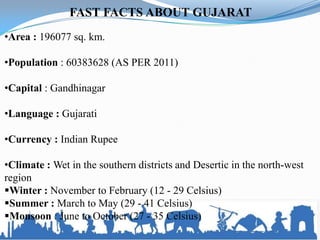
•Area : 196077 sq. km.
•Population : 60383628 (AS PER 2011)
•Capital : Gandhinagar
•Language : Gujarati
•Currency : Indian Rupee
•Climate : Wet in the southern districts and Desertic in the north-west
region
Winter : November to February (12 - 29 Celsius)
Summer : March to May (29 - 41 Celsius)
Monsoon : June to October (27 - 35 Celsius)
HISTORY:
The history of Gujarat encompasses the Indus Valley civilization.
The Dravidian tribes were the original inhabitants of the region. The
ancient history of Gujarat was enriched by their commercial
activities.
The history of Gujarat saw an Aryan invasion followed by a brief
period of Greek rule. There were a succession of Hindu kingdoms
including the era of the Guptas and culminating in the reign of the
Solankis.
The 9th century history of Gujarat saw the emergence of the Muslims
in the political arena of the state. The Mughals established and
consolidated their rule from Delhi The rule of the Mughals lasted for
two centuries before it was ended by the Marathas in the 18th
century.
ADVENTURE
•Aero Sports –
Saputara, Pavagadh, Junagad
h
•Water Sports – Ahmedpur
Mandvi, Ubhraat, Dwarka, N
argol, Tithal, Chorwad
CITIES FAMOUS FOR
NATURE
•Asiatic Lions in Gir forest
•Wild Ass in Rann of Kutchh
•Indian bustards in bird
reserves
•Dugong is found in Okha
HEALTH
•Ahmedabad
•Nadiad
•Karamsad
•Vadodara
•Gandhinagar,
•Mehsana
HERITAGE
•Champaner
•Indus Civilization sites
like Lothal and Dholavera
•Ancient Buddhist sites
RECREATIONAL AND ECO
•Nal Sarovar
•Gandhinagar
•Dunny Point
SPIRITUAL
•Jyotirlingas at Somnath
Temple
•Dwarkadhish Temple
•Dwarka (Jamnagar district)
•Pavagadh
•Mount Girnar at Junagadh
TRADITION, CULTURE AND LIFESTYLE :
Gujarat is blessed with rich and vibrant tradition of Handicrafts. It is
widely differing in its proportions of its patterns to the element of
wonderful exquisite Artifacts in various forms. It stands unique with
diverse arts and crafts – a mixed combination with aesthetic appeal.
•Needlework
•Pottery
•Tie and dye – Bandhani
•Woodwork
•Bead work
•Textile culture
•Patola
•Zari
•Temple culture
•Jewellery
•Furnishings
As Gujarat stands as ‘Heart of India’, Multiculturalism is traced in
Gujarat. Originally known as Gurjars, Gujaratis are influenced by the
waves from the past that inherit values of arts, culture and traditions.
For costumes, traditional outfits like chania choli by women and kedia
dress is worn by men in rural areas or during cultural festivals.
A traditional ‘Gujarati Thali’ consisting of dal (lentils), roti, rice and
vegetables apart from salads, farsan and sweet dish followed by
chaas, forms the morning meal. A variety of Cuisine sub-ordinates like
pickles, chutney, papad, yoghurt, etc serve as fillings on main menu.
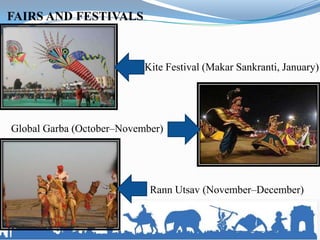
FAIRS AND FESTIVALS
Global Garba (October–November)
Kite Festival (Makar Sankranti, January)
Rann Utsav (November–December)
Kankaria Carnival (25–31 December)
Modhera Dance Festival
(3rd week January)
Tarnetar Fair (August)
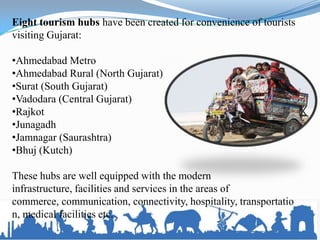
Eight tourism hubs have been created for convenience of tourists
visiting Gujarat:
•Ahmedabad Metro
•Ahmedabad Rural (North Gujarat)
•Surat (South Gujarat)
•Vadodara (Central Gujarat)
•Rajkot
•Junagadh
•Jamnagar (Saurashtra)
•Bhuj (Kutch)
These hubs are well equipped with the modern
infrastructure, facilities and services in the areas of
commerce, communication, connectivity, hospitality, transportatio
n, medical facilities etc.
AHMEDABAD
Founded in the 15th century, Ahmedabad is the largest city in the
state of Gujarat. The city is a vibrant business district and rising
centre of education, information technology and scientific
industries.
Divided in two - the old city and the new city; Ahmedabad enjoys a
thriving cultural tradition, being the centre of Gujarati cultural
activities. Popular celebrations and observances include Uttarayan -
an annual kite-flying day on 14 January and the nine nights of
Navratri - celebrated with people performing Garba - the folk dance
of Gujarat - at venues across the city.
Hathee-singh Jain Temple Modhera Sun Temple
Swami Narayan Mandir
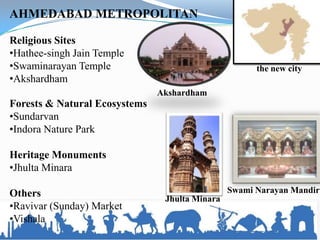
AHMEDABAD METROPOLITAN
Religious Sites
•Hathee-singh Jain Temple
•Swaminarayan Temple
•Akshardham
Forests & Natural Ecosystems
•Sundarvan
•Indora Nature Park
Heritage Monuments
•Jhulta Minara
Others
•Ravivar (Sunday) Market
•Vishala
the new city
Akshardham
Jhulta Minara
the old city
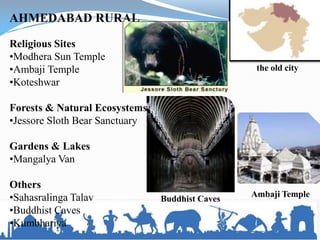
AHMEDABAD RURAL
Religious Sites
•Modhera Sun Temple
•Ambaji Temple
•Koteshwar
Forests & Natural Ecosystems
•Jessore Sloth Bear Sanctuary
Gardens & Lakes
•Mangalya Van
Others
•Sahasralinga Talav
•Buddhist Caves
•Kumbhariya
Ambaji Temple
Buddhist Caves
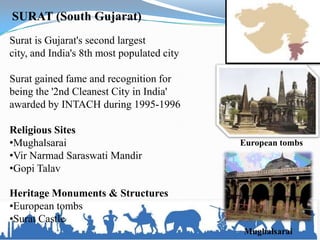
SURAT (South Gujarat)
Surat is Gujarat's second largest
city, and India's 8th most populated city
Surat gained fame and recognition for
being the '2nd Cleanest City in India'
awarded by INTACH during 1995-1996
Religious Sites
•Mughalsarai
•Vir Narmad Saraswati Mandir
•Gopi Talav
Heritage Monuments & Structures
•European tombs
•Surat Castle
European tombs
Mughalsarai
Museums & Learning Spaces
•Sardar V Patel museum and Planetorium
Beaches & Coastal Sites
•Nargol
•Dandi
•Dumas
•Suvali
•Tithal
Others
•Textile market
•Diamond industry
•Dandi
Dandi Beach
Gopi Talav
Textile market
VADODARA (Central Gujarat)
Vadodara, formerly known as Baroda, is
the third largest and most populated city in
Gujarat
Heritage Monuments & Structures
•Palaces
•Dabhoi
•Chhota Udepur
Forests & Natural Ecosystems
•Vadhvana Wetland & Eco campsite
Others
•Vadodra Museum
•Kadia Dungar caves Kadia Dungar caves
RAJKOT
Rajkot has many historical landmarks and
places to visit. The Jubilee Garden is a
large, open park in the center of the city
featuring many monuments from colonial
times
Heritage Monuments & Structures
•Wankaner
•Gondal
Forests & Natural Ecosystems
•Rampara Widlife Sanvtuary
•Bajana
Others
•Khambhalida caves
Wankaner
Khambhalida caves
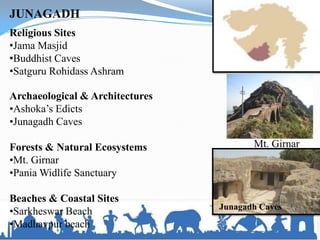
JUNAGADH
Religious Sites
•Jama Masjid
•Buddhist Caves
•Satguru Rohidass Ashram
Archaeological & Architectures
•Ashoka’s Edicts
•Junagadh Caves
Forests & Natural Ecosystems
•Mt. Girnar
•Pania Widlife Sanctuary
Beaches & Coastal Sites
•Sarkheswar Beach
•Madhavpur beach
Mt. Girnar
Junagadh Caves
SOMNATH TEMPLE
The Somnath Temple located near Veraval in Saushtra, on the
western coast of Gujarat
It is one of the twelve Jyotirlinga shrines of the God Shiva.
Somnath means "The Protector of (the) Moon God". The Somnath
Temple is known as "the Shrine Eternal", having been destroyed
sixteen times by Muslim invaders.
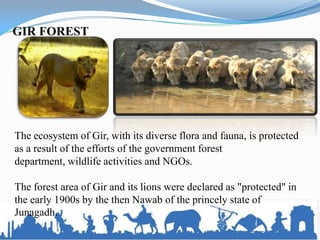
GIR FOREST
The ecosystem of Gir, with its diverse flora and fauna, is protected
as a result of the efforts of the government forest
department, wildlife activities and NGOs.
The forest area of Gir and its lions were declared as "protected" in
the early 1900s by the then Nawab of the princely state of
Junagadh.
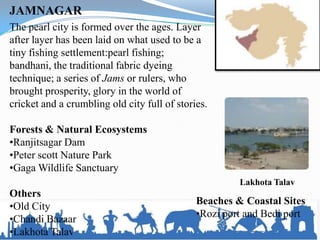
JAMNAGAR
The pearl city is formed over the ages. Layer
after layer has been laid on what used to be a
tiny fishing settlement:pearl fishing;
bandhani, the traditional fabric dyeing
technique; a series of Jams or rulers, who
brought prosperity, glory in the world of
cricket and a crumbling old city full of stories.
Forests & Natural Ecosystems
•Ranjitsagar Dam
•Peter scott Nature Park
•Gaga Wildlife Sanctuary
Others
•Old City
•Chandi Bazaar
•Lakhota Talav
Lakhota Talav
Beaches & Coastal Sites
•Rozi port and Bedi port
BHUJ (KUTCH)
Bhuj is a city in Kutch district. Bhuj
connects you to a range of civilizations and
important events in South Asian history
through prehistoric archaeological
finds, remnants of the Indus Valley
Civilization, places associated with the
Mahabharata.
Religious Sites
•Swaminarayan Temple
Heritage Monuments & Museums
•Aina Mahal
•Prag Mahal
•Kutch Museum
•Bharatiya Sanskriti Darshan
Aina Mahal
How to reach Gujarat:
By Air: The state of Gujarat has 10 domestic airports and an
international airport in the state capital Gandhinagar . All major airlines
of India like Indian Airlines, Jet Airways, etc have regular operations
By Road: Total 68,900kms of roadways comprising of National
Highways, State Highways and other roads run through the state
connecting the major cities of the state with the rest of the country.
By Rail: Extensive railways network runs through the state of Gujarat.
The state is served by several important trains
Ports:
Major Kandla
Minor
Mandvi, Mundra, Sikka, Okha, Porbandar, Veraval, Bhavnagar, Salaya, P
ipavav, Mahuva, Jafrabad, Hazira
DO’S AND DONT’S
DO’S
Read culture of Gujarat i.e. about their traditions and perception
Know about the temperature prevailing at the time of visit
Proper planning is to be done to avoid wastage of time
Check about photography permission / video filming at any
monument
 Keep valuables in hotel locker / safe deposit vaults and get receipt
DONT’S
Don’t travel without tickets in public transports
Don't encourage beggars.
Don't accept food or drink from strangers.
Smoking and drinking is not allowed in public places
Gujarat

Gujarat

  • 3.
    FAST FACTS ABOUTGUJARAT •Area : 196077 sq. km. •Population : 60383628 (AS PER 2011) •Capital : Gandhinagar •Language : Gujarati •Currency : Indian Rupee •Climate : Wet in the southern districts and Desertic in the north-west region Winter : November to February (12 - 29 Celsius) Summer : March to May (29 - 41 Celsius) Monsoon : June to October (27 - 35 Celsius)
  • 4.
    HISTORY: The history ofGujarat encompasses the Indus Valley civilization. The Dravidian tribes were the original inhabitants of the region. The ancient history of Gujarat was enriched by their commercial activities. The history of Gujarat saw an Aryan invasion followed by a brief period of Greek rule. There were a succession of Hindu kingdoms including the era of the Guptas and culminating in the reign of the Solankis. The 9th century history of Gujarat saw the emergence of the Muslims in the political arena of the state. The Mughals established and consolidated their rule from Delhi The rule of the Mughals lasted for two centuries before it was ended by the Marathas in the 18th century.
  • 5.
    ADVENTURE •Aero Sports – Saputara,Pavagadh, Junagad h •Water Sports – Ahmedpur Mandvi, Ubhraat, Dwarka, N argol, Tithal, Chorwad CITIES FAMOUS FOR NATURE •Asiatic Lions in Gir forest •Wild Ass in Rann of Kutchh •Indian bustards in bird reserves •Dugong is found in Okha HEALTH •Ahmedabad •Nadiad •Karamsad •Vadodara •Gandhinagar, •Mehsana HERITAGE •Champaner •Indus Civilization sites like Lothal and Dholavera •Ancient Buddhist sites RECREATIONAL AND ECO •Nal Sarovar •Gandhinagar •Dunny Point SPIRITUAL •Jyotirlingas at Somnath Temple •Dwarkadhish Temple •Dwarka (Jamnagar district) •Pavagadh •Mount Girnar at Junagadh
  • 6.
    TRADITION, CULTURE ANDLIFESTYLE : Gujarat is blessed with rich and vibrant tradition of Handicrafts. It is widely differing in its proportions of its patterns to the element of wonderful exquisite Artifacts in various forms. It stands unique with diverse arts and crafts – a mixed combination with aesthetic appeal. •Needlework •Pottery •Tie and dye – Bandhani •Woodwork •Bead work •Textile culture •Patola •Zari •Temple culture •Jewellery •Furnishings
  • 7.
    As Gujarat standsas ‘Heart of India’, Multiculturalism is traced in Gujarat. Originally known as Gurjars, Gujaratis are influenced by the waves from the past that inherit values of arts, culture and traditions. For costumes, traditional outfits like chania choli by women and kedia dress is worn by men in rural areas or during cultural festivals. A traditional ‘Gujarati Thali’ consisting of dal (lentils), roti, rice and vegetables apart from salads, farsan and sweet dish followed by chaas, forms the morning meal. A variety of Cuisine sub-ordinates like pickles, chutney, papad, yoghurt, etc serve as fillings on main menu.
  • 8.
    FAIRS AND FESTIVALS GlobalGarba (October–November) Kite Festival (Makar Sankranti, January) Rann Utsav (November–December)
  • 9.
    Kankaria Carnival (25–31December) Modhera Dance Festival (3rd week January) Tarnetar Fair (August)
  • 10.
    Eight tourism hubshave been created for convenience of tourists visiting Gujarat: •Ahmedabad Metro •Ahmedabad Rural (North Gujarat) •Surat (South Gujarat) •Vadodara (Central Gujarat) •Rajkot •Junagadh •Jamnagar (Saurashtra) •Bhuj (Kutch) These hubs are well equipped with the modern infrastructure, facilities and services in the areas of commerce, communication, connectivity, hospitality, transportatio n, medical facilities etc.
  • 11.
    AHMEDABAD Founded in the15th century, Ahmedabad is the largest city in the state of Gujarat. The city is a vibrant business district and rising centre of education, information technology and scientific industries. Divided in two - the old city and the new city; Ahmedabad enjoys a thriving cultural tradition, being the centre of Gujarati cultural activities. Popular celebrations and observances include Uttarayan - an annual kite-flying day on 14 January and the nine nights of Navratri - celebrated with people performing Garba - the folk dance of Gujarat - at venues across the city. Hathee-singh Jain Temple Modhera Sun Temple
  • 12.
    Swami Narayan Mandir AHMEDABADMETROPOLITAN Religious Sites •Hathee-singh Jain Temple •Swaminarayan Temple •Akshardham Forests & Natural Ecosystems •Sundarvan •Indora Nature Park Heritage Monuments •Jhulta Minara Others •Ravivar (Sunday) Market •Vishala the new city Akshardham Jhulta Minara
  • 13.
    the old city AHMEDABADRURAL Religious Sites •Modhera Sun Temple •Ambaji Temple •Koteshwar Forests & Natural Ecosystems •Jessore Sloth Bear Sanctuary Gardens & Lakes •Mangalya Van Others •Sahasralinga Talav •Buddhist Caves •Kumbhariya Ambaji Temple Buddhist Caves
  • 14.
    SURAT (South Gujarat) Suratis Gujarat's second largest city, and India's 8th most populated city Surat gained fame and recognition for being the '2nd Cleanest City in India' awarded by INTACH during 1995-1996 Religious Sites •Mughalsarai •Vir Narmad Saraswati Mandir •Gopi Talav Heritage Monuments & Structures •European tombs •Surat Castle European tombs Mughalsarai
  • 15.
    Museums & LearningSpaces •Sardar V Patel museum and Planetorium Beaches & Coastal Sites •Nargol •Dandi •Dumas •Suvali •Tithal Others •Textile market •Diamond industry •Dandi Dandi Beach Gopi Talav Textile market
  • 16.
    VADODARA (Central Gujarat) Vadodara,formerly known as Baroda, is the third largest and most populated city in Gujarat Heritage Monuments & Structures •Palaces •Dabhoi •Chhota Udepur Forests & Natural Ecosystems •Vadhvana Wetland & Eco campsite Others •Vadodra Museum •Kadia Dungar caves Kadia Dungar caves
  • 17.
    RAJKOT Rajkot has manyhistorical landmarks and places to visit. The Jubilee Garden is a large, open park in the center of the city featuring many monuments from colonial times Heritage Monuments & Structures •Wankaner •Gondal Forests & Natural Ecosystems •Rampara Widlife Sanvtuary •Bajana Others •Khambhalida caves Wankaner Khambhalida caves
  • 18.
    JUNAGADH Religious Sites •Jama Masjid •BuddhistCaves •Satguru Rohidass Ashram Archaeological & Architectures •Ashoka’s Edicts •Junagadh Caves Forests & Natural Ecosystems •Mt. Girnar •Pania Widlife Sanctuary Beaches & Coastal Sites •Sarkheswar Beach •Madhavpur beach Mt. Girnar Junagadh Caves
  • 19.
    SOMNATH TEMPLE The SomnathTemple located near Veraval in Saushtra, on the western coast of Gujarat It is one of the twelve Jyotirlinga shrines of the God Shiva. Somnath means "The Protector of (the) Moon God". The Somnath Temple is known as "the Shrine Eternal", having been destroyed sixteen times by Muslim invaders.
  • 20.
    GIR FOREST The ecosystemof Gir, with its diverse flora and fauna, is protected as a result of the efforts of the government forest department, wildlife activities and NGOs. The forest area of Gir and its lions were declared as "protected" in the early 1900s by the then Nawab of the princely state of Junagadh.
  • 21.
    JAMNAGAR The pearl cityis formed over the ages. Layer after layer has been laid on what used to be a tiny fishing settlement:pearl fishing; bandhani, the traditional fabric dyeing technique; a series of Jams or rulers, who brought prosperity, glory in the world of cricket and a crumbling old city full of stories. Forests & Natural Ecosystems •Ranjitsagar Dam •Peter scott Nature Park •Gaga Wildlife Sanctuary Others •Old City •Chandi Bazaar •Lakhota Talav Lakhota Talav Beaches & Coastal Sites •Rozi port and Bedi port
  • 22.
    BHUJ (KUTCH) Bhuj isa city in Kutch district. Bhuj connects you to a range of civilizations and important events in South Asian history through prehistoric archaeological finds, remnants of the Indus Valley Civilization, places associated with the Mahabharata. Religious Sites •Swaminarayan Temple Heritage Monuments & Museums •Aina Mahal •Prag Mahal •Kutch Museum •Bharatiya Sanskriti Darshan Aina Mahal
  • 23.
    How to reachGujarat: By Air: The state of Gujarat has 10 domestic airports and an international airport in the state capital Gandhinagar . All major airlines of India like Indian Airlines, Jet Airways, etc have regular operations By Road: Total 68,900kms of roadways comprising of National Highways, State Highways and other roads run through the state connecting the major cities of the state with the rest of the country. By Rail: Extensive railways network runs through the state of Gujarat. The state is served by several important trains Ports: Major Kandla Minor Mandvi, Mundra, Sikka, Okha, Porbandar, Veraval, Bhavnagar, Salaya, P ipavav, Mahuva, Jafrabad, Hazira
  • 24.
    DO’S AND DONT’S DO’S Readculture of Gujarat i.e. about their traditions and perception Know about the temperature prevailing at the time of visit Proper planning is to be done to avoid wastage of time Check about photography permission / video filming at any monument  Keep valuables in hotel locker / safe deposit vaults and get receipt DONT’S Don’t travel without tickets in public transports Don't encourage beggars. Don't accept food or drink from strangers. Smoking and drinking is not allowed in public places