SANITIZATION &
DISINFECTION
SURGERY
By Jingwa Klein & Babajide Salem
This Photo by Unknown author is licensed under CC BY-SA.
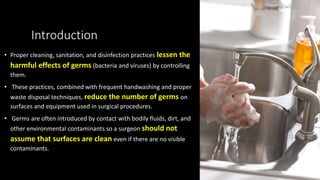
Introduction
• Proper cleaning, sanitation, and disinfection practices lessen the
harmful effects of germs (bacteria and viruses) by controlling
them.
• These practices, combined with frequent handwashing and proper
waste disposal techniques, reduce the number of germs on
surfaces and equipment used in surgical procedures.
• Germs are often introduced by contact with bodily fluids, dirt, and
other environmental contaminants so a surgeon should not
assume that surfaces are clean even if there are no visible
contaminants.
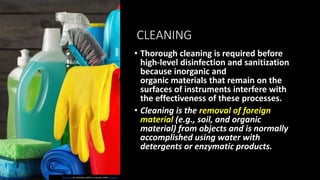
CLEANING
• Thorough cleaning is required before
high-level disinfection and sanitization
because inorganic and
organic materials that remain on the
surfaces of instruments interfere with
the effectiveness of these processes.
• Cleaning is the removal of foreign
material (e.g., soil, and organic
material) from objects and is normally
accomplished using water with
detergents or enzymatic products.
This Photo by Unknown author is licensed under CC BY-SA.
SANITIZATION
It is defined as a chemical process of
reducing the number of disease-
causing germs on cleaned surfaces to
a safe level. An example of
sanitization wiping a counter with a
bleach solution.
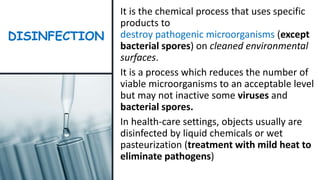
DISINFECTION
It is the chemical process that uses specific
products to
destroy pathogenic microorganisms (except
bacterial spores) on cleaned environmental
surfaces.
It is a process which reduces the number of
viable microorganisms to an acceptable level
but may not inactive some viruses and
bacterial spores.
In health-care settings, objects usually are
disinfected by liquid chemicals or wet
pasteurization (treatment with mild heat to
eliminate pathogens)
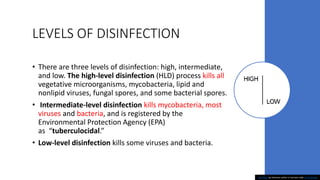
LEVELS OF DISINFECTION
• There are three levels of disinfection: high, intermediate,
and low. The high-level disinfection (HLD) process kills all
vegetative microorganisms, mycobacteria, lipid and
nonlipid viruses, fungal spores, and some bacterial spores.
• Intermediate-level disinfection kills mycobacteria, most
viruses and bacteria, and is registered by the
Environmental Protection Agency (EPA)
as “tuberculocidal.”
• Low-level disinfection kills some viruses and bacteria.
This Photo by Unknown author is licensed under CC BY-NC-ND.
The main
difference
between
sanitization
and
disinfection
Sanitizing is meant to reduce, not kill,
the occurrence and growth of bacteria,
viruses and fungi.
Disinfecting a surface will “kill” the
microscopic organisms as claimed on
the label of a particular product. ... If
we start with 1 million organisms on a
surface then a disinfectant must kill
100 percent of them; zero left.
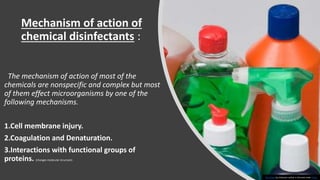
Mechanism of action of
chemical disinfectants :
The mechanism of action of most of the
chemicals are nonspecific and complex but most
of them effect microorganisms by one of the
following mechanisms.
1.Cell membrane injury.
2.Coagulation and Denaturation.
3.Interactions with functional groups of
proteins. (changes molecular structure).
This Photo by Unknown author is licensed under CC BY.
COMPOUNDS
USED AS
DISINFECTANTS
1. ALDEHYDE COMPOUNDS
2. ALCOHOL
3. IODOPHOR COMPOUNDS
4. BIGUANIDE
5. HYDROGEN PEROXIDE
This Photo by Unknown author is licensed under CC BY-ND.
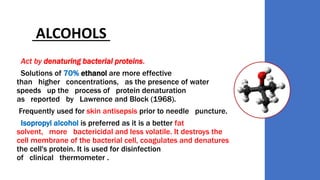
ALCOHOLS
Act by denaturing bacterial proteins.
Solutions of 70% ethanol are more effective
than higher concentrations, as the presence of water
speeds up the process of protein denaturation
as reported by Lawrence and Block (1968).
Frequently used for skin antisepsis prior to needle puncture.
Isopropyl alcohol is preferred as it is a better fat
solvent, more bactericidal and less volatile. It destroys the
cell membrane of the bacterial cell, coagulates and denatures
the cell's protein. It is used for disinfection
of clinical thermometer .
IODOPHOR COMPOUNDS
• Many studies have shown, that, iodophor compounds are the most
effective antiseptics,. Iodine is complexed with organic surface-active
agents, such as, polyvinylpyrrolidone (Betadine, Isodine).
• Their activity is dependent on the release of iodine from the
complex(Iodimetry).
• These compounds are effective against most bacteria, spores,
viruses, and fungi. These are the most commonly used surface
disinfectants along with hypochlorite.
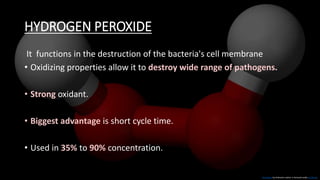
HYDROGEN PEROXIDE
It functions in the destruction of the bacteria's cell membrane
• Oxidizing properties allow it to destroy wide range of pathogens.
• Strong oxidant.
• Biggest advantage is short cycle time.
• Used in 35% to 90% concentration.
This Photo by Unknown author is licensed under CC BY-SA.
SURGICAL INSTRUMENT- CLEANING,
SANITIZATION AND DISINFECTION.
This Photo by Unknown author is licensed under CC BY-SA.
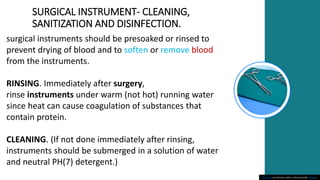
surgical instruments should be presoaked or rinsed to
prevent drying of blood and to soften or remove blood
from the instruments.
RINSING. Immediately after surgery,
rinse instruments under warm (not hot) running water
since heat can cause coagulation of substances that
contain protein.
CLEANING. (If not done immediately after rinsing,
instruments should be submerged in a solution of water
and neutral PH(7) detergent.)
FACTORS AFFECTING SANITIZATION AND
DISINFECTION
• Several physical and chemical factors also influence
disinfectant and sanitization procedures: temperature, pH,
relative humidity, and water hardness.
• For example, the activity of most disinfectants increases as
the temperature increases, but some exceptions exist.
Surgical Scrubbing
The purpose is to reduce resident and transient(transitory- lasting only for a short
time) skin flora (bacteria) to a minimum.
Proper hand scrubbing and the wearing of sterile gloves and a sterile gown
provide the patient with the best possible barrier against pathogenic bacteria in
the environment and against bacteria from the surgical team.
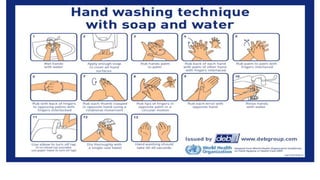
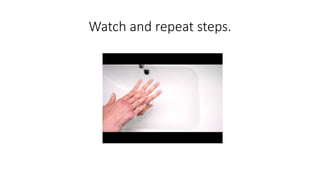
The following steps comprise the generally accepted method for the surgical
hand scrub-
Watch and repeat steps.
Sanitization and disinfection ppt

Sanitization and disinfection ppt

  • 1.
    SANITIZATION & DISINFECTION SURGERY By JingwaKlein & Babajide Salem This Photo by Unknown author is licensed under CC BY-SA.
  • 2.
    Introduction • Proper cleaning,sanitation, and disinfection practices lessen the harmful effects of germs (bacteria and viruses) by controlling them. • These practices, combined with frequent handwashing and proper waste disposal techniques, reduce the number of germs on surfaces and equipment used in surgical procedures. • Germs are often introduced by contact with bodily fluids, dirt, and other environmental contaminants so a surgeon should not assume that surfaces are clean even if there are no visible contaminants.
  • 3.
    CLEANING • Thorough cleaningis required before high-level disinfection and sanitization because inorganic and organic materials that remain on the surfaces of instruments interfere with the effectiveness of these processes. • Cleaning is the removal of foreign material (e.g., soil, and organic material) from objects and is normally accomplished using water with detergents or enzymatic products. This Photo by Unknown author is licensed under CC BY-SA.
  • 4.
    SANITIZATION It is definedas a chemical process of reducing the number of disease- causing germs on cleaned surfaces to a safe level. An example of sanitization wiping a counter with a bleach solution.
  • 5.
    DISINFECTION It is thechemical process that uses specific products to destroy pathogenic microorganisms (except bacterial spores) on cleaned environmental surfaces. It is a process which reduces the number of viable microorganisms to an acceptable level but may not inactive some viruses and bacterial spores. In health-care settings, objects usually are disinfected by liquid chemicals or wet pasteurization (treatment with mild heat to eliminate pathogens)
  • 6.
    LEVELS OF DISINFECTION •There are three levels of disinfection: high, intermediate, and low. The high-level disinfection (HLD) process kills all vegetative microorganisms, mycobacteria, lipid and nonlipid viruses, fungal spores, and some bacterial spores. • Intermediate-level disinfection kills mycobacteria, most viruses and bacteria, and is registered by the Environmental Protection Agency (EPA) as “tuberculocidal.” • Low-level disinfection kills some viruses and bacteria. This Photo by Unknown author is licensed under CC BY-NC-ND.
  • 7.
    The main difference between sanitization and disinfection Sanitizing ismeant to reduce, not kill, the occurrence and growth of bacteria, viruses and fungi. Disinfecting a surface will “kill” the microscopic organisms as claimed on the label of a particular product. ... If we start with 1 million organisms on a surface then a disinfectant must kill 100 percent of them; zero left.
  • 8.
    Mechanism of actionof chemical disinfectants : The mechanism of action of most of the chemicals are nonspecific and complex but most of them effect microorganisms by one of the following mechanisms. 1.Cell membrane injury. 2.Coagulation and Denaturation. 3.Interactions with functional groups of proteins. (changes molecular structure). This Photo by Unknown author is licensed under CC BY.
  • 9.
    COMPOUNDS USED AS DISINFECTANTS 1. ALDEHYDECOMPOUNDS 2. ALCOHOL 3. IODOPHOR COMPOUNDS 4. BIGUANIDE 5. HYDROGEN PEROXIDE This Photo by Unknown author is licensed under CC BY-ND.
  • 10.
    ALCOHOLS Act by denaturingbacterial proteins. Solutions of 70% ethanol are more effective than higher concentrations, as the presence of water speeds up the process of protein denaturation as reported by Lawrence and Block (1968). Frequently used for skin antisepsis prior to needle puncture. Isopropyl alcohol is preferred as it is a better fat solvent, more bactericidal and less volatile. It destroys the cell membrane of the bacterial cell, coagulates and denatures the cell's protein. It is used for disinfection of clinical thermometer .
  • 11.
    IODOPHOR COMPOUNDS • Manystudies have shown, that, iodophor compounds are the most effective antiseptics,. Iodine is complexed with organic surface-active agents, such as, polyvinylpyrrolidone (Betadine, Isodine). • Their activity is dependent on the release of iodine from the complex(Iodimetry). • These compounds are effective against most bacteria, spores, viruses, and fungi. These are the most commonly used surface disinfectants along with hypochlorite.
  • 12.
    HYDROGEN PEROXIDE It functionsin the destruction of the bacteria's cell membrane • Oxidizing properties allow it to destroy wide range of pathogens. • Strong oxidant. • Biggest advantage is short cycle time. • Used in 35% to 90% concentration. This Photo by Unknown author is licensed under CC BY-SA.
  • 13.
    SURGICAL INSTRUMENT- CLEANING, SANITIZATIONAND DISINFECTION. This Photo by Unknown author is licensed under CC BY-SA. surgical instruments should be presoaked or rinsed to prevent drying of blood and to soften or remove blood from the instruments. RINSING. Immediately after surgery, rinse instruments under warm (not hot) running water since heat can cause coagulation of substances that contain protein. CLEANING. (If not done immediately after rinsing, instruments should be submerged in a solution of water and neutral PH(7) detergent.)
  • 14.
    FACTORS AFFECTING SANITIZATIONAND DISINFECTION • Several physical and chemical factors also influence disinfectant and sanitization procedures: temperature, pH, relative humidity, and water hardness. • For example, the activity of most disinfectants increases as the temperature increases, but some exceptions exist.
  • 15.
    Surgical Scrubbing The purposeis to reduce resident and transient(transitory- lasting only for a short time) skin flora (bacteria) to a minimum. Proper hand scrubbing and the wearing of sterile gloves and a sterile gown provide the patient with the best possible barrier against pathogenic bacteria in the environment and against bacteria from the surgical team. The following steps comprise the generally accepted method for the surgical hand scrub-
  • 17.