Prepared By:
Basant Lekhak
6/19/2021 1
Sanitary System
CONTENTS
1. Introduction
2. Objective of sanitation
3. Sanitation, environment and public health
6/19/2021 2
1. Introduction
Sanitation refers to:
 the provision of facilities and service for the safe disposal of
human excreta/ urine and maintains hygienic condition by
collection and management of solid waste also.
 the safe management of human excreta and grey water.
 the principles and practices relating to the collection,
removal, or disposal of human excreta, refuse and waste
water.
 It includes hardware (facilities) and software (rules,
regulations, hygiene).
 Sanitation facility refers to infrastructure dedicated for the
disposal, conveyance or treatment of human excreta, grey
water or solid waste.
3
6/19/2021
Sanitation
 Sanitation is prevention of the spreadic outbreak of
diseases, and can be achieved by either controlling or
eliminating such environmental factors that contribute
in some form or the other to the transmission of
diseases.
6/19/2021 4
Sanitary Engineering
 Sanitary Engineering is the branch of Public Health
Engineering which deals with the preservation and
maintenance of health of the individuals and the
community by preventing communicable diseases.
 It consists of scientific and methodical collection,
conveyance, treatment, and disposal of the waste
matter, so that public health can be protected from the
offensive and injurious substances.
6/19/2021 5
2. Objective of Sanitation
 To provide a healthy living environment for everyone,
 To protect the natural resources ( surface water,
groundwater, soil).
 To provide safety, security and dignity for people when
they defecate or urinate.
 To break the cycle of diseases.
 To educate the community on proper hygiene and
sanitation practices.
 To educate the community on the risk of not adhering
to proper hygiene and sanitation practices.
6/19/2021 6
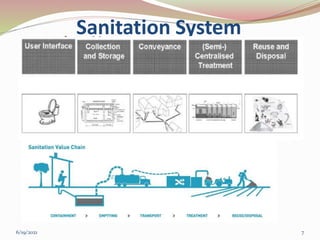
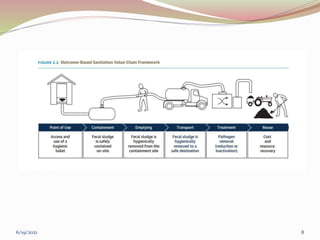
Sanitation System
6/19/2021 7
6/19/2021 8
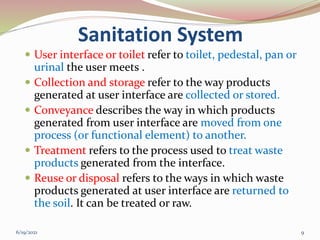
 User interface or toilet refer to toilet, pedestal, pan or
urinal the user meets .
 Collection and storage refer to the way products
generated at user interface are collected or stored.
 Conveyance describes the way in which products
generated from user interface are moved from one
process (or functional element) to another.
 Treatment refers to the process used to treat waste
products generated from the interface.
 Reuse or disposal refers to the ways in which waste
products generated at user interface are returned to
the soil. It can be treated or raw.
6/19/2021 9
Sanitation System
Sanitation System and Technology
6/19/2021 10
6/19/2021 11
Sanitation, environment and public health is needed to:
1. Protect and promote health
 Keeping disease carrying waste and insects away from people,
toilets and homes
 Break the spread of diseases
 Prevent spreading of waterborne diseases
 Improve the health and quality of life
2. Protect the environment against pollution
 Keeping disease carrying waste and insects away from the
environment
 Prevent environmental pollution (air, soil and emission)
 Prevent contamination of water resources (surface and
ground water)
6/19/2021 12
3. Sanitation, environment and
public health
Thank you
13
6/19/2021

Sanitary system

  • 1.
  • 2.
    CONTENTS 1. Introduction 2. Objectiveof sanitation 3. Sanitation, environment and public health 6/19/2021 2
  • 3.
    1. Introduction Sanitation refersto:  the provision of facilities and service for the safe disposal of human excreta/ urine and maintains hygienic condition by collection and management of solid waste also.  the safe management of human excreta and grey water.  the principles and practices relating to the collection, removal, or disposal of human excreta, refuse and waste water.  It includes hardware (facilities) and software (rules, regulations, hygiene).  Sanitation facility refers to infrastructure dedicated for the disposal, conveyance or treatment of human excreta, grey water or solid waste. 3 6/19/2021
  • 4.
    Sanitation  Sanitation isprevention of the spreadic outbreak of diseases, and can be achieved by either controlling or eliminating such environmental factors that contribute in some form or the other to the transmission of diseases. 6/19/2021 4
  • 5.
    Sanitary Engineering  SanitaryEngineering is the branch of Public Health Engineering which deals with the preservation and maintenance of health of the individuals and the community by preventing communicable diseases.  It consists of scientific and methodical collection, conveyance, treatment, and disposal of the waste matter, so that public health can be protected from the offensive and injurious substances. 6/19/2021 5
  • 6.
    2. Objective ofSanitation  To provide a healthy living environment for everyone,  To protect the natural resources ( surface water, groundwater, soil).  To provide safety, security and dignity for people when they defecate or urinate.  To break the cycle of diseases.  To educate the community on proper hygiene and sanitation practices.  To educate the community on the risk of not adhering to proper hygiene and sanitation practices. 6/19/2021 6
  • 7.
  • 8.
  • 9.
     User interfaceor toilet refer to toilet, pedestal, pan or urinal the user meets .  Collection and storage refer to the way products generated at user interface are collected or stored.  Conveyance describes the way in which products generated from user interface are moved from one process (or functional element) to another.  Treatment refers to the process used to treat waste products generated from the interface.  Reuse or disposal refers to the ways in which waste products generated at user interface are returned to the soil. It can be treated or raw. 6/19/2021 9 Sanitation System
  • 10.
    Sanitation System andTechnology 6/19/2021 10
  • 11.
  • 12.
    Sanitation, environment andpublic health is needed to: 1. Protect and promote health  Keeping disease carrying waste and insects away from people, toilets and homes  Break the spread of diseases  Prevent spreading of waterborne diseases  Improve the health and quality of life 2. Protect the environment against pollution  Keeping disease carrying waste and insects away from the environment  Prevent environmental pollution (air, soil and emission)  Prevent contamination of water resources (surface and ground water) 6/19/2021 12 3. Sanitation, environment and public health
  • 13.