MITIGATION vs. RESTORATION
        Testing the legal limits
We Cannot Single Out the Individual to
          Bear the Burdens of Society
      If the Nollans were being singled out to bear the burden of
      California’s attempt to remedy these problems, although they had
      not contributed to it more than other coastal landowners, the State’s
      action, even if otherwise valid, might violate either the incorporated
      Takings Clause or the Equal Protection Clause.

      One of the principal purposes of the Takings Clause is “to bar
      Government from forcing some people alone to bear public
      burdens which, in all fairness and justice, should be borne by
      the public as a whole.” [citation omitted].

    Nollan v. California Coastal Comm., 483 U.S. 825, 835-36, 107 S. Ct.
      3141, 97 L. Ed. 2d. 677 (1987), emphasis supplied.


2
When Government Moves Onto Private
      Property to Solve a Public Problem a
         Heightened Scrutiny is Present

     Dolan (encroaching on property for public
      purpose)—requirements –in addition to
      nexus
       Rough proportionality to project impact
       Individualized determination required
       Burden of proof on local government


3
When Government Moves Onto Private
      Property to Solve a Public Problem a
         Heightened Scrutiny is Present
     Isla Verde v. Camas—dedicated open space for
      wildlife protection
        Requires particularized determination
        Burden is on the government
        After 2002 local governments "know such
         requirements are unlawful" for damage purposes
         under Chapter 64.40 RCW

     See Isla Verde Intern. Holdings, Ltd. v. City of Camas,
      147 Wn. App. 454, 196 P.3d 719 (2008)


4
Definitions: Mitigation
                 Fix a problem you created
      (1) Avoiding the impact altogether by not taking a certain action or
      parts of an action;
      (2) Minimizing impacts by limiting the degree or magnitude of the
      action and its implementation, by using appropriate technology, or
      by taking affirmative steps to avoid or reduce impacts;
      (3) Rectifying the impact by repairing, rehabilitating, or restoring
      the affected environment;
      (4) Reducing or eliminating the impact over time by preservation
      and maintenance operations during the life of the action;
      (5) Compensating for the impact by replacing, enhancing, or
      providing substitute resources or environments; and/or
      (6) Monitoring the impact and taking appropriate corrective
      measure
    WAC 197-11-768


5
Definitions: Restoration
          Fix a problem created by others
       “Restore,” “restoration” or “ecological restoration” means
      the reestablishment or upgrading of impaired
      ecological shoreline processes or functions. This
      may be accomplished through measures including, but
      not limited to, revegetation, removal of intrusive
      shoreline structures and removal or treatment of toxic
      materials. Restoration does not imply a requirement for
      returning the shoreline area to aboriginal or pre-
      European settlement conditions.

    WAC 173-26-020(31)


6
What is the Base From Which We
                 Measure Change?
     Legislation sets the benchmarks for SMA and GMA
        SMA—No net loss
        Shoreline master programs shall provide a level of protection to
         critical areas located within shorelines of the state that assures
         no net loss of shoreline ecological functions necessary to
         sustain shoreline natural resources as defined by department of
         ecology guidelines adopted pursuant to RCW 90.58.060.
         RCW 36.70A.480(5)

        GMA—"protect" critical area (Not preclude activity, which was in
         the original GMA bill and changed the next year)
            Swinomish Indian Tribal Community v. WWGMHB, 161 Wn.2d 415,
             166 P.3d 1198 (2007) ("Do no harm" in LTCA lands)
     Protection not restoration is the standard


7
Working Standards—On Site
     Condition has reasonable connection to problem caused
      by the project under review—nexus
     Condition is roughly proportional to the problem sought
      to be solved—proportionality

     Reasonable necessity proven by particularized
      determination—burden on local governments
        Applicable to condition to be protected
            Shade streams where appropriate, but not eelgrass or nearshore
        Appropriate to the circumstance
            Buffers require naturally functioning conditions
            Buffer does not cross the road


8
Examples of Regulatory Requirements
                 in Question
     Whatcom County
       All near shore habitat is critical area (to 20
        meters or 66 foot depth)
       All marine critical areas require 150-foot
        buffer
       All buffers require vegetative replanting to
        native conditions
       Nonconforming use limitations


9
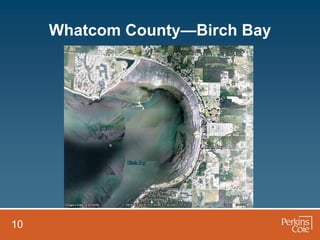
Whatcom County—Birch Bay


10
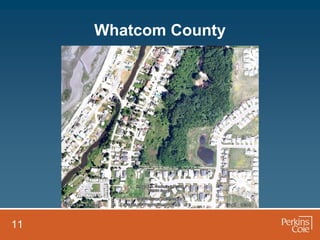
Whatcom County


11
Restoration Science
           City of Bainbridge RPZ + Buffer
    Because the functions provided by a riparian area are fundamental to
     maintaining a healthy functioning marine nearshore, it is recommended that
     the City designate a riparian protection zone (RPZ) with more restricted
     uses and assign a separate marine shoreline buffer to protect the RPZ.
       This would be done to protect such areas that are currently intact, and

       to establish an RPZ where such areas do not currently exist such as when
        properties re-develop, remodel or otherwise expand development.

    The RPZ would be treated as a conservation area to preserve the
     essential relationship between nearshore and shoreline ecological
     functions.

 Herrera report August 11, 2011 (on SMP update website)


12
Draft Revegetation Requirement
     For New Development or Redevelopment
      a. Zone 1 shall be planted to obtain 65% native
      vegetation coverage within 10 years,
      consisting of a mix of native trees and shrubs or
      other approved native vegetation … (50 foot
      typical along entire shoreline frontage)

      For single-family residential property,
      construction of one pervious surface trail for
      non-motorized use, provided the trail is no wider
      than four (4) feet and the vegetation trimming is
      limited to four (4) feet on either side of the trail;

13
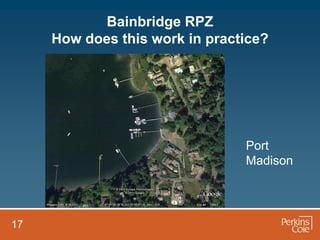
Bainbridge RPZ in Practice
        Does it pass the mitigation test?
  New development or redevelopment
      Naturally functioning conditions do not exist
      Properties typically developed to the water
      Assume any new development meets the no net loss
       test from existing conditions without the buffers
  Look at three examples and see if you see the
   permit program fostering
      Mitigation—within allowable rules or
      Restoration—going beyond mitigation to serve a
       public purpose


14
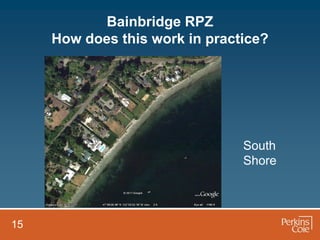
Bainbridge RPZ
     How does this work in practice?


                                South
                                Shore


15
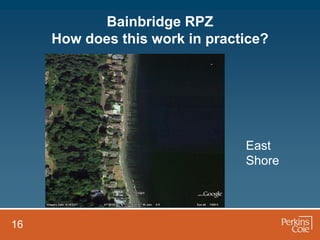
Bainbridge RPZ
     How does this work in practice?


                                East
                                Shore


16
Bainbridge RPZ
     How does this work in practice?


                                Port
                                Madison


17
Puget Sound Partnership and the
         Mandate to Restore Puget Sound
  Puget Sound Partnership
        Created in 2007
        Non regulatory
        Works through Action Agenda and targets
        To restore a healthy Puget Sound by 2020


18
Puget Sound Partnership
         Action Agenda and Targets
  2011 in approaching the 2012 update of
   the Action Agenda set a variety of targets
   to measure how successful the agency
   was in achieving its goal of restoration of
   Puget Sound by 2020


19
Local Governments and
               PSP Restoration Targets
  Estuaries—Add 7,380 acres (~12 square miles)
  Land cover—268 miles of riparian vegetation are
   restored or restoration projects are underway. ...
  Floodplains
      No net loss from 2011 baseline
      Restore 15% of degraded floodplains
  Shellfish beds
      A net increase 10,800 harvestable shellfish acres
      Includes 7,000 acres where harvest is currently prohibited
  Eelgrass—Add 10,000 acres (15 square miles)


20
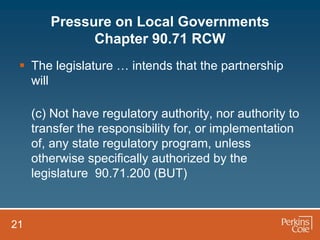
Pressure on Local Governments
              Chapter 90.71 RCW
  The legislature … intends that the partnership
   will

     (c) Not have regulatory authority, nor authority to
     transfer the responsibility for, or implementation
     of, any state regulatory program, unless
     otherwise specifically authorized by the
     legislature 90.71.200 (BUT)


21
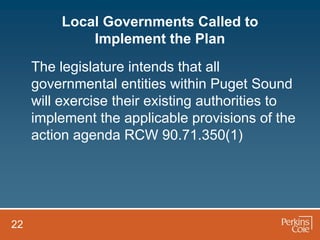
Local Governments Called to
             Implement the Plan
     The legislature intends that all
     governmental entities within Puget Sound
     will exercise their existing authorities to
     implement the applicable provisions of the
     action agenda RCW 90.71.350(1)


22
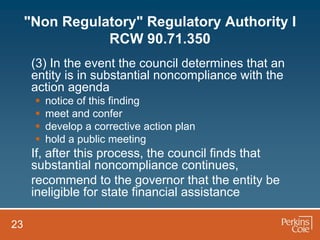
"Non Regulatory" Regulatory Authority I
                RCW 90.71.350
      (3) In the event the council determines that an
      entity is in substantial noncompliance with the
      action agenda
         notice of this finding
         meet and confer
         develop a corrective action plan
         hold a public meeting
      If, after this process, the council finds that
      substantial noncompliance continues,
      recommend to the governor that the entity be
      ineligible for state financial assistance

23
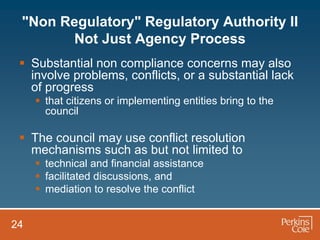
"Non Regulatory" Regulatory Authority II
       Not Just Agency Process
  Substantial non compliance concerns may also
   involve problems, conflicts, or a substantial lack
   of progress
      that citizens or implementing entities bring to the
       council

  The council may use conflict resolution
   mechanisms such as but not limited to
      technical and financial assistance
      facilitated discussions, and
      mediation to resolve the conflict


24
"Non Regulatory" Regulatory Authority III
       About as Friendly as the IRS
  The council may recommend to the governor that the
   entity be ineligible for state financial assistance until the
   substantial noncompliance is remedied.

  Instances of noncompliance shall be included in the
   state of the Sound report required under RCW
   90.71.370.

  The council shall provide its analysis of the conflict and
   recommendations resolution to the governor, the
   legislature, and to those entities with jurisdictional
   authority to resolve the conflict.


25
"Non Regulatory" Regulatory Authority III
       About as Friendly as the IRS
     (6) The council may make recommendations to the
     governor and appropriate committees of the senate and
     house of representatives for local or state administrative
     or legislative actions to address barriers it has identified
     to successfully implementing the action age

  (Does anyone remember Chelan County and the "hell no
   we wont go" phase of its GMA planning—until DCTED
   recommended a funding cut off?)
      Nothing voluntary about it


26
Local Governments and
               PSP Restoration Targets
  Estuaries—Add 7,380 acres (~12 square miles)
  Land cover—268 miles of riparian vegetation are
   restored or restoration projects are underway. ...
  Floodplains
      No net loss from 2011 baseline
      Restore 15% of degraded floodplains
  Shellfish beds
      A net increase 10,800 harvestable shellfish acres
      includes 7,000 acres where harvest is currently prohibited
  Eelgrass—Add 10,000 acres (15 square miles)


27
Estuaries/Riparian Restoration
           Nisqually Success Story


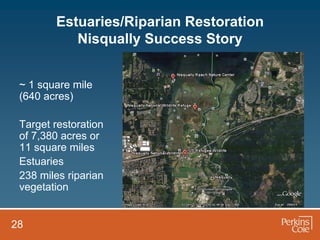
 ~ 1 square mile
 (640 acres)

 Target restoration
 of 7,380 acres or
 11 square miles
 Estuaries
 238 miles riparian
 vegetation


28
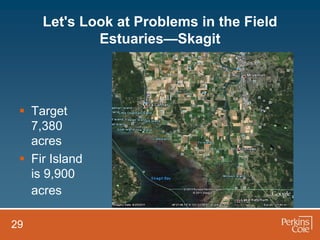
Let's Look at Problems in the Field
             Estuaries—Skagit


  Target
   7,380
   acres
  Fir Island
   is 9,900
   acres

29
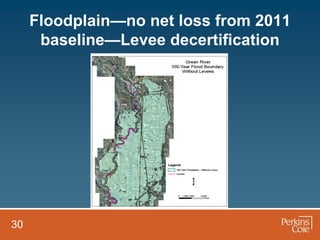
Floodplain—no net loss from 2011
      baseline—Levee decertification


30
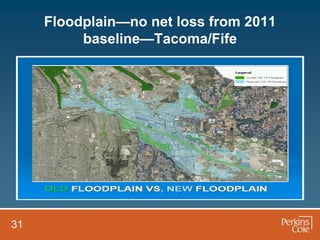
Floodplain—no net loss from 2011
          baseline—Tacoma/Fife


31
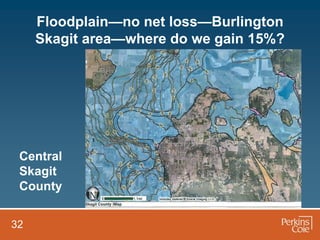
Floodplain—no net loss—Burlington
     Skagit area—where do we gain 15%?


 Central
 Skagit
 County


32
Riparian Restoration
                          Rivers
                     278-mile Target
Buffers depend on naturally functioning conditions
Test for validity for local enforcement:
 Nexus-proportionality
 Reasonable necessity
     Particularized determination
     Applicable to conditions
     Appropriate to circumstance


33
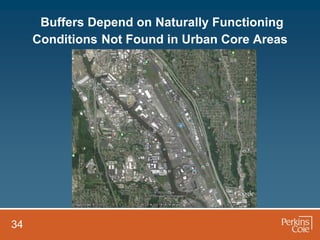
Buffers Depend on Naturally Functioning
     Conditions Not Found in Urban Core Areas


34
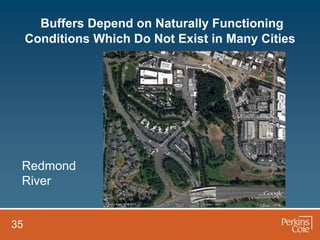
Buffers Depend on Naturally Functioning
     Conditions Which Do Not Exist in Many Cities


 Redmond
 River


35
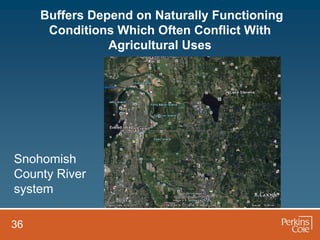
Buffers Depend on Naturally Functioning
      Conditions Which Often Conflict With
                Agricultural Uses


Snohomish
County River
system

36
Where Do We Find the Areas for
      Restoration and How Is It Imposed?
   "If the local government used the best available science in
   adopting its critical areas regulations, the permit decisions it
   bases on those regulations will satisfy the nexus and rough
   proportionality rules."
 Honesty in Environmental Analysis and Legislation (HEAL) v. Central,
   96 Wn. App. 522, 534; 979 P.2d 864 (1999).
 Message: Read HEAL carefully

  Best available science when intruding on private property for open
   space buffers and vegetation restoration
      Naturally functioning conditions present
      Reasonable necessity-particularized determination
          Applicable to condition
          Appropriate to the circumstance
      Difficult to enforce where project already meets the no net loss test


37
Lesson: Mitigation is Within the Proper
           Realm of Lawful Exaction
          Restoration is Typically Not

  Restoration beyond
       No net loss
       Do no harm
       Protect, not restore
  Is a public responsibility beyond the ability
   of local governments to command from
   private property owners


38
Lesson

  Local governments for their shoreline
   restoration plans
  Puget Sound Partnership for its Puget
   Sound restoration targets
      Cannot rely on local government police power
       to achieve the desired results
      Restoration beyond mitigation can only be
       achieved through public investment and
       private incentives

39
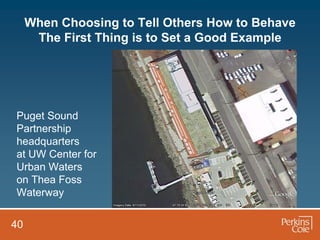
When Choosing to Tell Others How to Behave
      The First Thing is to Set a Good Example


Puget Sound
Partnership
headquarters
at UW Center for
Urban Waters
on Thea Foss
Waterway


40
Presented by
        Alexander W. "Sandy" Mackie
        Perkins Coie LLP
        1201 Third Avenue, Suite 4800
        Seattle, WA 98101-3099
        206-359-8653
        amackie@perkinscoie.com


41

Sandy Mackie on Restoration vs. Mitigation

  • 1.
    MITIGATION vs. RESTORATION Testing the legal limits
  • 2.
    We Cannot SingleOut the Individual to Bear the Burdens of Society If the Nollans were being singled out to bear the burden of California’s attempt to remedy these problems, although they had not contributed to it more than other coastal landowners, the State’s action, even if otherwise valid, might violate either the incorporated Takings Clause or the Equal Protection Clause. One of the principal purposes of the Takings Clause is “to bar Government from forcing some people alone to bear public burdens which, in all fairness and justice, should be borne by the public as a whole.” [citation omitted]. Nollan v. California Coastal Comm., 483 U.S. 825, 835-36, 107 S. Ct. 3141, 97 L. Ed. 2d. 677 (1987), emphasis supplied. 2
  • 3.
    When Government MovesOnto Private Property to Solve a Public Problem a Heightened Scrutiny is Present  Dolan (encroaching on property for public purpose)—requirements –in addition to nexus  Rough proportionality to project impact  Individualized determination required  Burden of proof on local government 3
  • 4.
    When Government MovesOnto Private Property to Solve a Public Problem a Heightened Scrutiny is Present  Isla Verde v. Camas—dedicated open space for wildlife protection  Requires particularized determination  Burden is on the government  After 2002 local governments "know such requirements are unlawful" for damage purposes under Chapter 64.40 RCW  See Isla Verde Intern. Holdings, Ltd. v. City of Camas, 147 Wn. App. 454, 196 P.3d 719 (2008) 4
  • 5.
    Definitions: Mitigation Fix a problem you created (1) Avoiding the impact altogether by not taking a certain action or parts of an action; (2) Minimizing impacts by limiting the degree or magnitude of the action and its implementation, by using appropriate technology, or by taking affirmative steps to avoid or reduce impacts; (3) Rectifying the impact by repairing, rehabilitating, or restoring the affected environment; (4) Reducing or eliminating the impact over time by preservation and maintenance operations during the life of the action; (5) Compensating for the impact by replacing, enhancing, or providing substitute resources or environments; and/or (6) Monitoring the impact and taking appropriate corrective measure WAC 197-11-768 5
  • 6.
    Definitions: Restoration Fix a problem created by others “Restore,” “restoration” or “ecological restoration” means the reestablishment or upgrading of impaired ecological shoreline processes or functions. This may be accomplished through measures including, but not limited to, revegetation, removal of intrusive shoreline structures and removal or treatment of toxic materials. Restoration does not imply a requirement for returning the shoreline area to aboriginal or pre- European settlement conditions. WAC 173-26-020(31) 6
  • 7.
    What is theBase From Which We Measure Change?  Legislation sets the benchmarks for SMA and GMA  SMA—No net loss  Shoreline master programs shall provide a level of protection to critical areas located within shorelines of the state that assures no net loss of shoreline ecological functions necessary to sustain shoreline natural resources as defined by department of ecology guidelines adopted pursuant to RCW 90.58.060. RCW 36.70A.480(5)  GMA—"protect" critical area (Not preclude activity, which was in the original GMA bill and changed the next year)  Swinomish Indian Tribal Community v. WWGMHB, 161 Wn.2d 415, 166 P.3d 1198 (2007) ("Do no harm" in LTCA lands)  Protection not restoration is the standard 7
  • 8.
    Working Standards—On Site  Condition has reasonable connection to problem caused by the project under review—nexus  Condition is roughly proportional to the problem sought to be solved—proportionality  Reasonable necessity proven by particularized determination—burden on local governments  Applicable to condition to be protected  Shade streams where appropriate, but not eelgrass or nearshore  Appropriate to the circumstance  Buffers require naturally functioning conditions  Buffer does not cross the road 8
  • 9.
    Examples of RegulatoryRequirements in Question  Whatcom County  All near shore habitat is critical area (to 20 meters or 66 foot depth)  All marine critical areas require 150-foot buffer  All buffers require vegetative replanting to native conditions  Nonconforming use limitations 9
  • 10.
  • 11.
  • 12.
    Restoration Science City of Bainbridge RPZ + Buffer  Because the functions provided by a riparian area are fundamental to maintaining a healthy functioning marine nearshore, it is recommended that the City designate a riparian protection zone (RPZ) with more restricted uses and assign a separate marine shoreline buffer to protect the RPZ.  This would be done to protect such areas that are currently intact, and  to establish an RPZ where such areas do not currently exist such as when properties re-develop, remodel or otherwise expand development.  The RPZ would be treated as a conservation area to preserve the essential relationship between nearshore and shoreline ecological functions. Herrera report August 11, 2011 (on SMP update website) 12
  • 13.
    Draft Revegetation Requirement For New Development or Redevelopment a. Zone 1 shall be planted to obtain 65% native vegetation coverage within 10 years, consisting of a mix of native trees and shrubs or other approved native vegetation … (50 foot typical along entire shoreline frontage) For single-family residential property, construction of one pervious surface trail for non-motorized use, provided the trail is no wider than four (4) feet and the vegetation trimming is limited to four (4) feet on either side of the trail; 13
  • 14.
    Bainbridge RPZ inPractice Does it pass the mitigation test?  New development or redevelopment  Naturally functioning conditions do not exist  Properties typically developed to the water  Assume any new development meets the no net loss test from existing conditions without the buffers  Look at three examples and see if you see the permit program fostering  Mitigation—within allowable rules or  Restoration—going beyond mitigation to serve a public purpose 14
  • 15.
    Bainbridge RPZ How does this work in practice? South Shore 15
  • 16.
    Bainbridge RPZ How does this work in practice? East Shore 16
  • 17.
    Bainbridge RPZ How does this work in practice? Port Madison 17
  • 18.
    Puget Sound Partnershipand the Mandate to Restore Puget Sound  Puget Sound Partnership  Created in 2007  Non regulatory  Works through Action Agenda and targets  To restore a healthy Puget Sound by 2020 18
  • 19.
    Puget Sound Partnership Action Agenda and Targets  2011 in approaching the 2012 update of the Action Agenda set a variety of targets to measure how successful the agency was in achieving its goal of restoration of Puget Sound by 2020 19
  • 20.
    Local Governments and PSP Restoration Targets  Estuaries—Add 7,380 acres (~12 square miles)  Land cover—268 miles of riparian vegetation are restored or restoration projects are underway. ...  Floodplains  No net loss from 2011 baseline  Restore 15% of degraded floodplains  Shellfish beds  A net increase 10,800 harvestable shellfish acres  Includes 7,000 acres where harvest is currently prohibited  Eelgrass—Add 10,000 acres (15 square miles) 20
  • 21.
    Pressure on LocalGovernments Chapter 90.71 RCW  The legislature … intends that the partnership will (c) Not have regulatory authority, nor authority to transfer the responsibility for, or implementation of, any state regulatory program, unless otherwise specifically authorized by the legislature 90.71.200 (BUT) 21
  • 22.
    Local Governments Calledto Implement the Plan The legislature intends that all governmental entities within Puget Sound will exercise their existing authorities to implement the applicable provisions of the action agenda RCW 90.71.350(1) 22
  • 23.
    "Non Regulatory" RegulatoryAuthority I RCW 90.71.350 (3) In the event the council determines that an entity is in substantial noncompliance with the action agenda  notice of this finding  meet and confer  develop a corrective action plan  hold a public meeting If, after this process, the council finds that substantial noncompliance continues, recommend to the governor that the entity be ineligible for state financial assistance 23
  • 24.
    "Non Regulatory" RegulatoryAuthority II Not Just Agency Process  Substantial non compliance concerns may also involve problems, conflicts, or a substantial lack of progress  that citizens or implementing entities bring to the council  The council may use conflict resolution mechanisms such as but not limited to  technical and financial assistance  facilitated discussions, and  mediation to resolve the conflict 24
  • 25.
    "Non Regulatory" RegulatoryAuthority III About as Friendly as the IRS  The council may recommend to the governor that the entity be ineligible for state financial assistance until the substantial noncompliance is remedied.  Instances of noncompliance shall be included in the state of the Sound report required under RCW 90.71.370.  The council shall provide its analysis of the conflict and recommendations resolution to the governor, the legislature, and to those entities with jurisdictional authority to resolve the conflict. 25
  • 26.
    "Non Regulatory" RegulatoryAuthority III About as Friendly as the IRS (6) The council may make recommendations to the governor and appropriate committees of the senate and house of representatives for local or state administrative or legislative actions to address barriers it has identified to successfully implementing the action age  (Does anyone remember Chelan County and the "hell no we wont go" phase of its GMA planning—until DCTED recommended a funding cut off?)  Nothing voluntary about it 26
  • 27.
    Local Governments and PSP Restoration Targets  Estuaries—Add 7,380 acres (~12 square miles)  Land cover—268 miles of riparian vegetation are restored or restoration projects are underway. ...  Floodplains  No net loss from 2011 baseline  Restore 15% of degraded floodplains  Shellfish beds  A net increase 10,800 harvestable shellfish acres  includes 7,000 acres where harvest is currently prohibited  Eelgrass—Add 10,000 acres (15 square miles) 27
  • 28.
    Estuaries/Riparian Restoration Nisqually Success Story ~ 1 square mile (640 acres) Target restoration of 7,380 acres or 11 square miles Estuaries 238 miles riparian vegetation 28
  • 29.
    Let's Look atProblems in the Field Estuaries—Skagit  Target 7,380 acres  Fir Island is 9,900 acres 29
  • 30.
    Floodplain—no net lossfrom 2011 baseline—Levee decertification 30
  • 31.
    Floodplain—no net lossfrom 2011 baseline—Tacoma/Fife 31
  • 32.
    Floodplain—no net loss—Burlington Skagit area—where do we gain 15%? Central Skagit County 32
  • 33.
    Riparian Restoration Rivers 278-mile Target Buffers depend on naturally functioning conditions Test for validity for local enforcement: Nexus-proportionality Reasonable necessity Particularized determination Applicable to conditions Appropriate to circumstance 33
  • 34.
    Buffers Depend onNaturally Functioning Conditions Not Found in Urban Core Areas 34
  • 35.
    Buffers Depend onNaturally Functioning Conditions Which Do Not Exist in Many Cities Redmond River 35
  • 36.
    Buffers Depend onNaturally Functioning Conditions Which Often Conflict With Agricultural Uses Snohomish County River system 36
  • 37.
    Where Do WeFind the Areas for Restoration and How Is It Imposed? "If the local government used the best available science in adopting its critical areas regulations, the permit decisions it bases on those regulations will satisfy the nexus and rough proportionality rules." Honesty in Environmental Analysis and Legislation (HEAL) v. Central, 96 Wn. App. 522, 534; 979 P.2d 864 (1999). Message: Read HEAL carefully  Best available science when intruding on private property for open space buffers and vegetation restoration  Naturally functioning conditions present  Reasonable necessity-particularized determination  Applicable to condition  Appropriate to the circumstance  Difficult to enforce where project already meets the no net loss test 37
  • 38.
    Lesson: Mitigation isWithin the Proper Realm of Lawful Exaction Restoration is Typically Not  Restoration beyond  No net loss  Do no harm  Protect, not restore  Is a public responsibility beyond the ability of local governments to command from private property owners 38
  • 39.
    Lesson  Localgovernments for their shoreline restoration plans  Puget Sound Partnership for its Puget Sound restoration targets  Cannot rely on local government police power to achieve the desired results  Restoration beyond mitigation can only be achieved through public investment and private incentives 39
  • 40.
    When Choosing toTell Others How to Behave The First Thing is to Set a Good Example Puget Sound Partnership headquarters at UW Center for Urban Waters on Thea Foss Waterway 40
  • 41.
    Presented by Alexander W. "Sandy" Mackie Perkins Coie LLP 1201 Third Avenue, Suite 4800 Seattle, WA 98101-3099 206-359-8653 amackie@perkinscoie.com 41