HOW DECISIONS ARE
MADE IN THE PLANNING
FRAMEWORK


David Roemer, MURP , Lecturer,
San Jose State
University, Department of
Urban and Regional Planning
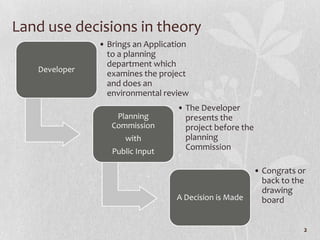
Land use decisions in theory
               • Brings an Application
                 to a planning
                 department which
   Developer
                 examines the project
                 and does an
                 environmental review
                                   • The Developer
                   Planning          presents the
                  Commission         project before the
                     with            planning
                  Public Input
                                     Commission

                                                          • Congrats or
                                                            back to the
                                                            drawing
                                  A Decision is Made        board


                                                                      2
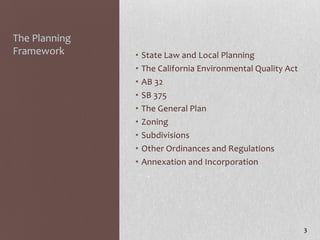
The Planning
Framework      •   State Law and Local Planning
               •   The California Environmental Quality Act
               •   AB 32
               •   SB 375
               •   The General Plan
               •   Zoning
               •   Subdivisions
               •   Other Ordinances and Regulations
               •   Annexation and Incorporation


                                                              3
Local planning in
California is           THE PLANNING AND ZONING LAW
established in state
                          (California Government Code)
laws
                       TITLE 7. PLANNING AND LAND USE
                       DIVISION 1. PLANNING AND ZONING
                          Chapter 1. General Provisions
                             (Sections 65000 et seq.)


                                                      4
A California statute
passed in 1970         • CEQA requires local and state
The California           governments to consider the
Environmental            potential environmental effects
Quality Act (CEQA)       of a project before deciding
                         whether to approve it or not.


                                                           5
Assembly Bill 32:
Global Warming
Solutions Act (2006)
                       Reduce statewide levels of
                       greenhouse gas emissions
                                  to
                          1990 levels by 2020


                                                    6
Senate Bill B
375, The Sustainable      “In order to reach
Communities and        California’s greenhouse
Climate Protection
Act of 2008              gas goals we must
                       rethink how we design
                          our communities”

                       (From Governor Schwarzenegger’s Office
                                Fact Sheet on SB 375)


                                                                7
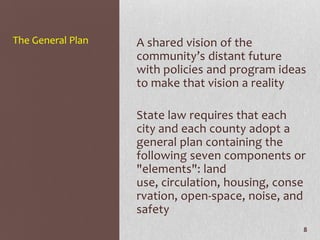
The General Plan   A shared vision of the
                   community’s distant future
                   with policies and program ideas
                   to make that vision a reality

                   State law requires that each
                   city and each county adopt a
                   general plan containing the
                   following seven components or
                   "elements": land
                   use, circulation, housing, conse
                   rvation, open-space, noise, and
                   safety
                                                  8
Seven Mandatory
Elements
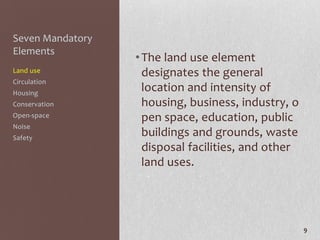
                  • The land use element
Land use            designates the general
Circulation
Housing
                    location and intensity of
Conservation        housing, business, industry, o
Open-space          pen space, education, public
Noise
Safety
                    buildings and grounds, waste
                    disposal facilities, and other
                    land uses.


                                                     9
Seven Mandatory
Elements
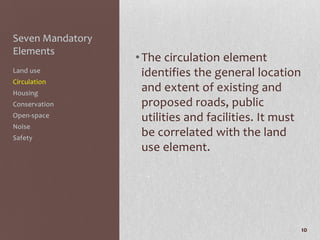
                  • The circulation element
Land use            identifies the general location
Circulation
Housing
                    and extent of existing and
Conservation        proposed roads, public
Open-space          utilities and facilities. It must
Noise
Safety
                    be correlated with the land
                    use element.


                                                        10
Seven Mandatory
Elements
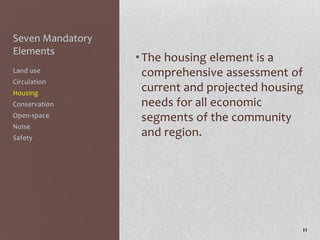
                  • The housing element is a
Land use            comprehensive assessment of
Circulation
Housing
                    current and projected housing
Conservation        needs for all economic
Open-space          segments of the community
Noise
Safety
                    and region.


                                                11
Seven Mandatory
Elements
                  • The conservation element
Land use            addresses the
Circulation
Housing
                    conservation, development, a
Conservation        nd use of natural resources
Open-space          including
Noise
Safety
                    water, forests, soils, rivers, an
                    d mineral deposits.


                                                        12
Seven Mandatory
Elements
                  • The open-space element
Land use            details plans and measures for
Circulation
Housing
                    preserving open-space for
Conservation        natural resources, and the
Open-space          identification of agricultural
Noise
Safety
                    land.


                                                 13
Seven Mandatory
Elements
                  • The noise element identifies
Land use            and appraises noise problems
Circulation
Housing
                    within the community and
Conservation        forms the basis for
Open-space          distributing new noise-
Noise
Safety
                    sensitive land uses.


                                                   14
Seven Mandatory
Elements
                  • The safety element
Land use            establishes policies and
Circulation
Housing
                    programs to protect the
Conservation        community from risks
Open-space          associated with
Noise
Safety
                    seismic, geologic, flood, and
                    wildfire hazards.


                                                    15
Santa Clara County
General Plan Update
                      • Santa Clara will be one of the
New Health Element
                        first counties in California to
                        integrate a Health Element
                        into their General Plan.

                      • The Health Element will
                        address a number health and
                        wellness topics affecting
                        County residents.


                                                          16
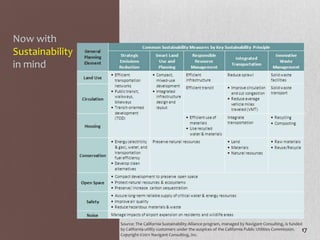
Now with
Sustainability
in mind


                 Source: The California Sustainability Alliance program, managed by Navigant Consulting, is funded
                 by California utility customers under the auspices of the California Public Utilities Commission. 17
                 Copyright ©2011 Navigant Consulting, Inc.
The State
Subdivision Map Act   • In general, land cannot be
(commencing with        divided in California without
Government Code
                        local government approval.
Section 66410)
Subdivisions
                      • The local general
                        plan, zoning, subdivision, and
                        other ordinances govern the
                        design of the subdivision, the
                        size of its lots, and the types
                        of improvements (street
                        construction, sewer
                        lines, drainage facilities, etc.). 18
Other Ordinances
and Regulations
                   • Common types include: flood
                     protection, historic
                     preservation, design
                     review, hillside development
                     control, growth
                     management, impact
                     fees, traffic management, and
                     sign control.


                                                 19
• A zoning ordinance is the local
Zoning     law that spells out the
           immediate, allowable uses for
           each piece of property within
           the community.
         • Zoning is adopted by
           ordinance and carries the
           weight of local law.
         • If a landowner proposes a use
           that is not allowed in the
           zone, the city or county must
           approve a rezoning (change in
           zone) before development of
           that use can begin.           20
Annexation and
Incorporation    • Annexation (the addition of
                   territory to an existing city)
                   and incorporation (creation of
                   a new city) are controlled by
                   the Local Agency Formation
                   Commission (LAFCO)
                   established in each county by
                   the state's Cortese-Knox Act
                   (commencing with
                   Government Code Section
                   56000).
                                                21
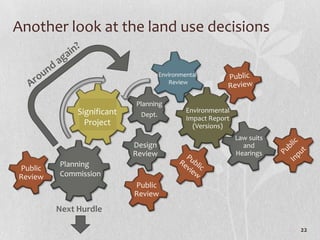
Another look at the land use decisions

                                     Environmental
                                        Review


                            Planning
              Significant                     Environmental
                             Dept.
                                              Impact Report
                Project                         (Versions)
                                                              Law suits
                            Design                              and
                            Review                            Hearings
         Planning
Public
Review   Commission
                            Public
                            Review
         Next Hurdle

                                                                          22
BIBLIOGRAPHY
•   Alternative Techniques for Controlling Land Use: A Guide to Small Cities and Rural Areas in California, by Irving Schiffman (University Center for Economic
    Development and Planning, California State University, Chico) 1982, revised1989. This book discusses, in detail, concepts suc h as hillside development
    standards, planned unit development, and specific plans.


•   California Environmental Quality Act: Statutes and Guidelines (Governor's Office of Planning and Research, Sacramento, Califo rnia) 1996, 301 pp. The CEQA
    Guidelines describe the requirements for evaluating environmental impacts. Out of Print, check in the government documents se ction of your local library.


•   California Land Use and Planning Law, by Daniel J. Curtin Jr., (Solano Press, Pt. Arena, California) revised annually. A look at the
    planning, zoning, subdivision, and environmental quality laws that is illustrated by references to numerous court cases.


•   The General Plan Guidelines (Governor's Office of Planning and Research, Sacramento, California) 1987, 368 pp. The Guidelines discuss local planning activities
    and how to write or revise a general plan.


•   Guide to California Government, (League of Women Voters of California, Sacramento, California) 13th Edition, 1986, 167 pp. An excellent summary of the
    processes of local and state government.


•   Guide to the Cortese/Knox Local Government Reorganization Act of 1985, by the Assembly Local Government Committee (Joint Publications
    Office, Sacramento, California),1985, 228 pp. A compilation of the law that authorizes annexations and other local government reorganizations. It contains a
    flowchart illustrating the annexation process.


•   Planning Commission Handbook (League of California Cities, Sacramento, California) 1984. A well -written overview of the role of the planning commission and
    California planning law.


•   Subdivision Map Act Manual, by Daniel J. Curtin, Jr., (Solano Press, Pt. Arena, California), revised annually. A practitioner 's guide to the Map Act, including
    pertinent legal precedents.


•   Your Guide to Open Meetings, The Ralph M. Brown Act, by the Senate Local Government Committee (Joint Publications Office, Sac ramento, California), 1989.
    An easy to read explanation of the state's open meeting laws and the responsibilities of local government with regard to publ ic meetings.
•   Source for most of this presentation taken from the web site: http://ceres.ca.gov/ceqa/more/tas/Planning_Guide.html#intro


                                                                                                                                                                       23
THANK YOU
David Roemer
San Jose State University
Urban and Regional Planning
der_gis@earthlink.net

How Decisions Are Made in the Planning Framework By David Roemer

  • 1.
    HOW DECISIONS ARE MADEIN THE PLANNING FRAMEWORK David Roemer, MURP , Lecturer, San Jose State University, Department of Urban and Regional Planning
  • 2.
    Land use decisionsin theory • Brings an Application to a planning department which Developer examines the project and does an environmental review • The Developer Planning presents the Commission project before the with planning Public Input Commission • Congrats or back to the drawing A Decision is Made board 2
  • 3.
    The Planning Framework • State Law and Local Planning • The California Environmental Quality Act • AB 32 • SB 375 • The General Plan • Zoning • Subdivisions • Other Ordinances and Regulations • Annexation and Incorporation 3
  • 4.
    Local planning in Californiais THE PLANNING AND ZONING LAW established in state (California Government Code) laws TITLE 7. PLANNING AND LAND USE DIVISION 1. PLANNING AND ZONING Chapter 1. General Provisions (Sections 65000 et seq.) 4
  • 5.
    A California statute passedin 1970 • CEQA requires local and state The California governments to consider the Environmental potential environmental effects Quality Act (CEQA) of a project before deciding whether to approve it or not. 5
  • 6.
    Assembly Bill 32: GlobalWarming Solutions Act (2006) Reduce statewide levels of greenhouse gas emissions to 1990 levels by 2020 6
  • 7.
    Senate Bill B 375,The Sustainable “In order to reach Communities and California’s greenhouse Climate Protection Act of 2008 gas goals we must rethink how we design our communities” (From Governor Schwarzenegger’s Office Fact Sheet on SB 375) 7
  • 8.
    The General Plan A shared vision of the community’s distant future with policies and program ideas to make that vision a reality State law requires that each city and each county adopt a general plan containing the following seven components or "elements": land use, circulation, housing, conse rvation, open-space, noise, and safety 8
  • 9.
    Seven Mandatory Elements • The land use element Land use designates the general Circulation Housing location and intensity of Conservation housing, business, industry, o Open-space pen space, education, public Noise Safety buildings and grounds, waste disposal facilities, and other land uses. 9
  • 10.
    Seven Mandatory Elements • The circulation element Land use identifies the general location Circulation Housing and extent of existing and Conservation proposed roads, public Open-space utilities and facilities. It must Noise Safety be correlated with the land use element. 10
  • 11.
    Seven Mandatory Elements • The housing element is a Land use comprehensive assessment of Circulation Housing current and projected housing Conservation needs for all economic Open-space segments of the community Noise Safety and region. 11
  • 12.
    Seven Mandatory Elements • The conservation element Land use addresses the Circulation Housing conservation, development, a Conservation nd use of natural resources Open-space including Noise Safety water, forests, soils, rivers, an d mineral deposits. 12
  • 13.
    Seven Mandatory Elements • The open-space element Land use details plans and measures for Circulation Housing preserving open-space for Conservation natural resources, and the Open-space identification of agricultural Noise Safety land. 13
  • 14.
    Seven Mandatory Elements • The noise element identifies Land use and appraises noise problems Circulation Housing within the community and Conservation forms the basis for Open-space distributing new noise- Noise Safety sensitive land uses. 14
  • 15.
    Seven Mandatory Elements • The safety element Land use establishes policies and Circulation Housing programs to protect the Conservation community from risks Open-space associated with Noise Safety seismic, geologic, flood, and wildfire hazards. 15
  • 16.
    Santa Clara County GeneralPlan Update • Santa Clara will be one of the New Health Element first counties in California to integrate a Health Element into their General Plan. • The Health Element will address a number health and wellness topics affecting County residents. 16
  • 17.
    Now with Sustainability in mind Source: The California Sustainability Alliance program, managed by Navigant Consulting, is funded by California utility customers under the auspices of the California Public Utilities Commission. 17 Copyright ©2011 Navigant Consulting, Inc.
  • 18.
    The State Subdivision MapAct • In general, land cannot be (commencing with divided in California without Government Code local government approval. Section 66410) Subdivisions • The local general plan, zoning, subdivision, and other ordinances govern the design of the subdivision, the size of its lots, and the types of improvements (street construction, sewer lines, drainage facilities, etc.). 18
  • 19.
    Other Ordinances and Regulations • Common types include: flood protection, historic preservation, design review, hillside development control, growth management, impact fees, traffic management, and sign control. 19
  • 20.
    • A zoningordinance is the local Zoning law that spells out the immediate, allowable uses for each piece of property within the community. • Zoning is adopted by ordinance and carries the weight of local law. • If a landowner proposes a use that is not allowed in the zone, the city or county must approve a rezoning (change in zone) before development of that use can begin. 20
  • 21.
    Annexation and Incorporation • Annexation (the addition of territory to an existing city) and incorporation (creation of a new city) are controlled by the Local Agency Formation Commission (LAFCO) established in each county by the state's Cortese-Knox Act (commencing with Government Code Section 56000). 21
  • 22.
    Another look atthe land use decisions Environmental Review Planning Significant Environmental Dept. Impact Report Project (Versions) Law suits Design and Review Hearings Planning Public Review Commission Public Review Next Hurdle 22
  • 23.
    BIBLIOGRAPHY • Alternative Techniques for Controlling Land Use: A Guide to Small Cities and Rural Areas in California, by Irving Schiffman (University Center for Economic Development and Planning, California State University, Chico) 1982, revised1989. This book discusses, in detail, concepts suc h as hillside development standards, planned unit development, and specific plans. • California Environmental Quality Act: Statutes and Guidelines (Governor's Office of Planning and Research, Sacramento, Califo rnia) 1996, 301 pp. The CEQA Guidelines describe the requirements for evaluating environmental impacts. Out of Print, check in the government documents se ction of your local library. • California Land Use and Planning Law, by Daniel J. Curtin Jr., (Solano Press, Pt. Arena, California) revised annually. A look at the planning, zoning, subdivision, and environmental quality laws that is illustrated by references to numerous court cases. • The General Plan Guidelines (Governor's Office of Planning and Research, Sacramento, California) 1987, 368 pp. The Guidelines discuss local planning activities and how to write or revise a general plan. • Guide to California Government, (League of Women Voters of California, Sacramento, California) 13th Edition, 1986, 167 pp. An excellent summary of the processes of local and state government. • Guide to the Cortese/Knox Local Government Reorganization Act of 1985, by the Assembly Local Government Committee (Joint Publications Office, Sacramento, California),1985, 228 pp. A compilation of the law that authorizes annexations and other local government reorganizations. It contains a flowchart illustrating the annexation process. • Planning Commission Handbook (League of California Cities, Sacramento, California) 1984. A well -written overview of the role of the planning commission and California planning law. • Subdivision Map Act Manual, by Daniel J. Curtin, Jr., (Solano Press, Pt. Arena, California), revised annually. A practitioner 's guide to the Map Act, including pertinent legal precedents. • Your Guide to Open Meetings, The Ralph M. Brown Act, by the Senate Local Government Committee (Joint Publications Office, Sac ramento, California), 1989. An easy to read explanation of the state's open meeting laws and the responsibilities of local government with regard to publ ic meetings. • Source for most of this presentation taken from the web site: http://ceres.ca.gov/ceqa/more/tas/Planning_Guide.html#intro 23
  • 24.
    THANK YOU David Roemer SanJose State University Urban and Regional Planning der_gis@earthlink.net

Editor's Notes

  • #2 Good morning I’m David Roemer, an instructor at San Jose State in the Department of Urban and Regional Planning where we offer an advanced degree in planning, Masters in Urban and Regional Planning or MURP. I am also a regional Planner. I worked for many years at AMBAG, the Association of Monterey Bay Area Governments and last but not least I am your neighbor and pass through commuter. I live in Hollister.This morning I am going to take you through an overview of land use planning before the rest of the folks get specific.
  • #3 This is how land use decisions normally seem to be made. Developer gets and idea for a project goes to the planning department who takes a look and then forwards it to the planning commission for a decision.
  • #4 And much of the time that is how it works but that is only because it is following a larger framework already established by state laws such as these.
  • #5 Planning law is founded on laws for health and safety. These provisions contain many of the laws pertaining to the regulation of land uses by local governments including: the general plan requirement, specific plans, subdivisions, and zoning.
  • #6 CEQA's purpose is to disclose the potential impacts of a project, suggest methods to minimize those impacts, and discuss alternatives to the project so that decision makers will have full information upon which to base their decision.CEQA is a complex law with a great deal of subtlety and local variation.
  • #7 Assembly Bill 32 sets California on the road that the rest of the United States have yet to walk. Not only does the bill aim to stop the rise of greenhouse gases but to turn down the gases to 1990 levels.
  • #8 SB 375 enhances California's ability to reach its AB 32 goals by promoting good planning with the goal of more sustainable communities. It also forms a hard linkage between Transportation planning and land use planning at the city, county, and regional level.
  • #9 It is the official city or county policy regarding the location of housing, business, industry, roads, parks, and other land uses, protection of the public from noise and other environmental hazards, and for the conservation of natural resources.General plans must hold seven mandatory elements but may have others as the community sees fit. These seven contain the bulk of needed information to direct land use decisions in a general way.
  • #10 The Land use element is the what where and how much now and what will be needed later
  • #11 The Circulation Element tells how you can get from one place to another and more importantly how you are going to continue to get there in the future
  • #12 Housing is what you have and what you will need
  • #13 Conservation how to best use the natural resources you have,
  • #14 I think of conservation and open space as a pair, not competitors with conservation making use of the resources and open space preserving and protecting those resources.
  • #15 Noise tries to minimize impacts around airports, recreation venues and loud industry,
  • #16 and the Safety element plans for responses to natural hazards.All these elements should be consistent both internally and with each other.The state allows a lot of variation in the elements to allow the general plan to have local relevance.
  • #17 Beyond the seven mandatory elementseach jurisdiction is free to adopt a wide variety of additional elements covering subjects of particular interest to that jurisdiction such as recreation, urban design, or public facilities. Santa Clara County will be including a new innovative Health Element into their General Plan. We will hear more about this element a little later today.
  • #18 General plans are living documents. As communities change in population and complexity the general plan is updated. In fact all the elements are continuously being reassessed. The latest large changes coming in response to AB32 and SB 375.
  • #19 The general plan does not stand on its own it is supported by documents that give it day to day power.In general, land cannot be divided in California without local government approval. In addition, the city or county may impose a variety of fees upon the subdivision, depending upon local and regional needs, such as school impact fees, park dedications, etc.
  • #20 Cities and counties often adopt other ordinances besides zoning and subdivision to protect the general health, safety, and welfare of their inhabitants.
  • #21 The purpose of zoning is to implement the policies of the general plan.
  • #22 Over time cities grow and want to add land, smaller settlements grow in size and complexity and want to become cities. LAFCOs make these changes orderly.
  • #23 This is another look at land use decision making but I don’t want you bogged down by the seeming complexity but rather marvel in the amount of possible public involvement. At nearly every step the process is open and waiting … for you.
  • #24 I wouldn’t be an instructor if I didn’t give you a reading list so here is a bibliography.
  • #25 Thank you. I’ve made this presentation available to you through Erin.