Planning and Environmental
Law Update
Birmingham Seminar
13 November 2014
• ENFORCEMENT
• CHANGE OF USE
• PLANNING POLICIES AND PLANNING JUDGMENTS
– HOUSING POLICY
– HERITAGE
– GREEN BELT
– DEVELOPMENT PLAN
– NEIGHBOURHOOD PLANS
• DECISION-MAKING
• ENVIRONMENTAL IMPACT ASSESSMENT
• STRATEGIC ENVIRONMENTAL ASSESSMENT
• NUISANCE/WASTE
Paper Topics:
Environmental Update
EIA, SEA, nuisance and waste
Rose Grogan
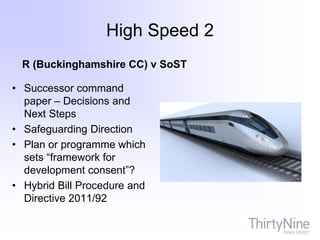
High Speed 2
R (Buckinghamshire CC) v SoST
• Successor command
paper – Decisions and
Next Steps
• Safeguarding Direction
• Plan or programme which
sets “framework for
development consent”?
• Hybrid Bill Procedure and
Directive 2011/92
HS2
Directive 2001/ 42 on SEA
• Art 2(a) ”required by
legislative, regulatory or
administrative provisions”
• command paper sufficed
• Art 3(a) “set framework
for future development
consents”
• more than mere
“influence” required
• parliamentary process
still to come
EIA/Habitats
• Champion v North Norfolk District Council [2014]
EWCA Civ 1657
– EIA/ AA: Water quality monitoring condition may be
“necessary “ even where no “real risk” pollution
– Permission to appeal granted on wider mitigation and time of
screening issues
• Feeney v SoST [2013] EWHC 1238
– possible effects of deposition of NOx not ascertainable prior to
operation
– residual range of uncertainty: no harm and harm unlikely
SEA
An Taisce v SoSECC & NNB [2014] EWCA Civ 1111
• Art 7 & transboundary
consultation
• significant effect likely?
• contrast Art 2(1) EIA v
6(3) HD
• acte claire: 1 in 10m yrs
SEA Part 2
• R (HS2 Action Alliance & LB Hillingdon) v SoS T
[2014] EWHC 2759
– Safeguarding directions – plan or project setting framework?
• West Kensington ET&R v HFLBC [2013] EWHC 2834
– failure to comply with regulation 16(4) “single compendious
document”
– discretion?
Nuisance
Coventry v Lawrence [2014] UKSC 13
• prescriptive right
• “came to the nuisance”
• character of locality
• relevance planning
permission
• injunction or damages
Manchester Ship Canal Co v United Utilities
[2014] UKSC 40
Water Industry Act 1991 - right to discharge surface water?
• no such right implied into section 159 of the Water
Industry Act
• pre-existing right under 1936 Act must survive –
obligation to operate public sewers
• cessation impractical
• limited right
Waste
Walker & Son (Hauliers) v EA [2014] PTSR 929
• Regulation 38(1)(a) of Environmental Permitting (England
Wales) Regulations 2007
• Proof that not merely knew permitted waste operation, but
also not within permit
• CA ready to look again – but noted structure of such
offences
• Regulationss specifically removed due diligence defence
Habitats and Birds
R (RSPB) v SoSE & Defra [2014] EWHC 1645
• Deliberate cull of interest
feature and adverse
impact on integrity
• Objectives HD or WBD?
• COs set by NE binding?
• Scope for judgement
Planning Update
Part 1
Green Belt, Correct Approach,
Enforcement
Paul Stinchcombe QC
Green Belt and the NPPF
• Section 9 of the NPPF
• Paragraphs 87, 89 and 90:
– all development is inappropriate (and thus can be permitted only
in very special circumstances) unless it is either
• development falling within one or more of the categories set
out in paragraph 90 or
• is the construction of a new building or buildings that comes,
or potentially comes, within one of the exceptions referred to
in paragraph 89.
• Jury is out on whether simplicity and clarity have been
achieved.
Redhill Aerodrome Limited v SSCLG
• Paragraph 88 NPPF
• Does “any other harm” mean only harm to the green belt
(in addition to harm by reason of inappropriateness)?
– River Club v Secretary of State for Communities and Local
Government [2009] EWHC 2674, Frances Patterson QC, held
that the words “any other harm” within paragraph 3.2 of PPG2
included any harm caused by the proposal, whether it was to
the Green Belt or to other interests.
– The issue in this case was whether the approach in the NPPF
means that “any other harm” should be confined to harm to the
green belt.
Redhill Aerodrome Limited v SSCLG
• NPPF vs PPG2
– PPG2
“3.2 … Inappropriate development is, by definition, harmful to the
Green Belt. It is for the applicant to show why permission should be
granted. Very special circumstances to justify the inappropriate
development will not exist unless the harm by reason of
inappropriateness, and any other harm, is clearly outweighed by
other considerations…”
– NPPF
“When considering any planning application, local planning
authorities should ensure that substantial weight is given to any
harm to the Green Belt. ‘Very special circumstances’ will not exist
unless the potential harm to the Green Belt by reason of
inappropriateness, and any other harm, is clearly outweighed by
other considerations.”
Redhill Aerodrome Limited v SSCLG
• In the High Court, the case came before Mrs Justice
Patterson:
– Held that the NPPF set thresholds for refusal of planning
permission (e.g. noise and “significant impact”).
– If impact of a scheme does not reach that threshold it cannot be
considered as “any other harm”
– NPPF marked a “considerable policy shift”
• In the Court of Appeal:
– No radical departure from PPG2
– Required to consider “other considerations” for VSC, cannot
exclude non-green belt harm from other side of the balance.
Europa Oil and Gas v Secretary of State for
Communities and Local Government
• Planning permission for exploratory drill site refused by
LPA and on appeal.
• Inspector found the development was not “mineral
extraction” or “engineering operations” and so was
inappropriate development.
• High Court and Court of Appeal disagreed – “mineral
extraction” includes exploration.
Lloyd v. Secretary of State for CLG and
Dacorum BC
• Paragraph 89 NPPF, construction of new buildings in the
green belt is inappropriate development but replacement
of a building is not provided it is in the same use and not
materially larger.
• Mobile home replaced by building which was not
materially larger.
• Decision of the CA (Sullivan LJ) - “Building” does not
include a mobile home.
R (Timmins) v. Gedling Borough Council
• Paragraph 89 NPPF again.
• Planning permission sought for a crematorium and
cemetery in the Green Belt.
• Construction of new buildings not inappropriate if it is:
“provision of appropriate facilities for … cemeteries, as
long as it preserves the openness of the Green Belt and
does not conflict with the purposes of including land
within it”.
• High Court held that para 89 concerned new buildings
which provide appropriate facilities for cemeteries, not
new cemeteries per se.
• Further held that para 89 and 90 are an exclusive list
The Correct Approach
• What approach is required of decision makers?
• R. (Hampton Bishop Council) v Herefordshire
Council [2013] EWHC 3947 (Admin)
– Could the committee take into account “off-site” benefits?
– Rugby club sought permission for a new ground with 190
dwellings.
– Hickinbottom J held that the transfer of the existing ground to the
Council to ensure continued use and operation was “directly
related to the proposed development” and so was a material
consideration.
– Upheld on appeal [2014] EWCA Civ 878
• See also Arsenal FC v. SSCLG & Islington LBC [2014]
EWHC 2620 (Admin).
Out of Town Superstores
• (R (Midcounties Co-Operative Ltd) v. Forest of Dean
District Council and (2) Trilogy Developments Ltd
[2014] EWHC 3059
– Council acted inconsistently with previous decision about likely
impact of spin-off trade on town centre.
– Held that officers had erred by not asking themselves how
contributions would improve linkages between site and Town
Centre.
• (R (Tesco Stores Limited) v. (1) Forest of Dean
District Council (2) Asda Stores Limited and Others
[2014] EWHC 3348 (Admin))
– No previous decision about vulnerability of Town Centre
– Committee entitled to take s.106 into account.
Enforcement
R (Ahmed) v SSCLG [2014] EWCA Civ 566
• Inspector failed to consider “obvious alternative” of
lesser scheme after wrongly concluding he had no power
to grant planning permission for the lesser scheme.
• Inspector does have the power if the lesser scheme is
“part of” the scheme enforced against.
R (Ioannou) v SSCLG [2014] EWCA Civ 1432;
• Ahmed distinguished. Inspector has no power under
ground (f) to bring about deemed permission for scheme
which was not in existence at the time of the EN.
Plan-making and Housing Case law
John Pugh-Smith
Policy making
2004 Regulations
• 2 categories of Local
Development Documents
• Development plan
documents
• Include Core Strategy,
Area Action plan,
proposals map
• Supplementary Planning
Documents
2012 Regulations
• 3 categories
• Local Plan
• Supplementary Planning
Document
• Other local development
documents
• See R(RWE Npower) v
Milton Keynes Council
Development plans
• Challenges, e.g., on housing – Gallagher v
Solihull MBC error in relying on regional strategy
• Exceptional circumstances for Green Belt
alteration: Gallagher
• Issues depend on stage: sites plan relied on
core strategy figures: Gladman v Wokingham
BC
Legal problems
• Categorisation –
Wakil, Houghton
• Conflict between SPD
and development
plan: RWE Npower
Soundness test
Grand Union Investments v Dacorum BC
[2014] EWHC 1894 (Admin)
• LPA's adoption of a core strategy in relation to housing allocation in
its borough, which committed it to an early review of housing needs,
following a modification to the strategy as recommended by a
planning inspector, was not irrational in the light of relevant
governmental policy in NPPF
• The concept of the soundness of a development plan document was
not defined in the 2004 Act. The NPPF included four criteria of
soundness, but that guidance was policy and should not be treated
as law
• The question was whether the core strategy, incorporating the
modification, could properly be regarded as having become sound
and a plan that was capable of being lawfully adopted. The
assessment of soundness was essentially a practical one. The
modification was, in the inspector's judgement, a sufficient and
proportionate solution to the problem
The NPPF
Para. 47: To boost significantly the supply of housing, local
planning authorities should:
• Use their evidence base to ensure that their Local Plan meets the
full, objectively assessed needs for market and affordable housing in
the housing market area, as far as is consistent with the policies set
out in this Framework, including identifying key sites which are
critical to the delivery of the housing strategy over the plan period;
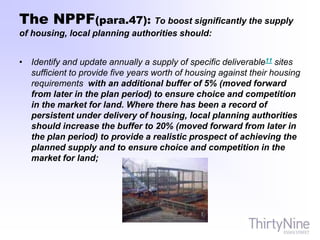
The NPPF(para.47): To boost significantly the supply
of housing, local planning authorities should:
• Identify and update annually a supply of specific deliverable11 sites
sufficient to provide five years worth of housing against their housing
requirements
Footnote11: To be considered deliverable, sites should be
available now, offer a suitable location for development now, and
be achievable with a realistic prospect that housing will be
delivered on the site within five years and in particular that
development of the site is viable. Sites with planning permission
should be considered deliverable until permission expires, unless
there is clear evidence that schemes will not be implemented
within five years, for example they will not be viable, there is no
longer a demand for the type of units or sites have long term
phasing plans.
The NPPF(para.47): To boost significantly the supply
of housing, local planning authorities should:
• Identify and update annually a supply of specific deliverable11 sites
sufficient to provide five years worth of housing against their housing
requirements with an additional buffer of 5% (moved forward
from later in the plan period) to ensure choice and competition
in the market for land. Where there has been a record of
persistent under delivery of housing, local planning authorities
should increase the buffer to 20% (moved forward from later in
the plan period) to provide a realistic prospect of achieving the
planned supply and to ensure choice and competition in the
market for land;
The Practical Outworking …
• The PPG guidance (“living advice”) N.B. viability tests
• LGA/PAS Guidance Note: “Ten key principles for owning
your housing number – finding your objectively assessed
needs” (PBA July 2013 – Updated Nov 2013); and if you
can find it via: http://www.pas.gov.uk/4-plan-making/-
/journal_content/56/332612/4077684/ARTICLE
• “Liverpool” v “Sedgefield” approach to backlog (but, as yet,
no guidance or advice to preferred approach despite latter more
closely aligned to NPPF requirements):
• The ‘Liverpool approach’ is to seek to meet this backlog over the whole
plan period. It is also known as the residual approach.
• The ‘Sedgefield approach’ is to front load the provision of this backlog
within the first five years.
Objectively Assessing Needs?
• Keeping up to date with
Household Projections: 2008,
2010, 2011, 2014 (when?)
• Full OAN pending adoption:
Gallagher
• Dealing with shortfalls:
Liverpool v Sedgefield
• Persistent under-delivery
• Delivery rates in practice
• Is the plan sound?
Examples:
Hunston Properties v SSCLG
[2013] EWCA Civ 1610
• Proper construction of NPPF para. 47: “meeting full objectively
assessed needs for market and affordable housing in the housing
market area, as far as is consistent with the policies set out in this
Framework”
• Inspector not entitled to use housing requirement figure from
revoked RSS as a proxy for what LP process might eventually
produce as it did not reflect the full objectively assessed housing
needs
• In GB cases the correct approach was to look at the context of the
HLS shortfall as well as its scale and extent. Was that shortfall
inevitable? What weight should be attached to it?
• Constraints in NPPF policies had to be taken fully into account.
Others:
Gallagher Homes v Solihull MBC
[2014] EWHC 1283 (Admin)
• Local Plan not supported by a figure of full objectively assessed
housing need (FOAHN)
Gladman Development v Wokingham BC [2014]
EWHC 2320 (Admin)
• Inspector not required to consider whether there was a FOAHN
before examining the Local Plan to determine whether site
allocations were sound
IM Properties v Lichfield DC [2014] EWHC 2440 (Admin)
• Court has no jurisdiction to quash LPA’s decision to endorse
modifications to a draft Local Plan strategy
.
Duty to Co-operate
• Requirement to ‘engage
constructively, actively and on
an ongoing basis’ with public
bodies on major planning
• Inspector cannot correct
• Real issue – is plan sound
given what other authorities
doing?
• Problems in practice:
- Runnymede
- Mid-Sussex
- Coventry
- Doncaster
Old development plans
• Reasoned justification
is saved with the
policies: Cherkley
Campaign [2014] EWCA
Civ 567
• Reasoned justification
not to have the status
of policy: Cherkley
Campaign
Neighbourhood Plans
• Defining areas: Daws Hill
• Neighbourhood development plans: SEA upheld
• Examiner not biased: BDW Trading v Cheshire
West
• SEA screening error : R(Crownhall Estates) v
Chichester DC (Loxwood plan)
Planning Appeals
• Procedural Fairness – know
the case and have
reasonable opportunity to
deal with it
• Rules not a complete code
for fairness
• Third party cases to be
considered
• Warning of unanticipated
points
SSCLG v Hopkins
Developments [2014]
EWCA Civ 470
Planning judgments
and the NPPF
William Davis v SSCLG
[2013] EWHC 3058 (Admin)
• SSCLG’s recovered appeal decision
• Site in long-designated green wedge
• Local Plan (2006) housing provision out of date
• NPPF paras . 49 & 14
• Preliminary issue whether appeal proposals “sustainable
development”
• Presumption in favour under the NPPF only applies to “sustainable
development”
• “The Lang test” based on her acceptance of the submissions made
by counsel for the SSCLG – “the author”
The Presumption in Favour of
Sustainable Development [para.14]
• The ‘golden thread’
• The ‘three dimensions’: an economic, social, and environmental
role - described as ‘mutually interdependent’ and “to be sought
jointly and simultaneously”
• The ‘five guiding principles’: seeking positive improvements in the
quality of the built, natural and historic environment, as well as in
people’s quality of life, including (but not limited to):
• making it easier for jobs to be created in cities, towns and
villages;
• moving from a net loss of bio-diversity to achieving net gains for
nature;
• replacing poor design with better design;
• improving the conditions in which people live, work, travel and
take leisure; and
• widening the choice of high quality homes.
NPPF para.14
application
Dartford BC v SSCLG
[2014] EWHC 2636 (Admin):
Patterson J: In my judgment the claimant's approach is excessively
legalistic... As was recognised in the case of William Davis (supra)
at paragraph 38 the ultimate decision on sustainability is one of
planning judgment .There is nothing in the NPPF, whether at
paragraph 7 or paragraph 14 which sets out a sequential approach
of the sort that Mr Whale, on behalf of the claimant, seeks to read
into the judgment of Lang J at paragraph 37. I agree with Lang J in
her conclusion that it would be contrary to the fundamental
principles of the NPPF if the presumption in favour of development,
in paragraph 14,applied equally to sustainable and non-sustainable
development. To do so would make a nonsense of Government
policy on sustainable development (para. 54)
Planning judgments and
the NPPF
Cotswold DC v SSCLG
[2013] EWHC 3719 (Admin)
• Meaning of NPPF para. 47: “a record of
persistent under delivery of housing … increase the buffer to 20%”
• No requirement for Inspector to have regard to previous decisions not
cited to him
Barrow PC v SSCLG [2014] EWHC 274 (Admin)
• NPPF para. 49 – realistic prospect of some houses being delivered
during life of permission
• Tension with current policy on use of negative conditions
Ongoing debate over application of “Sedgefield approach” for s.78
appeals against “Liverpool approach” where “local circumstances”
permit e.g. Green Belt releases – NPPG preference
Closing thoughts ….
• Where will housing decisions go next pre-May 2015 Election?
• What happens to affordable housing provision?
• What happens to happens to land values?
• What happens to large & complex sites?
• When will we see the “infrastructure”?
• What happens to CIL next?
• When will we see the real growth
outwith London and the South-East?
• What happens to the Housing
Market next?
Meanwhile, enjoy the political spread!
John Pugh-Smith
Barrister & Mediator
Thirty-Nine Essex Street Chambers,
London & Manchester
www.39essex.com
john.pugh-smith@39essex.com
Thirty Nine Essex Street LLP is a governance and holding entity and a limited liability partnership registered in England and Wales (registered number0C360005) with
its registered office at 39 Essex Street, London WC2R 3AT Thirty Nine Essex Street's members provide legal and advocacy services as independent, self-employed barristers
and no entity connected with Thirty Nine Essex Street provides any legal services. Thirty Nine Essex Street (Services) Limited manages the administrative, operational and
support functions of Chambers and is a company incorporated in England and Wales (company number 7385894) with its registered office at 39 Essex Street, London WC2R 3AT
Planning and
Environmental Law
Update
13 November 2014

Planning and Environmental Law Update

  • 1.
    Planning and Environmental LawUpdate Birmingham Seminar 13 November 2014
  • 2.
    • ENFORCEMENT • CHANGEOF USE • PLANNING POLICIES AND PLANNING JUDGMENTS – HOUSING POLICY – HERITAGE – GREEN BELT – DEVELOPMENT PLAN – NEIGHBOURHOOD PLANS • DECISION-MAKING • ENVIRONMENTAL IMPACT ASSESSMENT • STRATEGIC ENVIRONMENTAL ASSESSMENT • NUISANCE/WASTE Paper Topics:
  • 3.
    Environmental Update EIA, SEA,nuisance and waste Rose Grogan
  • 4.
    High Speed 2 R(Buckinghamshire CC) v SoST • Successor command paper – Decisions and Next Steps • Safeguarding Direction • Plan or programme which sets “framework for development consent”? • Hybrid Bill Procedure and Directive 2011/92
  • 5.
    HS2 Directive 2001/ 42on SEA • Art 2(a) ”required by legislative, regulatory or administrative provisions” • command paper sufficed • Art 3(a) “set framework for future development consents” • more than mere “influence” required • parliamentary process still to come
  • 6.
    EIA/Habitats • Champion vNorth Norfolk District Council [2014] EWCA Civ 1657 – EIA/ AA: Water quality monitoring condition may be “necessary “ even where no “real risk” pollution – Permission to appeal granted on wider mitigation and time of screening issues • Feeney v SoST [2013] EWHC 1238 – possible effects of deposition of NOx not ascertainable prior to operation – residual range of uncertainty: no harm and harm unlikely
  • 7.
    SEA An Taisce vSoSECC & NNB [2014] EWCA Civ 1111 • Art 7 & transboundary consultation • significant effect likely? • contrast Art 2(1) EIA v 6(3) HD • acte claire: 1 in 10m yrs
  • 8.
    SEA Part 2 •R (HS2 Action Alliance & LB Hillingdon) v SoS T [2014] EWHC 2759 – Safeguarding directions – plan or project setting framework? • West Kensington ET&R v HFLBC [2013] EWHC 2834 – failure to comply with regulation 16(4) “single compendious document” – discretion?
  • 9.
    Nuisance Coventry v Lawrence[2014] UKSC 13 • prescriptive right • “came to the nuisance” • character of locality • relevance planning permission • injunction or damages
  • 10.
    Manchester Ship CanalCo v United Utilities [2014] UKSC 40 Water Industry Act 1991 - right to discharge surface water? • no such right implied into section 159 of the Water Industry Act • pre-existing right under 1936 Act must survive – obligation to operate public sewers • cessation impractical • limited right
  • 11.
    Waste Walker & Son(Hauliers) v EA [2014] PTSR 929 • Regulation 38(1)(a) of Environmental Permitting (England Wales) Regulations 2007 • Proof that not merely knew permitted waste operation, but also not within permit • CA ready to look again – but noted structure of such offences • Regulationss specifically removed due diligence defence
  • 12.
    Habitats and Birds R(RSPB) v SoSE & Defra [2014] EWHC 1645 • Deliberate cull of interest feature and adverse impact on integrity • Objectives HD or WBD? • COs set by NE binding? • Scope for judgement
  • 13.
    Planning Update Part 1 GreenBelt, Correct Approach, Enforcement Paul Stinchcombe QC
  • 14.
    Green Belt andthe NPPF • Section 9 of the NPPF • Paragraphs 87, 89 and 90: – all development is inappropriate (and thus can be permitted only in very special circumstances) unless it is either • development falling within one or more of the categories set out in paragraph 90 or • is the construction of a new building or buildings that comes, or potentially comes, within one of the exceptions referred to in paragraph 89. • Jury is out on whether simplicity and clarity have been achieved.
  • 15.
    Redhill Aerodrome Limitedv SSCLG • Paragraph 88 NPPF • Does “any other harm” mean only harm to the green belt (in addition to harm by reason of inappropriateness)? – River Club v Secretary of State for Communities and Local Government [2009] EWHC 2674, Frances Patterson QC, held that the words “any other harm” within paragraph 3.2 of PPG2 included any harm caused by the proposal, whether it was to the Green Belt or to other interests. – The issue in this case was whether the approach in the NPPF means that “any other harm” should be confined to harm to the green belt.
  • 16.
    Redhill Aerodrome Limitedv SSCLG • NPPF vs PPG2 – PPG2 “3.2 … Inappropriate development is, by definition, harmful to the Green Belt. It is for the applicant to show why permission should be granted. Very special circumstances to justify the inappropriate development will not exist unless the harm by reason of inappropriateness, and any other harm, is clearly outweighed by other considerations…” – NPPF “When considering any planning application, local planning authorities should ensure that substantial weight is given to any harm to the Green Belt. ‘Very special circumstances’ will not exist unless the potential harm to the Green Belt by reason of inappropriateness, and any other harm, is clearly outweighed by other considerations.”
  • 17.
    Redhill Aerodrome Limitedv SSCLG • In the High Court, the case came before Mrs Justice Patterson: – Held that the NPPF set thresholds for refusal of planning permission (e.g. noise and “significant impact”). – If impact of a scheme does not reach that threshold it cannot be considered as “any other harm” – NPPF marked a “considerable policy shift” • In the Court of Appeal: – No radical departure from PPG2 – Required to consider “other considerations” for VSC, cannot exclude non-green belt harm from other side of the balance.
  • 18.
    Europa Oil andGas v Secretary of State for Communities and Local Government • Planning permission for exploratory drill site refused by LPA and on appeal. • Inspector found the development was not “mineral extraction” or “engineering operations” and so was inappropriate development. • High Court and Court of Appeal disagreed – “mineral extraction” includes exploration.
  • 19.
    Lloyd v. Secretaryof State for CLG and Dacorum BC • Paragraph 89 NPPF, construction of new buildings in the green belt is inappropriate development but replacement of a building is not provided it is in the same use and not materially larger. • Mobile home replaced by building which was not materially larger. • Decision of the CA (Sullivan LJ) - “Building” does not include a mobile home.
  • 20.
    R (Timmins) v.Gedling Borough Council • Paragraph 89 NPPF again. • Planning permission sought for a crematorium and cemetery in the Green Belt. • Construction of new buildings not inappropriate if it is: “provision of appropriate facilities for … cemeteries, as long as it preserves the openness of the Green Belt and does not conflict with the purposes of including land within it”. • High Court held that para 89 concerned new buildings which provide appropriate facilities for cemeteries, not new cemeteries per se. • Further held that para 89 and 90 are an exclusive list
  • 21.
    The Correct Approach •What approach is required of decision makers? • R. (Hampton Bishop Council) v Herefordshire Council [2013] EWHC 3947 (Admin) – Could the committee take into account “off-site” benefits? – Rugby club sought permission for a new ground with 190 dwellings. – Hickinbottom J held that the transfer of the existing ground to the Council to ensure continued use and operation was “directly related to the proposed development” and so was a material consideration. – Upheld on appeal [2014] EWCA Civ 878 • See also Arsenal FC v. SSCLG & Islington LBC [2014] EWHC 2620 (Admin).
  • 22.
    Out of TownSuperstores • (R (Midcounties Co-Operative Ltd) v. Forest of Dean District Council and (2) Trilogy Developments Ltd [2014] EWHC 3059 – Council acted inconsistently with previous decision about likely impact of spin-off trade on town centre. – Held that officers had erred by not asking themselves how contributions would improve linkages between site and Town Centre. • (R (Tesco Stores Limited) v. (1) Forest of Dean District Council (2) Asda Stores Limited and Others [2014] EWHC 3348 (Admin)) – No previous decision about vulnerability of Town Centre – Committee entitled to take s.106 into account.
  • 23.
    Enforcement R (Ahmed) vSSCLG [2014] EWCA Civ 566 • Inspector failed to consider “obvious alternative” of lesser scheme after wrongly concluding he had no power to grant planning permission for the lesser scheme. • Inspector does have the power if the lesser scheme is “part of” the scheme enforced against. R (Ioannou) v SSCLG [2014] EWCA Civ 1432; • Ahmed distinguished. Inspector has no power under ground (f) to bring about deemed permission for scheme which was not in existence at the time of the EN.
  • 24.
    Plan-making and HousingCase law John Pugh-Smith
  • 25.
    Policy making 2004 Regulations •2 categories of Local Development Documents • Development plan documents • Include Core Strategy, Area Action plan, proposals map • Supplementary Planning Documents 2012 Regulations • 3 categories • Local Plan • Supplementary Planning Document • Other local development documents • See R(RWE Npower) v Milton Keynes Council
  • 26.
    Development plans • Challenges,e.g., on housing – Gallagher v Solihull MBC error in relying on regional strategy • Exceptional circumstances for Green Belt alteration: Gallagher • Issues depend on stage: sites plan relied on core strategy figures: Gladman v Wokingham BC
  • 27.
    Legal problems • Categorisation– Wakil, Houghton • Conflict between SPD and development plan: RWE Npower
  • 28.
    Soundness test Grand UnionInvestments v Dacorum BC [2014] EWHC 1894 (Admin) • LPA's adoption of a core strategy in relation to housing allocation in its borough, which committed it to an early review of housing needs, following a modification to the strategy as recommended by a planning inspector, was not irrational in the light of relevant governmental policy in NPPF • The concept of the soundness of a development plan document was not defined in the 2004 Act. The NPPF included four criteria of soundness, but that guidance was policy and should not be treated as law • The question was whether the core strategy, incorporating the modification, could properly be regarded as having become sound and a plan that was capable of being lawfully adopted. The assessment of soundness was essentially a practical one. The modification was, in the inspector's judgement, a sufficient and proportionate solution to the problem
  • 29.
    The NPPF Para. 47:To boost significantly the supply of housing, local planning authorities should: • Use their evidence base to ensure that their Local Plan meets the full, objectively assessed needs for market and affordable housing in the housing market area, as far as is consistent with the policies set out in this Framework, including identifying key sites which are critical to the delivery of the housing strategy over the plan period;
  • 30.
    The NPPF(para.47): Toboost significantly the supply of housing, local planning authorities should: • Identify and update annually a supply of specific deliverable11 sites sufficient to provide five years worth of housing against their housing requirements Footnote11: To be considered deliverable, sites should be available now, offer a suitable location for development now, and be achievable with a realistic prospect that housing will be delivered on the site within five years and in particular that development of the site is viable. Sites with planning permission should be considered deliverable until permission expires, unless there is clear evidence that schemes will not be implemented within five years, for example they will not be viable, there is no longer a demand for the type of units or sites have long term phasing plans.
  • 31.
    The NPPF(para.47): Toboost significantly the supply of housing, local planning authorities should: • Identify and update annually a supply of specific deliverable11 sites sufficient to provide five years worth of housing against their housing requirements with an additional buffer of 5% (moved forward from later in the plan period) to ensure choice and competition in the market for land. Where there has been a record of persistent under delivery of housing, local planning authorities should increase the buffer to 20% (moved forward from later in the plan period) to provide a realistic prospect of achieving the planned supply and to ensure choice and competition in the market for land;
  • 32.
    The Practical Outworking… • The PPG guidance (“living advice”) N.B. viability tests • LGA/PAS Guidance Note: “Ten key principles for owning your housing number – finding your objectively assessed needs” (PBA July 2013 – Updated Nov 2013); and if you can find it via: http://www.pas.gov.uk/4-plan-making/- /journal_content/56/332612/4077684/ARTICLE • “Liverpool” v “Sedgefield” approach to backlog (but, as yet, no guidance or advice to preferred approach despite latter more closely aligned to NPPF requirements): • The ‘Liverpool approach’ is to seek to meet this backlog over the whole plan period. It is also known as the residual approach. • The ‘Sedgefield approach’ is to front load the provision of this backlog within the first five years.
  • 33.
    Objectively Assessing Needs? •Keeping up to date with Household Projections: 2008, 2010, 2011, 2014 (when?) • Full OAN pending adoption: Gallagher • Dealing with shortfalls: Liverpool v Sedgefield • Persistent under-delivery • Delivery rates in practice • Is the plan sound?
  • 34.
    Examples: Hunston Properties vSSCLG [2013] EWCA Civ 1610 • Proper construction of NPPF para. 47: “meeting full objectively assessed needs for market and affordable housing in the housing market area, as far as is consistent with the policies set out in this Framework” • Inspector not entitled to use housing requirement figure from revoked RSS as a proxy for what LP process might eventually produce as it did not reflect the full objectively assessed housing needs • In GB cases the correct approach was to look at the context of the HLS shortfall as well as its scale and extent. Was that shortfall inevitable? What weight should be attached to it? • Constraints in NPPF policies had to be taken fully into account.
  • 35.
    Others: Gallagher Homes vSolihull MBC [2014] EWHC 1283 (Admin) • Local Plan not supported by a figure of full objectively assessed housing need (FOAHN) Gladman Development v Wokingham BC [2014] EWHC 2320 (Admin) • Inspector not required to consider whether there was a FOAHN before examining the Local Plan to determine whether site allocations were sound IM Properties v Lichfield DC [2014] EWHC 2440 (Admin) • Court has no jurisdiction to quash LPA’s decision to endorse modifications to a draft Local Plan strategy .
  • 36.
    Duty to Co-operate •Requirement to ‘engage constructively, actively and on an ongoing basis’ with public bodies on major planning • Inspector cannot correct • Real issue – is plan sound given what other authorities doing? • Problems in practice: - Runnymede - Mid-Sussex - Coventry - Doncaster
  • 37.
    Old development plans •Reasoned justification is saved with the policies: Cherkley Campaign [2014] EWCA Civ 567 • Reasoned justification not to have the status of policy: Cherkley Campaign
  • 38.
    Neighbourhood Plans • Definingareas: Daws Hill • Neighbourhood development plans: SEA upheld • Examiner not biased: BDW Trading v Cheshire West • SEA screening error : R(Crownhall Estates) v Chichester DC (Loxwood plan)
  • 39.
    Planning Appeals • ProceduralFairness – know the case and have reasonable opportunity to deal with it • Rules not a complete code for fairness • Third party cases to be considered • Warning of unanticipated points SSCLG v Hopkins Developments [2014] EWCA Civ 470
  • 40.
    Planning judgments and theNPPF William Davis v SSCLG [2013] EWHC 3058 (Admin) • SSCLG’s recovered appeal decision • Site in long-designated green wedge • Local Plan (2006) housing provision out of date • NPPF paras . 49 & 14 • Preliminary issue whether appeal proposals “sustainable development” • Presumption in favour under the NPPF only applies to “sustainable development” • “The Lang test” based on her acceptance of the submissions made by counsel for the SSCLG – “the author”
  • 41.
    The Presumption inFavour of Sustainable Development [para.14] • The ‘golden thread’ • The ‘three dimensions’: an economic, social, and environmental role - described as ‘mutually interdependent’ and “to be sought jointly and simultaneously” • The ‘five guiding principles’: seeking positive improvements in the quality of the built, natural and historic environment, as well as in people’s quality of life, including (but not limited to): • making it easier for jobs to be created in cities, towns and villages; • moving from a net loss of bio-diversity to achieving net gains for nature; • replacing poor design with better design; • improving the conditions in which people live, work, travel and take leisure; and • widening the choice of high quality homes.
  • 42.
    NPPF para.14 application Dartford BCv SSCLG [2014] EWHC 2636 (Admin): Patterson J: In my judgment the claimant's approach is excessively legalistic... As was recognised in the case of William Davis (supra) at paragraph 38 the ultimate decision on sustainability is one of planning judgment .There is nothing in the NPPF, whether at paragraph 7 or paragraph 14 which sets out a sequential approach of the sort that Mr Whale, on behalf of the claimant, seeks to read into the judgment of Lang J at paragraph 37. I agree with Lang J in her conclusion that it would be contrary to the fundamental principles of the NPPF if the presumption in favour of development, in paragraph 14,applied equally to sustainable and non-sustainable development. To do so would make a nonsense of Government policy on sustainable development (para. 54)
  • 43.
    Planning judgments and theNPPF Cotswold DC v SSCLG [2013] EWHC 3719 (Admin) • Meaning of NPPF para. 47: “a record of persistent under delivery of housing … increase the buffer to 20%” • No requirement for Inspector to have regard to previous decisions not cited to him Barrow PC v SSCLG [2014] EWHC 274 (Admin) • NPPF para. 49 – realistic prospect of some houses being delivered during life of permission • Tension with current policy on use of negative conditions Ongoing debate over application of “Sedgefield approach” for s.78 appeals against “Liverpool approach” where “local circumstances” permit e.g. Green Belt releases – NPPG preference
  • 44.
    Closing thoughts …. •Where will housing decisions go next pre-May 2015 Election? • What happens to affordable housing provision? • What happens to happens to land values? • What happens to large & complex sites? • When will we see the “infrastructure”? • What happens to CIL next? • When will we see the real growth outwith London and the South-East? • What happens to the Housing Market next?
  • 45.
    Meanwhile, enjoy thepolitical spread! John Pugh-Smith Barrister & Mediator Thirty-Nine Essex Street Chambers, London & Manchester www.39essex.com john.pugh-smith@39essex.com
  • 46.
    Thirty Nine EssexStreet LLP is a governance and holding entity and a limited liability partnership registered in England and Wales (registered number0C360005) with its registered office at 39 Essex Street, London WC2R 3AT Thirty Nine Essex Street's members provide legal and advocacy services as independent, self-employed barristers and no entity connected with Thirty Nine Essex Street provides any legal services. Thirty Nine Essex Street (Services) Limited manages the administrative, operational and support functions of Chambers and is a company incorporated in England and Wales (company number 7385894) with its registered office at 39 Essex Street, London WC2R 3AT Planning and Environmental Law Update 13 November 2014